Connect with us

Published

on

India and South Korea Sign Article 6.2 Deal as Global Carbon Trading Gains Momentum

India and South Korea have signed a cooperation agreement under Article 6.2 of the Paris Agreement. This is a key step for creating cross-border carbon markets between these two major Asian economies.

The deal was signed when the South Korean president visited India. More than a dozen agreements were made about clean energy, trade, and industrial cooperation. It reflects growing global interest in carbon trading as countries seek cost-effective ways to meet climate targets.

The agreement allows both countries to cooperate on emissions reduction projects and exchange carbon credits. This could open up new sources of climate finance and help decarbonize sectors like energy, industry, and transport.

How Article 6.2 Unlocks Cross-Border Carbon Trading

Article 6.2 of the Paris Agreement allows countries to trade emission reductions through bilateral or multilateral deals. These are known as “internationally transferred mitigation outcomes” (ITMOs).

Each ITMO represents one tonne of carbon dioxide equivalent (tCO₂e) reduced or removed. Countries can invest in emissions-cutting projects abroad and count those reductions toward their own climate targets.

A key rule is the “corresponding adjustment.” The host country must add the sold emissions back to its carbon balance. This prevents double-counting and ensures transparency.

This system improves on older carbon markets under the Kyoto Protocol. It links carbon trading directly to national climate targets and strengthens accountability.

Although Article 6.2 is still new, activity is growing quickly.

  • Around 58 bilateral Article 6.2 agreements have already been signed globally.
  • At least 68 pilot ITMO projects are under development worldwide.
  • More than 100 countries have signaled interest in using Article 6 mechanisms.

Here are key examples of these agreements, as shown in the World Bank carbon pricing dashboard:
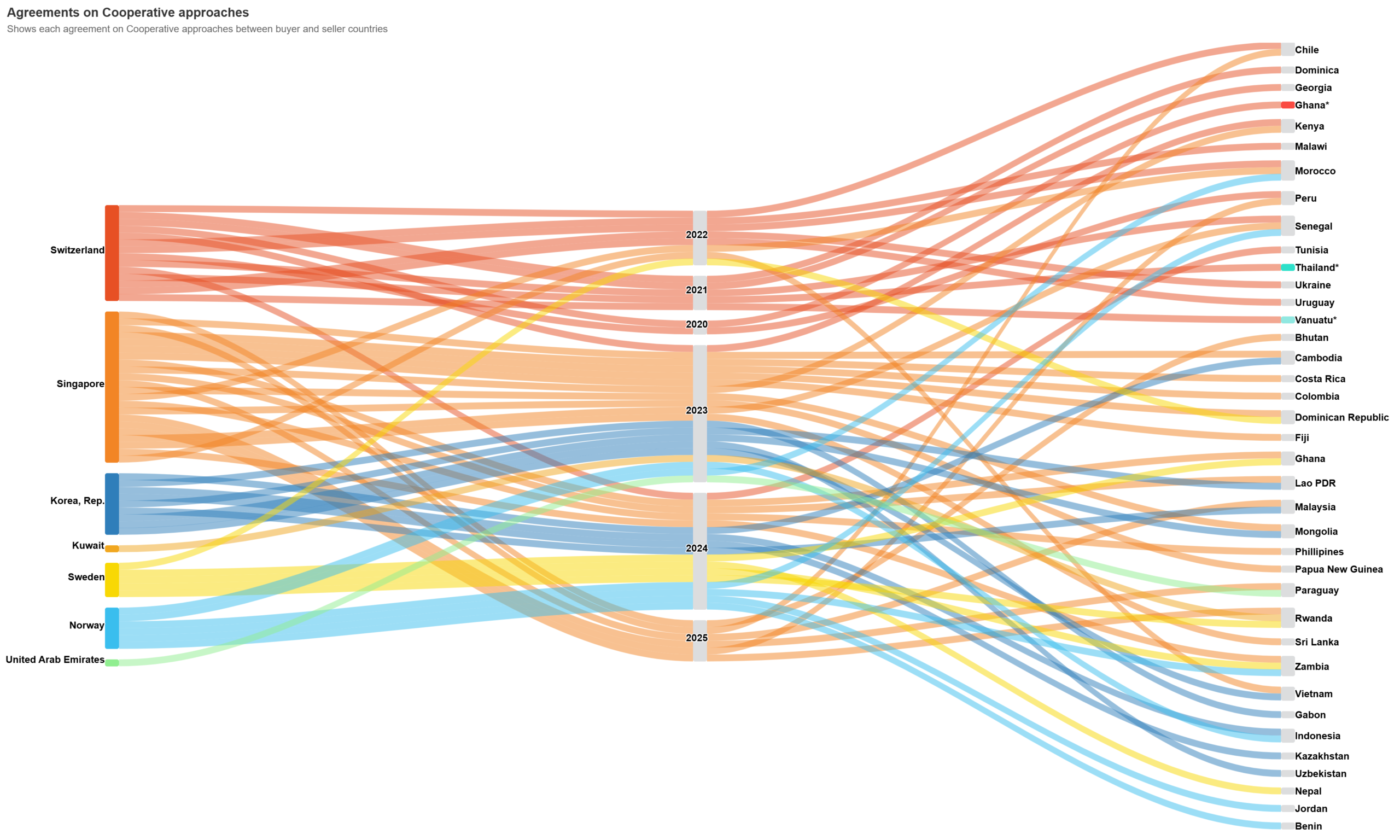
agreements-on-cooperative article 6.2 credits

Most early projects are in developing countries. These nations can supply carbon credits while receiving investment and technology. Buyers are often developed countries with stricter climate targets and higher costs of domestic emissions reduction.

India and South Korea confirmed that their agreement will support:

  • Investment-driven mitigation projects, 
  • Development of carbon markets, and
  • Cooperation in renewable energy and low-carbon technologies. 

This is a major step because global carbon markets are still in early stages. Many countries are now building bilateral agreements to operationalize Article 6 mechanisms.
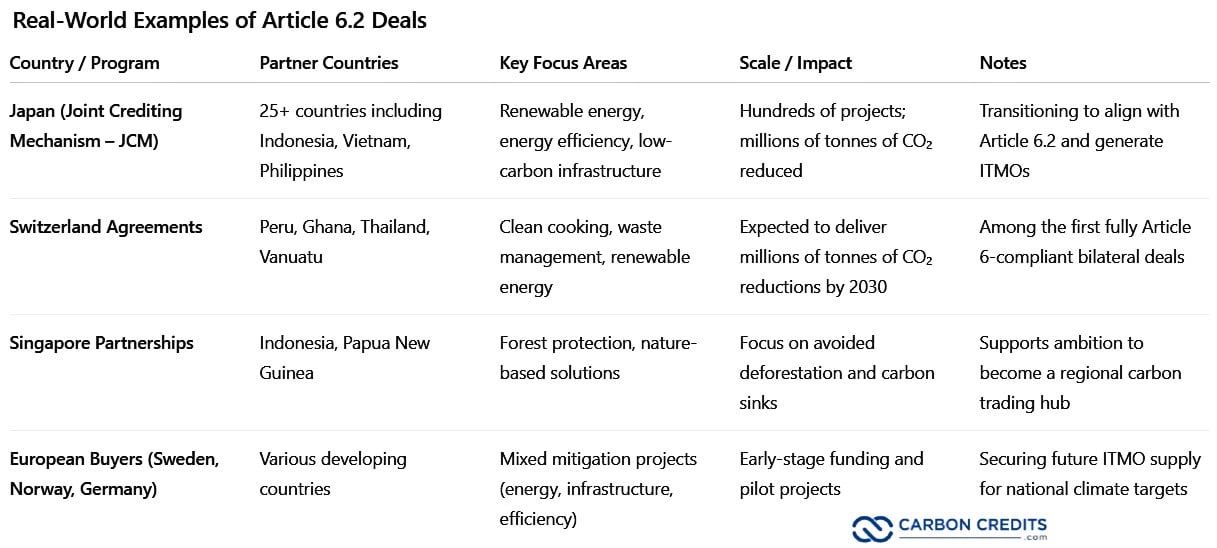
real world examples of article 6.2 carbon credit deals

The deal also aligns with a broader shift toward market-based climate solutions. These mechanisms are seen as a way to lower the cost of achieving national climate targets.

Net Zero Targets Drive Bilateral Climate Cooperation

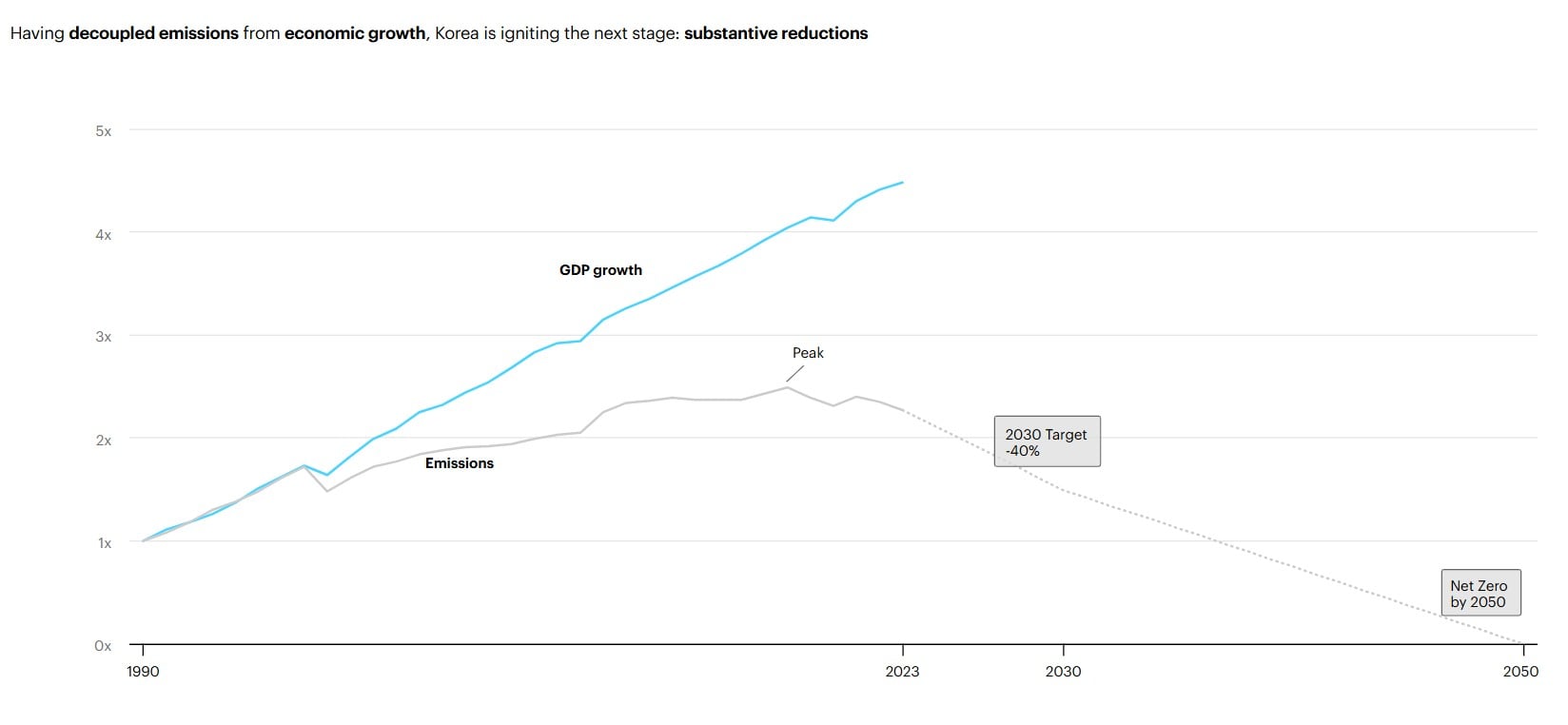
The agreement is closely tied to both countries’ long-term climate goals. India has committed to reaching net-zero emissions by 2070. South Korea has set an earlier target of 2050.
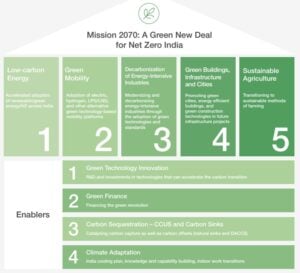
Mission 2070 for India net zero goal
Source: WEF

These timelines create both challenges and opportunities. South Korea is a developed economy with limited land and resources. So, it may look for cost-effective ways to cut emissions abroad.
South Korea net zero goal
Source: IEA

India, as a fast-growing economy, offers large-scale opportunities for clean energy and carbon reduction projects. This creates a natural partnership. The two countries also agreed to expand cooperation in:

  • Renewable energy, 
  • Green hydrogen, and 
  • Low-carbon industrial technologies.

These sectors are critical for reducing emissions in hard-to-abate industries such as steel, cement, and heavy transport. Both countries also reaffirmed their commitment to the Paris Agreement and global climate action.

Carbon Markets Poised for Rapid Global Growth

The India–South Korea deal comes as global carbon markets are expected to expand significantly over the next decade.

Carbon pricing systems already cover about 28% of global emissions, according to the World Bank’s 2025 State and Trends of Carbon Pricing report. At the same time, voluntary carbon markets and compliance markets are evolving rapidly.

Analysts expect carbon markets to grow into a multi-billion-dollar sector by 2030, until 2050, driven by:

  • Net-zero commitments from over 140 countries,
  • Increasing corporate climate targets, and
  • Rising demand for carbon offsets.

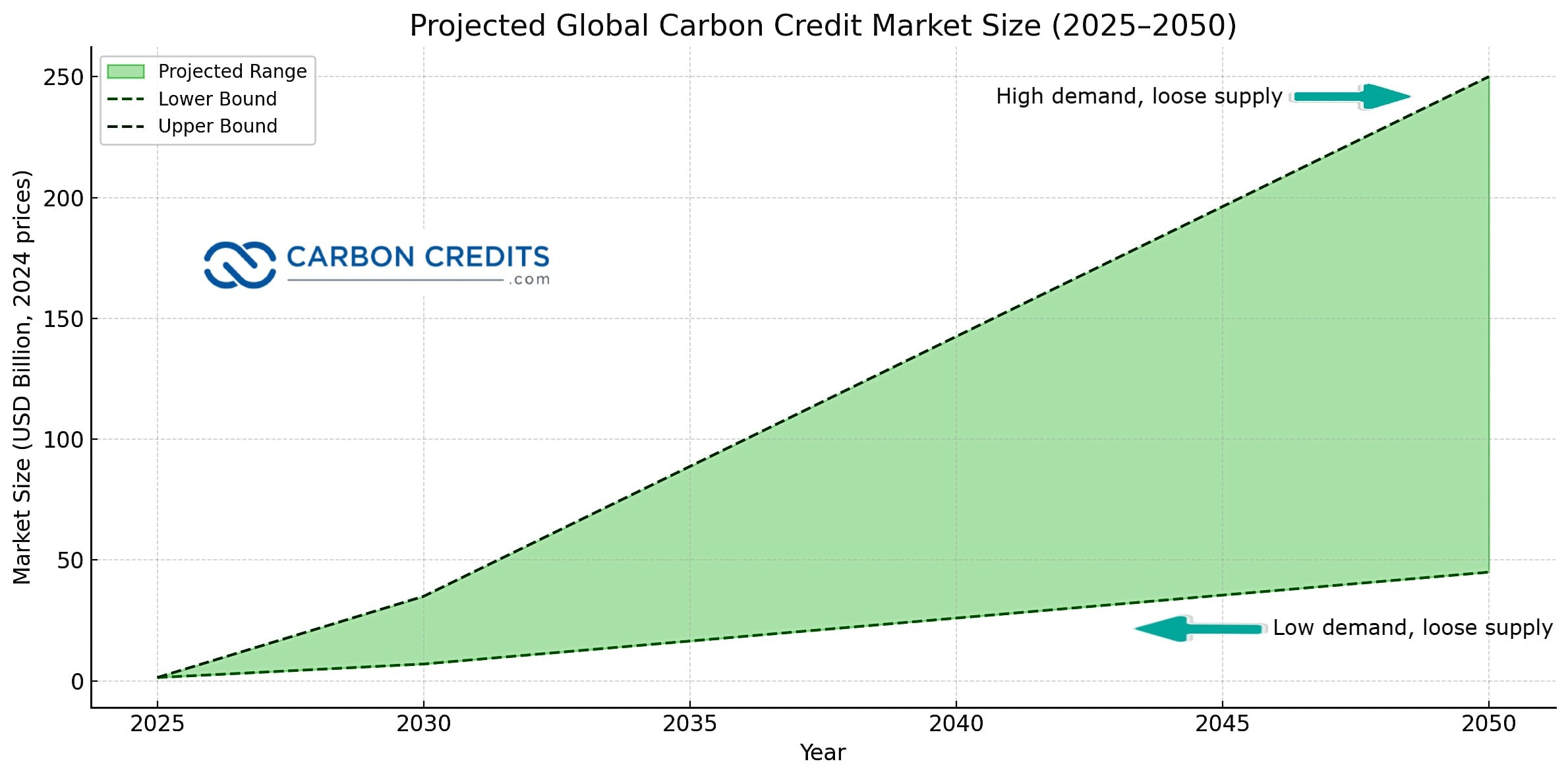
projected global carbon credit market 2050
This chart shows the projected global carbon credit market size from 2025 to 2050. The green range shows lower and upper bounds, reaching $50–250 billion by 2050 (2024 prices). Growth depends on demand: high demand with loose supply drives the market to the upper bound, while low demand with loose supply results in the lower bound.

Article 6 agreements are expected to play a key role in this growth. They provide a formal framework for cross-border carbon trading, which has been limited in the past.

For emerging economies like India, this could unlock new sources of climate finance. For developed economies like South Korea, it offers flexibility in meeting emissions targets.

Economic Ties Expand Alongside Climate Cooperation

The carbon agreement is part of a broader expansion in India–South Korea relations. The two countries aim to double bilateral trade from about $27 billion today to $50 billion by 2030.

They also signed multiple agreements covering clean energy and critical minerals,  shipbuilding and manufacturing, and semiconductors and digital trade. This reflects a wider strategy to align economic growth with sustainability goals.

Both countries are working to build resilient supply chains in key sectors such as batteries, energy, and advanced manufacturing. These industries are essential for the global energy transition.

The partnership also includes efforts to improve energy security. This is especially important as global energy markets face volatility due to geopolitical tensions.

A Strategic Shift in Global Climate Cooperation

The signing of the Article 6.2 agreement marks a broader shift in how countries approach climate action. Instead of relying only on domestic measures, governments are increasingly turning to international cooperation. This allows them to share technology, reduce costs, and accelerate emissions reductions.

For India, the agreement opens new opportunities to attract climate finance and scale up clean energy projects.

For South Korea, it provides access to cost-effective mitigation options and supports its net-zero strategy.

The deal also strengthens the strategic partnership between the two countries. It links climate action with trade, technology, and industrial policy.

As more countries adopt similar agreements, Article 6.2 could become a central pillar of global carbon markets. This would reshape how emissions reductions are financed and delivered worldwide.

The Big Picture: Carbon Markets Move From Concept to Reality

The India–South Korea Article 6.2 agreement is more than a climate deal. It is part of a larger shift toward market-based decarbonization and international cooperation.

With global carbon markets set to expand and net-zero targets tightening, such partnerships are likely to increase.

For both countries, the agreement offers a pathway to balance economic growth with climate goals. It also signals growing momentum behind carbon trading as a key tool in the global energy transition.

As implementation begins, the real impact will depend on how quickly projects are developed and how well carbon markets scale. But the signal is clear: cross-border climate cooperation is moving from theory to practice.

The post India and South Korea Sign Article 6.2 Deal as Global Carbon Trading Gains Momentum appeared first on Carbon Credits.

Continue Reading

Carbon Footprint

RBC and Scotiabank Step Back on Climate Targets as Policy Support Weakens and AI Drives Energy Demand

Published

on

Canada’s biggest banks are quietly resetting their climate ambitions. As reported by The Canadian Press, both Royal Bank of Canada (RBC) and Scotiabank have pulled back from key interim emissions targets, signaling a broader shift in how financial institutions are navigating the energy transition.

The move reflects a more complicated reality. Climate goals are colliding with policy uncertainty, geopolitical tensions, and a sharp rise in energy demand—especially from artificial intelligence. What once looked like a clear path to net zero is now far less predictable.

RBC Does a Reality Check on 2030 Targets

RBC had set clear 2030 targets in 2022. The bank aimed to reduce financed emissions across three high-impact sectors: oil and gas, power generation, and automotive. These interim goals were meant to guide its broader ambition of reaching net-zero financed emissions by 2050.

However, in its 2025 sustainability report, the bank acknowledged that the landscape has changed significantly. After reviewing policy shifts, global energy trends, and technology progress, the bank concluded that some of these targets are simply “not reasonably achievable.”

This is not a complete retreat. RBC is still committed to its long-term net-zero goal. But the bank is adjusting its expectations. It now emphasizes that success depends heavily on external factors—strong government policies, technological breakthroughs, and stable capital flows.

In simple terms, RBC is saying it cannot drive the transition alone.

RBC
Source: RBC

Strategy Shifts Toward Flexibility

Instead of sticking to rigid targets, RBC is moving toward a more flexible approach. The bank will continue tracking emissions intensity in key sectors and reporting absolute emissions for oil and gas. At the same time, it is doubling down on financing the transition.

Its strategy now focuses on supporting clients through the shift to a low-carbon economy. This includes advising companies on decarbonization, investing in climate solutions, and scaling financing for clean energy. RBC is also working to manage its exposure to high-emission sectors while capturing opportunities in emerging technologies.

To support this transition, the bank is strengthening internal capabilities across its energy transition, sustainable finance, and cleantech teams. These efforts aim to align its business growth with long-term climate goals while remaining responsive to changing market conditions.

Scotiabank Goes Further: Net Zero Goal Dropped

While RBC has recalibrated, Scotiabank has taken a more decisive step. The bank has not only withdrawn its interim 2030 targets but also scrapped its goal of achieving net-zero financed emissions by 2050.

This marks a significant shift.

According to its sustainability report, the bank cited slower-than-expected progress in climate policy, rising global energy demand, and delays in key technologies such as carbon capture. It also pointed to major policy changes, including the rollback of parts of the U.S. Inflation Reduction Act and Canada’s removal of the consumer carbon tax.

Scotiabank said the assumptions behind its 2022 targets no longer reflect current realities. The transition, it noted, is not moving as quickly as expected.

Still, the bank continues to focus on managing climate-related risks and financing opportunities. It remains committed to mobilizing $350 billion in climate-related finance by 2030 and has already delivered over $200 billion since 2018.

scotiabank
Source: Scotiabank

Climate Momentum Slows Across Canada

The banks’ decisions reflect a broader slowdown in climate momentum across Canada.

Insights from RBC’s Climate Action 2026: Retreat, Reset or Renew show that, for the first time, the Climate Action Barometer has declined. This index tracks climate-related progress across policy, capital flows, business activity, and consumer behavior.

The drop was broad-based. Policy changes, including the removal of the consumer carbon tax and the reduction of electric vehicle incentives, weakened momentum. At the same time, economic uncertainty and trade tensions shifted focus toward affordability and job creation.

Energy policy also added friction. Restrictions on renewable energy development in Alberta slowed project pipelines. As a result, both businesses and consumers pulled back on clean energy investments.

Capital Flows Show Signs of Caution

Investment trends reinforce this shift. Climate-related investment in Canada has plateaued at roughly $20 billion per year. However, public funding continues to provide support, with nearly $100 billion in clean technology incentives planned through 2035. But private capital is becoming more cautious.

Investors are increasingly selective, particularly when it comes to early-stage climate technologies. Policy uncertainty is amplifying risks in sectors like renewable energy and clean manufacturing.

While some regions—such as Canada’s East Coast wind projects—continue to attract funding, overall growth has slowed.

AI and Energy Demand Complicate the Transition

Another major factor reshaping the transition is the rapid rise in energy demand from artificial intelligence.

AI systems require vast computing infrastructure, and data centers are expanding quickly. This surge in electricity demand is putting pressure on energy systems already trying to decarbonize.

For banks, this creates a difficult balancing act. They must support high-growth sectors like AI while also working to reduce emissions. This tension makes near-term climate targets harder to meet.

A Shift From Targets to Transition

The decisions by RBC and Scotiabank highlight a broader shift in strategy. Instead of rigid interim targets, banks are moving toward a more flexible, transition-focused approach.

They recognize that achieving net zero depends on factors beyond their control—policy support, technology development, and global energy demand. When those factors shift, strategies must adapt.

Rather than committing to targets that may become unrealistic, banks are focusing on financing solutions, managing risks, and supporting clients through the transition.

The Road Ahead

The rollback of interim targets signals a more cautious phase in the energy transition. It shows that progress is uneven and heavily dependent on policy alignment and market conditions.

RBC continues to hold its long-term net-zero ambition. Scotiabank, meanwhile, is prioritizing flexibility and risk management. Both approaches reflect a more complex and uncertain path forward.

Ultimately, achieving net zero will require stronger coordination between governments, industries, and financial institutions. Without that alignment, even the most ambitious climate plans will face significant hurdles.

For now, Canada’s largest banks are adjusting course—responding to a transition that is proving far more challenging than expected.

The post RBC and Scotiabank Step Back on Climate Targets as Policy Support Weakens and AI Drives Energy Demand appeared first on Carbon Credits.

Continue Reading

Carbon Footprint

Samsung SDI Signs $6.8 Billion Multi-Year EV Battery Supply Deal with Mercedes-Benz

Published

on

Samsung SDI Signs $6.8 Billion Multi-Year EV Battery Supply Deal with Mercedes-Benz

Samsung SDI has signed a multi-year battery supply agreement with Mercedes-Benz worth more than 10 trillion won, or about $6.8 billion. The deal marks the South Korean battery maker’s first direct supply contract with the German luxury automaker.

It comes at a time of fast growth in the electric vehicle (EV) battery market. Industry forecasts predict growth from around $92.7 billion in 2025 to $181.8 billion by 2032. This rise is fueled by increasing EV adoption in Europe, China, and the United States.

The agreement strengthens Samsung SDI’s position in the premium EV supply chain. It also shows how automakers are reshaping their sourcing strategies to reduce risk, improve supply stability, and meet long-term carbon goals.

Mercedes-Benz Secures Long-Term Battery Supply for Next-Gen EVs

Mercedes-Benz will use Samsung SDI’s batteries in upcoming compact and mid-size electric SUVs and coupe models. These vehicles are expected to form part of the company’s next wave of electrification plans.

The batteries will use high-nickel NCM (nickel, cobalt, manganese) chemistry. This design improves energy density and driving range. It also supports longer battery life and higher output, which are important for premium EV performance.

The agreement also includes cooperation beyond supply. Both companies plan joint development work on next-generation battery technologies. This signals a deeper strategic partnership rather than a short-term contract.

Industry reports suggest the batteries will likely be used in Mercedes-Benz EV platforms from around 2028. This matches the company’s broader shift toward electric-first vehicle architecture, aligning with its Ambition 2039. 

Mercedes-Benz ambition 2039
Source: Mercedes-Benz

Samsung SDI Expands Its European EV Footprint

The deal significantly strengthens Samsung SDI’s position in Europe’s premium automotive market. The company supplies batteries to major global automakers. This includes BMW, Volvo-linked platforms, and Stellantis joint ventures.

A Samsung SDI official remarked:

“This partnership brings together the innovative DNA of both companies. It is meaningful in that SAMSUNG SDI has secured a battery order aimed at strengthening its position in the global EV market.”

Europe is becoming a key battleground for battery suppliers. Automakers are moving away from single-source supply chains. They are also reducing dependence on China-based production networks due to geopolitical and logistics risks.

Samsung SDI’s entry into Mercedes-Benz’s supply chain adds scale and visibility. It also improves its exposure to high-margin luxury EV segments.

At the same time, the partnership supports Mercedes-Benz’s supplier diversification strategy. The company already works with LG Energy Solution and SK On for EV batteries, reflecting a multi-supplier model now common in the industry.

The $180B Battery Boom: Why EV Demand Is Still Accelerating

The global EV battery market continues to expand rapidly. Persistence Market Research says the market will grow at a compound annual growth rate (CAGR) of 10.1%. It should hit around $181.8 billion by 2032.

global EV battery market forecast

Other industry data shows strong near-term concentration. In 2025, the top two battery producers accounted for 55.6% of global installations, equal to 659.5 GWh out of a total 1,187 GWh, according to SNE Research.

world top global ev battery maker

This concentration highlights two trends:

  • A small number of leaders dominate large-scale production.
  • Mid-tier players compete for premium contracts and long-term OEM deals.

At the same time, EV battery demand is projected to rise by over 25% each year until 2030. This growth is driven by increased EV adoption in key markets and tougher emissions regulations.

global EV battery demand 2030
Source: World Economic Forum

This growth is also linked to broader energy transition trends. EV batteries are now central to national decarbonization plans, especially in Europe and North America.

Net-Zero Pressure Shapes Both Automakers and Battery Makers

The Mercedes–Samsung SDI deal is also shaped by climate targets and ESG pressure across the automotive value chain.

Mercedes-Benz has set a goal for its new vehicle fleet to become net carbon-neutral by 2039 across the full lifecycle, including supply chains and production. The company also aims to reduce CO₂ emissions per passenger car by up to 50% compared to 2020 levels.

To support this, Mercedes-Benz is expanding renewable energy use in production. It is also pushing suppliers to reduce emissions in materials such as steel, aluminum, and battery cells.

Samsung SDI is also increasing its focus on low-carbon manufacturing. The company has been expanding efforts in sustainable sourcing and battery efficiency improvements. It is part of a wider Korean battery industry push toward cleaner production and circular battery systems.

Mercedes-Benz has already introduced net carbon-neutral battery cell production requirements for suppliers in its EV programs. This means battery partners must reduce emissions across raw materials and production processes.

These policies are reshaping competition. Battery performance is no longer the only factor. Carbon intensity is becoming a key procurement metric.

Technology Focus: High-Nickel and Prismatic Battery Design

Samsung SDI’s batteries for Mercedes-Benz will use high-nickel NCM chemistry. This type of battery increases energy density while reducing reliance on cobalt over time.

Higher nickel content generally improves driving range. This is critical for luxury EVs competing on performance and long-distance capability.

The batteries will also use a prismatic format. This rectangular design improves space efficiency inside the vehicle. It also helps with thermal control, which improves safety and performance stability.

prismatic battery design
Source: Samsung

Key advantages include:

  • Higher energy density for longer range,
  • Better space utilization in vehicle design,
  • Improved thermal management for safety, and
  • Strong fit for compact and mid-size EV platforms.

These features are important as automakers move toward more compact EV architectures while maintaining premium performance standards.

Market Impact: Strategic Shift in EV Supply Chains

The Samsung SDI–Mercedes-Benz agreement reflects a wider transformation in the EV industry. Automakers are now prioritizing:

  • Supply chain diversification,
  • Long-term battery partnerships, 
  • Access to advanced chemistry technologies, and
  • Lower carbon production systems.

For Samsung SDI, the deal strengthens its position in the global battery race. It adds a major European luxury OEM to its customer base and increases visibility in the premium EV segment.

For Mercedes-Benz, the agreement supports its electrification roadmap while reducing reliance on single suppliers and improving supply chain resilience.

The financial scale of the deal also signals confidence in long-term EV demand, despite short-term market volatility in the sector. As EV adoption continues to grow and battery demand rises sharply toward 2030, partnerships like this are likely to become more common across the industry.

The agreement highlights a key shift. Battery supply is no longer just a procurement decision. It is now a strategic pillar of global automotive competition and decarbonization.

The post Samsung SDI Signs $6.8 Billion Multi-Year EV Battery Supply Deal with Mercedes-Benz appeared first on Carbon Credits.

Continue Reading

Carbon Footprint

USA Rare Earth (USAR) Stock Jumps 15% on $2.8B Brazil Rare Earth Acquisition, Giving Massive Boost to Western Supply Chains

Published

on

USA Rare Earth is making a big move in the critical minerals space. The company plans to acquire Brazil’s Serra Verde for $2.8 billion. This deal includes $300 million in cash and 126.9 million new shares. This values Serra Verde at about $2.8 billion based on USA Rare Earth’s share price from April 17. The acquisition is expected to close in the third quarter of 2026.

This purchase connects one of the few heavy rare earth producers outside China with USA Rare Earth’s growing mine-to-magnet platform. It aims to create an integrated supply chain for mining, processing, and magnet manufacturing. This is key as governments and industries want to reduce their reliance on Chinese supplies.

Barbara Humpton, Chief Executive Officer of USA Rare Earth, stated:

“The acquisition of Serra Verde represents a transformational step in delivering on our ambition to build a global champion and the partner of choice in rare earth elements, oxides, metals and magnets. Serra Verde’s Pela Ema mine is a one-of-a-kind asset and the only producer outside Asia capable of supplying all four magnetic rare earths at scale, together with other vital REEs, such as Yttrium. Serra Verde’s global importance is evidenced by its 15-year offtake agreement with a special purpose vehicle capitalized by various U.S. Government entities, as well as private capital sources, for 100% of its Phase 1 Nd, Pr, Dy and Tb production.

By combining Serra Verde’s world-class operations and team with our processing, separation, metallization and magnet-making capabilities, we are advancing our goal of creating a fully integrated platform that will serve as a cornerstone of global rare earth supply security for decades to come.”

Serra Verde Adds Heavy Rare Earth Supply the West Has Been Missing

Serra Verde provides access to heavy rare earths like dysprosium, terbium, and yttrium. These materials are essential for permanent magnets in electric vehicles, wind turbines, robotics, and defense tech. Sourcing them outside China is challenging. Supply concerns are rising as demand grows.

Many Western projects focus on light rare earths, but Serra Verde offers valuable heavy elements. Its Pela Ema mine in Goiás began production in 2024 after over $1.1 billion in investments. It became the first operational ionic clay deposit in the West.

REEs from clay deposits at Pela Ema

rare earth Serra Verde
Source: Serra Verde
  • By 2027, Phase 1 is projected to produce about 6,400 metric tons of total rare earth oxide annually. The mine aims to supply over 50% of non-China heavy rare earths by 2027. These figures boost the asset’s strategic value, with growth potential beyond current operations.
  • A Phase 2 expansion could double production.

This growth aligns with USA Rare Earth’s goal of building a complete rare earth supply chain. Serra Verde adds feedstock production, while Round Top in Texas offers another source of heavy rare earths. Together, these assets strengthen the upstream supply base. But the story goes beyond mining.

Building a Vertically Integrated Rare Earth Platform

USA Rare Earth has spent years creating a vertically integrated platform. They acquired Less Common Metals in the UK, adding rare earth metal, alloy, and strip-casting capabilities. An Oklahoma magnet plant, launching later this year, will enhance downstream manufacturing.

With Serra Verde, these assets connect Brazilian feedstock, U.S. project development, European metallization, and U.S. magnet production.

Closing the Weak Links in the Supply Chain

According to the U.S. Geological Survey’s Mineral Commodity Summaries 2025, rare earth supply remains highly concentrated, with China continuing to dominate both mining and, more importantly, processing and magnet production.

usa rare earth elements
Source: USGS

Thus, this integration is crucial. Supply chain gaps have hindered Western rare earth ambitions. Mines without processing capacity face bottlenecks. Processing without secure feedstock risks supply. Magnet manufacturing without reliable materials can leave operations vulnerable.

This deal addresses these issues by combining multiple stages of the value chain. Strategic highlights from the acquisition show expansion opportunities across nearly every part of the platform.

  • Upstream Supply Base: Upstream, Serra Verde’s Phase 2 growth paves the way for larger production volumes, while Round Top adds long-term potential. On the processing side, USA Rare Earth gains separation expertise through its partnership with Carester and plans to develop a rare earth carbonate separation line.
  • Processing and Metallization Capacity: In metallization, the company aims to expand Less Common Metals’ reach in France, the U.S., and other markets to increase non-China metal, alloy, and strip-cast output.
  • Downstream Magnet Manufacturing: Downstream, management sees potential to grow magnet manufacturing capacity for industrial customers focused on supply security. Together, these initiatives create a strategy that scales the entire supply chain rather than adding isolated assets.

Financial Structure Designed to Reduce Risk and Support Growth

The deal includes financial features aimed at reducing risk while supporting growth. Serra Verde secured a $565 million financing package from the U.S. International Development Finance Corporation to fund expansion through positive cash flow.

This eases financing pressure and supports scaling. It also has a 15-year, 100% offtake agreement for neodymium, praseodymium, dysprosium, and terbium, with minimum price floors, improving revenue stability and limiting commodity price risk.

Serra Verde expects $550–650 million in annualized EBITDA by 2027, with the combined company targeting about $1.8 billion by 2030 and roughly 80% cash flow conversion. The projections underline the deal’s transformational nature, focused on earnings growth and supply chain resilience.

 USA Rare Earth (USAR) Stock Jumps 15%

Meanwhile, USA Rare Earth secured a separate $1.6 billion funding package from the U.S. government earlier this year. The company expects more than $3.2 billion in pro forma liquidity, which includes around $1.2 billion in cash and $1.8 billion from milestone-based funding. This funding comes from DFC and the U.S. Department of Commerce loan facilities.

This government support shows that rare earth supply connects to industrial strategy and national security. Governments see critical mineral supply chains as essential for energy, advanced manufacturing, and defense. The deal’s financing reflects this change and improves the company’s financial outlook.

Significantly, USA Rare Earth (USAR stock) shares rose over 15% after the announcement, boosting the company’s market value to about $4.9 billion.

USAR stock
Source: USAR

Overall, this acquisition marked a shift in how the Western rare earth industry approached supply security. Instead of relying on isolated mining projects, USA Rare Earth moved toward a fully integrated platform that connected mining, processing, metallization, and magnet manufacturing across multiple regions.

The deal strengthened access to heavy rare earths, improved supply chain control, and aligned closely with government-backed industrial strategy. While execution risks remained, the overall direction pointed clearly toward building a more secure and independent rare earth supply chain outside China.

The post USA Rare Earth (USAR) Stock Jumps 15% on $2.8B Brazil Rare Earth Acquisition, Giving Massive Boost to Western Supply Chains appeared first on Carbon Credits.

Continue Reading

Trending

Copyright © 2022 BreakingClimateChange.com