
Global electricity demand is entering a decisive growth phase. IEA’s 2026 electricity report forecasts that over the next five years, power consumption is set to rise faster than at any time in recent decades, marking a structural shift in how the world uses energy. This trend reflects the rapid electrification of industries, transport, buildings, and digital infrastructure, alongside climate-driven demand for cooling and heating.
Unlike previous cycles, electricity demand is no longer simply following economic growth. Instead, power consumption is becoming a leading driver of economic activity. This shift signals the arrival of what analysts increasingly call the “Age of Electricity,” where power is the backbone of modern economies and decarbonization strategies.
Let’s deep dive into IEA’s report here to understand the present and the future of electricity demand.
Electricity Demand Breaks Away from Economic Growth
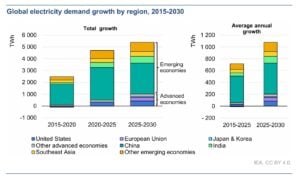
Global electricity demand is projected to grow at an average annual rate of around 3.6% between 2026 and 2030, significantly faster than the growth seen over the past decade. In contrast, total energy demand will rise much more slowly, meaning electricity will expand at least 2.5 times faster than overall energy consumption.
This divergence marks a fundamental change. Historically, electricity consumption closely tracked GDP growth. That relationship is now reversing. In 2024, electricity demand outpaced economic growth globally for the first time in three decades outside of crisis periods, and this trend is expected to continue.
Several structural drivers are accelerating this shift:
- Electrification of transport, especially electric vehicles
- Expansion of data centres and artificial intelligence workloads
- Rising demand for air conditioning due to climate change
- Industrial electrification and reshoring
- Growth in heat pumps and electric heating
Together, these trends are pushing electricity to become the dominant form of final energy consumption.
Emerging economies will remain the main engine of demand growth, accounting for roughly 80% of new electricity consumption through 2030. However, advanced economies are also seeing a resurgence after more than a decade of stagnation, driven by digitalization and electrification.
Global Power Mix: Renewables and Nuclear Take Half the Market
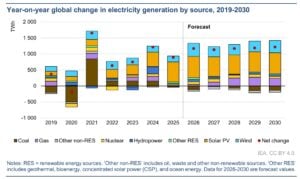
Globally, renewables and nuclear are on track to supply around 50% of electricity generation by 2030. Solar is the fastest-growing source, contributing more than half of annual generation additions.
Renewable generation is expected to grow by about 1,000 TWh per year through 2030, with solar alone adding more than 600 TWh annually. Nuclear power is also gaining momentum, supported by reactor restarts, lifetime extensions, and new builds in emerging economies.
However, coal will likely remain the single largest source of electricity in 2030, even as its share declines. Natural gas generation is also expected to rise, driven by US demand and fuel switching in the Middle East.
Overall, renewables, nuclear, and gas are projected to meet all net new electricity demand globally, displacing coal in aggregate but not eliminating it.
Advanced Economies Re-Enter the Demand Growth Cycle
Electricity demand in advanced economies is rising again after a prolonged period of stagnation. In the United States, demand is projected to grow by around 2% annually through 2030, with data centres accounting for roughly half of the increase.
In the European Union, electricity demand is expected to grow at around 2% per year, though consumption may not return to pre-2021 levels until the late 2020s. Other advanced economies, including Japan, Canada, Korea, and Australia, are also seeing accelerating growth.
This resurgence reflects:
- AI and cloud computing expansion
- Electrification of heating and transport
- Industrial reshoring and new manufacturing facilities
- Climate-driven cooling demand
Electricity is becoming a core input for economic competitiveness in digital and industrial sectors.
Power Sector Emissions: Plateau but Not Yet Declining Fast Enough
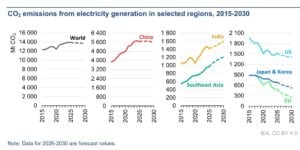
Electricity generation remains the largest source of energy-related carbon dioxide emissions, producing roughly 13.9 billion tonnes of CO₂ per year. After rising between 2022 and 2024, power sector emissions stabilised in 2025.
Looking ahead, emissions are expected to plateau through 2030, rather than decline sharply. This reflects the rapid growth in electricity demand, offsetting gains from clean power deployment.
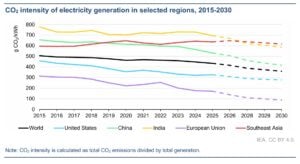
The carbon intensity of electricity has already fallen by around 14% over the past decade, and it is expected to decline faster as low-emission generation expands. This decline is mainly due to more renewable energy and strong nuclear power output.
- The trend is expected to accelerate. CO₂ intensity is forecast to fall by around 3.7% per year, dropping from 435 g CO₂ per kWh in 2025 to about 360 g CO₂ per kWh by 2030.
However, absolute emissions reductions will be harder to achieve due to rising demand. China’s trajectory is particularly critical. As the world’s largest power market and emitter, its pace of renewable deployment, coal retirement, and grid reform will heavily influence global climate outcomes.
China: The Single Largest Driver of Global Electricity Growth
China will remain the central force shaping global electricity demand over the next decade. Despite slower economic growth and structural shifts toward services, China’s sheer scale means it will contribute close to half of global electricity demand growth through 2030.
Electricity demand in China rose by just over 5% in 2025, down from roughly 7% in 2024. Looking ahead, demand is expected to grow at an average of around 4.9% annually between 2026 and 2030, slower than the past decade but still massive in absolute terms.
The drivers are multifaceted:
- Continued electrification across industry and households
- Expansion of manufacturing, including clean energy supply chains
- Growing services sector electricity use
- Rising cooling demand due to extreme heat events
- Digital infrastructure and smart technologies
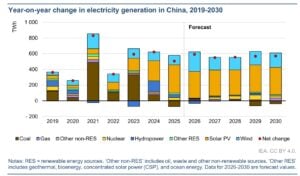
China’s power demand growth over the next five years alone is expected to match the current total electricity consumption of the European Union. This highlights the scale of China’s influence on global power markets, fuel demand, and emissions trajectories.
At the same time, efficiency improvements are tempering demand growth. Government policies targeting lower energy intensity and more efficient appliances are helping reduce electricity use per unit of GDP. However, these gains are not enough to offset the scale of electrification and economic activity.
MUST READ:
- China Adds Power 8x More Than the US in 2025, with $500B Energy Build-Out in a Single Year
- How China’s $180B Clean-Tech Investments Transform the Global South
Renewables Surge, But Grid Constraints Loom Large
China’s renewable energy buildout continues at an unprecedented pace. Solar generation jumped by more than 40% in 2025, while wind grew by double digits. The share of variable renewable energy (VRE) in China’s power mix reached around 22%, up sharply from the previous year.
Record capacity additions are transforming the power system. More than 300 GW of solar and over 100 GW of wind were added in a single year, driven partly by developers rushing to complete projects before the end of fixed-price tariffs.
However, this rapid expansion is creating new challenges. Curtailment rates for solar and wind increased, reflecting grid congestion and integration constraints. This highlights a global issue: generation is growing faster than grid infrastructure.
Coal’s Role Is Changing, Not Disappearing
Despite the renewable boom, coal remains a dominant force in China’s power sector. Coal-fired generation declined slightly in 2025, but coal still accounts for the largest share of electricity generation.
China’s coal share is expected to fall from around 55% in 2025 to about 43% by 2030, reflecting the rapid expansion of renewables and nuclear. However, coal capacity continues to grow, driven by projects approved during the 2022–2023 permitting boom.
Rather than serving as baseload power, coal plants are increasingly being used as flexibility and backup resources to support variable renewables. Capacity utilisation is expected to decline, even as installed capacity rises.
This shift illustrates a broader global trend: coal is becoming a reliability asset rather than a growth engine, but its persistence complicates decarbonization efforts.
Grids and Flexibility: The Hidden Bottleneck
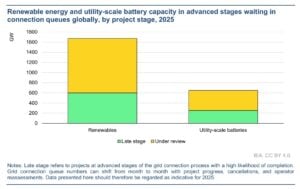
The transition to an electricity-centric energy system depends on grid expansion and flexibility. Investment in grids currently lags far behind generation capacity additions. Worldwide, more than 2,500 GW of projects are stuck in grid connection queues, including renewables, storage, and large industrial loads such as data centres. Without faster grid expansion and smarter system management, power shortages and curtailment risks will rise.
Meeting projected demand will require around 50% higher annual grid investment by 2030, rising from roughly USD 400 billion today. Without this, congestion, curtailment, and reliability risks will increase.
Flexibility solutions are also scaling rapidly. Utility-scale battery deployment is accelerating, especially in regions with high solar and wind penetration. However, conventional power plants still provide most flexibility today.
Policy reforms, grid-enhancing technologies, and non-firm connection agreements could unlock 1,200–1,600 GW of stalled projects, significantly accelerating the transition.
The Global Outlook: A Power-Centric Energy System
The global energy system is undergoing a structural transformation. Electricity is becoming the dominant vector for economic growth, digitalization, and decarbonization. Demand growth is accelerating across emerging and advanced economies, with China playing the most decisive role.
Renewables and nuclear are rapidly expanding, but coal and gas will remain part of the mix for reliability. Emissions are stabilising but not falling fast enough to meet climate targets, highlighting the scale of the challenge ahead.
The next five years will be critical. Grid expansion, flexibility solutions, and policy reforms will determine whether the Age of Electricity delivers a clean, affordable, and resilient energy future—or locks in new infrastructure bottlenecks and emissions risks.
- ALSO READ: 2026: The Year Nuclear Power Reclaims Relevance With 15 Reactors, AI Demand, and China’s Expansion
The post How Power Demand, Emissions, and China Will Shape the Global Energy System to 2030 appeared first on Carbon Credits.
Carbon Footprint
CATL’s Profit Surges 42% With Global Battery Demand and the Shift to a Zero-Carbon Future
The post CATL’s Profit Surges 42% With Global Battery Demand and the Shift to a Zero-Carbon Future appeared first on Carbon Credits.
Carbon Footprint
Nvidia’s $2B Bet in AI: Powering Innovation with Nebius and Palantir While Tackling Energy Impact
Artificial intelligence (AI) is changing many industries. NVIDIA, the company that designs the chips and systems that power large AI models and data centers, leads in AI technology and hardware.
The big tech company made headlines with major news about its AI investments and partnerships with Nebius and Palantir Technologies. These moves have implications for environmental sustainability, energy use, and greenhouse gas emissions.
NVIDIA’s $2B Nebius Investment Fuels AI Cloud Expansion
NVIDIA announced it will invest $2 billion in Nebius, a cloud infrastructure company. This investment aims to support AI cloud expansion and data center capacity.
NVIDIA will take an 8.3% stake in Nebius through this investment. The cloud provider plans to build AI data centers with more than 5 gigawatts of capacity by 2030. This capacity is roughly enough power for over 4 million U.S. homes.
The partnership includes early access to NVIDIA’s compute hardware and software. The companies will work together on large‑scale AI computing clusters. Nebius also received approval to build a 1.2 gigawatt data center campus in Missouri, U.S.
Nvidia (NVDA) stock saw a modest increase, while Nebius Group (NBIS) shares soared over 16% following the announcement of the investment. The deal drove significant investor confidence in Nebius.


What This Means for Energy and Emissions
AI data centers use a lot of electricity. They power powerful chips and run complex models. Building larger infrastructure without considering energy efficiency can raise carbon emissions.
But NVIDIA’s hardware and software often aim to improve performance per watt. Improved efficiency means less energy per unit of computation. Better energy use can reduce running costs and overall emissions at scale.
At CES 2026, NVIDIA unveiled its Rubin architecture for data center GPUs, claiming 40% higher energy efficiency per watt over the prior generation. Unlike single chips, Rubin unites six specialized chips into a rack-level system, slashing power for massive AI workloads while boosting speed. This advances NVIDIA’s “Green AI” for sustainable data centers.

Still, expanding data center capacity will add to total energy demand. For this reason, it is important that such expansions use low‑carbon electricity sources such as wind, solar, and hydropower.
Operational AI with Palantir: Smarter Workflows, Lower Emissions
NVIDIA and Palantir Technologies announced a collaboration to build an integrated operational AI technology stack. This stack combines the chipmaker’s accelerated computing and AI software with Palantir’s data intelligence platform.
Justin Boitano, vice president, Enterprise AI Platforms, NVIDIA, said:
“AI is redefining the infrastructure stack — demanding, latency-sensitive and data-sovereign environments require a full-stack architecture — built from silicon to systems to software. By combining Palantir’s sovereign AI OS reference architecture with NVIDIA AI infrastructure, industries and nations can turn data into intelligence with speed, efficiency, and trust.”
NVIDIA CEO Jensen Huang also noted that ‘Palantir and NVIDIA share a vision: to put AI into action, turning enterprise data into decision intelligence.’ The partnership was highlighted at NVIDIA’s GTC Washington, D.C. event.
This technology helps businesses and governments use AI to manage data and decision intelligence. It allows complex data from supply chains, logistics, and operations to feed into AI systems, which can make real‑time decisions and improve efficiency.
For example, systems built on this stack can automate workflows, optimize routes, and predict supply needs. Logistics and supply processes often involve fuel use and emissions. AI tools that help optimize these processes can help companies reduce waste and energy use.
This partnership also includes integration of NVIDIA’s AI models and tools into the Palantir platform. The combined stack supports automation and digital decision making for complex operations.
AI’s Role in Net‑Zero and Emission Reductions
AI technology has potential benefits for climate and environmental goals. AI can help sectors in many ways, such as:
- Energy systems planning: AI can optimize grid load, match supply and demand, and reduce waste.
- Industrial operations: AI can monitor and adjust machinery to cut fuel use and emissions.
- Transportation and logistics: AI routing tools can lower fuel consumption and emissions.
- Building efficiency: Smart systems can reduce energy use in heating or cooling.
These applications show that AI can support net‑zero goals across industries.
In particular, using operational AI to improve logistics and supply chains can help companies reduce emissions. AI tools can analyze traffic, weather, and delivery patterns in real time. They can recommend routes that use less fuel and avoid delays. AI can also reduce idle time for trucks, ships, and warehouse equipment.
Logistics is a major source of emissions. According to the International Energy Agency, transport accounted for about 23% of global energy-related CO₂ emissions in recent years. Freight transport alone produces roughly 40% of transport emissions.

AI optimization can lower these emissions. Research from the World Economic Forum shows that digital technologies such as AI, data platforms, and automation could cut logistics emissions by up to 10–15% by 2030. These tools improve route planning, fleet efficiency, and cargo utilization.
Industry studies show similar results. McKinsey & Company estimates that AI-based route optimization can reduce fuel use in logistics fleets by about 5–10%. Even small gains can matter at scale. For example, a large delivery fleet that burns 100 million liters of fuel per year could save 5–10 million liters annually using smarter routing systems.

These estimates help explain why companies are investing in operational AI platforms. When applied across supply chains, AI can help businesses lower fuel use, reduce emissions, and improve efficiency at the same time.
NVIDIA’s technology, including high‑performance GPUs, optimized software, and AI models, can be part of these solutions. By improving performance per watt and enabling energy‑aware workflows, the tech giant contributes to both the growth of AI and the efficiency of systems that use it.
AI for Efficiency and Sustainability
Artificial intelligence has a dual climate role:
- AI systems can be energy‑intensive and add to electricity demand.
- AI tools can also help optimize energy use in other sectors.
AI computing infrastructure continues to expand. More powerful chips and larger data centers mean higher energy use. Research shows that data center energy demand could nearly double by 2030 due to AI workloads alone. AI servers and cooling systems are energy‑intensive, and they also use significant water resources.

However, efficiency improvements and smarter energy use can reduce emissions. New hardware designs, better cooling technologies, and renewable power integration can lower the environmental footprint of AI computing.
Major cloud providers and AI infrastructure firms, including NVIDIA partners, are investing in energy‑efficient systems. This includes technologies that cut power demand and reduce heat waste.
NVIDIA’s push for next‑generation hardware, such as chips designed to improve energy efficiency per computation, helps support these goals. GPUs and AI accelerators that do more work with less energy can have a positive impact on total energy use over time.
Conclusion: Balancing Growth and Sustainability
NVIDIA’s recent news shows the company’s strategy at the center of AI growth. Its $2 billion investment in Nebius will help expand AI cloud infrastructure. The collaboration with Palantir aims to bring AI tools into complex enterprise operations.
At the same time, AI infrastructure carries environmental challenges. Data centers and high‑performance computing need vast energy. But the deployment of more efficient hardware, smarter software, and renewable energy integration can reduce this impact.
NVIDIA’s technologies, when used to improve energy use and emissions management, can help companies work toward net‑zero targets. As AI continues to grow, balancing innovation with sustainability will remain essential.
The post Nvidia’s $2B Bet in AI: Powering Innovation with Nebius and Palantir While Tackling Energy Impact appeared first on Carbon Credits.
Carbon Footprint
Trafigura to Buy 80,000 Tonnes Over 10 Years from U.S. Smackover Project
Trafigura has signed a long-term offtake agreement to purchase lithium carbonate from the South West Arkansas (SWA) Project. Smackover Lithium is a joint venture between Standard Lithium Ltd. and Equinor ASA.
Trafigura Secures Long-Term Lithium Supply
Trafigura will purchase 8,000 metric tonnes of battery-grade lithium carbonate each year from the SWA Project. The agreement runs for ten years, bringing the total contracted supply to about 80,000 tonnes.
The contract follows a take-or-pay structure. This means Trafigura must purchase the agreed volume every year or pay for it regardless. Agreements like this are common in mining and energy because they provide financial certainty for new projects.
Deliveries will begin once the project enters commercial production. The partners expect production to start in 2028, while the final investment decision is planned for 2026. Notably, for developers, long-term supply contracts often play a key role. They signal market confidence and make it easier to secure project financing.
Gonzalo De Olazaval, Head of Metals and Minerals at Trafigura, commented:
“We are pleased to have signed this offtake agreement with Smackover Lithium, further strengthening our North American critical minerals footprint. The SWA Project is expected to provide a reliable source of battery-grade lithium carbonate produced in the United States, enhancing domestic supply chains. We look forward to collaborating with Smackover Lithium on this strategic project and to delivering this material to customers across North America and globally.”
Unlocking The South West Arkansas Lithium Project
The SWA Project sits in southern Arkansas near the borders of Texas and Louisiana. It lies within the Smackover Formation, a geological region known for lithium-rich brine deposits.
- Smackover Lithium operates the project as a joint venture. Standard Lithium owns 55%, while Equinor holds 45%, and Standard Lithium serves as the operator.
The project covers roughly 30,000 acres of brine leases. The first phase of development focuses on the Reynolds Brine Unit, which spans more than 20,800 acres. Regulators approved the unit without objections from local stakeholders. And this approval marked an important milestone for the project’s development.
The first stage of the project aims to produce about 22,500 tonnes of battery-grade lithium carbonate each year. Nearby leases offer additional space for future expansion if production increases.
Direct Lithium Extraction at the Core
The project will rely on direct lithium extraction (DLE) technology to recover lithium from underground brine.
Traditional lithium operations often use evaporation ponds that take months or even years to produce lithium chemicals. In contrast, DLE removes lithium directly from brine using specialized materials and chemical processes.
After extraction, the remaining brine is usually pumped back underground. This process helps maintain reservoir pressure and reduces surface water use.
Because of these advantages, DLE has attracted strong attention across the lithium industry. It can shorten production times and reduce the land footprint of operations. The company has spent several years testing and refining this technology. The SWA Project aims to apply it on a commercial scale.
Smackover Formation: A Rising Center for U.S. Lithium Production
The Smackover Formation stretches from central Texas to the Florida Panhandle. It is widely considered one of the most promising lithium brine regions in North America. Lithium concentrations in the formation are comparable to those found in major production areas in Argentina and Chile.
Arkansas sits at the center of this resource. The region already has a long industrial history. Oil and gas production began there in the early twentieth century. Later, the region became a key hub for bromine extraction from brine.

This industrial background created several advantages for lithium development. Infrastructure such as wells, pipelines, and processing facilities already exists. In addition, the local workforce has decades of experience handling brine extraction.
Because of this foundation, lithium production can build on existing systems rather than starting from scratch. Furthermore, the region also faces fewer water stress challenges than some lithium-rich areas in South America or the western United States. This improves the long-term feasibility of brine-based lithium projects.
Strong Resources Support the Project
The company revealed that resource estimates suggest the SWA Project holds significant lithium potential. Current studies project about 447,000 tonnes of proven lithium carbonate equivalent reserves.
This represents roughly 38 percent of the project’s measured and indicated resource base, which totals about 1.17 million tonnes of lithium carbonate equivalent.
The operation will begin production with lithium concentrations of around 549 milligrams per liter in the brine. Over its estimated 20-year operating life, the project is expected to process about 0.20 cubic kilometers of brine. The average lithium concentration during that period is expected to remain around 481 milligrams per liter.
Higher lithium grades play a major role in project economics. Strong concentrations allow producers to recover more lithium from each unit of brine. As a result, processing costs fall, and efficiency improves.
Because of this, projects with both strong grades and large resources tend to attract greater interest from investors and long-term buyers.

U.S. Lithium Potential in a Global Context
Lithium resources in the United States come from several geological sources.
- According to the latest data from the U.S. Geological Survey, measured and indicated lithium resources in the country are estimated at around 30 million tons.
These resources occur in different types of deposits, including continental brines, oilfield brines, geothermal brines, claystone deposits, hectorite, and hard-rock pegmatites.
Global exploration continues to expand the lithium resource base. And worldwide, measured and indicated lithium resources are estimated at 150 million tons. As exploration advances and new extraction technologies emerge, more regions are becoming viable sources of lithium supply.

Rising Demand from EVs, Energy Storage, and AI
Lithium demand continues to increase across several sectors. The largest driver remains the electric vehicle market.
In the United States, lithium demand for EV batteries is expected to grow by about 25% per year over the next decade. This growth rate exceeds the projected global EV demand growth of about 13 percent annually.

Energy storage is another rapidly expanding market. Large battery systems help store electricity from renewable sources such as solar and wind power and release it when demand rises.
At the same time, digital infrastructure is creating new pressure on electricity systems. Data centers that support artificial intelligence require massive amounts of energy. This trend is pushing utilities to expand battery storage capacity.
Because of these factors, the U.S. energy storage market could grow by roughly 29 percent per year, further increasing the need for lithium-based batteries.
A Practical Shift in the U.S. Lithium Story
For many years, the United States relied heavily on imported lithium materials. However, that approach is slowly changing.
Projects like the SWA development show how companies are trying to rebuild parts of the battery supply chain domestically. Instead of shipping raw materials across several continents, producers are exploring ways to supply lithium closer to battery and vehicle manufacturing centers.
The Smackover region fits naturally into this transition. Its geology, infrastructure, and long history of brine extraction already support industrial operations.
The agreement with Trafigura adds another layer of confidence. Commodity traders usually commit to long-term supply deals only when they believe a project has strong potential.
If development moves forward as planned, the SWA Project could turn southern Arkansas into a new center for lithium production. Over time, the region may shift from its long history of oil, gas, and bromine toward a growing role in supplying the battery metals needed for modern energy systems.
- READ MORE: U.S. Lithium Push: How Washington’s Bet on Lithium Americas Could Reshape the Global Market
The post Trafigura to Buy 80,000 Tonnes Over 10 Years from U.S. Smackover Project appeared first on Carbon Credits.
-
Greenhouse Gases7 months ago
Guest post: Why China is still building new coal – and when it might stop
-
Climate Change7 months ago
Guest post: Why China is still building new coal – and when it might stop
-
Greenhouse Gases2 years ago嘉宾来稿:满足中国增长的用电需求 光伏加储能“比新建煤电更实惠”
-

Climate Change2 years ago
Bill Discounting Climate Change in Florida’s Energy Policy Awaits DeSantis’ Approval
-
Climate Change2 years ago
Spanish-language misinformation on renewable energy spreads online, report shows
-
Climate Change2 years ago嘉宾来稿:满足中国增长的用电需求 光伏加储能“比新建煤电更实惠”
-
Climate Change Videos2 years ago
The toxic gas flares fuelling Nigeria’s climate change – BBC News
-
Carbon Footprint2 years agoUS SEC’s Climate Disclosure Rules Spur Renewed Interest in Carbon Credits


