

In 2021, amidst a wave of corporate net-zero targets, a campaign group called Investors for Paris Compliance was set up in British Columbia, aiming to use investor pressure to hold Canadian companies to account on their climate promises.
In the five years since, the group has notched up several wins: pressuring National Bank into providing $20 billion of finance to renewable energy, getting Royal Bank of Canada to improve its green finance labels and persuading 20-25% of investors to regularly back climate proposals at annual general meetings (AGMs) for shareholders.
But last month, the group’s then executive director Matt Price put out a statement saying it was shutting down. Despite some progress, Price explained, his organisation had concluded that “investor accountability has reached its limits”.
Companies and their investors often understand that climate change threatens the economic system, Price said. But, he added, they do not respond adequately because they are worried that, if they do, their competitors will not put in as much effort and could therefore gain a financial advantage.
-
Santa Marta process can confront trade protection for fossil fuels, experts say
Academics at the first fossil fuel phase-out summit urged governments to recognise investor protection treaties as a barrier to the energy transition -
Indonesia’s failing Just Energy Transition Partnership is a cautionary tale
The government has abandoned its plan to shut down a major coal plant, which was a key part of the deal, raising doubts about the donor-backed approach -
After another battery startup bankruptcy, can Europe ever cut reliance on China?
Norway’s Morrow Batteries set out to challenge Chinese producers, but a cash crunch forced it to file for bankruptcy in a setback for European ambitions for clean energy sovereignty


This “tragedy of the commons” situation cannot be fixed by shareholder advocacy, Price said, but instead needs litigation, regulatory action and accountability mechanisms. “Some of our team will take those things on in new initiatives,” he said.
Price’s words echo the findings of a London School of Economics (LSE) report published last month, based on workshops with asset owners and managers in New York, Amsterdam, London and Singapore.
Government policy key
The LSE report noted that “action by investors on climate change is severely constrained by their duties, the limited tools at their disposal and the pathways of technology development”. To be effective, pressure from climate-conscious investors must be coupled with government policy that incentivises green investment and technological innovation, the authors concluded.
An investigation by the Guardian recently found that, despite overwhelming shareholder support for its climate action plan, Australian mining company BHP has carried on buying polluting diesel trucks instead of electric ones. The Australian government subsidises diesel, saving BHP hundreds of millions of dollars a year.
As EU acts to stop greenwash, funds drop climate claims from their names
Lindsey Stewart, director of institutional insights for investment research firm Morningstar, told Climate Home News that investor activism does work but it “doesn’t do everything that people expected it to do towards the beginning of the 2020s”.
“There is a limit to what can be achieved by minority shareholders exercising their votes and engaging with companies. Quite a lot, it does seem, is reliant on the legal and regulatory framework,” he said, adding that the closure of Investors for Paris Compliance shows this “realisation is sinking in a lot more than perhaps it was in 2020, 2021, 2022”.
Decline of investor activism
Stewart said that in the early 2020s, investor activists were pushing companies for “things that were sort of already on the regulatory conveyor belt anyway”, like companies setting targets for their operational (Scope 1 and 2) emissions, disclosing their carbon footprints, and assessing their exposure to risk from climate change.
With this low-hanging fruit picked, green-minded investors have moved on to make demands that are more controversial and have received less support from other investors, he said. He gave examples of just transition reporting, green capital expenditure financing ratios for banks and disclosing emissions from the use of products a company sells, known as Scope 3 emissions.
On top of this, Stewart said, there has been pressure from the “right-wing political establishment in the US” against investors taking climate change into consideration. BlackRock, which manages $9.5 trillion of assets, has walked back its climate commitments after pressure from US Republicans.
More fundamentally, Stewart described the idea that fossil fuel majors would dismantle their oil and gas business and transform into renewables companies as a “pipe dream on the part of environmentalists”. “Why would they have the skill or capability, or even the stakeholder backing, to completely transform a business of that size?” he asked.
Shareholder activism is only possible at privately owned and listed companies, while most investment in oil and gas is now coming from state-owned companies, like Saudi Arabia’s Aramco. In 2025, less than a quarter of investment was from oil majors like BP and Shell.
Business backlash shows power
Yet despite the uphill climb, Mark van Baal defends shareholder activism. He runs an Amsterdam-based campaign group called Follow This, which has tried to get investors to vote for pro-climate resolutions at the AGMs of oil and gas multinationals.
He accepts that success peaked around 2021, but says the effort oil and gas firms are now putting into winning over shareholders and discouraging pro-climate resolutions – which he characterised as “the Empire Strikes Back” – shows the power of shareholder activism, which was previously underestimated.

In January 2024, ExxonMobil sued Follow This, aiming to block the group’s climate resolution. Fearing the case would end up in the Supreme Court, where conservative judges could set an anti-climate precedent, Follow This withdrew the resolution.
But, said van Baal, although the legal battle created a “chilling effect among investors”, it is a “proof point that shareholder pressure works and that they’re really afraid of the shareholders”.
Vote, don’t sell
Stewart and van Baal both agreed that selling, or threatening to sell off shares is not an effective way to change a company’s behaviour.
It allows less climate-conscious investors to buy the shares, they said, adding that there is no evidence that threats to sell shares and therefore lower the valuation over climate concerns have influenced company management.
Van Baal said the share price is set by short-term traders, not long-term shareholders like the pension funds he works with.
How Shell is still benefiting from offloaded Niger Delta oil assets
Nonetheless, investors’ engagement should be forceful, van Baal insisted – and not just within their comfort zone of talking to management about sustainability behind closed doors without voting for it at AGMs. “Shareholder democracy is the only democracy where voting is called escalation,” he said.
The Follow This website says that only investors can stop fossil fuel companies destroying the planet. “Marches didn’t change their minds. Lawsuits didn’t stop them. But shareholders can,” it trumpets.
But van Baal told Climate Home News this wording is “too strong” and may have to be revised, adding that shareholder activism just “fits me more than gluing myself to roads” and is a tactic he “stumbled on” 11 years ago.
Legal, political and investor activism can reinforce each other, he added. When Friends of the Earth sued Shell alleging inadequate climate action, for example, the green group’s lawyers cited the company’s rejection of a Follow This resolution as evidence. “The pressure needs to come from all sides,” van Baal said.
The post Investor climate group closes down, blaming “limits” of shareholder activism appeared first on Climate Home News.
Investor climate group closes down, blaming “limits” of shareholder activism

Next week, diplomats from around the world will descend on Yerevan, Armenia, to negotiate a series of decisions under the UN Convention on Biological Diversity (CBD).
Between 19 and 30 October, 196 parties will gather to hammer out the precise wording of the dozens of legal texts that make up the decisions under the Conference of the Parties (COP) to the CBD.
This year’s summit is particularly significant, as it marks the halfway point between the agreement of the Kunming-Montreal Global Biodiversity Framework and the deadline for achieving its targets.
The CBD has found that countries are currently not on track to meet 22 out of the framework’s 23 targets.
During the fortnight, delegates will also be negotiating decisions relating to the two supplemental protocols to the CBD: the Cartagena Protocol, which covers biosafety; and the Nagoya Protocol, which covers access and benefit-sharing for the use of genetic resources.
(The Cartagena and Nagoya Protocols, which are each governed by a “meeting of the parties”, or “MOP”, have fewer parties than the CBD as a whole, with 173 and 141, respectively.)
Carbon Brief is tracking the progress of countries towards consensus on dozens of negotiating texts using the interactive table below.
The tracker includes texts from the COP, as well as the MOPs for the Cartagena and Nagoya protocols. It also includes draft decisions from the most recent subsidiary body meetings, as these form the starting point for the negotiations in Yerevan.
The CBD has three subsidiary bodies: the subsidiary body on scientific, technical and technological advice (SBSTTA), the subsidiary body on implementation (SBI) and the subsidiary body on article 8(j) and other provisions (SB8J).
SB8J focuses on issues related to the Indigenous peoples and local communities. It was established at COP16 in Cali, Colombia, in 2024.
The first two columns of the interactive tracker list the topic of each agenda item and the relevant body, with subsequent columns including dates, page counts and links to the original documents.
The table is searchable and can be sorted using the arrows in the header.
Areas of disagreement in UN draft texts are denoted by square brackets. Counting the brackets in a particular iteration of a text therefore gives a sense of how far parties are from reaching consensus.
The bracket column is colour-coded, with dark green indicating a low number of brackets and red indicating a high number of brackets remaining.
Texts can also present parties with choices using “options” or alternatives (“alt”), which are counted together in the sixth column of the table.
The key discussions in Yerevan will centre around two agenda items in particular. The first is the global review, which will assess progress towards the GBF and make recommendations for accelerating action.
The second is finance, which can be separated into two parts: resource mobilisation and the financial mechanism. On resource mobilisation, biodiverse global south countries are likely to push for an increased amount of international finance for conservation.
Disagreement over the creation of the financial mechanism led to the suspension of COP16 in Cali in October 2024, as parties failed to find agreement on the mobilisation of finance before the end of the summit.
Global south countries want the establishment of a separate financial mechanism under the control of the CBD; global north countries largely prefer to maintain the existing mechanism, which sits under the Global Environment Facility.
At the resumed session of COP16 in Rome in early 2025, countries agreed on a roadmap that would lead to the establishment of a permanent mechanism.
related

Analysis: Lula presidency saved at least 20,000km2 of Brazilian Amazon since 2022
Why land-use emissions have fallen by a third this century – in six charts

Analysis: 84% of nations miss deadline to identify ‘nature-harming’ subsidies by 2025

UK withdraws millions in funding from world’s second-largest rainforest in Congo
The post Interactive: Tracking negotiating texts at the COP17 biodiversity summit appeared first on Carbon Brief.
Interactive: Tracking negotiating texts at the COP17 biodiversity summit
A beacon of love
On an outer island of Fiji, two thousand nautical miles from Sydney, is a shining light of hope and resilience for our troubled world.
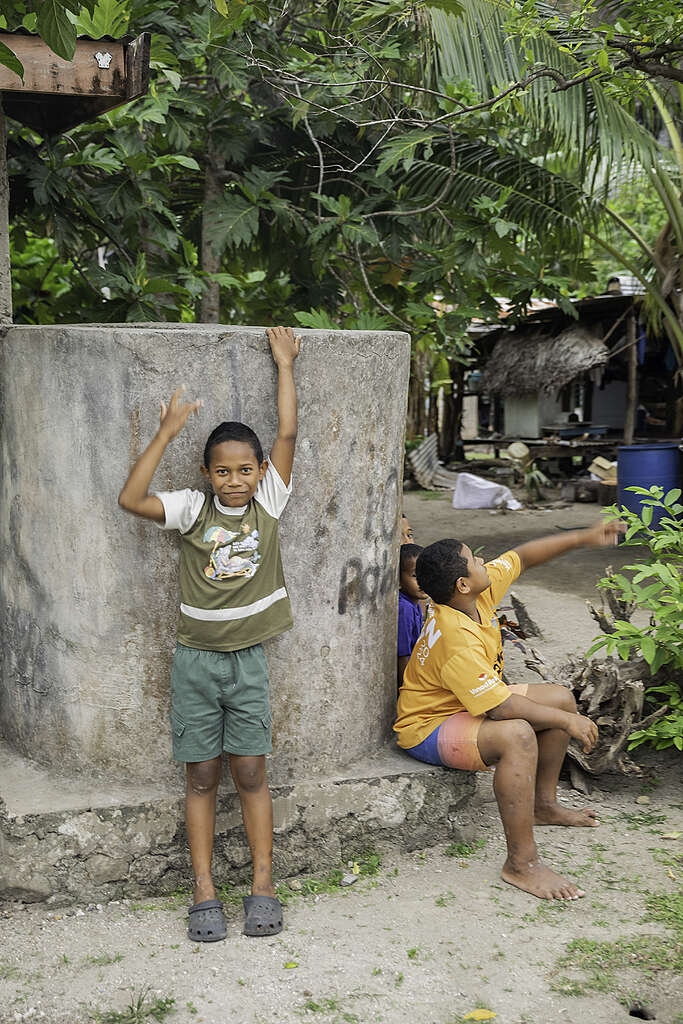
The island of Kioa is home to a Tuvaluan community who migrated from their atoll of Vaitupu in the late 1940s. It is a land of warm hearts, big smiles, and deep cultural roots; a place where the sound of a conch still summons the island together, where islanders paddle out to fish in carved outrigger canoes, and healthy happy children walk barefoot to school.
Here, culture is life. Kioans live sustainably through their traditional knowledge and practices. The island is alive with song, dance and the rhythms of a life tied to the tides, the winds, and the seasons.
Facing the future
Greenpeace has been lucky to have a relationship with Kioa for a number of years now, and we are continually learning from this remarkable community.
Last week, as part of our Voyaging Oceania project, we returned to the island. Our purpose was twofold —- to carry messages from the island to leaders gathering in Nadi this week for the Pacific Pre-COP, and to support the Kioa community in their efforts to improve water security for the island.
Unlike Tuvalu itself, with its eight atolls, Kioa is a mountainous, forested and richly fertile island. It will remain habitable far into the future. Kioans did not initially migrate from Vaitupu due to climate change, but the move was prophetic. They now have a lifeboat.
However, even Kioa faces challenges on our rapidly warming planet, in particular when it comes to water. Climate change is shifting once reliable rainfall patterns. On top of this, the island is already feeling the effect of this year’s intensifying El Niño event, which for Fiji means reduced rainfall and prolonged dry spells.
Right now, fresh water has to be carefully rationed, and is only available for a few hours a day. During last week’s visit aboard our campaigning ship Oceania, Greenpeace was privileged to work with the Kioa community on a new solar-powered water distribution project for the island.
Designed and led by the island, the project involves using a solar pump to move water from a reliable source to a storage tank and then using gravity to distribute the water around the village.
It was a lesson in how local knowledge and ingenuity can be the backbone of today’s climate solutions. To build a dam around the source, the local community knew the exact spot where they could gather gravel at low tide to mix with the cement. They took only what was needed, knowing that all resources must be carefully conserved. Kioa has no roads and no machinery, and it was an all-of-island effort to carry the materials up to the project site, including many heavy bags of sand and rock.
Such projects truly bring to life the vision of a resilient, locally-led, fossil fuel free Pacific.