

newcleo, a European nuclear technology company, announced that it has raised €75 million (about USD $88 million) in a new funding round. The cash will help the company build and develop advanced small nuclear reactors powered by recycled nuclear waste. The financing is a sign of growing investor interest in clean and low-carbon energy solutions.
Newcleo also said that it has now raised more than $124 million in total for 2025. The company was founded in September 2021 and is based in Paris, France. The nuclear energy developer also operates in Italy, the UK, Belgium, and Slovakia, with roughly 1,000 employees.
What newcleo’s Technology Does: Turning Nuclear Waste into Usable Fuel
newcleo develops a type of advanced nuclear technology known as lead-cooled fast reactors (LFRs). These reactors are a form of small modular reactor (SMR).
Unlike traditional nuclear reactors that use fresh uranium fuel, newcleo’s design aims to use reprocessed nuclear waste as fuel. This means existing waste from older reactors could become a power source.
Using nuclear waste as fuel is intended to have two benefits:
- It could reduce long-term waste storage needs.
- It may help lower the carbon footprint of nuclear power.
Lead-cooled fast reactors also use liquid lead to transfer heat out of the core. The liquid lead acts as a coolant and enables the reactor to operate at high temperatures without high pressure.
This reactor type is still under development and not yet in wide commercial operation. But companies like newcleo believe it could play a role in future clean energy systems.
Heavy Industry and Investors Double Down
The €75 million funding round brought in both new and existing investors. New industrial backers included heavy industry groups such as:
- Danieli & C, a steel mill manufacturer
- Cementir Holding, a cement and concrete producer
- Orion Valves, an industrial valve maker
- NextChem, an energy engineering firm
Existing financial backers also participated. These included Kairos, Indaco Ventures, Azimut Investments, the CERN pension fund, and Walter Tosto (industrial engineering).
The mix of industrial and financial investors shows that newcleo’s technology draws interest from companies looking for reliable, low-carbon power and firms focused on clean energy investments.
Scaling from Design to Deployment
newcleo said the fresh funding will support several key parts of its business. The company highlighted progress in:
- Licensing and regulatory approval processes
- Research and development (R&D) of reactors and fuel systems
- Vertical integration of technology and manufacturing
- Geographic expansion in key markets like Europe and the United States
This means newcleo is working not just on reactor design, but on building the skills and facilities needed to support production, testing, and commercial deployment. The company also has partnerships and projects in multiple countries, including France, Italy, Slovakia, and the U.S. These collaborations relate to licensing and siting work, research facilities, and future commercial reactor projects.
Closing the Nuclear Fuel Loop
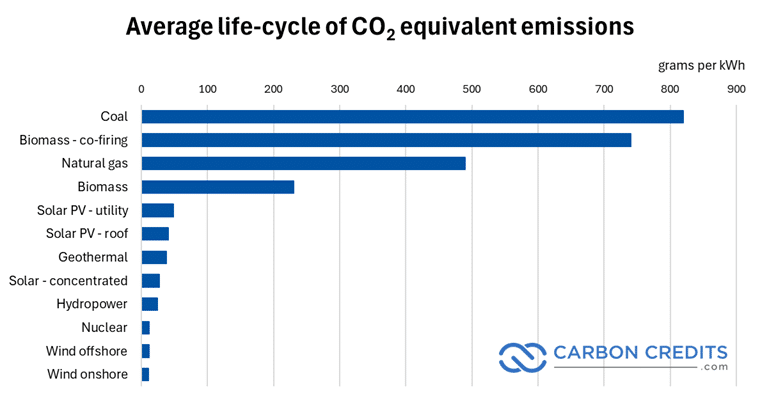
Nuclear power is often seen as a low-carbon energy source because it produces virtually no direct CO₂ emissions during operation. However, it leaves behind radioactive waste that can remain hazardous for thousands of years.
Traditional reactors use uranium fuel once and store the resulting waste. newcleo’s approach aims to reuse existing waste as reactor fuel. This could potentially reduce the volume and hazard of waste that needs long-term storage.
Lead-cooled fast reactors are one class of Generation IV nuclear technology. These designs are intended to be safer and more efficient than older reactors. They can run on fuels that traditional reactors cannot and may help make nuclear energy more sustainable in the long term.
Using recycled radioactive fuel helps close the nuclear fuel cycle. This means sourcing more energy from mined uranium, which leaves less waste behind.
Building a Cross-Border Nuclear Footprint
newcleo has stated that it plans to roll out its technology in several countries with active regulatory frameworks for advanced nuclear projects. The company has started licensing and planning partnerships in Europe and the U.S. These moves aim to make it a major supplier of advanced nuclear power systems.
In France, newcleo is preparing regulatory filings for both fuel and reactor projects. In Italy, it is building R&D infrastructure and test systems, while in Slovakia, it has formed a joint venture to deploy multiple reactors at a nuclear site. And in the U.S., it is engaging in collaborations to build fuel manufacturing and fabrication capabilities.
The company’s CEO, Stefano Buono, said investors view newcleo’s progress in licensing, R&D, and global expansion as a key advantage. He further added,
“Our ability to deliver impactful low-carbon energy solutions for energy-intensive firms is proving an attractive investment rationale for both industrial and financial investors. Our tangible progress in licensing, R&D, vertical integration, and geographic expansion is seen by investors as a key differentiator in the race to deliver clean, safe, and affordable nuclear energy.”
Small Modular Reactors Gain Global Traction
Interest in small modular reactors is rising as countries look for reliable, low-carbon power. Governments and industry groups also track SMRs more closely than before.
One sign is the growing number of designs in development. The OECD Nuclear Energy Agency (NEA) reported that its latest SMR Dashboard found 98 SMR technologies globally. It detailed 56 of these SMRs in its dashboard set.
A separate NEA summary shows a larger count of designs tracked over editions. This highlights how quickly the pipeline is expanding.
-
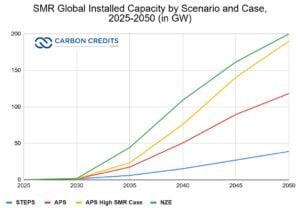
Forecasts also show wider deployment in the coming decades. The International Energy Agency (IEA) publishes scenario data on global SMR capacity from 2025 to 2050.
In its analysis, SMR capacity rises from near-zero today to tens of gigawatts by 2050 in its main scenarios (39 GW), and it grows even higher in its “high SMR” case (190 GW). This suggests that SMRs could move from pilot projects to meaningful scale if costs fall and licensing speeds up.
International institutions also expect nuclear growth overall, with SMRs playing a bigger role. In September 2025, the International Atomic Energy Agency (IAEA) said it raised its long-term nuclear outlook again.
In its best-case scenario, the IAEA predicts that global nuclear capacity could grow to 2.6 times the 2024 level by 2050. It also noted that SMRs will be key to this growth.
Policy signals further support this direction. The NEA reports that over 20 countries at COP28 pledged to triple global nuclear energy capacity by 2050.
These forecasts do not guarantee fast deployment. SMRs still face key hurdles such as licensing timelines, supply chains, fuel availability, and first-of-a-kind costs.
SMRs are increasingly central to global nuclear talks. The NEA tracks more designs, and the IEA outlines new deployment pathways. And interest from investors and policymakers has grown as countries look for reliable low-carbon baseload power.
- SEE MORE: From Now to 2060: How Canada’s SMRs and Maritime Nuclear Power Will Drive a Net-Zero Future
The €75 million funding round adds to newcleo’s growing capital base. It boosts the company’s ability to advance its technology and work toward deployment. As of early 2026, newcleo has raised more than $124 million over the past year, with total funding since 2021 likely exceeding €645 million.
Private Capital Signals a Nuclear Comeback
The investment in newcleo highlights a broader trend: private capital is moving into advanced nuclear technologies.
Investors in heavy industry and finance are now seeing nuclear power as key to global decarbonization efforts. Some countries have recently updated their policies. This supports nuclear research and licensing. It shows a focus on energy security and climate goals.
Lead-cooled fast reactors and similar designs remain in early stages of testing and regulatory review. Newcleo and similar companies think their technologies can provide clean, reliable power. They also believe these systems create less waste over their life cycles compared to older reactors.
If successful, this approach could expand the role of nuclear power in the energy transition. But much work remains in testing, licensing, manufacturing, and cost reduction before commercial deployment at scale.
The post Nuclear’s Next Chapter: newcleo Raises $88M to Scale SMR Powered by Nuclear Waste appeared first on Carbon Credits.

EU carbon credit claims changed on 27 September 2026, the day the Directive (EU) 2024/825 began to apply across the European Union. The change is narrow. It changes how a company can talk about the credits it buys. A product can no longer be called neutral on the strength of compensation alone; however, every specific, evidenced statement about what a company measured, reduced, and funded stays fully available.

The post Promoting Improved Cooking Practices in Nigeria appeared first on Terrapass.



-
Climate Change1 year ago
Guest post: Why China is still building new coal – and when it might stop
-

 Greenhouse Gases2 years ago
嘉宾来稿:满足中国增长的用电需求 光伏加储能“比新建煤电更实惠”
-
Greenhouse Gases1 year ago
Guest post: Why China is still building new coal – and when it might stop
-

 Climate Change2 years ago
嘉宾来稿:满足中国增长的用电需求 光伏加储能“比新建煤电更实惠”
-

 Renewable Energy12 months ago
Sending Progressive Philanthropist George Soros to Prison?
-
Climate Change2 years ago
Bill Discounting Climate Change in Florida’s Energy Policy Awaits DeSantis’ Approval
-
Greenhouse Gases1 year ago
嘉宾来稿:探究火山喷发如何影响气候预测
-

 Climate Change2 years ago
Analysis: China’s CO2 falls 1% in Q2 2024 in first quarterly drop since Covid-19