

We handpick and explain the most important stories at the intersection of climate, land, food and nature over the past fortnight.
This is an online version of Carbon Brief’s fortnightly Cropped email newsletter. Subscribe for free here.
Key developments
COP30 roundup
FOOD OFF THE MENU: COP30 wrapped up in the Brazilian Amazon city of Belém, with several new announcements for forest protection, but with experts saying that food systems were seemingly “erased” from official negotiations, Carbon Brief reported. Other observers told the Independent that the lack of mention of food in some of the main negotiated outcomes was “surprising” and “deeply disappointing”. The outlet noted that smallholder farmers spend an “estimated 20 to 40% of their annual income on adaptive measures…despite having done next to nothing to contribute to the climate crisis”.
‘BITTERSWEET’: Meanwhile, Reuters said that the summit’s outcomes for trees and Indigenous peoples were “unprecedented”, but “bittersweet”. It noted that countries had “unlocked billions in new funds for forests” through the Tropical Forest Forever Facility. (For more on that fund, see Carbon Brief’s explainer.) However, the newswire added, “nations failed to agree on a plan to keep trees standing as they have repeatedly promised to do in recent summits”. Mongabay noted that pledges to the new forest fund totalled “less than a quarter of the $25bn initially required for a full-scale rollout”.
‘MIXED OUTCOMES’: A separate piece in Mongabay said that COP30 “delivered mixed outcomes” for Indigenous peoples. One positive outcome was a “historic pledge to recognise Indigenous land tenure rights over 160m hectares” of tropical forest land, the outlet said. This was accompanied by a monetary pledge of $1.8bn to support “Indigenous peoples, local and Afro-descendant communities in securing land rights over the next five years”, it added. However, Mongabay wrote, there were some “major disappointments” around the summit’s outcomes, particularly around the absence of mention of critical minerals and fossil-fuel phaseout in the final texts.
Africa on edge
SOMALIA DROUGHT: Somalia officially declared a drought emergency last month “after four consecutive failed rainy seasons left millions at risk of hunger and displacement”, allAfrica reported, with 130,000 people in “immediate life-threatening need”. According to Al Jazeera, more than 4.5 million people “face starvation”, as “failed rains and heat devastated” the country, with displaced communities also “escaping fighting” in their villages and aid cuts impacting relief. Down to Earth, meanwhile, covered an Amnesty International report that demonstrated that Somalia failed to “implement a functional social-security system for the marginalised, particularly those negatively affected by drought”.
COCOA CRASH: Ivory Coast’s main cocoa harvest is expected to “decline sharply for [the] third consecutive year” due to erratic rainfall, crop disease, ageing farms and poor investment, Reuters reported. Africa Sustainability Matters observed that the delayed implementation of the EU’s deforestation law – announced last week – could impact two million smallholder farmers, who may see “delays in certification processes ripple through payment cycles and export volumes”. Meanwhile, SwissInfo reported that the “disconnect between high global cocoa prices and the price paid to farmers” is leading to “unprecedented cocoa smuggling” in Ghana.
‘FERTILISER CRISIS’: Nyasa Times reported that, “for the first time”, Malawian president Peter Mutharika admitted that the country is “facing a planting season…for which his government is dangerously unprepared”. According to the paper, Mutharika acknowledged that the country is “heading into the rains without adequate fertiliser and with procurement dangerously behind schedule” at a meeting with the International Monetary Fund’s Africa director. “We are struggling with supplies… We are not yet ready in terms of fertiliser,” Mutharika is quoted as saying, with the paper adding that his administration is “overwhelmed” by a fertiliser crisis.
News and views
PLANT TALKS COLLAPSE: “Decade-long” talks aimed at negotiating new rules for seed-sharing “collapsed” after week-long negotiations in Lima, Euractiv reported. The International Treaty on Plant Genetic Resources for Food and Agriculture allows “any actor to access seed samples of 64 major food crops stored in public gene banks”, but “virtually no money flows back to countries that conserve and share seed diversity”, the outlet said. Observers “criticised the closed-door nature of the final talks”, which attempted to postpone a decision on payments until 2027, it added.
UNSUSTAINABLE: The UK food system is driving nature loss and deepening climate change, according to a new WWF report. The report analysed the impacts on nature, climate and people of 10 UK retailers representing 90% of the domestic grocery market. Most of the retailers committed in 2021 to halving the environmental impact of the UK grocery market by 2030. However, the report found that the retailers are “a long way off” on reducing their emissions and sourcing products from deforestation-free areas.
GREY CARBON: A “flurry” of carbon-credit deals “covering millions of hectares of landmass” across Africa struck by United Arab Emirates-based firm Blue Carbon on the sidelines of COP28 “have gone nowhere”, according to a joint investigation by Agence-France Presse and Code for Africa. In Zimbabwe – where the deal included “about 20% of the country’s landmass” – national climate change authorities said that the UAE company’s memorandum of understanding “lapsed without any action”. AFP attempted multiple ways to contact Blue Carbon, but received no reply. Meanwhile, research covered by New Scientist found that Africa’s forests “are now emitting more CO2 than they absorb”.
UK NATURE: The UK government released an updated “environmental improvement plan” to help England “meet numerous legally binding goals” for environmental restoration, BusinessGreen reported. The outlet added that it included measures such as creating “wildlife-rich habitats” and boosting tree-planting. Elsewhere, a study covered by the Times found that England and Wales lost “almost a third of their grasslands” in the past 90 years. The main causes of grassland decline were “increased mechanisation on farms, new agrochemicals and crop-growing”, the Times said.
IN DANGER: The Trump administration proposed changes to the US Endangered Species Act that “could clear the way for more oil drilling, logging and mining” in key species habitats, reported the New York Times. This act is the “bedrock environmental law intended to prevent animal and plant extinctions”, the newspaper said, adding that one of the proposals could make it harder to protect species from future threats, such as the effects of climate change. It added: “Environmental groups are expected to challenge the proposals in court once they are finalised.”
‘ALREADY OVERSTRETCHED’: Producing enough food to feed the world’s growing population by 2050 “will place additional pressure on the world’s already overstretched” resources, according to the latest “state of the world’s land and water resources” report from the UN Food and Agriculture Organization. The report said that degradation of agricultural lands is “creating unprecedented pressure on the world’s agrifood systems”. It also found that urban areas have “more than doubled in size in just two decades”, consuming 24m hectares “of some of the most fertile croplands” in the process.
Spotlight
Saudi minister interviewed
During the second week of COP30 in Belém, Carbon Brief’s Daisy Dunne conducted a rare interview with a Saudi Arabian minister.
Dr Osama Faqeeha is deputy environment minister for Saudi Arabia and chief adviser to the COP16 presidency on desertification.
Carbon Brief: Thank you very much for agreeing to this interview. You represent the Saudi Arabia COP16 presidency on desertification. What are your priorities for linking desertification, biodiversity and climate change at COP30?
Dr Osama Faqeeha: First of all, our priority is to really highlight the linkages – the natural linkage – between land, climate and biodiversity. These are all interconnected, natural pillars for Earth. We need to pursue actions on the three together. In this way, we can achieve multiple goals. We can achieve climate resilience, we can protect biodiversity and we can stop land degradation. And this will really give us multiple benefits – food security, water security, climate resilience, biodiversity and social goals.
CB: Observers have accused Saudi Arabia, acting on behalf of the Arab group, of blocking an ambitious outcome on a text on synergies between climate change and biodiversity loss, under the item on cooperation with international organisations. [See Carbon Brief’s full explanation.] What is your response?
OF: We support synergies in the action plans. We support synergies in the financial flows. We support synergies in the political [outcome]. What we don’t support is trying to reduce all of the conventions. We don’t support dissolving the conventions. We need a climate convention, we need a biodiversity convention and we need a desertification convention. There was this incident, but the discussion continued after that and has been clarified. We support synergies. We oppose dissolution. This way we dilute the issues. No. This is a challenge. But we don’t have to address them separately. We need to address them in a comprehensive way so that we can really have a win-win situation.
CB: But as the president of the COP16 talks on desertification, surely more close work on the three Rio conventions would be a priority for you?
OF: First of all, we have to realise the convention is about land. Preventing land degradation and combating drought. These are the two major challenges.

CB: We’re at COP30 now and we’re at a crucial point in the negotiations where a lot of countries have been calling for a roadmap away from fossil fuels. What is Saudi Arabia’s position on agreeing to a roadmap away from fossil fuels?
OF: I think the issue is the emissions, it’s not the fuel. And our position is that we have to cut emissions regardless. In Saudi Arabia, in our nationally determined contribution [NDC], we doubled [the 2030 emissions reductions target] – from 130MtCO2 to 278MtCO2 – on a voluntary basis. So we are very serious about cutting emissions.
CB: The presidency said that some countries see the fossil-fuel roadmap as a red line. Is Saudi Arabia seeing a fossil-fuel roadmap as a red line for agreement in the negotiations?
OF: I think people try to put pressure on the negotiation to go in one way or another. And I think we should avoid that because, trying to demonise a country, that’s not good. Saudi Arabia is a signatory to the Paris Agreement. Saudi Arabia made the Paris Agreement possible. We are committed to the Paris Agreement.
[Carbon Brief obtained the “informal list” of countries that opposed a fossil-fuel roadmap at COP30, which included Saudi Arabia.]
CB: You mention that you feel sometimes the media demonises Saudi Arabia. So could you clarify, what do you hope to be Saudi Arabia’s role in guiding the negotiations to conclusion here at this COP?
OF: I think we have to realise that there is common but differentiated responsibilities. We have developed countries and developing countries. We have to realise that this is very well established in the convention. We can reach the same end point, but with different pathways. And this is what the negotiation is all about. It’s not one size fits all. What works with a certain country may not work with another country. So, I think people misread the negotiations. We, as Saudi Arabia, officially announced that we will reach carbon neutrality by 2060 – and we are putting billions and billions of dollars to reach this goal. But it doesn’t mean that we agree on everything. On every idea. We agree to so many things, you never hear that. Saudi Arabia agrees on one thousand points and we disagree on one point, then suddenly it becomes the news. Now, why does the media do that? Maybe that gives them more attention. I don’t know. But all I can tell you is that Saudi Arabia is part of the process. Saudi Arabia is making the process work.
This interview has been edited for length.
Watch, read, listen
NEW CHALLENGE: CNN discussed the environmental impacts of AI usage and how scientists are using it to conserve biodiversity.
AMAZON COP: In the Conversation, researchers argued that hosting COP30 in the Amazon made the “realities of climate and land-use change jarringly obvious” and Indigenous voices “impossible to ignore”.
DUBIOUS CLAIMS: DeSmog investigated an EU-funded “campaign blitz” that “overstated the environmental benefits of eating meat and dairy, while featuring bizarre and misleading claims”.
WASP’S NEST: In a talk for the Leverhulme Centre for Nature Recovery, Prof Seirian Sumner explained the “natural capital” of wasps and why it is important to “love the unlovable parts of nature”.
New science
- Climate change can “exacerbate” the abundance and impacts of plastic pollution on terrestrial, freshwater and marine ecosystems | Frontiers in Science
- The North Sea region accounts for more than 20% of peatland-related emissions within the EU, UK, Norway and Iceland, despite accounting for just 4% of the region’s peatland area | Nature Communications
- Economic damages from climate-related disasters in the Brazilian Amazon rose 370% over 2000-22, with farming experiencing more than 60% of total losses | Nature Communications
In the diary
- 1-5 December: Meeting of the implementation review committee of the UN desertification convention | Panama City
- 2-5 December: Meeting of the contracting parties to the Barcelona Convention on the protection of the Mediterranean Sea | Cairo
- 5 December: World soil day
- 8-12 December: International Water Association water and development congress and exhibition | Bangkok
Cropped is researched and written by Dr Giuliana Viglione, Aruna Chandrasekhar, Daisy Dunne, Orla Dwyer and Yanine Quiroz. Ayesha Tandon also contributed to this issue. Please send tips and feedback to cropped@carbonbrief.org
The post Cropped 3 December 2025: Extreme weather in Africa; COP30 roundup; Saudi minister interview appeared first on Carbon Brief.
Cropped 3 December 2025: Extreme weather in Africa; COP30 roundup; Saudi minister interview

Drought and heatwaves occurring together – known as “compound” events – have “surged” across the world since the early 2000s, a new study shows.
Compound drought and heat events (CDHEs) can have devastating effects, creating the ideal conditions for intense wildfires, such as Australia’s “Black Summer” of 2019-20 where bushfires burned 24m hectares and killed 33 people.
The research, published in Science Advances, finds that the increase in CDHEs is predominantly being driven by events that start with a heatwave.
The global area affected by such “heatwave-led” compound events has more than doubled between 1980-2001 and 2002-23, the study says.
The rapid increase in these events over the last 23 years cannot be explained solely by global warming, the authors note.
Since the late 1990s, feedbacks between the land and the atmosphere have become stronger, making heatwaves more likely to trigger drought conditions, they explain.
One of the study authors tells Carbon Brief that societies must pay greater attention to compound events, which can “cause severe impacts on ecosystems, agriculture and society”.
Compound events
CDHEs are extreme weather events where drought and heatwave conditions occur simultaneously – or shortly after each other – in the same region.
These events are often triggered by large-scale weather patterns, such as “blocking” highs, which can produce “prolonged” hot and dry conditions, according to the study.
Prof Sang-Wook Yeh is one of the study authors and a professor at the Ewha Womans University in South Korea. He tells Carbon Brief:
“When heatwaves and droughts occur together, the two hazards reinforce each other through land-atmosphere interactions. This amplifies surface heating and soil moisture deficits, making compound events more intense and damaging than single hazards.”
CDHEs can begin with either a heatwave or a drought.
The sequence of these extremes is important, the study says, as they have different drivers and impacts.
For example, in a CDHE where the heatwave was the precursor, increased direct sunshine causes more moisture loss from soils and plants, leading to a drought.
Conversely, in an event where the drought was the precursor, the lack of soil moisture means that less of the sun’s energy goes into evaporation and more goes into warming the Earth’s surface. This produces favourable conditions for heatwaves.
The study shows that the majority of CDHEs globally start out as a drought.
In recent years, there has been increasing focus on these events due to the devastating impact they have on agriculture, ecosystems and public health.
In Russia in the summer of 2010, a compound drought-heatwave event – and the associated wildfires – caused the death of nearly 55,000 people, the study notes.

The record-breaking Pacific north-west “heat dome” in 2021 triggered extreme drought conditions that caused “significant declines” in wheat yields, as well as in barley, canola and fruit production in British Columbia and Alberta, Canada, says the study.
Increasing events
To assess how CDHEs are changing, the researchers use daily reanalysis data to identify droughts and heatwaves events. (Reanalysis data combines past observations with climate models to create a historical climate record.) Then, using an algorithm, they analyse how these events overlap in both time and space.
The study covers the period from 1980 to 2023 and the world’s land surface, excluding polar regions where CDHEs are rare.
The research finds that the area of land affected by CDHEs has “increased substantially” since the early 2000s.
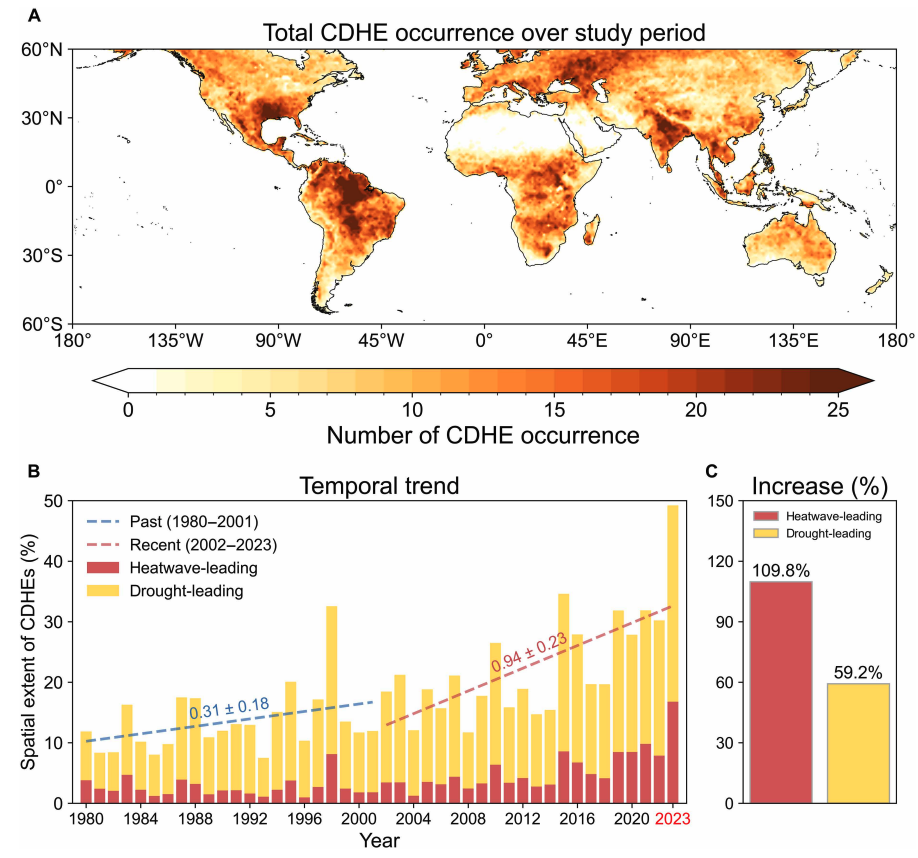
Heatwave-led events have been the main contributor to this increase, the study says, with their spatial extent rising 110% between 1980-2001 and 2002-23, compared to a 59% increase for drought-led events.
The map below shows the global distribution of CDHEs over 1980-2023. The charts show the percentage of the land surface affected by a heatwave-led CDHE (red) or a drought-led CDHE (yellow) in a given year (left) and relative increase in each CDHE type (right).
The study finds that CDHEs have occurred most frequently in northern South America, the southern US, eastern Europe, central Africa and south Asia.
Threshold passed
The authors explain that the increase in heatwave-led CDHEs is related to rising global temperatures, but that this does not tell the whole story.
In the earlier 22-year period of 1980-2001, the study finds that the spatial extent of heatwave-led CDHEs rises by 1.6% per 1C of global temperature rise. For the more-recent period of 2022-23, this increases “nearly eightfold” to 13.1%.
The change suggests that the rapid increase in the heatwave-led CDHEs occurred after the global average temperature “surpasse[d] a certain temperature threshold”, the paper says.
This threshold is an absolute global average temperature of 14.3C, the authors estimate (based on an 11-year average), which the world passed around the year 2000.
Investigating the recent surge in heatwave-leading CDHEs further, the researchers find a “regime shift” in land-atmosphere dynamics “toward a persistently intensified state after the late 1990s”.
In other words, the way that drier soils drive higher surface temperatures, and vice versa, is becoming stronger, resulting in more heatwave-led compound events.
Daily data
The research has some advantages over other previous studies, Yeh says. For instance, the new work uses daily estimations of CDHEs, compared to monthly data used in past research. This is “important for capturing the detailed occurrence” of these events, says Yeh.
He adds that another advantage of their study is that it distinguishes the sequence of droughts and heatwaves, which allows them to “better understand the differences” in the characteristics of CDHEs.
Dr Meryem Tanarhte is a climate scientist at the University Hassan II in Morocco, and Dr Ruth Cerezo Mota is a climatologist and a researcher at the National Autonomous University of Mexico. Both scientists, who were not involved in the study, agree that the daily estimations give a clearer picture of how CDHEs are changing.
Cerezo-Mota adds that another major contribution of the study is its global focus. She tells Carbon Brief that in some regions, such as Mexico and Africa, there is a lack of studies on CDHEs:
“Not because the events do not occur, but perhaps because [these regions] do not have all the data or the expertise to do so.”
However, she notes that the reanalysis data used by the study does have limitations with how it represents rainfall in some parts of the world.
Compound impacts
The study notes that if CDHEs continue to intensify – particularly events where heatwaves are the precursors – they could drive declining crop productivity, increased wildfire frequency and severe public health crises.
These impacts could be “much more rapid and severe as global warming continues”, Yeh tells Carbon Brief.
Tanarhte notes that these events can be forecasted up to 10 days ahead in many regions. Furthermore, she says, the strongest impacts can be prevented “through preparedness and adaptation”, including through “water management for agriculture, heatwave mitigation measures and wildfire mitigation”.
The study recommends reassessing current risk management strategies for these compound events. It also suggests incorporating the sequences of drought and heatwaves into compound event analysis frameworks “to enhance climate risk management”.
Cerezo-Mota says that it is clear that the world needs to be prepared for the increased occurrence of these events. She tells Carbon Brief:
“These [risk assessments and strategies] need to be carried out at the local level to understand the complexities of each region.”



The post Heatwaves driving recent ‘surge’ in compound drought and heat extremes appeared first on Carbon Brief.
Heatwaves driving recent ‘surge’ in compound drought and heat extremes
Greenhouse Gases
DeBriefed 6 March 2026: Iran energy crisis | China climate plan | Bristol’s ‘pioneering’ wind turbine
Welcome to Carbon Brief’s DeBriefed.
An essential guide to the week’s key developments relating to climate change.
This week
Energy crisis
ENERGY SPIKE: US-Israeli attacks on Iran and subsequent counterattacks across the Middle East have sent energy prices “soaring”, according to Reuters. The newswire reported that the region “accounts for just under a third of global oil production and almost a fifth of gas”. The Guardian noted that shipping traffic through the strait of Hormuz, which normally ferries 20% of the world’s oil, “all but ground to a halt”. The Financial Times reported that attacks by Iran on Middle East energy facilities – notably in Qatar – triggered the “biggest rise in gas prices since Russia’s full-scale invasion of Ukraine”.
‘RISK’ AND ‘BENEFITS’: Bloomberg reported on increases in diesel prices in Europe and the US, speculating that rising fuel costs could be “a risk for president Donald Trump”. US gas producers are “poised to benefit from the big disruption in global supply”, according to CNBC. Indian government sources told the Economic Times that Russia is prepared to “fulfil India’s energy demands”. China Daily quoted experts who said “China’s energy security remains fundamentally unshaken”, thanks to “emergency stockpiles and a wide array of import channels”.
‘ESSENTIAL’ RENEWABLES: Energy analysts said governments should cut their fossil-fuel reliance by investing in renewables, “rather than just seeking non-Gulf oil and gas suppliers”, reported Climate Home News. This message was echoed by UK business secretary Peter Kyle, who said “doubling down on renewables” was “essential” amid “regional instability”, according to the Daily Telegraph.
China’s climate plan
PEAK COAL?: China has set out its next “five-year plan” at the annual “two sessions” meeting of the National People’s Congress, including its climate strategy out to 2030, according to the Hong Kong-based South China Morning Post. The plan called for China to cut its carbon emissions per unit of gross domestic product (GDP) by 17% from 2026 to 2030, which “may allow for continued increase in emissions given the rate of GDP growth”, reported Reuters. The newswire added that the plan also had targets to reach peak coal in the next five years and replace 30m tonnes per year of coal with renewables.
ACTIVE YET PRUDENT