

Dr. Stacy Jupiter is the Executive Director of the Wildlife Conservation Society’s Global Marine Program. Melissa Wright is Bloomberg Ocean Initiative Lead at Bloomberg Philanthropies.
For years, the dominant story on coral reefs has been one of inevitable loss, with news headlines focusing on mass bleaching, ecosystem collapse, and catastrophic tipping points. As ocean temperatures continue to rise, many people have come to see the decline of the world’s reefs as unavoidable.
The threats are real and urgent, but new evidence points to a more complicated and useful conclusion: some reefs still have a meaningful chance to survive and recover, provided they are protected.
A major new analysis, published today with the support of Bloomberg Philanthropies, identifies more than 165,000 square kilometers of coral reefs, across 71 countries and 100 territories and jurisdictions, with the strongest potential to withstand and recover from climate impacts.
Drawing on more than 45,000 coral surveys, along with decades of climate and ocean data, the research finds that three times more reefs may be capable of surviving the climate crisis than previously understood. That has major implications for reef-dependent communities, food security, coastal protection, fisheries, tourism, and national economies.
-
Offshore oil and gas expansion threatens key marine ecosystems, report warns
Sea life in countries like Kenya is under threat from planned new oil and gas production, analysis by environmental groups has found -
The Pacific made history in the courts – now we must do it in the negotiations
Legal clarity alone will not lead to reduced emissions, more finance or stronger national climate plans – political will is key to meeting states’ obligations


Essential natural infrastructure for communities
The findings make clear that reefs will not all respond to climate impacts in the same way. Some are located in rare underwater cool spots that can help shield them from extreme heat. Some show greater resistance to bleaching and other climate-related stress. Others recover more quickly after severe disturbances. These differences matter because they show where protection can have the greatest long-term impact.
More than 500 million people depend on reefs for food, livelihoods, and coastal protection. For those communities, climate-resilient reefs are not an abstract conservation priority. They are essential natural infrastructure. They help protect coastlines, sustain fisheries, support local economies, and reduce climate risk. Because ocean currents move coral larvae and marine life between reef systems, some of these reefs may also help regenerate wider reef ecosystems after climate shocks.
This should change how governments, funders, and conservation partners prioritize action.
Climate change remains the greatest long-term threat to coral reefs. At the same time, many of the pressures pushing reefs closer to collapse are immediate and local. Sewage pollution, deforestation, agricultural runoff, destructive fishing practices, and poorly managed coastal development continue to damage reefs that are already under stress. Recent research shows that water pollution and fishing pressure are now among the leading local threats affecting nearly two-thirds of the world’s coral reefs.
These pressures can be reduced. Governments and local partners are already working to improve reef management, cut pollution, strengthen enforcement, and protect critical ecosystems. Those efforts need to move faster, alongside much stronger action to reduce greenhouse gas emissions.
Prioritising climate-resilient reefs
The new maps of climate-resilient reefs give governments, communities, and reef managers a clearer basis for action. They show where reefs have the strongest potential to persist over time, and where protection can deliver the greatest benefits for people, coastlines, and economies.
Right now, only around 28 percent of the identified climate-resilient reefs fall within protected or conserved areas. If these reefs are among the most capable of surviving climate impacts and helping regenerate broader reef systems, they should be prioritized for protection, management, and investment.
The case for action is practical as well as ecological. Healthy reefs can reduce wave energy by up to 97 percent, helping protect coastlines from storms, flooding, and erosion. They support fisheries that feed millions of people, sustain tourism jobs and local economies, and help reduce climate risk for vulnerable coastal communities.
For many families, a healthy reef means food, income, and protection when storms hit. For Indigenous Peoples and coastal communities, reefs are also tied to culture, heritage, identity, and traditional knowledge systems.
Ocean conservation must catch up
Governments are beginning to recognize the urgency of protecting climate-resilient reefs. At last year’s UN Ocean Conference in Nice, 11 countries signed a declaration committing to stronger protection of these reefs, including action to address destructive fishing, pollution, and unsustainable coastal development.
As leaders meet in Kenya this week to discuss the challenges facing the world’s ocean, more governments should join the declaration and help build a broader coalition committed to safeguarding these critical ecosystems.
As coral reefs pass tipping point, ocean protection rises up political agenda
Some countries are already showing what this leadership can look like. Brazil has included corals in its national climate plans. The Bahamas is embedding reef protection into national policy and local stewardship systems. The declaration offers a way to build on these efforts and scale them globally.
But commitments will not be enough. Success will depend on implementation. That means stronger protection and management, reduced local pressures, increased investment, and meaningful support for the Indigenous Peoples and local communities stewarding these ecosystems.
The science is clear. Many reefs still have the capacity to persist and recover. The question is whether policy and investment will move quickly enough to protect them, so they can continue sustaining communities, economies, and coastlines for generations to come.
The post Coral reefs are not doomed – but policy must catch up with the science appeared first on Climate Home News.
Coral reefs are not doomed – but policy must catch up with the science

For the first time, new-energy vehicles (NEVs) made up 67% of new car sales in China in September, according to the latest data from the China Passenger Car Association (CPCA).
The figures show that NEVs, which include battery electric cars and plug-in hybrids, captured a record share of sales, even though fewer were sold than last year.
This is because sales of combustion-engine cars are falling steeply, a trend that the CPCA has attributed to rising petrol prices following the start of the Hormuz crisis.
Indeed, sales of fuel-only cars were down 31% year-on-year in the first nine months of 2026, with plug-in hybrid sales down 26% – whereas battery EV sales were only down 4%.
One analyst tells Carbon Brief that China’s rapidly growing EV fleet has offset demand for 143m barrels of oil since the start of the Hormuz crisis.
Another says that the crisis is “reinforcing China’s electrification of road transport”.
Meanwhile, amid slowing domestic sales, Chinese carmakers’ exports of NEVs more than doubled [in 2026 to date / in September] from a year earlier.
NEV record
A record two out of every three cars sold in September in China were NEVs, according to CPCA data, as shown in the figure below.
(NEVs predominantly include battery electric vehicles – BEVs – and plug-in hybrids – PHEVs. BEVs only run on electricity, whereas PHEVs also have a combustion engine.)
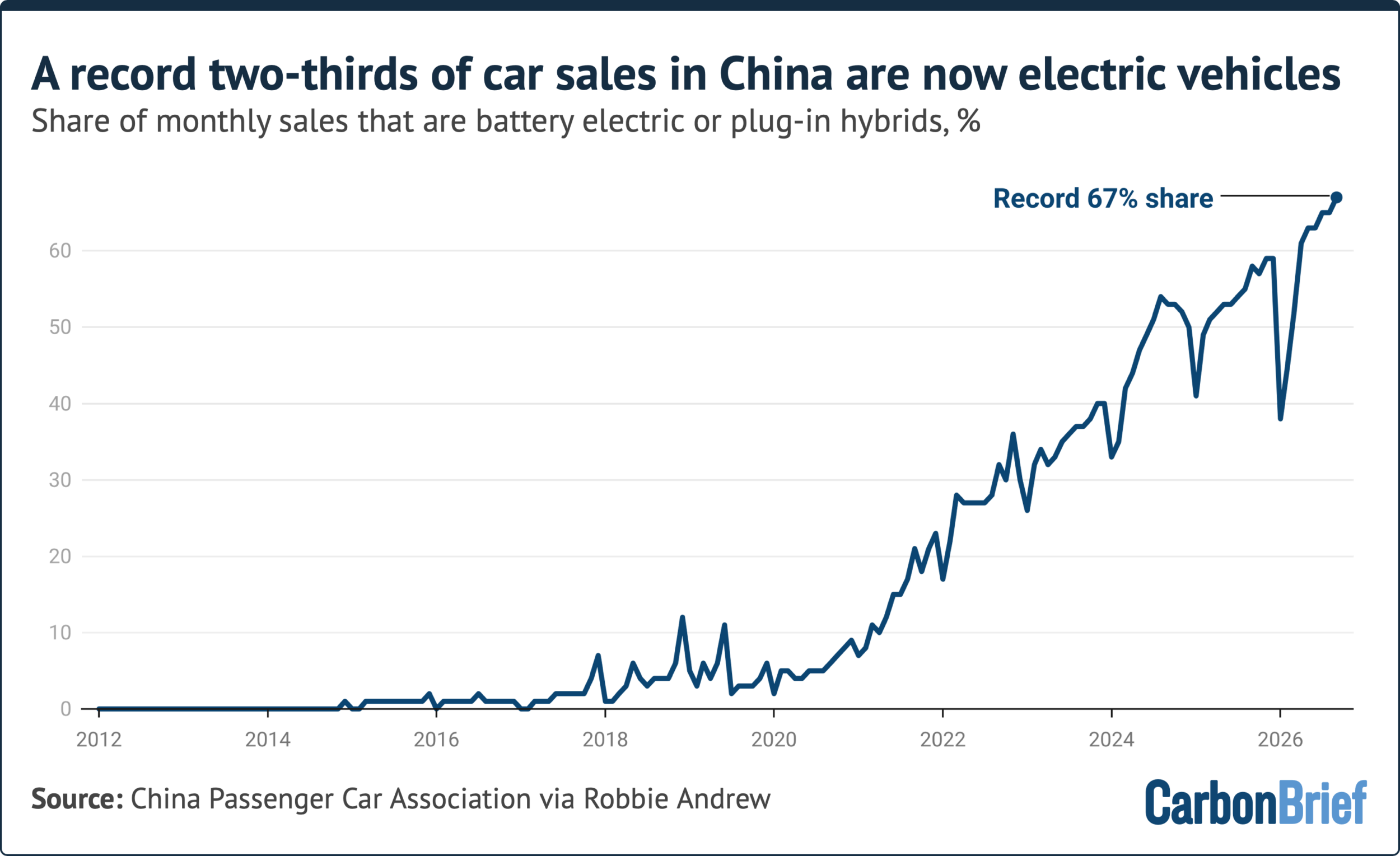
This marks a rapid rise for NEVs from just 6% of new car sales in 2020 up to 58% in 2026 to date – and a record 67% in the month of September.
This year, NEVs’ share of sales has also bounced back from a low of 39% in January, after the full purchase tax exemption that had been in place for more than a decade came to an end in December 2025.
The gain in NEV share in 2026 has come amid a slowdown across the wider domestic passenger-car market, which has hit sales of combustion-engine vehicles particularly hard.
This September, passenger-car retail sales across all categories declined, with overall sales volumes falling 28% year-on-year.
The contraction was led by combustion-engine vehicles, which saw sales fall 43% year-on-year in September and 31% in 2026 to date.
However, sales of PHEVs also fell by 36% year-on-year in September and by 26% in 2026 to date. By comparison, BEVs performed better, although sales still declined 8.5% from a year earlier in September and 4% in 2026 to date.
As a result, NEV sales overall fell by 17% in September and 13% in 2026 to date.
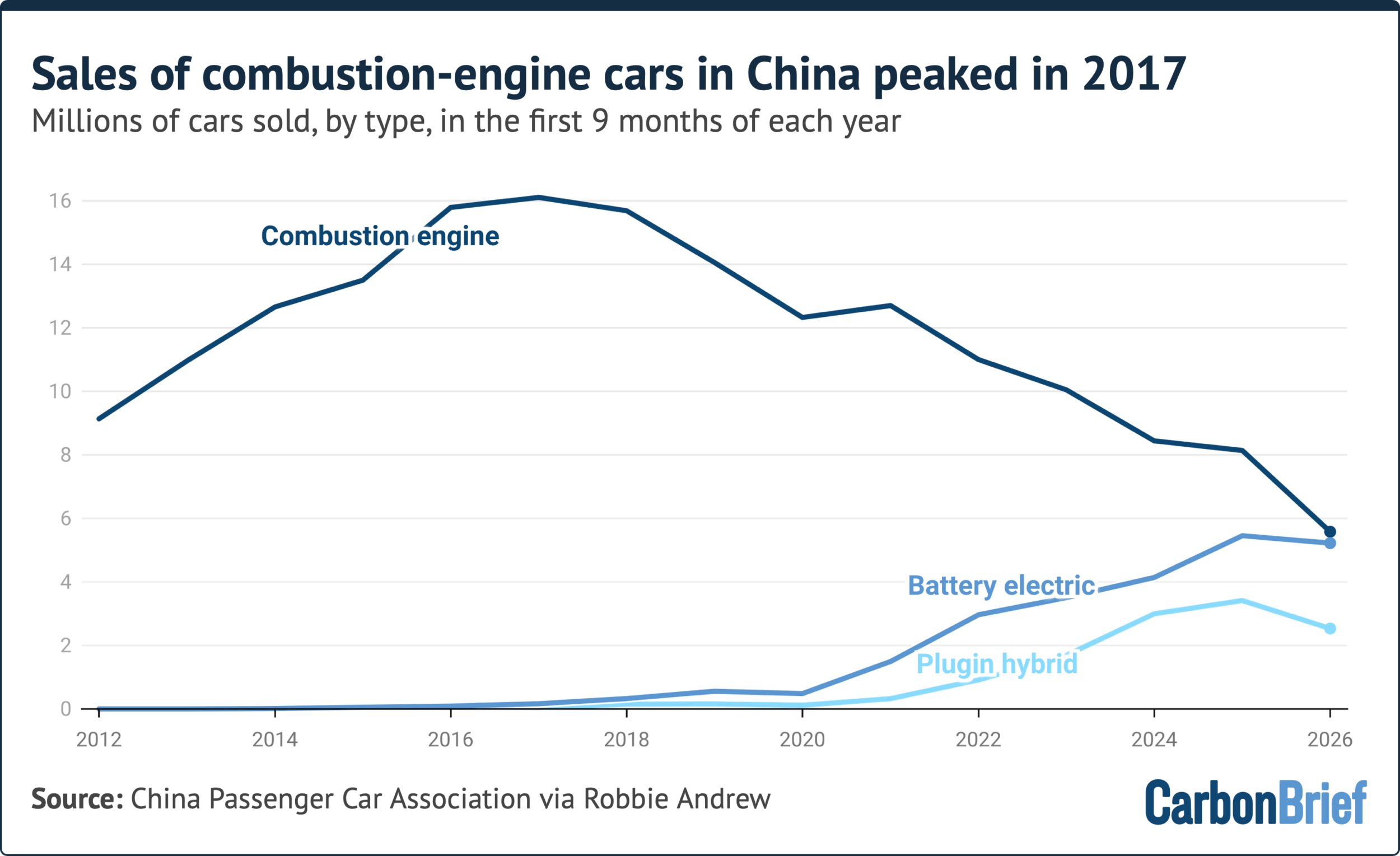
While the market changes in 2026 to date were particularly dramatic, they reflect a broad continuation of trends seen over the past decade.
Indeed, sales of combustion-engine cars in China peaked in 2017 and they have been declining ever since, shown in the figure below.
Impact of Hormuz
Part of the reason for the advance of NEVs in 2026, said Chinese technology news outlet OFweek, was petrol cars “giving up market share” as they were outperformed by electric alternatives.
Cui Dongshu, secretary-general of the CPCA, cited higher petrol prices as an explanation for September’s weak combustion-car sales, in comments to financial news outlet National Business Daily.
Imports of oil into China in January-September have fallen 15% compared to 2025, equivalent to 470m barrels, as ongoing conflict tightened supply and drove up prices.
China’s passenger-car NEV fleet has displaced 143m barrels of oil so far during the strait of Hormuz crisis, Euan Graham, senior energy analyst at thinktank Ember, tells Carbon Brief.
EVs “accounted for 12% of the decrease in China’s oil use post-Hormuz”, according to an estimate provided to thinktank the Brookings Institute by an unnamed analyst.
Erica Downs, a senior research scholar at Columbia University’s Center on Global Energy Policy, tells Carbon Brief that the strait of Hormuz crisis and higher oil prices are “reinforcing China’s electrification of road transport”.
She says the “world’s largest oil supply disruption” vindicates China’s early bet on EVs, which was partly driven by concerns about oil-supply security.
NEV demand down
Nevertheless, NEV sales have fallen year-on-year, albeit at a slower rate than overall car sales. The growth in NEV market share has also been decelerating.
Zhang Yichao, a partner at consulting firm AlixPartners, tells Carbon Brief that NEVs benefit from government trade-in policies and a “strong pipeline” of new models, particularly those involving innovation.
He says these factors help explain why NEVs sales have fallen at a slower rate to their combustion-car counterparts.
Cui told the state-run China National Radio that the fall for NEVs and for cars overall in September 2026, is also due to a high baseline of sales from the same month in 2025, as well as changes to trade-in policies and disruptions from the holiday period.
Other factors, says consulting firm Wood Mackenzie, are the weakened demand due to “demand pull-forward” in 2025 caused by the end of subsidies, as well as “tighter financing conditions”.
Zhang tells Carbon Brief he does not “see much more room ahead” for further growth in NEVs’ market share.
He adds that, in his view, their share in China is unlikely to exceed 80%, as some premium-market segments and specific use cases will continue to require combustion-engine vehicles.
Exports surge
Meanwhile, while domestic NEV retail sales fell 17% in September 2026, exports more than doubled, increasing 164% year-on-year, according to the CPCA.
This extends the decline in domestic sales and very strong growth in exports seen across 2026 to date, as shown in the figure below.