

Welcome to Carbon Brief’s DeBriefed.
An essential guide to the week’s key developments relating to climate change.
This week
Deadly floods in Asia
MOUNTING DEVASTATION: The Associated Press reported that the death toll from catastrophic floods in south-east Asia had reached 1,500, with Indonesia, Sri Lanka and Thailand most affected and hundreds still missing. The newswire said “thousands” more face “severe” food and clean-water shortages. Heavy rains and thunderstorms are expected this weekend, it added, with “saturated soil and swollen rivers leaving communities on edge”. Earlier in the week, Bloomberg said the floods had caused “at least $20bn in losses”.
CLIMATE CHANGE LINKS: A number of outlets have investigated the links between the floods and human-caused climate change. Agence France-Presse explained that climate change was “producing more intense rain events because a warmer atmosphere holds more moisture and warmer oceans can turbocharge storms”. Meanwhile, environmental groups told the Associated Press the situation had been exacerbated by “decades of deforestation”, which had “stripped away natural defenses that once absorbed rainfall and stabilised soil”.
‘NEW NORMAL’: The Associated Press quoted Malaysian researcher Dr Jemilah Mahmood saying: “South-east Asia should brace for a likely continuation and potential worsening of extreme weather in 2026 and for many years.” Al Jazeera reported that the International Federation of Red Cross and Red Crescent Societies had called for “stronger legal and policy frameworks to protect people in disasters”. The organisation’s Asia-Pacific director said the floods were a “stark reminder that climate-driven disasters are becoming the new normal”, the outlet said.
Around the world
- REVOKED: The UK and Netherlands withdrew $2.2bn of financial backing from a controversial liquified natural gas (LNG) project in Mozambique, Reuters reported. The Guardian noted that TotalEnergies’ “giant” project stood accused of “fuelling the climate crisis and deadly terror attacks”.
- REVERSED: US president Donald Trump announced plans to “significantly weaken” Biden-era fuel efficiency requirements for cars, the New York Times said.
- RESTRICTED: EU leaders agreed to ban the import of Russian gas from autumn 2027, the Financial Times reported. Meanwhile, Reuters said it is “likely” the European Commission will delay announcing a plan on auto sector climate targets next week, following pressure to “weaken” a 2035 cut-off for combustion engines.
- RETRACTED: An influential Nature study that looked at the economic consequences of climate change has been withdrawn after “criticism from peers”, according to Bloomberg. [The research came second in Carbon Brief’s ranking of the climate papers most covered by the media in 2024.]
- REBUKED: The federal government of Canada faced a backlash over an oil pipeline deal struck last week with the province of Alberta. CBC News noted that First Nations chiefs voted “unanimously” to demand the withdrawal of the deal and Canada’s National Observer quoted author Naomi Klein as saying that the prime minister was “completely trashing Canada’s climate commitments”.
- RESCHEDULED: The Indonesian government has cancelled plans to close a coal plant seven years early, Bloomberg reported. Meanwhile, Bloomberg separately reported that India is mulling an “unprecedented increase” in coal-power capacity that could see plants built “until at least 2047”.
$518 billion a year
The projected coastal flood damages for the Asia-Pacific region by 2100 if current policies continue, according to a Scientific Reports study covered this week by Carbon Brief.
Latest climate research
- More than 100 “climate-sensitive rivers” worldwide are experiencing “large and severe changes in streamflow volume and timing” | Environmental Research Letters
- Africa’s forests have switched from a carbon sink into a source | Scientific Reports
- Increasing urbanisation can “substantially intensify warming”, contributing up to 0.44C of additional temperature rise per year through 2060 | Communications Earth & Environment
(For more, see Carbon Brief’s in-depth daily summaries of the top climate news stories on Monday, Tuesday, Wednesday, Thursday and Friday.)
Captured
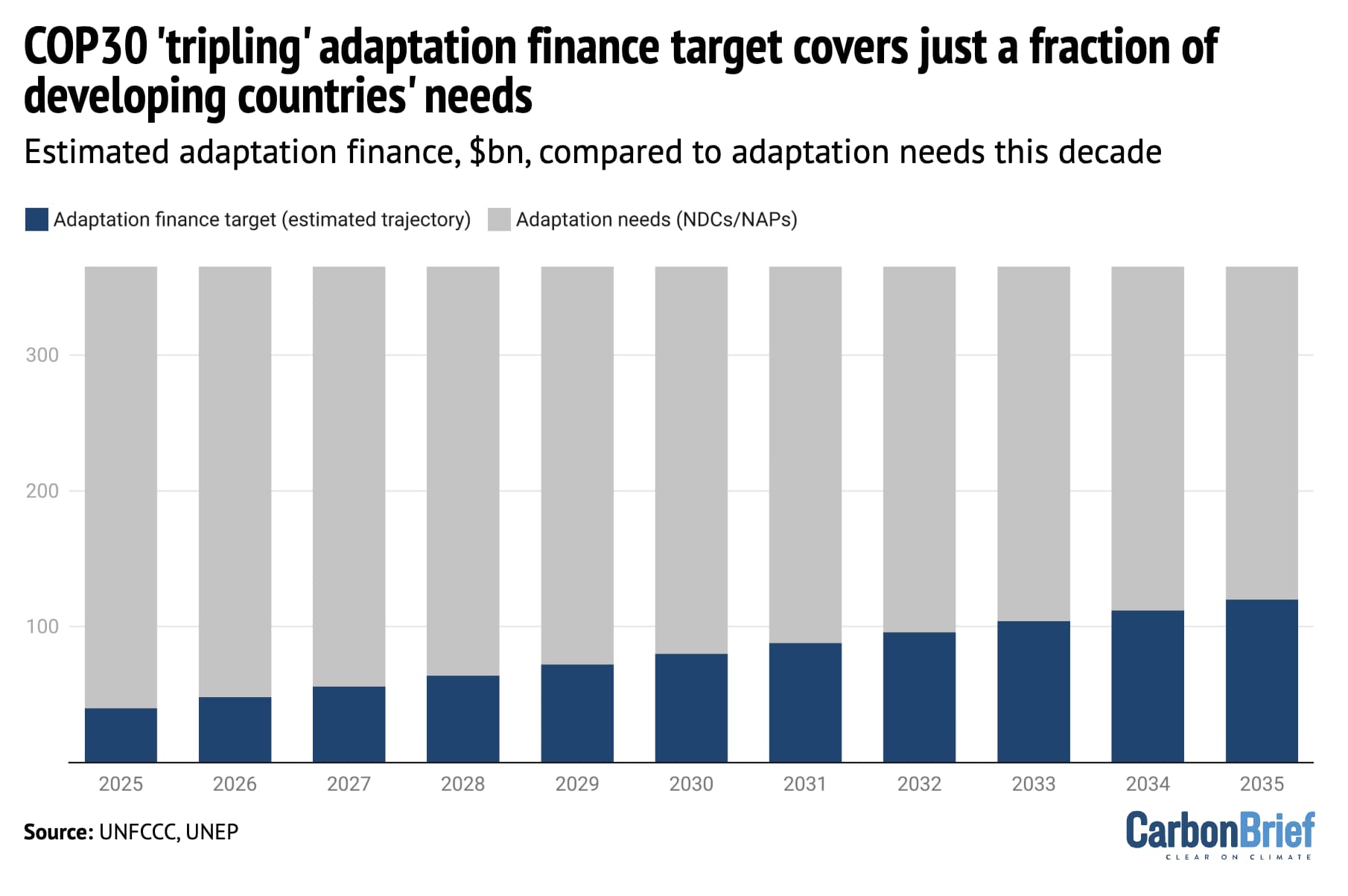
A new target for developed nations to triple adaptation finance by 2035, agreed at the COP30 climate summit, would not cover more than a third of developing countries’ estimated needs, Carbon Brief analysis showed. The chart above compares a straight line to meeting the adaptation finance target (blue), alongside an estimate of countries’ adaptation needs (grey), which was calculated using figures from the latest UN Environmental Programme adaptation gap report, which were based on countries’ UN climate plans (called “nationally determined contributions” or NDCs) and national adaptation plans (NAPs).
Spotlight
Inclusivity at the IPCC
This week, Carbon Brief speaks to an IPCC lead author researching ways to improve the experience of global south scientists taking part in producing the UN climate body’s assessments.
Hundreds of climate scientists from around the world met in Paris this week to start work on the Intergovernmental Panel on Climate Change’s (IPCC’s) newest set of climate reports.
The IPCC is the UN body responsible for producing the world’s most authoritative climate science reports. Hundreds of scientists from across the globe contribute to each “assessment cycle”, which sees researchers aim to condense all published climate science over several years into three “working group” reports.
The reports inform the decisions of governments – including at UN climate talks – as well as the public understanding of climate change.
The experts gathering in Paris are the most diverse group ever convened by the IPCC.
Earlier this year, Carbon Brief analysis found that – for the first time in an IPCC cycle – citizens of the global south make up 50% of authors of the three working group reports. The IPCC has celebrated this milestone, with IPCC chair Prof Jim Skea touting the seventh assessment report’s (AR7’s) “increased diversity” in August.
But some IPCC scientists have cautioned that the growing involvement of global south scientists does not translate into an inclusive process.
“What happens behind closed doors in these meeting rooms doesn’t necessarily mirror what the diversity numbers say,” Dr Shobha Maharaj, a Trinidadian climate scientist who is a coordinating lead author for working group two (WG2) of AR7, told Carbon Brief.
Global south perspective
Motivated by conversations with colleagues and her own “uncomfortable” experience working on the small-islands chapter of the sixth assessment cycle (AR6) WG2 report, Maharaj – an adjunct professor at the University of Fiji – reached out to dozens of fellow contributors to understand their experience.
The exercise, she said, revealed a “dominance of thinking and opinions from global north scientists, whereas the global south scientists – the scientists who were people of colour – were generally suppressed”.
The perspectives of scientists who took part in the survey and future recommendations for the IPCC are set out in a peer-reviewed essay – co-authored by 20 researchers – slated for publication in the journal PLOS Climate. (Maharaj also presented the findings to the IPCC in September.)
The draft version of the essay notes that global south scientists working on WG2 in AR6 said they confronted a number of diversity, equity and inclusion (DEI) issues, including “skewed” author selection, “unequal” power dynamics and a “lack of respect and trust”. The researchers also pointed to logistical constraints faced by global south authors, such as visa issues and limited access to journals.
The anonymous quotations from more than 30 scientists included in the essay, Maharaj said, are “clear data points” that she believes can advance a discussion about how to make academia more inclusive.
“The literature is full of the problems that people of colour or global south authors have in academia, but what you don’t find very often is quotations – especially from climate scientists,” she said. “We tend to be quite a conservative bunch.”
Road to ‘improvement’
Among the recommendations set out in the essay are for DEI training, the appointment of a “diversity and inclusion ombudsman” and for updated codes of conduct.
Marharaj said that these “tactical measures” need to occur alongside “transformative approaches” that help “address value systems, dismantle power structures [and] change the rules of participation”.
With drafting of the AR7 reports now underway, Maharaj said she is “hopeful” the new cycle can be an improvement on the last, pointing to a number of “welcome” steps from the IPCC.
This includes holding the first-ever expert meeting on DEI this autumn, new mechanisms where authors can flag concerns and the recruitment of a “science and capacity officer” to support WG2 authors.
The hope, Maharaj explained, is to enhance – not undermine – climate science.
“The idea here was to move forward and to improve the IPCC, rather than attack it,” she said. “Because we all love the science – and we really value what the IPCC brings to the world.”
Watch, read, listen
BROKEN PROMISES: Climate Home News spoke to communities in Nigeria let down by the government’s failure to clean up oil spills by foreign companies.
‘WHEN A ROAD GOES WRONG’: Inside Climate News looked at how a new road from Brazil’s western Amazon to Peru has become a “conduit for rampant deforestation and illegal gold mining”.
SHADOWY COURTS: In the Guardian, George Monbiot lamented the rise of investor-state dispute settlements, which he described as “undemocratic offshore tribunals” that are already having a “chilling effect” on countries’ climate ambitions.
Coming up
- 1-12 December: UN Environment Assembly 7, Nairobi, Kenya
- 7 December: Hong Kong legislative elections
- 11 December: Falkland Islands legislative assembly elections
Pick of the jobs
- Greenpeace International, engagement manager – climate and energy | Salary: Unknown. Location: Various
- The Energy, newsletter editor | Salary: Unknown. Location: Australia (remote)
- University of Groningen, PhD position in motivating people to contribute to societal transitions | Salary: €3,059-€3,881 per month. Location: Groningen, the Netherlands
DeBriefed is edited by Daisy Dunne. Please send any tips or feedback to debriefed@carbonbrief.org.
This is an online version of Carbon Brief’s weekly DeBriefed email newsletter. Subscribe for free here.


The post DeBriefed 5 December: Deadly Asia floods; Adaptation finance target examined; Global south IPCC scientists speak out appeared first on Carbon Brief.

Drought and heatwaves occurring together – known as “compound” events – have “surged” across the world since the early 2000s, a new study shows.
Compound drought and heat events (CDHEs) can have devastating effects, creating the ideal conditions for intense wildfires, such as Australia’s “Black Summer” of 2019-20 where bushfires burned 24m hectares and killed 33 people.
The research, published in Science Advances, finds that the increase in CDHEs is predominantly being driven by events that start with a heatwave.
The global area affected by such “heatwave-led” compound events has more than doubled between 1980-2001 and 2002-23, the study says.
The rapid increase in these events over the last 23 years cannot be explained solely by global warming, the authors note.
Since the late 1990s, feedbacks between the land and the atmosphere have become stronger, making heatwaves more likely to trigger drought conditions, they explain.
One of the study authors tells Carbon Brief that societies must pay greater attention to compound events, which can “cause severe impacts on ecosystems, agriculture and society”.
Compound events
CDHEs are extreme weather events where drought and heatwave conditions occur simultaneously – or shortly after each other – in the same region.
These events are often triggered by large-scale weather patterns, such as “blocking” highs, which can produce “prolonged” hot and dry conditions, according to the study.
Prof Sang-Wook Yeh is one of the study authors and a professor at the Ewha Womans University in South Korea. He tells Carbon Brief:
“When heatwaves and droughts occur together, the two hazards reinforce each other through land-atmosphere interactions. This amplifies surface heating and soil moisture deficits, making compound events more intense and damaging than single hazards.”
CDHEs can begin with either a heatwave or a drought.
The sequence of these extremes is important, the study says, as they have different drivers and impacts.
For example, in a CDHE where the heatwave was the precursor, increased direct sunshine causes more moisture loss from soils and plants, leading to a drought.
Conversely, in an event where the drought was the precursor, the lack of soil moisture means that less of the sun’s energy goes into evaporation and more goes into warming the Earth’s surface. This produces favourable conditions for heatwaves.
The study shows that the majority of CDHEs globally start out as a drought.
In recent years, there has been increasing focus on these events due to the devastating impact they have on agriculture, ecosystems and public health.
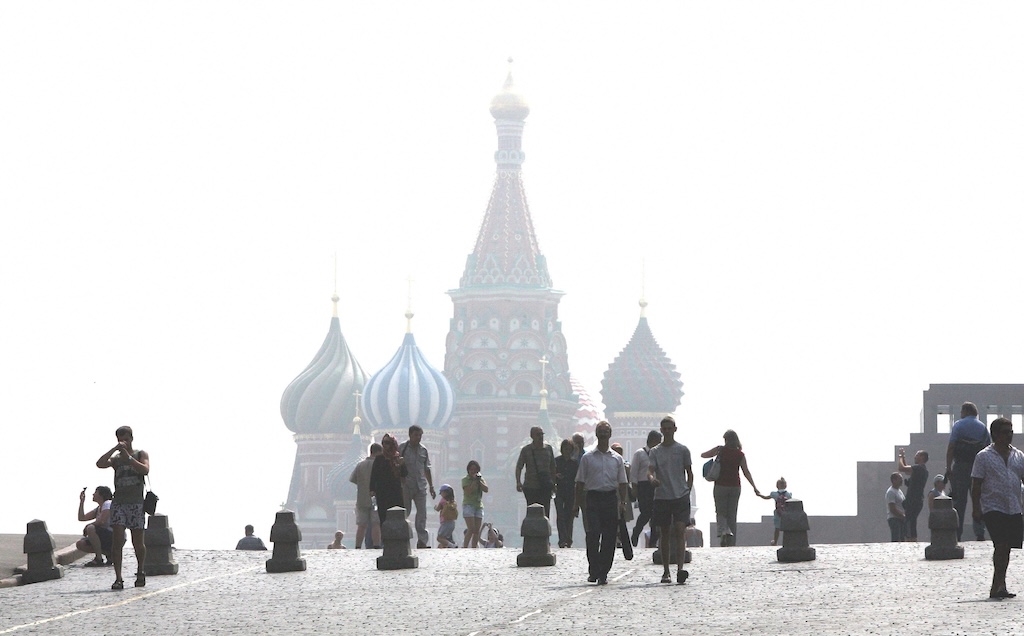
In Russia in the summer of 2010, a compound drought-heatwave event – and the associated wildfires – caused the death of nearly 55,000 people, the study notes.
The record-breaking Pacific north-west “heat dome” in 2021 triggered extreme drought conditions that caused “significant declines” in wheat yields, as well as in barley, canola and fruit production in British Columbia and Alberta, Canada, says the study.
Increasing events
To assess how CDHEs are changing, the researchers use daily reanalysis data to identify droughts and heatwaves events. (Reanalysis data combines past observations with climate models to create a historical climate record.) Then, using an algorithm, they analyse how these events overlap in both time and space.
The study covers the period from 1980 to 2023 and the world’s land surface, excluding polar regions where CDHEs are rare.
The research finds that the area of land affected by CDHEs has “increased substantially” since the early 2000s.
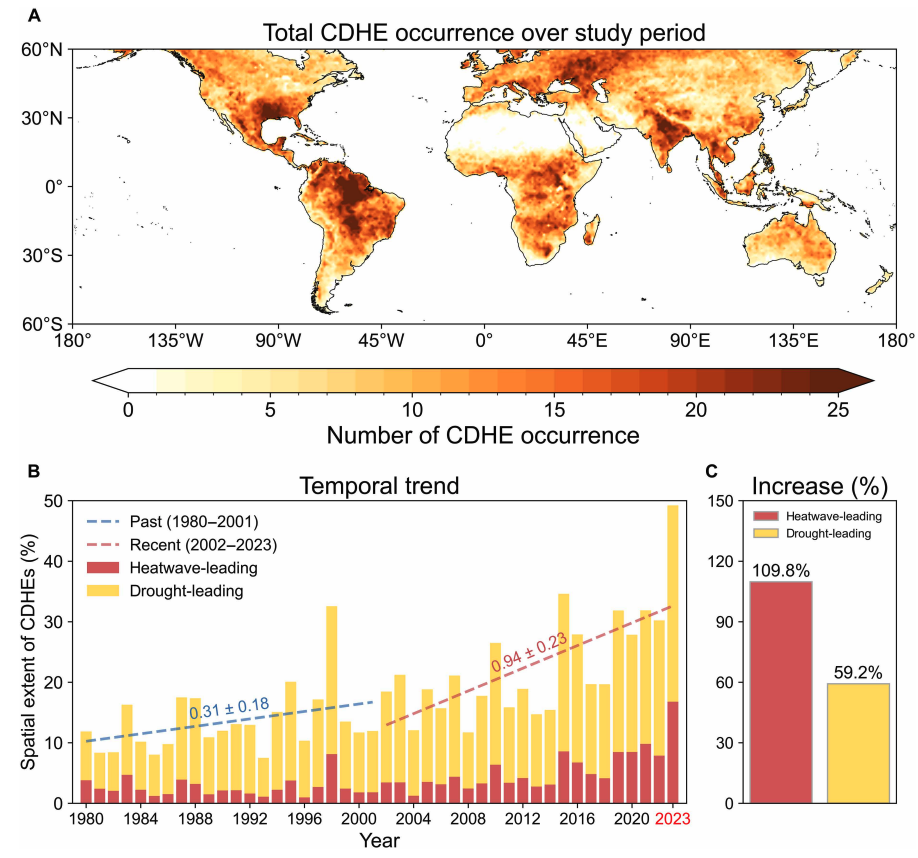
Heatwave-led events have been the main contributor to this increase, the study says, with their spatial extent rising 110% between 1980-2001 and 2002-23, compared to a 59% increase for drought-led events.
The map below shows the global distribution of CDHEs over 1980-2023. The charts show the percentage of the land surface affected by a heatwave-led CDHE (red) or a drought-led CDHE (yellow) in a given year (left) and relative increase in each CDHE type (right).
The study finds that CDHEs have occurred most frequently in northern South America, the southern US, eastern Europe, central Africa and south Asia.
Threshold passed
The authors explain that the increase in heatwave-led CDHEs is related to rising global temperatures, but that this does not tell the whole story.
In the earlier 22-year period of 1980-2001, the study finds that the spatial extent of heatwave-led CDHEs rises by 1.6% per 1C of global temperature rise. For the more-recent period of 2022-23, this increases “nearly eightfold” to 13.1%.
The change suggests that the rapid increase in the heatwave-led CDHEs occurred after the global average temperature “surpasse[d] a certain temperature threshold”, the paper says.
This threshold is an absolute global average temperature of 14.3C, the authors estimate (based on an 11-year average), which the world passed around the year 2000.
Investigating the recent surge in heatwave-leading CDHEs further, the researchers find a “regime shift” in land-atmosphere dynamics “toward a persistently intensified state after the late 1990s”.
In other words, the way that drier soils drive higher surface temperatures, and vice versa, is becoming stronger, resulting in more heatwave-led compound events.
Daily data
The research has some advantages over other previous studies, Yeh says. For instance, the new work uses daily estimations of CDHEs, compared to monthly data used in past research. This is “important for capturing the detailed occurrence” of these events, says Yeh.
He adds that another advantage of their study is that it distinguishes the sequence of droughts and heatwaves, which allows them to “better understand the differences” in the characteristics of CDHEs.
Dr Meryem Tanarhte is a climate scientist at the University Hassan II in Morocco, and Dr Ruth Cerezo Mota is a climatologist and a researcher at the National Autonomous University of Mexico. Both scientists, who were not involved in the study, agree that the daily estimations give a clearer picture of how CDHEs are changing.
Cerezo-Mota adds that another major contribution of the study is its global focus. She tells Carbon Brief that in some regions, such as Mexico and Africa, there is a lack of studies on CDHEs:
“Not because the events do not occur, but perhaps because [these regions] do not have all the data or the expertise to do so.”
However, she notes that the reanalysis data used by the study does have limitations with how it represents rainfall in some parts of the world.
Compound impacts
The study notes that if CDHEs continue to intensify – particularly events where heatwaves are the precursors – they could drive declining crop productivity, increased wildfire frequency and severe public health crises.
These impacts could be “much more rapid and severe as global warming continues”, Yeh tells Carbon Brief.
Tanarhte notes that these events can be forecasted up to 10 days ahead in many regions. Furthermore, she says, the strongest impacts can be prevented “through preparedness and adaptation”, including through “water management for agriculture, heatwave mitigation measures and wildfire mitigation”.
The study recommends reassessing current risk management strategies for these compound events. It also suggests incorporating the sequences of drought and heatwaves into compound event analysis frameworks “to enhance climate risk management”.
Cerezo-Mota says that it is clear that the world needs to be prepared for the increased occurrence of these events. She tells Carbon Brief:
“These [risk assessments and strategies] need to be carried out at the local level to understand the complexities of each region.”



The post Heatwaves driving recent ‘surge’ in compound drought and heat extremes appeared first on Carbon Brief.
Heatwaves driving recent ‘surge’ in compound drought and heat extremes
Greenhouse Gases
DeBriefed 6 March 2026: Iran energy crisis | China climate plan | Bristol’s ‘pioneering’ wind turbine
Welcome to Carbon Brief’s DeBriefed.
An essential guide to the week’s key developments relating to climate change.
This week
Energy crisis
ENERGY SPIKE: US-Israeli attacks on Iran and subsequent counterattacks across the Middle East have sent energy prices “soaring”, according to Reuters. The newswire reported that the region “accounts for just under a third of global oil production and almost a fifth of gas”. The Guardian noted that shipping traffic through the strait of Hormuz, which normally ferries 20% of the world’s oil, “all but ground to a halt”. The Financial Times reported that attacks by Iran on Middle East energy facilities – notably in Qatar – triggered the “biggest rise in gas prices since Russia’s full-scale invasion of Ukraine”.
‘RISK’ AND ‘BENEFITS’: Bloomberg reported on increases in diesel prices in Europe and the US, speculating that rising fuel costs could be “a risk for president Donald Trump”. US gas producers are “poised to benefit from the big disruption in global supply”, according to CNBC. Indian government sources told the Economic Times that Russia is prepared to “fulfil India’s energy demands”. China Daily quoted experts who said “China’s energy security remains fundamentally unshaken”, thanks to “emergency stockpiles and a wide array of import channels”.
‘ESSENTIAL’ RENEWABLES: Energy analysts said governments should cut their fossil-fuel reliance by investing in renewables, “rather than just seeking non-Gulf oil and gas suppliers”, reported Climate Home News. This message was echoed by UK business secretary Peter Kyle, who said “doubling down on renewables” was “essential” amid “regional instability”, according to the Daily Telegraph.
China’s climate plan
PEAK COAL?: China has set out its next “five-year plan” at the annual “two sessions” meeting of the National People’s Congress, including its climate strategy out to 2030, according to the Hong Kong-based South China Morning Post. The plan called for China to cut its carbon emissions per unit of gross domestic product (GDP) by 17% from 2026 to 2030, which “may allow for continued increase in emissions given the rate of GDP growth”, reported Reuters. The newswire added that the plan also had targets to reach peak coal in the next five years and replace 30m tonnes per year of coal with renewables.
ACTIVE YET PRUDENT: Bloomberg described the new plan as “cautious”, stating that it “frustrat[es] hopes for tighter policy that would drive the nation to peak carbon emissions well before president Xi Jinping’s 2030 deadline”. Carbon Brief has just published an in-depth