- Subscribe to Sustainability In Your Ear on iTunes
- Follow Sustainability In Your Ear on Spreaker, iHeartRadio, or YouTube
Interview Transcript
Mitch Ratcliffe 0:10
Hello. Good morning, good afternoon, or good evening, wherever you are in this beautiful planet of ours. Welcome to Sustainability in Your Ear. This is the podcast conversation about accelerating the transition to a sustainable, carbon-neutral society, and I’m your host, Mitch Ratcliffe. Thanks for joining the conversation today, and it’s one I particularly enjoy — talking to a young person. Well, actually, two of them, making a positive impact.
Textile waste has become one of the most stubborn problems in the American waste stream. Americans throw away roughly 17 million tons of clothing every year, and a great majority of it ends up buried in landfills, where natural fibers slowly decompose and release methane — a greenhouse gas many times more potent than carbon dioxide. Over a century, as things break down in a landfill, clothing is uniquely wasteful, because so much of what gets discarded is still perfectly usable, and it’s simply been outgrown, or it’s gone out of style, or fallen out of someone’s rotation.
And the environmental cost we pay is paid twice: once when a still-good garment is thrown away, and again when a brand-new one is manufactured to replace it, consuming water, energy, and raw materials in the process. And nowhere is that double cost more visible than with children’s school uniforms. Kids outgrow them on a predictable annual cycle, long before the clothing wears out. And for families on a tight budget, replacing a uniform every year is a recurring expense that arrives whether the household can afford it or not.
The result is a steady stream of good clothing headed for the trash and a parallel stream of families struggling to pay for its replacement — two problems that, looked at the right way, turn out to be each other’s solution. And our guests today saw that connection when they were still in middle school.
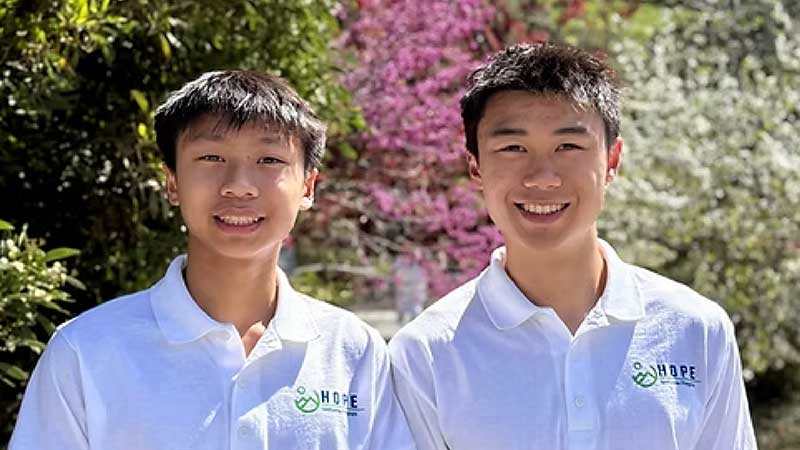
Ethan and Desmond Hua are the founders of HOPE — H-O-P-E — the HOPE Uniforms Program. HOPE stands for Help Our Planet Earth, a student-led nonprofit that they launched in 2020 in San Mateo, California. The idea was simple: collect gently used school uniforms that families had outgrown and redistribute them for free to families who need them.
What began in a single elementary school run out of the family garage has grown into an operation serving 10 schools across three districts, and to date, HOPE has kept more than 14,000 uniforms out of landfills, redistributed over 12,000 of them back to families, and served more than 1,400 households, saving those families an estimated $141,000 in clothing costs along the way.
The spark, as Ethan has said, was a single moment: a classmate came to school in shorts on a cold day because he couldn’t afford another pair of pants to last until laundry day. And from that, Ethan and Desmond built something with real operational sophistication — an online request system with a live inventory tracker, and a website in English, Spanish, and Mandarin Chinese to reach every corner of his multilingual community. They’ve since secured a donation of 2,000 brand-new uniforms from Costco, and their work has earned Ethan a 2025 Gloria Barron Prize for Young Heroes, a Samaritan House Young Samaritan Award, and coverage on national television.
So we’re going to talk with Ethan and Desmond about what started it all, why reuse is one of the most underrated tools in the sustainability toolkit, and the environmental case for keeping a garment whole and in circulation rather than recycling or replacing it. We’ll dig into how they built a real logistics operation as teenagers and why they made the program multilingual from the start, as well as how they designed it so that asking for help feels routine rather than uncomfortable. And we’ll look ahead at what’s next for HOPE, and what they’d tell any listener sitting on an idea but waiting for money, permission, or someone else to go first.
So, to learn more, visit hopeuniformsprogram.com. That’s all one word, no space, no dash — hopeuniformsprogram.com. And if you’re a teen making a difference for the planet, check out the Barron Prize at barronprize.org. Again, all one word, no space, no dash — barronprize.org — to learn how to enter your work for recognition by the Gloria Barron Prize program.
Can a teenager with a garage, a good idea, and a little persistence really make a dent in two of our most intractable problems at once — textile waste and the cost of raising a family? Let’s find out, right after this.
Mitch Ratcliffe 4:30
Welcome to the show, Ethan and Desmond. Hey, introduce yourselves so people can recognize the difference.
Ethan Hua 4:42
Hi, I’m Ethan. I just graduated as a senior.
Desmond Hua 4:46
My name is Desmond, and I just finished my freshman year at Aragon High School.
Ethan Hua 4:51
And we’re the co-founders of the HOPE Uniforms Program, HOPE standing for Help Our Planet Earth.
Mitch Ratcliffe 4:56
You guys have done some amazing work already, and I just want to start off by — tell me about how this started. You saw a classmate come to school in shorts, and it was a cold day, and he was wearing them because they couldn’t afford a pair of pants until laundry day. What went through your mind, and how did you come to the conclusion, “I can solve that problem”?
Desmond Hua 5:13
Well, I guess what went through our minds was that when we were in elementary school, when we saw our friends, we realized that we outgrow so much clothes ourselves when we grew up, and we wondered, what do we do with them when we outgrow them? So when we went — how do…
Ethan Hua 5:27
…they go?
Desmond Hua 5:28
Yeah, like to—
Ethan Hua 5:29
Narnia. Like, some place.
Desmond Hua 5:33
Yeah. So when we went home, we talked to our parents, and we asked them, where does our clothes go? And they said we used to just throw them away, don’t usually have a better purpose. So me and my brother wanted to give them a new life, something to reuse those uniforms, and so we actually founded HOPE around five years ago.
Ethan Hua 5:54
One of the biggest travesties that we saw in these uniforms is that they’re very reusable, they’re gently used, there’s nothing wrong with them, and it’s a shame that, with this little time that we spent with the uniform, they’re going thrown away — when they’re able to be perfectly used and given a second life. In fact, we tell that these uniforms not only have a second life in them, but a third life and a fourth life as well, and because of that, it just seemed like a shame to be tossed away after one single use.
Mitch Ratcliffe 6:23
You picked the name “Help Our Planet Earth,” but this program obviously does something else. It helps families just as much as the planet. Which did you really feel like was the right focus at the time you launched?
Desmond Hua 6:34
I think the main focus at first was our community, because we, you know, grew up in the elementary school. But then at the same time our mission was also helping the earth, because this cause not only impacted the community, but also took out over 40 tons of textile waste from the landfills — 40 metric tons of textile waste, or 30, 30 metric tons of textile waste out of the landfills. So we wanted to cover both aspects while we’re doing HOPE.
Ethan Hua 7:06
So yes — when we first addressed this problem, the community, it was based on a problem that we experienced, that we witnessed from peers. However, we did act, because we’re Scouts, and we’ve been part of the Scouting program since kindergarten, so we have a lot of sustainability virtues instilled in us, like Leave No Trace principles, and we thought that there’s something we can give back to the environment.
Mitch Ratcliffe 7:33
Clothing reuse, thrift shopping, is a big deal these days. Is clothing reuse gaining traction? Is it becoming cool to say these clothes are being reused? Or is that still a point of resistance in people who you might give a uniform to?
Ethan Hua 7:48
I think that there’s, in the youth, there’s a little disparity, but I guess between the youth and the more grown-up adults. We live — me and Desmond live — 10 minutes away from San Francisco, and some people don’t know this, but San Francisco is one of the thrifting capitals of the nation, and because of that, it’s very trendy. I thrift. A lot of kids love thrifting as a hobby; it’s something fun to do on the weekends, so there’s nothing wrong with thrifting. However, there are certain stigmas surrounding getting used clothes, and it’s understandable.
However, to combat that, what we do is, once we get our donations from the community, we process them, we check them for any rips, stains, tears, make sure they’re gently used. We want these families to have — we want these uniforms to have — many, many lives, not just one life or two. We’re in for the long, the long sustainable impact, long-term impact. Because of that, we check them, and what we pride ourselves in is ensuring that our families are repeat customers.
So we get all our uniforms from families all across the community — we get them from families who no longer need to use their uniforms — so we receive them through donation bins in each of our partner schools’ offices. We drop them off in these wooden bins that we’ve built, and then once we take these uniforms back, we process them, we do the check, as I said. And on our website, a family would request, okay, I need three articles of size-medium white polo tops. And our website is multilingual, because we serve a very diverse customer base across the community, across the Bay Area.
And on these websites we see, okay, this family at so-and-so school needs this amount of uniforms at this size. Let’s go check our inventory — a spreadsheet of all the uniforms we have in our inventory. Currently, we have roughly 2,000; it’s all sitting in our garage. And then we refill this order, we put it in the bag, we drop it off to the school, and these families would receive them. And, say, it’s probably six months down the line, hopefully: they wear the uniforms, they take good care of them, and they outgrow them, and at this point they’re back at stage one. The family goes, “Hey, at least out of four, I have these uniforms that they’ve outgrown — what do I do with them?” And they send it back to us.
So because of that, we want to make sure these uniforms are kept very nice, they’ve been spot-checked, so the families are happy with their services and they will reuse us in the future, thereby forming an eco-friendly cycle — a long-term sustainability impact.
Mitch Ratcliffe 10:31
So, by getting them involved in the return process too, you’re also reinforcing the value of reuse, and that makes it feel more normal to them to get what would, in earlier generations, be described as hand-me-downs. Does that activation of their concern about the planet play a big part in that messaging?
Ethan Hua 10:49
We try to include that message — we do include that messaging in all our announcements. That’s one of our main selling points. However, it’s hard to beat the word “free” when it comes to advertising to the community, especially when it’s across different cultures or languages — Spanish, Chinese, and English. It’s a lot more direct to say, hey, we have free uniforms that are reused through our program, and it’s a really cool benefit that we prevent them from going to landfills. One of our most proud statistics, actually — Des, you might want to share the statistics. Yeah, okay. So the reason why I’m sharing this with you is that, since inception, we have diverted roughly 14,900 garments from landfills and given back out to the community roughly 12,700 uniforms. Desmond, do you want to share our most proud statistics that sprung up from that?
Desmond Hua 11:45
So I think we’ve roughly also helped around 1,400 families, and we’ve also saved families around $140,000 through uniforms, so they don’t have to keep buying uniforms over and over as they grow up. Also, the methane equivalent to carbon emissions is around 3,000 kilograms, and, as I said, the 30 metric tons is saved from the landfills through HOPE’s Uniform Program, and those are some of our proudest statistics.
Ethan Hua 12:16
When we — so this is our message to the community — when we usually talk about HOPE, we mention the 30 to 30,000 methane-equivalent carbon emissions avoided from landfill diversion. So when uniforms reach landfills, what someone might ask is, why are they so harmful to the atmosphere? The answer to that question is that when they sit in these landfills, over time they decompose — first goes the cotton, then go the poly fibers, the plastics — and throughout the years it takes for a uniform garment to decompose, it releases harmful greenhouse gases, such as methane. Especially methane: methane is 20 times more potent than carbon dioxide to our atmosphere, and throughout these many years it just releases more and more of these gases, and it builds up, adding to the greenhouse effect, warming up our planet.
Mitch Ratcliffe 13:08
Both of you have articulated a number of benefits and a number of the concerns that people should be aware of. You mentioned that “free” is the driving force in a lot of this — the messaging, and the reuse generally. When you think about how your generation is growing up in a world where it’s very difficult to be unaware of the environmental consequences of our life, are we beginning to see a change in their relationship with materials like clothing that you see as promising for a more sustainable economy?
Desmond Hua 13:42
I feel like I would say so, because — I think not just here, but around the world — there’s many ways people are trying to find ways to reuse, recycle, and, right, there’s like new methods, and, I guess, new technology now that we’re able to access, to find ways to reduce carbon emissions and make things more eco-friendly.
Ethan Hua 14:07
Just to specify your question — are you asking, is the next generation more willing to reuse?
Mitch Ratcliffe 14:13
More willing to reuse, but also, to what Desmond was just saying — are we also seeing a generation grow up that recognizes they have tools to do things with material that we weren’t able to do before? When I was growing up, there was a garbage can and there was nothing else. Now there’s a recycling bin too. How do you imagine the world will be configured to support what your generation recognizes it needs to do with regard to reuse, with creating a circular economy?
Ethan Hua 14:42
I think, of course, we’re a lot more well-equipped to deal with the climate crisis, and, more importantly, a lot of people are a lot more aware. For example, we know a lot about the textile world because we run a uniform organization. But one thing that we’ve noticed has taken on in the industry is that a lot more fabrics have been developed to become more eco-friendly, such as hemp. Hemp is a little coarse of a fabric, so… very comfortable, but it’s all plant-based. Well, it’s a lot more plant-based than just microfibers and plastics, and it’s very durable as well, and it seems like that could be a possible trend, and something that the textile industry is going towards in the future. So, trends like that — just seeing things like that — it’s very encouraging to see that there are good people concerned about our future and thinking of keeping that in mind.
Mitch Ratcliffe 15:48
So, you’ve run this out of your family’s garage, as you said, but you’ve also built an inventory management system. Tell us about how you learned to run an operation like this, because that’s another key to unlocking the potential your generation has to make a really massive difference in the way the economy runs.
Desmond Hua 16:06
I think, in the beginning, in order to talk to families and reach out to families, we actually had to do a really slow system where we just had to email back and forth. We realized, you know, if we want the operation to grow or to improve, it would require a much more mechanical process. So I think we started to use a spreadsheet, taking everything that came in, managing how much of each uniform we have, roughly, and what we’re giving out. So, like, we have a spreadsheet of our entire inventory, and even when we do orders to give out to families, we keep track of everything we give out. So I think, in order for us to have a mechanical process and to know what we have and how much we can help the families, and remove gas emissions — that’s how the spreadsheet would really help, because it just keeps everything in track.
Mitch Ratcliffe 17:11
So, how do you deliver the uniform once you have that need identified? Is it — you hand it to them, or do they pick it up?
Desmond Hua 17:21
So we actually drop it off at their school’s front office, and they can just pick it up at the school.
Ethan Hua 17:29
We send them an announcement to come pick it up, as well as the school does, to their emails.
Mitch Ratcliffe 17:33
So, is it getting easier with the new tools — the vibe-coding tools and things like that — for you to start to solve some of these problems? Have you explored them?
Ethan Hua 17:42
Oh, yeah. We have automation. We have, like, automated emails to the families that, yes, your order is in queue, it’s coming up, we’re working on it, and we have ways to let them know that, yeah, your order is ready for pickup. And social media is a very great tool for that — we use Instagram. Follow us on our HOPE Uniforms Program Instagram. It’s a very good way to let families know en masse. And one thing that I’d like to add to Desmond’s point: in our journey of collecting uniform orders from families, originally in 2020 when we started this program, we were doing it by email — literally one-on-one email chains, so we’re managing 50 email chains at once, which was very logistically challenging. On top of that, we’re receiving emails not even in English — we’re in Chinese, in Vietnamese, in Spanish — so, using Google Translate, it was just a lot of steps to take to get to the final product of getting the uniforms to the family.
Desmond Hua 18:47
Yeah.
Ethan Hua 18:47
And because of that, we set up this multilingual website to help us address the multilingual, cultural diversity in our community, which was very helpful.
Mitch Ratcliffe 18:57
I guess the question I want to get to before we take a quick commercial break is: do you think the satisfaction that both of you are expressing about the impact you’re having — as well as the satisfaction people have in participating in the program — is the catalyst for jump-starting thousands of local programs to solve thousands of different problems across the country? Like keeping uniforms in circulation, but potentially collecting a lot of other things for reuse?
Ethan Hua 19:23
Is it worth it? Is that your question?
Mitch Ratcliffe 19:24
Is this the kind of thing that can inspire people to solve local problems? Do you have a template here for a solution to jump-starting the circular economy in the many small places it needs to happen?
Ethan Hua 19:38
I think it matters — or, I think true sustainability is very hard to reach. When I hear the word “sustainability” nowadays, I think of words like gourmet and adventure. What do I mean by that? So, if you look at the Merriam-Webster definition of adventure, you see it connotes risk-taking and danger, yet when you go on adventure travel, it’s rarely ever dangerous. And for gourmet — if you eat a gourmet burger at a restaurant, sometimes it’s not even that tasty, yet it’s still labeled as gourmet. Same thing with sustainability. When you hear the word “sustainability” — sustainability buildings, for example — yes, they might be carbon-neutral, yet the process to get these net-carbon-zero buildings, it’s not sustainable, like all the building practices; it takes a lot of energy and resources to get that building to energy perfection, as you could say.
And likewise, in the real world, achieving true sustainability is very, very hard, and clothing is one of these things that we noticed could have a cyclical life cycle, and being able to be reused for these many, many life cycles. Again, we’re long-term impact; it’s something that you could reuse many times, not just one or two. So, yes, I think that we are jump-starting and inspiring a lot of grassroots efforts in achieving these reuse programs. Not everything can be reused, though. However, the idea, and getting it into people’s minds, is, I think, the biggest, most important part.
Mitch Ratcliffe 21:16
And then we’ll start to solve problems. So, this is a great conversation. I want to take a quick commercial break. Folks, we’re going to be right back to continue the conversation.
Mitch Ratcliffe 21:28
Welcome back to Sustainability in Your Ear. Let’s continue the discussion with Ethan and Desmond Hua, who created Help Our Planet Earth, or HOPE — a clothing reuse program that helps teens in need while reducing the volume of textile waste headed for landfill. And Ethan was a 2025 winner of the Gloria Barron Prize for Young Heroes. Ethan, what has that recognition — as well as the Samaritan House Young Samaritan Award that you won — done for the program? Are you getting more attention now?
Ethan Hua 21:55
Yes, we are getting more attention. The biggest thing this exposure has helped us with is that it gives us credibility to talk to new schools, and then it’s just really helpful, because when we first started this program, we started with one school — me and Desmond’s elementary school — and we started by announcing it just to the couple of families at our school, saying that we have this program available, it’d be pretty cool for the environment and for other families, if you could help out. And now, instead, with this exposure to the Gloria Barron Prize and Samaritan House, and our interviews on ABC, NBC — it just helps us a lot, because schools were like, okay, these guys are legit, they’re really in the business of helping the community, they’ll do their job, and they’ve been verified by all these organizations. And because of that, it’s all the easier to spread and make a bigger impact on the community.
Mitch Ratcliffe 22:55
So, how big can this get before you outgrow your garage, and your parents say, “Look, that’s just too many uniforms”?
Ethan Hua 23:02
Well, I would say — I’m not exactly sure about the limit, that’s a good question. Yeah, it’s certainly going to reach a limit, and I think the beauty about HOPE is that anyone can do it. Yes, me and Desmond, we do have backgrounds in scouting, and we have strong sustainability virtues, however, that does not make us that unique, and students like us could take on the program. And in the long term, what I think would be great is if we could spread HOPE to other districts — like, other districts beyond what we can manage — and we’ll have HOPE in another garage.
Desmond Hua 23:47
Yeah.
Ethan Hua 23:48
And then maybe another one. And I think that is what makes HOPE — I think that is the biggest impact that HOPE could have: it’s not, of course, only the environmental impact of diverting uniforms from landfills and saving them from decomposing into the atmosphere, but it’s also putting the idea in other kids’ minds that they could do something as well. And I see a lot of kids in the Bay Area having a lot of reuse programs, like saving food waste, or other service projects in parks. I think that’s very, very powerful — just the fact that you’re doing it, and you’re telling other people about it. It puts the idea in kids’ minds, saying, I could do something like that as well.
Mitch Ratcliffe 24:29
Well, you’re also creating new communities by connecting different lingual groups — you do English, Spanish, Mandarin on the site right now. As you think about the various communities you serve and the reuse challenges that are emerging all around you — the Bay Area being a hotspot for a variety of new trends in the world — how would you use a multilingual website and other services to help people understand what they could do together to solve some of our environmental problems?
Ethan Hua 25:00
So what we like to do is fully contextualize the problem. It’s very important for families to understand that this is an issue, in order for them to fully appreciate their usage of our services. Going back to our number-one most serious statistic — the 30 metric tons of carbon emissions prevented through uniform reuse — we tell families this. We need to fully explain what goes behind that 30 metric tons. So that 30 metric tons represents the 12,700 uniforms that we’ve given back to the community; this represents all the carbon that would have gone into making 12,700 uniforms, but was saved because they used one that was pre-existing. So this carbon waste includes — when we try to calculate a rough estimate — all the carbon used through all the land that it takes to grow the cotton for these uniforms, all the water that was used to grow the cotton, all the pesticides, all the chemical dyes used to dye the uniforms, the energy that goes into making it in the factory, and all the car emissions that are emitted through that, the transportation costs to the store. It’s a long laundry list of all the things that go into making a uniform. Although it’s a lot of carbon going into a uniform, just a rough estimate, it adds up — it does make a really sizable difference when you add up all the 12,000 uniforms. And it’s important to tell the families that, because if they don’t understand what it means to reuse the uniform, then they won’t understand the true impact of their actions, and I want them to appreciate it.
Mitch Ratcliffe 26:48
Well, so that’s really what I’m getting at. Are there other areas where you can see being able to tell that story in a variety of languages, rather than just in English, which shuts out a lot of people, that we could start to activate within many communities a lot of different circular cycles? Not just uniforms, but maybe school supplies that go unused, and so forth. Have you thought about what else HOPE could eventually manage within the circular economy?
Desmond Hua 27:16
Definitely, I think so. Actually, recently I’ve been trying to expand to some schools in San Jose. They actually do especially have a need for uniforms, and seeing that, I think it’s definitely a school that would appreciate getting free uniforms. And seeing that, I think if we showed them the true meaning of what we’re trying to aim for — which is helping, or helping Planet Earth — I think the families would be more willing to, first of all, help with the eco cycle, which is donating back to HOPE, where we can, and then we can give back to them. So it’s like a process. So, but yes, there’s definitely schools around here that would appreciate HOPE.
Mitch Ratcliffe 28:06
Now, Ethan, you’ve said that meaningful change doesn’t take a lot of resources or institutional backing — just an idea and the willingness to act. For someone who’s listening, who has an idea but assumes that they need a lot of money or some permission to get started, what would you tell them?
Ethan Hua 28:23
I remember when me and Desmond started, we were very, very scared talking to adults in that moment, but deep down, we knew what we were doing was good. It was good for the community. It was going to be a benefit for the community and the environment. We didn’t have any doubt about that. Our biggest fear was that, right now, we’re just going to say the wrong thing and embarrass ourselves, but deep down we knew that it was an ultimate good — there’s no way that it couldn’t be an ultimate good for the community. And I think most people do understand: if they’re trying to launch an initiative, and it truly is a net benefit for the community, I think people deep down know what’s good, and I would say, keep pushing on that feeling.
Mitch Ratcliffe 29:21
If a student wanted to start something like HOPE in their own district, where would you point them, so they could take a first step? What did you learn that allowed you to confidently pursue that vision you just described?
Ethan Hua 29:35
It’s like — you want to foster your idea in an environment where you know it will succeed. At first, you always want to start strong, you always want to start in a community where you understand your community 100%. So we started ours in our elementary school. We knew the principal, we spoke Chinese — it was a Chinese-immersion school — so we knew that we could address this community. And I want everyone to address their own community at first. Help your community first, make sure it survives — sorry, let me say, make sure it survives, make sure it grows — until you can expand to other areas that you know can be helped.
Mitch Ratcliffe 30:21
Knowing a community is something that a lot of brands wish they could do, and you managed to get Costco to give you 2,000 new uniforms. How did that relationship emerge, and is that potentially a pointer to the new relationships you could build in order to take HOPE to the next level?
Desmond Hua 30:40
Well, what we did with Costco is, both of us actually reached out to the CEO, Ron Vachris, and we asked him if, in our local Costco area, they had any extra uniforms they could possibly donate to us.
Mitch Ratcliffe 30:57
Wait — so you sent an email to the CEO of Costco?
Desmond Hua 31:00
So what we did is, we actually reached out to Ron Vachris, the CEO of Costco, and we told him that we had such a low supply of uniforms at that time, and for—
Ethan Hua 31:11
—the back-to-school season. Yeah, our most popular demand season is back-to-school.
Desmond Hua 31:16
Yeah, so we reached out to him asking if he had any extra uniforms he could possibly donate to HOPE’s Uniform Program, and he actually responded saying yes, he does have surplus inventory. And so—
Mitch Ratcliffe 31:31
—I think that’s a nervy move, but boy, congratulations.
Desmond Hua 31:35
Thank you. Yeah, both of us. Yeah.
Mitch Ratcliffe 31:37
That says a lot about the potential for an initiative like yours to make a difference in the world.
Desmond Hua 31:44
Yes, that actually does show — when you try to reach out, and when you have a good cause, whether it’s in the community or in the world, I think reaching out to people who could help you is definitely a thing that — it’s like an opportunity for you to expand and to improve the initiative, or your passion.
Mitch Ratcliffe 32:05
Ethan, you’ve just graduated from high school. What’s next for you?
Ethan Hua 32:10
So, in the fall, I’ll be attending Wharton at UPenn. And I think, if there’s one thing I’d like people to know about me, it’s that I enjoy addressing unmet needs in the community with self-sustaining solutions. With HOPE, I’ve done that; and in my work at the San Mateo–Foster City School District, I built a repository of Eagle Scout projects in order to create an outlet for schools to get their service projects out to the community, and to help other scouts like us find their Eagle Scout projects. By the way, an Eagle Scout project is the final step a scout can take in their scouting journey to achieve the rank of Eagle, which is the highest rank.
Mitch Ratcliffe 32:55
Desmond, what are your plans? I mean, you’ve got a couple more years of high school, but what are you thinking about doing?
Desmond Hua 33:00
Well, first of all, for HOPE, I think my mission is to keep expanding HOPE into further areas — even though I may not be as familiar with the communities, I want to reach out to as many people and families as I’m able to help, beyond the San Mateo–Foster City School District. I guess outside of HOPE, I would also love to continue Boy Scouts as the senior patrol leader this year. The senior patrol leader is basically — it’s like a CEO; not CEO, club president — yeah, the highest rank.
Ethan Hua
I’m very proud of Desmond.
Desmond Hua
Yeah, yeah. So I think — he’s been a senior patrol leader, and I’m going to be one this year, so being in that position, leading younger scouts and showing them the right path, I think that’s going to be a really fun experience. That’s what I’m looking forward to this year, too.
Mitch Ratcliffe 33:52
So, Ethan, you’re going to business school, and based on what both of you are saying, leadership is really that instigator of the change that you want to see in the world. Is business the primary lever that you see as our opportunity for change?
Ethan Hua 34:07
Yes. In fact, I think that business is going to be the discipline that helps push the world to be more sustainable. If you think about it, all too often the careers that attack the climate crisis are very siloed — for example, politicians in their chambers, engineers in their labs, or lawmakers in their courts — but all too often these disciplines are not very interconnected and working together in unity to address these issues. And I think that business is something that — its profit is what connects all these efforts together. It’s what pushes people to attempt to create a greener world: financial incentives. Okay, let me give you an example: the solar panel industry. Families would be less incentivized to purchase a solar panel for their home if they didn’t understand that it would save them money in the long term. Because they understand that solar panels will save them money on their electricity bills, they’re like, okay, not only does it save me money, but it’s also a lot greener for the planet. So because people have that — it’s an example of the power of financial incentives to motivate people to join sustainable causes. I think that’s why that cause and effect is what interests me in pursuing business.
Mitch Ratcliffe 35:31
Do you see that as the pursuit of vast wealth, or distributed prosperity?
Ethan Hua 35:38
Distributed prosperity. I think that financial incentives are what’s going to push sustainable efforts, and that’s kind of how HOPE is founded upon, too — free uniforms for families who then don’t have to go out and spend roughly $100 a year per child, with the added benefit that it saves landfill waste.
Mitch Ratcliffe 36:02
So obviously there’s a lot of opportunity in front of you, and for HOPE. What are you thinking about growing into, and where can people find out how to donate, or to request uniforms, or maybe just make a contribution to help make this bigger?
Desmond Hua 36:18
I think just helping out HOPE in general. First of all, donating to HOPE is a really big thing. Contacting HOPE — of course, we have a multilingual website, so visiting that, we have all the info on where to donate, where to request. But I think also what we’re trying to aim for is expanding into bigger schools, where we reach out with HOPE, with our mission, to help out families that, like you said, need uniforms, so they don’t have to spend that $100 to $200 every single year.
Mitch Ratcliffe 36:57
So, Ethan, how can people track what you all are doing and get involved?
Ethan Hua 37:01
Follow our Instagram, @hopeuniformsprogram. Stay on our website; we update our statistics there. You can find out a lot more about how we started this, where we are, and why we do what we do, on our website. We provide it so that families across the community, no matter what language they speak, can understand us — understand our story, understand our passion, our mission.
Mitch Ratcliffe 37:27
Congratulations, gentlemen, to both of you, for an immense good that you have brought into the world. And I wish you both the greatest success in the future. And Ethan, enjoy Wharton.
Ethan Hua 37:38
Thank you, Mitch.
Mitch Ratcliffe 37:46
Welcome back to Sustainability in Your Ear. You’ve been listening to my conversation with Ethan and Desmond Hua. They are brothers who founded the HOPE Uniforms Program. HOPE is short for Help Our Planet Earth, and that’s a student-led nonprofit that collects gently used school uniforms and redistributes them free to families who need them. You can learn more about their work at hopeuniformsprogram.com. That’s all one word, no space, no dash — hopeuniformsprogram.com.
And if you know a teenager doing this kind of work, the Gloria Barron Prize for Young Heroes is something you should point out to them. Ethan was recognized by the program last year, and you can learn more about the Gloria Barron Prize for Young Heroes at barronprize.org. Again, all one word, no space, no dash — barronprize.org, and Barron has two R’s.
The circular economy won’t be built only in boardrooms and at pilot plants; it will also grow from the grassroots, in garages like the one we’ve heard about today. That happens when people recognize human needs and take steps to address them. Ethan and Desmond started HOPE in 2020 while they were still in middle school, after a classmate showed up in shorts on a cold day. That’s a failure of material flows, in the same sense as when a species within an ecosystem struggles because something further up or down the food chain is disrupted.
Ethan kept returning to the idea that the highest-value thing you can do with a uniform is keep it whole and keep it in use, flowing through the economy. Keep the garment in circulation, and you can avoid a variety of environmental impacts, including the water used to grow the cotton, the pesticides, the oil drilled to create the synthetic textiles, the dyes, the factory energy, and the freight emissions produced simply by transporting a uniform to the store. We’ve trained a generation to feel good about the recycling bin, but reuse sits a rung above recycling, and textiles are only the clearest case for it. Americans throw away something like 17 million tons of clothing every year, most of it still wearable.
HOPE’s answer to that isn’t a new material or a chemical process; it’s a reverse-logistics system — a community solution based on a phone number and a website — that keeps uniforms in use. And you’ll note that HOPE is building a closed loop, not a one-way consumption model. That’s an important shift. Families request uniforms through the website; the uniforms come back when kids outgrow them; and the brothers spot-check and then reissue them for another use.
Ethan and Desmond built in the return mechanism, and that’s important. It’s a blocker that many big players are running into. Think back a couple of weeks ago to my conversation with Amy Fernandez and Zach Lauer of Trex, the synthetic decking company. They struggle to recapture material because contractors don’t want to separate old Trex decking from the sprues and connectors used to make the deck in the first place. HOPE started by making returns routine and building a solution for getting the material back, and then communicating about the services in three languages, so that no family is shut out. They also refuse to treat what they’re doing as charity, focusing on raising the service experience for families, which is the basis for long-term engagement and long-term behavior change.
Ethan said his goal is distributed prosperity, and that echoes the idea shared by many of our guests, that sustainability can be a profitability lever rather than a cost center, even while creating social benefits. Ethan’s pitch is that HOPE is replicable — a model that other communities can use. As he said, anyone can do it, and the dream is HOPE in another garage, and then another. And I think Desmond’s comment that the biggest impact isn’t the uniforms diverted, it’s putting the idea in another kid’s head that they could do this too — that’s an important point. We can spread this virally. We’re building the systems for the next generation, not the last.
When I was growing up, there was a garbage can, and nothing else — no recycling bin, no curbside pickup. The recycling system that we know today, the one that we take for granted, didn’t exist even within living memory. It’s going to be built again by another generation, piece by piece, by people who start small and local and don’t wait for permission to do so. And, of course, we have to acknowledge this: the scale of challenges and adverse environmental impacts faced by this generation is daunting. But every system we now treat as permanent was once somebody’s improbable idea, run out of a garage, a church, a basement, or a classroom.
What Ethan and Desmond have proven at the scale of San Mateo County is that circular economies are waiting for people willing to do the unglamorous work of moving material back to where it’s needed. Ethan heads off to Wharton this fall with a thesis already tested in the field: the belief that business is a lever for prosperity. And that’s the important point. We’ll be watching where they take HOPE, and who copies them.
And if this conversation gave you something to think about, please share it with a young person in your life who’s sitting on a great idea. You folks are the amplifiers to spread more ideas and create less waste, and I hope you’ll take a moment to share one of the more than 550 episodes in our archive to help others get up to speed on recycling, circularity, and sustainable business. Please point your friends, family, coworkers, and the people you meet on the street to Sustainability in Your Ear on Apple Podcasts, Spotify, iHeartRadio, Audible, or whatever purveyor of podcast goodness you prefer, and if you take a moment to leave a rating or review, that will go a long way toward helping others find the show.
Thanks for your support. I’m Mitch Ratcliffe. This is Sustainability in Your Ear, and we will be back with another innovator interview soon. In the meantime, folks, take care of yourself, take care of one another, and, of course, let’s all take care of this beautiful planet of ours. Have a green day.
The post Sustainability In Your Ear: Ethan and Desmond Hua Build HOPE for School Uniform Reuse appeared first on Earth911.
https://earth911.com/podcast/sustainability-in-your-ear-ethan-and-desmond-hua-build-hope-for-school-uniform-reuse/
Green Living
Choose the Right Type of Grill for Your Sustainable Summer
The biggest climate decision at your next cookout is not the grill you buy. It is what you put on the grates. A backyard charcoal barbecue for four people can release as much greenhouse gas as an 80-mile car drive; and most of that comes from the meat, not the fuel, according to researchers at the University of Sheffield’s Institute for Sustainable Food.
Grilling season is back, and a new grill is a chance to cut the emissions from summer entertaining. But the fuels are only part of the story, and the rankings have shifted since this guide first ran. The U.S. power grid has gotten markedly cleaner, which changes the case for electric grills. Before you head to the store, it helps to understand the carbon impact of charcoal, wood pellets, propane, natural gas, electricity, and solar — and where each one actually lands. And if you’re replacing an old grill, don’t forget to recycle the one you’re retiring.
Start With What’s on the Grates
Cook from scratch and you’re already ahead. Preparing a meal from whole ingredients rather than processed food can lower its global warming and human toxicity potential by up to 35%, according to a study in the Journal of Cleaner Production. That doesn’t make a barbecue carbon-free, though — and the single largest lever you control is protein.
The Sheffield team compared three grilled meals and found the gap is dramatic. A beef-heavy cookout was the most carbon-intensive option they measured, while swapping beef burgers for chicken cut the barbecue’s emissions by roughly a third, and a fully plant-based spread cut them by more than half. The lifecycle impact of the food, especially red meat, typically dwarfs the footprint of the fuel used to cook it. A burger’s beef carries far more embodied carbon than the propane needed to char it.
Put plainly: grilling more vegetables, chicken, or plant-based options is the highest-impact change most people can make at a cookout. The fuel decisions below matter — they’re just the second-biggest lever, not the first.
The Burning Truth About Fuels
Grilling is a science, as any grill master knows. A meal for four takes roughly 30 minutes to an hour on the grates, and different fuels need different lengths of time to reach cooking temperature. The estimates below assume about one hour of cooking to make dinner for four — your actual results will vary with the grill and fuel you use.

Charcoal: The Most Polluting Choice
Dinner for four needs about 300 square inches of grill space for meat, vegetables, and warming buns. Charcoal runs about 30 briquettes per 100 square inches, so you’ll need roughly 90 pieces. At an average briquette weight of about 0.8 ounces, that’s about 4.7 pounds of charcoal for the meal.
Charcoal carries two carbon costs: the embodied carbon of making the briquettes and the emissions from burning them. Manufacturing is the hidden problem. Charcoal is produced by heating wood in a low-oxygen kiln until moisture and volatile compounds cook off, leaving nearly pure carbon, and only about 20% to 35% of the original wood’s energy survives the process. The rest burns off during production. Estimates put the manufacturing footprint at roughly 3.5 to 7 pounds of CO2 per pound of charcoal, before you ever light the grill.
Burning the 90 briquettes for an hour adds about 21 pounds of CO2, plus roughly 0.79 pounds of carbon monoxide and 1.6 pounds of particulate matter. All told, a single charcoal cookout for four exceeds 28 pounds of CO2 along with other pollutants and is by far the most polluting way to grill. Eric Johnson’s lifecycle comparison in Environmental Impact Assessment Review reached a similar verdict: charcoal’s carbon footprint is roughly three times that of liquefied petroleum gas.
There’s a footprint upstream of your patio, too. Worldwide, woodfuel harvest, which includes wood used to make charcoal, accounts for about 30% of the estimated 2.1 billion tons of CO2 released annually by forest degradation across developing countries, according to research published in Carbon Balance and Management. In parts of Africa, charcoal production now rivals outright deforestation as a driver of forest loss. The wood in a U.S. bag of briquettes may be sourced differently, but the global picture is a reminder that “natural” charcoal is not the same as low-impact.
Wood Pellets: Second Place, by a Wide Margin
Wood pellets are a popular charcoal alternative, and some grillers treat them as a low-carbon, renewable fuel. Cooking on a 300-square-inch grill takes about two pounds of pellets.
Embodied carbon varies widely with the wood used, the manufacturing process, and how far the pellets travel. In general, a pound of pellets carries about 0.09 pounds of embodied carbon and produces about 1.8 pounds of CO2 when burned — putting our four-person dinner at roughly 3.78 pounds total. Because pellets burn cleaner than charcoal, the meal generates only a few grams of carbon monoxide, particulate matter, and nitrogen and sulfur compounds. Pellets are the second-worst option on this list, but at a fraction of charcoal’s impact.
The Lower Footprint of Cooking With Gas
Propane and natural gas grills carry a lower environmental impact than charcoal and pellets, mostly because they heat fast and switch off the moment you’re done. That control over cooking time makes a real difference — charcoal keeps throwing off heat and emissions long before the grates are ready and well after the food comes off. Gas also keeps far more of its energy: propane retains roughly 90% of its energy from wellhead to grill, against charcoal’s 20% to 35%.
A propane grill uses about a half pound of propane for the 30 minutes our four-person meal needs. Including the embodied carbon of producing and delivering the fuel, that session totals about 1.99 pounds of CO2.
Natural gas usually requires a gas line plumbed to the home, so propane is more convenient for many grillers. A 30-minute cook uses roughly 1.2 pounds of natural gas, for a footprint of about 1.73 pounds of CO2. One caveat worth naming: natural gas systems can leak methane, a greenhouse gas far more potent than CO2 over the short term, which the combustion math above doesn’t capture.
Electric Grilling Has Quietly Become a Top Choice
For years the conventional wisdom held that electric grills were the dirtiest option, citing a 2003 Oak Ridge National Laboratory analysis from an era when coal dominated the power grid. That conclusion no longer holds, because the grid underneath it has changed.
In 2023, generating a kilowatt-hour of U.S. electricity produced about 0.81 pounds of CO2 on average, according to the U.S. Energy Information Administration — down sharply from the coal-heavy mix of two decades ago, and still falling. The EPA’s emissions database shows grid carbon intensity dropping again by an average of about 3% from 2023 to 2024 as wind, solar, and natural gas displace coal.
Run the math on a modern electric grill, which draws roughly 1.5 to 1.8 kilowatts, and an hour of cooking on the average U.S. grid now produces somewhere in the neighborhood of 1.2 to 1.5 pounds of CO2. That puts it below propane on the typical grid — and well below charcoal — with one feature no fuel-burning grill offers: it gets cleaner every year on its own, as the grid decarbonizes, the same logic that drives heat pumps and electric vehicles. If your power comes from a cleaner-than-average source — rooftop solar, a green-power plan, or a state rich in hydro, wind, or nuclear — the number drops further still. Pair an electric grill with a solar generator and you approach a genuinely zero-carbon cookout.
The honest tradeoff is flavor and feel. Electric grills heat with coils or elements rather than open flame, so they don’t impart the same smoke, and purists notice. Cast-iron grates can deliver sear marks, and add-on smoking accessories help, but this is the option where the cooking experience differs most from a traditional grill.
Solar Cooking: Zero Fuel, Real Limits
Solar ovens use reflectors to concentrate sunlight on a sealed cooking chamber, making a meal with no fuel and no direct emissions. They excel at slow, moist, flavorful cooking — think baking and braising more than searing.
The limits are practical. It takes a genuinely sunny day to reach broiling or grilling temperatures, output drops with the light, and solar cookers don’t produce the signature grill lines many cooks prize. As a complement to another method — or for the right dish on the right afternoon — solar is unbeatable on carbon. As an everyday grill replacement for most households, it’s a harder sell than a clean-grid electric model.
The Carbon Impact of Grilling
A season of cooking 45 meals using each of the options we’ve reviewed will produce the following emissions:
- Charcoal: 1,260 lbs. of CO2, plus other pollutants
- Wood Pellets: 170 lbs. of CO2, plus some other pollutants
- Propane: 90 lbs. of CO2
- Natural Gas: 78 lbs. of CO2
- Solar: No CO2
Stretch these single-meal figures across a season of 45 cookouts and the differing environmental become starkly evident. The table below assumes the same four-person meal each time, cooked on the average U.S. grid for the electric estimate.
| The Carbon Cost of Grilling, by Fuel | ||
| Fuel | Per Meal (4 people) | 45-Meal Season |
|---|---|---|
| Charcoal | 28+ lbs. CO2, plus pollutants | ~1,260 lbs. CO2, plus pollutants |
| Wood pellets | ~3.78 lbs. CO2 | ~170 lbs. CO2 |
| Propane | ~1.99 lbs. CO2 | ~90 lbs. CO2 |
| Natural gas | ~1.73 lbs. CO2 | ~78 lbs. CO2 |
| Electric (avg. U.S. grid) | ~1.2–1.5 lbs. CO2, falling yearly | ~55–65 lbs. CO2, falling yearly |
| Electric (clean power) / Solar | Near zero | Near zero |
| Charcoal, gas, and electric are not roughly equivalent; they’re separated by a factor of three or more. Electric figures assume the average U.S. grid (~0.81 lb CO2/kWh, 2023) and drop further on cleaner power. Sources: U.S. EIA; EPA eGRID; University of Sheffield Institute for Sustainable Food. | ||
What You Can Do
If you’re buying a new grill
- Consider electric first. On today’s grid it beats propane, and it keeps improving as power generation cleans up, with no equipment swap required.
- If you want flame, choose gas over charcoal. Propane and natural gas heat fast and shut off instantly, cutting both fuel use and emissions.
- Recycle the grill you’re replacing rather than sending it to landfill. Check Earth911’s recycling locator for locations near you that accept grills, metal, or appliances.
If you’re keeping the grill you have
- Cook with the lid down to trap heat and burn less fuel per meal.
- Preheat for about 10 minutes instead of 20, and turn a gas grill off the moment the food is done.
- If you grill on charcoal, skip lighter fluid and use a chimney starter — a metal cylinder lit with a sheet of newspaper, usually under $20. Choose lump charcoal over briquettes, ideally from a brand that names its wood source, and light only as much as you need.
The change that beats all of the above
- Grill more vegetables, chicken, and plant-based options. Shifting even a few beef meals to chicken or veggies each season cuts more emissions than switching fuels does. The food is the bigger lever.
- Cook from scratch with whole ingredients to trim the lifecycle footprint of the meal itself.
The grilling choices you make this summer carry a long-term climate cost, or savings. Pick the cleaner fuel where you can, rethink what goes on the grates, and the backyard barbecue stays exactly as good while asking a lot less of the planet.
Related Reading
- Recycling Mystery: Barbecue Grills
- Solar Ovens Cook Food Almost Anywhere
- What Is Embodied Carbon?
- Recycling Mystery: Propane Tanks
Editor’s Note: Originally published on May 31, 2023, this article was substantially updated in June 2026.
The post Choose the Right Type of Grill for Your Sustainable Summer appeared first on Earth911.
https://earth911.com/living-well-being/minimize-grilling-co2-footprint/
Green Living
Sustainability In Your Ear: Shareholder Democracy and Causeway Impact Founders on Building Shareholder Influence
If you hold a 401(k), an IRA, or a single index fund, you own a sliver of hundreds of American companies, yet you almost certainly let someone else decide how those shares vote. Individual investors hold about 25% of all U.S. public equities, more than BlackRock, Vanguard, and State Street combined, yet only about one in eight of them votes the shares they own; the rest of those ballots get cast by a handful of asset managers and the proxy advisory firms they rely on, deciding who sits on corporate boards, how executives are paid, and what a company owes its workers, its customers, and the climate. This week’s two guests want to put that voice back in owners’ hands. Gabriel Grant, co-founder of the nonprofit Shareholder Democracy, is building the machinery to let everyday investors delegate their proxy votes to a civil-society organization they already trust, such as a labor union, a faith community, an environmental group, choosing a representative once and changing it whenever they want. Doug Heske, CEO of Newday Impact Investing and its Causeway platform, comes at the same problem from the engagement side, channeling revenue from values-aligned portfolios into work with more than 50 mission-aligned nonprofit partners and connecting investors and donors to the causes — and companies — they care about. Grant is building the rights layer that gets a vote counted; Doug is building the engagement layer that turns it into a continuing conversation with management. Their conversation brings the challenge into focus.

On this episode of Sustainability In Your Ear, learn how the proxy vote problem undercuts foundations whose endowments quietly vote against the shareholder proposals their own grantees are writing — one side of the house funds the change while the other votes it down, because the signal most managers are rewarded for is next year’s return. Coordinating millions of small owners across thousands of ballots was mechanically impossible for most of the last century, but the internet collapsed the cost of communication and AI is collapsing the cost of reading thousands of ballot items at once, which is what makes the idea newly buildable. Grant is quick to add that the vote is leverage, not the destination, because most of the value in corporate governance is created in dialogue with management. He is candid about the limits: one share, one vote will never be pure democracy. The thread the conversation dives into governance ideas pioneered by Dee Hock, the founder of Visa, who built a global network by getting rival banks to share sensitive data around one shared purpose. Hock’s “chaordic” thinking blends chaos, and offers a model that Grant and Doug believe is finally buildable for shareholders.
To learn more about Shareholder Democracy and delegate your proxy votes — or, if you have a brokerage account, to try the pilot that auto-forwards your ballots to the new voting platform — visit shareholderdemocracy.org. To explore Newday Impact Investing and the Causeway platform for values-aligned investing and giving, visit causewayimpact.com.
- Subscribe to Sustainability In Your Ear on iTunes
- Follow Sustainability In Your Ear on Spreaker, iHeartRadio, or YouTube
Interview Transcript
Mitch Ratcliffe (0:00)
Hello. Good morning, good afternoon, or good evening, wherever you are on this beautiful planet of ours. Welcome to Sustainability In Your Ear. This is the podcast conversation about accelerating the transition to a sustainable, carbon-neutral society, and I’m your host, Mitch Ratcliffe. Thanks for joining the conversation today.
We’re going to look at how individual investors can band together to drive the economy towards sustainable and just outcomes. Almost everyone listening owns a piece of corporate America, and almost no one knows how it votes. If you have a 401(k), an IRA, a pension, or a single index fund, you’re a shareholder, and every spring the shares with your name behind them get voted on hundreds of corporate ballots. These votes decide who sits on the board, how executives get paid, and what a company owes its workers, its customers, and the climate.
You almost certainly didn’t cast those votes. In fact, only 29.8% of shareholders did so in 2024, and for most of us, that voice is exercised by a very small number of asset managers and the proxy advisory firms that they lean on, often in directions that the actual owners would never choose.
For most of the 20th century, the question “Who does a company answer to?” kept narrowing until Milton Friedman shrank it to a single word: shareholders. What’s strange about this moment is that the ownership has spread to almost everyone, while the voice and power that comes with it has collected into very few hands.
That gap went unchallenged for so long because closing it was mechanically impossible. You simply couldn’t coordinate millions of small owners across thousands of ballots, but the internet made that kind of coordination cheap, and AI is starting to make it manageable, and the thing that couldn’t be done — letting ordinary owners express real preferences at scale — is suddenly worth taking seriously.
So one of my guests today is building the infrastructure to do exactly that. Gabriel Grant is the co-founder of Shareholder Democracy, a nonprofit effort to let everyday investors delegate their proxy votes to civil society organizations they already trust — for instance, a labor union or a faith community or an environmental group — so then those organizations can carry their members’ values into the boardroom.
Gabriel holds a PhD in leadership and sustainability from Yale, with earlier degrees in physics and ecological systems engineering from Purdue, and he founded the leadership firm Human Partners and co-founded the Byron Fellowship. He may be best known for a book that he wrote with his Shareholder Democracy co-founder, Jason Jay, of the MIT Sloan Sustainability Initiative. It’s called Breaking Through Gridlock, and it became an international bestseller about how people actually talk across deep disagreement. He’s someone whose life work is depolarizing hard conversations, and now he’s trying to build a voting machinery for one of the most polarized arenas of all, in finance.
It’s a project that resists easy political coding. One of the endorsements on Shareholder Democracy’s site comes from Kevin Hassett, a former chair of President Trump’s Council of Economic Advisers, and he makes the case that organizing owners to vote for their wishes is something people across the spectrum should want, so it’s not a right or left issue.
Joining the conversation as well is my occasional partner in these discussions, Doug Heske, CEO of Newday Impact Investing and Causeway Impact, and he comes at the same problem from the engagement side: how to connect investors with mission-driven nonprofits and with companies that take their stakeholders seriously. Where Gabriel is building the rights layer, Doug is building the engagement layer, and the interesting question is, what happens when these two layers come into contact?
We’ll talk about how delegating your proxy votes would actually work, and what has to fall into place legally, technologically, and culturally for it to do so, and what Shareholder Democracy is reaching for. We’ll sit with the hard question, whether one share, one vote can ever be democratic when wealthier owners carry more weight, and whether the same infrastructure that lets a community organize its shares could let a faction capture a company. Because I spent several years as a trustee of the Chaordic Commons, I also want to test Visa founder Dee Hock’s old idea that distributed authority held together by shared purpose can really create new opportunity for collaboration.
So you can learn a lot more by visiting ShareholderDemocracy.org — Shareholder Democracy is all one word, no space, no dash: ShareholderDemocracy.org. Or if you’d like to find out more about Newday Impact Investing and Causeway Impact, visit CausewayImpact.com — again, Causeway Impact is all one word, no space, no dash: CausewayImpact.com. So you own a sliver of corporate America. What would it take to get your voice back to the table? Let’s find out right after this brief commercial break, folks.
[COMMERCIAL BREAK]
Mitch Ratcliffe (4:57)
So we’ve got two guests today. Let me introduce them in sequence. First, Gabriel, welcome to Sustainability In Your Ear. How are you doing today?
Gabriel Grant (5:06)
I’m doing well. Thanks so much for having me here, Mitch.
Mitch Ratcliffe (5:09)
Well, thank you for joining us. And Doug, it’s a pleasure to have you back. How are you doing?
Doug Heske (5:13)
Likewise, Mitch — great to be back. I’m doing well, and very much looking forward to this conversation.
Mitch Ratcliffe (5:18)
Well, I’ve been excited about this, because we’ve talked a lot about the power of the shareholder, but that shareholder power is dilute at this point. Let’s start with the diagnosis. Most listeners hold shares without realizing it — they might have a 401(k), an IRA, a pension fund that’s indexed to the major market indices. What’s actually happening with their voting rights right now, and why should they care about their voting rights in the first place? Gabriel, tell us about it.
Gabriel Grant (5:46)
Yeah, happy to. I think some people are very content with the way the world is, and the way corporations are behaving, and capitalism is working, and if you’re in that bucket, then maybe everything is golden for you. But other people are starting to sort of lose hope for capitalism. They aren’t happy with the way businesses are behaving, or maybe they care about one of the 15 UN SDGs that require business behavior change in order to achieve that future.
And for those of you who care about one of those things — whether it’s human health or environmental health or human rights, something that requires business behavior change — then your access to that is your votes. And the reason why corporations are behaving the way corporations are behaving today is because that’s what we’re voting for, so changing our voting can give us access to those futures that we want to create.
Mitch Ratcliffe (6:52)
Gabriel, your site puts this really bluntly. It says that most portfolios, including donor-advised funds, are being voted against the values of the people who own them, and that’s even true for some major film philanthropic trusts. How did we get to this place where even a foundation’s investment arm can be working against its grantees’ values?
Gabriel Grant (7:12)
Well, I think that’s a long story that goes all the way back to the Dutch East Indies Trading Company and the first corporation, but I’ll try to make it short. If you think about even three decades ago, like in my lifetime, people often had a pension and they owned a couple of equities, stocks in their portfolio, and they would vote — they would vote for board members — and it felt more personal. It’s almost like you can imagine with the food system, when you knew your farmer, right? You had more of a relationship there.
And today it’s more like the industrial ag system, where you don’t know where your food comes from. People don’t know what’s in their portfolio. The diversified modern portfolio theory — their investments are diversified, sort of all over the place — so it’s sort of impossible to know everything that’s in there, much less vote. And so we’ve kind of wound up in a situation where sometimes people are never voting, but other times there’s an intermediary, and that intermediary is trying to do what everybody wants, or rather what they get rewarded for, which is competing on annual returns. So they’re voting to maximize the annual returns, because you’re choosing them because they have higher annual returns than the next guy, and so everybody ends up voting — who does vote — largely to maximize annual returns, which then, paradoxically, is not any individual’s interest.
So it becomes very acute in a foundation, because we wind up with one side of the house often tasked with maximizing the endowment, and they sometimes don’t vote at all. As I talked to one chief investment officer, they said time spent voting is time not spent stock picking, so we just focus on the stock picking. But then what happens is, on the other side of the house, in the foundation, they’re funding grantees that are trying to change business behavior and literally authoring shareholder proposals, and what’s most common is then the money in the endowment is literally being voted against the shareholder proposals that the foundation is funding.
Mitch Ratcliffe (9:33)
So as shareholder capitalism has scaled, it’s becoming increasingly depersonalized. Doug, you have built Causeway Impact to try to create a narrative around interventions that people can make with their investments and with their philanthropic money. How do you see the market reshaping itself now that we have the capacity to tune messaging right down to the individual because of AI and the internet?
Doug Heske (9:59)
Yeah. Mitch, thank you for that, and maybe an opening comment about what Gabriel was sharing about capitalism. I think that it’s not necessarily that capitalism is at fault today, it’s how we’re using capitalism, and it is in the nature of capitalism to evolve, right? We’ve moved from colonial capitalism to industrial capitalism to shareholder capitalism, and now, hopefully, stakeholder capitalism, and we’re big believers in that. And fundamentally, institutions we view as institutions that should be social institutions, right, and the power that these institutions have today is greater than they’ve ever had in history, so it is a responsibility of these institutions to make impact on more than just their shareholders.
So I’d also like to talk a little bit about the framework that has been adopted historically around ESG and CSR, because much of this has been created as a result of this, and I think that ESG and CSR deserve a lot more credit than they’ve gotten today. And certainly there’s been a lot of criticism over the last few years about the intentions of at least ESG. There were attempts to address what were a real problem: markets were systematically ignoring risks and opportunities associated with people, communities, and the environment, and after all, academic institutions were teaching that shareholder advocacy was primary, at least when I was going through business school. But ESG was never really designed to be a capital construction framework, it was designed to be a risk management tool, so ESG has become largely a measurement industry today, and we create scores, as we do here at Causeway today, rankings, disclosures, and reporting frameworks.
The assumption was that if we measured stakeholder impacts, capital would naturally flow towards better outcomes, but in practice that didn’t happen consistently, and there were too many that treated it as an asset class, unfortunately, rather than what it was really designed to do. So what ESG largely got wrong in this framework was treating stakeholders as data points rather than participants, and this is everything that we’re trying to do in the Causeway Impact system: really move people from this point of emotional connection to these impact pillars that we embrace to participation. And I think that’s what needs to happen in the marketplace as well. So employees become workforce metrics, communities became impact metrics, and environmental outcomes become carbon metrics. But at Causeway we think that the missing ingredient today is really agency, and this is what we’re trying to bring back to the investment construct. Stakeholder capitalism isn’t about producing a better sustainability report, it’s really about creating mechanisms through which stakeholders can actually influence outcomes.
Mitch Ratcliffe (13:08)
Gabriel, you want to give those data points their voice back by letting people delegate proxy votes to trusted nonprofits. Can you explain how that process would work?
Gabriel Grant (13:17)
Sure. I appreciate what you named there. We want people to have a voice, and right now we believe that people don’t feel like they have a voice — they don’t have a voice expressed in the boardroom, they don’t have a voice expressed when the shareholder resolutions are being created. And we think that the way that they can have a voice in this modern investment-theory, diversified-portfolio system is, instead of a direct democracy like I was talking about, where you elected the board members to the few stocks you owned, we need a representative shareholder democracy. And that’s how you have a voice in this complex system, is by having a representative.
And then the question is, well, who might be those trusted representatives that people aggregate their power, their voice, around? And we’re starting with organizations that already have the trust of the public, some of which have been doing shareholder advocacy for hundreds of years — so, for example, since the Dutch East Indies Trading Company, the churches have been doing shareholder advocacy and have had a lot of wins with human rights, et cetera.
And the mechanics: what we’re doing is we’re saying, let’s change the default, how we’re asking people for their vote. Rather than asking them to vote on a particular issue on a particular company at a particular moment in time — right, as the churches have done for 400 years — let’s ask them to vote with us by default, in perpetuity, like set it and forget it, until you want to change it, until you want to choose a different representative, which you could do at any time, or if you want to vote yourself. But we’re changing the ask, the call to action, from “vote this one time on this one issue on this one company” to “let’s allow you to use our voting recommendations by default,” so that you’re voting all the time with your representative, with the group that expresses your values, and without effort. So set it once, and then let it go.
Mitch Ratcliffe (15:29)
Does that involve using artificial intelligence, and if so, do we need new regulations to control how its behavior is disclosed?
Gabriel Grant (15:39)
Sure. So I’ll say that no, it doesn’t require using artificial intelligence. We don’t need AI to do shareholder democracy. It will involve artificial intelligence, as everything does today, right? Everybody is augmenting their workflows with artificial intelligence, and so it will be enabled through artificial intelligence, but it actually would not require it. Like, when you think about the number of people that have been involved in creating shareholder voting recommendations over the past decade, it’s not difficult to imagine — for instance, BlackRock has about 60 people working in stewardship. It’s not difficult to imagine that there could be 60 people working on human rights, 60 people working on human health, and 60 people working on the environment to create shareholder recommendations the way that’s been done over the previous years. But nevertheless, just like my everyday work, those 60 people can do a lot more with the assistance of AI.
Mitch Ratcliffe (16:48)
I’m thinking back to when I got my securities license. Are those people simply certified today by the SEC, or do we need another layer of validation and certification of their commitment to the values that you’re talking about? I’m trying to unpack the mechanical change here.
Gabriel Grant (17:06)
Right. I think that transparency is important. So I want to be able to know how — I want to be able to know that my representative voted, right? Like, you know, whether your congressman or woman showed up to vote — that track record is public, and so you don’t want a representative that doesn’t show up and vote. And I want to know how they voted. And so the transparency is important there. And then I think we can leave it open to markets, or, you know, public opinion, to reflect on whether or not that actually matches your values. I don’t think we have to certify people — you know, are you actually the human rights — but I think it becomes an economy of trust. So does the organization that you’re using their shareholder voting recommendations, do you trust them? And that’ll play out: if they don’t do a good job representing what you care about, then they’ll lose trust, and you’ll assign your votes somewhere else.
Doug Heske (18:17)
Mitch, I think — I think you asked a really interesting question here, and I’ve not been through my securities testing in many years, but I do think that there’s a tremendous amount of value in building in components to this testing experience that bring about an understanding of values-based investing as a part of the advice that individuals are giving. And I think one thing, as an extension to what Gabriel is saying, is that what AI makes possible is helping us understand these relationships at scale, instead of reducing everything to a simple ESG or an impact score. We can begin documenting thousands of interactions between companies, investors, nonprofits, employees, and communities, and then the question shifts from “what is this company’s rating” to “how does the company actually engage with the people who affect and are affected by its success.” So, you know, delegated voting tells a company what stakeholders want, engagement helps the company understand why. When those two things come together, governance becomes a really important conversation rather than just a transaction.
Gabriel Grant (19:32)
Yeah, I really want to reiterate and double-click on what Doug’s pointing to there, because often people focus on the voting. And if we had an AI that could vote, that could perfectly vote your values all the time, that would be entirely insufficient for a democratic corporate governance mechanism, because most of the value that gets created in this process is in the dialog, in the engagement with management. That’s where most of the solutions get created. It’s not in the voting. So you need a representative, you need a voice that’s engaging with management on your behalf — that is where most of the changes, the behavior changes, the innovation, that’s where the value gets created. It’s much more in the soft power in that dialog that the voting enables, not the voting itself.
Mitch Ratcliffe (20:30)
There’s another scale tension here, and that is with regard to the wealth inequity that we see these days. One share, one vote means that a wealthier shareholder carries more weight than a typical citizen. So how does delegating to a civic organization help potentially correct that, or does it simply shift the imbalance to whoever can mobilize the most assets? What are your thoughts about the legitimacy of the way that we come to a shared conclusion about the values a company will pursue?
Gabriel Grant (20:57)
Sure. I mean, often when we’re talking about the UN SDGs or human rights or human health or environmental health, we’re inherently talking about how do we care for people, or life forms, with less power, right? So let’s talk about future generations. Future generations don’t have any power today — they can’t come back and exert force onto us, they can’t coerce or reward us for leaving the planet better for them. So inherently we have a power asymmetry, where the only way that we can make it better for them is because we choose to.
So what Shareholder Democracy is doing is it’s creating a way for people with power to express something, anything, other than maximizing annual returns. And maybe you just want to maximize your 15-year returns instead of annual returns, but you’re sort of rewarding yourself 15 years in the future instead of one year in the future. But if you care about other people and the impact of your investments on other people — your grandchildren, maybe your own health, like you don’t want to give yourself cancer in 10 years — then there’s inherently this power asymmetry, which we can allow for people to choose something different.
We can’t necessarily, like I said, it’s hard to force or coerce. It’s very hard for, you know, people in extreme poverty, for instance, to force or coerce us into making the world better for them, but we can allow people to choose to work toward that and free them up. Is it democratic? Is it, like, sort of pure democracy, where there’s one person, one vote? No — and, like I said, we can’t have that, because future generations, your grandchildren, maybe your grandchild, my grandchildren that I don’t have yet, can’t have a vote. So we’re allowing that choice. But no, there’s no way to create a pure democratic system here. There’s only the opportunity to allow people to choose how they want to impact the future for themselves and others.
Mitch Ratcliffe (23:29)
We have the system we have, and we relitigate the election every day in the news by saying, did the decision come out the right way? Did it come out the wrong way? Who did it? Who’s responsible? Who won, who lost? All of that. Can you envision a campaign season for shareholder decisions, shareholder values, as another emanation of the way media will transform as a result of our new ability to communicate even more granularly? Like I asked before, will we start to see money being spent to influence which way those corporate proxy votes go?
Gabriel Grant (24:03)
I think absolutely. Yeah, I think absolutely. And you know, that was one of my fears, actually, was that we’d have kind of capitalism squared, like we just auction off the votes. And I learned, if I start working on this, you know, isn’t that one where we might end up? And somebody told me, well, that’s actually happening now. People are renting your votes, and you don’t know it, and then voting against your short-term profit interests. And you do that when your shares can be loaned out from your brokerage, and somebody else votes in their interest and not in your interests. And then there was actually a startup about a year ago that launched to do exactly what I feared, which was just auction off the vote — let’s create an eBay for shareholder votes —
Mitch Ratcliffe (25:04)
And another source of profit…
Gabriel Grant (25:05)
Right! The SEC, thankfully, shut that down. But yeah, I think there already is money moving to influence the vote, and that will continue. But I like how you pointed the attention at media. The way I think about our shareholder democracy today is, if you can imagine a country that’s actually a democracy by law, but nobody knows they live in a democracy, nobody knows they have a vote, they don’t know that their vote’s important, they don’t vote, they don’t know how to vote, and they probably need a representative — they’ve never heard of having a representative, there is nobody that is a representative for them to even choose — so that’s kind of the society we live in today. So if you can imagine this future where we have representatives, they’re competing for your votes, they’re running campaigns, then yes, it will become more front and center in our media and public relations campaigns, a lot of different sources, right? People that are trying to acquire your vote — you’ll be getting emails, instead of just asking you for donations, you’ll be getting emails asking you for your votes. So yeah, that will become much more front and center.
Mitch Ratcliffe (26:16)
Doug, what are your thoughts? Causeway, to a degree, is creating an environment where that debate can start to happen.
Doug Heske (26:23)
Mitch, I think foundationally this is a really, really important issue, because the proxy voting construct is messy, right? And anybody that’s owned individual shares before understands it’s really difficult to understand how to sort the wheat from the chaff related to what’s material and what’s immaterial here. So a vote by itself is a signal, engagement by itself is a conversation, but when you combine the two, you’re creating accountability. So imagine a nonprofit has spent years working on water quality, workforce development, public health, even veterans’ issues or financial inclusion. These organizations have built expertise, they’ve built relationships with affected communities, they’ve often engaged directly with companies on these issues.
So if investors choose to delegate voting authority to that organization, the vote isn’t coming from an abstract ideology or a proxy advisor sitting hundreds of miles away. It’s informed by actual experience working on the ground. And this is what I find so brilliant about the work of Shareholder Democracy: it is informed by the actual experience, and that’s really, really powerful. But what excites me is the possibility of creating this continuous feedback loop where ownership and impact have largely been disconnected. So this is where the system needs to go.
Mitch Ratcliffe (27:58)
Well, I think we can all agree that democracy and capitalism are pretty messy. It has led us to where we are, but this is a great place to take a quick commercial break, folks. Stay tuned, we’re going to be right back to continue the conversation.
[COMMERCIAL BREAK]
Mitch Ratcliffe (28:10)
Welcome back to Sustainability In Your Ear. Let’s get back to my discussion with Gabriel Grant, co-founder of Shareholder Democracy, and Doug Heske, CEO of Newday Impact Investing and Causeway Impact. They’re both working to empower individual shareholders in corporate decision-making. Gabriel, Doug, as we had that conversation earlier, I was thinking about the fact that business seems to love to tout the centrality of the shareholder in all of its decision-making, but actually loathes having them express their values. What are your thoughts on how management needs to rethink its relationship with shareholders, maybe moving past Milton Friedman’s rigid perspective?
Gabriel Grant (28:58)
Thanks for the question, Mitch. So it really depends on the management. So, for example, I had a long conversation with Paul Polman, the former CEO of Unilever, and he believes shareholder democracy is the antidote to the short-termism, because there’s a narrow set of activists — shareholder activists, not to be confused with shareholder advocacy — shareholder activists that are chasing the short-term profit, and they have a very loud voice. And so even if Paul knew, in order to build long-term value creation and a long-term business, he needed to take care of the stakeholders in the system, there is always an opportunity to cash out and make more money right now. And so without the shareholders engaged, he wouldn’t be able to focus on those long-term objectives.
So to him it was very important to have the shareholder engagement and be operating in the milieu of these tensions that represent the reality of people’s cares and concerns. I’m not saying there shouldn’t be someone out there expressing their short-term interest, if that’s their interest, but the reality of our world is there’s a greater diversity, complexity of objectives, of cares and concerns, that need to be addressed. And so if there’s no market signal, if there’s no way for those to be communicated to the management, then the management is beholden to the signal that is being sent. So Paul realized that it was liberatory to have a multitude of shareholders expressing different cares and concerns. Other CEOs would just prefer no shareholders who are expressing cares or concerns. So it really depends on, you know, maybe the level of consciousness or the mindset of the management that you’re talking about.
Mitch Ratcliffe (31:03)
Doug, what are your thoughts on the question of whether or not business loves to hear from its owners?
Doug Heske (31:08)
Yeah, I laugh cautiously, because I have sat in rooms with general counsels before, and I think that they largely — not in all circumstances, but some — view the shareholder voting process as a nuisance. And maybe they’re sharing that from the perspective of being a general counsel, because they’re in the midst of it, especially when things get messy. So I think one of the things that’s really important that we all need to be paying attention to is this rising generation, or the next generation of investors, and we at Causeway like to refer to them as dangerous consumers. And the reason we refer to them as dangerous consumers is that they are armed with information today that none of us have ever had before, given the acceleration of AI and information that can be accessed at their fingertips. So they are going to have a stronger voice on a go-forward basis, especially as they continue to build wealth.
So at Causeway, what we’re really interested in doing is creating a record of engagement — not just how people voted, and not just what companies disclosed, but whether meaningful dialog actually occurred. Were stakeholders heard? Did the company respond? Did outcomes improve? And then, of course, perhaps most importantly, did trust increase? So over time that engagement history becomes a form of institutional memory, I’ll call it. Companies can see which organizations are constructive partners, investors can see which organizations consistently produce thoughtful recommendations and respond to them, and then communities, of course, can see whether their concerns are actually influencing decisions at those organizations.
Mitch Ratcliffe (33:07)
Each of you is building a facet of how we do this. Gabriel, you have the rights management system, and Doug, you the engagement interface. What does the economy look like when this is working? How would the discussion about business’s role in society change if we had this kind of transparency?
Gabriel Grant (33:31)
Well, I’d like to say that I think we would align corporate purpose with societal values. So it would be more complex — companies would be integrating or internalizing externalities, rather than externalizing externalities. We’d be promoting people based on their ability to integrate all those objectives and create long-term value that satisfies societal cares and concerns, rather than promoting people that are good at externalizing the costs and focusing on a very single objective function. I think that management and board members would feel liberated to pursue the things that they care about, and so would employees. Like, often we’re taught in business that you’re not allowed to care about that, that’s not yours to care about, if we diversify — and that’s because the only market signal is to maximize annual returns. If the market signal gets diversified, and people’s diversity of cares and concerns are expressed through their shareholder voting and engagement, then all of a sudden it is your job to care about those things, because your shareholders care about those things. So it begins to feel very different in the workplace, and sort of a different experience for humanity. I also get to feel really good about my portfolio and what I own, because I know that my voice, my values, are being expressed through what I own, rather than owning things that are working against what I care about.
Mitch Ratcliffe (35:19)
Doug, your thoughts on the idea that we move from a business environment where “not my responsibility” is the primary statement by many organizations, to “that’s my responsibility and I’m going to take ownership of the outcome”? How do we tell that story differently?
Doug Heske (35:35)
Yes, I think that this is what’s really cool regarding what can happen from here, and this is what I find so exciting. It’s not just that we would have more people that can vote, it’s that more people can participate in creating the actual solutions. And the internet today has dramatically reduced the cost of communication, and certainly AI is dramatically reducing the cost of this understanding, but when you combine those two things, entirely new forms of collaboration become possible. And the opportunity isn’t to create a better shareholder meeting, it’s to create an ecosystem where investors, nonprofits, communities, and companies can continuously learn from one another and coordinate around this long-term value creation.
So, you know, Mitch, you’re certainly familiar with the work that we have done. We’re partnered with 50 nonprofits today that we work with across seven impact pillars. Every one of those partner organizations possesses a community, a very large community of people that at some level are emotionally attached and engaged in the impact cause. So, as an example, constituents of the Jane Goodall Institute obviously care about conservation. Constituents of the Sustainable Media Center, who you know well, which I often share as one of our most important partnerships, care about truth and responsibility in media. The Sustainable Media Center is, in effect, redesigning what I would call the public square, while Causeway is redesigning the civic operating system that runs within it. SMC recognizes that social media platforms were largely designed around engagement extraction — attention, advertising, and even algorithmic amplification — but their premise is that if younger generations are included as co-designers, we can create digital environments that better support human flourishing, civic participation, and healthy communities. And so our role as an organization is to help complement that.
Mitch Ratcliffe (37:50)
As I listen to this, and in my consulting recently, I’m hearing a lot more interest in an idea called chaordics. And I happen to have been on the board of trustees of the Chaordic Commons, which was founded by Dee Hock, the creator of the Visa network, the credit card network. “Chaord” was a new coinage of chaos and order, and Dee envisioned an environment where people — banks, in this case — shared data that they considered to be extremely sensitive customer data, so that they could complete transactions using a credit card. This is back in the late ’60s, early ’70s. The model that he created just asked one question: what’s the function of a bank? And it’s to transfer money. So if that’s all you focus on, and you say we can share information in the context of transferring money, then compete — and the competition was fierce for cardholder loyalty — we can have a successful environment where everybody can play. Small banks can join later, large banks don’t retain permanent control of the network. It was a distributed model. Is that more possible today? I certainly hear a lot of people asking the question, is the chaordic model a valuable model to finally begin to implement at scale. I’m curious if you’ve thought about that, and I know it’s a little esoteric.
Doug Heske (39:07)
I’ve been doing a lot of thinking about it, and I actually love the phrase, the combination of chaos and order. And I think he understood something decades before the technology existed, really, to fully implement it. Now that exists. The challenge isn’t choosing between centralized control and complete decentralization, it’s creating systems where distributed participants can coordinate around a shared purpose, and then connect it back to corporate governance. So for most of the history that I’ve been involved with, shareholder democracy wasn’t really possible, because the coordination costs were so overwhelming. But now all of that’s changed. We used to have millions of investors, thousands of companies, tens of thousands of ballot items, and almost no practical way for ordinary people to understand and participate. So now we create intermediaries — fund managers, proxy advisors, institutional investors — to aggregate those decisions on everyone’s behalf, and, going back to our previous conversations, most of those organizations, including the company, say, “Oh, well, we know better, you know, we know where your values should be placed.” So I think what’s changed isn’t necessarily human nature, but what has changed is the cost of coordination, and that’s really, really important. Now, Gabriel, what are your thoughts?
Gabriel Grant (40:37)
Well, I appreciate your framing, and for me it just speaks to the beauty of the possibility of capitalism — the self-organizing system that creates more flourishing results than a command-and-control system. And yet we’re diversifying the ability for signals to flow, for people to collaborate, coordinate around what they care about, whereas if you think of who controls the votes today, it’s more centralized.
Mitch Ratcliffe (41:10)
The idea that the company’s right, or the company defines the choices that the shareholders will vote on, is an interesting one. Do you anticipate sort of an initiative movement in the future where shareholders bring issues to boards and say, this is what you need to be voting on this year?
Gabriel Grant (41:25)
Well, yes, that’ll be an interim case. But the future I’m envisioning — right now, to get elected onto a board, you’re courting the votes from the people who control them, large asset managers, hedge funds, et cetera. So the future I’m envisioning, you’ll be courting the votes from the coalitions that control them, which will include human rights, human health organizations, environmental organizations, churches, unions, et cetera. So imagine, just to get on the board, you already had to run the campaign to appeal to what people care about. So then you have the representatives on the board that are both aligned with, and have the capacity, but are also liberated to pursue what their shareholders actually want. So then you don’t actually have to run those campaigns that you’re speaking to, Mitch, because you’ve already put the right people in and allowed them the freedom to run with and manage in a way that reflects societal values.
Mitch Ratcliffe (42:39)
I hear this, and at the same time, I think about a new capital structure that is emerging, where — and I’m going to use the phrase very guardedly — great men are given control of our future. And let’s take SpaceX as an example, where Elon Musk effectively controls the voting rights of about 84% of the shares of the company, even though he doesn’t own 84% of the shares of the company. Is there a great battle beginning here over the future of corporate governance, and what are the moments that we need to be watching for in order to understand which way the market is going to go?
Gabriel Grant (43:15)
Elon is a really interesting story to watch unfold, because when he started out, he very clearly believed in shareholder democracy, and the need. He said he didn’t want to own more than 25%, he didn’t want to have control of more than 25%, because he needed that feedback. He needed those voices other than his own, in case he went crazy, he would say. And he is in a position now to, you know, possibly control an enormous robot army, among other things. And so I think, you know, I would like to believe that in the midst of having to contend with the short-term interests — like, if you watch the shareholder calls, the questions over and over, no wonder why he didn’t appreciate the shareholder meetings, right? And management doesn’t want shareholder engagement, because if you watch those meetings, he’s talking about long-term value creation, and they’re bringing him back question after question after question about today’s stock price, and, you know, the next quarter. No wonder why he bemoans it.
And so eventually, where he lands is like, I just have to have all the control, I can’t have the shareholder democracy, I just have to control it myself. Well, you know, maybe that’s fair enough, but that doesn’t actually create a plan that transcends Elon, like it doesn’t outlive him. That’s not a governance model. I had this conversation with Yvon Chouinard at Patagonia back in 2010, maybe, which is, you know, that’s the benevolent dictator model. And I said, I’m not knocking your benevolent dictator model, like I’d like to be a benevolent dictator, I’d like to have a benevolent dictator — but benevolent dictators have a succession problem, you know. Even if they’re a benevolent dictator, they have a succession problem.
Mitch Ratcliffe (45:07)
Plato demonstrated that about 2,500 years ago.
Gabriel Grant (45:10)
Right. [Laughter= So, what’s your succession plan? And Elon doesn’t have a succession — I haven’t heard it, you know. He thought it needed to be democratic and diversified, but then the only signal that was coming through was short-term return, so then he changed his posture to “I just need to control it.” But that’s not a succession plan. So, you know, I wonder if Elon would see the beauty, the elegance, in shareholder democracy and the representative shareholder democracy that we’re building at ShareholderDemocracy.org, and actually see that as the preferred model for his organizations.
Mitch Ratcliffe (45:47)
I’m struck by the fact that Elon’s story is kind of Dickensian, as you describe it that way. Doug, what are your thoughts?
Doug Heske (45:55)
Yeah. So we’ve been spending a lot of time thinking through this right now, over the last year, and one of the things that we characterize this as is liquid democracy. And one of the things that we want to build into the Causeway Impact platform is an opportunity to collect votes from the individuals that are represented in our membership base that we can aggregate and use that as a mechanism to vote. I think that’s going to become really very much increasingly important, and I’m going to come back to this community of next-gen investors that have, or will have, enormous sway on a go-forward basis. They already represent 50% of American purchasing power today. They are developing their own blueprints for change, and that’s extending well beyond just providing capital, but actively getting involved and speaking up, actively using their voices for change. So I think that’s going to be a big, big driver going forward.
I think one of the things that needs to be repaired right now is the trust issue, and the technology problem is relatively easy, given where we are today. The trust problem is a much harder one, and that’s not going to be something that’s fixed overnight. And this is one of the reasons that we spend as much time as we do right now working with organizations like the Sustainable Media Center, because we are entering this era right now in what they refer to as a post-truth environment, where, you know, falsities can be manufactured with the press of a button. And when that trust erodes, especially with younger people right now, where they don’t trust really anything that they’re seeing online, then we have a major, major issue to contend with.
Mitch Ratcliffe (47:55)
So again, we’re in the messy middle of some sort of a transition. If a listener hears this and thinks, okay, I want to actually do something — whether they’re a retail investor, a foundation program officer, a nonprofit leader — what’s the first concrete step that each of you recommend they take?
Gabriel Grant (48:12)
So you can go to our website, ShareholderDemocracy.org, and put your information in. We’re building a movement, so right now it requires — we call them catalysts — the philanthropic leaders, the family members, the people that have means that want to pave the trail for everyone else, and the civil society organizations that want to go on the journey toward becoming a representative in the emerging representative shareholder democracy. Those are the organizations that we’re partnering with, but we need lots of volunteers, so you can share whatever you can give, or introductions. And then eventually we need everyone — we’ll need everyone, as we build the plumbing out, to click the emails you get and figure out who you want to vote your shares.
And actually, there is a pilot available. We partnered with iconik, and you can go to iconik’s website, and if you have a brokerage account — it’s a little clunky, we want to get the whole system down to one click, it’s a lot of clicks right now — but you can set up an email auto-forward to forward your control numbers to iconik, and then you can choose what nonprofit shareholder voting recommendations you want to vote with. So you can set that up. Eventually we want to get it so simple that when you set up an account anywhere, they just ask you, like, if you don’t vote, whose shareholder voting recommendations would you like to use? It should be one drop-down, or, you know, literally one click. But right now it’s a bunch of clicks. Still, you can do it: if you have those voting control numbers, you can set that up.
Mitch Ratcliffe (49:51)
That’s really interesting. Doug, what about the Causeway Impact approach?
Doug Heske (49:55)
Yeah, I actually think the most important thing people can do is to stop thinking of themselves today as spectators. Most Americans are already investors — we’ve talked about that — through their retirement plans and all of these other aggregated vehicles. Many belong to communities, nonprofits, faith organizations, professional associations. The question isn’t whether or not you have influence, as an organization or as an individual. The question is whether you’re exercising it intentionally, and this is what we try to do at Causeway.
So, for retail investors, the first step is simply to discover how your shares are being voted today. Number one, most people have no idea. Then look at your retirement accounts, look at your mutual funds and ETFs. Ask your asset manager whether they offer pass-through voting or proxy voting choices. If they do, start paying attention to this as well. And before trying to change the system, understand where your voice is currently residing. You know, ownership begins with awareness, and Mitch, as you know, there are these three paths that we embrace around getting informed, getting involved, and getting invested, which are all mechanisms to driving change.
If you’re a nonprofit leader, ask the simple question: do the issues you work on have corporate governance dimensions? You know, examples are workforce development, public health, housing, et cetera. Most nonprofits spend enormous amounts of energy trying to influence policy, but very few of them spend time thinking about influence through ownership today. So if you’re a foundation or a foundation program officer, I’d encourage you to think beyond just your grants. Most of these foundations are deploying 5% of their capital through philanthropy and 95% through investments, but there’s enormous power in that 95% that doesn’t get exercised, so—
Gabriel Grant (52:01)
It does get exercised — it gets exercised against the 5%.
Doug Heske (52:05)
Exactly. And those two things — this is foundationally what we do in our system, like these things have always operated in silos, on a very fragmented basis, and we’re trying to unify all of these things. I guess the thing that I would conclude with is, you know, we oftentimes hear from our investors that Causeway is doing a lot, and that’s by design. We’re building the trust infrastructure within our community of mission-aligned nonprofits, for-profit-for-purpose businesses, and individuals and institutions that are both investors and donors, and we believe that this meaningful change happens when capital, community, and purpose all become connected together. So whatever role that you’re in, the first step is always the same: find the intersection between what you care about and what you own. And then, once people begin making that connection, entirely new forms of participation can become possible.
Mitch Ratcliffe (53:03)
This conversation has illuminated many of the emerging levers we have for influence in society, and I want to thank you both for taking the time to talk with me today. Doug and Gabriel, thanks so much for spending time with us.
Gabriel Grant (53:16)
Thank you, Mitch.
Doug Heske (53:17)
Thank you.
[COMMERCIAL BREAK]
Mitch Ratcliffe (53:22)
Welcome back to Sustainability In Your Ear. You’ve been listening to a conversation with Gabriel Grant, co-founder of ShareholderDemocracy.org — that’s a nonprofit building the machinery that would let everyday investors delegate their proxy votes to civil society organizations they already trust — and Doug Heske, CEO of Newday Impact Investing and CausewayImpact.com, who works on the engagement side of that same problem. You can learn more about Gabriel and his team’s work at ShareholderDemocracy.org — Shareholder Democracy is all one word, no space, no dash — and check out Doug’s Causeway Impact work at CausewayImpact.com, again, Causeway Impact, all one word, no space, no dash.
Ownership of corporate America has spread to almost everyone who has a 401(k), an IRA, a pension, or a single index fund, and at the same time, the voice that comes with that ownership has been collected by a handful of asset managers and the proxy advisors that they lean on to get their job done. In 2024, fewer than three in 10 shareholders cast the votes attached to their shares, and many of those were cast by those proxy advisors.
The sharpest illustration Gabriel offered wasn’t about retail investors at all — it was about the challenge in foundations whose endowments quietly vote against the shareholder proposals their grantees are actually writing. On one side of the house, they fund the change; on the other, they vote it down. It’s dysfunctional. It’s the default behavior of a system optimized for one signal — annual return — and nothing else. We need bigger perspectives to create prosperity for future generations, and shareholder votes communicate diverse perspectives that help companies look beyond next quarter’s returns.
Now, why did that gap go unchallenged for so long? It wasn’t apathy. Coordinating millions of small owners across thousands of corporate ballots was, for most of the last century, mechanically impossible. The coordination costs were overwhelming, as Doug put it, and that thread brings us back to Dee Hock, the founder of Visa, that we spoke about, who coined the term “chaord” to describe a system that holds chaos and order together through a shared set of rules to undertake a specific function in society. At the turn of the 1970s, Dee Hock built a network by asking banks that deeply distrusted one another to share sensitive customer data in service of a single job, and that was moving money. Chaordic systems distribute authority around that shared purpose, but we’re not talking about a kumbaya moment when everybody gets together and there’s no further conflict. Instead, there was fierce competition amongst Visa-associated banks for cardholder loyalty. The rules set the stage for co-opetition, not just competition.
Gabriel and Doug are betting that what Hock saw decades before the enabling technology arrived is finally buildable. The internet collapsed the cost of communication, and AI is collapsing the cost of reading and managing thousands of ballot items at one time. What hasn’t changed is human nature. You might assume a project called Shareholder Democracy is fundamentally about the vote, but Gabriel said exactly the opposite: a system that perfectly reflected your values every time, with no human engagement behind it, would still be insufficient, because most of the value in corporate governance is created through dialog with management. The vote is the leverage that gets shareholders into the room, but conversation is where behavior actually changes.
And that’s where Doug’s reframe of ESG and its drift is important to understand. ESG was built as a risk management tool and hardened into a scoring regime that treats stakeholders as data points: employees become workforce metrics, communities become impact metrics, emissions become carbon numbers. This spring on the show, Martin Johnston of EarthRating.ai made a smart case for AI-scored credibility as a way of cutting through greenwashing, and there’s value in that, but a score alone, however good, merely measures. What Gabriel and Doug are reaching for is the agency that allows people to move from being only points on a chart to participants in a debate who have a real and legitimate voice. Dialog is a harder thing to build, and much more valuable now.
Finally, there’s the issue of concentrated power. One share, one vote already means that wealthier owners with more shares carry more weight, and routing votes through civic organizations doesn’t erase that.
Mitch Ratcliffe (57:56)
It simply shifts the question to whoever can mobilize the most assets — whatever organization can attract the most shareholders, who will grant them their vote. Gabriel was candid that this can’t be pure democracy. But future generations, the people most exposed to today’s climate decisions, hold no shares and cast no votes. The most this system can do is let today’s owners, who have the power to choose, act on their values. And shares are already being loaned out of brokerage accounts and voted by strangers against the owner’s interests, often without the owner’s knowledge. And recently, a startup even tried to build an outright auction for shareholder votes before the SEC shut the initiative down.
And then there’s that great-man succession problem that Gabriel raised when we spoke about Elon Musk, who controls the lion’s share of SpaceX voting power after, earlier in his career, insisting that he wanted to own no more than 25% of a company, because, as he said, he needed other voices to check his own. Well, that changed. Even a benevolent dictator, as Gabriel noted — and Plato did 2,500 years before him — has no guaranteed succession plan. There is only going to be a battle after they pass. Concentrated control doesn’t outlive the person holding it. A representative system, for all its messiness, is an attempt to build governance that can last decades or even centuries, and we need that to blend a longer perspective with today’s concerns about immediate returns demanded by the market, in order to come to a better plan for our shared future.
ShareholderDemocracy.org and CausewayImpact.com are just getting started. The pilot that Gabriel described still takes a dozen clicks and an email auto-forward to work, and the trust infrastructure Doug is assembling takes years, not quarters, to build. But they’re on their way, and the path is clear. The cost of coordinating owners’ votes has fallen far enough that the question is no longer whether ordinary investors can have a voice, but who they’ll choose to carry that voice to the boardroom. We’ll be tracking ShareholderDemocracy.org and CausewayImpact.com as the movement takes shape.
So, stay tuned, folks. And hey, if this conversation gave you something to chew on, the best thing you can do is pass it along. A share or a quick review on your favorite podcast site can be the amplifier to spread more ideas that create less waste, and it helps new listeners find the more than 560 conversations in the Sustainability In Your Ear archive. I hope you’ll share the show. You’ll find us on Apple Podcasts, Spotify, iHeartRadio, Audible, and other purveyors of podcast goodness. Thanks for your support. Please take a moment to share the show now.
I’m Mitch Ratcliffe. This is Sustainability In Your Ear, and we will be back with another innovator interview soon. In the meantime, folks, take care of yourself, take care of one another, and let’s all take care of this beautiful planet of ours. Have a green day.
The post Sustainability In Your Ear: Shareholder Democracy and Causeway Impact Founders on Building Shareholder Influence appeared first on Earth911.
https://earth911.com/podcast/sustainability-in-your-ear-shareholderdemocracy-org-and-causewayimpact-com-founders-on-building-shareholder-influence/
Green Living
7 Best Ethical and Sustainable Sandals Brands For Summer Days
Slip into style this season with a pair of sustainable and ethical sandals from one of these conscious brands.
This sustainable sandal guide has any type of footwear you need for warmer weather! Think eco-friendly vegan sandals, recycled and natural rubber flip flops, fair trade slides, and ethical walking sandals.
What Are (More) Sustainable Sandals?
Oof. The word “sustainable” is a bit of a loaded term that comes with a lot of confusion and difference of opinions! I actually try to stay away from using the word sustainable when it comes to products, since pretty much no product is sustainable, even if it was made with some lower impact and eco-minded processes. But that’s the language most people use, and I want this content to be accessible and discoverable.
With that said, here are some sustainability criterion you’ll want to look for when it comes to footwear like sandals:
Quality and Materials
Footwear is probably the hardest category in fashion to find eco-friendly materials for, because shoes require considerable functionality and durability. Virtually no footwear right now is recyclable (with the exception of a few brands). So durability is even more important for shoes than clothing when it comes to sustainability.
Buying less (which usually requires buying more durable, longer-lasting goods) is a key part of sustainability. This is why I’ve included vegetable-tanned leather sandals, despite some very valid concerns about the sustainability of leather. Good quality leather is long-lasting, durable, and importantly, more repairable.
I have also included plant-based vegan leather alternatives. Most of these do still contain a percentage of synthetic materials. I am a vegetarian myself so buying leather doesn’t quite sit right with me, and I do like to see more alternatives coming to the market since “vegan leather” right now typically means pleather (i.e. plastic). In addition to being made with fossil fuels, many plastic vegan leather items I own haven’t lasted. They’ve simply shedded off after a year or two of wear! Disappointing to say the least.
Personally, I prioritize upcycled leather and secondhand leather so I can get the best of both worlds with durability, sustainability, and animal welfare. However, you might feel uncomfortable buying used shoes, and I totally understand that!
Ethical Production
Way too often, we see workers left out of the sustainability equation. But safe conditions and fair wages are absolutely necessary in a truly sustainable fashion future. People are part of the planet too! So you’ll see next to the Conscious Qualities section by each brand, I’ve added which brands are going above and beyond to ensure supply chain transparency and fair production.
Other Sustainable Practices
Some other sustainability-minded supply chain practices might include:
- Use of renewable energy at manufacturing facilities and throughout the supply chain
- Take-back and resale program
- Repairability of products
- Recycled and biodegradable packaging
The Certifications to Look For
Certifications are never an end-all-be-all (I know, don’t we wish anything could be simple in sustainability?!) but they can be a helpful sign that a brand is investing in better materials, processes, and/or labor practices. Here are a few certifications relevant to footwear you might want to know about.
Leather Working Group (LWG)
LWG is a multi-stakeholder group, which means it doesn’t just encompass brands and retailers but also leather manufacturers, suppliers, traders, industry groups, nonprofits, and finished product manufacturers.
The Leather Working Group certifies suppliers that use best practices in production, including water and energy use, waste and effluent management, traceability, worker health and safety, chemical management, and emissions. This means that its the manufacturers or traders getting this certification, not brands. That said, a brand might work with a certified supplier and use the LWG certification on their product pages.
OEKO-TEX® STANDARD 100 and OEKO-TEX® LEATHER STANDARD
OEKO-TEX® is a common certification group, and their most common certification is the OEKO-TEX® STANDARD 100 which tests for over 1,000 harmful substances and chemicals. For the footwear testing, independent laboratories test both individual components of shoes (like the uppers, midsoles, outsoles, and insoles) as well as the finished footwear product.
As you might imagine, the leather production process varies vastly from a normal textile item, so there is a different certification for shoes primarily made with leather. Though these items are also tested against a list of over 1,000 harmful substances.
All products with either certification are compliant with global regulations including the EU’s REACH directive — the bloc’s primary law designed to protect human health and the environment from hazardous chemicals.
From there, there are four different product classes, depending on how close the product is to the skin typically. Class 2 encompasses products with direct skin contact, like underwear or bed linens, while Class 4 includes home textile items like curtains. Class 1 for products made for babies and children has the strictest requirements and lowest limit values.
OEKO-TEX® STANDARD 100 does not certify for other types of environmental sustainability beyond testing against toxic substances.
GRS (Global Recycled Standard) Certified or SCS Recycled Content Certification
Both of these are third-party certifications verifying claims around the recycled content of products. GRS generally has a higher standard, usually requiring that a product contains at least 50% recycled content to hold the certification, while the SCS Recycled Content Standard could apply to products with as little as 5% recycled material. That doesn’t mean that products with the SCS label have a lower recycled content percentage necessarily, it just means the bar to entry is lower. So you may want to do some additional due diligence on that certification.
Where to Find Sustainable and Ethical Sandals
Without further ado, let’s get onto the brand list! Each brand features a description, a breakdown of their sustainability highlights (called “Conscious Qualities), and a price range key, so you have an idea of which brands fit your budget for your ethical and eco-friendly sandals.
One note on the budget front: don’t forget to consider cost per wear! This is the total cost divided by the number of times you wear an item. If you’re buying a quality pair of sandals that’ll be your go-to shoes for many summers to come, you could be wearing them 300+ times!
Price Range Key: $ = Under $100 | $$ = $100 – $200 | $$$ = $200+
This article features affiliates and partners. As always, we only feature brands that meet high standards for sustainability that we love — and that we think you’ll love too!
1. Nisolo
Best for classic everyday sandals
Nisolo is a women-led footwear brand with artisan-made shoes crafted from Leather Working Group-certified leather.
I own several pairs of Nisolo sandals that I’ve had for several years and they’ve held up really well. They’ve been my tried and true simple sandals for everyday wear.
Conscious Qualities: Artisan Craftsmanship, LWG-Certified Leather, Reclamation and Donations
Price Range: $$
Size Range: US 5 -11
2. VIVAIA
Best for variety of sandal styles
Founded in 2020, VIVAIA is a brand dedicating to merging sustainability, comfort, and style. Not an easy mix to master!
Their styles — all made with recycled plastic bottles and plant-based materials like rice husks and natural rubber— range from platform and walker sandals to slides and round-toe slippers, to slingbacks and block heel sandals. Coming in warm neutrals or pops of color, many of their shoes are machine washable, though not their platform or heeled styles.
Conscious Qualities: Recycled & Plant-Based Materials, Shoe Donation Programs, Greener Shipping
Price Range: $$
Size Range: US 5-11

3. Rothy’s
Best for machine-washable vegan sandals
The shoe brand that made waves with their ultra comfy recycled flats has a gorgeous selection of sandals, too.
Rothy’s uses recycled plastic bottles for their footwear. While I’m typically not a fan of using recycled plastic in fashion, it can make sense in footwear which necessitates durability with flexibility. I have a pair of Rothy’s that has held up well for the past 5 years — I love that they’re machine washable so I can easily get them looking (almost) good as new again.
Conscious Qualities: Vegan, Recycled Materials, TRUE Platinum certified for zero waste practices
Price Range: $ – $$
Size Range: US 5-13
4. Brother Vellies
Best for leather artisan-crafted sandals
Brother Vellies is a Black-owned sustainable accessories brand founded by Aurora James with the goal of celebrating and sustaining traditional African artisan techniques. The brand sources from artisans around the world who create timeless, quality shoes from conscious materials like vegetable-tanned leathers, recycled tires, hand-carved wood, and natural dyes — all in intentionally small batches.
Conscious Qualities: Artisan-Made, Black Woman-Owned, Small Batch
Price Range: $$$ – $$$+
Size Range: US 5-12
5. Indosole
Best for budget-friendly recycled flip flops
Indosole creates vegan flip flops from recycled tires, which helps reduce the 1.5 billion tires that end up in the landfill each year while also avoiding the production of new resources. For the uppers of the flip flops, Indosole uses organic canvas, banana leaves, and grass. The B-Corporation pretty much checks the box for every value: sustainable, ethically-made, and vegan! And compared to many other conscious shoe brands, the prices are affordable too.
Conscious Qualities: Ethical Production, Recycled Materials, Vegan
Price Range: $
Size Range: US 4-11
6. NAE Vegan
Best for cork and plant-based vegan sandal alternatives
Nae is a vegan shoe brand producing sustainable sandals from natural materials like cork and piñatex (faux leather made from discarded pineapple leaves) and recycled materials, such as rubber from car tires.
When browsing their selections, note that there are also some synthetic materials used such as OEKO-TEX Certified microsuede which aren’t as ideal. I would personally avoid these!
Conscious Qualities: Vegan, Plant-Based and Recycled Options
Price Range: $ – $$
Size Range: EU 36-42 (US 5.5-11)
Shipping: Global (more info here)
7. Lanius
Best for sophisticated veg-tanned leather sandals
Dedicated to using only the highest quality natural materials, and producing under fair conditions, this German brand’s sandals are responsibly made from vegetable-tanned leather from Germany and Austria.
Lanius partners only with certified factories to produce their wares, with many of the veg-tanned leather sandals being produced in a Fair Wear audited facility in Romania.
And you don’t have to sacrifice aesthetics for sustainability either. My favorite picks: the strappy sandal in chocolate and cork mule in kiwi (a bright summery yellow).
Conscious Qualities: ClimatePartner Certified, Locally-Sourced Vegetable-Tanned Leather
Price Range: €€
Size Range: EU 36-42 (US 5.5-11)
Shipping: Europe (more info here)
Bonus: ThredUp (Secondhand)
ThredUp is the ultimate online destination for thrifted fashion — shoes included. You can sort by size, color, and price range among many other filters to find a pair that suits you. I know that not everyone feels comfortable wearing pre-worn sandals, but ThredUp also has some options with tags still on them so it may still be worth browsing through even if you would prefer a pair of sandals that haven’t been worn before.
Conscious Qualities: Sustainable
Price Range: $ – $$
Size Range: US 4-12
Explore ThredUp’s Secondhand Sandals
You May Also Want to Check Out:
14 Ethical, Eco & Vegan Shoe Brands
Sustainably Handmade Sandals and Slides from Salt + Umber
7 Brands with Sustainable and Ethical Flats
The post 7 Best Ethical and Sustainable Sandals Brands For Summer Days appeared first on Conscious Life & Style.
7 Best Ethical and Sustainable Sandals Brands For Summer Days
-
Greenhouse Gases11 months ago
Guest post: Why China is still building new coal – and when it might stop
-
Climate Change11 months ago
Guest post: Why China is still building new coal – and when it might stop
-
Greenhouse Gases2 years ago嘉宾来稿:满足中国增长的用电需求 光伏加储能“比新建煤电更实惠”
-
Climate Change2 years ago嘉宾来稿:满足中国增长的用电需求 光伏加储能“比新建煤电更实惠”
-
Renewable Energy8 months agoSending Progressive Philanthropist George Soros to Prison?
-
Climate Change2 years ago
Bill Discounting Climate Change in Florida’s Energy Policy Awaits DeSantis’ Approval
-
Carbon Footprint2 years agoUS SEC’s Climate Disclosure Rules Spur Renewed Interest in Carbon Credits
-
Greenhouse Gases12 months ago
嘉宾来稿:探究火山喷发如何影响气候预测


