

More energy-efficient air-conditioning units could, together, save Indian households ₹69bn ($724m) a year, according to new analysis by Carbon Brief.
Climate change-induced extreme heat is driving up the use of air conditioning across the country, as people try to cope with record-breaking temperatures.
This demand, however, is straining the country’s power grid and raising emissions.
On 21 May 2026, India’s power demand reached a record 270 gigawatts (GW), fuelled by a heatwave sweeping across the country and a surge in air-conditioning demand.
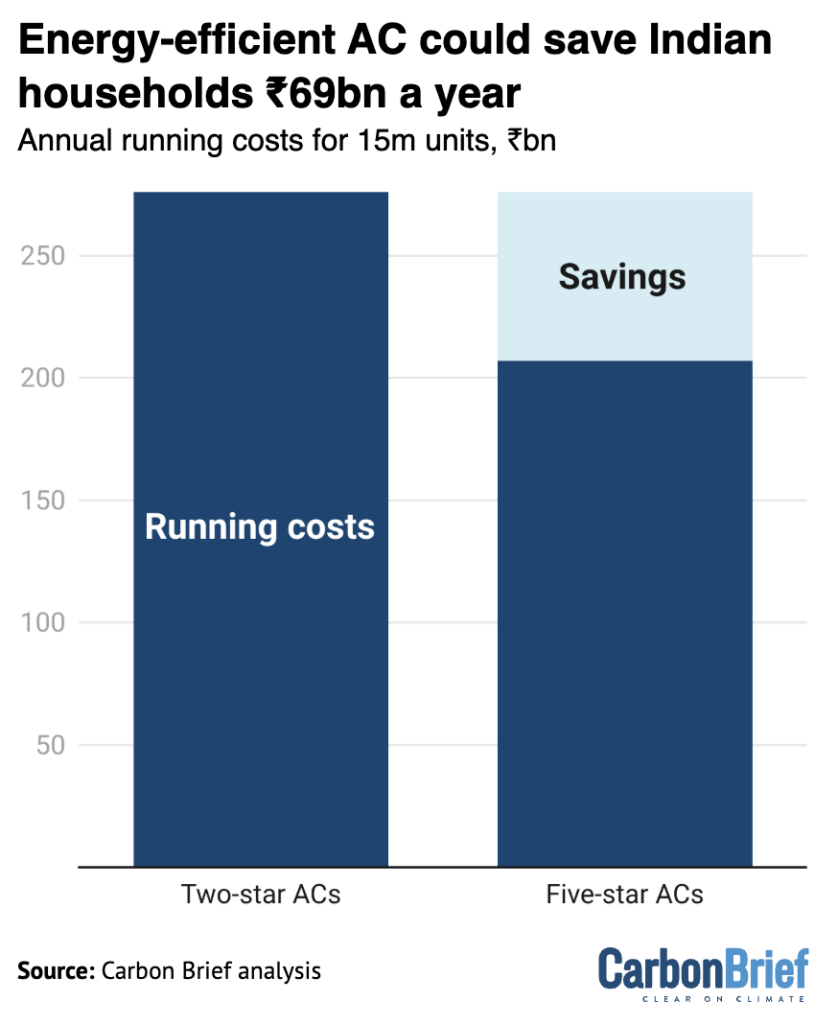
Carbon Brief’s analysis shows that, if the roughly 15m households expected to buy a new air conditioning (AC) unit this year bought a “five-star” rated one instead of a “two-star”, it would cut carbon dioxide (CO2) emissions by nearly 5m tonne (Mt).
The installation of AC units in India is currently uneven and ongoing challenges remain, predominantly around the cost of the technology.
Below, Carbon Brief looks at what more energy-efficient models would mean for India’s emissions and household electricity savings, as well as opportunities and barriers to cooling access.
Record heat
Historically, India has had one of the lowest levels of access to cooling in the world. As the nation continues to see an increasing number of heatwave days, this is shifting.
For example, India saw record-breaking heat in 2024 and nearly 14m air conditioners sold – up from 10m in 2023.
Between 2021 and 2023, AC sales volumes increased by more than 25% year-on-year in India.
While solar power is playing an increasing role in meeting the daytime electricity demand from these units, coal power plays a significant role in powering air conditioners on warm nights.
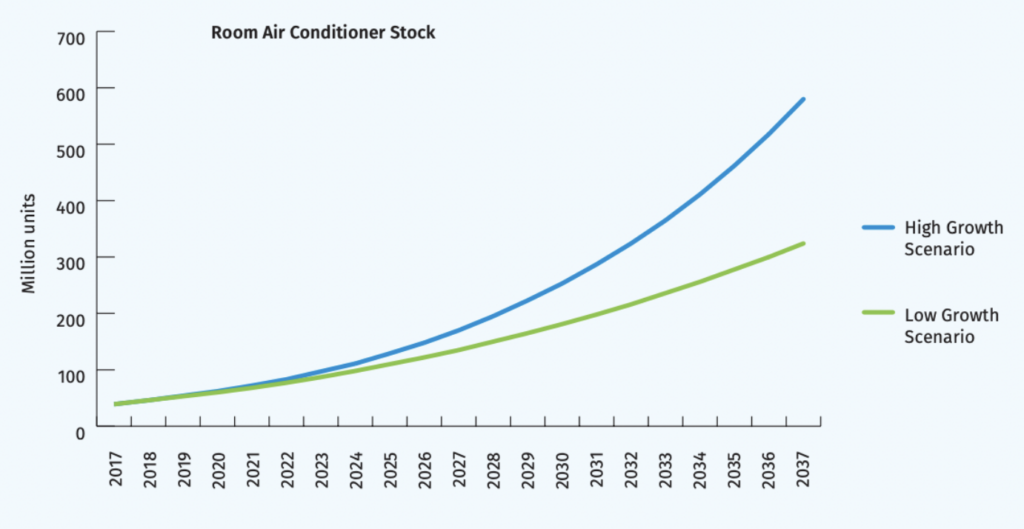
By 2037, India’s space-cooling demand was expected to grow nearly 11-fold in a business-as-usual scenario compared to 2017, according to the government’s 2019 India Cooling Action Plan (ICAP).
According to a World Bank study, this would mean a new air-conditioning unit is bought every 15 seconds in India. There would also be a 435% increase in annual greenhouse gas emissions related to air conditioning in the country over the next two decades.
The chart below shows the ICAP’s estimated rise in air conditioner units in India from 2021 to 2037. The blue line represents a high-growth scenario, while the green line corresponds to a low-growth scenario.
Growing demand
Despite the upswing in installations over recent years, it remains rare for households to have access to air conditioning in India.
According to India’s national sample survey in 2020-21, only 4.9% of Indian households owned air conditioning, with ownership concentrated among the urban rich. As of 2024, this had increased to around 8%.
(Ownership of evaporative air coolers is significantly higher than it is for air conditioning, particularly in the arid north and central Indian states, where humidity is low.)
Dr Nikit Abhyankar, an associate adjunct professor at the Goldman School of Public Policy at the University of California Berkeley, tells Carbon Brief that India is set to add between 100-150m new air conditioners in the next 10 years, which could go up to 200m “if you factor in the crazy heatwaves”.
According to his research, the two factors that drive “dramatic” sales of ACs are income and extreme temperatures.
He tells Carbon Brief:
“The moment you cross a specific income threshold, the first appliance you buy is an air conditioner, no matter whether it’s hot or not. And the moment there are extreme temperatures, the next summer, you see a huge wave of new ACs being purchased.”
With that in mind, he says India offers a “classic lock-in opportunity”, since 90% of the air conditioners that will exist in 2040 have yet to be purchased, particularly given the tendency among Indian users to repair and reuse units. Abhyankar continues:
“That’s why making sure that first AC purchase is the most efficient one is very important in India, because that AC is not going out of the market in seven years.”
Energy-efficient units
With the number of air-conditioning units in India on the rise, ensuring they are as energy-efficient as possible could save households money, while cutting emissions and electricity demand.
India’s Bureau of Energy Efficiency (BEE) mandates star ratings for air conditioners to indicate their efficiency. It uses a metric called the Indian seasonal energy efficiency ratio (ISEER), which is based on an India-specific temperature distribution.
Ratings range from one to five stars, with the latter being the most energy-efficient.
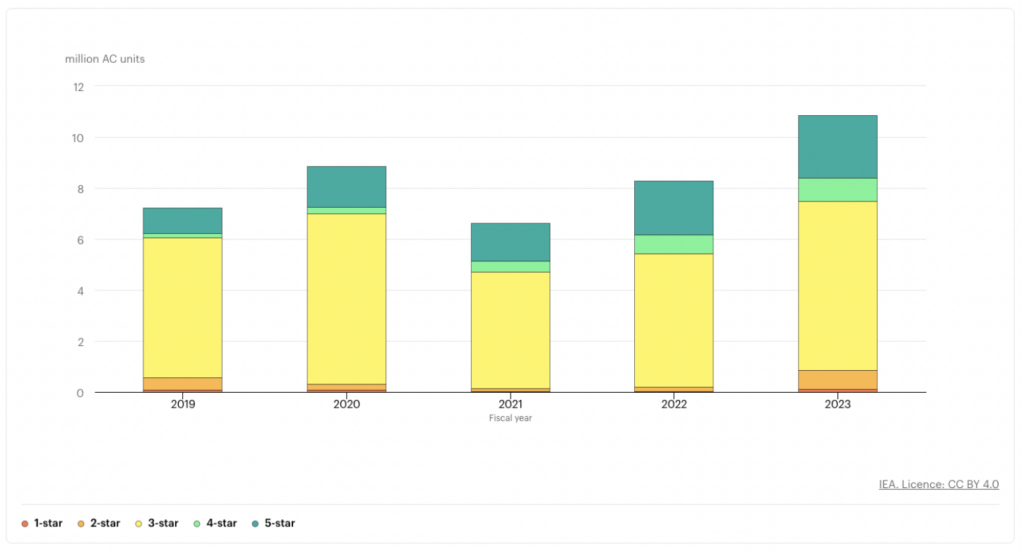
According to the International Energy Agency (IEA), three-star units “dominate” India’s air-conditioning market, “possibly due to [up-front] cost considerations”, while four- and five-star units account for a minority of sales.
The chart below shows AC production volumes in India between 2019 and 2023 by energy-efficiency star rating, according to the IEA.
Carbon Brief analysis finds that buying a five-star air conditioner could cut the emissions associated with generating electricity to run the unit by around 300 kilograms (kg) of CO2 per year, when compared to a two-star unit.
As such, if all 15m air-conditioning units expected to be sold in 2026 were five-star, it could save 5MtCO2 annually.
This is roughly equivalent to the emissions from an average-sized coal-fired power plant, the analysis shows.
In a year, the lower electricity demand from more efficient units could mean ₹69bn ($724m) in cost savings for consumers, as shown in the chart below. Each affected household could save ₹4,600 ($48) annually on their bills.
There are also significant savings from five-star units compared with three-stars, amounting to around 150kgCO2 and ₹2,300 ($24) per household per year.
Carbon Brief’s illustrative analysis is supported by a new working paper from the India Energy and Climate Center (IECC) at UC Berkeley, which looks at the longer-term impact of AC demand on electricity demand and emissions, as well as grid investment costs and consumer savings.
Released in May 2026, it says that room air conditioners already account for nearly a quarter of India’s peak electricity demand (60-70GW).
The authors estimate that AC-driven peak power demand could reach 120GW by 2030 and 180GW by 2035, pushing India’s power grid beyond its capacity. They warn:
“Even with all under-construction generation and storage projects online, power shortages are expected as early as 2028.”
Sustained energy-efficiency improvements, however, could reduce this cooling-driven peak power demand by 10GW by 2030 and 47GW by 2035.
They estimate that these improvements could help avoid nearly $80bn in power infrastructure investments and deliver $9-25bn in consumer savings between 2028 and 2035, while reducing emissions by 12MtCO2 per year by 2030.
Rolling out five-star units
While there are emissions and cost benefits to five-star air-conditioning units compared to the alternatives, the higher upfront costs can still present a barrier.
These more energy-efficient units can pay for their higher purchase price over a three-year period, but on average cost ₹5,000 to ₹8,000 ($52-84) more upfront than a three-star unit.
Researchers at the Indian climate thinktank Sustainable Futures Collaborative (SFC) called on Indian state and national governments to create a “highly-targeted active cooling” programme last year.
They recommended deploying a subsidy or a large-scale purchase programme that allows families to buy energy-efficient air conditioners. This, they said, must be targeted at portions of Indian cities with the highest heat risk, determined by the vulnerability assessments of their heat action plans.
Climate adaptation researcher at King’s College London and SFC author Aditya Valiathan Pillai tells Carbon Brief:
“Commit money to air conditioning for the poorest-of-the-poor: subsidise ultra-efficient ACs and electricity, but give them cool air at the cheapest possible, most efficient rate.
“Because these are the people running the economy, which is not going to function in a heatwave if these people are dying or unable to work.”
Methodology
Carbon Brief’s analysis is based on official energy consumption, power pricing and emissions data from different ministries and government institutions.
It uses BEE’s “search and compare” tool to list all five-star and three-star “variable speed” or “inverter” air conditioners, given their enhanced efficiency and ability to regulate humidity.
This was then filtered to air conditioners with a capacity of 1.5t, which studies say are most preferred by Indian households.
Using the same tool, Carbon Brief then listed all “fixed speed” two-star ACs of a similar capacity (1.45t to 1.55t), given that these account for the majority of two-star ACs available on the market and favoured by renters.
Based on expert estimates, the analysis lists the energy consumption of each of these key categories in kilowatt-hours (kWh) and added 15% to account for losses in power transmission and distribution.
The carbon intensity of Indian electricity is specified by the CO2 baseline database published by India’s Central Electricity Authority in November 2025.
The number of hours per year a household’s air conditioning runs is estimated at 1,600 hours by the BEE.
Carbon Brief uses a marginal electricity tariff of ₹10 per kWh to calculate annual electricity consumption costs.
This is because average electricity tariffs vary significantly from state to state, but especially by energy consumption “slabs”, with AC use pushing bills into higher-tariff rates.
For instance, in Maharashtra, electricity tariffs for domestic households range from ₹1.52 per unit for below-poverty-line households to ₹16.64 per unit for homes using more than 500 units of electricity.
Savings from higher energy efficiency, therefore, reduce electricity consumption in the highest electricity tariff block, where rates are the most expensive.
Cooling hours
Air-conditioner usage varies across India’s climatic zones. The ISEER metric that underpins star ratings estimates that, on average, a household air conditioner runs for 1, 600 hours a year.
This estimate is based on 2014 weather data for 54 cities across India, to see how many hours in a year temperatures exceed 24C.
Refrigerant emissions
The analysis only accounts for emissions from electricity generation and does not factor in “fugitive” emissions from refrigerant leaks.
These are significant, given that refrigerants are greenhouse gases that can have hundreds of times more warming potential than CO2.
According to a study published by climate thinktank iForest last year, Indian households with air conditioning are refilling their refrigerants more frequently than the global average.
It estimates that greenhouse gas emissions from refrigerant release from India’s air conditioners were 52Mt of CO2 equivalent (CO2e) in 2024, likely to increase to 84MtCO2e by 2035.
Cooling access and population data
Government estimates vary on how many Indian households do not own a single air conditioner, with little publicly available data differentiating between cooling devices and a delayed national census.
India’s national sample survey, published in 2020-21, is the only one of its kind in recent years to separate air-conditioner ownership from air cooler ownership, estimating that only 4.9% of all Indian households owned an air conditioner.



The post Analysis: Energy-efficient air conditioning could save Indian homes 69bn rupees a year appeared first on Carbon Brief.
Analysis: Energy-efficient air conditioning could save Indian homes 69bn rupees a year

For the first time, new-energy vehicles (NEVs) made up 67% of new car sales in China in September, according to the latest data from the China Passenger Car Association (CPCA).
The figures show that NEVs, which include battery electric cars and plug-in hybrids, captured a record share of sales, even though fewer were sold than last year.
This is because sales of combustion-engine cars are falling steeply, a trend that the CPCA has attributed to rising petrol prices following the start of the Hormuz crisis.
Indeed, sales of fuel-only cars were down 31% year-on-year in the first nine months of 2026, with plug-in hybrid sales down 26% – whereas battery EV sales were only down 4%.
One analyst tells Carbon Brief that China’s rapidly growing EV fleet has offset demand for 143m barrels of oil since the start of the Hormuz crisis.
Another says that the crisis is “reinforcing China’s electrification of road transport”.
Meanwhile, amid slowing domestic sales, Chinese carmakers’ exports of NEVs more than doubled [in 2026 to date / in September] from a year earlier.
NEV record
A record two out of every three cars sold in September in China were NEVs, according to CPCA data, as shown in the figure below.
(NEVs predominantly include battery electric vehicles – BEVs – and plug-in hybrids – PHEVs. BEVs only run on electricity, whereas PHEVs also have a combustion engine.)
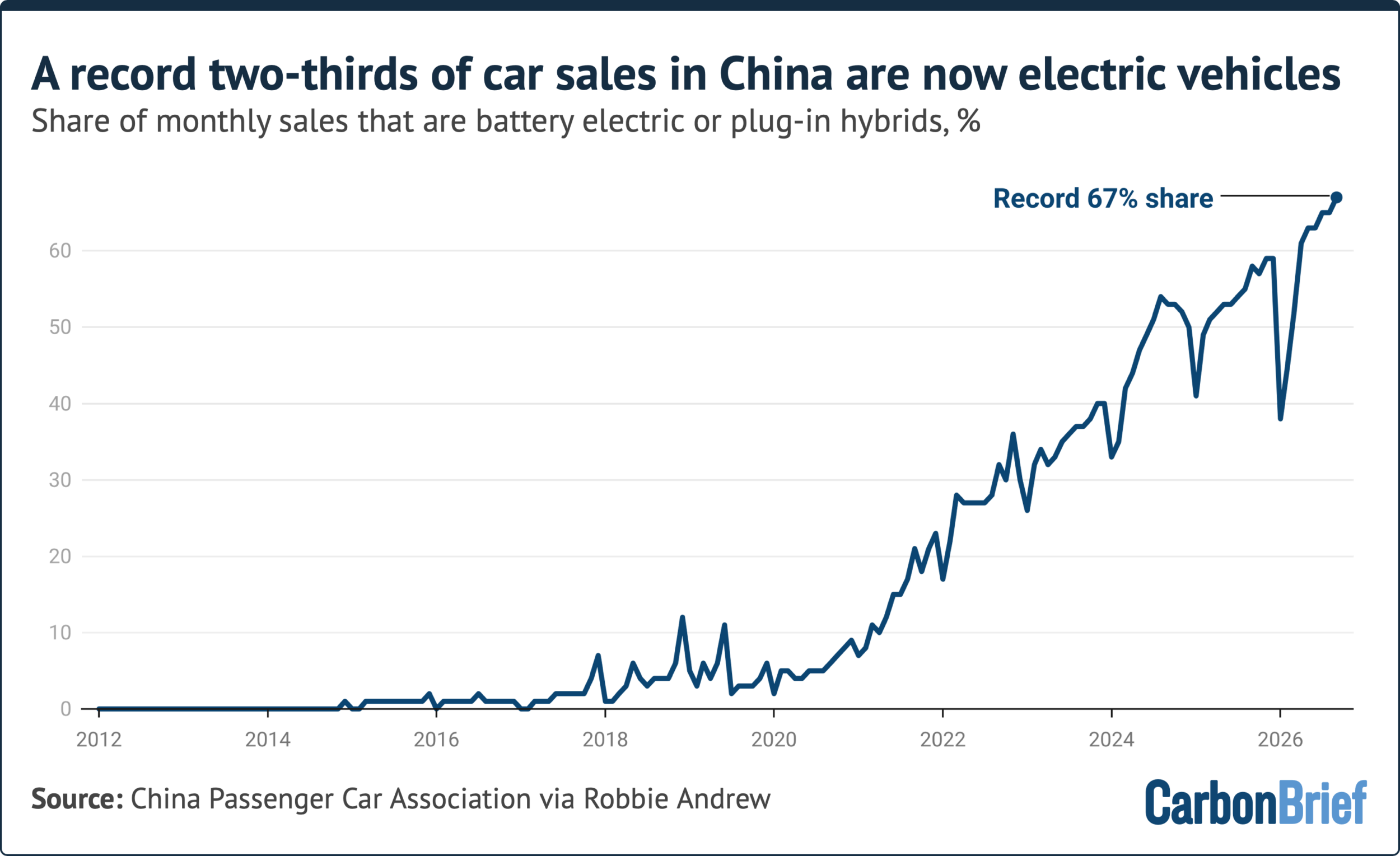
This marks a rapid rise for NEVs from just 6% of new car sales in 2020 up to 58% in 2026 to date – and a record 67% in the month of September.
This year, NEVs’ share of sales has also bounced back from a low of 39% in January, after the full purchase tax exemption that had been in place for more than a decade came to an end in December 2025.
The gain in NEV share in 2026 has come amid a slowdown across the wider domestic passenger-car market, which has hit sales of combustion-engine vehicles particularly hard.
This September, passenger-car retail sales across all categories declined, with overall sales volumes falling 28% year-on-year.
The contraction was led by combustion-engine vehicles, which saw sales fall 43% year-on-year in September and 31% in 2026 to date.
However, sales of PHEVs also fell by 36% year-on-year in September and by 26% in 2026 to date. By comparison, BEVs performed better, although sales still declined 8.5% from a year earlier in September and 4% in 2026 to date.
As a result, NEV sales overall fell by 17% in September and 13% in 2026 to date.
While the market changes in 2026 to date were particularly dramatic, they reflect a broad continuation of trends seen over the past decade.
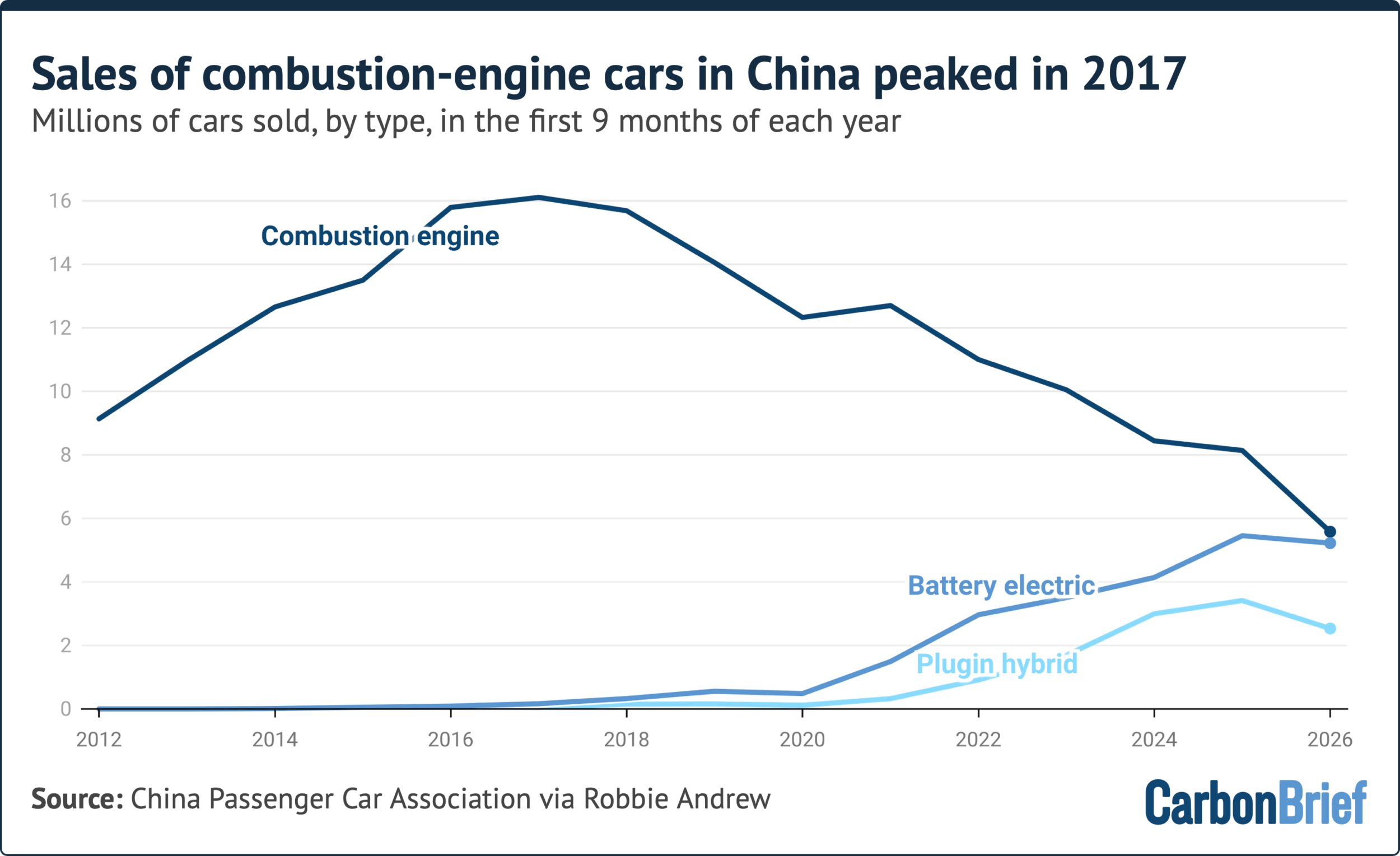
Indeed, sales of combustion-engine cars in China peaked in 2017 and they have been declining ever since, shown in the figure below.
Impact of Hormuz
Part of the reason for the advance of NEVs in 2026, said Chinese technology news outlet OFweek, was petrol cars “giving up market share” as they were outperformed by electric alternatives.
Cui Dongshu, secretary-general of the CPCA, cited higher petrol prices as an explanation for September’s weak combustion-car sales, in comments to financial news outlet National Business Daily.
Imports of oil into China in January-September have fallen 15% compared to 2025, equivalent to 470m barrels, as ongoing conflict tightened supply and drove up prices.
China’s passenger-car NEV fleet has displaced 143m barrels of oil so far during the strait of Hormuz crisis, Euan Graham, senior energy analyst at thinktank Ember, tells Carbon Brief.
EVs “accounted for 12% of the decrease in China’s oil use post-Hormuz”, according to an estimate provided to thinktank the Brookings Institute by an unnamed analyst.