

Felix Wertli is the Swiss Ambassador for the Environment
At COP28 in Dubai in 2023, countries sent a long-awaited political signal by agreeing to “transition away from fossil fuels” in energy systems. For the first time, the direction of travel was acknowledged collectively. Yet, this signal remains abstract. What matters now is the implementation that supports development, energy access, and economic transformation.
The transition away from fossil fuels offers opportunities: it can create jobs, strengthen energy security and advance sustainable development, including universal access to affordable and reliable energy. At the same time, the implementation challenges are significant and unevenly distributed across geographies. It requires large-scale investment, careful management of shifting price structures, and safeguards to prevent economic disruption and social instability. This is why countries agreed in Dubai that the transition must be just, orderly and equitable.
Against this backdrop, Brazil’s proposal to develop a roadmap to operationalise the transition away from fossil fuels was both timely and necessary. Supported by more than 80 countries, it responded to a clear gap in the international process: the absence of guidance on how to move from political commitment to implementation. The proposal did not reach consensus, due to opposition from a number of highly fossil-fuel dependent countries. They were concerned that a roadmap could translate political commitments into tangible expectations and measures and could pressure them to transition faster than their economies can sustain.
-
Türkiye prioritises cleaning up garbage emissions in COP31 ‘action agenda’
‘Zero Waste’ is the personal project of Turkish First Lady Emine Erdogan and aims to cut emissions from landfills and waste disposal -
After disappointing COP30, EU mulls “less naive” strategy for climate talks
EU environment ministers are discussing how to show more “realism” and “pragmatism” in international climate negotiations -
Climate action is “weapon” for security in unstable world, UN climate chief says
With geopolitical tensions rising, Simon Stiell urges leaders to accelerate global climate cooperation in pursuit of a safer world


This outcome illustrates a broader challenge within the UNFCCC. The problem is no longer a lack of negotiated ambition. It is the growing disconnect between agreed objectives and the collective ability to implement them.
Brazil’s decision to proceed by launching two roadmaps in its own capacity, one on transitioning away from fossil fuels and one on halting deforestation, therefore deserves strong support. This approach supports multilateralism. It recognises that complementary initiatives are sometimes necessary to advance implementation among a coalition of the willing, especially when formal processes stall and full consensus is not possible.
Developing the roadmap outside the COP process allows countries willing to engage constructively to move faster, provide greater clarity and focus on practical solutions, without being bound by the consensus rule. Importantly, such an initiative should be understood as a complement to the UNFCCC, not a substitute, and as a mean to inform future multilateral decisions.
How roadmaps can succeed
For the roadmap to succeed, several conditions must be met.
First, ownership must be shared. Participating countries need to see their national circumstances, development priorities and constraints reflected in the process. This requires collective leadership. Brazil’s role should be that of a convener and facilitator, not a single agenda-setter. The upcoming meeting co-hosted by Colombia and the Netherlands on the Just Transition Away from Fossil fuels offers an important opportunity to shape the roadmap collaboratively from the outset.
Second, the roadmap should be global, but not necessarily universal. All countries should be invited to participate, with constructive engagement as the sole entry criterion. Universal participation is not required at the beginning. What matters is broad representation across regions and levels of development, including a critical mass of G20 members, to ensure political relevance and economic weight. Countries should also be able to join at later stages as confidence in the process grows.
Third, partnerships must extend beyond environment ministries. For many countries, the transition away from fossil fuels is inseparable from questions of industrial policy, fiscal stability and energy security. Energy, finance and economy ministries should therefore also be involved. Engagement with sub-national actors, the private sector, and international organisations such as the International Energy Agency (IEA), OECD, existing coalitions like “Beyond Oil and Gas (BOGA) and think-tanks like the World Resources Institute (WRI) can further strengthen the roadmap’s impact.
Fourth, the roadmap must be a sustained process, not a one-off report. Experience shows that standalone reports rarely change outcomes. What is needed is an ongoing platform for dialogue, learning and cooperation, including among fossil fuel–producing countries.
Fifth, linkages to the UNFCCC process should be explicit. The second Global Stocktake in 2028 could serve as a natural milestone to reflect progress, extract lessons and feed relevant elements of the roadmap back into the multilateral process, helping to inform the next generation of nationally determined contributions.
-
Why cutting climate journalism is a risk we can’t afford
A recent wave of lay-offs will reduce public understanding of how climate change impacts lives and weaken the media’s ability to hold power to account, enabling climate misinformation to spread -
As China builds the future, Trump’s repeal of climate finding is self-inflicted wound
The Trump administration’s repeal of the “endangerment finding” is bad policy, terrible economics and incorrect science that will hurt US innovation -
COP31 chief slams climate backsliding, but rejects priority focus on fossil fuels
After a first COP31 strategy meeting, Türkiye’s environment minister says he will “safeguard the development priorities” of developing countries


Finally, the roadmap must adopt a broad, economy-wide perspective. Even in the absence of binding targets, clear signals and concrete measures can shape markets and guide investment decisions. The roadmap should help clarify what the transition implies for public and private investment, trade, subsidies and public support. It should address critical issues such as new fossil fuel investments, inefficient subsidies or stranded assets. It must tackle significant barriers, e.g. the reduction of the costs of capital across the various geographic regions to increase investment flows.
It should also define the roles of key actors, including multilateral development banks, in de-risking investments, crowding in private capital and supporting enabling policy environments. Just as importantly, the roadmap should serve as a platform for voluntary commitments and facilitate technical assistance and capacity-building.
If designed well, the roadmap can become an enabling instrument, which can support planning and investment and build on the momentum we see in the real economy. It can be one that helps countries to develop credible national transition pathways and send political signals. At a moment when trust in multilateral processes is fragile, it can also demonstrate that pragmatic, inclusive cooperation remains possible. It is not about additional obligations, but about gaining the clarity, support and policy space needed to deliver a just and sustainable transition.
The post What we need to see in the roadmap to transition away from fossil fuels appeared first on Climate Home News.
What we need to see in the roadmap to transition away from fossil fuels

Three countries have been named by the Paris Agreement’s compliance committee for failing to submit a nationally determined contribution (NDC) and repeatedly snubbing offers of help with their climate plans.
After months of internal debate over whether to identify serial non-responders, the Paris Agreement’s Implementation and Compliance Committee (PAICC) named the three countries which have failed to engage with it over their NDCs on Friday.
It named Democratic Republic of Congo, Senegal and North Korea in a footnote of its annual report, adding that it decided to name them “with a view to facilitating engagement”, adding that representatives of the three nations had been invited to its meeting in early 2027 “with the purpose of identifying any challenges and constraints”.
“The Committee noted the importance of Parties engaging with the Committee in a timely manner, while noting that some delays may be due to the national capabilities and circumstances of the Parties”, the report said.
-
Under US pressure, World Bank says it will back gas “where appropriate”
The US wants the World Bank to expand its gas support while climate campaigners are pushing for it to end – its head spoke this week of limited backing for the fossil fuel -
IPCC scientists vow to press on with climate reports despite political deadlock
After governments again failed to agree a timeline, nearly 120 IPCC authors pledged to complete their assessment on time and with full scientific rigour -
Paris Agreement committee snubbed over missing NDC climate plans
Many governments have still not submitted a nationally determined contribution to the UN, breaching a key requirement of the Paris Agreement

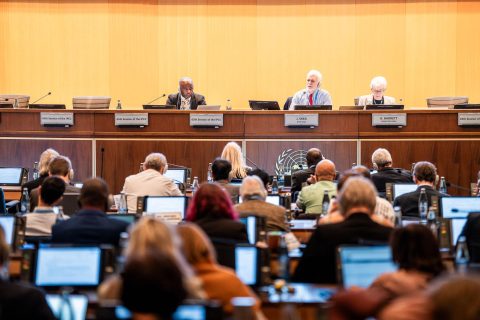

In July, PAICC said 12 countries had ignored its repeated attempts to discuss why they had not published an NDC as required every five years under the 2015 Paris accord.
Members of the committee had been divided over whether to name them, but at a September meeting decided to do so in their annual report to the annual climate COP summit.
By the time the report was published on Friday, only Congo, Senegal and North Korea “had not communicated an NDC or submitted a [Biennial Transparency Report] and had not yet responded to any of the Committee’s notifications, despite several reminders issued by the Committee in this regard”.
Rainforest and renewable energy ambitions
The silence from Congo and Senegal is notable because the former is home to much of the Congo Basin rainforest while the latter has sought billions of dollars in climate finance to support its renewable energy ambitions.
After Brazil, Congo has more rainforest than any country in the world. This forest, and the country’s peatlands, absorb huge amounts of greenhouse gas but are fast being lost to expanding farmland, charcoal production, logging and mining.
Senegal signed a Just Energy Transition Partnership with Canada and wealthy European nations in 2023, to help it meet its renewable energy targets under the-then government of Macky Sall. It was chair of the Least Developed Countries group between January 2022 and December 2023.

Tejas Rao, who is researching the PAICC as part of a doctoral thesis at Cambridge University, said the governments of the three countries should engage with the committee.
“Engagement costs these governments very little and the committee has shown it will listen,” he said.
“Silence leaves the committee with no basis to help, and it leaves the [governments] exposed to the narrative that they are simply disengaged,” he told Climate Home News.
Paris Agreement requirement
The 2015 Paris Agreement requires all parties to publish an NDC every five years outlining their emissions reduction targets, with each plan meant to be more ambitious than the country’s last NDC.
The latest set – the third round of plans, with new targets for 2035 – was due in February 2025. While most countries missed this deadline, all but around 30 – mostly small emitters but including Egypt, Vietnam and Argentina – have now submitted them.
Over the year, the PAICC – which is made up of government climate officials from developed and developing countries – has been communicating with governments that have not submitted NDCs and trying to overcome barriers to them doing so.
Some nations have cited exceptional circumstances as the reason for not submitting an NDC, a process that requires a significant amount of work in tracking emissions and consulting on how to curb them across the economy. For example, a letter from a Sudanese official to the PAICC, seen by Climate Home News, said that the country’s civil war had led to the suspension of its NDC preparation.
-
IPCC scientists vow to press on with climate reports despite political deadlock
After governments again failed to agree a timeline, nearly 120 IPCC authors pledged to complete their assessment on time and with full scientific rigour -
Under US pressure, World Bank says it will back gas “where appropriate”
The US wants the World Bank to expand its gas support while climate campaigners are pushing for it to end – its head spoke this week of limited backing for the fossil fuel -
Who shapes climate science? The equity question facing the IPCC
Early completion of the next global climate science assessment reports risks excluding research from the Global South, which is key to ensuring the findings are fair
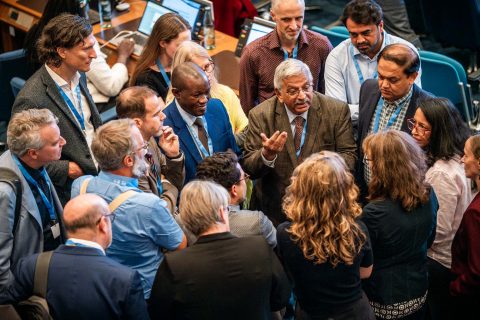
The US and Iran are not signed up to the Paris Agreement and so do not have active NDCs, nor does Taiwan, which is not a UN member state.
Rao said that because the PAICC is “facilitative and non-punitive”, naming the countries “is meant to open a door, not close one – the invited consultation is the point”.
“In recent months, governments that explained their constraints, whether capacity, finance or domestic process, have been met with follow-up and support rather than sanction, and the number of silent governments has fallen sharply,” Rao said.
The post Paris Agreement committee names three countries snubbing it over NDCs appeared first on Climate Home News.
Paris Agreement committee names three countries snubbing it over NDCs