
Connect with us

Published

on

FIFA World Cup and the 3.7 Million-Tonne Problem: Can Football’s Biggest Event Reduce Its Climate Impact?

As FIFA prepares for its upcoming World Cup tournaments from June 11 to July 19, 2026, its climate strategy is facing closer attention, too. The organization has set a goal to reach net zero emissions by 2040. It also aims to cut emissions by 50% by 2030.

These targets are part of FIFA’s long-term sustainability plan, which aligns with the UN Sports for Climate Action Framework and the Paris Agreement. FIFA first announced its climate strategy in 2021 and has since applied it across major tournaments.

However, the challenge is not setting targets. The real challenge is reducing emissions in a global event that depends on international travel. The World Cup is one of the most complex events to decarbonize because most emissions come from sources outside direct control.

FIFA’s Climate Commitments and Official Emissions Targets

FIFA’s climate strategy follows a structured pathway based on global climate standards. It includes measuring emissions, reducing them where possible, and offsetting what remains.

The organization has committed to three main actions:

  • Reduce greenhouse gas emissions by 50% by 2030.
  • Achieve net zero emissions by 2040.
  • Align operations with international climate frameworks.

FIFA reports emissions using standard greenhouse gas accounting. This includes tracking emissions across tournaments, host cities, and operational activities.
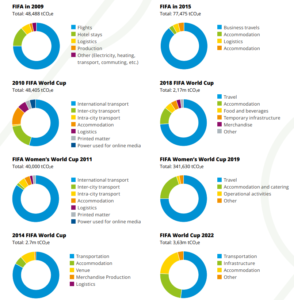
FIFA greenhouse gas emissions
Source: FIFA

In past tournaments, FIFA has introduced sustainability measures such as energy-efficient stadiums, waste reduction programs, and public transport planning. For example, several recent World Cup venues have used renewable electricity and modern cooling systems to reduce energy demand.

FIFA also works with host countries to improve infrastructure planning. This includes encouraging the use of existing stadiums and limiting new construction where possible. These steps aim to reduce emissions linked to building materials and long-term infrastructure.

Still, these efforts mainly affect operational emissions. The larger challenge lies beyond stadiums and facilities.

How Emissions Are Measured in the World Cup

FIFA measures emissions using the widely accepted Scope 1, Scope 2, and Scope 3 framework.

Scope 1 emissions come from direct sources such as fuel use in vehicles and on-site operations. Scope 2 emissions come from purchased electricity used in stadiums and facilities. These emissions can be reduced through renewable energy and efficiency improvements.

Scope 3 emissions include all indirect emissions linked to the event. These are the most complex and the largest category.

In the World Cup, Scope 3 emissions come from these sources:

  • International and domestic travel by fans,
  • Team and staff transportation,
  • Accommodation and hospitality services,
  • Supply chains and merchandise production, and
  • Broadcasting and logistics operations.

In large global events, Scope 3 emissions often account for more than half of total emissions. The share is even higher due to the scale of international travel in football tournaments. 

This structure shows that most emissions do not come from FIFA’s direct operations. They come from the wider system that supports the event.

By the Numbers: Inside the 3.7M Ton Carbon Footprint of 2026 World Cup

The FIFA World Cup is one of the largest global sporting events. The 2022 tournament in Qatar drew over 3.4 million spectators, according to FIFA, and reached billions of viewers worldwide. This level of participation creates a large environmental footprint.

For the 2026 FIFA World Cup, hosted by the United States, Canada, and Mexico, total emissions are projected at around 3.7 million tonnes of CO₂ equivalent (CO₂e). This estimate comes from the United 2026 bid’s environmental impact assessment. It reflects the full lifecycle footprint of the event, including travel, operations, and infrastructure.

Fifa world cup 2026 carbon footprint estimates

Transportation is the main driver of these emissions. About 85% of total emissions are linked to travel, especially air travel. This includes both international flights and travel between host cities.

The scale of the 2026 tournament adds to this challenge. It will feature 48 teams, up from 32 in previous editions, and will span multiple countries and cities. This increases travel demand, distances between matches, and overall logistics complexity.

The structure of emissions can be summarized as follows:

  • ~85% from travel-related activities (~3.15 million tonnes CO₂e)
  • ~15% from operations, energy use, and infrastructure (~0.55 million tonnes CO₂e)

Travel emissions alone include:

  • 51% from international journeys
  • 34% from travel between host cities

Compared with more compact tournaments, this format leads to higher emissions due to increased reliance on long-distance flights.

Scope 3 Emissions: The Core Climate Challenge

The emissions profile of the World Cup highlights a clear imbalance. Most emissions fall under Scope 3, which includes indirect sources such as travel, logistics, and supply chains.

Scope 1 and Scope 2 emissions, which cover direct operations and energy use, represent only a small share of the total footprint. These can be reduced through renewable energy and efficient design.

Scope 3 emissions are different. They come from activities outside FIFA’s direct control. These include fan travel, team transport, global logistics, and services linked to the event. This creates a structural challenge. Even if FIFA reduces emissions from stadiums and operations, total emissions can remain high due to travel demand.

Fifa world cup scope 3 emissions

  • In simple terms, the World Cup’s carbon footprint is driven more by movement than by infrastructure.

Scope 3 is also the hardest category to reduce. It depends on global travel patterns, geography, and individual choices. FIFA cannot fully control how fans travel or how often they move between cities.

This is why Scope 3 emissions are central to the climate challenge. They account for the largest share of emissions and the biggest barrier to reducing the World Cup’s overall footprint.

Cuts vs. Credits: The Ongoing Offset Debate

To meet its climate targets, FIFA uses both emissions reduction and carbon offsetting. Reduction focuses on lowering emissions at source. This includes improving energy efficiency, using renewable electricity, and optimizing event operations.

Offsetting is used to balance emissions that cannot be eliminated. This involves investing in projects that reduce or remove carbon emissions elsewhere.
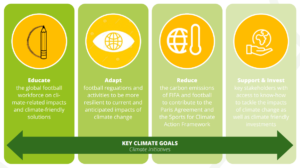
FIFA climate strategies
Source: FIFA

FIFA’s approach includes:

  • Reducing energy use in stadiums and facilities,
  • Increasing the use of renewable electricity, and
  • Supporting carbon offset projects for remaining emissions.

Carbon offsets can include projects such as reforestation, renewable energy development, and carbon capture. However, their effectiveness depends on project quality, verification, and long-term impact.

This has led to debate in climate policy. Some experts argue that offsets should not replace real emissions reduction. Others point out that offsets can support the transition when used carefully.

The key issue is transparency. Clear reporting and verified data are needed to ensure that net-zero claims reflect real outcomes.

Why Net Zero Is Difficult for Mega Sports Events

Mega sporting events like the World Cup have unique challenges. They are temporary, global, and highly mobile. Their emissions come from:

  • International travel,
  • Temporary infrastructure,
  • Large-scale logistics, and 
  • Global audience participation.

Even with strong sustainability measures, these factors create a high baseline of emissions.

Take for example, the Paris 2024 Olympics. The event’s total footprint hit 1.7 million tonnes CO₂e. Travel caused 72%, that’s 1.2 million tonnes, from 720,000+ international visitors. Stadiums run on 100% renewables, but aviation emissions? Untouched.

Super Bowl LIX in 2025 told the same story. The event generated 400,000 tonnes CO₂e, with 85% coming from 150,000+ out-of-state fans flying to New Orleans. The NFL bought 400,000 offsets for carbon-neutral claims. Still, travel cuts? Zero.
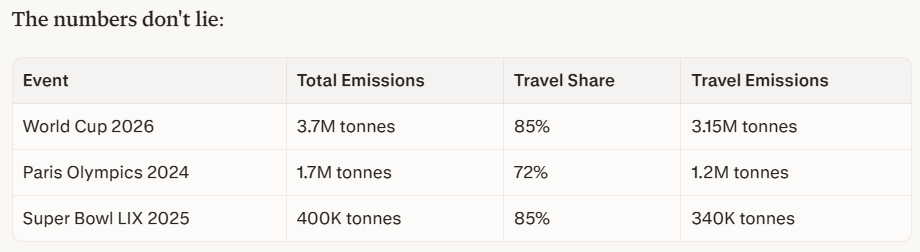
mega sporting events emissions

This pattern is industry-wide. Organizers control stadium power. Fans control flights. These mega-events lean on offsets, not aviation reductions. FIFA faces the same problem that other organizers couldn’t easily resolve.

Thus, decarbonization becomes more complex. It also means progress may be slower compared to sectors with more direct control over emissions.

What a Credible Net Zero World Cup Requires

For FIFA’s net-zero goals to be credible, several conditions need to be met.

  • Emissions must be clearly measured and reported across all scopes. This includes full disclosure of total emissions before offsets are applied. Transparency is essential for trust.
  • There must also be a stronger focus on reducing emissions at source. While offsets can play a role, long-term progress depends on real reductions.
  • Independent verification of emissions data can improve credibility. Better coordination of travel and logistics can also help reduce unnecessary emissions.
  • In the long term, advances in low-carbon transport, including sustainable aviation fuels, may help reduce travel-related emissions.

Final Whistle: Can FIFA Turn Climate Targets Into Reality?

FIFA has set clear climate targets, including net zero emissions by 2040. These targets reflect growing pressure on global organizations to reduce their environmental impact.

However, the data shows a clear challenge. Most emissions from the World Cup come from indirect sources, especially global travel. Scope 3 emissions dominate the total footprint and remain difficult to control. This makes them the key factor in any net-zero strategy.

As the World Cup continues to grow in scale, emissions challenges will also increase. Operational improvements can reduce part of the impact, but they cannot fully address the larger system.

The future of football’s climate strategy will depend on how this gap is managed. The goal is not only to set targets, but also to achieve measurable and transparent progress in a global, complex system.

In this field, will FIFA lead or lag? We will watch this space closely.

The post FIFA World Cup and the 3.7 Million-Tonne Problem: Can Football’s Biggest Event Reduce Its Climate Impact? appeared first on Carbon Credits.

Continue Reading

Carbon Footprint

Tesla Q1 2026 Hits $22.38B Revenue – But Do Weak Deliveries and Falling Credits Expose a Fragile Growth?

Published

on

Tesla (TSLA) reported a mixed performance in the first quarter of 2026 (Q1 2026. The company beat earnings expectations and delivered stronger margins, but several underlying trends pointed to weakening demand signals and rising execution pressure across key segments.

Earnings Beat, But Growth Is Not Fully Organic

Tesla posted revenue of $22.38 billion, slightly ahead of Wall Street expectations of $22.3 billion. Earnings came in at $0.41 per share (non-GAAP), above the expected $0.37. This marked a clear improvement from Q1 2025, when the company reported weaker results. Revenue grew about 14% year over year, while earnings rose roughly 33%.

However, the quality of earnings raised questions. Tesla itself highlighted that part of the profit improvement came from one-time benefits tied to warranties and tariffs. These are not recurring revenue sources. As a result, the headline beat does not fully reflect the underlying operating strength.

Margins Improve, But Vehicle Demand Weakens

One of the strongest positives in the quarter was profitability. Tesla’s gross margin rose to 21.1%, compared to 16.3% a year ago and 20.1% in the previous quarter. This was one of the best margin performances in recent periods and showed better cost control and pricing stability.

But the demand picture told a different story.

Tesla delivered 358,023 vehicles, falling short of expectations by around 7,600 units. At the same time, production exceeded deliveries by more than 50,000 vehicles. This created a noticeable inventory buildup.

tesla vehicle
Source: Tesla

This gap matters because it suggests supply is running ahead of demand. If this continues, Tesla may face pricing pressure, higher discounts, or slower production adjustments in future quarters. In simple terms, the company is producing more cars than the market is absorbing right now.

Regulatory Credit Revenue Slides 30%

Another weak point was the sharp decline in regulatory credit revenue. Tesla generated about $380 million in Q1 2026, down from $542 million in Q4 2025, a drop of nearly 30% in just one quarter.

tesla regulatory credit revenue
Source: Tesla

These credits have historically been one of its highest-margin income streams. The company earns them by producing zero-emission vehicles and selling surplus credits to other automakers that fail to meet emissions requirements.

The decline in credit revenue reflects a structural change in the EV market. More automakers are now producing electric vehicles, and emissions rules are evolving. This reduces demand for Tesla’s credits over time. As a result, Tesla is becoming less dependent on this high-margin but unpredictable revenue stream.

Energy Storage Weakens Despite Long-Term Potential

Tesla’s energy business also showed softness in Q1. Energy storage deployments fell to 8.8 GWh, down 38% from the previous quarter. This was significantly below analyst expectations and marked a slowdown in momentum for a key growth area.

Even so, Tesla continues to invest heavily in energy. The company is expanding its Megafactory near Houston, which will produce next-generation Megapack systems. Production is expected to begin later this year, and the facility is central to Tesla’s long-term energy strategy.

The company also began rolling out its new in-house solar panels. These panels are designed to perform better in low-light conditions and offer faster installation. While early in deployment, Tesla sees energy products as a long-term growth engine that can complement its vehicle business.

battery storage
Source: Tesla

Autonomy, AI, and Robotics Define the Long-Term Vision

Tesla continues to shift its focus toward advanced technologies, particularly autonomy, artificial intelligence, and robotics.

  • In the Robotaxi program, paid miles nearly doubled compared to the previous quarter. It is expanding testing and regulatory groundwork across multiple U.S. cities, including Austin, Dallas, and Houston. The company is preparing for a broader rollout and expects its upcoming Cybercab to eventually become a core fleet vehicle.
tesla robotaxi
Source: Tesla
  • In robotics, Tesla is accelerating work on its Optimus humanoid robot. The company plans to build a dedicated large-scale production facility. The first phase targets a capacity of up to one million robots per year, with long-term expansion plans reaching significantly higher volumes.
  • In artificial intelligence, the company is moving toward semiconductor development. It is working with SpaceX to develop chip manufacturing capabilities. The goal is to build a vertically integrated system covering chip design, fabrication, and packaging.

Tesla has already completed the design of its next-generation AI5 inference chip, which will support future autonomy and robotics workloads. This step is important because chip demand is expected to rise sharply as Robotaxi and Optimus scale.

FSD Numbers Remain Unclear

Tesla reported 1.28 million Full Self-Driving (FSD) users, but the figure includes both subscription users and customers who purchased the package outright. This makes it difficult to understand actual subscription growth.

The company has also pushed more customers toward subscription-based access in recent quarters. While this may improve recurring revenue over time, the current reporting structure makes trends harder to track clearly.

PG&E and Tesla’s Vehicle-to-Grid Push Expands Energy Role

A notable development this quarter came from Tesla’s partnership with Pacific Gas and Electric Company. Tesla’s Cybertruck and energy products are now part of PG&E’s Vehicle-to-Everything (V2X) program.

This system allows electric vehicles to send power back to homes or the grid. During outages, vehicles can act as backup power sources. During peak demand, they can export electricity to stabilize the grid and earn compensation.

Additionally,

  • Customers participating in the program can receive up to $4,500 in incentives, along with additional payments for participating in grid events.
  • The system uses AC-based bidirectional charging, which reduces complexity compared to traditional DC systems.

This development is important because it expands the role of electric vehicles beyond transportation. EVs are increasingly becoming distributed energy assets that support grid stability, especially in high-adoption markets like California.

Is Musk Balancing Two Futures?

Tesla’s Q1 2026 results show a company moving through a transition phase. On one side, profitability is improving, and margins are strong. On the other hand, demand signals are weakening in key areas such as vehicle deliveries, energy storage, and regulatory credit revenue.

At the same time, it is investing aggressively in long-term technologies like autonomy, robotics, and AI infrastructure. These areas could define the company’s future growth, but they remain early-stage and execution-heavy.

The key challenge ahead is balance. Tesla must manage short-term operational pressure while scaling long-term bets that are still under development. The direction is clear, but the path forward will depend heavily on execution in the coming quarters.

The post Tesla Q1 2026 Hits $22.38B Revenue – But Do Weak Deliveries and Falling Credits Expose a Fragile Growth? appeared first on Carbon Credits.

Continue Reading

Carbon Footprint

RBC and Scotiabank Step Back on Climate Targets as Policy Support Weakens and AI Drives Energy Demand

Published

on

Canada’s biggest banks are quietly resetting their climate ambitions. As reported by The Canadian Press, both Royal Bank of Canada (RBC) and Scotiabank have pulled back from key interim emissions targets, signaling a broader shift in how financial institutions are navigating the energy transition.

The move reflects a more complicated reality. Climate goals are colliding with policy uncertainty, geopolitical tensions, and a sharp rise in energy demand—especially from artificial intelligence. What once looked like a clear path to net zero is now far less predictable.

RBC Does a Reality Check on 2030 Targets

RBC had set clear 2030 targets in 2022. The bank aimed to reduce financed emissions across three high-impact sectors: oil and gas, power generation, and automotive. These interim goals were meant to guide its broader ambition of reaching net-zero financed emissions by 2050.

However, in its 2025 sustainability report, the bank acknowledged that the landscape has changed significantly. After reviewing policy shifts, global energy trends, and technology progress, the bank concluded that some of these targets are simply “not reasonably achievable.”

This is not a complete retreat. RBC is still committed to its long-term net-zero goal. But the bank is adjusting its expectations. It now emphasizes that success depends heavily on external factors—strong government policies, technological breakthroughs, and stable capital flows.

In simple terms, RBC is saying it cannot drive the transition alone.

RBC
Source: RBC

Strategy Shifts Toward Flexibility

Instead of sticking to rigid targets, RBC is moving toward a more flexible approach. The bank will continue tracking emissions intensity in key sectors and reporting absolute emissions for oil and gas. At the same time, it is doubling down on financing the transition.

Its strategy now focuses on supporting clients through the shift to a low-carbon economy. This includes advising companies on decarbonization, investing in climate solutions, and scaling financing for clean energy. RBC is also working to manage its exposure to high-emission sectors while capturing opportunities in emerging technologies.

To support this transition, the bank is strengthening internal capabilities across its energy transition, sustainable finance, and cleantech teams. These efforts aim to align its business growth with long-term climate goals while remaining responsive to changing market conditions.

Scotiabank Goes Further: Net Zero Goal Dropped

While RBC has recalibrated, Scotiabank has taken a more decisive step. The bank has not only withdrawn its interim 2030 targets but also scrapped its goal of achieving net-zero financed emissions by 2050.

This marks a significant shift.

According to its sustainability report, the bank cited slower-than-expected progress in climate policy, rising global energy demand, and delays in key technologies such as carbon capture. It also pointed to major policy changes, including the rollback of parts of the U.S. Inflation Reduction Act and Canada’s removal of the consumer carbon tax.

Scotiabank said the assumptions behind its 2022 targets no longer reflect current realities. The transition, it noted, is not moving as quickly as expected.

Still, the bank continues to focus on managing climate-related risks and financing opportunities. It remains committed to mobilizing $350 billion in climate-related finance by 2030 and has already delivered over $200 billion since 2018.

scotiabank
Source: Scotiabank

Climate Momentum Slows Across Canada

The banks’ decisions reflect a broader slowdown in climate momentum across Canada.

Insights from RBC’s Climate Action 2026: Retreat, Reset or Renew show that, for the first time, the Climate Action Barometer has declined. This index tracks climate-related progress across policy, capital flows, business activity, and consumer behavior.

The drop was broad-based. Policy changes, including the removal of the consumer carbon tax and the reduction of electric vehicle incentives, weakened momentum. At the same time, economic uncertainty and trade tensions shifted focus toward affordability and job creation.

Energy policy also added friction. Restrictions on renewable energy development in Alberta slowed project pipelines. As a result, both businesses and consumers pulled back on clean energy investments.

Capital Flows Show Signs of Caution

Investment trends reinforce this shift. Climate-related investment in Canada has plateaued at roughly $20 billion per year. However, public funding continues to provide support, with nearly $100 billion in clean technology incentives planned through 2035. But private capital is becoming more cautious.

Investors are increasingly selective, particularly when it comes to early-stage climate technologies. Policy uncertainty is amplifying risks in sectors like renewable energy and clean manufacturing.

While some regions—such as Canada’s East Coast wind projects—continue to attract funding, overall growth has slowed.

AI and Energy Demand Complicate the Transition

Another major factor reshaping the transition is the rapid rise in energy demand from artificial intelligence.

AI systems require vast computing infrastructure, and data centers are expanding quickly. This surge in electricity demand is putting pressure on energy systems already trying to decarbonize.

For banks, this creates a difficult balancing act. They must support high-growth sectors like AI while also working to reduce emissions. This tension makes near-term climate targets harder to meet.

A Shift From Targets to Transition

The decisions by RBC and Scotiabank highlight a broader shift in strategy. Instead of rigid interim targets, banks are moving toward a more flexible, transition-focused approach.

They recognize that achieving net zero depends on factors beyond their control—policy support, technology development, and global energy demand. When those factors shift, strategies must adapt.

Rather than committing to targets that may become unrealistic, banks are focusing on financing solutions, managing risks, and supporting clients through the transition.

The Road Ahead

The rollback of interim targets signals a more cautious phase in the energy transition. It shows that progress is uneven and heavily dependent on policy alignment and market conditions.

RBC continues to hold its long-term net-zero ambition. Scotiabank, meanwhile, is prioritizing flexibility and risk management. Both approaches reflect a more complex and uncertain path forward.

Ultimately, achieving net zero will require stronger coordination between governments, industries, and financial institutions. Without that alignment, even the most ambitious climate plans will face significant hurdles.

For now, Canada’s largest banks are adjusting course—responding to a transition that is proving far more challenging than expected.

The post RBC and Scotiabank Step Back on Climate Targets as Policy Support Weakens and AI Drives Energy Demand appeared first on Carbon Credits.

Continue Reading

Carbon Footprint

India and South Korea Sign Article 6.2 Deal as Global Carbon Trading Gains Momentum

Published

on

India and South Korea Sign Article 6.2 Deal as Global Carbon Trading Gains Momentum

India and South Korea have signed a cooperation agreement under Article 6.2 of the Paris Agreement. This is a key step for creating cross-border carbon markets between these two major Asian economies.

The deal was signed when the South Korean president visited India. More than a dozen agreements were made about clean energy, trade, and industrial cooperation. It reflects growing global interest in carbon trading as countries seek cost-effective ways to meet climate targets.

The agreement allows both countries to cooperate on emissions reduction projects and exchange carbon credits. This could open up new sources of climate finance and help decarbonize sectors like energy, industry, and transport.

How Article 6.2 Unlocks Cross-Border Carbon Trading

Article 6.2 of the Paris Agreement allows countries to trade emission reductions through bilateral or multilateral deals. These are known as “internationally transferred mitigation outcomes” (ITMOs).

Each ITMO represents one tonne of carbon dioxide equivalent (tCO₂e) reduced or removed. Countries can invest in emissions-cutting projects abroad and count those reductions toward their own climate targets.

A key rule is the “corresponding adjustment.” The host country must add the sold emissions back to its carbon balance. This prevents double-counting and ensures transparency.

This system improves on older carbon markets under the Kyoto Protocol. It links carbon trading directly to national climate targets and strengthens accountability.

Although Article 6.2 is still new, activity is growing quickly.

  • Around 58 bilateral Article 6.2 agreements have already been signed globally.
  • At least 68 pilot ITMO projects are under development worldwide.
  • More than 100 countries have signaled interest in using Article 6 mechanisms.

Here are key examples of these agreements, as shown in the World Bank carbon pricing dashboard:

agreements-on-cooperative article 6.2 credits

Most early projects are in developing countries. These nations can supply carbon credits while receiving investment and technology. Buyers are often developed countries with stricter climate targets and higher costs of domestic emissions reduction.

India and South Korea confirmed that their agreement will support:

  • Investment-driven mitigation projects, 
  • Development of carbon markets, and
  • Cooperation in renewable energy and low-carbon technologies. 

This is a major step because global carbon markets are still in early stages. Many countries are now building bilateral agreements to operationalize Article 6 mechanisms.

real world examples of article 6.2 carbon credit deals

The deal also aligns with a broader shift toward market-based climate solutions. These mechanisms are seen as a way to lower the cost of achieving national climate targets.

Net Zero Targets Drive Bilateral Climate Cooperation

The agreement is closely tied to both countries’ long-term climate goals. India has committed to reaching net-zero emissions by 2070. South Korea has set an earlier target of 2050.

Mission 2070 for India net zero goal
Source: WEF

These timelines create both challenges and opportunities. South Korea is a developed economy with limited land and resources. So, it may look for cost-effective ways to cut emissions abroad.

South Korea net zero goal
Source: IEA

India, as a fast-growing economy, offers large-scale opportunities for clean energy and carbon reduction projects. This creates a natural partnership. The two countries also agreed to expand cooperation in:

  • Renewable energy, 
  • Green hydrogen, and 
  • Low-carbon industrial technologies.

These sectors are critical for reducing emissions in hard-to-abate industries such as steel, cement, and heavy transport. Both countries also reaffirmed their commitment to the Paris Agreement and global climate action.

Carbon Markets Poised for Rapid Global Growth

The India–South Korea deal comes as global carbon markets are expected to expand significantly over the next decade.

Carbon pricing systems already cover about 28% of global emissions, according to the World Bank’s 2025 State and Trends of Carbon Pricing report. At the same time, voluntary carbon markets and compliance markets are evolving rapidly.

Analysts expect carbon markets to grow into a multi-billion-dollar sector by 2030, until 2050, driven by:

  • Net-zero commitments from over 140 countries,
  • Increasing corporate climate targets, and
  • Rising demand for carbon offsets.

projected global carbon credit market 2050
This chart shows the projected global carbon credit market size from 2025 to 2050. The green range shows lower and upper bounds, reaching $50–250 billion by 2050 (2024 prices). Growth depends on demand: high demand with loose supply drives the market to the upper bound, while low demand with loose supply results in the lower bound.

Article 6 agreements are expected to play a key role in this growth. They provide a formal framework for cross-border carbon trading, which has been limited in the past.

For emerging economies like India, this could unlock new sources of climate finance. For developed economies like South Korea, it offers flexibility in meeting emissions targets.

Economic Ties Expand Alongside Climate Cooperation

The carbon agreement is part of a broader expansion in India–South Korea relations. The two countries aim to double bilateral trade from about $27 billion today to $50 billion by 2030.

They also signed multiple agreements covering clean energy and critical minerals,  shipbuilding and manufacturing, and semiconductors and digital trade. This reflects a wider strategy to align economic growth with sustainability goals.

Both countries are working to build resilient supply chains in key sectors such as batteries, energy, and advanced manufacturing. These industries are essential for the global energy transition.

The partnership also includes efforts to improve energy security. This is especially important as global energy markets face volatility due to geopolitical tensions.

A Strategic Shift in Global Climate Cooperation

The signing of the Article 6.2 agreement marks a broader shift in how countries approach climate action. Instead of relying only on domestic measures, governments are increasingly turning to international cooperation. This allows them to share technology, reduce costs, and accelerate emissions reductions.

For India, the agreement opens new opportunities to attract climate finance and scale up clean energy projects.

For South Korea, it provides access to cost-effective mitigation options and supports its net-zero strategy.

The deal also strengthens the strategic partnership between the two countries. It links climate action with trade, technology, and industrial policy.

As more countries adopt similar agreements, Article 6.2 could become a central pillar of global carbon markets. This would reshape how emissions reductions are financed and delivered worldwide.

The Big Picture: Carbon Markets Move From Concept to Reality

The India–South Korea Article 6.2 agreement is more than a climate deal. It is part of a larger shift toward market-based decarbonization and international cooperation.

With global carbon markets set to expand and net-zero targets tightening, such partnerships are likely to increase.

For both countries, the agreement offers a pathway to balance economic growth with climate goals. It also signals growing momentum behind carbon trading as a key tool in the global energy transition.

As implementation begins, the real impact will depend on how quickly projects are developed and how well carbon markets scale. But the signal is clear: cross-border climate cooperation is moving from theory to practice.

The post India and South Korea Sign Article 6.2 Deal as Global Carbon Trading Gains Momentum appeared first on Carbon Credits.

Continue Reading

Trending

Copyright © 2022 BreakingClimateChange.com

