

The annual June climate talks in Bonn are taking place this year against the backdrop of an oil and gas supply crisis tied to the Iran war and deadly heatwaves in Europe, India and the Middle East. Can they produce anything substantial to ease the squeeze on economies and communities around the world?
Watchers of the negotiations say the UN climate process is under pressure to prove its worth at a time when climate action and clean energy offer an increasingly attractive alternative to the global economic and political instability brought by fossil fuel dependency.
Kaysie Brown, associate director of climate diplomacy and geopolitics at think-tank E3G, said the June 8-18 meetings “must show that the multilateral system can make a durable and politically resilient shift to support delivery [of climate action] at scale”. She added that it “will act as a key health check for the climate regime at a time of a rapidly shifting global order”.
-
Investor climate group closes down, blaming “limits” of shareholder activism
Canadian campaign group Investors for Paris Compliance shut in May, saying efforts to push companies to tackle climate change have become less effective -
Santa Marta process can confront trade protection for fossil fuels, experts say
Academics at the first fossil fuel phase-out summit urged governments to recognise investor protection treaties as a barrier to the energy transition


There are hopes for significant progress on issues ranging from a new mechanism to support a just transition away from fossil fuels, to funding and measuring adaptation to worsening climate impacts.
Bonn will also see the launch of dialogues on trade and climate change, on how to implement what was promised in the first stocktake of national climate plans in 2023, and on ways to shift global finance flows to support a low-carbon and climate-resilient world.
Climate Home News doesn’t have a crystal ball, but we have done our homework. Here’s what experts expect to top the agenda at the World Conference Center by the River Rhine:
COP31 priorities
Bonn is where we will get a sense of what the joint COP31 hosts – Türkiye and Australia – want from their presidency. Signs are that they will push for a global goal on the share of final energy consumption that will come from electricity, which may be based on a target proposed by the International Renewable Energy Agency of 35% by 2035.
Watch back: Webinar – From Santa Marta to Bon, where next for the fossil fuel transition?
Other priorities already identified include energy storage, energy security and clean cooking. Türkiye has stressed reducing emissions from landfills as a priority for the “Action Agenda” strand of COP31, which encompasses government and business initiatives outside the formal discussions. Türkiye will lead on the Action Agenda, while Australia handles the negotiations.
Just transition mechanism
The Bonn negotiations are tasked with producing a draft decision on how to set up a new just transition mechanism that can facilitate a fair and orderly shift from a high-carbon world to a greener future. This decision will be forwarded for approval by countries at COP31.
Governments agreed at COP30 in Brazil to set up what civil society has dubbed the “Belém-Antalya Mechanism” (BAM) but the details have yet to be worked out. Climate Action Network International, which has advocated strongly for the global mechanism, said it should be designed to provide decent jobs, social protection, public investment, energy access and support for affected workers and communities.
“If governments move decisively, the [BAM] could become one of the most significant developments in the climate regime since the Paris Agreement – helping connect climate action with economic transformation and tangible improvements in people’s daily lives,” the coalition of hundreds of green groups said in a statement ahead of Bonn.
Let’s talk trade
At COP30, after two years of trying, emerging economies finally got the overlap between trade and climate policy onto the UN climate talks agenda. Governments agreed to hold dialogues on trade at the June Bonn talks in 2026, 2027 and 2028 before a summary of these dialogues is presented at a “high-level event” in 2028.
What aspects of trade are to be discussed at the first such dialogue on Saturday June 13 is undecided. Developing-country heavyweights like China and India will likely be keen to criticise the European Union’s new carbon border adjustment mechanism, which they regard as protectionist and burdensome for their exporters. Representatives of the World Trade Organization and other trade bodies will make presentations, which governments and civil society will be allowed to comment upon.
On Sunday June 14, a separate meeting of the fledgling Integrated Forum on Climate Change and Trade – an initiative launched by the Brazilian COP30 Presidency – will take place in a grand hilltop hotel overlooking Bonn and the Rhine. The meeting is not part of the official UN climate process or the official Bonn talks and will be more informal than the previous day’s dialogue.
Topics that will be discussed are trade and climate adaptation, how to create a level playing field for low-carbon products, how to trade particularly polluting products and how to bridge climate and trade tools. An expert panel chaired by South Africa’s Faizel Ismail and New Zealand’s Jo Tyndall has been appointed to advise the forum.
Aligning on adaptation
At COP30, talks on finalising a list of indicators to measure progress on adapting to climate change ended in recriminations, with several Latin American governments complaining that the decision was adopted by the Brazilian presidency without their consent.
The indicators, which were developed by experts in a two-year process, were stripped down by the Brazilians on the last night of COP30 and presented to governments at the last minute as a done deal.
New data shows rich nations likely missed 2025 goal to double adaptation finance
Several governments and some of the technical experts have argued that many of the adopted indicators are unworkable, as they lack definitions or explanations of how they will be measured. Many indicators for important areas – like poverty reduction, ecosystems, infrastructure and food production – are missing or inadequate, they say.
Government negotiators and experts now have two years to fix the mess, through a “policy alignment process” due to end at COP32 in Ethiopia. At the Bonn talks, governments will try to agree on who will make up a new taskforce of experts to help countries put the indicators into practice and how it will operate.
Mission to 1.5 and Global Implementation Accelerator
After pressure from small island nations, governments at COP30 agreed to set up the Belém Mission to 1.5 and the Global Implementation Accelerator (GIA) to speed up the implementation of countries’ emissions-cutting and adaptation plans.
For the Mission to 1.5, several past and current COP presidencies are drawing up a report – scheduled to be published before COP31 – which will identify several especially impactful solutions to climate change. On June 12 in Bonn, governments and civil society will weigh in on what they want included.
Also in Bonn, governments will input into the GIA. The Brazilian COP30 Presidency’s vision is that it should drive forward the strongest climate solutions. According to COP30 CEO Ana Toni, an independent panel of experts will pre-select 10-15 solutions and a council will narrow this down to three to five each year which the GIA would then aim to speed up.
The GIA’s “added value is that it will focus exclusively on solutions with the potential to scale and generate cascading effects through high-impact exponential technologies”, she said last month.

Whether Mission to 1.5 and the GIA will identify the same shortlist of solutions – and how they work together – is unclear. But the GIA could become a permanent body working on the real-world “Action Agenda” of COPs.
Ruenna Haynes is the deputy lead negotiator for the small islands group (AOSIS) which pushed for these two initiatives, but she is now worried about what the COP presidencies might make of them.
She told a recent briefing, “the last thing we want to do is to set up a process that is nothing more than a talking shop that doesn’t deliver and doesn’t go anywhere”. To avoid that, the reports of the GIA and Mission 1.5 must be linked to the wider UN climate talks process and at least discussed by governments, she emphasised.
Finance roadmap and dialogue
COP30 left a bitter taste regarding what was expected to be one of its main outcomes: progress on how to increase climate finance through the “Baku to Belém Roadmap to $1.3 trillion”. The initiative, included in the new finance goal agreed in Baku – the NCQG – was an effort to top up the 2035 target of $300 billion a year in public finance which fell short of what developing countries wanted and an independent panel of experts estimated would be needed.
The high expectations surrounding this roadmap began to fade during 2025 as the process lacked transparency, clarity, participation and ambition. The result was a report abundant in general recommendations of actions to be taken but lacking clear commitments. Most of the suggestions mentioned are targeted at institutions outside the UN climate process, such as multilateral development banks.
The COP30 decision merely “took note of” that report. So was it the end of the road for this particular roadmap? Not yet.
From Baku to Belém and beyond: How we turn a climate finance roadmap into reality
In Bonn, an “implementation” meeting will be held to “listen to the Parties and observers on the updated work being carried out,” as a member of the COP30 Presidency team told Climate Home News. The challenge is how to ensure the roadmap doesn’t remain fine words in a document and is put into practice. It will also serve either as a good or bad example for the other two voluntary roadmaps (on deforestation and fossil fuels) that the Brazilian presidency is putting together ahead of COP31.
Also in Bonn, the Veredas Dialogue will address the opportunities and obstacles to implementing Article 2.1.c of the Paris Agreement – on making finance flows consistent with low-carbon development – and its complementarity with Article 9 on the responsibility of developed countries to provide financial resources. The limitations of the Baku to Belém Roadmap could shift the divisions between developed and developing nations to this dialogue, especially considering that 2026 is the first year for mobilising finance under the NCQG.
More roadmaps on fossil fuels and forests
At COP30, a group of 80 countries led a failed push to kickstart a process for a global roadmap to guide the transition away from fossil fuels (TAFF). As an alternative, the Brazilian presidency proposed to draft two voluntary roadmaps: one on phasing out fossil fuels and another to end deforestation by 2030, both commitments endorsed by all countries in the COP28 deal.
In the lead-up to Bonn and after months of consultations with countries, Brazil presented an outline for the forest roadmap – which will invite countries to submit their own voluntary national roadmaps to halt forest loss.
It will also include a menu of options to bridge the $216-billion forest funding gap. One of the key initiatives to achieve this is the new rainforest fund, the Tropical Forest Forever Facility (TFFF), which is still rallying investors for seed funding. Brazil convened an investor meeting in Rotterdam last week, with participation from over 50 financial institutions – including BlackRock, Bank of America and Barclays – and 30 government representatives.
COP30 rainforest fund unlikely to make first payments until 2028
While not on the formal negotiating agenda In Bonn, Brazil will continue consultations on the forest roadmap at an event with governments on June 8. The final document is expected to be published later in September.
As for the TAFF roadmap, Brazil will hold an open event on June 12 after receiving suggestions from 120 countries. It is expected to be informed by the first global fossil fuel phase-out summit held in Santa Marta in April.
COP30 advisor Flávia Bellaguarda told an online briefing that the informal sessions in Bonn are meant to open a “space for dialogue” on both roadmaps, and that the more countries engage, the more international relevance the process gains.
“We managed to get the elephant into the room. Now, it needs to stay there. For that, we need to give him plenty of food so he can’t fit through the door and leave. We achieve that with dialogue and creating space for genuine exchange,” the Brazilian advisor said.
The post What to expect from the Bonn climate talks appeared first on Climate Home News.

Next week, diplomats from around the world will descend on Yerevan, Armenia, to negotiate a series of decisions under the UN Convention on Biological Diversity (CBD).
Between 19 and 30 October, 196 parties will gather to hammer out the precise wording of the dozens of legal texts that make up the decisions under the Conference of the Parties (COP) to the CBD.
This year’s summit is particularly significant, as it marks the halfway point between the agreement of the Kunming-Montreal Global Biodiversity Framework and the deadline for achieving its targets.
The CBD has found that countries are currently not on track to meet 22 out of the framework’s 23 targets.
During the fortnight, delegates will also be negotiating decisions relating to the two supplemental protocols to the CBD: the Cartagena Protocol, which covers biosafety; and the Nagoya Protocol, which covers access and benefit-sharing for the use of genetic resources.
(The Cartagena and Nagoya Protocols, which are each governed by a “meeting of the parties”, or “MOP”, have fewer parties than the CBD as a whole, with 173 and 141, respectively.)
Carbon Brief is tracking the progress of countries towards consensus on dozens of negotiating texts using the interactive table below.
The tracker includes texts from the COP, as well as the MOPs for the Cartagena and Nagoya protocols. It also includes draft decisions from the most recent subsidiary body meetings, as these form the starting point for the negotiations in Yerevan.
The CBD has three subsidiary bodies: the subsidiary body on scientific, technical and technological advice (SBSTTA), the subsidiary body on implementation (SBI) and the subsidiary body on article 8(j) and other provisions (SB8J).
SB8J focuses on issues related to the Indigenous peoples and local communities. It was established at COP16 in Cali, Colombia, in 2024.
The first two columns of the interactive tracker list the topic of each agenda item and the relevant body, with subsequent columns including dates, page counts and links to the original documents.
The table is searchable and can be sorted using the arrows in the header.
Areas of disagreement in UN draft texts are denoted by square brackets. Counting the brackets in a particular iteration of a text therefore gives a sense of how far parties are from reaching consensus.
The bracket column is colour-coded, with dark green indicating a low number of brackets and red indicating a high number of brackets remaining.
Texts can also present parties with choices using “options” or alternatives (“alt”), which are counted together in the sixth column of the table.
The key discussions in Yerevan will centre around two agenda items in particular. The first is the global review, which will assess progress towards the GBF and make recommendations for accelerating action.
The second is finance, which can be separated into two parts: resource mobilisation and the financial mechanism. On resource mobilisation, biodiverse global south countries are likely to push for an increased amount of international finance for conservation.
Disagreement over the creation of the financial mechanism led to the suspension of COP16 in Cali in October 2024, as parties failed to find agreement on the mobilisation of finance before the end of the summit.
Global south countries want the establishment of a separate financial mechanism under the control of the CBD; global north countries largely prefer to maintain the existing mechanism, which sits under the Global Environment Facility.
At the resumed session of COP16 in Rome in early 2025, countries agreed on a roadmap that would lead to the establishment of a permanent mechanism.
related
Analysis: Lula presidency saved at least 20,000km2 of Brazilian Amazon since 2022
Why land-use emissions have fallen by a third this century – in six charts

Analysis: 84% of nations miss deadline to identify ‘nature-harming’ subsidies by 2025
UK withdraws millions in funding from world’s second-largest rainforest in Congo
The post Interactive: Tracking negotiating texts at the COP17 biodiversity summit appeared first on Carbon Brief.
Interactive: Tracking negotiating texts at the COP17 biodiversity summit
A beacon of love
On an outer island of Fiji, two thousand nautical miles from Sydney, is a shining light of hope and resilience for our troubled world.
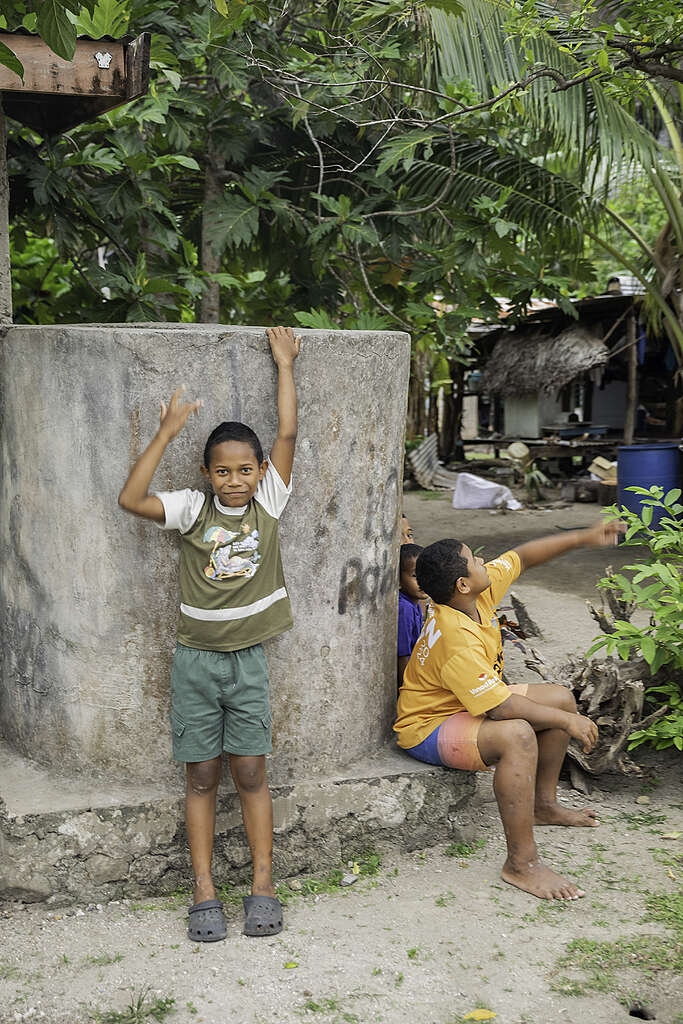
The island of Kioa is home to a Tuvaluan community who migrated from their atoll of Vaitupu in the late 1940s. It is a land of warm hearts, big smiles, and deep cultural roots; a place where the sound of a conch still summons the island together, where islanders paddle out to fish in carved outrigger canoes, and healthy happy children walk barefoot to school.
Here, culture is life. Kioans live sustainably through their traditional knowledge and practices. The island is alive with song, dance and the rhythms of a life tied to the tides, the winds, and the seasons.
Facing the future
Greenpeace has been lucky to have a relationship with Kioa for a number of years now, and we are continually learning from this remarkable community.
Last week, as part of our Voyaging Oceania project, we returned to the island. Our purpose was twofold —- to carry messages from the island to leaders gathering in Nadi this week for the Pacific Pre-COP, and to support the Kioa community in their efforts to improve water security for the island.
Unlike Tuvalu itself, with its eight atolls, Kioa is a mountainous, forested and richly fertile island. It will remain habitable far into the future. Kioans did not initially migrate from Vaitupu due to climate change, but the move was prophetic. They now have a lifeboat.
However, even Kioa faces challenges on our rapidly warming planet, in particular when it comes to water. Climate change is shifting once reliable rainfall patterns. On top of this,