Connect with us

Published

on

Europe’s Green Shift Hits Overdrive: Robotaxis Launch, EV Sales Surge, Emissions Fall

Europe’s climate transition is entering a new phase. In the space of a few weeks, three major developments have emerged across the continent: the launch of the first commercial robotaxi service, a historic surge in electric vehicle (EV) sales, and another drop in carbon emissions under the EU’s flagship trading system.

Each story is different, but together, they point in the same direction. Europe is rapidly reshaping how people move, how energy is consumed, and how emissions are controlled. At the same time, the pace and stability of this transition remain uneven.

Robotaxis Arrive: Europe’s First Commercial Deployment

Europe has officially entered the autonomous mobility era. In Zagreb, the Croatian company Verne launched the first robotaxi service in Europe. This service uses the seventh-generation system from the Chinese firm Pony.ai. The service allows the public to book and pay for fully autonomous rides using the Verne app.

The launch marks a shift from testing to real-world deployment. The service operates in a defined zone of around 90 square kilometers across central Zagreb, including the airport. It runs daily from 7:00 a.m. to 9:00 p.m., according to company disclosures.

The fleet uses Arcfox Alpha T5 electric vehicles, built by BAIC and equipped with Pony.ai’s Gen-7 autonomous driving technology. For safety, trained operators stay in the front seat during this early rollout. The system is fully autonomous for passengers in the back.

Each vehicle carries up to two passengers per trip, reflecting the controlled nature of this early deployment stage.

Verne, a spin-off from Rimac Group, operates the fleet. The company was originally planning a custom-built robotaxi but has now launched using existing vehicle platforms. It has already tested dozens of prototype vehicles and is preparing for scale-up.

This launch is significant for Europe. Until now, autonomous ride-hailing has been largely concentrated in the United States and China. Europe has been slower due to stricter safety rules and regulatory frameworks.

But the commercial rollout changes that narrative. As Verne’s leadership noted, Europe now needs autonomous systems that move beyond pilots into real services.

Expansion is already planned. Partners plan to expand to thousands of robotaxis in over 20 cities worldwide. Uber will also help with future deployments and investment talks. This suggests Zagreb is not the endpoint, but the starting point.

EV Sales Break Records as Fuel Prices Surge

At the same time, Europe’s electric vehicle market is accelerating at an unexpected pace.

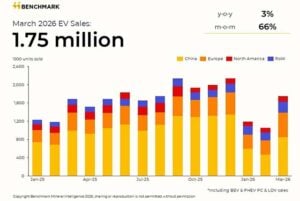
In March, the region hit over 500,000 monthly EV sales for the first time. Registrations jumped about 37% from last year, reaching nearly 540,000 units, based on data from Benchmark Mineral Intelligence. The region’s EV sales reached 1.2 million units in the first quarter, up 27% year-on-year.
March-2026-EV-sales europe from BMI

This surge is not happening in isolation. Rising fuel costs are tied to geopolitical disruptions that have increased global oil prices. As petrol and diesel became more expensive, consumers increasingly shifted toward electric alternatives.

The response has been immediate in major markets.

In Germany, the biggest car market in Europe, battery electric vehicle registrations soared 66.2% from last year. In March alone, over 70,000 units were registered, as reported by the Federal Motor Transport Authority (KBA). EVs now account for roughly 24% of all new car registrations in the country, overtaking petrol in monthly sales for the first time.

This is a major shift for a market that struggled just a year earlier. Germany cut subsidies in 2024, leading to a sharp drop in demand. Then, in 2026, it reversed the policy and reintroduced incentives of up to €6,000 for each electric vehicle. At the same time, fuel prices surged. Diesel crossed €2.50 per litre, one of the highest levels on record.

Elsewhere in Europe, similar trends are visible.

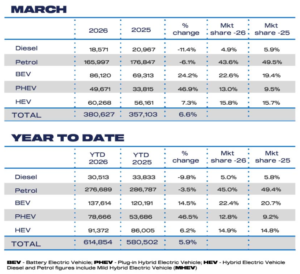
The UK saw 86,120 new battery electric vehicle registrations in March. This is a 24.2% increase compared to last year, according to the Society of Motor Manufacturers and Traders. EVs now represent over 22% of the UK market, although still below mandated targets for 2026.
UK EV new registrations
Source: whicheve.net

Across the continent, fuel prices have become a key driver of change. Gasoline prices jumped about 17% in key EU countries. Diesel surged up to 30% in some areas. This followed supply issues tied to geopolitical tensions and unstable oil routes.

Even after oil prices eased from earlier peaks near $120 per barrel, they remain significantly above pre-crisis levels, keeping pressure on consumers.

Online car platforms show how quickly sentiment is shifting. EV searches and inquiries have surged in Germany, the UK, and Spain. This shows a rising consumer urgency, not just slow adoption.

But questions remain about durability. Previous fuel-driven EV surges have faded once prices stabilized. This time, however, structural forces are stronger: tighter EU emissions rules, more affordable EV models, and expanding charging infrastructure are reinforcing demand.

A key economic factor is running cost. In markets like Belgium, driving an EV now costs 45–56% less per kilometre than petrol or diesel vehicles when charged at home.

Emissions Continue to Fall—but Progress Is Uneven

While transport electrification accelerates, Europe’s emissions trend continues downward.

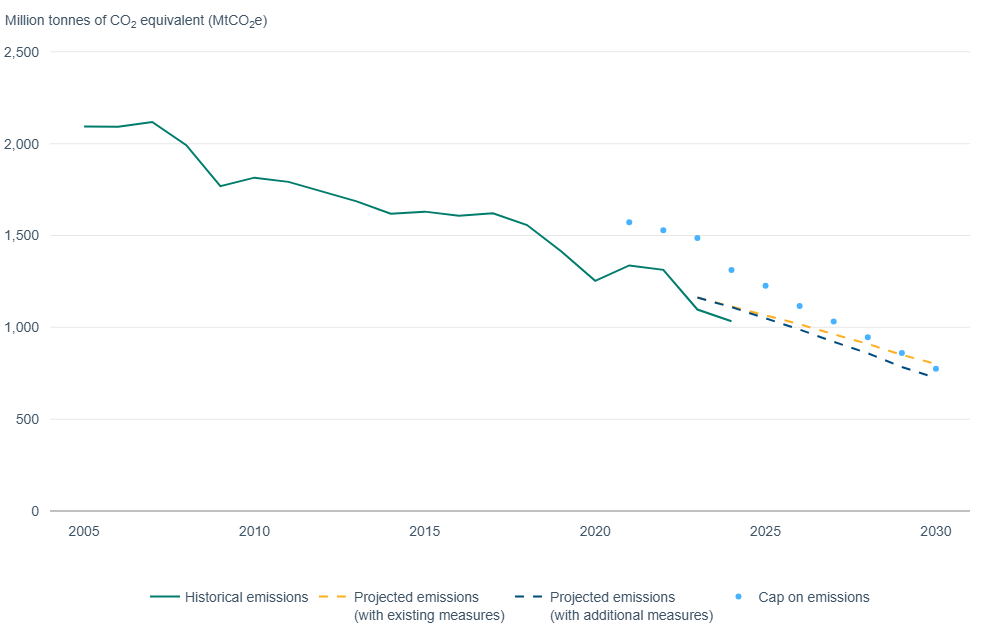
The European Commission reports that emissions under the EU Emissions Trading System (EU ETS) dropped by 1.3% in 2025. This decline continues a long-term trend in the bloc’s industrial and energy sectors.

The EU ETS covers around 45% of total EU greenhouse gas emissions, including power generation, heavy industry, aviation, and maritime transport. It operates under a declining cap system designed to force emissions reductions over time.

Since 2005, emissions in covered sectors have fallen by roughly 50%, placing the EU broadly on track toward its 2030 target of a 62% reduction.
EU EMISSIONS EU net zero
Source: EU

A major driver of recent progress is the power sector. Renewables continue to expand rapidly. Solar generation rose over 20% in 2025. Together, wind and solar made up about 30% of EU electricity. This marked the first time they surpassed fossil fuels in total share.

Overall, renewables supplied roughly 48% of Europe’s electricity in 2025, compared with declining fossil fuel contributions. Coal has seen the sharpest decline, falling to just 9.2% of electricity generation, down from nearly 25% a decade ago.
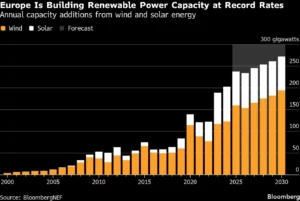
Europe renewable power capacity forecast 2030

However, the transition is not linear.

Natural gas usage has remained volatile, and in some cases increased, as it continues to play a balancing role in the energy system. Aviation emissions have also risen as travel demand recovered after the pandemic, highlighting one of the hardest sectors to decarbonize.

Carbon markets reflect this mixed picture. EU carbon allowance prices have remained around €70–75 per tonne, supported by steady demand but influenced by shifting energy dynamics.
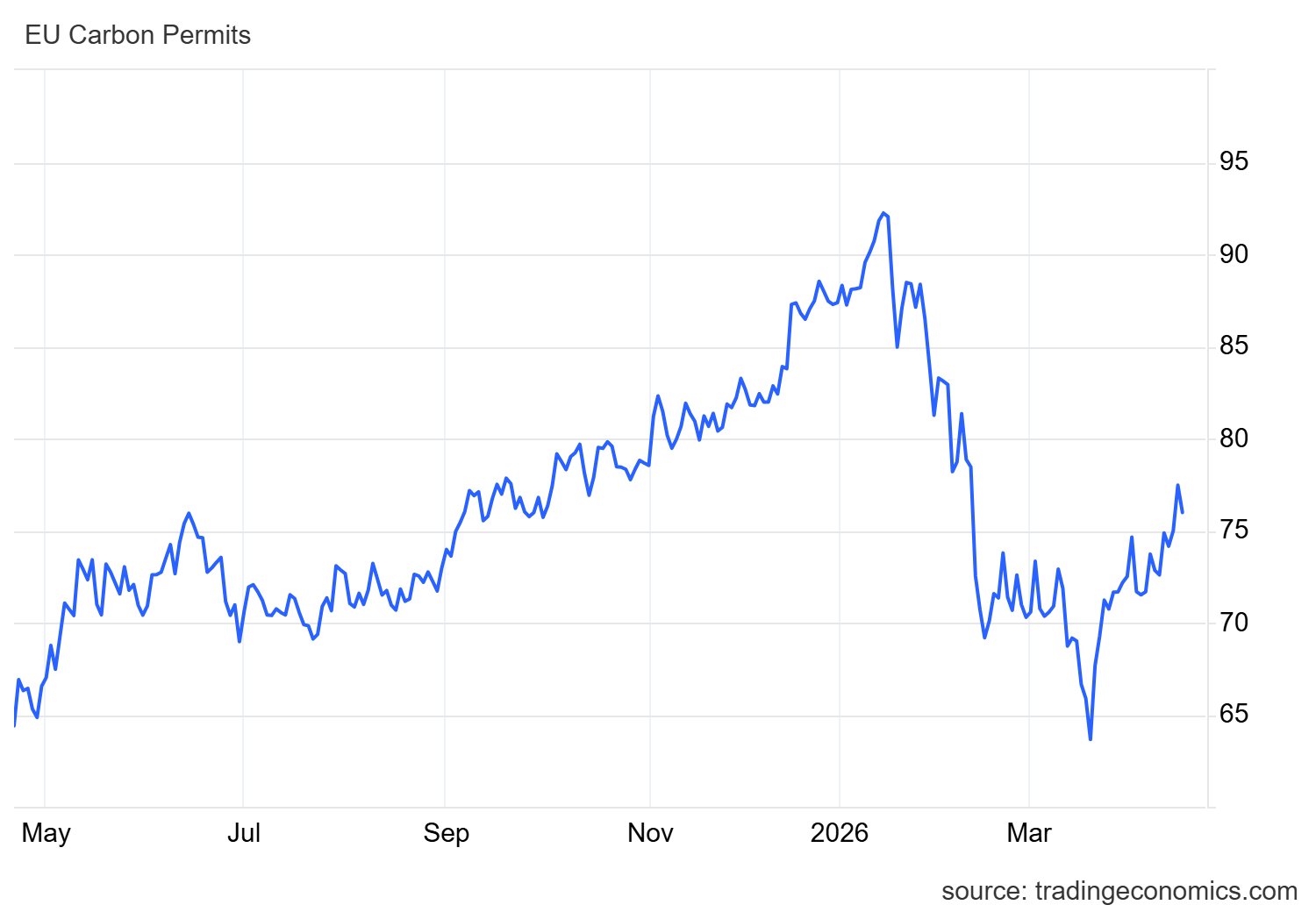
Eu carbon price april 2026

A Transition Moving at Uneven Speeds

Taken together, these three developments reveal a Europe that is transforming quickly—but not evenly. Robotaxis in Zagreb show how fast mobility innovation is moving when regulation, technology, and investment align.

Record EV sales show how sensitive consumer behaviour is to energy prices, incentives, and infrastructure. And falling emissions show that policy frameworks like the EU ETS are still effective in driving long-term reductions.

But they also show limitations. Electrification is rising, but unevenly across countries. Emissions are falling, but not fast enough in harder sectors like aviation and gas-heavy power systems. And innovation is advancing, but still constrained by regulation and scale.

Europe’s climate transition is no longer theoretical. It is visible in cities, car markets, and industrial emissions data. The path forward may be complex, and there are constraints; still, progress is real.

Europe is not just decarbonizing but is redesigning how mobility, energy, and industry interact. And that process is only just beginning.

The post Europe’s Green Shift Hits Overdrive: Robotaxis Launch, EV Sales Surge, Emissions Fall appeared first on Carbon Credits.

Continue Reading

Carbon Footprint

FIFA World Cup and the 3.7 Million-Tonne Problem: Can Football’s Biggest Event Reduce Its Climate Impact?

Published

on

FIFA World Cup and the 3.7 Million-Tonne Problem: Can Football’s Biggest Event Reduce Its Climate Impact?

As FIFA prepares for its upcoming World Cup tournaments from June 11 to July 19, 2026, its climate strategy is facing closer attention, too. The organization has set a goal to reach net zero emissions by 2040. It also aims to cut emissions by 50% by 2030.

These targets are part of FIFA’s long-term sustainability plan, which aligns with the UN Sports for Climate Action Framework and the Paris Agreement. FIFA first announced its climate strategy in 2021 and has since applied it across major tournaments.

However, the challenge is not setting targets. The real challenge is reducing emissions in a global event that depends on international travel. The World Cup is one of the most complex events to decarbonize because most emissions come from sources outside direct control.

FIFA’s Climate Commitments and Official Emissions Targets

FIFA’s climate strategy follows a structured pathway based on global climate standards. It includes measuring emissions, reducing them where possible, and offsetting what remains.

The organization has committed to three main actions:

  • Reduce greenhouse gas emissions by 50% by 2030.
  • Achieve net zero emissions by 2040.
  • Align operations with international climate frameworks.

FIFA reports emissions using standard greenhouse gas accounting. This includes tracking emissions across tournaments, host cities, and operational activities.

FIFA greenhouse gas emissions
Source: FIFA

In past tournaments, FIFA has introduced sustainability measures such as energy-efficient stadiums, waste reduction programs, and public transport planning. For example, several recent World Cup venues have used renewable electricity and modern cooling systems to reduce energy demand.

FIFA also works with host countries to improve infrastructure planning. This includes encouraging the use of existing stadiums and limiting new construction where possible. These steps aim to reduce emissions linked to building materials and long-term infrastructure.

Still, these efforts mainly affect operational emissions. The larger challenge lies beyond stadiums and facilities.

How Emissions Are Measured in the World Cup

FIFA measures emissions using the widely accepted Scope 1, Scope 2, and Scope 3 framework.

Scope 1 emissions come from direct sources such as fuel use in vehicles and on-site operations. Scope 2 emissions come from purchased electricity used in stadiums and facilities. These emissions can be reduced through renewable energy and efficiency improvements.

Scope 3 emissions include all indirect emissions linked to the event. These are the most complex and the largest category.

In the World Cup, Scope 3 emissions come from these sources:

  • International and domestic travel by fans,
  • Team and staff transportation,
  • Accommodation and hospitality services,
  • Supply chains and merchandise production, and
  • Broadcasting and logistics operations.

In large global events, Scope 3 emissions often account for more than half of total emissions. The share is even higher due to the scale of international travel in football tournaments. 

This structure shows that most emissions do not come from FIFA’s direct operations. They come from the wider system that supports the event.

By the Numbers: Inside the 3.7M Ton Carbon Footprint of 2026 World Cup

The FIFA World Cup is one of the largest global sporting events. The 2022 tournament in Qatar drew over 3.4 million spectators, according to FIFA, and reached billions of viewers worldwide. This level of participation creates a large environmental footprint.

For the 2026 FIFA World Cup, hosted by the United States, Canada, and Mexico, total emissions are projected at around 3.7 million tonnes of CO₂ equivalent (CO₂e). This estimate comes from the United 2026 bid’s environmental impact assessment. It reflects the full lifecycle footprint of the event, including travel, operations, and infrastructure.

Fifa world cup 2026 carbon footprint estimates

Transportation is the main driver of these emissions. About 85% of total emissions are linked to travel, especially air travel. This includes both international flights and travel between host cities.

The scale of the 2026 tournament adds to this challenge. It will feature 48 teams, up from 32 in previous editions, and will span multiple countries and cities. This increases travel demand, distances between matches, and overall logistics complexity.

The structure of emissions can be summarized as follows:

  • ~85% from travel-related activities (~3.15 million tonnes CO₂e)
  • ~15% from operations, energy use, and infrastructure (~0.55 million tonnes CO₂e)

Travel emissions alone include:

  • 51% from international journeys
  • 34% from travel between host cities

Compared with more compact tournaments, this format leads to higher emissions due to increased reliance on long-distance flights.

Scope 3 Emissions: The Core Climate Challenge

The emissions profile of the World Cup highlights a clear imbalance. Most emissions fall under Scope 3, which includes indirect sources such as travel, logistics, and supply chains.

Scope 1 and Scope 2 emissions, which cover direct operations and energy use, represent only a small share of the total footprint. These can be reduced through renewable energy and efficient design.

Scope 3 emissions are different. They come from activities outside FIFA’s direct control. These include fan travel, team transport, global logistics, and services linked to the event. This creates a structural challenge. Even if FIFA reduces emissions from stadiums and operations, total emissions can remain high due to travel demand.

Fifa world cup scope 3 emissions

  • In simple terms, the World Cup’s carbon footprint is driven more by movement than by infrastructure.

Scope 3 is also the hardest category to reduce. It depends on global travel patterns, geography, and individual choices. FIFA cannot fully control how fans travel or how often they move between cities.

This is why Scope 3 emissions are central to the climate challenge. They account for the largest share of emissions and the biggest barrier to reducing the World Cup’s overall footprint.

Cuts vs. Credits: The Ongoing Offset Debate

To meet its climate targets, FIFA uses both emissions reduction and carbon offsetting. Reduction focuses on lowering emissions at source. This includes improving energy efficiency, using renewable electricity, and optimizing event operations.

Offsetting is used to balance emissions that cannot be eliminated. This involves investing in projects that reduce or remove carbon emissions elsewhere.

FIFA climate strategies
Source: FIFA

FIFA’s approach includes:

  • Reducing energy use in stadiums and facilities,
  • Increasing the use of renewable electricity, and
  • Supporting carbon offset projects for remaining emissions.

Carbon offsets can include projects such as reforestation, renewable energy development, and carbon capture. However, their effectiveness depends on project quality, verification, and long-term impact.

This has led to debate in climate policy. Some experts argue that offsets should not replace real emissions reduction. Others point out that offsets can support the transition when used carefully.

The key issue is transparency. Clear reporting and verified data are needed to ensure that net-zero claims reflect real outcomes.

Why Net Zero Is Difficult for Mega Sports Events

Mega sporting events like the World Cup have unique challenges. They are temporary, global, and highly mobile. Their emissions come from:

  • International travel,
  • Temporary infrastructure,
  • Large-scale logistics, and 
  • Global audience participation.

Even with strong sustainability measures, these factors create a high baseline of emissions.

Take for example, the Paris 2024 Olympics. The event’s total footprint hit 1.7 million tonnes CO₂e. Travel caused 72%, that’s 1.2 million tonnes, from 720,000+ international visitors. Stadiums run on 100% renewables, but aviation emissions? Untouched.

Super Bowl LIX in 2025 told the same story. The event generated 400,000 tonnes CO₂e, with 85% coming from 150,000+ out-of-state fans flying to New Orleans. The NFL bought 400,000 offsets for carbon-neutral claims. Still, travel cuts? Zero.

mega sporting events emissions

This pattern is industry-wide. Organizers control stadium power. Fans control flights. These mega-events lean on offsets, not aviation reductions. FIFA faces the same problem that other organizers couldn’t easily resolve.

Thus, decarbonization becomes more complex. It also means progress may be slower compared to sectors with more direct control over emissions.

What a Credible Net Zero World Cup Requires

For FIFA’s net-zero goals to be credible, several conditions need to be met.

  • Emissions must be clearly measured and reported across all scopes. This includes full disclosure of total emissions before offsets are applied. Transparency is essential for trust.
  • There must also be a stronger focus on reducing emissions at source. While offsets can play a role, long-term progress depends on real reductions.
  • Independent verification of emissions data can improve credibility. Better coordination of travel and logistics can also help reduce unnecessary emissions.
  • In the long term, advances in low-carbon transport, including sustainable aviation fuels, may help reduce travel-related emissions.

Final Whistle: Can FIFA Turn Climate Targets Into Reality?

FIFA has set clear climate targets, including net zero emissions by 2040. These targets reflect growing pressure on global organizations to reduce their environmental impact.

However, the data shows a clear challenge. Most emissions from the World Cup come from indirect sources, especially global travel. Scope 3 emissions dominate the total footprint and remain difficult to control. This makes them the key factor in any net-zero strategy.

As the World Cup continues to grow in scale, emissions challenges will also increase. Operational improvements can reduce part of the impact, but they cannot fully address the larger system.

The future of football’s climate strategy will depend on how this gap is managed. The goal is not only to set targets, but also to achieve measurable and transparent progress in a global, complex system.

In this field, will FIFA lead or lag? We will watch this space closely.

The post FIFA World Cup and the 3.7 Million-Tonne Problem: Can Football’s Biggest Event Reduce Its Climate Impact? appeared first on Carbon Credits.

Continue Reading

Carbon Footprint

Rivian (RIVN) and Redwood Deploy 10 MWh Second-Life Battery Storage at Illinois Factory

Published

on

American EV maker Rivian and battery recycling leader Redwood Materials are showing how retired EV batteries can do more than power cars. Their new partnership at Rivian’s Illinois manufacturing plant uses second-life batteries as stationary energy storage, creating a model that could support factories, strengthen the grid, and lower electricity costs.

The project starts with more than 100 used Rivian battery packs. Together, they will deliver 10 megawatt-hours of dispatchable energy at Rivian’s Normal, Illinois facility. That stored energy will help the plant reduce electricity use during peak-demand periods, cut costs, and ease stress on the power system.

The numbers behind the opportunity are much larger. The press release reveals that by 2030, the U.S. is expected to need more than 600 gigawatt-hours of energy storage to support rising electricity demand, stabilize peak loads, and power expanding digital infrastructure. Simply put, it is equivalent to the total energy output of the Hoover Dam running continuously for two months.

Rivian Founder and CEO RJ Scaringe said,

“EVs represent a massive, distributed and highly competitive energy resource. As energy needs grow, our grid needs to be flexible, secure, and affordable. Our partnership with Redwood enables us to utilize our vehicle’s batteries beyond the life of a vehicle and contribute to grid health and American competitiveness.”

Second-Life Batteries Move Beyond Recycling

The Rivian-Redwood system gives retired EV batteries a second job before recycling. Redwood will integrate the battery packs into a stationary storage system using its Redwood Pack Manager software. The technology allows batteries with different levels of degradation and chemistries to work together safely.

This is important because EV batteries often remain healthy long after vehicles retire. Many can still serve for years as stationary storage assets. This creates a powerful circular economy model. Instead of going straight to recycling, batteries can generate added value while supporting energy needs.

redwood battery
Source: Redwood Materials

The supply potential is significant. Redwood already receives more than 20 GWh of batteries each year, equal to roughly 250,000 EVs. The company says that by 2030, end-of-life batteries could supply more than 50% of the entire energy storage market.

And this could make second-life batteries a major domestic energy resource.

JB Straubel, Redwood Materials Founder and CEO, also commented on this development. He said,

“Electricity demand is accelerating faster than the grid can expand, posing a constraint on industrial growth. At the same time, the massive amount of domestic battery assets already in the U.S. market represents a strategic energy resource. Our partnership with Rivian shows how EV battery packs can be turned into dispatchable energy resources, bringing new capacity online quickly, supporting critical manufacturing, and reducing strain on the grid without waiting years for new infrastructure. This is a scalable model for how we add meaningful energy capacity in the near term.”

Data Centers Drive Storage Demand

The timing is critical because electricity demand is accelerating.

Artificial intelligence, cloud computing, and hyperscale data centers are pushing power demand sharply higher. Research from the Belfer Center cited,

The Lawrence Berkeley National Laboratory predicts that data center demand will grow from 176 terawatt hours (TWh) in 2023 (or, about 4.4% of total U.S. electricity consumption) to between 325-580 TWh (6.7-12.0%) by 2028.

Secondly, according to the Battery Council International, data center demand is expected to quadruple by 2030, again driven by AI and cloud computing. This surge is one reason stationary battery systems are becoming essential.

BESS

Battery Energy Storage Systems, or BESS, help store electricity and release it when demand spikes. They support peak shaving, frequency regulation, microgrids, and backup power.

Uninterruptible Power Supply (UPS) systems play a different role. They provide immediate short-term power support for critical systems such as data centers, telecom networks, and emergency infrastructure, where even brief outages can cause major disruption.

Together, UPS and BESS are becoming critical to keeping digital infrastructure running.

Market Size

Speaking about market size, the global commercial and industrial battery energy storage market is forecast to reach $21 billion in value by 2036, driven by AI-fueled data center construction, according to research from Globe Newswire.

This is where the Rivian-Redwood model becomes useful. It connects second-life batteries to one of the fastest-growing needs in the energy system. The modular structure of repurposed battery systems may also allow faster deployment than traditional infrastructure, which can take years to build.

Circular Economy Meets Energy Security

The project also supports energy security. Using domestic battery assets for storage can reduce dependence on imported energy storage systems. It may also help defer billions of dollars in grid infrastructure upgrades. This is vital when the U.S. is looking for ways to expand electricity capacity faster.

Second-life batteries can also help during high-stress events. During heat waves or peak demand events, stored energy can be discharged instantly to reduce strain on the grid and avoid buying higher-cost electricity.

It creates economic and reliability benefits at the same time.

The partnership also shows how batteries are evolving from transportation assets into broader infrastructure assets. And this shift can have wide implications for manufacturing, utilities, defense facilities, and digital infrastructure.

Market Competition and Technology

Redwood faces competition from established players in the energy storage market. Tesla has been running Megapack as a first-life business, while Redwood is building a parallel market in second-life batteries.

The Redwood Pack Manager technology acts as specialized software that enables battery packs with different degradation levels and chemistries to work together safely. This capability is crucial for second-life applications where batteries have varying performance characteristics.

Second-life batteries are gaining traction in industrial applications. Battery costs have fallen to historic lows, making these projects increasingly viable economically.

A Blueprint for the Next Phase of Clean Energy

Rivian and Redwood’s 10 MWh deployment represents a practical solution to two major challenges: managing retired EV batteries and meeting surging industrial energy demand. The project demonstrates how automakers can extract additional value from their battery investments while supporting grid stability.

As AI-driven electricity demand continues climbing and EV adoption accelerates, second-life battery projects could become standard practice across the automotive industry. The success of this Illinois pilot may influence how other manufacturers approach end-of-life battery management, creating a new revenue stream while supporting America’s clean energy transition

This project suggests one answer is to connect those two problems. Old EV batteries can become new energy infrastructure.

The post Rivian (RIVN) and Redwood Deploy 10 MWh Second-Life Battery Storage at Illinois Factory appeared first on Carbon Credits.

Continue Reading

Carbon Footprint

How Carbon Credits Help Address Residual Emissions From Large Events

Published

on

If you’re considering the environmental impact of hosting an event, you might focus on logistics like energy efficiency, the food you serve, or the event materials distributed to attendees. While focusing on these types of areas can help soften the event’s environmental footprint and greenhouse gas emissions, it’s hard to build a truly sustainable event based on operational choices alone.

The problem is that events, especially large ones like conferences or major sporting events, tend to involve decisions outside your control, like how attendees travel to your event and how they consume resources at the event venue. These factors can create a significant negative impact, even when sustainability measures are in place.

Carbon emissions from people flying in to attend, one of the largest contributors to event related greenhouse gasses, can easily overshadow the emissions you avoid by reusing name badge lanyards from previous events, for example. And you might put out compost bins next to landfill and recycling containers, but at a busy, crowded event, an attendee might haphazardly throw whatever trash they have on hand into whatever bin they first see.

That’s not to say you shouldn’t try to focus on logistics, as sustainability isn’t all or nothing. Every step helps. And you may be able to make meaningful progress toward sustainability goals, based on choices like venue location, reducing reliance on traditional power plants, and improving energy savings through more efficient or renewable energy sources, such as swapping diesel generators for solar ones.

But if you really want to make your event net zero or at least get closer to minimizing environmental impacts, buying high quality carbon credits and other environmental credits, like renewable energy certificates, is often critical.

Doing so isn’t a shortcut to event sustainability. Instead, carbon credits can help you account for the areas outside your control, like travel emissions, as well as taking responsibility for the emissions impact of all the little details that you cannot reduce or avoid. Many carbon credit projects work to store carbon or support initiatives where emissions are actively reduced or carbon removed from the atmosphere, often at a large scale.

To ensure credibility, it’s important that carbon credits follow strict verification standards aligned with global frameworks like those supported by the United Nations. This helps prevent issues like double counting, where the same emissions reduction is claimed more than once.

Terrapass makes it easy to buy carbon credits for both individuals and businesses. You can buy credits that align with emissions from specific events like weddings, those that help address the impact of flying, or other personal or corporate packages based on your emissions goals.

Case Study: The Olympics

How Carbon Credits Help Address Residual Emissions from Large Events

The Olympics haven’t always had the best environmental reputation, such as with the legacy of host cities spinning up massive new sporting facilities that soon become abandoned. Recent Olympic Games, however, have made environmental sustainability and social responsibility more of a focal point.

For example, the Paris 2024 Games included significant sustainability efforts, such as with 95 percent of the venues being temporary or from preexisting infrastructure. Event organizers also added grid connections so that nearly all energy consumption came from renewable sources, reducing dependence on fossil fuel-based power plants and increasing overall energy savings, instead of relying as much on sources like diesel generators.

Yet despite reducing emissions by more than half compared to the preceding Rio and London summer Olympics, the Paris Games still had a carbon footprint of 1.59 million tCO2e, which was more than Netflix’s total Scope 1 to 3 emissions that year, for comparison. Nearly half of those emissions came from spectators traveling to the Games, indicating how hard it is to cut your way to zero while still maintaining the power of live events.

So, Paris 2024 spent €12.1 million on carbon sequestration and avoidance credits that matched the 1.59 million tCO2e residual emissions total. This included financing projects such as cooking systems in several African countries, solar projects in Senegal and Vietnam, deforestation protection in Guatemala and Kenya, and mangrove restoration in Senegal. These types of initiatives help store carbon and contribute to carbon removed from the atmosphere on a large scale. The Organising Committee also financed some forestry projects within France to more directly compensate for emissions within its control.

Another type of credit usage showed up recently during the Milano Cortina 2026 Olympics. Their commitment to using virtually all clean electricity during the Games was made possible in part by Italian electricity company Enel procuring Guarantees of Origin, essentially a European version of renewable energy certificates, that correspond with renewable energy, as PBS reported.

And for the upcoming LA 2028 Olympics, the host has established an internal carbon price as a way to incentivize efficiencies while also generating funds for the LA28 Resilience Champions Fund. This will finance local improvements rather than international carbon offsets. For example, the fund will focus on areas including cooling solutions like native tree planting, wildfire resilience such as by planting fire resilient native plants, and ocean protection such as through beach cleanups.

Going forward, carbon credits could become even more important to Olympic events, considering that in 2020, the International Olympic Committee (IOC) set a requirement that, starting in 2030, all host cities would need to go even further by making the Games climate positive. Granted, that has arguably since been softened, such as with Brisbane 2032’s contract being adjusted to make being climate positive more of a goal than a necessity.

Still, carbon credits and similar financing mechanisms will likely continue to provide ways for host cities to address unavoidable emissions, such as those associated with flying, while reducing their overall negative impact. In addition to addressing emissions, carbon credits also typically provide co benefits that support health and other positive outcomes in local communities.

Terrapass offers carbon credits across a broad range of project types, such as reforestation and landfill gas capture. You can support a mix of projects and their associated benefits with a monthly subscription of carbon credits for just $8.50 per employee that offsets what many businesses emit during normal operations, or you could build a carbon credit portfolio that aligns more with specific events if you’re hosting.

Using Carbon Offsets for Your Own Events

While you’re probably not hosting an Olympic sized event, similar strategies can be scaled to all sorts of other sustainable event planning, ranging from conferences to parties.

To fully balance emissions, an event organizer would ideally calculate total emissions. Depending on the scale of your event, this might require working with a third-party sustainability consultant that can assist with carbon accounting, or you might be able to use online carbon footprint calculators.

Even if you can’t map out all of your emissions, you might calculate some of the largest sources, like flight emissions. A virtual event might avoid a big chunk of these travel emissions, but that might run counter to your goals of facilitating in person bonding that’s hard to replicate online. So, if you’re hosting a company retreat in another city, for example, you could add up the flight miles among your employees and calculate the associated emissions.

While this doesn’t account for everything, such as on-site emissions like hotel energy usage and food, it can give you a good starting point. By at least purchasing flight carbon offsets, organizers can take responsibility for what is typically one of the largest emissions components of any large event, particularly those tied to greenhouse gasses. Meanwhile, you can make operational choices for your corporate event, like choosing a sustainable venue, reducing reliance on fossil fuel-based power plants, and improving energy savings through efficient practices.

You also may be able to buy carbon credits that align with the approximate emissions from specific types of events. For example, Terrapass sells carbon offsets for weddings, which you can scale according to how many guests you have and whether you also want to account for honeymoon emissions and the impact on water systems.

Whether you’re hosting a personal event or a large corporate one, Terrapass offers a mix of ready to buy carbon offset packages, or our team of sustainability experts can help you develop a custom carbon offset plan as you aim to balance your carbon footprint. By supporting verified projects that operate at a large scale, you can address emissions responsibly while contributing to meaningful climate solutions.

Talk to a Sustainability Expert Today

The post How Carbon Credits Help Address Residual Emissions From Large Events appeared first on Terrapass.

Continue Reading

Trending

Copyright © 2022 BreakingClimateChange.com

