

Doubts over whether governments will maintain ambitious targets on boosting the use of sustainable aviation fuel (SAF) are a threat to the industry’s growth and play into the hands of fossil fuel companies, investors warned this week.
Several executives from airlines and oil firms have forecast recently that SAF requirements in the European Union, United Kingdom and elsewhere will be eased or scrapped altogether, potentially upending the aviation industry’s main policy to shrink air travel’s growing carbon footprint.
Such speculation poses a “fundamental threat” to the SAF industry, which mainly produces an alternative to traditional kerosene jet fuel using organic feedstocks such as used cooking oil (UCO), Thomas Engelmann, head of energy transition at German investment manager KGAL, told the Sustainable Aviation Fuel Investor conference in London.
He said fossil fuel firms would be the only winners from questions about compulsory SAF blending requirements.
The EU and the UK introduced the world’s first SAF mandates in January 2025, requiring fuel suppliers to blend at least 2% SAF with fossil fuel kerosene. The blending requirement will gradually increase to reach 32% in the EU and 22% in the UK by 2040.
Another case of diluted green rules?
Speaking at the World Economic Forum in Davos in January, CEO of French oil and gas company TotalEnergies Patrick Pouyanné said he would bet “that what happened to the car regulation will happen to the SAF regulation in Europe”.
The EU watered down green rules for car-makers in March 2025 after lobbying from car companies, Germany and Italy.
“You will see. Today all the airline companies are fighting [against the EU’s 2030 SAF target of 6%],” Pouyanne said, even though it’s “easy to reach to be honest”.
While most European airline lobbies publicly support the mandates, Ryanair Group CEO Michael O’Leary said last year that the SAF is “nonsense” and is “gradually dying a death, which is what it deserves to do”.
EU and UK stand by SAF targets
But the EU and the British government have disputed that. EU transport commissioner Apostolos Tzitzikostas said in November that the EU’s targets are “stable”, warning that “investment decisions and construction must start by 2027, or we will miss the 2030 targets”.
UK aviation minister Keir Mather told this week’s investor event that meeting the country’s SAF blending requirement of 10% by 2030 was “ambitious but, with the right investment, the right innovation and the right outlook, it is absolutely within our reach”.
“We need to go further and we need to go faster,” Mather said.

SAF investors and developers said such certainty on SAF mandates from policymakers was key to drawing the necessary investment to ramp up production of the greener fuel, which needs to scale up in order to bring down high production costs. Currently, SAF is between two and seven times more expensive than traditional jet fuel.
Urbano Perez, global clean molecules lead at Spanish bank Santander, said banks will not invest if there is a perceived regulatory risk.
David Scott, chair of Australian SAF producer Jet Zero Australia, said developing SAF was already challenging due to the risks of “pretty new” technology requiring high capital expenditure.
“That’s a scary model with a volatile political environment, so mandate questioning creates this problem on steroids”, Scott said.
Others played down the risk. Glenn Morgan, partner at investment and advisory firm SkiesFifty, said “policy is always a risk”, adding that traditional oil-based jet fuel could also lose subsidies.

Asian countries join SAF mandate adopters
In Asia, Singapore, South Korea, Thailand and Japan have recently adopted SAF mandates, and Matti Lievonen, CEO of Asia-based SAF producer EcoCeres, predicted that China, Indonesia and Hong Kong would follow suit.
David Fisken, investment director at the Australian Trade and Investment Commission, said the Australian government, which does not have a mandate, was watching to see how the EU and UK’s requirements played out.
The US does not have a SAF mandate and under President Donald Trump the government has slashed tax credits available for SAF producers from $1.75 a gallon to $1.
Is the world’s big idea for greener air travel a flight of fancy?
SAF and energy security
SAF’s potential role in boosting energy security was a major theme of this week’s discussions as geopolitical tensions push the issue to the fore.
Marcella Franchi, chief commercial officer for SAF at France’s Haffner Energy, said the Canadian government, which has “very unsettling neighbours at the moment”, was looking to produce SAF to protect its energy security, especially as it has ample supplies of biomass to use as potential feedstock.
Similarly, German weapons manufacturer Rheinmetall said last year it was working on plans that would enable European armed forces to produce their own synthetic, carbon-neutral fuel “locally and independently of global fossil fuel supply chain”.
Scott said Australia needs SAF to improve its fuel security, as it imports almost 99% of its liquid fuels.
He added that support for Australian SAF production is bipartisan, in part because it appeals to those more concerned about energy security than tackling climate change.
The post Doubts over European SAF rules threaten cleaner aviation hopes, investors warn appeared first on Climate Home News.
Doubts over European SAF rules threaten cleaner aviation hopes, investors warn

Three countries have been named by the Paris Agreement’s compliance committee for failing to submit a nationally determined contribution (NDC) and repeatedly snubbing offers of help with their climate plans.
After months of internal debate over whether to identify serial non-responders, the Paris Agreement’s Implementation and Compliance Committee (PAICC) named the three countries which have failed to engage with it over their NDCs on Friday.
It named Democratic Republic of Congo, Senegal and North Korea in a footnote of its annual report, adding that it decided to name them “with a view to facilitating engagement”, adding that representatives of the three nations had been invited to its meeting in early 2027 “with the purpose of identifying any challenges and constraints”.
“The Committee noted the importance of Parties engaging with the Committee in a timely manner, while noting that some delays may be due to the national capabilities and circumstances of the Parties”, the report said.
-
Under US pressure, World Bank says it will back gas “where appropriate”
The US wants the World Bank to expand its gas support while climate campaigners are pushing for it to end – its head spoke this week of limited backing for the fossil fuel -
IPCC scientists vow to press on with climate reports despite political deadlock
After governments again failed to agree a timeline, nearly 120 IPCC authors pledged to complete their assessment on time and with full scientific rigour -
Paris Agreement committee snubbed over missing NDC climate plans
Many governments have still not submitted a nationally determined contribution to the UN, breaching a key requirement of the Paris Agreement

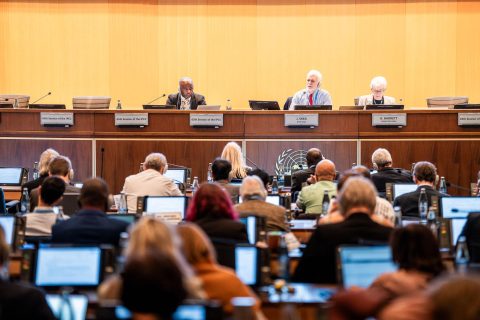

In July, PAICC said 12 countries had ignored its repeated attempts to discuss why they had not published an NDC as required every five years under the 2015 Paris accord.
Members of the committee had been divided over whether to name them, but at a September meeting decided to do so in their annual report to the annual climate COP summit.
By the time the report was published on Friday, only Congo, Senegal and North Korea “had not communicated an NDC or submitted a [Biennial Transparency Report] and had not yet responded to any of the Committee’s notifications, despite several reminders issued by the Committee in this regard”.
Rainforest and renewable energy ambitions
The silence from Congo and Senegal is notable because the former is home to much of the Congo Basin rainforest while the latter has sought billions of dollars in climate finance to support its renewable energy ambitions.
After Brazil, Congo has more rainforest than any country in the world. This forest, and the country’s peatlands, absorb huge amounts of greenhouse gas but are fast being lost to expanding farmland, charcoal production, logging and mining.
Senegal signed a Just Energy Transition Partnership with Canada and wealthy European nations in 2023, to help it meet its renewable energy targets under the-then government of Macky Sall. It was chair of the Least Developed Countries group between January 2022 and December 2023.

Tejas Rao, who is researching the PAICC as part of a doctoral thesis at Cambridge University, said the governments of the three countries should engage with the committee.
“Engagement costs these governments very little and the committee has shown it will listen,” he said.
“Silence leaves the committee with no basis to help, and it leaves the [governments] exposed to the narrative that they are simply disengaged,” he told Climate Home News.
Paris Agreement requirement
The 2015 Paris Agreement requires all parties to publish an NDC every five years outlining their emissions reduction targets, with each plan meant to be more ambitious than the country’s last NDC.
The latest set – the third round of plans, with new targets for 2035 – was due in February 2025. While most countries missed this deadline, all but around 30 – mostly small emitters but including Egypt, Vietnam and Argentina – have now submitted them.
Over the year, the PAICC – which is made up of government climate officials from developed and developing countries – has been communicating with governments that have not submitted NDCs and trying to overcome barriers to them doing so.
Some nations have cited exceptional circumstances as the reason for not submitting an NDC, a process that requires a significant amount of work in tracking emissions and consulting on how to curb them across the economy. For example, a letter from a Sudanese official to the PAICC, seen by Climate Home News, said that the country’s civil war had led to the suspension of its NDC preparation.
-
IPCC scientists vow to press on with climate reports despite political deadlock
After governments again failed to agree a timeline, nearly 120 IPCC authors pledged to complete their assessment on time and with full scientific rigour -
Under US pressure, World Bank says it will back gas “where appropriate”
The US wants the World Bank to expand its gas support while climate campaigners are pushing for it to end – its head spoke this week of limited backing for the fossil fuel -
Who shapes climate science? The equity question facing the IPCC
Early completion of the next global climate science assessment reports risks excluding research from the Global South, which is key to ensuring the findings are fair
The US and Iran are not signed up to the Paris Agreement and so do not have active NDCs, nor does Taiwan, which is not a UN member state.
Rao said that because the PAICC is “facilitative and non-punitive”, naming the countries “is meant to open a door, not close one – the invited consultation is the point”.
“In recent months, governments that explained their constraints, whether capacity, finance or domestic process, have been met with follow-up and support rather than sanction, and the number of silent governments has fallen sharply,” Rao said.
The post Paris Agreement committee names three countries snubbing it over NDCs appeared first on Climate Home News.
Paris Agreement committee names three countries snubbing it over NDCs