

Seven Pacific island nations say they will demand heftier levies on global shipping emissions if opponents of a green deal for the industry succeed in reopening negotiations on the stalled accord.
The United States and Saudi Arabia persuaded countries not to grant final approval to the International Maritime Organization’s Net-Zero Framework (NZF) in October and they are now leading a drive for changes to the deal.
In a joint submission seen by Climate Home News, the seven climate-vulnerable Pacific countries said the framework was already a “fragile compromise”, and vowed to push for a universal levy on all ship emissions, as well as higher fees . The deal currently stipulates that fees will be charged when a vessel’s emissions exceed a certain level.
“For many countries, the NZF represents the absolute limit of what they can accept,” said the unpublished submission by Fiji, Kiribati, Vanuatu, Nauru, Palau, Tuvalu and the Solomon Islands.
The countries said a universal levy and higher charges on shipping would raise more funds to enable a “just and equitable transition leaving no country behind”. They added, however, that “despite its many shortcomings”, the framework should be adopted later this year.
US allies want exemption for ‘transition fuels’
The previous attempt to adopt the framework failed after governments narrowly voted to postpone it by a year. Ahead of the vote, the US threatened governments and their officials with sanctions, tariffs and visa restrictions – and President Donald Trump called the framework a “Green New Scam Tax on Shipping”.
Since then, Liberia – an African nation with a major low-tax shipping registry headquartered in the US state of Virginia – has proposed a new measure under which, rather than staying fixed under the NZF, ships’ emissions intensity targets change depending on “demonstrated uptake” of both “low-carbon and zero-carbon fuels”.
The proposal places stringent conditions on what fuels are taken into consideration when setting these targets, stressing that the low- and zero-carbon fuels should be “scalable”, not cost more than 15% more than standard marine fuels and should be available at “sufficient ports worldwide”.
This proposal would not “penalise transitional fuels” like natural gas and biofuels, they said. In the last decade, the US has built a host of large liquefied natural gas (LNG) export terminals, which the Trump administration is lobbying other countries to purchase from.
The draft motion, seen by Climate Home News, was co-sponsored by US ally Argentina and also by Panama, a shipping hub whose canal the US has threatened to annex. Both countries voted with the US to postpone the last vote on adopting the framework.
-
IMO head: Shipping decarbonisation “has started” despite green deal delay
Arsenio Dominguez said the shipping industry’s net zero emissions goal is not in dispute although countries have stalled on adopting a framework to reach it -
US-led alliance wins a year’s delay in adoption of green shipping deal
The IMO’s Net-Zero Framework will be up for approval again in October 2026, after the US and Saudi Arabia persuaded countries not to vote on it as planned


The IMO’s Panamanian head Arsenio Dominguez told reporters in January that changes to the framework were now possible.
“It is clear from what happened last year that we need to look into the concerns that have been expressed [and] … make sure that they are somehow addressed within the framework,” he said.
Patchwork of levies
While the European Union pushed firmly for the framework’s adoption, two of its shipping-reliant member states – Greece and Cyprus – abstained in October’s vote.
After a meeting between the Greek shipping minister and Saudi Arabia’s energy minister in January, Greece said a “common position” united Greece, Saudi Arabia and the US on the framework.
If the NZF or a similar instrument is not adopted, the IMO has warned that there will be a patchwork of differing regional levies on pollution – like the EU’s emissions trading system for ships visiting its ports – which will be complicated and expensive to comply with.
This would mean that only countries with their own levies and with lots of ships visiting their ports would raise funds, making it harder for other nations to fund green investments in their ports, seafarers and shipping companies. In contrast, under the NZF, revenues would be disbursed by the IMO to all nations based on set criteria.
Anais Rios, shipping policy officer from green campaign group Seas At Risk, told Climate Home News the proposal by the Pacific nations for a levy on all shipping emissions – not just those above a certain threshold – was “the most credible way to meet the IMO’s climate goals”.
“With geopolitics reframing climate policy, asking the IMO to reopen the discussion on the universal levy is the only way to decarbonise shipping whilst bringing revenue to manage impacts fairly,” Rios said.
“It is […] far stronger than the Net-Zero Framework that is currently on offer.”
The post Pacific nations want higher emissions charges if shipping talks reopen appeared first on Climate Home News.
Pacific nations want higher emissions charges if shipping talks reopen

Three countries have been named by the Paris Agreement’s compliance committee for failing to submit a nationally determined contribution (NDC) and repeatedly snubbing offers of help with their climate plans.
After months of internal debate over whether to identify serial non-responders, the Paris Agreement’s Implementation and Compliance Committee (PAICC) named the three countries which have failed to engage with it over their NDCs on Friday.
It named Democratic Republic of Congo, Senegal and North Korea in a footnote of its annual report, adding that it decided to name them “with a view to facilitating engagement”, adding that representatives of the three nations had been invited to its meeting in early 2027 “with the purpose of identifying any challenges and constraints”.
“The Committee noted the importance of Parties engaging with the Committee in a timely manner, while noting that some delays may be due to the national capabilities and circumstances of the Parties”, the report said.
-
Under US pressure, World Bank says it will back gas “where appropriate”
The US wants the World Bank to expand its gas support while climate campaigners are pushing for it to end – its head spoke this week of limited backing for the fossil fuel -
IPCC scientists vow to press on with climate reports despite political deadlock
After governments again failed to agree a timeline, nearly 120 IPCC authors pledged to complete their assessment on time and with full scientific rigour -
Paris Agreement committee snubbed over missing NDC climate plans
Many governments have still not submitted a nationally determined contribution to the UN, breaching a key requirement of the Paris Agreement

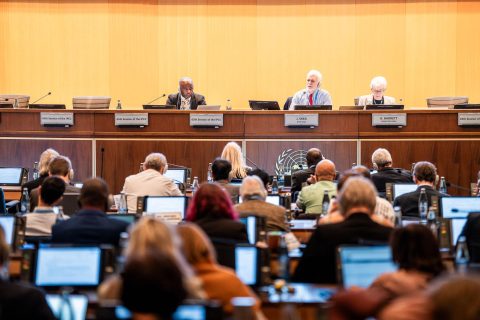

In July, PAICC said 12 countries had ignored its repeated attempts to discuss why they had not published an NDC as required every five years under the 2015 Paris accord.
Members of the committee had been divided over whether to name them, but at a September meeting decided to do so in their annual report to the annual climate COP summit.
By the time the report was published on Friday, only Congo, Senegal and North Korea “had not communicated an NDC or submitted a [Biennial Transparency Report] and had not yet responded to any of the Committee’s notifications, despite several reminders issued by the Committee in this regard”.
Rainforest and renewable energy ambitions
The silence from Congo and Senegal is notable because the former is home to much of the Congo Basin rainforest while the latter has sought billions of dollars in climate finance to support its renewable energy ambitions.
After Brazil, Congo has more rainforest than any country in the world. This forest, and the country’s peatlands, absorb huge amounts of greenhouse gas but are fast being lost to expanding farmland, charcoal production, logging and mining.
Senegal signed a Just Energy Transition Partnership with Canada and wealthy European nations in 2023, to help it meet its renewable energy targets under the-then government of Macky Sall. It was chair of the Least Developed Countries group between January 2022 and December 2023.

Tejas Rao, who is researching the PAICC as part of a doctoral thesis at Cambridge University, said the governments of the three countries should engage with the committee.
“Engagement costs these governments very little and the committee has shown it will listen,” he said.
“Silence leaves the committee with no basis to help, and it leaves the [governments] exposed to the narrative that they are simply disengaged,” he told Climate Home News.
Paris Agreement requirement
The 2015 Paris Agreement requires all parties to publish an NDC every five years outlining their emissions reduction targets, with each plan meant to be more ambitious than the country’s last NDC.
The latest set – the third round of plans, with new targets for 2035 – was due in February 2025. While most countries missed this deadline, all but around 30 – mostly small emitters but including Egypt, Vietnam and Argentina – have now submitted them.
Over the year, the PAICC – which is made up of government climate officials from developed and developing countries – has been communicating with governments that have not submitted NDCs and trying to overcome barriers to them doing so.
Some nations have cited exceptional circumstances as the reason for not submitting an NDC, a process that requires a significant amount of work in tracking emissions and consulting on how to curb them across the economy. For example, a letter from a Sudanese official to the PAICC, seen by Climate Home News, said that the country’s civil war had led to the suspension of its NDC preparation.
-
IPCC scientists vow to press on with climate reports despite political deadlock
After governments again failed to agree a timeline, nearly 120 IPCC authors pledged to complete their assessment on time and with full scientific rigour -
Under US pressure, World Bank says it will back gas “where appropriate”
The US wants the World Bank to expand its gas support while climate campaigners are pushing for it to end – its head spoke this week of limited backing for the fossil fuel -
Who shapes climate science? The equity question facing the IPCC
Early completion of the next global climate science assessment reports risks excluding research from the Global South, which is key to ensuring the findings are fair
The US and Iran are not signed up to the Paris Agreement and so do not have active NDCs, nor does Taiwan, which is not a UN member state.
Rao said that because the PAICC is “facilitative and non-punitive”, naming the countries “is meant to open a door, not close one – the invited consultation is the point”.
“In recent months, governments that explained their constraints, whether capacity, finance or domestic process, have been met with follow-up and support rather than sanction, and the number of silent governments has fallen sharply,” Rao said.
The post Paris Agreement committee names three countries snubbing it over NDCs appeared first on Climate Home News.
Paris Agreement committee names three countries snubbing it over NDCs