Climate Change
Doubts over European SAF rules threaten cleaner aviation hopes, investors warn
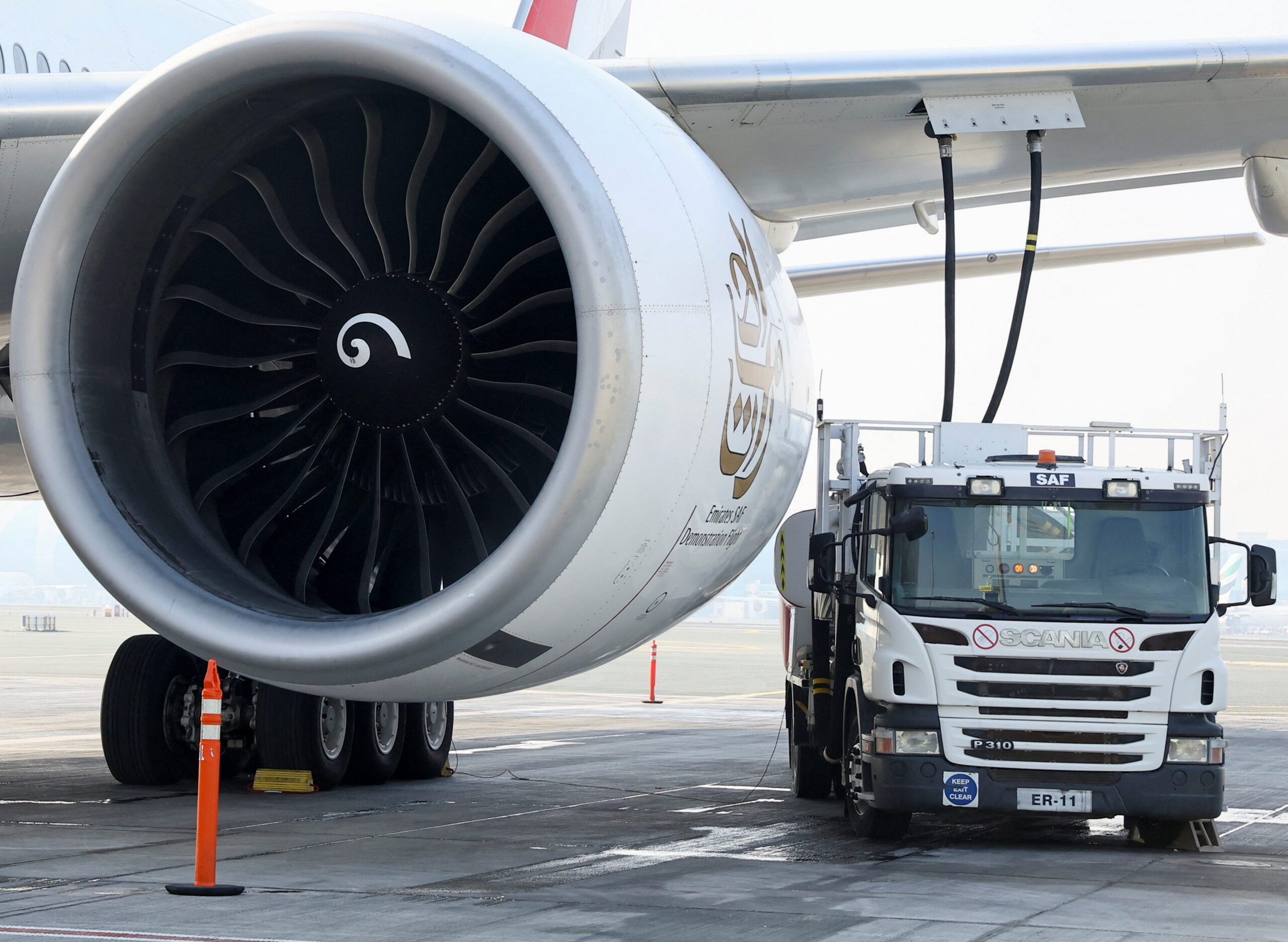
Doubts over whether governments will maintain ambitious targets on boosting the use of sustainable aviation fuel (SAF) are a threat to the industry’s growth and play into the hands of fossil fuel companies, investors warned this week.
Several executives from airlines and oil firms have forecast recently that SAF requirements in the European Union, United Kingdom and elsewhere will be eased or scrapped altogether, potentially upending the aviation industry’s main policy to shrink air travel’s growing carbon footprint.
Such speculation poses a “fundamental threat” to the SAF industry, which mainly produces an alternative to traditional kerosene jet fuel using organic feedstocks such as used cooking oil (UCO), Thomas Engelmann, head of energy transition at German investment manager KGAL, told the Sustainable Aviation Fuel Investor conference in London.
He said fossil fuel firms would be the only winners from questions about compulsory SAF blending requirements.
The EU and the UK introduced the world’s first SAF mandates in January 2025, requiring fuel suppliers to blend at least 2% SAF with fossil fuel kerosene. The blending requirement will gradually increase to reach 32% in the EU and 22% in the UK by 2040.

Another case of diluted green rules?
Speaking at the World Economic Forum in Davos in January, CEO of French oil and gas company TotalEnergies Patrick Pouyanné said he would bet “that what happened to the car regulation will happen to the SAF regulation in Europe”.
The EU watered down green rules for car-makers in March 2025 after lobbying from car companies, Germany and Italy.
“You will see. Today all the airline companies are fighting [against the EU’s 2030 SAF target of 6%],” Pouyanne said, even though it’s “easy to reach to be honest”.
While most European airline lobbies publicly support the mandates, Ryanair Group CEO Michael O’Leary said last year that the SAF is “nonsense” and is “gradually dying a death, which is what it deserves to do”.
EU and UK stand by SAF targets
But the EU and the British government have disputed that. EU transport commissioner Apostolos Tzitzikostas said in November that the EU’s targets are “stable”, warning that “investment decisions and construction must start by 2027, or we will miss the 2030 targets”.
UK aviation minister Keir Mather told this week’s investor event that meeting the country’s SAF blending requirement of 10% by 2030 was “ambitious but, with the right investment, the right innovation and the right outlook, it is absolutely within our reach”.
“We need to go further and we need to go faster,” Mather said.


SAF investors and developers said such certainty on SAF mandates from policymakers was key to drawing the necessary investment to ramp up production of the greener fuel, which needs to scale up in order to bring down high production costs. Currently, SAF is between two and seven times more expensive than traditional jet fuel.
Urbano Perez, global clean molecules lead at Spanish bank Santander, said banks will not invest if there is a perceived regulatory risk.
David Scott, chair of Australian SAF producer Jet Zero Australia, said developing SAF was already challenging due to the risks of “pretty new” technology requiring high capital expenditure.
“That’s a scary model with a volatile political environment, so mandate questioning creates this problem on steroids”, Scott said.
Others played down the risk. Glenn Morgan, partner at investment and advisory firm SkiesFifty, said “policy is always a risk”, adding that traditional oil-based jet fuel could also lose subsidies.

Asian countries join SAF mandate adopters
In Asia, Singapore, South Korea, Thailand and Japan have recently adopted SAF mandates, and Matti Lievonen, CEO of Asia-based SAF producer EcoCeres, predicted that China, Indonesia and Hong Kong would follow suit.
David Fisken, investment director at the Australian Trade and Investment Commission, said the Australian government, which does not have a mandate, was watching to see how the EU and UK’s requirements played out.
The US does not have a SAF mandate and under President Donald Trump the government has slashed tax credits available for SAF producers from $1.75 a gallon to $1.
Is the world’s big idea for greener air travel a flight of fancy?
SAF and energy security
SAF’s potential role in boosting energy security was a major theme of this week’s discussions as geopolitical tensions push the issue to the fore.
Marcella Franchi, chief commercial officer for SAF at France’s Haffner Energy, said the Canadian government, which has “very unsettling neighbours at the moment”, was looking to produce SAF to protect its energy security, especially as it has ample supplies of biomass to use as potential feedstock.
Similarly, German weapons manufacturer Rheinmetall said last year it was working on plans that would enable European armed forces to produce their own synthetic, carbon-neutral fuel “locally and independently of global fossil fuel supply chain”.
Scott said Australia needs SAF to improve its fuel security, as it imports almost 99% of its liquid fuels.
He added that support for Australian SAF production is bipartisan, in part because it appeals to those more concerned about energy security than tackling climate change.
The post Doubts over European SAF rules threaten cleaner aviation hopes, investors warn appeared first on Climate Home News.
Doubts over European SAF rules threaten cleaner aviation hopes, investors warn