A report analyzing carbon credit demand for over 400 airlines under the Carbon Offsetting and Reduction Scheme for International Aviation (CORSIA) projects significant fluctuations in credit prices and airline costs.
According to modeling by MSCI Carbon Markets, CORSIA-eligible carbon credits could cost between $18-51 per tonne of carbon dioxide equivalent (CO2e) during Phase I, rising to $27-91 in Phase II. If airlines pass these costs on to consumers, international ticket prices could increase by 0.5-1.0% in Phase I.
Alternatively, if airlines absorb the costs, their operating profits could decrease by up to 4%. The impact will vary depending on different demand and supply scenarios.
We crunch the report and here are our key takeaways.
What Are CORSIA Credits? A Flight Plan for Emission Reductions
The aviation sector is one of the fastest-growing contributors to global greenhouse gas (GHG) emissions. As international air travel expands, airlines face increasing pressure to mitigate their environmental impact.

The CORSIA, developed by the International Civil Aviation Organization (ICAO), is designed to limit emissions growth in international aviation. By purchasing carbon offsets known as CORSIA credits, airlines can balance emissions exceeding 2020 levels and invest in sustainability.
CORSIA credits allow airlines to compensate for their emissions by funding projects that reduce or remove CO2. These projects include renewable energy initiatives, reforestation, and carbon capture technologies. Verified under internationally recognized standards such as the Verified Carbon Standard (VCS) and the Gold Standard, these credits ensure that emission reductions are real, additional, and permanent.
CORSIA aims to cap international aviation emissions at 2020 levels. Through its two implementation phases—voluntary (2021–2023) and mandatory (from 2024)—the program encourages investment in global sustainability while aligning the aviation industry with broader climate goals.
Carbon Credit Demand: Will Airlines Keep Up with Rising Costs?
CORSIA’s demand for carbon credits hinges on international aviation growth and decarbonization efforts. Using a bottom-up modeling approach, MSCI Carbon Markets analysts assess individual airline emissions, growth rates, and adoption of sustainable practices to project credit needs.
Demand Scenarios
Three scenarios highlight the variability in credit demand:
- High-Demand Scenario: Strong aviation growth (+4% annually) and slow adoption of sustainable aviation fuels (SAFs) result in higher offsetting needs. Estimated demand reaches 137 million metric tons of CO2 equivalent (MtCO2e) in Phase I (2024–2026) and 1,299 MtCO2e in Phase II (2027–2035).
- Medium-Demand Scenario: Moderate aviation growth and increased decarbonization lower credit demand to 123 MtCO2e in Phase I and 1,006 MtCO2e in Phase II.
- Low-Demand Scenario: Limited growth and poor adoption of SAFs reduce requirements to 106 MtCO2e in Phase I and 502 MtCO2e in Phase II.

Regional and Airline-Level Insights
Demand will be concentrated among major airlines and regions. For instance, the top 10 airlines are expected to account for 40% of cumulative demand by 2035.
European carriers are likely to lead credit purchases despite regional compliance mechanisms such as the EU Emissions Trading System (ETS). If the ETS is expanded to cover more flights, global demand for CORSIA credits could decrease by 25–50% by 2050.
Supply Struggles: Why CORSIA Credit Availability Could Impact Aviation
The supply of CORSIA-eligible credits faces significant challenges. Credits must meet ICAO criteria, including corresponding adjustments that prevent double counting of emissions reductions under a country’s Nationally Determined Contributions (NDCs). This process requires host countries to authorize projects and align carbon accounting frameworks—a complex and underdeveloped requirement.
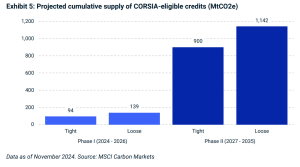
As of late 2024, ICAO-approved registries like Verra, Gold Standard, and Climate Action Reserve have expanded the potential credit pool to 230 MtCO2e. However, only 7 MtCO2e of these credits meet Phase I criteria due to limited corresponding adjustments.
Most eligible credits have been issued by a single REDD+ project in Guyana under ART TREES.
A lack of Letters of Authorization (LoAs) from host countries further constrains supply. Of 40 major credit-producing countries assessed, only two are highly prepared to issue LoAs. Without accelerated regulatory progress, substantial credit supply growth is unlikely until the late 2020s.
Projections and Flexibility
Supply projections factor in registry eligibility, crediting timelines, and the readiness of host countries to provide corresponding adjustments. A 30% reduction is applied to projects not yet in the registry pipeline. Despite these hurdles, expanded registry approvals and government action could gradually increase the availability of CORSIA-compliant credits.
Scenarios for Carbon Prices: How High Will CORSIA Credits Soar?
The prices of CORSIA credits will depend on supply-demand dynamics, influenced by credit availability, international aviation growth, and compliance requirements.
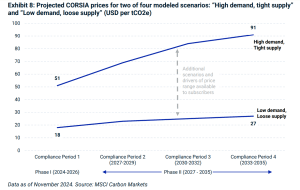
Under high-demand and tight-supply scenarios, Phase I credit prices are expected to range between $18 and $51 per ton of CO2. Prices could climb to $27–$91 per ton during the fourth compliance period (2033–2035) as demand peaks.
Supply-Demand Scenarios
- Tight Supply: A potential deficit of 12–43 million tons of CO2 in Phase I could drive prices higher.
- Loose Supply: A surplus of 2–33 million tons of CO2 may stabilize prices during Phase I. Airlines also have a grace period until January 2028 to offset emissions, easing initial supply constraints.
In Phase II, higher demand from aviation and other sectors, such as corporate voluntary commitments and sovereign programs, could lead to significant price increases.
Market Value Estimates
The market for CORSIA-eligible credits could reach $2–$8 billion by Phase I and grow to $5–$66 billion by the fourth compliance period. This growth reflects both rising demand and the financial implications of carbon market integration.
Implications for Airlines and Carbon Markets
CORSIA credits are an essential tool for airlines to manage emissions and comply with climate regulations. However, reliance on credits is only a short-term solution.
Long-term strategies include investment in SAFs or Sustainable Aviation Fuel, fleet upgrades, and operational efficiencies. Airlines with slower decarbonization may face higher offsetting costs, incentivizing innovation and sustainable practices.
Geopolitical factors and regulatory developments will heavily influence the carbon market. Expanding participation and ensuring the environmental integrity of credits are critical to maintaining trust and achieving emissions reductions.
CORSIA credits are pivotal to the aviation industry’s efforts to cap emissions and contribute to global climate goals. Although challenges remain in scaling credit supply and ensuring regulatory compliance, CORSIA serves as a transitional mechanism while the sector invests in greener technologies. As demand for high-quality offsets grows, the aviation industry’s collaboration with carbon markets will shape the roadmap of global emissions reductions.
The post CORSIA Credits Soaring Costs: How They Are Reshaping Aviation’s Future appeared first on Carbon Credits.
Carbon Footprint
Finding Nature Based Solutions in Your Supply Chain
Carbon Footprint
How Climate Change Is Raising the Cost of Living
Americans are paying more for insurance, electricity, taxes, and home repairs every year. What many people may not realize is that climate change is already one of the drivers behind those rising costs.
For many households, climate change is no longer just an environmental issue. It is becoming a cost-of-living issue. While climate impacts like melting glaciers and shrinking polar ice can feel distant from everyday life, the financial effects are already showing up in monthly budgets across the country.
Today, a larger share of household income is consumed by fixed costs such as housing, insurance, utilities, and healthcare. (3) Climate change and climate inaction are adding pressure to many of those expenses through higher disaster recovery costs, rising energy demand, infrastructure repairs, and increased insurance risk.
The goal of this article is to help connect climate change to the everyday financial realities people already experience. Regardless of where someone stands on climate policy, it is important to recognize that climate change is already increasing costs for households, businesses, and taxpayers across the United States.
More conservative estimates indicate that the average household has experienced an increase of about $400 per year from observed climate change, while less conservative estimates suggest an increase of $900.(1) Those in more disaster-prone regions of the country face disproportionate costs, with some households experiencing climate-related costs averaging $1,300 per year.(1) Another study found that climate adaptation costs driven by climate change have already consumed over 3% of personal income in the U.S. since 2015.(9) By the end of the century, housing units could spend an additional $5,600 on adaptation costs.(1)
Whether we realize it or not, Americans are already paying for climate change through higher insurance premiums, energy costs, taxes, and infrastructure repairs. These growing expenses are often referred to as climate adaptation costs.
Without meaningful climate action, these costs are expected to continue rising. Choosing not to invest in climate action is also choosing to spend more on climate adaptation.
Here are a few ways climate change is already increasing the cost of living:
- Higher insurance costs from more frequent and severe storms
- Higher energy use during longer and hotter summers
- Higher electricity rates tied to storm recovery and grid upgrades
- Higher government spending and taxpayer-funded disaster recovery costs
The real debate is not whether climate change costs money. Americans are already paying for it. The question is where we want those costs to go. Should we invest more in climate action to help reduce future climate adaptation costs, or continue paying growing recovery and adaptation expenses in everyday life?
How Climate Change Is Increasing Insurance Costs
There is one industry that closely tracks the financial impact of natural disasters: insurance. Insurance companies are focused on assessing risk, estimating damages, and collecting enough revenue to cover losses and remain financially stable.
Comparing the 20-year periods 1980–1999 and 2000–2019, climate-related disasters increased 83% globally from 3,656 events to 6,681 events. The average time between billion-dollar disasters dropped from 82 days during the 1980s to 16 days during the last 10 years, and in 2025 the average time between disasters fell to just 10 days. (6)
According to the reinsurance firm Munich Re, total economic losses from natural disasters in 2024 exceeded $320 billion globally, nearly 40% higher than the decade-long annual average. Average annual inflation-adjusted costs more than quadrupled from $22.6 billion per year in the 1980s to $102 billion per year in the 2010s. Costs increased further to an average of $153.2 billion annually during 2020–2024, representing another 50% increase over the 2010s. (6)
In the United States, billion-dollar weather and climate disasters have also increased significantly. The average number of billion-dollar disasters per year has grown from roughly three annually during the 1980s to 19 annually over the last decade. In 2023 and 2024, the U.S. recorded 28 and 27 billion-dollar disasters respectively, both setting new records. (6)
The growing impact of climate change is one reason insurance costs continue to rise. “There are two things that drive insurance loss costs, which is the frequency of events and how much they cost,” said Robert Passmore, assistant vice president of personal lines at the Property Casualty Insurers Association of America. “So, as these events become more frequent, that’s definitely going to have an impact.” (8)
After adjusting for inflation, insurance costs have steadily increased over time. From 2000 to 2020, insurance costs consistently grew faster than the Consumer Price Index due to rising rebuilding costs and weather-related losses.(3) Between 2020 and 2023 alone, the average home insurance premium increased from $75 to $360 due to climate change impacts, with disaster-prone regions experiencing especially steep increases.(1) Since 2015, homeowners in some regions affected by more extreme weather have seen home insurance costs increased by nearly 57%.(1) Some insurers have also limited or stopped offering coverage in high-risk areas.(7)
For many families, rising insurance costs are no longer occasional financial burdens. They are becoming recurring monthly expenses tied directly to growing climate risk.
How Rising Temperatures Increase Household Energy Costs

The financial impacts of climate change extend beyond insurance. Rising temperatures are also changing how much energy Americans use and how utilities plan for future electricity demand.
Between 1950 and 2010, per capita electricity use increased 10-fold, though usage has flattened or slightly declined since 2012 due to more efficient appliances and LED lighting. (3) A significant share of increased energy demand comes from cooling needs associated with higher temperatures.
Over the last 20 years, the United States has experienced increasing Cooling Degree Days (CDD) and decreasing Heating Degree Days (HDD). Nearly all counties have become warmer over the past three decades, with some areas experiencing several hundred additional cooling degree days, equivalent to roughly one additional degree of warmth on most days. (1) This trend reflects a warming climate where air conditioning demand is increasing while heating demand generally declines. (4)
As temperatures continue rising, households are expected to spend more on cooling than they save on heating. The U.S. Energy Information Administration (EIA) projects that by 2050, national Heating Degree Days will be 11% lower while Cooling Degree Days will be 28% higher than 2021 levels. Cooling demand is projected to rise 2.5 times faster than heating demand declines. (5)
These projections come from energy and infrastructure experts planning for future electricity demand and grid capacity needs. Utilities and grid operators are already preparing for higher peak summer electricity loads caused by rising temperatures. (5)
Longer and hotter summers also affect how homes and buildings are designed. Buildings constructed for past climate conditions may require upgrades such as larger air conditioning systems, stronger insulation, and improved ventilation to remain comfortable and energy efficient in the future. (10)
For many households, this means higher monthly utility bills and potentially higher long-term home improvement costs as temperatures continue to rise.
How Climate Change Affects Electricity Rates
On an inflation-adjusted basis, average U.S. residential electricity rates are slightly lower today than they were 50 years ago. (2) However, climate-related damage to utility infrastructure is creating new upward pressure on electricity costs.
Electric utilities rely heavily on above-ground poles, wires, transformers, and substations that can be damaged by hurricanes, storms, floods, and wildfires. Repairing and upgrading this infrastructure often requires substantial investment.
As a result, utilities are increasing electricity rates in response to wildfire and hurricane events to fund infrastructure repairs and future mitigation efforts. (1) The average cumulative increase in per-household electricity expenditures due to climate-related price changes is approximately $30. (1)
While this increase may appear modest today, utility costs are expected to rise further as climate-related infrastructure damage becomes more frequent and severe.
How Climate Disasters Increase Government Spending and Taxes
Extreme weather events also damage public infrastructure, including roads, schools, bridges, airports, water systems, and emergency services infrastructure. Recovery and rebuilding costs are often funded through taxpayer dollars at the federal, state, and local levels.
The average annual government cost tied to climate-related disaster recovery is estimated at nearly $142 per household. (1) States that frequently experience hurricanes, wildfires, tornadoes, or flooding can face even higher public recovery costs.
These expenses affect taxpayers whether they personally experience a disaster or not. Climate-related recovery spending can increase pressure on public budgets, emergency management systems, and infrastructure funding nationwide.
Reducing Climate Costs Through Climate Action
While this article focuses on the growing financial costs associated with climate change, the issue is not only about money for many people. It is also about recognizing our environmental impact and taking responsibility for reducing it in order to help preserve a healthy planet for future generations.
While individuals alone cannot solve climate change, collective action can help reduce future climate adaptation costs over time.
For those interested in taking action, there are three important steps:
- Estimate your carbon footprint to better understand the emissions connected to your lifestyle and activities.
- Create a plan to gradually reduce emissions through energy efficiency, cleaner technologies, and more sustainable choices.
- Address remaining emissions by supporting verified carbon reduction projects through carbon credits.
Carbon credits are one of the most cost-effective tools available for climate action because they help fund projects that generate verified emission reductions at scale. Supporting global emission reduction efforts can help reduce the long-term impacts and costs associated with climate change.
Visit Terrapass to learn more about carbon footprints, carbon credits, and climate action solutions.
The post How Climate Change Is Raising the Cost of Living appeared first on Terrapass.
Carbon Footprint
Carbon credit project stewardship: what happens after credit issuance
A carbon credit purchase is not a transaction that closes at issuance. The credit may be retired, the certificate filed, and the reporting box ticked. But on the ground, in the forest, in the field, and in the community, the work continues. It endures for years. In many cases, for decades.
![]()
-
Greenhouse Gases10 months ago
Guest post: Why China is still building new coal – and when it might stop
-
Climate Change10 months ago
Guest post: Why China is still building new coal – and when it might stop
-
Greenhouse Gases2 years ago嘉宾来稿:满足中国增长的用电需求 光伏加储能“比新建煤电更实惠”
-

Climate Change2 years ago嘉宾来稿:满足中国增长的用电需求 光伏加储能“比新建煤电更实惠”
-
Climate Change2 years ago
Bill Discounting Climate Change in Florida’s Energy Policy Awaits DeSantis’ Approval
-
Renewable Energy7 months agoSending Progressive Philanthropist George Soros to Prison?
-
Carbon Footprint2 years agoUS SEC’s Climate Disclosure Rules Spur Renewed Interest in Carbon Credits
-
Greenhouse Gases10 months ago
嘉宾来稿:探究火山喷发如何影响气候预测

