


With their substantial energy consumption and carbon emissions, hotel and restaurant chains are becoming key targets for reducing greenhouse gas (GHG) emissions through improved sustainability practices. Major companies like Chipotle, Marriott, Hilton, and others are presenting two conflicting faces.
On one side, these companies boast about their efforts to reduce carbon emissions and take strong climate action. Chipotle, for instance, offers an app that lets customers track the carbon footprint of their meals.
On the other side, these companies are involved in trade associations that are actively opposing local and state climate regulations, often filing lawsuits that could hamper environmental progress.
How Far Do Hotels And Restaurants Are in Lowering Their Emissions?
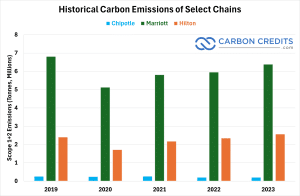
Chipotle aims to cut its GHG emissions by 50% by 2030. The restaurant managed to reduce Scope 1 (direct) and 2 (indirect from purchased energy) emissions by 13% in 2023 but Scope 3 (other indirect) emissions rose by the same percentage due to new restaurant openings.
- The restaurant chain reduced carbon emissions by 20% (vs. 2019 baseline) while growing its business by 80% as shown in the chart.
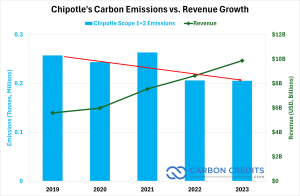
Chipotle’s strategy focuses on energy efficiency, reducing demand for traditional energy resources, and increasing the use of low-carbon and renewable energy. They commit to designing restaurants that rely less on fossil fuels like natural gas and aim for 100% renewable energy use.
Marriott and Hilton have made similar commitments, pledging to slash their emissions by nearly 50% by the same year.
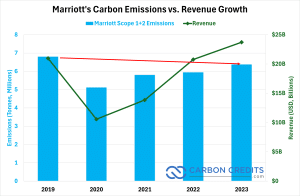
Marriott aims to cut absolute Scope 1 and 2 GHG emissions by 46.2% by 2030, using 2019 as a baseline. It also targets a 27.5% reduction in Scope 3 emissions, covering energy use, waste, and employee commuting. However, despite carbon reduction efforts, the hotel’s emissions (Scope 1+2) rose (7%) alongside its revenue (14%) in 2023 compared with 2022.
Moreover, the hotel plans for 22% of its suppliers to adopt science-based carbon emissions reduction targets by 2028.
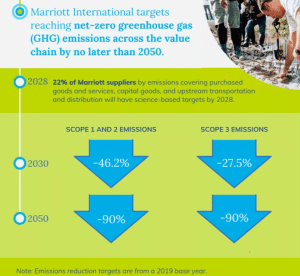
By 2050, the company aims to achieve a 90% reduction in Scope 1, 2, and 3 emissions, including emissions removal through bioenergy feedstocks. Marriott focuses on 3 distinct levers to reach its net zero target:
- Energy reduction,
- Getting energy from renewable sources, and
- Buying goods with lower carbon footprints
Hilton Worldwide aims for net zero by 2030, with clear targets for reducing Scope 1, Scope 2, and Scope 3 emissions. In 2023, Hilton reported Scope 1 and 2 emissions of 2,570,111 MT CO2e, reflecting a 9% increase from 2022. Meanwhile, revenue also increased by 17% for the same period.
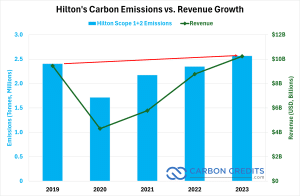
For Scope 3, the company reduced emissions from franchises by 5.50%, down to 4,020,579 MT CO2e. Hilton aims to cut Scope 1 and 2 emissions intensity by 75% from managed hotels and reduce Scope 3 emissions intensity from franchised hotels by 56%, both by 2030, using a 2008 baseline. The hospitality company was able to cut emissions intensity for managed hotels by 45% in 2023.
The problem of the climate policy split among hotels and restaurants is significant as their climate impact is substantial. Buildings, in particular, play a significant role in carbon emissions. The heating, cooling, and electricity consumed by commercial and residential structures account for about 35% of GHG emissions in the U.S., with large hotels and restaurants contributing a significant portion.

Climate Promises vs. Reality
In cities like Denver, lawmakers have passed ambitious climate regulations aimed at reducing the carbon footprint of buildings. The rules require large buildings, including hotels, to improve their energy efficiency by implementing measures like installing LED lighting, using heat pumps, and adding solar panels.
- For example, Denver’s building performance standards mandate that around 3,000 buildings cut their energy use by 30% by 2030.
While some buildings, like a quarter of those in Denver, already meet the 2030 goals, others, such as the Sheraton Denver Downtown Hotel (part of Marriott), may need to reduce their energy consumption by more than one-third.
However, despite the public climate commitments of companies like Marriott and Hilton, their trade associations have opposed these building efficiency rules. In April, groups such as the Colorado Hotel & Lodging Association (where Marriott executives hold key board positions) filed lawsuits to block both state and city climate mandates. These legal actions argue that the regulations are preempted by federal energy law and claim that complying with the rules would cost billions of dollars.
The inconsistency between hotel climate pledges and trade group actions creates confusion among consumers and policymakers. Companies like Chipotle, which promote their sustainability efforts, are also key members of the Restaurant Law Center, a trade association leading lawsuits against climate regulations in multiple cities, including Denver.
Marriott, too, distances itself from the actions of the Colorado Hotel & Lodging Association, stating that it does not control the group’s decisions, even though its representatives hold influential board positions. These contradictions make it difficult for cities and states to advance meaningful climate legislation.
The Dilemma in Driving Climate Policy
Buildings are major contributors to climate change, accounting for significant carbon emissions, particularly in urban areas. In cities like Denver, buildings are responsible for roughly half of all climate emissions due to their reliance on methane gas for heating and electricity consumption, much of which is sourced from fossil fuels.
To combat this, many cities and states have implemented building performance standards aimed at improving energy efficiency, primarily targeting large commercial buildings like hotels and offices. These regulations offer flexibility in how building operators achieve energy reductions, allowing options such as lighting upgrades or solar installations.
The conflicts between the corporate climate commitments of major hotels and restaurant chains and trade association actions could have far-reaching implications. If industry groups succeed in rolling back city and state climate regulations, it could undermine hospitality companies’ efforts to reduce their carbon emissions.
At the same time, these legal battles send mixed messages to consumers, who increasingly expect these companies to take a stand on environmental issues.
As cities and states take on an increasingly important role in driving climate policy, the need for corporate transparency and accountability on climate issues has never been more urgent.
- SEE MORE: EU Regulations Poised to Catalyze Global Carbon Market Convergence, Says Trafigura’s Hauman
The post The Net Zero Game: Are Hotels and Restaurants Truly Committed to Reducing Carbon Emissions? appeared first on Carbon Credits.

EU carbon credit claims changed on 27 September 2026, the day the Directive (EU) 2024/825 began to apply across the European Union. The change is narrow. It changes how a company can talk about the credits it buys. A product can no longer be called neutral on the strength of compensation alone; however, every specific, evidenced statement about what a company measured, reduced, and funded stays fully available.

The post Promoting Improved Cooking Practices in Nigeria appeared first on Terrapass.


Ming Yang Eyes 33 MW Turbine, Greenvolt Delays FID
‘A strong start’: WA’s transition to renewable energy powerhouse aided by Premier’s announcement
WA EPA warned Woodside of ‘serious, significant and irreversible’ harms to Scott Reef from gas plans, new documents reveal
-
Climate Change1 year ago
Guest post: Why China is still building new coal – and when it might stop
-

 Greenhouse Gases2 years ago
嘉宾来稿:满足中国增长的用电需求 光伏加储能“比新建煤电更实惠”
-
Greenhouse Gases1 year ago
Guest post: Why China is still building new coal – and when it might stop
-

 Climate Change2 years ago
嘉宾来稿:满足中国增长的用电需求 光伏加储能“比新建煤电更实惠”
-

 Renewable Energy1 year ago
Sending Progressive Philanthropist George Soros to Prison?
-
Climate Change2 years ago
Bill Discounting Climate Change in Florida’s Energy Policy Awaits DeSantis’ Approval
-
Greenhouse Gases1 year ago
嘉宾来稿:探究火山喷发如何影响气候预测
-

 Climate Change2 years ago
Analysis: China’s CO2 falls 1% in Q2 2024 in first quarterly drop since Covid-19