Connect with us

Published

on

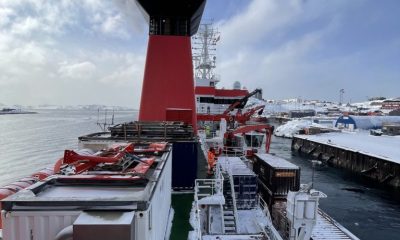
Hello from the tip of Greenland. After two days of semi-smooth sailing, we saw Greenland for the first time this morning and reached the southernmost point of our cruise. From now on, it’s only getting colder, the days are getting longer, and the work gets harder:)

Malte and Carmen, two hard-working ‘HiWis’, student assistant scientists from GEOMAR

To recap on the last three days: we set sail Tuesday morning and waved Reykjavik Goodbye from the pilot deck. This day was spent watching puffins and paying close attention to the mandatory safety drill. When the general alarm was sounded (seven short rings and one long one, repeatedly), we grabbed the life jackets from our cabins and tried to find the fastest way to the muster station. Everybody put their life jackets on, and it was ensured nobody was missing. Then the abandon ship alarm was sounded (short, long, short, long), and we proceeded to the free-fall lifeboat in the ship’s rear. In the boat, there is a seat for everybody on the ship, and it is quite a challenge to fold yourself into the seat, especially for tall people. Nonetheless, jokes were made that the lifeboat has more legroom than a Ryanair flight. Once everybody was seated and buckled up, the captain gave the command from the bridge that the drill was over. Hungry from all the excitement, we enjoyed a great dinner: fried potatoes, cauliflower, schnitzel, and broccoli. 

An even more exciting thing happened after dinner when we stood outside on the deck. Right after 5 minutes, we could see the blows from some whales. It seemed that they were following the ship at some distance. When you see some whales, the best thing to do is to go up directly to the bridge and get binoculars from the captain to have a closer look. On Wednesday and Thursday, the waves were getting higher, and the ship started shaking much more. So, instead of looking for whales, we slept, trying not to throw up. During the times when the seasickness pills were effective, we spent hours labeling and preparing our equipment for the soon-to-be samples.

This Friday morning, we could lay eyes for the first time on Greenland; combined with small pieces of sea ice floating by in the dark blue ocean and the sun shining from a blue sky, it accumulated to a truly magical moment even though no whales were there to greet us. A crisp and icy breeze blew away the seasickness, and the excitement rose in expectation of our first samples.

In case you are wondering who we are and what we are about to sample, we are Malte and Carmen, two assistant scientists from GEOMAR. Our goal is to collect sediment cores from the seafloor inside the Greenland fjords with an interest in the microbiology of these sediments. Later on, we will (hopefully) give you the good news about our successful sampling.

Greetings from Malte and Carmen:)

Greetings from Geomar’s coring team 🙂

Ocean Acidification

Cloud: The Pearl on the Crown

Published

on

By Qi-Fan Wu (Niels Bohr Institutet, University of Copenhagen)

During our journey, we saw many beautiful cloud patterns while looking outside the METEOR!  Even though people do not always pay attention to them, clouds are among the most visible elements of the sky and naturally form part of our everyday background. And when we sailed away from the coastal region of Recife to the open ocean, the sky seemed to open up, allowing clouds to reveal their full variety and structure.

In climate modelling, clouds are one of the biggest sources of uncertainty. There is a famous saying in mathematics: “Mathematics is the queen of the sciences, number theory is the crown of mathematics, and the Goldbach Conjecture is the pearl on the crown.” The same idea can be applied to the study of clouds in Earth science. There is still no general macroscopic theory of clouds. Cloud physics is an absolutely fascinating topic, as it combines turbulence, stochastic processes, chemicals in the air, multiscale interactions within the Earth–atmosphere system, and a close connection to our daily weather.

In this blog entry, we would like to share some lovely photos of cloud patterns that we took on METEOR. Instead of serious systematic investigations, we focus on the basic cloud physics behind some typical cloud phenomena shown in these photos. These examples might provide something interesting to think about during our leisure time, even after returning to land. If nature is an artist, clouds are among its finest masterpieces, shaped by physical laws and stochastic processes.

What are clouds, and what is inside them? Clouds are made of many liquid water droplets and ice crystals inside the boundaries of the cloud. They are mostly air, with the many particles dispersed widely and more or less randomly throughout the cloud interiors [a]. The individual particles that make up a cloud are very, very small and not generally visible to the human eye.

When we look up from our research vessel METEOR and observe clouds, we first see their macroscopic structure: their overall shape, height, thickness, and organization across the sky. Broad, layered clouds often form through slow, large-scale ascent, while towering clouds with visible turrets reflect rapid rising motion in smaller air parcels. These visible forms are continuously shaped by moisture supply, cooling, turbulence, mixing with drier air, and precipitation, linking the large-scale atmospheric flow to the clouds we observe [a,b].

After leaving Recife, we entered a region typically influenced by the southeast trade winds of the tropical South Atlantic, where a vertically layered atmosphere, warm ocean conditions, and wind-driven mixing often promote a turbulent marine boundary layer. In Figure 1, the sky shows a layered cloudscape ranging from thin, high cirrostratus and altocumulus clouds to low cumulus and towering cumulonimbus clouds. These different forms reflect how the atmosphere organizes moisture, cooling, and vertical motion: broad layers are associated with gradual ascent, while the rising turrets of cumulus and cumulonimbus reveal stronger localized updrafts. Together, they illustrate the visible macroscopic structure of clouds, shaped by atmospheric motion and the microphysical processes occurring within them.

Figure 1: Photograph showing different cloud types observed near 04°06.5’S, 23°18.5’W, together with a schematic summary of the major cloud types. Adapted from a photograph by Federico Scarscelli and [a].

It should be noted that, in general, atmospheric temperature in the troposphere decreases with increasing altitude. Over the subtropical oceans, however, this is not the case. A relatively thin temperature-inversion layer lies above the subtropical marine boundary layer, within which temperature increases with height and the atmosphere is highly stable (Figure 2). Cloud occurrence above the marine boundary layer is relatively low in this region. The base of the trade-wind inversion is typically located at an altitude of approximately 1–2 km, separating the moist lower layer from the dry free troposphere [c].

Figure 2: Schematic illustration of the key physical processes in the marine boundary layer. Adapted from [c].

This large-scale thermodynamic structure provides the environmental conditions under which clouds form and evolve. At the microscopic scale, however, clouds consist of particles: liquid water droplets, ice crystals, or a mixture of both. Clouds composed entirely of liquid droplets are commonly referred to as “warm clouds”, whereas clouds containing ice particles are classified as “cold clouds”. When liquid droplets and ice crystals coexist, the cloud is described as a mixed-phase cloud. However, the distinction between “warm” and “cold” clouds hinge on the phase of the particles, not on the temperature. The warm/cold distinction depends on the microphysical phase of the particles inside the cloud, which a normal naked eye observation cannot resolve.

Warm clouds consist of liquid water droplets spanning a range of sizes, from small haze droplets and cloud condensation nuclei to cloud droplets, drizzle drops, and raindrops (Figure 3). Cloud droplets typically form when water vapour condenses onto cloud condensation nuclei. Rainfall develops when some droplets grow much larger: larger droplets fall faster, collide with smaller droplets, and collect them. As a result, many small cloud droplets can combine to form fewer, larger drizzle drops and eventually raindrops [a]. This process approximately conserves the total liquid-water mass within the cloud, while transferring water from numerous small droplets to a much smaller number of large drops that are heavy enough to fall as rain.

Figure 3: Relative sizes of various liquid drops found in clouds. The bright spots highlighted by the green circles are circumzenithal halos produced by the refraction of sunlight through hexagonal ice crystals. Adapted from a photograph by Herbert Rafael Barbosa near 10°22.8’S 35°40.8’W and [a].

Cold clouds contain ice particles, either alone or together with supercooled liquid water droplets [a]. Unlike liquid droplets, which are nearly spherical because of surface tension, ice particles can develop a wide range of crystalline shapes, including plates, columns, needles, dendrites, and aggregates (Figure 4). Their shape depends mainly on temperature and ice supersaturation during growth by water-vapour deposition. As ice crystals become large enough to fall, they may collide and stick together to form snow aggregates, or collect supercooled droplets that freeze on contact, a process known as riming. The regular hexagonal structure of ice crystals can also produce optical phenomena such as halos, which form when sunlight is refracted or reflected by suitably oriented ice crystals in high-level clouds as shown in Figure 3. In mixed-phase clouds, uplift supports the growth of ice crystals at the expense of supercooled droplets. Once sufficiently large, the ice precipitates and may melt into rain or drizzle while falling through the melting layer (Figure 3).

Figure 4: Conceptual illustration of cold-cloud microphysical processes. Ice crystals grow in the subfreezing part of the cloud, precipitate downward, and melt into drizzle or rain as they pass through the melting layer. Localized updrafts can recirculate hydrometeors and promote further ice production. Photographs of snow crystals and a classification of snow-crystal habits by temperature and excess water-vapour density are also shown. Adapted from a photograph by Leonie Jaeger taken near 10°22.8′ S, 35°40.8′ W, and from [a, b].

When we approached the equator, we saw many cumulus clouds with remarkably flat bases, marking the lifting condensation level where warm, moist air rising from the ocean cooled to its dew point and condensed into droplets. Similar temperature/humidity across an area leads to clouds sharing flat bases. Their uneven, towering tops reflected continued turbulence and convection above this level, revealing the active vertical mixing of the tropical atmosphere (Figure 5). As moist tropical air rises toward the cold-point tropopause, it encounters extremely low temperatures. When an air mass reaches a local temperature minimum, water vapour can freeze into very thin cirrus clouds (Figure 6).

Figure 5: Flat-bottomed, fluffy-topped cumulus clouds. Adapted from a photograph by Joelle Habib taken near 00°00.0’S, 23°06.8’W.
Figure 6: Cirrus uncinus clouds. Adapted from a photograph by Joelle Habib taken near 00°00.0’S, 23°06.8’W.

After crossing the equator, we entered the Intertropical Convergence Zone (ITCZ), a band of heavy rainfall extending across the tropical Atlantic. Cloud organization within and around the ITCZ varies markedly from day to day. Extensive low-level stratocumulus clouds can also occur in the surrounding region, acting like a blanket that reduces the amount of incoming solar radiation reaching the ocean surface (Figure 7).

Figure 7: Cloud patterns in the ITCZ. Adapted from a photograph by Naomi Krauzig taken near 10°05.5′N, 23°02.5′W.

As we continued northward on our way home, we moved closer to the continent and witnessed some spectacular roll clouds, a very rare meteorological phenomenon. This type of cloud is known as “Morning Glory,” although evening land breezes can also produce roll clouds. The roll cloud is not attached to other clouds. associated with a solitary wave, a wave that has a single crest and moves without changing speed or shape.

As we were relatively close to the shoreline of West Africa, these roll clouds may have been produced by internal gravity waves propagating along a stable marine boundary layer [d]. The collision or sudden advance of a sea breeze or cold front can disturb the stable air layer near the surface, generating an atmospheric bore (a train of internal gravity waves). Such waves consist of alternating regions of upward and downward motion. Along the crest of the wave, moist air is lifted and cools to saturation, forming clouds, while behind the crest the air descends and warms, causing the cloud to evaporate. Because this cycle of ascent and descent extends along a long line of low-level convergence, cloud is continuously generated at the leading edge and dissipated at the trailing edge, maintaining a long, coherent band (Figure 8).

Figure 8: Roll cloud observed from METEOR, shown with a satellite image from approximately the same time. Adapted from a photograph by Naomi Krauzig taken near 28°01.265′N, 17°27.985′W, and [d].

I think observing and thinking about clouds can be a nice hobby for enjoying the beauty of nature. Cloud processes are stochastic because nucleation and droplet collection do not occur at exactly the same time for every particle, even under the same environmental conditions [a]. Instead, freezing, condensation, and coalescence depend on chance microscopic events, so only some droplets become “lucky” and grow or freeze earlier than others. Perhaps cloud viewing could also give us good food for thought. After all, many cloud-related problems in climate modeling remain among the most beautiful mysteries in climate science.

Figure 9: Adapted from a photograph by Leonie Jaeger taken near 11°30.0’S, 34°13.0’W.

Enjoy ~

References:

[a] Lamb D, Verlinde J. Physics and Chemistry of Clouds. Cambridge University Press; 2011.

[b] Levizzani, V., Kidd, C. (2025). Cloud Physics. In: Precipitation. Geophysics and Environmental Physics. Springer, Cham. https://doi.org/10.1007/978-3-031-97096-2_3

[c] Shang-Ping Xie. Subtropical climate: Trade winds and low clouds. In: Coupled Atmosphere-Ocean Dynamics. Elsevier; 2024. p. 139–163. doi:10.1016/B978-0-323-95490-7.00006-0.

[d] The Morning Glory and related phenomena. https://www.meteo.physik.uni-muenchen.de/~roger/AustralianProjects/TheMorningGlory/TheMorningGlory.html

Cloud: The Pearl on the Crown

Continue Reading

Ocean Acidification

Keeping the Record Alive: Long-Term Ocean Observations in the Tropical Atlantic

Published

on

By Naomi Krauzig (GEOMAR)

One of the most rewarding aspects of M219 has been contributing to the maintenance of the long-term GEOMAR mooring arrays that quietly monitor the tropical Atlantic year after year.

While CTD/LADCP casts and other shipboard measurements provide invaluable snapshots of the ocean, these anchored instruments provide something that cannot be obtained otherwise: continuous observations spanning minutes, days, seasons, years, and even decades. As an observational oceanographer, it is difficult not to appreciate the value of these datasets. They form the foundation for understanding ocean variability in regions that are critical for Atlantic climate variability and allow us to detect and quantify long-term changes that would otherwise remain hidden within the ocean’s natural variability.

Our first major operations took place off the Brazilian coast at 11°S, where the K1 to K4 moorings form part of a long-term observing system monitoring the western boundary current system and the Atlantic Meridional Overturning Circulation (AMOC). Within just a few days, the four deep-sea moorings were successfully recovered, assessed, serviced, and redeployed.

Every recovery felt a bit like opening a treasure chest. After spending a year or more beneath the ocean surface, these instruments returned carrying an invaluable record of currents, temperature, salinity, oxygen, and other key ocean properties. It was incredibly rewarding to see how well they had performed. Nearly all instruments operated successfully throughout the entire deployment period, delivering high-quality datasets with remarkably few gaps.

From Brazil, we continued north to the equator at 23°W, home to another key long-term mooring at exactly 0°N. Since 2006, this mooring has been monitoring the Equatorial Undercurrent and the deep equatorial circulation from the surface to nearly 4,000 m depth. Its successful recovery and redeployment mean that this unique 20-year time series will continue, helping us better understand how the tropical Atlantic influences climate, oxygen and nutrient transport, and marine ecosystems across the basin.

Our final mooring destination brought us to the Cape Verde Ocean Observatory (CVOO), one of the flagship long-term ocean observatories in the eastern tropical Atlantic. Here, physical, biogeochemical, and ecological observations come together to track how the ocean stores heat and carbon and how marine ecosystems respond to environmental change. Like the moorings at 11°S and the equator, the value of CVOO lies not in a single measurement, but in the continuity of the multi-decadal record.

For me, one of the most memorable aspects was seeing how many people contributed to the success of the mooring operations. Careful planning laid the foundation, while having a dedicated person keeping track of every step ensured that everything ran smoothly (kudos to Anna Christina Hans, aka Tina!). On deck, crew, technicians, and scientists worked together like a well-oiled machine, stepping in where needed and solving problems on the fly.

The teamwork extended all the way back home to GEOMAR. Thanks to Rebecca Hummels’ mooring toolbox, data from several instruments could already be processed and checked while parts of the moorings were still in the water, providing an early look at the quality of the observations. On top of that, mooring experts were available around the clock to provide information, advice, and troubleshooting whenever needed. I believe the high success rate of the recoveries and redeployments is a testament to the experience, teamwork, and dedication of everyone involved.

Redeployment of the K4 mooring showing the positive atmosphere and team spirit, despite long working hours and the demanding nature of the operations. Photo: Naomi Krauzig.

With the major milestone of the successful mooring work behind us, another exciting operation was still ahead. Waiting in Mindelo was a brand-new surface buoy, ready to begin its own contribution to these invaluable long-term observations. Stay tuned to learn more about that deployment in a future blog post.

Keeping the Record Alive: Long-Term Ocean Observations in the Tropical Atlantic

Continue Reading

Ocean Acidification

30 Days at Sea, 30 Ways to Make Potatoes

Published

on

By Joelle Habib (Laboratoire d’Océanographie Villefranche)

When you go on a scientific cruise, you always think about the instruments you’re going to deploy, the great data you’re going to acquire, or the experiments you’ll conduct. What you almost always forget is the small thing that isn’t actually small at all: food. And how are you going to eat it!

For those not familiar with scientific cruises: once you’re on board, most of your time goes to the science. You don’t really have time for food or food preparation. But there are always hidden heroes preparing your breakfast, lunch, and dinner, and, most importantly, the dessert for the dessert break. Today, instead of shedding light on the science, we’re going to talk about people, starting with the two chefs our lives basically depend on.

Rainer Götze and Peter Wernitz are the chefs of the last METEOR cruise. Rainer has been cooking on this ship for over 23 years, while Peter has been doing it for 13. Together they cook for 60 people on board, seamen and scientists alike. You’re probably wondering, like I was, how they pull it off. I had the chance to talk to them, and here are some of the ship’s secrets.

Let’s start with the planning. They don’t prepare the whole month’s menu before going on board, they plan it day by day. That said, a few dishes are practically law: fish on Tuesday and Friday, stew on Saturday (the stews are good, but it’s still my least favorite food day), and roasted meat on Sunday. Ice cream shows up for dessert on Sunday and Thursday lunches. And no matter the day, there’s always a vegetarian option on the table, nobody on board goes without something to eat.

So, all this cooking, but how many ingredients does it actually take? Let’s start with numbers. Every morning for breakfast there’s a choice of eggs (scrambled, boiled, fried…), pancakes, and more. So how many eggs are on this ship? For a one-month cruise, there are 3,000 eggs in storage, and the cooks go through around 90 of them a day. They also bake fresh bread every single day, about 3kg of flour goes into roughly 60 loaves. Coffee breaks happen all day, every day, there’s about 60kg of coffee on board. And since we’re on a German ship, and Germans do love their potatoes, there are 300kg of potatoes stored in a refrigerated, dark room so they don’t go bad.

You might be wondering why I’m talking so much about potatoes. Well, my dear reader, lunch has plenty of variety, but the one constant is potatoes. We’re on day 20 of the cruise, and I think we’ve worked through most of the varieties by now: fried, baked, soufflé, mashed, boiled and more still to come.

Another question I had was what happens if one of them gets sick. Rainer is a tough seaman who doesn’t get seasick anymore; Peter still does, occasionally. But either way, they’re always there, cooking through good conditions and bad. People generally love the food, though the chefs did tell me the one thing that never goes down well is old-school dishes like veal liver. (I can confirm.)

I think the message I’m trying to convey here is: a scientific cruise wouldn’t really be possible without Peter and Rainer. Science at sea is not only the science, but it’s also the work and effort of everyone on board. Especially the chefs!

Peter Wernitz and Rainer Götze in the METEOR’s kitchen. Photo: Joelle Habib

30 Days at Sea, 30 Ways to Make Potatoes

Continue Reading

Trending

Copyright © 2022 BreakingClimateChange.com