

Two weeks of tense UN climate talks in Bonn, Germany, have produced few tangible outcomes as diplomats faced “gridlock”.
Negotiators failed to find agreement in numerous areas, such as scaling up global emissions cuts and funding for climate adaptation.
In the closing plenary, many diplomats lamented weakened trust in the UN climate process, as it struggled to find its footing in a new geopolitical landscape.
As ever, climate finance was one of the greatest sources of tension between developed and developing countries, influencing the debate around adaptation and trade in the Bonn talks.
Many countries criticised “coordinated attacks” on science by those with “fossil-fuel interests”.
Some delegates saw progress on a “just transition mechanism” to support communities through decarbonisation as a positive outcome, with a package of texts agreed for the COP31 climate summit in Antalya, Turkey.
Reporting from the talks in Bonn, Carbon Brief covers the key outcomes and disputes at the 64th biannual sessions of the UN Framework Convention on Climate Change (UNFCCC) subsidiary bodies (SB64).
- Adaptation
- Just transition
- Climate finance
- Global stocktake
- Mitigation work programme
- Action agenda and new initiatives
- Climate science
- Fossil fuels
- Trade dialogues
- COP reform
- Ocean dialogue
- Road to COP31
Adaptation
Climate adaptation proved one of the most contentious areas of negotiation in Bonn. In particular, parties were unable to agree on text relating to the “global goal on adaptation” (GGA).
Across the two weeks, progress was “stuck, stalled or deferred”, even in the rooms of technical adaptation items, Jeffrey Qi, policy advisor with International Institute for Sustainable Development’s (IISD) resilience program, told Carbon Brief.
In many of the rooms, this was due to a “fault line” over finance, Ana Mulio Alvarez, policy advisor at thinktank E3G told Carbon Brief, as developing countries sought support to help protect themselves from escalating climate hazards.
Last year at COP30, parties had agreed on a new adaptation finance target within the “global mutirão”.
The text “calls for efforts to at least triple adaptation finance” for developing countries by 2035. This is largely expected to come from developed countries, which are obliged to provide climate finance under the Paris Agreement.
While this tripling target agreed in Brazil was broadly welcomed by developing countries, it lacked key details. For example, it did not specify the baseline for tripling, the parties which have to contribute or the types of finance that will be counted under the goal.
(Earlier drafts of the text in Belém had included reference to 2025 as the baseline, the deadline for a $40bn adaptation finance goal set at COP26. This led some parties and civil society organisations to state that the 2035 level ought to be $120bn.)
In Bonn, various parties said that the tripling target should also be included within the text on the GGA. This included the African group, small-island states (AOSIS), least developed countries (LDCs), some Latin American countries (AILAC), as well as the G77 and China.
They said that they would need finance to implement the GGA, especially as adaptation projects often rely on public, grant-based funding rather than private investment.
Canada, Norway and Japan were among those opposing a reference to the tripling target.
A first draft text on the GGA did not include a reference to the finance goal. Many parties again expressed their concern over this omission.
A second draft only included a reference to the tripling of adaptation finance within a bracketed opening paragraph. (Passages of text that are not yet agreed are shown in square brackets.)
A reference to tripling finance remained in the final draft, shown below. The entire text is surrounded by square brackets and is subject to negotiation and agreement at COP31.
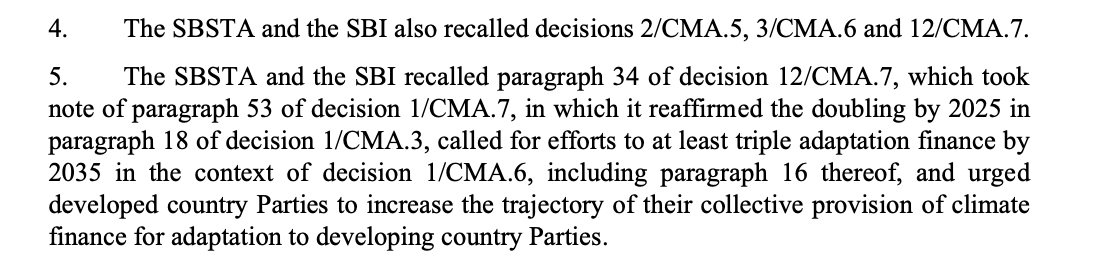
Speaking to Carbon Brief, Teresa Anderson, global lead on climate justice for ActionAid International, said:
“It’s been a huge fight to even get a soft acknowledgement of the Belém promise to triple adaptation finance, let alone a proper plan to meet that promise. It seems rich countries want to be able to quietly forget they ever said anything at all.”
Beyond the question of finance, a number of other GGA elements were discussed in Bonn. This included work on the “indicators”, a set of 59 ways to measure progress towards the GGA, which were agreed by parties at COP30.
The adoption of these indicators in Belém had proven difficult, despite experts having worked on them for two years. They were pushed through at the close of COP30 to mixed reactions.
Parties entered negotiations in Bonn amid the uncertainty this created. Alongside the indicators, the final text last year contained plans for a two-year “Belém-Addis vision” to further refine the indicator process.
As part of this, at SB64 parties worked towards creating a taskforce that would establish underlying data and methodologies for the indicators. However, the make-up of this taskforce became fraught, as parties disagreed on whether it should be technical or political.
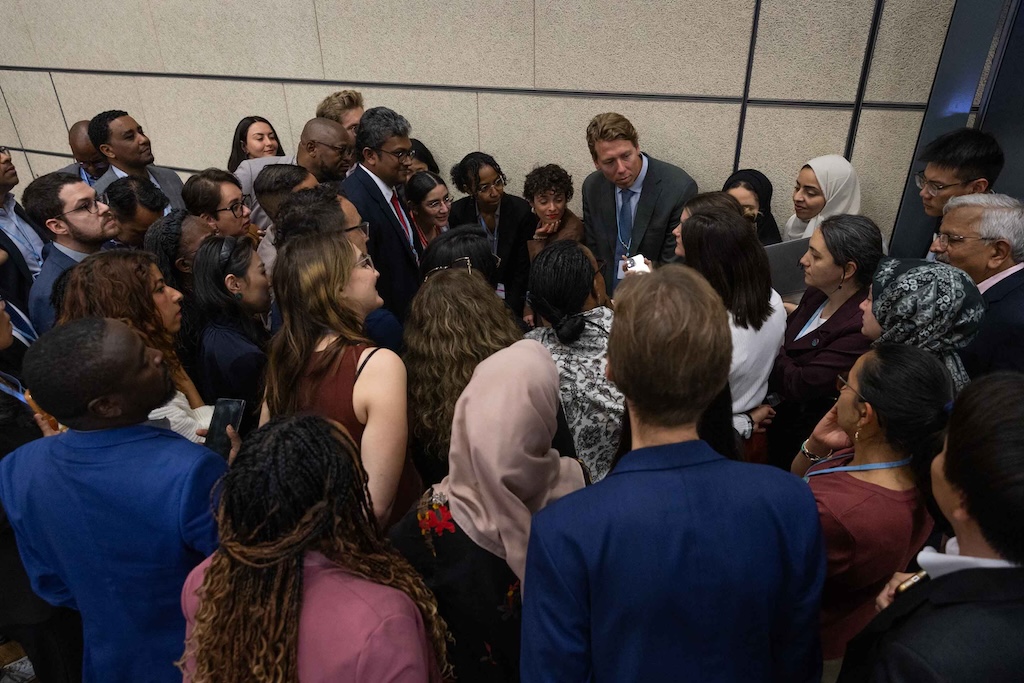
Speaking to Carbon Brief, Bethan Laughlin, senior policy specialist at the Zoological Society of London, said the negotiators were in “a very Groundhog Day’ situation”, where they were once again looking to experts to refine the indicator package, while struggling with the idea of ceding control of the process.
During negotiations in the second week, Brazil and the EU called for the taskforce to be expert-driven, while Grupo Sur, the like-minded developing countries (LMDCs) and the Arab group supported a party-driven taskforce.
As the talks moved into the final days of negotiations in Bonn, this remained a sticking point.
A final element of the GGA is the Baku adaptation roadmap (BAR), which was launched at COP29 in Azerbaijan. It is designed to help bring coherence across the multiple different adaptation efforts and advance progress towards the GGA.
At workshops during the first week in Bonn, parties focused on how the current adaptation framework supports the GGA and climate finance for adaptation.
In negotiations, the G77 and China called for the BAR to ensure access to finance in accordance with Article 9.1. This is the part of the Paris Agreement that refers to developed countries “providing” climate finance. (See: Climate finance.)
Canada, Japan, the UK and the EU all disagreed with this inclusion, arguing that finance should be addressed under other agenda items.
Ultimately, no agreement could be reached on the GGA. The issue was therefore subject to “rule 16” and passed to COP31 without any agreed text.
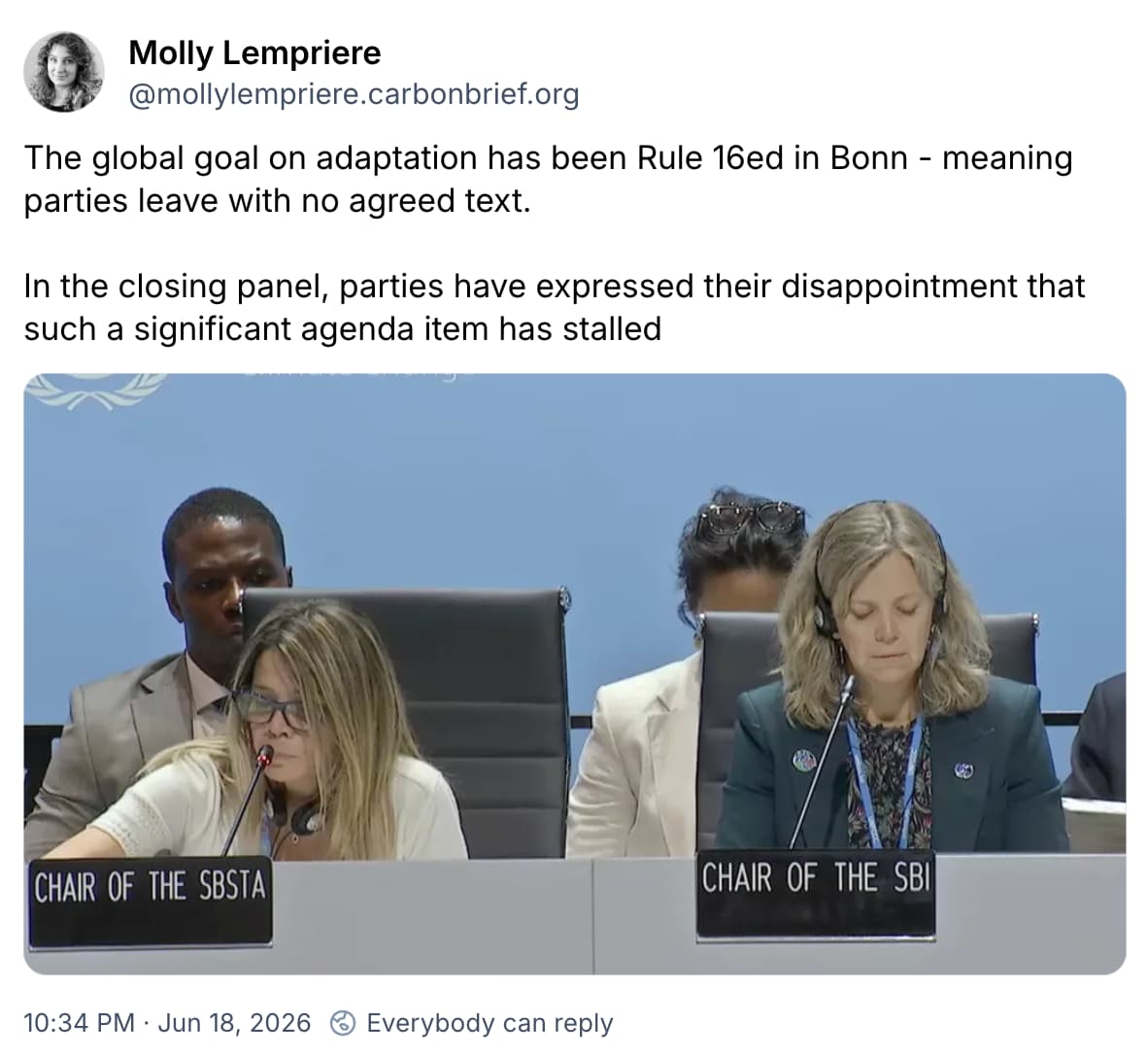
In the closing plenary, parties expressed their disappointment with the situation, with AOSIS noting the outcome was “completely unacceptable”.
In a statement, E3G’s Mulio Alvarez said that amid worsening climate impacts, the “rule 16 is more than a procedural outcome: it is a warning sign”.
Beyond the GGA, the adaptation space also includes numerous other negotiations.
Those around the adaptation fund drew particular focus this year, as it is in the process of transitioning to exclusively serve the Paris Agreement. This will allow it to access 5% of the revenues generated by the agreement’s new carbon market under Article 6.4.
A key challenge was the makeup of the fund’s board, which currently includes members from “Annex I” and “non-Annex I” countries. This refers to the division of countries based on their development status in 1992, when the UNFCCC was established.
The Paris Agreement refers instead simply to “developed” and “developing” countries. The concern, observers told Carbon Brief, is that this could open the door for wealthier developing countries to be defined as “developed” – something that some parties oppose.
Speaking to Carbon Brief, Qi said that the issue would require a head of delegation or higher to push through an agreement. He added:
“This is such a politically charged issue that concerns the fundamental question of the relationship between the convention and the Paris Agreement.”
Parties failed to come to an agreement on this point, instead deciding to continue discussions at COP31.
Just transition
The agreement to create a “just transition mechanism” was one of the most substantial outcomes of COP30. In Bonn, it took a further step forward.
Dubbed the “Belém-Antalya mechanism for global just transitions” (BAM) by civil society, it is intended to provide a centralised hub to support “just transitions” for workers and communities around the world.
Speaking during a press conference in the second week of SB64, COP30 president André Corrêa do Lago pointed to the mechanism as a key “legacy” of the conference.
However, as work got underway on the just transition work programme (JTWP), where the BAM sits, the focus of negotiations was instead on the “terms of reference” for an upcoming review.
Speaking to Carbon Brief, Anabella Rosemberg, senior advisor on just transition at NGO umbrella group Climate Action Network (CAN) International, said that while negotiations got off to a good start, negotiators got “distracted very fast”. She added:
“Basically, over the 10 days of negotiations, a week was just [spent] on an extremely procedural and technical discussion, instead of a conversation on the mechanism.”
Over the first week, parties diverged on the review’s mandate, objective and scope. This latter point includes how the JTWP relates to processes under the UN Framework Convention on Climate Change (UNFCCC), the Paris Agreement and UN entities.
Observers told Carbon Brief that they did not think the delay in the discussion of the mechanism had been orchestrated by parties to hamper progress, although they did suggest the BAM was not a priority for certain groups.
Going into the second week, with so much time focused on the terms of reference, Chadli Sadorra, senior program staff at the Asian Peoples’ Movement on Debt and Development, told Carbon Brief that whether or not there was enough time to come up with meaningful outcomes on the mechanism was a concern.
However, on 16 June, the co-chairs introduced a draft text with a “non-exhaustive” list on how to take the mechanism forward.
This was divided into sections on context, purpose, functions integration, coordination and coherence, barriers and opportunities, international cooperation, modalities and governance, timelines and links to the JTWP.
Parties, including Latin American countries under AILAC, Brazil, Norway, AOSIS, the African group and others, welcomed the note as the basis of further negotiations. The Arab group pushed back, saying the text did not reflect its priorities.
There were further discussions on key elements, such as AILAC suggesting a review of the timelines. Brazil and others said that the way the BAM operates and is governed should be considered separately, while the African group urged a strengthened focus on international cooperation.
Ultimately, talks were able to move forward substantially.
Civil society representatives also broadly welcomed the draft text. Rosemberg told Carbon Brief that “there’s a whole chunk that is really good”, adding:
“It points to functions that make sense; it’s not rehashing stuff that we have seen forever in the UNFCCC. It’s new, it’s fresh, it’s crisp, it has potential.”
On the penultimate day of the SB64 negotiations, the co-facilitators asked parties to agree on a package of outcomes, including a summary of the fifth JTWP “dialogue”, a placeholder for its next meeting and the terms of reference for the review of the process. It also included a list of items that would need to be agreed as part of developing the BAM.
Several parties said they could agree to the package in the spirit of compromise. This included an invitation to the chairs of the process to continue working on the matter before COP31, in order to try to find agreement on the BAM.
Speaking to Carbon Brief, Dr Leon Sealey-Huggins, a senior campaigner at the charity War on Want, said that lots of important elements remained in the text, albeit in “skeleton form”, including links to financial architecture.
But key questions remain around the details of the BAM, including on the role of non-party stakeholder participants, Huggins added. As such, civil society groups see further meetings on the mechanism, ahead of COP31, as key to allowing it to be adopted in November.
Ultimately, this package of texts was agreed without intervention in the closing plenary of SB64 on 18 June.
Speaking during a press conference that day, attended by Carbon Brief, Rosemberg concluded:
“Watch out, the BAM is coming”.
Climate finance
Delegates spent much of the first week in Bonn debating climate finance outside of formal negotiations, in a series of “workshops” and “dialogues”. Much of their focus was on how to fulfil financial commitments made during previous climate negotiations.
Finance is a core issue at UN climate talks and one that has frequently led to “agenda fights” and delays in recent years.
The major divide is between developing countries that receive climate finance and developed countries that are obliged, under the Paris Agreement, to provide or “mobilise” it.
There was no agenda fight as SB64 kicked off in Bonn. However, finance remained a source of friction across many workstreams, against a difficult global backdrop.
Recent official figures show that climate finance from developed countries reached a record $136.7bn in 2024. Developed countries, therefore, argue that they are raising climate finance in line with their obligations, despite other fiscal strains.
Since 2024, however, aid cuts by major donors – particularly the US – mean public climate spending by developed countries is likely to have fallen substantially. There have also been drops in support for UN climate funds, such as the Green Climate Fund.
Moreover, hardly any developed countries have pledged new finance for 2026 and beyond.
This is in spite of parties agreeing in 2024 on a “new collective quantified goal” (NCQG) of $300bn a year for developing countries by 2035 – largely from developed countries.
Given this, developing countries argue that developed countries are, in fact, shirking their responsibility to scale up their public-finance provision. They say this is vital, especially considering the $300bn goal is already far below the scale needed to tackle climate change.
Isatou Camara, lead climate finance coordinator for the Least Developed Countries (LDCs), told Carbon Brief that their adaptation needs depended on securing such funding:
“[Public finance is] oxygen for us, because when we talk about what we need as vulnerable countries, it’s basically enhancing resilience and adaptation.”
At COP30, parties agreed to launch a new two-year “work programme” for countries to discuss these concerns, among others.
This came after a concerted effort, led by the LMDCs and the Arab group, to start a work programme focused exclusively on Article 9.1 of the Paris Agreement. This is the part that says developed countries “shall provide” finance – generally taken to mean public spending.
However, developed countries note that the NCQG goal covers a “wide variety of sources”, including the private sector and wealthier developing countries, such as China.
In the end, parties at COP30 compromised on a programme to address Article 9.1 “in the context of Article 9…as a whole” – meaning it could cover all types of finance.
Nevertheless, in submissions ahead of SB64, many developing countries were clear that they wanted the programme to be a “dedicated space” to discuss Article 9.1.
The LMDCs and Arab group even erroneously referred to it simply as the “work programme on Article 9.1” and made it clear that they “do not see [it] as a way of consolidating other agenda items on finance”.
(Some developing-country groups, such as AOSIS, place a lot of emphasis on other aspects of finance, such as quality and accessibility, as well as the need for provision by developed countries.)
In contrast, developed countries, such as the EU, Norway and Canada, said they wanted a broad approach that focuses on “streamlining” the existing climate-finance agenda and “mobilising” finance from various sources.
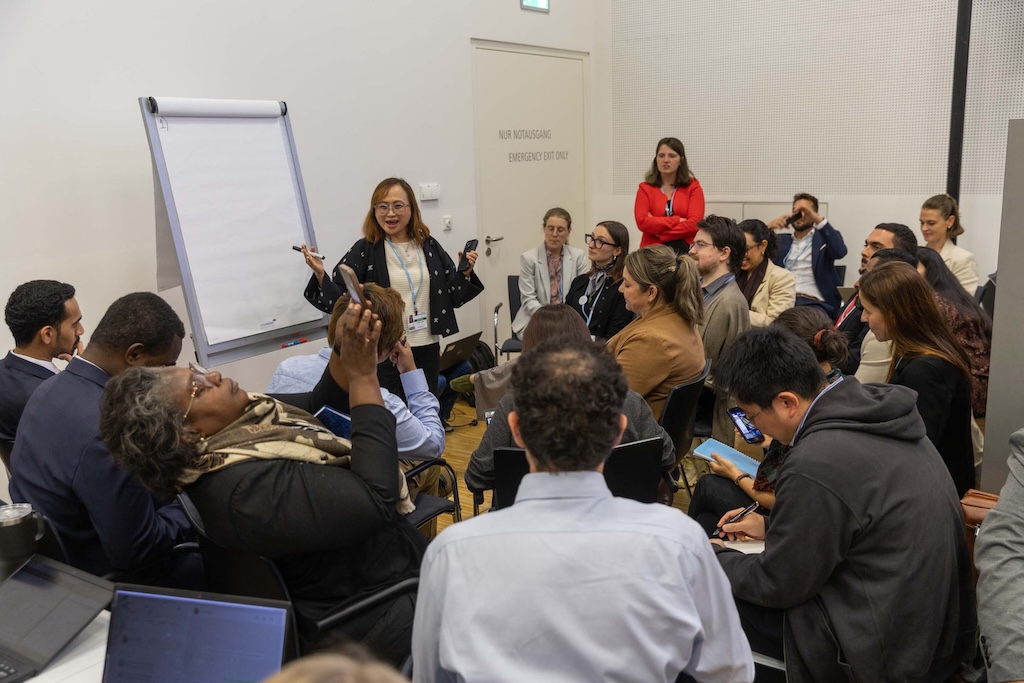
There were three “engagement workshops” to discuss this new climate-finance work programme at SB64.
Parties remained entrenched in long-held positions, with developed countries happy to keep the focus on climate finance of all kinds, as opposed to public funding.
The G77 and China rejected the “work plan” prepared by the co-chairs and said its focus should be squarely on Article 9.1. Some developing countries argued for “burden sharing agreements” and an “action plan” to compel developed countries to provide more finance.
In order to elevate these issues into formal negotiations, developing countries and civil-society organisations stressed throughout SB64 that the Article 9 work programme should be placed on the agenda at COP31. (A draft version of the agenda for November’s summit did not include it.)
This argument was given more weight when COP30 president Corrêa do Lago used his “authority” to request such an item, in a letter published towards the end of SB64 week one.
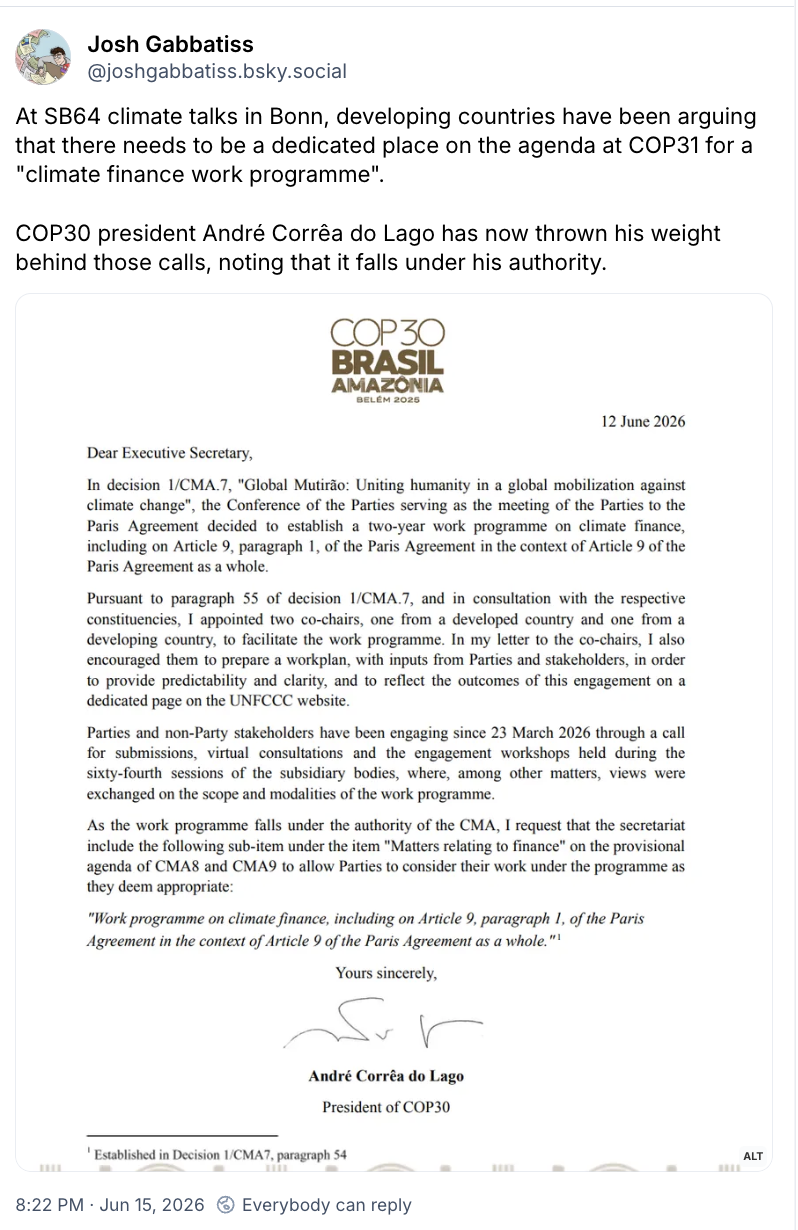
When asked why he made this unconventional intervention, Corrêa do Lago told Carbon Brief that it reflected his understanding of what was agreed last year:
“If I believe that we agreed in Belém that this would happen, I think it is normal that, as president of the COP, I request that to the secretariat.”
Nevertheless, his action is not binding and will not, in itself, avert conflict over whether to include the issue on the COP31 agenda. Despite this, the move was celebrated by civil society, with Sehr Raheja, a climate change programme office at the Centre for Science and Environment (CSE) telling Carbon Brief:
“Developed countries have been resistant to it from the beginning…Drama is going to be there [at COP31], whether we like it or not.”
The SB64 talks also saw the first two-day meeting of the “Veredas dialogue”, another new finance-related process agreed at COP30.
This is a space for parties to discuss Article 2.1c of the Paris Agreement, which concerns making all global financial flows “consistent” with climate goals. Some developing countries, such as the Arab group, have resisted this aspect of negotiations, preferring to keep the focus exclusively on finance from developed countries.
The Veredas dialogue is essentially a continuation of the “Sharm el-Sheikh dialogue” – which ended last year – except with greater focus on real-world implementation.
These discussions saw presentations on various topics, including how Rwanda is aligning its public finance with climate resilience and Norway’s experience with carbon pricing. As part of the dialogue, high-level “Xingu finance talks” will take place later this year.
Finally, the COP30 presidency hosted sessions to discuss the implementation of the “Baku to Belém roadmap”.
As well as the $300bn goal, the NCQG contains a more aspirational target of reaching $1.3tn in annual climate finance by 2035, which parties at COP30 agreed to “urgently advance”. The roadmap is a presidency-led attempt to add substance to the $1.3tn pledge.
In Bonn, parties and experts discussed activities to “focus collective energies” and “gain quick wins”, as well as how to follow up on the roadmap in “mandated workstreams and through the action agenda”.
A summary of the discussion will be produced and used to inform the continued follow-up on the roadmap, over the coming year.
Global stocktake
Years of discussions culminated in the first “global stocktake” (GST) of the Paris Agreement in 2023, which assessed progress towards climate goals and what more needed to be done.
Since then, countries have been engaging in a process known as the United Arab Emirates (UAE) dialogue, which focuses on implementing the GST outcomes.
There were two sessions at SB64 for parties to share experiences and information about how to implement the GST – and barriers they faced – as agreed at COP30.
Interventions from parties such as the EU, Switzerland and Colombia focused on the GST’s “energy package”, contained in paragraph 28 of the text, including “transitioning away from fossil fuels” and “phasing out inefficient fossil-fuel subsidies”.
AOSIS highlighted the recent conference on transitioning away from fossil fuels in Santa Marta, Colombia, as a good example of cooperation to deliver on these outcomes.
Many developing-country parties stressed that they needed more climate finance and other forms of support to carry out GST outcomes. The Philippines, speaking on behalf of the G77 and China, highlighted:
“The persistent gap between the scale of action required to implement GST outcomes…and the scale, quality, accessibility and predictability of support provided.”
Among the groups preferring to keep the focus on finance were those representing major fossil-fuel producers. Saudi Arabia, speaking for the LMDCs, described the dialogue as a “non-prescriptive space with a focus on finance”.
The co-facilitators are now expected to prepare a report that summarises the discussions, without providing guidance.
As the talks came to a close and an overview was presented to attendees by the diplomats leading the discussions, Colombia noted that “transitioning away from fossil fuels” was missing:
“This topic featured prominently in several interventions and was identified by many parties as a key element of the GST outcomes that requires [finance].”
Following this, Saudi Arabia said “cherry-picking” of paragraphs from the GST should be avoided, given it was a “carefully negotiated” package:
“While some parties may choose specific pathways, roadmaps, initiatives, approaches, others are contributing through other alternative approaches – all of which are valid and contribute to the goal of the Paris Agreement.”
(The stocktake calls on all parties to contribute to the entire energy package, including the fossil-fuel transition. Yet Saudi Arabia has consistently argued the package is a menu of options, from which parties can pick and choose.)
Across various rooms in Bonn, talk also turned to the next GST, a two-year process that will begin at COP31 later this year and end in 2028.
The most contentious issue regarding the second GST was whether or not the next Intergovernmental Panel on Climate Change (IPCC) report will feed directly into it. See: Climate science.
Mitigation work programme
Bonn closed with the mitigation work programme (MWP) – the only formal agenda item specifically about cutting greenhouse gas emissions – failing to reach an agreement. As a result, it was subject to “rule 16”, meaning it was simply pushed to COP31.
The main challenge within negotiations was a divergence between parties wanting the MWP to actively drive more urgent emissions cuts and those who want it to be merely a space for communication.
Speaking to Carbon Brief, Kaveh Guilanpour, vice president for international strategies at the Center for Climate and Energy Solutions (C2ES), explained:
“Tensions in the MWP go back to when it was adopted at COP27, where some parties wanted it to be a non-negotiated space to exchange ideas and views on how to accelerate mitigation action, while others hope the space could be used for more normative signals on what needs to be done going forward.
“At the heart of this is the fact that NDCs are nationally determined, while the goals of the Paris Agreement are collective in nature.”
One of the main areas of focus in Bonn was the future of the MWP, including its duration, its relationship with other UNFCCC processes and how it should be carried out.
For example, during discussions in the first week, parties disagreed on whether the mandate for the MWP’s work – which refers to “this critical decade” – meant it should continue operation until 2030, or whether this simply related to the urgency of action.
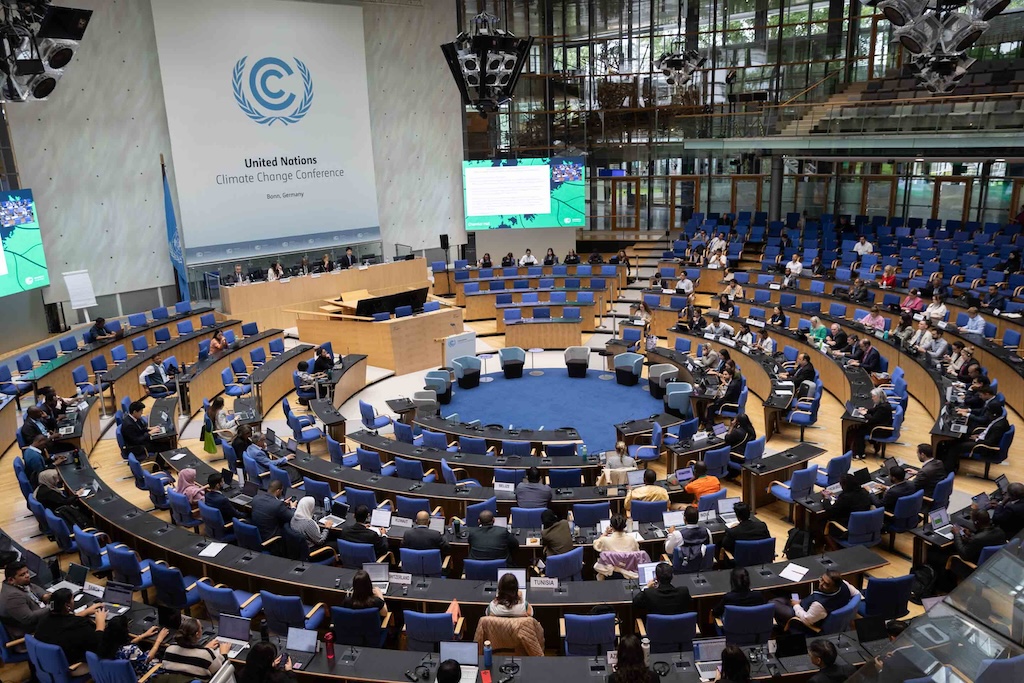
Speaking during a press conference in the second week attended by Carbon Brief, Anne Rasmussen, lead climate negotiator for AOSIS, said that on mitigation:
“We need to move beyond simply exchanging views and focus on how the work programme can support the implementation of GST outcomes, particularly those related to mitigation. These [include] accelerating renewable energy deployment and strengthening dedicated mitigation space beyond 2027.”
Questions of finance also became contentious, as they had across a range of negotiating rooms in Bonn.
During negotiations, some parties highlighted the need to engage with financiers, investors or other avenues, in order to turn MWP discussions into action.
In the second week, the diplomats leading negotiations put together three separate documents to represent the divided discussions: a draft legal text; a note capturing the key parts of the debate; and a “non-exhaustive reflection of the exchange of views”.
Further documents released the day after, with few substantial changes, faced a similar response.
In the afternoon of the final day in Bonn, brief draft conclusions were published. This contained just five points, predominantly focused on the need for continued work on the MWP.
Ultimately, however, parties could not even agree on this minimal document and the MWP was pushed to COP31.
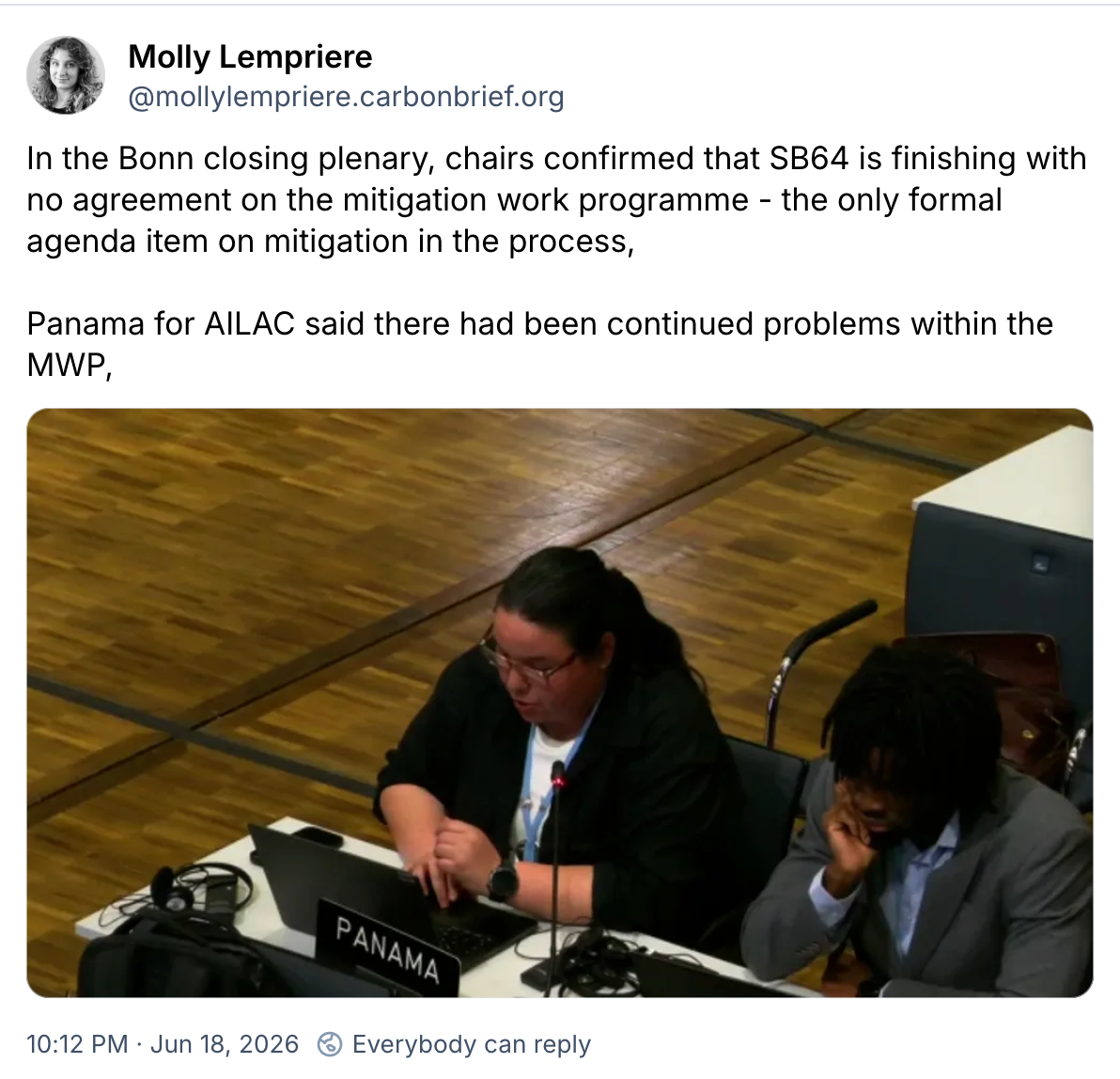
In the closing plenary, a range of parties expressed their “profound disappointment” and reaffirmed their commitment to the MWP process.
Action agenda and new initiatives
COP30 saw an effort by the Brazilian presidency to raise the profile of the “action agenda” – a long-running initiative to mobilise climate action outside the formal UN process.
Hundreds of voluntary climate initiatives have been launched by businesses, local governments and many other actors over the years at COP summits and other international events.
In a bid to turn this into real-world action, the COP30 presidency marshalled these initiatives into six broad themes and compiled them into a five-year plan for “accelerating implementation”.
These plans were intentionally aligned with the goals of the global stocktake, negotiated in 2023, which includes everything from “transitioning away from fossil fuels” to “halting and reversing deforestation”. (See: Global stocktake.)
This work continued at SB64, with UN Climate Change executive secretary Simon Stiell telling participants in his opening speech:
“We hear calls from many to elevate the global climate action agenda – complementing negotiations, bringing together governments, companies, innovators, investors, cities and regions and civil society.”
The Turkish COP31 presidency launched its own “priorities” for the action agenda during the first week of SB64. The most high-profile of these was a goal – yet to be endorsed by national governments – to increase the global share of final energy demand met by electricity from just over 20% today to 35% by 2035.
(Amid soaring fuel prices linked to the Iran war, some governments have already identified electrification as a way to curb their reliance on expensive fossil-fuel imports.)
The Turkish presidency also announced targets to halve the growth in global waste, reduce “energy consumption intensity in the building sector” by 25%, increase the global use of “circular materials” by 15% and “build awareness of the climate crisis” among young people and farmers, all by 2035.
Alongside these goals, the presidency has also announced a “climate implementation bridge”. This was described as an initiative to help developing countries access support and capacity building – but it is not a new climate fund.
(The COP31 action agenda is set to be formally launched at London Climate Action Week, the week after SB64.)
In a press conference announcing these new goals, the Australian “president of negotiations” for COP31, Chris Bowen, made it clear that the negotiations and the action agenda are “separate things” and that the latter could proceed without universal buy-in from every country. He said:
“The action agenda is set by the presidency, the negotiations are steered but are a party-driven process and require consensus.”
COP30 also had also seen the launch of more new presidency-led initiatives that were intended to drive climate action beyond the UN negotiating halls. SB64 provided an opportunity to flesh these out and for parties to provide their views.
One of these initiatives was the “global implementation accelerator”, which was the focus of an event in the first week of the conference.
COP30 and COP31 presidency representatives explained that this would involve providing additional support to three or four “high-impact” climate “solutions” from the action agenda. The goal would be to help parties – on a voluntary basis – as they implement nationally determined contributions (NDCs) and national adaptation plans (NAPs).
Another new presidency initiative was the “Belém mission to 1.5C”, which held a consultation event in Bonn. This has similar objectives to the global implementation accelerator – namely, driving ambition, implementation and investment in nations’ NDCs and NAPs.
The “mission” is gathering inputs from various actors and will use these, alongside various meetings and consultations, to produce a report ahead of COP31.
Some parties used these sessions to make their priorities clear. For example, Saudi Arabia, on behalf of the Arab Group, made statements during both consultations about the importance of carbon-capture technologies. They told the “mission to 1.5C” session:
“International cooperation currently disproportionately emphasises particular solutions, while technologies such as CCUS [carbon capture, utilisation and storage] and CDR [carbon dioxide removal], despite their critical role in IPCC-assessed pathways, remain disproportionately underrepresented.”
This is notable, given the predominance of major oil-and-gas producers in this negotiating bloc and the group’s resistance to efforts to move away from fossil fuels. Saudi Arabia also stressed that these initiatives are voluntary and not connected to UNFCCC processes.
Climate science
Throughout the Bonn talks, there were major disagreements about how climate science should feed into the UN climate process.
Parties traded accusations of “misinformation” and oversimplifying science. There were also disputes about the Paris Agreement’s 1.5C temperature goal and the role of the UN’s Intergovernmental Panel on Climate Change (IPCC).
This came to a head when a press briefing was assembled with representatives from the EU, Switzerland and various developing countries to denounce “coordinated attacks” on science by “fossil-fuel interests”.
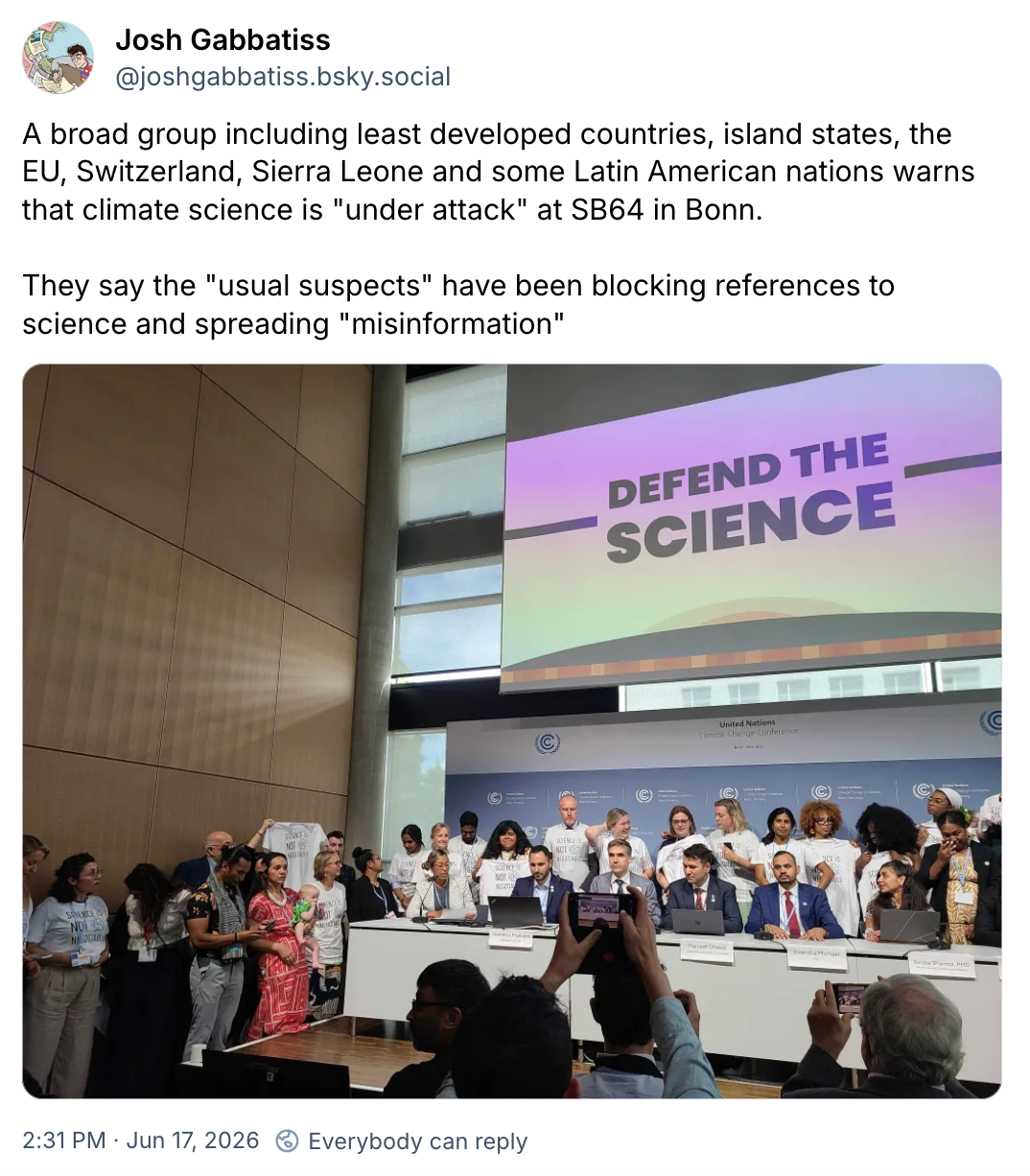
When asked which parties were behind these “attacks”, Sivendra Michael, chief negotiator for Fiji, told Carbon Brief:
“It is the usual suspects that seek to block progress…We are seeing efforts to remove references to the IPCC and the 1.5C temperature limit.”
A negotiator from one of the countries in the press conference later elaborated, telling Carbon Brief that Saudi Arabia and India were among those “undermining” climate science.
They also told Carbon Brief that Saudi Arabia had started referencing a Paris Agreement target of limiting warming to 2C – failing to mention the 1.5C component altogether. Saudi Arabia, a major oil-and-gas producer, has long opposed the 1.5C goal.
(The Paris Agreement technically has a single temperature target of “well-below 2C above pre-industrial levels and pursuing efforts to limit the temperature increase to 1.5C”.)
All economies face very steep emissions cuts if the world is to meet the 1.5C target and this could have major societal impacts, especially for emerging economies with fossil-fuel industries.
However, small islands and climate-vulnerable states frame warming beyond 1.5C as an existential threat.
Anne Rasmussen, lead negotiator of AOSIS, told Carbon Brief that they were concerned about the “attempt to delink any relevance of the 1.5C” across several tracks, including the JTWP and the MWP.
As at COP30, differences of opinion were most evident in negotiations on “research and systematic observation”, where parties discussed scientific inputs into UN climate talks.
The EU was among parties voicing concerns about “misinformation” and the importance of 1.5C. Saudi Arabia and India were among those arguing against references to “misinformation and disinformation”, as well as 1.5C.
(There was also some debate about the inclusion of references to El Niño and climate “tipping points”. Both were opposed by some large, developing countries, with India and Saudi Arabia arguing there were “varying perspectives” on tipping points science.)
Dr Kate Dooley, a senior research fellow at the University of Melbourne who followed the Bonn negotiations, told Carbon Brief that the accusations levelled by some parties in the press conference were oversimplified. She said:
“We’ve got both sides finger-pointing at each other – the EU and Switzerland pointing the finger at large, developing countries and saying: ‘What you’re doing is climate denial.’ And it’s not.”
There is growing acceptance that the world is likely to breach 1.5C. If that happens, the “overshoot” could be temporary if there is mass deployment of carbon removal technologies and tree-planting to suck carbon dioxide (CO2) from the atmosphere.
As ever, this raises questions as to who will be responsible for cutting emissions and for the mass deployment of CO2 removal – and when and where these actions should take place.
Dooley said that “1.5C is the temperature goal and we need all hands on deck to achieve that”, but there was nothing wrong with “interrogating the risks of mitigation pathways and trying to make sure those risks are minimised”.
Large, developing nations argue on the basis of “equity” that they should have more leeway, whereas developed countries bear significant historical responsibility for climate change and that, as a result, they should cut emissions further and faster in line with the 1.5C goal.
Moreover, they argue that developed countries have failed to provide sufficient climate finance and technological support to help developing countries cut emissions.
Responding to this idea, Fiji negotiator Michael told the press briefing there would be “no equity for the most vulnerable” if 1.5C is breached:
“There is this growing narrative that science and equity are in competition…We reject this notion.”
Saudi Arabia and India were also prominent in questioning the role of the IPCC – considered the world’s most authoritative voice on climate science – in the UN process.
Some Indian researchers have been vocal in arguing that the scenarios assessed by the IPCC place an unfair burden on developing countries.
There was also a wider conversation about IPCC timelines in Bonn. Many parties, including the EU, AOSIS and South Africa, argued that the panel’s “seventh assessment report” (AR7) should be brought forward so the “best available science” can feed into the second “global stocktake” in UN climate talks, which is set to conclude in 2028. (See: Global stocktake.)
A group of countries, including Saudi Arabia, India, China, Kenya and Russia, have pushed back against any effort to accelerate the report timing. As a result, for five consecutive IPCC meetings, countries have failed to agree on the AR7 timeline.
These debates spilled over into SB64 talks, with the same parties arguing against alignment with the second GST. Again, these countries often make arguments on the basis of equity, stating that accelerating the process would disadvantage developing-country scientists.
Fossil fuels
Fossil fuels were not an official part of the negotiating agenda in Bonn, but countries nevertheless discussed them throughout the talks.
At COP30, dozens of nations had backed a “roadmap” to “transition away” from fossil fuels, but ultimately strong opposition meant it did not end up in the formal text.
Instead, countries accepted COP30 president Corrêa do Lago’s compromise offer to develop “roadmaps” outside the formal UN regime, including one for fossil-fuel transition and another on ending deforestation.
So far, 21 countries and negotiating groups have submitted their views to help shape the informal fossil-fuel roadmap. With the exception of Russia, none of the countries that reportedly opposed a formal roadmap at COP30 have had their say.
(There has been a similar call for input from parties for the deforestation roadmap, with 22 submissions so far.)
In the first week of Bonn, the COP30 president hosted a 90-minute session to discuss the fossil-fuel issue in person.
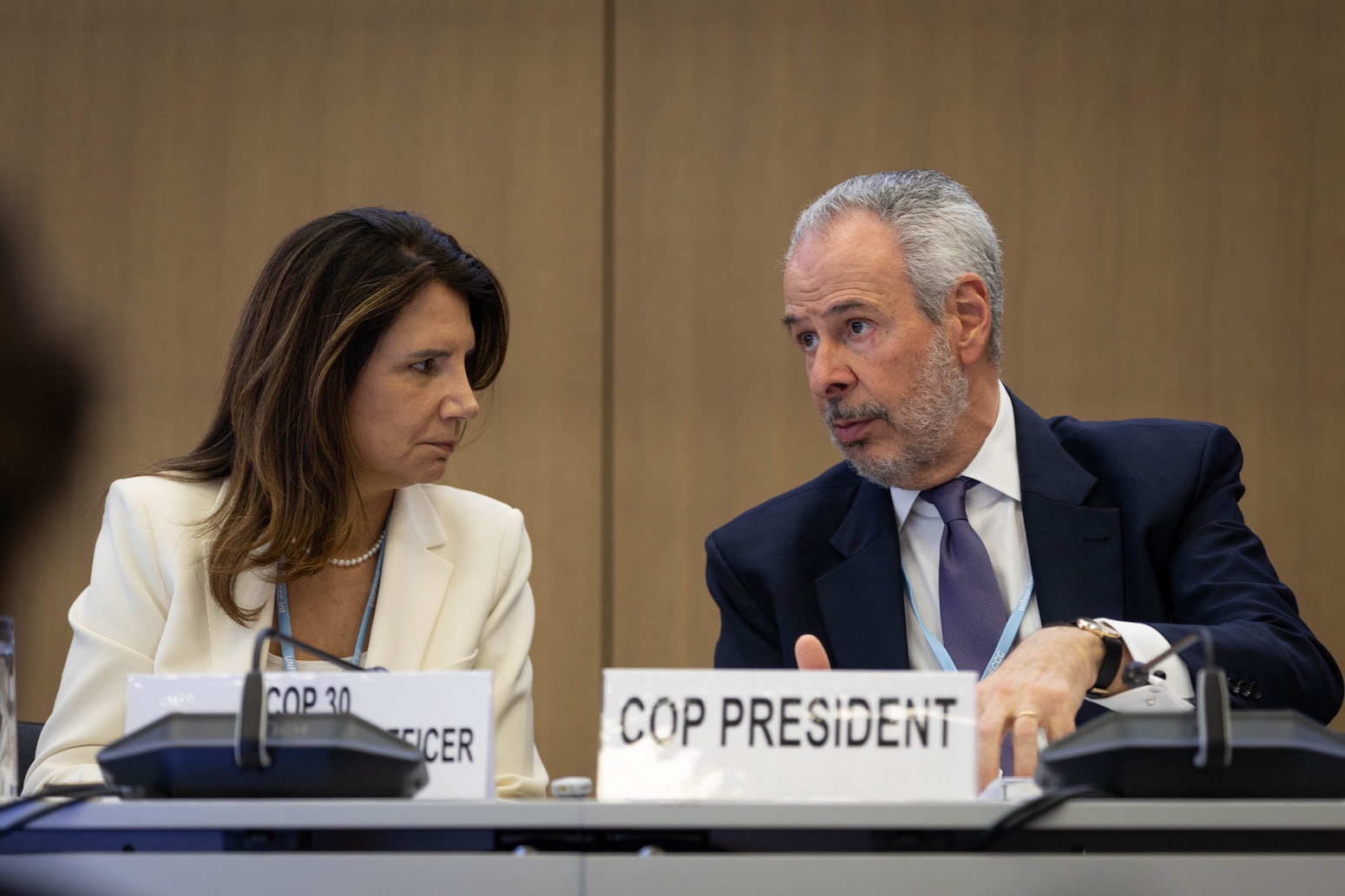
Corrêa do Lago presented progress on developing the roadmap, placing it in the context of implementing the energy-related outcomes from the first global stocktake. (See: Global stocktake.)
Some parties, including small-island nations and Switzerland on behalf of the Environmental Integrity Group (EIG) , expressed interest in carrying the roadmap discussion into the formal process – so it ended up as more than just “a document”.
Meanwhile, groups representing big fossil-fuel producers, such as the Arab group and the LMDCs, did not speak up at all.
Fossil fuels were also discussed in other parts of SB64, notably in the GST dialogue. Numerous nations pointed to the success of the recent “transitioning away from fossil fuels” conference in Santa Marta, Colombia.
Cosima Cassel, climate diplomacy lead at E3G, told a press conference on this topic that Santa Marta was an example of the climate regime “evolv[ing]”, with “coalitions of the willing” coming forward with solutions to move away from fossil fuels.
Trade dialogues
The first-ever dialogue on climate change and trade was held during the first week of negotiations. Parties approached it with a “pragmatic” tone, despite clear tensions, according to thinktank E3G.
Created as part of the “global mutirão” at COP30 in Brazil last year, this was the first of three dialogues that will be held at Bonn intersessional meetings between 2026 and 2028.
Opening the session, COP30 president André Corrêa do Lago highlighted the need to make trade work “as an engine of sustainable development”.
The session began with presentations from the World Trade Organization, the International Trade Centre and UN Trade and Development, which highlighted the potential for trade to contribute to countries’ climate objectives.
However, as parties moved into the discussion portion of the day, many developing nations drew attention to growing concerns that trade measures are creating burdens and barriers for them.
The discussion was organised around three questions: how trade can support climate action; how climate action can avoid adverse impacts on sustainable development; and how international cooperation can address the “trade-climate interface”.
Broadly, developing-country groups argued that the use of trade-related climate measures raises compliance costs, restricts market access and does not align with principles of “equity” and “common but differentiated responsibilities and respective capabilities”.
For example, the Arab group pointed to research by the International Monetary Fund, which it said found that the EU’s carbon border adjustment mechanism (CBAM) could generate “welfare gains” for developed countries, while imposing “losses” on developing countries.
Meanwhile, the LMDCs described unilateral trade-related climate measures as:
“Effectively extraterritorial regulatory projection by those with dominant market power and greater historical responsibility [for global warming] onto those with fewer resources and less historical responsibility.”
Developed-country groups pushed back against these criticisms, arguing that they were legitimate approaches to climate “externalities”. The EU said:
“If we disregard sustainability considerations, negative environmental externalities can emerge and lead to dependencies that undermine efforts to protect the environment and the climate.”
Others, such as AILAC and South Korea, focused on improving fairness and transparency in climate-related trade measures.
In a statement, Jordan Dilworth, policy advisor for climate diplomacy and geopolitics at E3G, said that despite the tensions, parties did come prepared to engage:
“Many expected the first trade and climate dialogue to be a showdown, but parties resisted trading blows and instead engaged constructively despite entrenched differences. The test now is for the chairs to ensure that parties feel their positions are being adequately addressed in the next round of dialogues.”
The diplomats running the talks will now consider the interventions and submissions made by parties in the dialogue, before determining the next steps.
They said they would prepare an “informal note under their own authority and with no legal status”, as a record of the first dialogue.
Trade also raised its head in the just transition work programme, with groups such as G77 and China opposing “restrictive” trade measures, while others, such as the UK, argued that the topic of trade does not fall within the mandate of the workstream.
This mirrored divisions seen at COP30, SB62 and other UNFCCC meetings. (See: Just transition work programme.)
COP reform
Following on from COP30, there were continued discussions on the future of the UNFCCC process and potential for reform, although it was less of a hot-button topic.
Much of this fell within negotiations on “arrangements for intergovernmental meetings”, focused on the organisation of COP31, improving efficiency and observer engagement.
Negotiations over the course of the two weeks in Bonn saw parties disagree over issues such as imposing conditions on proposals for new agenda items, the opportunities for parties to engage in consultations, budgetary implications and more.
Ultimately, a final text was agreed on the penultimate day of Bonn.
Parties also negotiated on “cooperation between other international organisations”, which relates to coordinating the work of UN treaties on climate change, nature and desertification.
While this agenda item has existed for over 20 years, it has previously been limited to the publication of an annual report in Bonn.
At COP30, however, it was reinvigorated following a push at the Bonn sessions in June 2025, ultimately being included on the agenda at a COP for the first time in 19 years.
The workstream drew focus at COP30 amid the wider calls for reform of the COP process.
Its inclusion in the agenda at SB64 followed a report from UN scientific panel on nature research, IPBES, on the nexus between biodiversity and other workstreams, which found that countries are wasting $10-25tn annually by dealing with interconnected crises within silos, instead of taking advantage of synergies.
Speaking to Carbon Brief, Bethan Laughlin, senior policy specialist at the Zoological Society of London, highlighted that countries now have to produce dozens of reports across the three UN conventions. She added:
“The evidence is clear that siloed decision-making is costing countries trillions per year. To tackle the scale of the climate and ecological crisis, we can no longer act as if these issues are separate from one another.
“Already existing mechanisms, such as the Joint Liaison Group, need to be strengthened, but we also need innovative approaches that will aid countries in scaling up synergistic approaches.”
Ocean dialogue
During the first week at Bonn, stakeholders and delegates took part in the “ocean and climate change dialogue”.
This focused on ocean-based priorities in countries’ “nationally determined contributions” (NDCs), access to finance and aligning international climate and biodiversity efforts relating to oceans.
The dialogue built on the “blue NDC challenge” launched by Brazil and France in 2025, with the goal of as many countries as possible incorporating the ocean into their pledges.
Speaking to Carbon Brief, Micheline Khan, senior associate for ocean climate at thinktank the World Resources Institute (WRI), explained that since it was launched at COP25, the dialogue has “achieved important milestones” in the integration of the ocean across the work of the UNFCCC. This included helping to move from ad-hoc inclusion of the topic to a “growing political recognition of ocean language”.
Representatives for both sides of the joint COP31 presidency – Turkey and Australia – spoke during the first day of the ocean dialogue at SB64.
Khan added that the Turkish presidency has “defined the ocean as a key priority within their agenda”, providing political signalling that could help elevate the topic.
But more still needs to be done, Khan said:
“The central challenge is no longer whether ocean action belongs in climate plans – it does. But whether countries have the governance, data, technical capacity and investment pipelines to implement what they have already committed to.”
For more on the ocean dialogue, see the 19 June 2016 edition of Debriefed.
Road to COP31
Attention now turns to COP31, which will be held in the resort city of Antalya, Turkey.
Unusually, the COP presidency is being shared, with Turkey hosting the summit, but Australia serving as “president of negotiations”.
This was a compromise landed on at COP30, after parties failed to agree on a single presidency following more than three years of dispute.
(COP32 will be held in Addis Ababa, Ethiopia, in 2027. It will be the first-ever COP hosted by one of the least-developed countries.)
COP31 is being promoted as an “implementation COP”, helping to “close the gap between multilateral commitments and real-world delivery”, according to its website.
However, the fraught negotiations in Bonn, including the lack of progress on key elements, mean the future effectiveness of climate summits is increasingly under question.
In his closing statement at Bonn, UN Climate Change executive secretary Simon Stiell urged countries to bring ministers together as soon as possible, “particularly on the thorniest issues,” to allow compromise to be found ahead of Antalya. He added:
“In some negotiating rooms, we’ve heard a familiar tendency towards you-first-ism: Groups refusing to deliver commitments or allow the process to move forward unless others go first. This is a recipe for gridlock when we need all negotiating tracks to be moving in the fast lane.”
| Date | Milestone |
|---|---|
| 20-28 June 2026 | London climate action week, London, UK |
| September 2026 | Climate week, New York City, US |
| 8-22 September | UN general assembly (UNGA81), New York City, US |
| 19-30 October 2026 | UN biodiversity summit COP17,, Yerevan, Armenia |
| 9-20 November 2026 | Global implementation accelerator – second information session |
| During Katowice Committee meeting, 2026 | Dialogue on the impact of response measures |
| 9-20 November 2026 | COP31, Antalya, Turkey |

The post Bonn climate talks: Key outcomes from the June 2026 UN climate conference appeared first on Carbon Brief.
Bonn climate talks: Key outcomes from the June 2026 UN climate conference

An exceptional El Niño is building. The World Meteorological Organization (WMO) says it has intensified to very strong levels and is likely to last at least through February 2027. If its current trajectory holds, it could become stronger than anything seen since WMO monitoring began four decades ago.
That is bad news for agriculture. El Niño – a naturally occurring weather phenomenon – can scramble rainfall patterns across the world, bringing drought to some regions and floods to others. And this time it is unfolding against the backdrop of a significantly hotter climate, with farmers already contending with unreliable growing seasons, extreme heat and less predictable rainfall because of global warming.
El Niño expected to bring next record-hot year as soon as 2027
We are seeing the consequences already. In Sri Lanka, drought linked to El Niño has dried wells and reservoirs and cut into crops and farmer incomes. Indonesia is experiencing its worst wildfire season in 11 years, with prolonged drought and extreme heat exacerbated by El Niño. And in Peru, authorities are preparing for the opposite extreme: intense rains, flooding and landslides which the national civil-defence agency says could affect around 1.2 million people.
These impacts will multiply as El Niño intensifies.
And yet, just as the risks to food production are rising, the money available to help farmers withstand them is shrinking.
10% funding decline in 2024
A forthcoming analysis from the Food and Agriculture Organization (FAO) shows that climate-related development finance for agrifood systems is moving in the wrong direction. In 2024, the latest year for which data is available, it fell by 10 percent compared with a 2 percent overall decline. The sectors that put food on our tables — crops, livestock, forestry and fisheries — received just 5 percent.
Yet this is precisely the moment when climate investment in agriculture needs to grow, not shrink. It can help communities adapt, build resilience and protect food security, while unlocking larger flows of public and private finance. Agriculture feeds us, supports the livelihoods of well over a billion people, and is often the first sector hit by drought, floods and extreme heat. Cutting that investment now is a false economy.
One failed harvest can plant the seed for the next crisis, forcing farmers to eat the seed they have saved for planting, sell livestock or tools, or take on debt. It can also deepen food insecurity, disrupt supply chains and drive up prices, showing up months later in supermarket aisles far away.
The Central American Dry Corridor, stretching through much of the region, shows both how exposed farmers are, and what investment can do. Based on an analysis of 41 years of satellite observations, FAO finds that some crop and pasture areas there face more than a 50 percent chance of agricultural drought over the coming months.
About half of Central America’s 1.9 million producers of maize, beans and other basic grains live in the Dry Corridor. Many grow food both for sale and for their own families. When a harvest fails, they lose both income and dinner.
El Salvador project conserves water and soil
In El Salvador, which lies within the Dry Corridor, more than 50,000 farmers have adopted practices to better withstand drought and increasingly unreliable rainfall through RECLIMA, a project financed by the Green Climate Fund and implemented by FAO in partnership with the government of El Salvador. It has substantial national co-financing, including from the country’s Environmental Investment Fund.
El Niño can intensify El Salvador’s annual mid-season dry spell, known as the canícula, turning it into a longer, harsher drought just as maize needs water most.
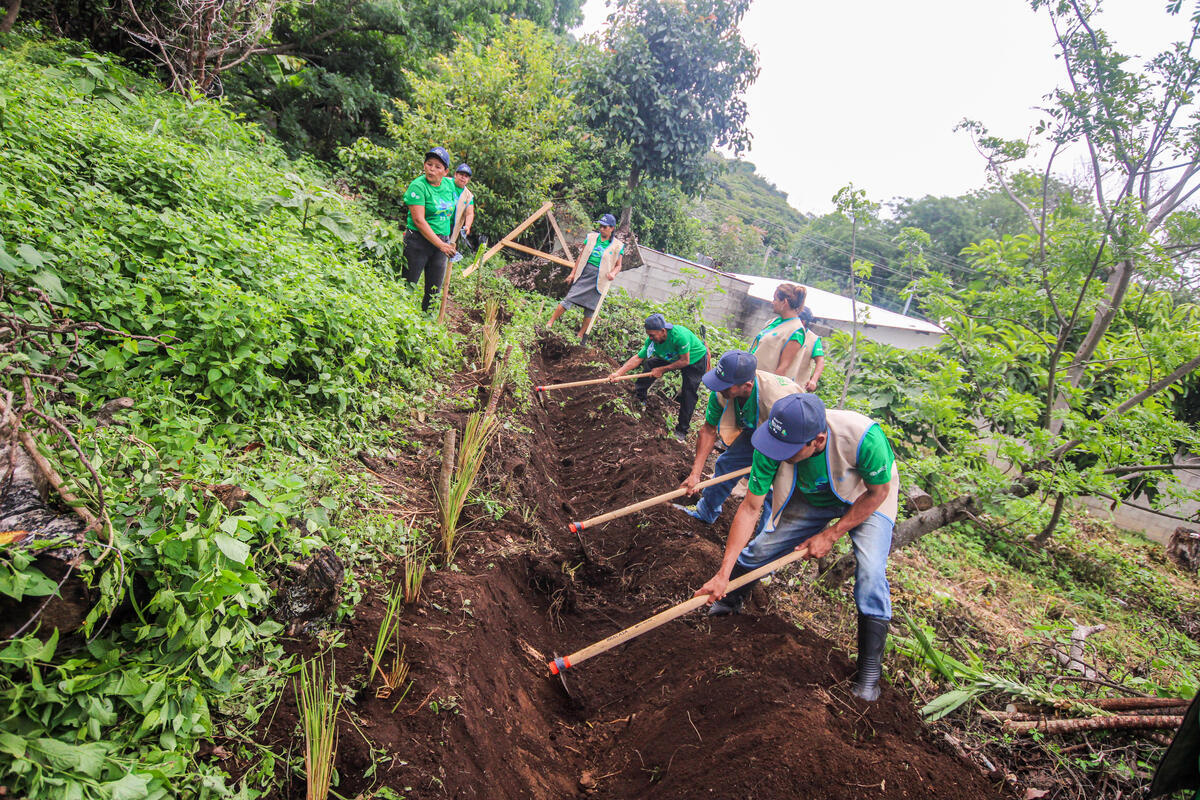
For María Cristina Corvera de López, a second-generation farmer in rural Nahualapa, adapting means changing how every drop of rain is captured and used. She plants trees alongside her crops to provide shade and minimise evaporation and uses simple irrigation channels and a homemade drip system to conserve water. Instead of burning stalks, leaves and husks after harvest, as generations before her did, she turns them into mulch to hold moisture in the soil.
“The effects of climate change are a constant challenge,” she says. But the new techniques have made her farm more resilient to El Niño as well. Where she once harvested about 50 bags of maize per acre, she now gets around 80, even during droughts. It’s enough to feed her family and sell the surplus.
Managing risk now cuts future costs
Together, these adaptations can mean the difference between losing a crop and getting through a dry season with enough food, seed and income to plant again. They are also the result of climate finance invested before disaster strikes.
RECLIMA shows what that kind of adaptation investment can buy. Adaptation accounted for 45 percent of climate-related development finance to agrifood systems in 2024, and multilateral development banks are directing more agricultural finance towards resilience. That shift reflects a growing recognition that adaptation is a form of risk management, not just a development cost.
We need much more of it. The same investments that help farmers withstand El Niño also enable them to adapt to a hotter, more unpredictable future. Cutting investment in the people who produce our food just as climate risks intensify does not save money. It simply pushes a much larger bill into the next harvest, the next food crisis, and the next El Niño.
The post As El Niño intensifies, we should be investing more in the world’s farmers appeared first on Climate Home News.
As El Niño intensifies, we should be investing more in the world’s farmers
An area of Amazon forest roughly the size of the US state of New Jersey has remained standing due to Luiz Inácio Lula da Silva’s leadership of Brazil, according to Carbon Brief analysis.
Lula beat Jair Bolsonaro in the 2022 election to become president of the nation that is home to nearly 60% of the Amazon rainforest.
Forest loss surged during Bolsonaro’s far-right presidency and dropped sharply under the left-wing Lula, with Amazon deforestation likely to hit its lowest level on record this year.
Now, as another presidential election approaches, Lula is facing off against Bolsonaro’s son, Flávio Bolsonaro, whose “anti-environmental” policies are similar to his father’s.
Carbon Brief’s analysis suggests that at least 20,000 square kilometres (km2) of deforestation has been avoided since Lula took office and prioritised Amazon protection.
The analysis is based on modelling by an international research team of an alternative scenario in which Brazil’s flagship forest code legislation was not enforced – a proxy for Jair Bolsonaro’s leadership.
Experts tell Carbon Brief that this estimate is likely “conservative” and that actual deforestation under Bolsonaro could have been “much higher”.
With Lula and Flávio Bolsonaro tied in the polls, the upcoming election is expected to significantly shape the level of environmental action in the world’s fourth-largest emitter, whose emissions are largely driven by deforestation.
‘Brazil is back’
When Jair Bolsonaro was president of Brazil between 2019 and 2022, he championed the nation’s powerful agribusiness sector and oversaw an unprecedented increase in Amazon deforestation.
Bolsonaro weakened regulations, slashed federal agency budgets and empowered illegal activities in the Amazon, while attacking Indigenous and environmental groups.
This meant that the forest code – Brazil’s flagship legislation that requires landowners to preserve and restore forest on their property – was not properly enforced.
After Lula’s presidential victory in 2022, he promised to target “zero deforestation” by 2030, telling the COP27 UN climate summit that “Brazil is back”.
Lula rolled back Bolsonaro’s wave of deregulation and reinstated a deforestation “action plan”. Led by celebrated environmentalist Marina Silva, the environment ministry scaled up enforcement and policing activities in the Amazon.
As a result, annual deforestation in the Amazon has more than halved from 11,594km2 per year in 2022 to 5,731km2 in 2025.
Data from August 2025 to July 2026 – the timespan used in government records – is yet to be released, but preliminary satellite alerts put the deforestation figure at 2,874km2.
While the final figure is likely to be higher, experts still think Amazon deforestation in 2026 could hit its lowest level since records began in 1988.
New Jersey-sized forest
Compared to a scenario in which Bolsonaro won in 2022, Carbon Brief analysis suggests that at least 20,000km2 of Amazon forest remains standing today due to Lula’s leadership.
This area – roughly the size of Wales, Belize, Slovenia or the US state of New Jersey – is indicated by the grey area in the chart below.
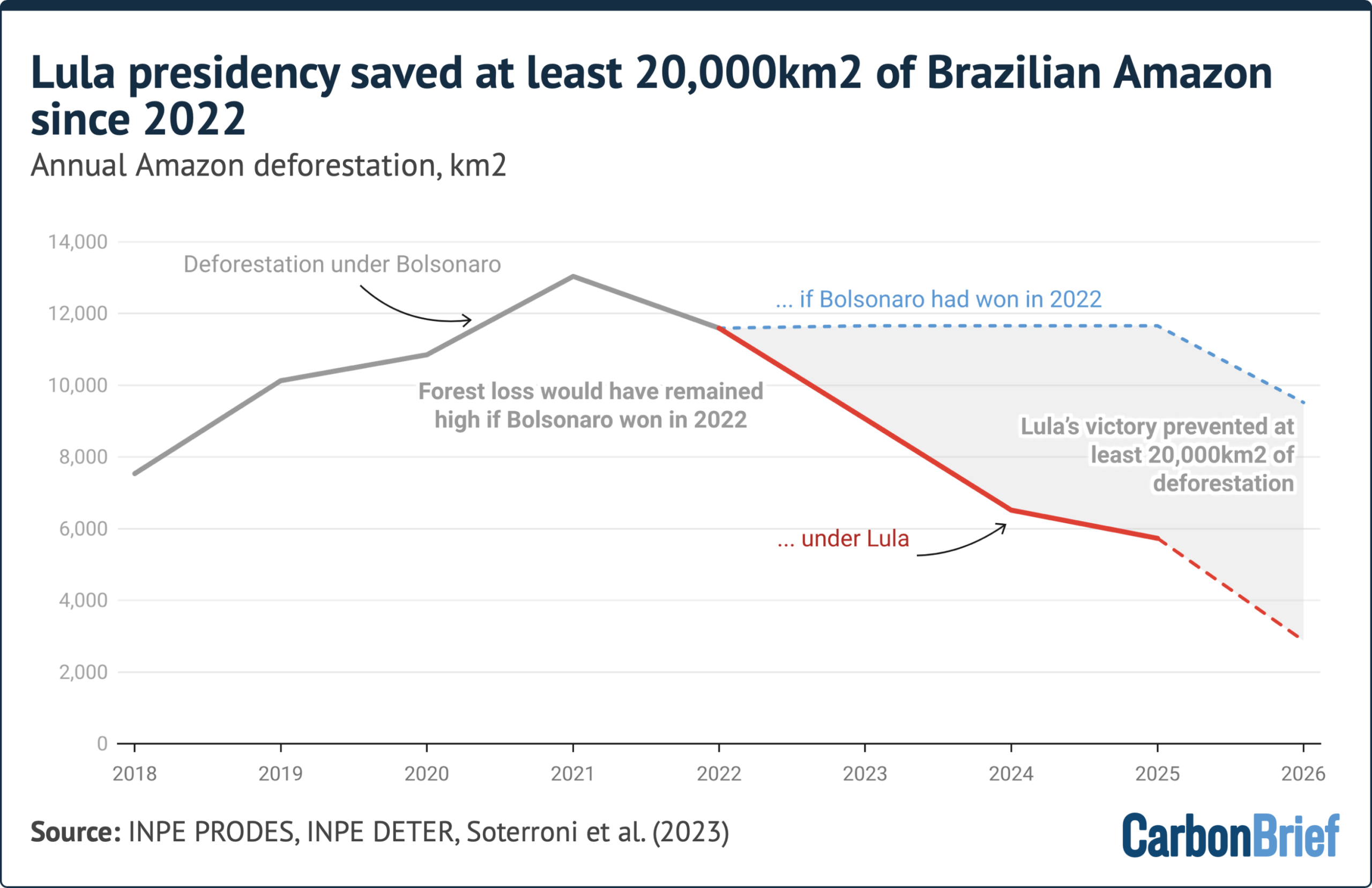
This analysis is based on a 2023 study on the role of nature-based solutions in Brazil’s pathway to net-zero emissions. This was a refined update of a 2018 study that used the same GLOBIOM-Brazil model, from researchers at the University of Oxford, the International Institute for Applied Systems Analysis and Brazil’s National Institute for Space Research (INPE).
It is based on a comparison of forest code implementation with a “baseline” scenario in which the code is not enforced, reflecting the kind of weak governance seen under the Bolsonaro administration. (See Carbon Brief’s 2022 article for more details of this modelling.)
Dr Aline Soterroni, a University of Oxford researcher who led the 2023 analysis, tells Carbon Brief that the reversal seen under Lula “shows how quickly deforestation can respond to political will”.
However, she stresses that the modelling of the “no forest code” scenario is “relatively conservative”, with deforestation remaining high but not rising.
Deforestation in this scenario – used here as a proxy for a Bolsonaro election win – is tempered by slower demand growth for Brazilian beef and soy, says Soterroni. She notes that the scenario also does not capture the potential for illegal forest clearing in response to weak governance.
Indeed, some experts anticipated in 2022 that a Bolsonaro victory would send deforestation rates rising to near-record levels.
Claudio Angelo, international policy coordinator at Brazil’s Climate Observatory, tells Carbon Brief that if Bolsonaro had won in 2022, “we have reason to believe [this would have resulted] in much higher rates than during his first term”.
Angelo says the “political signal” would likely have driven an “explosion of wildcat mining” and illegal deforestation in the Amazon. He also points to efforts – including by Flávio Bolsonaro – to formally dismantle the forest code in the Brazilian congress, during Jair Bolsonaro’s first term.
Soterroni notes that deforestation rates did not immediately drop following Lula’s election, as suggested by modelling of a full “forest code compliance” scenario. She says this reflects the “gradual and imperfect process” of restoring and enforcing the law.
Nevertheless, she tells Carbon Brief:
“The key message from our modelling is the contrast between these trajectories: weak environmental governance keeps deforestation substantially higher than full implementation of the forest code. That message remains relevant today.”
Election significance
With Jair Bolsonaro in prison for plotting a coup after losing the 2022 election, his son Flávio Bolsonaro, a senator for Rio de Janeiro, is standing against Lula in the upcoming contest for president.
There are 13 candidates, but Flávio Bolsonaro and Lula are by far the frontrunners and are currently neck-and-neck in opinion polls.
If Lula wins, experts say he is likely to continue with the “zero deforestation by 2030” agenda that has already had a pronounced impact on forest loss.
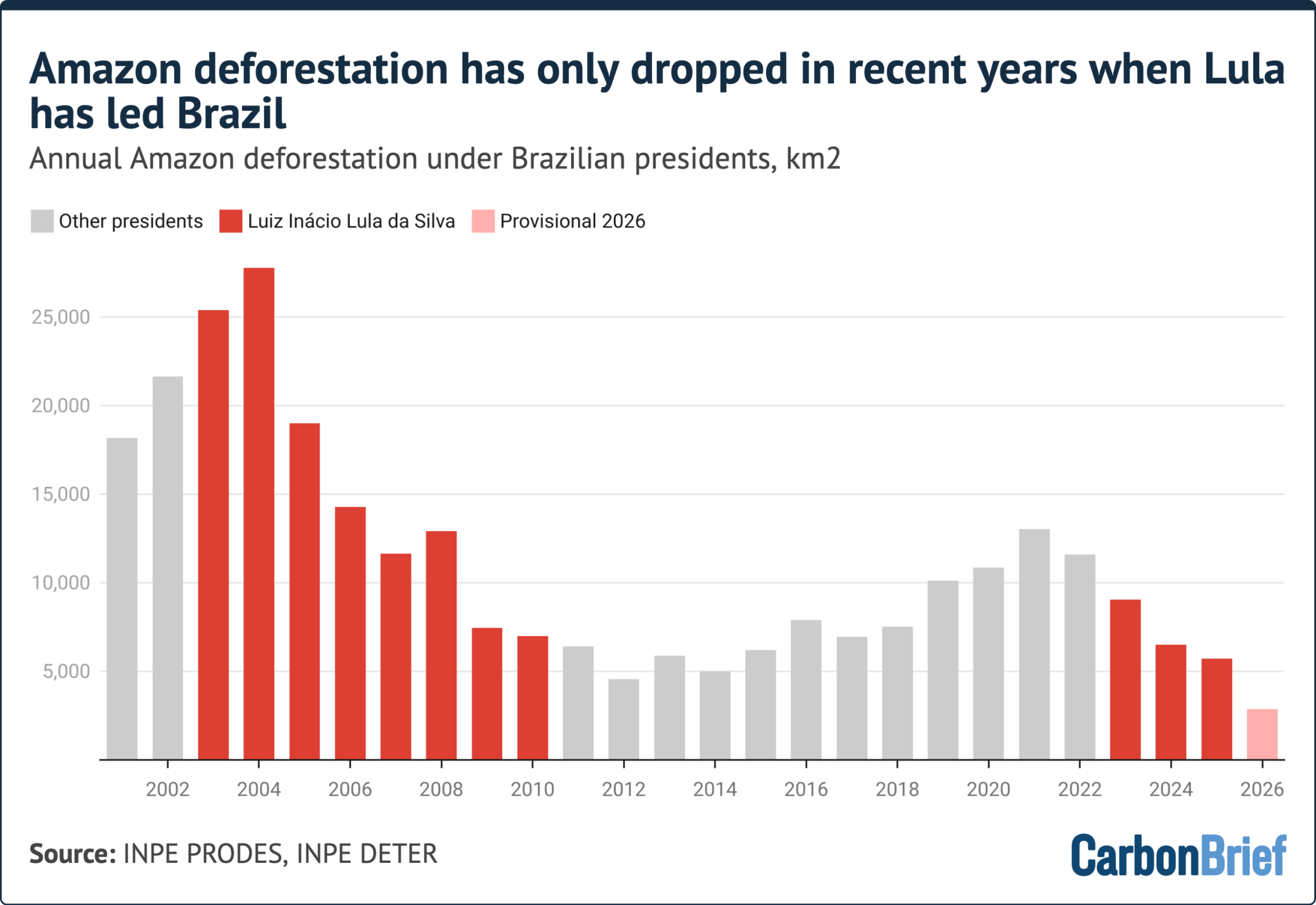
As the chart below shows, periods when Amazon deforestation fell in recent history all occurred during Lula’s three terms as president.
In contrast, experts say Flávio Bolsonaro, a climate sceptic who has indicated he will continue his father’s political agenda and favour agribusiness and mining, will likely drive a surge in deforestation. Angelo tells Carbon Brief:
“At the risk of sounding alarmist, I’ve been saying that Lula’s re-election is the only thing standing between us and a wide destruction of the Amazon.”
A Bolsonaro win would be a “tremendous disaster”, says Dr Patricia Pinho, deputy science director at the Amazon Environmental Research Institute, adding:
“I don’t think we can afford four years of increasing deforestation [and] violence against Indigenous peoples.”
Dr David Lapola, an ecologist focused on Amazon research at the University of Campinas in Brazil, says he believes deforestation “would certainly rise” and Brazil’s climate and deforestation goals “would be thrown in the trash bin”. He tells Carbon Brief:
“The Bolsonaro administration in the 2019-2022 period showed that the deconstruction of environmental policies and institutes can be done very, very quickly.
“In a matter of a few months, they can destroy what has been constructed over decades of environmental policy and activism in Brazil.”
‘Greenest’ policies
Lula has the “greenest” policy proposals of Brazil’s six top-polling presidential candidates, according to analysis by the Climate Observatory.
The analysis identifies 16 “positive and detailed” environmental commitments in Lula’s proposals, including reaffirming his “zero deforestation by 2030” goal.
Flávio Bolsonaro, on the other hand, has one positive environmental commitment and seven “clearly anti-environmental” proposals.
The right-wing politician has committed to zero “illegal” deforestation by 2029. However, he has also previously led an attempt to change the forest code, opening up large tracts of previously out-of-bounds forest for legal clearance by extractive industries.
Given this, Angelo tells Carbon Brief that he is sceptical about the 2029 pledge.
“The only way you can trust him on this is to think that he is going to revoke the forest code and make all illegal deforestation legal.”

Lula is also the only major candidate to list a clear target for cutting national emissions, sticking with Brazil’s existing goal to cut emissions by 59-67% by 2035, compared to 2005 levels.
Overall, the Climate Observatory notes that climate change and environmental issues “are off the radar for most candidates”, who are instead focusing on the economy and security issues.
Pinho adds that deforestation and the Amazon have not been at the “forefront” of this election, compared to 2022.
If Bolsonaro wins, up to 95% of the Amazon would fall under the leadership of right-wing national governments – including those in Bolivia, Colombia, Ecuador and Peru – reported Mongabay. It noted that presidents in all these nations “explicitly favour agribusiness and mining over environmental conservation”.
If no candidate receives a majority of votes in the first round of Brazil’s election on 4 October, a runoff will take place on 25 October, as has happened at every presidential election since 1998.
Soy moratorium and Brazilian congress
Other factors will also play a role in future deforestation in Brazil, regardless of the next president.
One is the effective end of the Amazon soy moratorium. This is a voluntary agreement signed by companies committing to not buy soya beans grown on land in the Brazilian Amazon that was deforested after 2008.
Conservation organisation WWF’s international director general, Kirsten Schuijt, previously described it as the “most impactful voluntary supply chain policy ever implemented”.
However, major grain traders withdrew from the agreement earlier this year, effectively bringing it to an end. Pinho describes this move as a “huge destruction” of Brazil’s environmental protections.
Research shows the moratorium prevented around 18,000km2 of deforestation in its first decade of operation from 2005-16.
In contrast, a 2026 study estimated that the end of the moratorium could result in 14,000km2 of additional deforestation in the Amazon by 2036.
Alongside choosing a new president on 4 October, Brazilian voters will elect state governors and members of congress, which will also factor into future environmental impacts.
Right-leaning parties, including the far-right Liberal Party linked to the Bolsonaros, currently hold half the seats of the two chambers of congress.
This has led to conflict between lawmakers and Lula. For example, in 2025, congress bypassed Lula’s veto of several aspects of a controversial piece of legislation dubbed the “devastation bill”.
Pinho says that the potential for a right-wing congress and president would be “devastating for the environmental and climate agenda”.
Lapola notes that a Flávio Bolsonaro presidency “would consolidate the view in Brazil that environmental protection is solely a matter of political preference, and not a crucial need of all people”. He adds:
“Land pillage, destruction of precious biodiversity and scorning of Indigenous peoples simply cannot be a nation’s project in the 21st century. We have got to be smarter than that, for sure.”
related
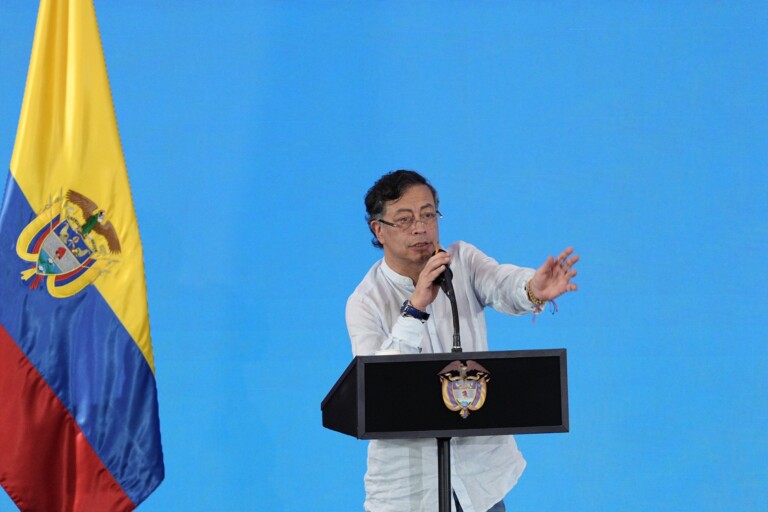
Q&A: What change of power in Colombia could mean for world’s fossil-fuel transition
Brazil’s biodiversity pledge: Six key takeaways for nature and climate change
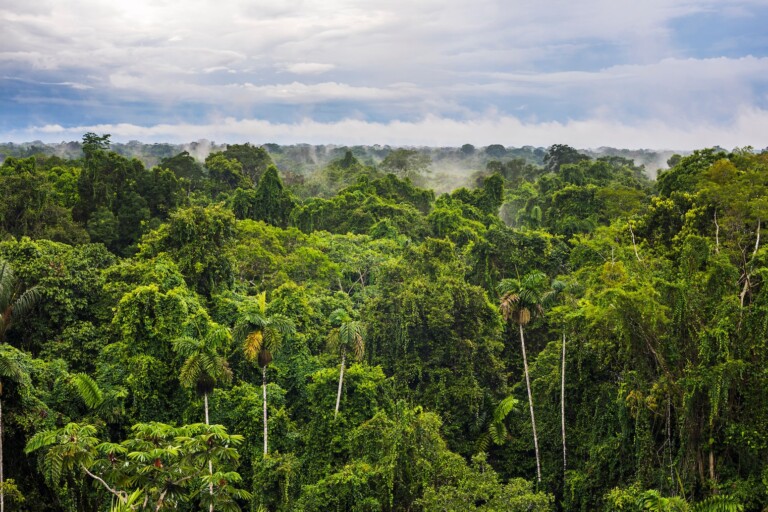
COP30: Could Brazil’s ‘Tropical Forest Forever’ fund help tackle climate change?
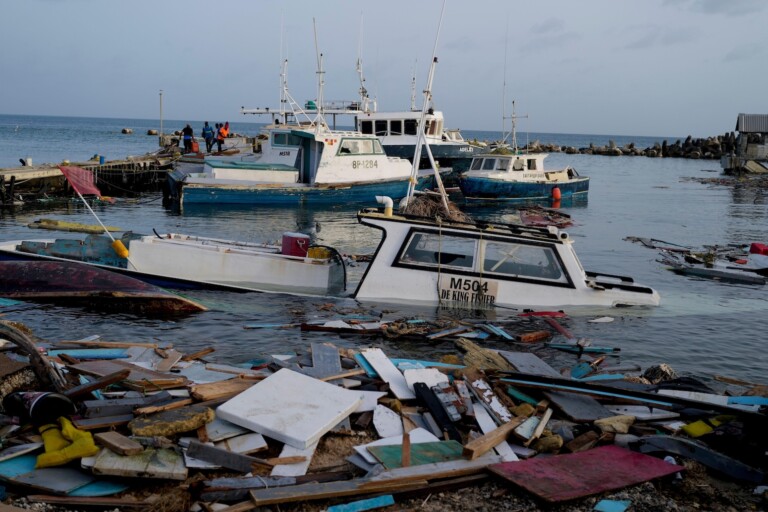
Guest post: How Caribbean states are shaping climate legislation
The post Analysis: Lula presidency saved at least 20,000km2 of Brazilian Amazon since 2022 appeared first on Carbon Brief.
Analysis: Lula presidency saved at least 20,000km2 of Brazilian Amazon since 2022
This letter is a bit more direct and longer than most of those which I write, but I hope you will be okay with that, because the times seem to call for being plain.
A few weeks ago I got a text message from an old and dear friend —let’s call her Hannah.
I have enough shared life with Hannah that, whenever we talk, the conversation always feels current and effortless, despite gaps of months or even years.
Hannah has been talking with her son — we’ll call him Neil — who is a teenager and doing well in school, but wildly worried about the state of the world, including the imminent trajectory of global warming. Hannah and I don’t text each other other very often, but on this occasion she’s reached out with something visceral:
Neil has challenged me to point him to something hopeful, if I can find it. He says so far no one is showing any will to uphold the Paris Agreement. I am checking in to see how you still manage to have real hope.*
Then, just a few days later, the United Nations Environment Programme Limiting Overshoot report landed, containing the principal finding that it is likely the global temperature will soon exceed 1.5°C.
After that news, and the real time devastation in Nepal, and in the context of the broader state of the world, I found myself having multiple conversations with friends and colleagues about the structure of hope. I want to openly share that after a few of these exchanges, I metaphorically closed the blinds, and wondered how to feel, and what to do, because there is no avoiding the dreadfulness of the news, and what it means for the suffering of people and life on Earth.
But if you are fortunate enough to have time, space and security to do so, then after the darkness, you open the shutters and once again there is light. This is the structure of my innermost resolve.
* * *
Our lives — those of us living on our magnificent earth now — have the greatest possible purpose.
There is virtually no problem that we endlessly clever and creative, human beings cannot solve, when we work together.
And we are not just intelligent and ingenious; we are inherently social, nurturing and brave; capable of the deepest enduring love.
Each of the roughly 12,000 generations of humanity so far has made life possible for those who have followed, through acts of devotion.
Babies have been held and fed. Water and food have been found and shared. Shelter has been built. For 12,000 generations we have held the hands of our children.
Every single one of us was once carried in the arms of another, unable to walk ourselves. It is our thoughtfulness, kindness and care that have seen us through as a species. Sometimes this has been in the most exigent of circumstances, when enough of our ancestors did not give in, faced incredibly difficult things, to somehow make it through.
And so it comes to this. To what we now must do. We must do as 12,000 generations of people did for us.
The struggle to keep global warming to under 1.5 degrees may be over. The battle of return—to get our planet back to safe temperatures at emergency speed and scale — is just beginning. Upon this struggle depends the future of all we care about, and that of all life on Earth. The prospects of the next 12,000 generations are conditioned by our efforts now.
Our work now is to keep the overshoot as low as we can, make it as brief as possible, and do everything within our power to alleviate other pressures on nature. It is to take care of humanity — of one another — in the face of mounting climate and ecological damage. And by these efforts, create the conditions for future flourishing. Every fraction of every degree matters.
What must now be done is hard, much tougher than should have been necessary, because of the vested interests in coal, oil and gas and deforestation, and the failures of decision makers. And while renewable energy has surged, making the case for change much simpler, on the other side of the ledger there’s the reactionary and gangsterist turn of politics and the multiplier effects of wars and mass violence, with the existential destabilisation of big tech looming over all.
There is no sugarcoating the scale of difficulty. But what is necessary remains within our collective power. We must never, for one second, say that returning our planet to flourishing is impossible — many of the obvious solutions already exist; but even where transformation relies on reforms, technologies or capabilities that might sound fanciful, or historical changes that are unprecedented, this can be no barrier to our conviction. After all, much of what we take for granted today as ordinary features of social life, would have been considered impossible by every single generation before us.
The world has not been destroyed by nuclear war; we solved the growing hole in the ozone layer; Antarctica was kept sacrosanct from exploitation. Humanity has collectively triumphed before, and can do so again.
We can find the necessary social and political will to do what is needed because these are endlessly renewable resources. The necessary financial capital exists. Apart from the fossil fuel industry, the greatest barrier we face is to mistakenly concede that what lies before us is insurmountable. It is not.
We must avoid the siren song of fatalism. Because. It. Is. Never. Too. Late.
None of which is to be insensitive to the horrors already unleashed — the deadly and grotesque harm to people, places and species that cannot be undone; or to be blind to the impacts that are coming. But where we have the power to act, we also have the responsibility — and the extraordinary privilege — to do what must be done.
Although she is wounded, our planet is still alive and beautiful beyond all of our comprehension. Hundreds of billions of creatures live and thrive still upon this earth. Nothing has happened until it has happened, and life fights for life. Every beetle, every tree, all the fish in the ocean, the smallest of the geothermal shrimps, the greatest of the whales and the mightiest of the birds — all demand life every second of their existence, so that their species too may have future generations.
No individual has to know how to solve this alone. Indeed, finding some detachment and humility is essential to concentrate on the role that each of us can play.
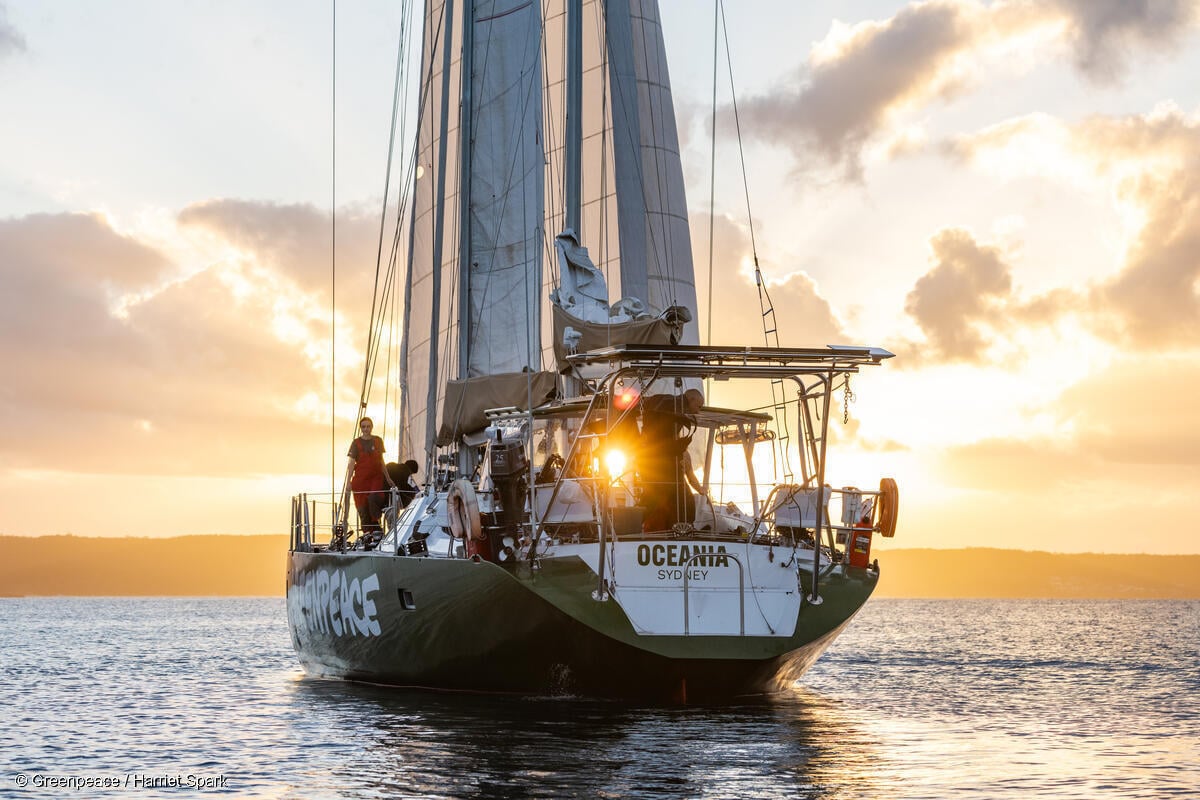
Hope is not merely a mindset or a story we tell ourselves. Collective power is not abstract; it is what we do, together, applying ourselves to the practical mechanics of change and contestation within society, by being part of the organisations and networks of people that are dedicated to effective strategies. It is why I am so committed to Greenpeace.
Working from without and within, there are opportunities to make rapid change within institutions, governments, businesses and communities to create the social, economic and political momentum for emissions reduction at speed and scale, reminding ourselves always of what remains possible, even if it hasn’t happened yet.
We can return the planet to safer temperatures. We can put technologies back in the service of people and life. We can return to the assumptions that seemed so obvious just one generation ago — that it is both possible, and our obligation, to build a better future for all people, and for life on Earth.
I did write back to Hannah and Neil, to say honestly to a treasured friend and her son, that yes, as a matter of faith, conviction, evidence and strategy, absolutely there is real hope. And this is a pledge not just to Neil and his generation, but to the next 12,000.
Together, we have the power. Together, we cross this bridge through the dark. To secure an Earth capable of nurturing life in all of its magnificent diversity.
We did not choose to carry this historic responsibility, but here we are. And it is so lucky that we are here.
I wouldn’t choose any other time to be here, alive on Earth, with you.




-
Climate Change1 year ago
Guest post: Why China is still building new coal – and when it might stop
-

 Greenhouse Gases2 years ago
嘉宾来稿:满足中国增长的用电需求 光伏加储能“比新建煤电更实惠”
-
Greenhouse Gases1 year ago
Guest post: Why China is still building new coal – and when it might stop
-

 Climate Change2 years ago
嘉宾来稿:满足中国增长的用电需求 光伏加储能“比新建煤电更实惠”
-

 Renewable Energy11 months ago
Sending Progressive Philanthropist George Soros to Prison?
-
Climate Change2 years ago
Bill Discounting Climate Change in Florida’s Energy Policy Awaits DeSantis’ Approval
-
Greenhouse Gases1 year ago
嘉宾来稿:探究火山喷发如何影响气候预测
-

 Climate Change2 years ago
Analysis: China’s CO2 falls 1% in Q2 2024 in first quarterly drop since Covid-19