

The name “gummy squirrel” seems more fitting for a dangerously delicious confection dreamt up by Willy Wonka, but you may be surprised to learn it is actually a sea cucumber found in the deep ocean. While its name is inspired by its resemblance to gummy candy, to me, this weirdo looks a bit more like a banana-shaped Runt that didn’t pass quality control. Sweet looks aside, this sea cucumber is a fascinating creature only found hidden in the deep ocean.
Love ocean content?
Enter your email and never miss an update
The gummy squirrel is about two feet long—large for a sea cucumber, which is typically four to 12 inches in length. Under its bright yellow topside, it has a beautiful bouquet of 18 feeding palps, or “lips,” that help it ingest nutrient-rich detritus that sinks to the ocean floor. The big tail that inspired the “squirrel” part of its name functions like a sail on a boat, helping it to hitch a ride on currents to new parts of the ocean floor with more food to eat.
Scientists first discovered the gummy squirrel in the Clarion-Clipperton Zone, a large stretch of the Pacific Ocean between Hawaii and Mexico. This area is hard to explore because it is located approximately 16,000 feet below sea level. We are only just beginning to have the tools to explore deep-ocean areas such as this. The gummy squirrel is just one of many deep-sea mysteries we have recently had the chance to meet. In 202,a team of scientists found more than 5,000 new species in the Clarion-Clipperton Zone, proving there is so much more we have to learn about this region of our ocean.

Yet even this remote zone of the ocean is facing a new threat from industry: deep-sea mining.
Deep-sea mining is the practice of removing mineral deposits from the ocean floor at depths below 200 meters. Interest in this type of mining is rapidly growing all over the world, and we must act quickly to protect gummy squirrels and all the mysterious creatures we have yet to discover. Seabed mining would deploy massive machines down into these deep-sea habitats that would destroy these incredible ocean ecosystems that have developed over tens of millions of years to survive extreme pressure, darkness and incredibly tough conditions. We could see environmental destruction akin to mountaintop coal removal, wiping out entire habitats and species. If we don’t act now, we could lose wildlife we haven’t even had the chance to meet yet! Imagine how much duller our lives would be without the joy of discovering deep-sea darlings like the gummy squirrel, vampire squid or dumbo octopus. We have an historic opportunity to prevent an environmental disaster before it even starts. Take action to halt seabed mining in its tracks.
The post What is a Gummy Squirrel? appeared first on Ocean Conservancy.

When I attended the OBIS Data Mobilization Workshop in the Azores (Thanks to the Air Center) this year, one observation immediately caught my attention: compared with countries such as the United States, Europe still appears surprisingly fragmented and underinvested in biodiversity data mobilization. The issue is not necessarily a lack of biodiversity research. European scientists produce enormous amounts of ecological data. The challenge is that publishing biodiversity observations into global infrastructures such as MBON/GBIF often remains an additional task rather than an integral part of funded research. In the United States, biodiversity data publication is frequently embedded in funding mechanisms and institutional mandates. Data management, curation, and dissemination seem to be recognized research activities. In much of Europe, including Denmark, researchers often mobilize data on top of their existing responsibilities, with limited dedicated funding for long-term stewardship.
I asked myself how is Denmark performing compared with its Nordic and neighboring countries?
Denmark is not lagging behind, but neither is it leading
The numbers reveal a mixed picture.
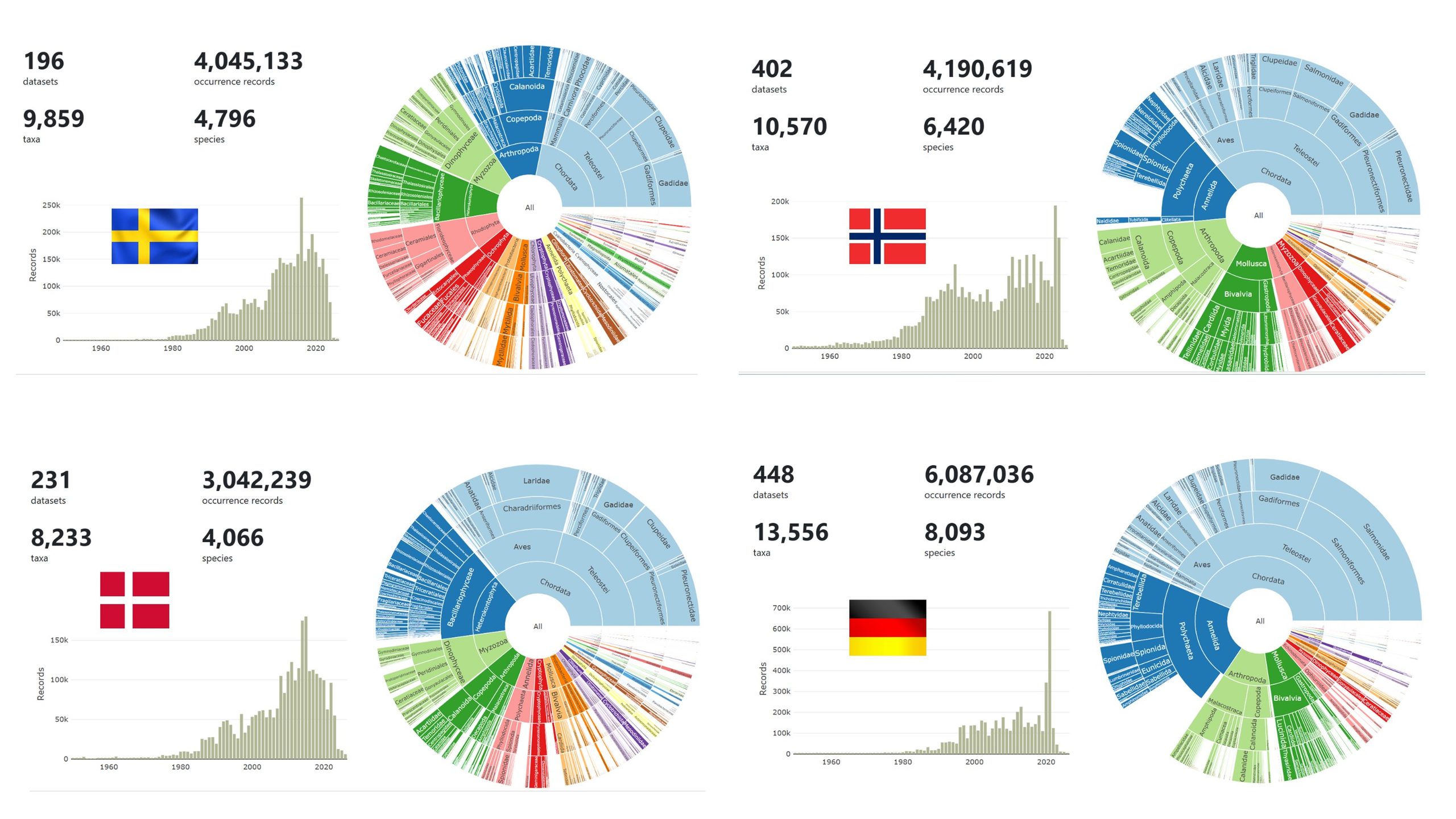
Germany clearly stands out as the regional leader, with both the highest number of datasets and the highest taxonomic coverage. Denmark has the lowest number of occurrence records and species represented among the four countries, despite having a very active biodiversity research community. What is striking is that Denmark does not fall dramatically behind in dataset numbers. Rather, the difference appears in scale and breadth. Danish datasets tend to contain fewer records and cover fewer taxa than those from Germany, Norway, and Sweden.
Different countries tell different biodiversity stories
The taxonomic breakdowns are equally revealing. Denmark should appreciate its fish and birds’ activists. Large portions of the records belong to Gadidae (cod family), Clupeidae (herring family), Laridae (gulls), and other marine vertebrates. This reflects Denmark’s historical strengths in fisheries monitoring, marine ecology, and seabird observations. However, many invertebrate groups, microorganisms, and less visible components of biodiversity remain comparatively underrepresented in global data sets despite active programs like national Program like MONIS.
Norway shows stronger contributions from invertebrate sides such as polychaetes, bivalves, copepods, and marine benthic fauna. The Norwegian data landscape appears heavily influenced by aquaculture sectores, long-term marine monitoring programs and offshore environmental surveys. There is greater representation of marine invertebrates, which are often critical indicators of ecosystem change.
What stood out in Sweden’s data profile is the relatively large contribution from copepods, diatoms, dinoflagellates, and macroalgae. These groups are often overlooked in biodiversity databases because they require specialized expertise and monitoring programs. Sweden’s contribution suggests sustained investment in aquatic ecosystem monitoring beyond commercially important species. Well done Sweden!
Germany’s profile appears the most diverse. While fish and vertebrates remain important, there are strong contributions from polychaete worms, molluscs, arthropods, plankton in general term and benthic organisms. Germany not only contributes more records but also appears to mobilize a wider variety of biodiversity data types. You made me proud Germany 
The real gap may be invisible biodiversity
One lesson from the workshop was that biodiversity databases often reflect what is easiest to observe, identify, and fund. Fish, birds, and mammals are well represented almost everywhere. The groups that drive ecosystem processes, such as jellyfish, zooplankton, benthic invertebrates, phytoplankton, and microbial communities, remain far less visible. This is particularly relevant for marine ecosystems. Some of the most important ecological changes currently occurring in our seas involve gelatinous zooplankton, plankton communities, and benthic assemblages, yet these groups remain underrepresented in many biodiversity repositories. For someone working with jellyfish and marine food webs, this raises an important question:
Are we documenting the biodiversity that is easiest to count, or the biodiversity that is most important for understanding ecosystem change?
This fall, Ocean Conservancy is celebrating its 41st annual International Coastal Cleanup® (ICC), once again bringing together volunteers to protect the beaches and waterways we all love. Ocean Conservancy recently hosted flagship events in Long Beach and Washington, D.C. that celebrated this global movement close to home.
Over the past four decades, nearly 20 million volunteers have rolled up their sleeves to remove more than 405 million pounds of trash from beaches and waterways around the world. And their impact extends far beyond what they collect. ICC volunteers have documented nearly 440 million individual items, creating the world’s largest marine debris database and providing invaluable information that helps Ocean Conservancy and others better understand—and tackle—ocean plastic pollution.
This year’s celebration continued that incredible legacy. At Alamitos Beach in Southern California, more than 150 volunteers gathered on September 19 and removed 1,109 pounds of trash, alongside members of Team USA Artistic Swimming and Olympic and Paralympic athletes. In Washington, D.C., 439 volunteers gathered on September 26 to remove 2,182 pounds of trash from Anacostia Park along the Anacostia River.


“I am so grateful to all of the volunteers who came out today for our ocean—and every volunteer who has made the last 41 years of impact possible,” said Ocean Conservancy’s Senior Director of Conservation Cleanups, Allison Schutes. “Every piece of plastic collected helps protect marine animals and habitats and contributes to research and advocacy.”
And the impact doesn’t stop when the cleanup ends. During International Coastal Cleanup events, volunteers do more than remove trash: They document what they find, helping build a clearer picture of the plastic pollution threatening our waterways and wildlife. Through the Clean Swell® app or paper data sheets, ICC volunteers contribute to Ocean Conservancy’s online, open-access database, the world’s largest repository of marine debris data. These records help scientists, conservation groups and governments understand pollution trends and identify solutions.
That data can also drive meaningful policy change. ICC data were recently used in a peer-reviewed study showing that plastic bag bans lead to reduced plastic bag pollution. The data have also helped advance policies ranging from California’s SB 54 to Florida’s balloon release ban and the federal Farewell to Foam Act. From a neighborhood cleanup to statewide action, every piece of documented trash helps build the evidence needed to tackle plastic pollution at its source.
Get Ocean Updates in Your Inbox
Sign up with your email and never miss an update.
Want to get involved?
Whether you join a local cleanup, record the trash you find using the Clean Swell app, or take action to reduce plastic pollution, you can be part of this incredible collective effort to protect our ocean. Here are a few ways to make an impact:
- Find a cleanup near you.
- Download our Clean Swell app to easily record the trash you collect.
- Take action to reduce plastic pollution.
- Explore our Wildlife Impact Calculator to estimate the potential benefits of your cleanup for marine wildlife.
- Donate today to Ocean Conservancy to help us fight plastic pollution for years to come!
The post Celebrating 41 Years of the International Coastal Cleanup® appeared first on Ocean Conservancy.