Connect with us

Published

on

By Joelle Habib (Laboratoire d’Océanographie Villefranche)

When you go on a scientific cruise, you always think about the instruments you’re going to deploy, the great data you’re going to acquire, or the experiments you’ll conduct. What you almost always forget is the small thing that isn’t actually small at all: food. And how are you going to eat it!

For those not familiar with scientific cruises: once you’re on board, most of your time goes to the science. You don’t really have time for food or food preparation. But there are always hidden heroes preparing your breakfast, lunch, and dinner, and, most importantly, the dessert for the dessert break. Today, instead of shedding light on the science, we’re going to talk about people, starting with the two chefs our lives basically depend on.

Rainer Götze and Peter Wernitz are the chefs of the last METEOR cruise. Rainer has been cooking on this ship for over 23 years, while Peter has been doing it for 13. Together they cook for 60 people on board, seamen and scientists alike. You’re probably wondering, like I was, how they pull it off. I had the chance to talk to them, and here are some of the ship’s secrets.

Let’s start with the planning. They don’t prepare the whole month’s menu before going on board, they plan it day by day. That said, a few dishes are practically law: fish on Tuesday and Friday, stew on Saturday (the stews are good, but it’s still my least favorite food day), and roasted meat on Sunday. Ice cream shows up for dessert on Sunday and Thursday lunches. And no matter the day, there’s always a vegetarian option on the table, nobody on board goes without something to eat.

So, all this cooking, but how many ingredients does it actually take? Let’s start with numbers. Every morning for breakfast there’s a choice of eggs (scrambled, boiled, fried…), pancakes, and more. So how many eggs are on this ship? For a one-month cruise, there are 3,000 eggs in storage, and the cooks go through around 90 of them a day. They also bake fresh bread every single day, about 3kg of flour goes into roughly 60 loaves. Coffee breaks happen all day, every day, there’s about 60kg of coffee on board. And since we’re on a German ship, and Germans do love their potatoes, there are 300kg of potatoes stored in a refrigerated, dark room so they don’t go bad.

You might be wondering why I’m talking so much about potatoes. Well, my dear reader, lunch has plenty of variety, but the one constant is potatoes. We’re on day 20 of the cruise, and I think we’ve worked through most of the varieties by now: fried, baked, soufflé, mashed, boiled and more still to come.

Another question I had was what happens if one of them gets sick. Rainer is a tough seaman who doesn’t get seasick anymore; Peter still does, occasionally. But either way, they’re always there, cooking through good conditions and bad. People generally love the food, though the chefs did tell me the one thing that never goes down well is old-school dishes like veal liver. (I can confirm.)

I think the message I’m trying to convey here is: a scientific cruise wouldn’t really be possible without Peter and Rainer. Science at sea is not only the science, but it’s also the work and effort of everyone on board. Especially the chefs!
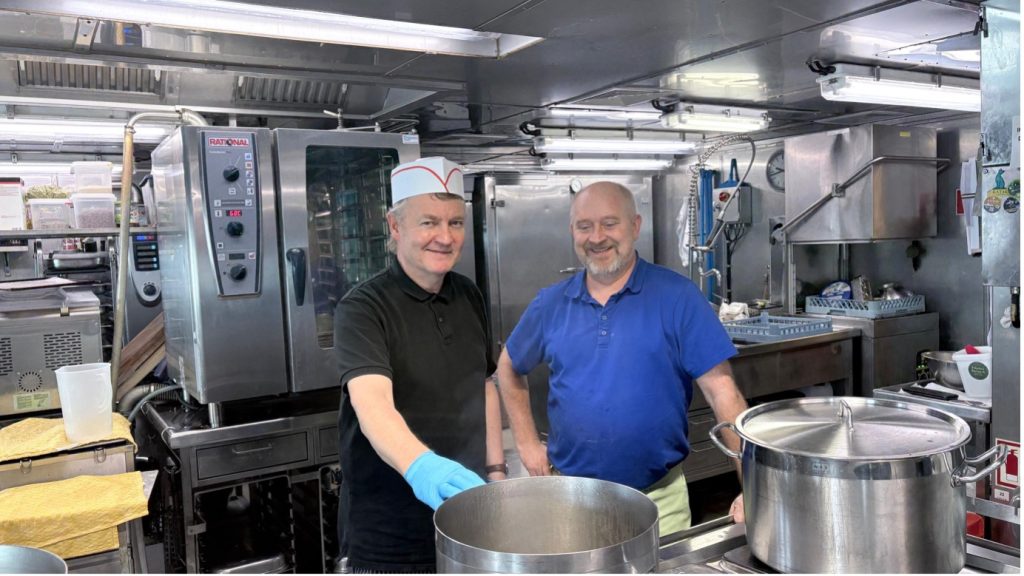
Peter Wernitz and Rainer Götze in the METEOR’s kitchen. Photo: Joelle Habib

30 Days at Sea, 30 Ways to Make Potatoes

Continue Reading

Ocean Acidification

The Strata that Matta

Published

on

From Desert to Seafloor

Fig. 1) team Strata That Matta: Victoria C., Maeghan D., Maddie B., Vale B. (from left to right)

The months leading up to OCEAN CORE Academy were filled with another type of adventure for me, surveying the badlands of New Mexico in search of dinosaur bones. Yet, my work in the Gulf Coast Repository consisted of examining ocean cores using a microscope. Although these experiences couldn’t be any more different, the two were similar in that each attempted to answer the same question: what did Earth look like in the past?

I focus much of my research on vertebrate paleontological and geological fieldwork, such as prospecting for fossils, measuring strata, or describing ancient paleoenvironments and faunal assemblages. While I knew about microfossils, I had not fully grasped how much geological history is present in them.

 Fig. 2) fieldwork, NM (May 2026)

History Through a Microscope 

This leads me to one of the most memorable parts of OCEAN CORE Academy, learning to prepare smear slides and identify what existed within the ocean cores. Ocean sediments are fairly recent in that they have not yet been lithified, each layer represents tens to hundreds of years of depositions onto the seafloor. What I looked at was much deeper!

It was a momentous occasion when I first saw a radiolarian beneath the microscope! These tiny fossilized organisms provide surprisingly detailed insights into ancient environments. The conditions in which different groups of microfossils thrive vary, but by tracking how they fluctuate between layers, we can reconstruct climatic shifts over geologic time.

Team Strata That Matta correlated a transition from calcareous to siliceous ooze layers with a cooling climate!

Fig. 3) my first time seeing microfossils


Fig. 4) radiolarian                                                Fig. 5) coccolithophores                                          Fig. 6) sponge spiccules 

Bringing OCA Back to AZ   

Upon my return to Arizona, I will carry this new perspective with me. As I move forward with future projects and field seasons in New Mexico, volunteer at the Arizona Museum of Natural History, and pursue my degree, the skills I developed here will prove to be invaluable for strengthening my own research.

Prior to attending OCEAN CORE Academy I viewed microfossils as existing, yet somewhat separate from my projects. This place has challenged that perspective. I came to understand that many of the most detailed records of Earth’s past are the microfossils hidden within a single grain of sediment!

Fig. 7) class of OCA 2026 

Written by OCA 2026 student, Maddie Baare

The Strata that Matta

Continue Reading

Ocean Acidification

Earth’s History at Every Scale

Published

on

From Desert to Seafloor

Fig. 1) team Strata That Matta: Victoria C., Maeghan D., Maddie B., Vale B. (from left to right)

The months leading up to OCEAN CORE Academy were filled with another type of adventure for me, surveying the badlands of New Mexico in search of dinosaur bones. Yet, my work in the Gulf Coast Repository consisted of examining ocean cores using a microscope. Although these experiences couldn’t be any more different, the two were similar in that each attempted to answer the same question: what did Earth look like in the past?

I focus much of my research on vertebrate paleontological and geological fieldwork, such as prospecting for fossils, measuring strata, or describing ancient paleoenvironments and faunal assemblages. While I knew about microfossils, I had not fully grasped how much geological history is present in them.

 Fig. 2) fieldwork, NM (May 2026)

History Through a Microscope 

This leads me to one of the most memorable parts of OCEAN CORE Academy, learning to prepare smear slides and identify what existed within the ocean cores. It was a momentous occasion when I first saw a radiolarian beneath the microscope!

Before, I had been hunting for fossils measured in centimeters/meters, but now I am studying those measured in micrometers. These tiny fossilized organisms provide surprisingly detailed insights into ancient environments. The conditions in which different groups of microfossils thrive vary, but by tracking how they fluctuate between layers, we can reconstruct climatic shifts over geologic time.

Using these changing microfossil assemblages, my team correlated a transition from calcareous to siliceous ooze layers with a cooling climate!

Fig. 3) my first time seeing microfossils

Fig. 4) radiolarian                                           Fig. 5) coccolithophores                                          Fig. 6) sponge spiccules 

Bringing OCA Back to AZ   

Upon my return to Arizona, I will carry this new perspective with me. As I move forward with future projects and field seasons in New Mexico, volunteer at the Arizona Museum of Natural History, and pursue my degree, the skills I developed here will prove to be invaluable for strengthening my own research.

Prior to attending OCEAN CORE Academy I viewed microfossils as existing, yet somewhat separate from my projects. This place has challenged that perspective. I came to understand that many of the most detailed records of Earth’s past are the microfossils hidden within a single grain of sediment!

Fig. 7) class of OCA 2026 

Written by OCA 2026 student, Maddie Baare

Earth’s History at Every Scale

Continue Reading

Ocean Acidification

Microplastic Pollution Research at Sea

Published

on

I have been studying plastic pollution for more than a decade. I’ve analyzed hundreds of samples in labs, pored over data and spent years thinking hard about where plastics go once they leave our hands and enter the environment. I love doing work on the water—this was a big part of my previous professional roles in Alaska and in Saipan, Northern Mariana Islands.

And here’s where it took me! I was thrilled to have the opportunity to join the first leg of eXXpedition’s voyage in the South Pacific this past spring, trading my lab coat for a lifejacket to study microplastics at sea. Sailing from Auckland, New Zealand, to the Bay of Islands aboard the 70-foot research vessel Wind Shift over 10 days, our crew of 12 women conducted ocean water-surface sampling via manta tow nets (a long cone-shaped mesh net), cleaned up debris on remote beaches and examined city streets with measuring tapes and field equipment. Our purpose? To collect key data to help us better understand the flow of plastics from land to sea.

Our all-female guest crew—hence the XX in “eXXpedition”—brought aboard expertise from the fields of structural engineering, circular economy strategy, sustainable fashion, plastics research, robotics and more. Together, we represented a remarkable cross-section of disciplines united around a shared concern for the health of our ocean.

Seeing it with my own eyes

We found plastics of all shapes and sizes everywhere we went—in the city streets of Auckland, while crossing the Hauraki Gulf and even at Aotea Great Barrier Island (one of the most remote and protected stretches of New Zealand’s coastline). Our ocean is vast and some of these places felt far removed from the centers of human activity, but this eXXpedition was a good reminder that plastic doesn’t respect remoteness. It moves, accumulates and shows up where we least expect.

Working alongside local NGO Sustainable Coastlines, we arrived on a remote stretch of beach on Aotea Great Barrier Island to audit and clean up any plastics we came across. What we found there told the same story our Auckland street surveys did: We found bottle caps, food packaging, fragments, plastic pellets and fishing debris. The everyday materials of modern life—but weathered, broken and scattered.

Science at sea

One of my favorite parts of the voyage (which was also one of the most challenging, if I’m being honest!) was the sea-surface manta trawl analyses we did onboard. I found out quickly that sorting microplastics from krill-laden seawater samples under a microscope while sailing is not for the faint of stomach.

The most common plastic culprit we found in those samples? Microplastic fibers. This type of microplastic is no wider than a human hair and is the most common type of microplastic found in the environment. Microplastic fibers can come from a variety of sources like cigarette butts, weathered ropes or wet wipes, but actually, most microplastic fibers shed from synthetic clothing and textiles. Laundering is a major source— shockingly, a single load of laundry can generate up to 18 million microfibers.

And yet, we found these tiny plastic fibers floating in the ocean many miles away from the nearest washing machine.

In my lab research, I have found microplastic fibers time and time again, but there’s something even more sobering about hand-picking them out of a seawater sample collected from pristine-looking waters. It was a good reminder of why understanding where plastic comes from, how it moves and where it ends up is so critical to addressing the problem at its roots.

Filter Out NSFW Microplastics
Tell your elected officials to take action against plastic pollution by requiring microplastic fiber filters! Adding your name takes less than two minutes, and goes a long way in protecting our ocean, forever and for everyone.

What I’m bringing back

Studying plastic pollution from the deck of a boat in some of the most remote waters in the Southern Hemisphere made me appreciate the work I do even more. It also made me appreciate how important people are in this giant puzzle of plastic pollution solutions. The plastic pollution crisis is a human problem, and solving it requires all of us. The courage and dedication of the women I shared those 10 days with is something I won’t forget. Going to sea, doing the science and pushing through discomfort to collect data that matters was not easy. We were seasick some days and exhilarated others. Despite that fact, we showed up for it fully, every day.

The plastic is out there, even in far-flung corners of the ocean. And the answer is not to be paralyzed by that fact, but to use it as fuel. Every sample we collected is now a data point in a larger story about where plastic comes from and where it goes. Every cleanup, every surface trawl, every street block walked and every hour spent at a microscope are parts of building the evidence base that informs policies, regulations and systems-level changes that can actually turn this crisis around.

Cleaning up beaches and coastlines is valuable and necessary work. But we also must stop plastic from entering the ocean in the first place—through stronger policy, better product design and real investment in waste management infrastructure everywhere. Luckily, when it comes to the most common microplastics in the ocean— microplastic fibers—there is already an effective, affordable solution to immediately reduce microplastics coming from our laundry by roughly 90%: washing machine filters. These filters act just like laundry lint filters in our dryers, capturing fibers in tightly-woven mesh and effectively preventing them from leaving our homes and leaking into the environment.

What can you do?

There’s no better time to tackle plastic pollution than right now, during Plastic Free July™! Take two minutes to add your name and call on your elected leaders to combat those pesky, dangerous microfibers that are pouring into our ocean daily—like the ones I found from my samples at sea. Together, we can stop plastic pollution at the source and protect our ocean forever and for everyone.

My biggest takeaways from this experience? People are remarkable. Our ocean is remarkable. And our ocean is worth fighting for, including from 70 feet of sailing vessel in the South Pacific, staring down a microscope with a pair of tweezers and a queasy stomach.

The eXXpedition South Pacific I voyage ran from April 27 to May 6, 2026, sailing from Auckland to the Bay of Islands. Learn more about the research team and our itinerary at https://exxpedition.com/voyage/auckland-to-bay-of-islands/.

The post Microplastic Pollution Research at Sea appeared first on Ocean Conservancy.

Microplastic Pollution Research at Sea

Continue Reading

Trending

Copyright © 2022 BreakingClimateChange.com