Connect with us

Published

on

Warming driven by deforestation caused an extra 28,000 heat-related deaths per year across Africa, South America and Asia over 2001-20, new research finds.

The study, published in Nature Climate Change, is the first to look at human health impacts of warming caused specifically by tropical deforestation, as opposed to the burning of fossil fuels, its lead author tells Carbon Brief.

The authors find that deforestation alone drove, on average, 0.45C of warming in the tropics over 2001-20, accounting for 64% of the total warming in regions with tropical forest loss.

They also find that tropical deforestation over 2001-20 exposed 345 million people to “local warming”, in addition to the warming they were already facing due to global warming.

Six out of every 100,000 people living in deforested areas died as a result of deforestation-induced warming during this time, they warn.

This number is higher in south-east Asia, with Vietnam setting a record of, on average, 29 deaths per 100,000 people.

A researcher who was not involved with the study tells Carbon Brief that the “sobering” paper “reframes tropical deforestation as not only a carbon emissions and ecological issue, but also a critical public health concern”.

Tropical deforestation

Tropical forests, mainly distributed across South America, Africa and Asia, account for 45% of global forest cover.

These regions are well-known for their high biodiversity and the crucial ecosystem services that they provide, such as carbon storage.

However, tropical forest loss is on the rise.

A record 6.7m hectares of previously intact tropical forest was lost last year, mainly due to fires and land clearing for agriculture. As the planet warms, worsening heat and drought extremes are also causing trees to become less resilient to change, resulting in forest degradation.

The new study uses data from the Global Land Analysis and Discovery laboratory at the University of Maryland to assess how tropical forest cover has changed year on year. The authors find that over 2001-20, a total of 1.6m square kilometres (160m hectares) of tropical forest was lost globally. This is shown on the map below, where blue indicates high forest loss and yellow indicates low loss.
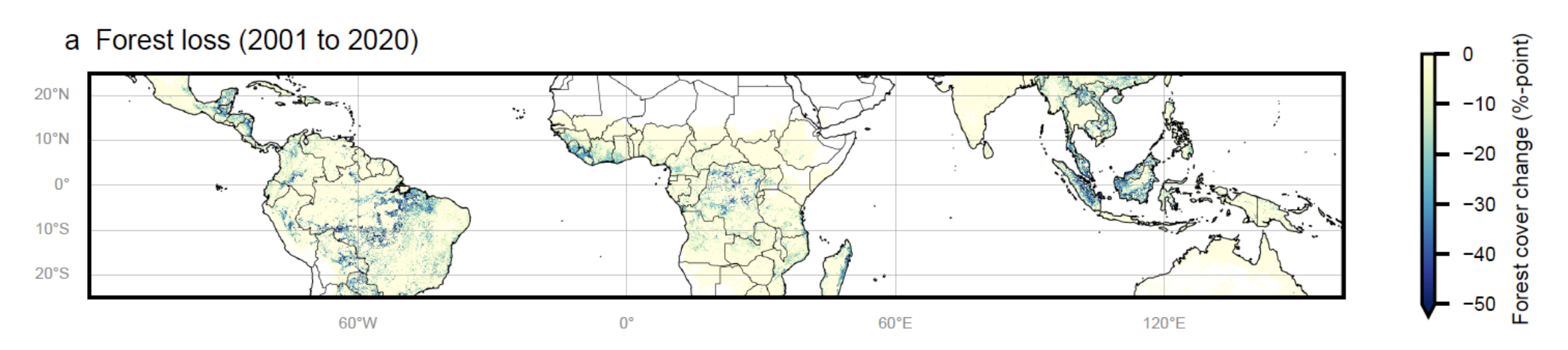
Map of the equatorial region showing forest loss (2001 to 2020)
Change in tropical forest cover (top) over 2001-20, using satellite data with a resolution of one square kilometre. Source: Reddington et al. (2025)

The authors find the largest forest loss was in central and South America, but also highlight “extensive” loss in south-east Asia and tropical Africa.

Forest warming

Tropical deforestation has a wide range of negative consequences, including decreasing biodiversity, releasing carbon into the atmosphere and threatening the safety of Indigenous communities.

Loss of tree cover can also affect local temperatures by influencing the water cycle.

Water is constantly moving from the surface of the land into the atmosphere through a process called evapotranspiration. Plants play a crucial part in this process by moving water from the soil up through their roots and into their leaves, where it evaporates, cooling the air above. When trees are cut down, this cooling effect is reduced.

The authors use data of land surface temperatures from the NASA MODIS satellite to map warming in tropical regions over 2001-20. These results are shown in the map below, where red indicates warming and blue indicates cooling.

Map of the equatorial region showing change in land surface temperature (2001-2003 mean to 2018-2020 mean)
Change in land surface temperature between 2001-03 and 2018-20. Source: Reddington et al. (2025)

The authors find that between 2001-03 and 2018-20, surface temperatures increased by 0.34C in tropical central and South America, 0.1C in tropical Africa and 0.72C in south-east Asia. They add that “areas of forest loss coincide with areas of strong positive change in temperature across many regions of the tropics”.

By comparing their deforestation and surface warming maps, the authors find that deforested regions of the tropics saw an average of 0.7C warming over 2001-20, while areas that “maintained forest cover” saw an increase of only 0.2C.

By comparing the change in temperature in deforested regions with that in neighbouring locations without forest loss, they find that deforestation alone caused 0.45C of warming in the tropics over 2001-20 – accounting for 64% of total warming experienced over those regions.

Heat exposure

High temperatures can be deadly.

During periods of extreme heat, people can suffer from heat stroke and exhaustion – and even die. Those with underlying health conditions are at higher risk of fatal complications.

The authors use data from Oak Ridge National Laboratory’s LandScan to map where people live in the tropics. They estimate that 425 million people live in regions that were exposed to tropical deforestation over 2001-20, and just over three-quarters of them were exposed to warming as a result of the loss of forest cover.

Finally, the authors estimated “heat-related excess mortality” due to nearby tropical deforestation.

Using data from the 2019 Global Burden of Disease study, they determine the number of “non-accidental” deaths in each deforested tropical area. This excludes deaths from “external” causes, such as accidents and suicides, but includes “internal” causes, such as disease.

The researchers then used previously published “temperature-mortality” relationships for different countries. These relationships show the link between temperature and excess mortality rate, indicating the percentage increase in mortality for every degree of warming.

These relationships vary between countries, as people in hotter regions are generally better adapted to extreme heat.

By combining the data on local warming due to deforestation, temperature-mortality relationships and the non-accidental mortality data, the authors calculated how many non-accidental deaths would have been expected in deforested regions if they had not warmed due to the loss of forest cover.

By comparing the real and counterfactual mortality rates, the authors were able to calculate the total mortality burden due to tropical deforestation-induced warming.

Overall, the authors find that tropical deforestation drove an additional 28,300 deaths every year over 2001-20, accounting for 39% of the total heat-related mortality from global climate change and deforestation combined over locations of forest loss.

The study finds that, on average, six out of every 100,000 people living in deforested areas died as a result of deforestation-induced warming. However, these numbers vary by country.

The chart below shows the average annual deaths due to deforestation-induced heat per 100,000 people living in areas of forest loss.

Bar chart showing deaths per 100,000 people
Average number of deaths due to deforestation-induced heat per 100,000 people living in areas of forest loss. The dashed blue lines show the 95% confidence interval. Chart by Carbon Brief. Data from Reddington et al. (2025)

Dr Carly Reddington is a research fellow at the University of Leeds and lead author of the study. She tells Carbon Brief that it is the “first study to look at human health impacts of tropical deforestation-induced warming”.

Dr Nicholas Wolff, a climate change scientist at the Nature Conservancy who was not involved with the study, tells Carbon Brief that the paper is “sobering”. He adds that it “reframes tropical deforestation as not only a carbon emissions and ecological issue, but also a critical public health concern”.

Data-scarce

The authors note that there are no country-specific heat vulnerability indices available for African countries. To develop their data for African countries, they used the average heat vulnerability index for South America.

Reddington tells Carbon Brief that Africa is the most “uncertain region” in the study and tells Carbon Brief that “more data is really crucial” to develop more accurate estimates.

Wolff tells Carbon Brief that extrapolating heat-mortality relationships “from data-rich regions to data-poor ones” is a “common practice in global-scale climate-health research”.

He praises the overall methodology as “innovative, transparent and scientifically sound, with appropriate caveats”.

Dr Luke Parsons, a climate modelling scientist at the Nature Conservancy, tells Carbon Brief that the conclusions are “robust”. However, he notes some “methodological issues” with the paper, such as the fact that all results are modelled, rather than measured.

He tells Carbon Brief that future work could assess “near-surface air temperature and humidity changes associated with deforestation, as well as study regional air temperature changes beyond deforested areas”.

While the new study focuses on warming within one square kilometre of forest loss, Reddington tells Carbon Brief that “deforestation is associated with warming up to 100km away”.

Furthermore, the study notes that the increase in deaths due to excess heat is likely to affect the most vulnerable members of society the most. It says:

“Vulnerable populations, particularly traditional and Indigenous communities, often live near deforested areas and face limited access to resources and infrastructure needed to cope with the combination of rising temperatures and environmental changes caused by deforestation and climate change.”

Wolff also stresses this disparity, adding that “many of these communities depend on forest clearing for agriculture, income and survival, and are forced to make difficult choices between short-term economic needs and long-term health and environmental stability”.

The authors also note that deforestation can drive a range of other interacting health problems, which were not considered in this study. For example, deforestation is linked to a rise in zoonotic diseases, such as malaria.

Dr Vikki Thompson, a climate scientist at the Royal Netherlands Meteorological Institute who was not involved in the study, says that the findings of the paper are “relevant to everyone”. She continues:

“We can reduce impacts of extreme heat by planting more trees and reducing deforestation everywhere, on both local and international scales.”

The post Warming due to tropical deforestation linked to 28,000 ‘excess’ deaths per year appeared first on Carbon Brief.

Warming due to tropical deforestation linked to 28,000 ‘excess’ deaths per year

Continue Reading

Climate Change

Maryland Passes Energy Bill That Delivers Short-Term Relief, Locks Ratepayers into Long-Term Nuclear Subsidy

Published

on

Advocates say Maryland lawmakers passed consequential energy proposals without adequate analysis or public debate during the 2026 session.

Maryland lawmakers’ new solution for rising utility bills reduces a surcharge funding an effective energy-efficiency program, offers rebates by raiding the state’s clean energy fund and includes subsidies for nuclear power that advocates say may prove costly over time.

Maryland Passes Energy Bill That Delivers Short-Term Relief, Locks Ratepayers into Long-Term Nuclear Subsidy

Continue Reading

Climate Change

To avoid COP mistakes, Santa Marta conference must be shielded from fossil fuel influence

Published

on

Rachel Rose Jackson is a climate researcher and international policy expert whose work involves monitoring polluter interference at the UNFCCC and advancing pathways to protect against it.

Next week, dozens of governments will gather in the Colombian city of Santa Marta for a conference on transitioning away from fossil fuels.

The conference is a first of its kind, in name and in practice. It’s a welcome change to see a platform for global climate action actually acknowledge the primary cause of the climate crisis – fossil fuels. This sends a clear message about what needs to be done to avoid tumbling off the climate cliff edge we are precariously balancing on.

The agenda set for governments to hash out goes further than any other multilateral space has managed to date. Over the week, participants will discuss how to overcome the economic dependence on fossil fuels, transform supply and demand, and advance international cooperation to transition away from fossil fuels.

Alongside the conference, academics, civil society, movements and others are convening to put forward their visions of a just and forever fossil fuel phase out. The conference can help shape pathways and tools governments can use to achieve a fossil-fuel-free future, particularly if the dialogue begins with an honest assessment of “fair shares.”

    This means assessing who is most responsible for emissions and exploring truer means of international collaboration that can unlock the technology, resources and finances necessary for a just transition.

    Fossil fuel-driven violence is spiraling in places like Palestine, Iran, and Venezuela. Climate disasters are causing billions and billions of dollars in damage annually with no climate reparations in sight. All of this remains recklessly unaddressed on account of corporate-funded fascism.

    We know the world’s addiction to fossil fuels must end. Is it surprising that a global governmental convening chooses now to try to tackle fossil fuels? It shouldn’t be, but it is.

    COP failures

    By contrast, meetings of governments signed up to the longest-standing multilateral forum for climate action—the United Nations Framework Convention on Climate Change (UNFCCC) – took nearly three decades before it officially responded to the power built by movements and acknowledged the need to address fossil fuel use at COP28 in 2023.

    Even then, this recognition came riddled with loopholes. It may seem illogical that a forum established by governments in 1992 to coordinate a response to climate change should take decades to acknowledge the root of the problem. Yet there are clear reasons why arenas like the UNFCCC have consistently failed to curb fossil fuels decade after decade.

    What would the outcome be when a fossil fuel executive literally oversaw COP28 and when Coca-Cola was one of the sponsors for COP27?

    How can strong action take hold when, year after year, the UNFCCC’s COPs are inundated with thousands of fossil fuel lobbyists?

    And how can justice be achieved when there are zero safeguards in place to protect against the conflicts of interest these polluters have?

    Colombia pledges to exit investment protection system after fossil fuel lawsuits

    Justly transitioning off fossil fuels cannot be charted when the very actors that have knowingly caused the climate crisis are at the helm—the same actors that consistently spend billions to spread denial and delay.

    Unless platforms like the UNFCCC take concerted action to protect climate policymaking from the profit-at-all-costs agenda of polluters, the world will not deliver the climate action people and the planet deserve.

    The impacts of climate action failure are now endured on a daily basis in some way by each of us – and especially by frontline communities, Indigenous Peoples, youth, women, and communities in the Global South. We must be closing gaps and unlocking pathways for advancing the strongest, fairest and fastest action possible.

    Learn from mistakes

    Yet, as we chase a fossil-fuel-free horizon, it’s essential that we learn from the mistakes of the past. We do not have the luxury or time to repeat them. History shows us we must protect against the polluting interests that want the world addicted to fossil fuels for as long as humanly possible.

    We must also reject their schemes that undermine a just transition—dangerous distractions like carbon markets and Carbon Capture Utilisation and Storage (CCUS) that are highly risky and spur vast harm, all while allowing for polluters to continue polluting.

    Fossil Free Zones can be on-ramps to the clean energy transition

    We get to a fossil-fuel-free future by following the leadership of the movements, communities and independent experts who hold the knowledge and lived experience to guide us there.

    We succeed by protecting against those who have a track record of prioritising greed over the sacredness of life.

    And we arrive at a world liberated from fossil fuels by doing all of these things from day one, before the toxicity of the fossil fuel industry’s poison takes hold.

    If this gathering in Santa Marta can do this, then it can help set a new precedent for what people-centered and planet-saving climate action looks like. When everything hangs in the balance, there can be no if’s, and’s, or but’s. There’s only here and now, what history shows us must be done, and what we know is lost if we do not.

    The post To avoid COP mistakes, Santa Marta conference must be shielded from fossil fuel influence appeared first on Climate Home News.

    To avoid COP mistakes, Santa Marta conference must be shielded from fossil fuel influence

    Continue Reading

    Climate Change

    Q&A: How the UK government aims to ‘break link between gas and electricity prices’

    Published

    on

    The UK government has announced a series of measures to “double down on clean power” in response to the energy crisis sparked by the Iran war.

    The conflict has caused a spike in fossil-fuel prices – and the high cost of gas is already causing electricity prices to increase, particularly in countries such as the UK.

    In response, alongside plans to speed the expansion of renewables and electric vehicles, the UK government says it will “move…to break [the] link between gas and electricity prices”.

    Ahead of the announcement, there had been speculation that this could mean a radical change to the way the UK electricity market operates, such as moving gas plants into a strategic reserve.

    However, the government is taking a more measured approach with two steps that will weaken – but not completely sever – the link between gas and electricity prices.

    • From 1 July 2026, the government will increase the “electricity generator levy”, a windfall tax on older renewable energy and nuclear plants, using part of the revenue to limit energy bills.
    • The government will encourage older renewable projects to sign fixed-price contracts, which it says will “help protect families and businesses from higher bills when gas prices spike”.

    There has been a cautious response to the plans, with one researcher telling Carbon Brief that it is a “big step in the right direction in policy terms”, but that the impact might be “relatively modest”.

    Another says that, while the headlines around the government plans “suggest a decisive shift” in terms of “breaking the link” between gas and power, “the reality is more incremental”.

    Why are electricity prices linked to gas?

    The price of electricity is usually set by the price of gas-fired power plants in the UK, Italy and many other European markets.

    This is due to the “marginal pricing” system used in most electricity markets globally.

    (For more details of what “marginal pricing” means and how it works, see the recent Carbon Brief explainer on why gas usually sets the price of electricity and what the alternatives are.)

    As a result, whenever there is a spike in the cost of gas, electricity prices go up too.

    This has been illustrated twice in recent years: during the global energy crisis after Russia invaded Ukraine in 2022; and since the US and Israel attacked Iran in February 2026.

    Notably, however, the expansion of clean energy is already weakening the link between gas and electricity, a trend that will strengthen as more renewables and nuclear plants are built.

    The figure below shows that recent UK wholesale electricity prices have been lower than those in Italy, as a result of the expansion of renewable sources.

    The contrast with prices in Spain is even larger, where thinktank Ember says “strong solar and wind growth [has] reduced the influence of expensive coal and gas power”.

    Chart showing that renewables are 'decoupling' power prices from gas in some countries
    Wholesale electricity prices in the UK, Spain and Italy, € per megawatt hour. Source: Ember.

    The share of hours where gas sets the price of power on the island of Great Britain (namely, England, Scotland and Wales) has fallen from more than 90% in 2021 to around 60% today, according to the Department of Energy Security and Net Zero (DESNZ). (Northern Ireland is part of the separate grid on the island of Ireland.)

    This is largely because an increasing share of generation is coming from renewables with “contracts for difference” (CfDs), which offer a fixed price for each unit of electricity.

    CfD projects are paid this fixed price for the electricity they generate, regardless of the wholesale price of power. As such, they dilute the impact of gas on consumer bills.

    The rise of CfD projects means that the weeks since the Iran war broke out have coincided with the first-ever extended periods without gas-fired power stations in the wholesale market.

    This shows how, in the longer term, the shift to clean energy backed by fixed-price CfDs will almost completely sever the link between gas and electricity prices.

    The National Energy System Operator (NESO) estimated that the government’s target for clean power by 2030 could see the share of hours with prices set by gas falling to just 15%.

    What is the government proposing?

    For now, however, about one-third of UK electricity generation comes from renewable projects with an older type of contract under the “renewables obligation” scheme (RO).

    It is these projects that the new government proposals are targeting.

    The government hopes to move some of these projects onto fixed-price contracts, which would no longer be tied to gas prices, further weakening the link between gas and electricity prices overall.

    When RO projects generate electricity, they earn the wholesale price, which is usually set by gas power. In addition, they are paid a fixed subsidy via “renewable obligation certificates” (ROCs).

    This means that the cost of a significant proportion of renewable electricity is linked to gas prices. Moreover, it means that, when gas prices are high, these projects earn windfall profits.

    In recognition of this, the Conservative government introduced the “electricity generator levy” (EGL) in 2022. Under the EGL, certain generators pay a 45% tax on earnings above a benchmark price, which rises with inflation and currently sits at £82 per megawatt hour (MWh).

    The tax applies to renewables obligation projects and to old nuclear plants.

    The current government will now increase the rate of the windfall tax to 55% from 1 July 2026, as well as extending the levy beyond its previously planned end date in 2028.

    It says it will use some of the additional revenue to “support businesses and households with the impacts of the conflict in the Middle East on the cost of living”. Chancellor Rachel Reeves said:

    “This ensures that a larger proportion of any exceptional revenues from high gas prices are passed back to government, providing a vital revenue stream so that money is available for government to support businesses and families with the impacts of the conflict in the Middle East.”

    The increase in the windfall tax may also help to achieve the government’s second aim, which is to persuade older renewable projects to accept new fixed-price contracts.

    Simon Evans on Bluesky: Details of UK govt plans to break influence of gas on electricity prices

    Reeves made this aim explicit in her comments to MPs, saying the higher levy “will encourage older, low-carbon electricity generators, which supply about a third of our power, to move from market pricing to fixed-price contracts for difference”.

    (This is an adaptation of a proposal for “pot zero” fixed-price contracts, made by the UK Energy Research Centre (UKERC) in 2022, see below for more details.)

    As with traditional CfDs, the new fixed-price contracts would not be tied to the price of gas power. Instead of earning money on the wholesale electricity market, these generators would take a fixed-price “wholesale CfD”. In addition, they would be exempted from the windfall tax and would continue to receive their fixed subsidy via ROCs.

    The government says this will be voluntary. It will offer further details “in due course” and will then consult on the plans “later this year”, with a view to running an auction for such contracts next year.

    It adds: “Government will only offer contracts to electricity generators where it represents clear value for money for consumers.”

    Leo Hickman on Bluesky: UK energy secretary Ed Miliband appearing on BBC Breakfast

    (It is currently unclear if the proposals for new fixed-price contracts would also apply to older nuclear plants. Last month, the government said it intended to “enable existing nuclear generating stations to become eligible for CfD support for lifetime-extension activities”.)

    What is not being proposed?

    Contrary to speculation ahead of today’s announcement, the government is not taking forward any of the more radical ideas for breaking the link between gas and electricity prices.

    Many of these ideas had already been considered in detail – and rejected – during the government’s “review of electricity market arrangements” (REMA) process.

    This includes the idea of creating two separate markets, one “green power pool” for renewables and another for conventional sources of electricity.

    It also includes the idea of operating the market under “pay as bid” pricing. This has been promoted as a way to ensure that each power plant is only paid the amount that it bid to supply electricity, rather than the higher price of the “marginal” unit, which is usually gas.

    However, “pay as bid” would have been expected to change bidding behaviour rather than cutting bills, with generators guessing what the marginal unit would have been and bidding at that level.

    Finally, the government has also not taken forward the idea of putting gas-fired power stations in a strategic reserve that sits outside the electricity market.

    Last year, this had been proposed jointly by consultancy Stonehaven and NGO Greenpeace. In March, they shared updated figures with Carbon Brief showing that – according to their analysis – this could have cut bills by a total of around £6bn per year, or about £80 per household.

    However, some analysts argued that it would have distorted the electricity market, removing incentives to build batteries and for consumers to use power more flexibly.

    What will the impact be?

    The government’s plan for voluntary fixed-price contracts has received a cautious response.

    UKERC had put forward a similar proposal in 2022, under which older nuclear and renewable projects would have received a fixed-price “pot zero” CfD.

    (This name refers to the fact that CfDs are given to new onshore wind and solar under “pot one”, with technologies such as offshore wind bidding into a separate “pot two”.)

    In April 2026, UKERC published updated analysis suggesting that its “pot zero” reforms could have saved consumers as much as £10bn a year – roughly £120 per household.

    Callum McIver, research fellow at the University of Strathclyde and a member of the UKERC, tells Carbon Brief that the government proposals are a “big step in the right direction in policy terms”.

    However, he says the “bill impact potential is lower” than UKERC’s “pot zero” idea, because it would leave renewables obligation projects still earning their top-up subsidy via ROCs.

    As such, McIver tells Carbon Brief that, in his view, the near-term impact “could be relatively modest”. Still, he says that the idea could “insulate electricity prices” from gas:

    “The measures are very welcome and, with good take-up, they have the potential to insulate electricity prices further from the impact of continued or future gas price shocks, which should be regarded as a win in its own right.”

    In a statement, UKERC said the government plan “stops short of the full pot-zero proposal, since it will leave the RO subsidy in place”. It adds:

    “This makes the potential savings smaller, but it will break the link with gas prices. The devil will be in the detail, but provided the majority of generators join the scheme, most of the UK’s power generation fleet will have a price that is not related to the global price of gas.”

    Marc Hedin, head of research for Western Europe and Africa at consultancy Aurora Energy Research, tells Carbon Brief that, while the headlines “suggest a decisive shift” in terms of “breaking the link” between gas and power, “the reality is more incremental”. He adds:

    “In principle, moving a larger share of generation onto fixed prices would reduce consumers’ exposure to gas‑driven price spikes and aligns well with the direction already taken for new build [generators receiving a CfD].”

    However, he cautioned that “poorly calibrated [fixed] prices would transfer value to generators at consumers’ expense, while overly aggressive pricing could result in low participation”.

    In an emailed statement, Sam Hollister, head of UK market strategy for consultancy LCP, says that the principle of the government’s approach is to “bring stability to the wholesale market and avoid some of the disruption that a more radical break might have caused”.

    However, he adds that the reforms will not “fundamentally reduce residential energy bills today”.

    Johnny Gowdy, a director of thinktank Regen, writes in a response to the plans that while both the increased windfall tax and the fixed-price contracts “have merit and could save consumers money”, there were also “pitfalls and risks” that the government will need to consider.

    These include that a higher windfall tax could “spook investors”. He writes:

    “A challenge for policymakers is that, while the EGL carries an investment risk downside, unless there is a very significant increase in wholesale prices, the tax revenue made by the current EGL could be quite modest.”

    Gowdy says that the proposed fixed-price contracts for older renewables “is not a new idea, but its time may have come”. He writes:

    “It would offer a practical way to hedge consumers and generators against volatile wholesale prices. The key challenge, however, is to come up with a strike price that is fair for consumers and does not lock future consumers into higher prices, given that we expect wholesale prices to fall over the coming decade.”

    Gowdy adds that it might be possible to use the scheme as a way to support “repowering”, where old windfarms replace ageing equipment with new turbines.

    On LinkedIn, Adam Bell, partner at Stonehaven and former head of government energy policy, welcomes the principle of the government’s approach, saying: “The right response to yet another fossil fuel crisis is to make our economy less dependent on fossil fuels.”
    However, he adds on Bluesky that the proposals were “unlikely to reduce consumer bills”. He says this is because they offered a weak incentive for generators to accept fixed-price contracts.

    The post Q&A: How the UK government aims to ‘break link between gas and electricity prices’ appeared first on Carbon Brief.

    Q&A: How the UK government aims to ‘break link between gas and electricity prices’

    Continue Reading

    Trending

    Copyright © 2022 BreakingClimateChange.com