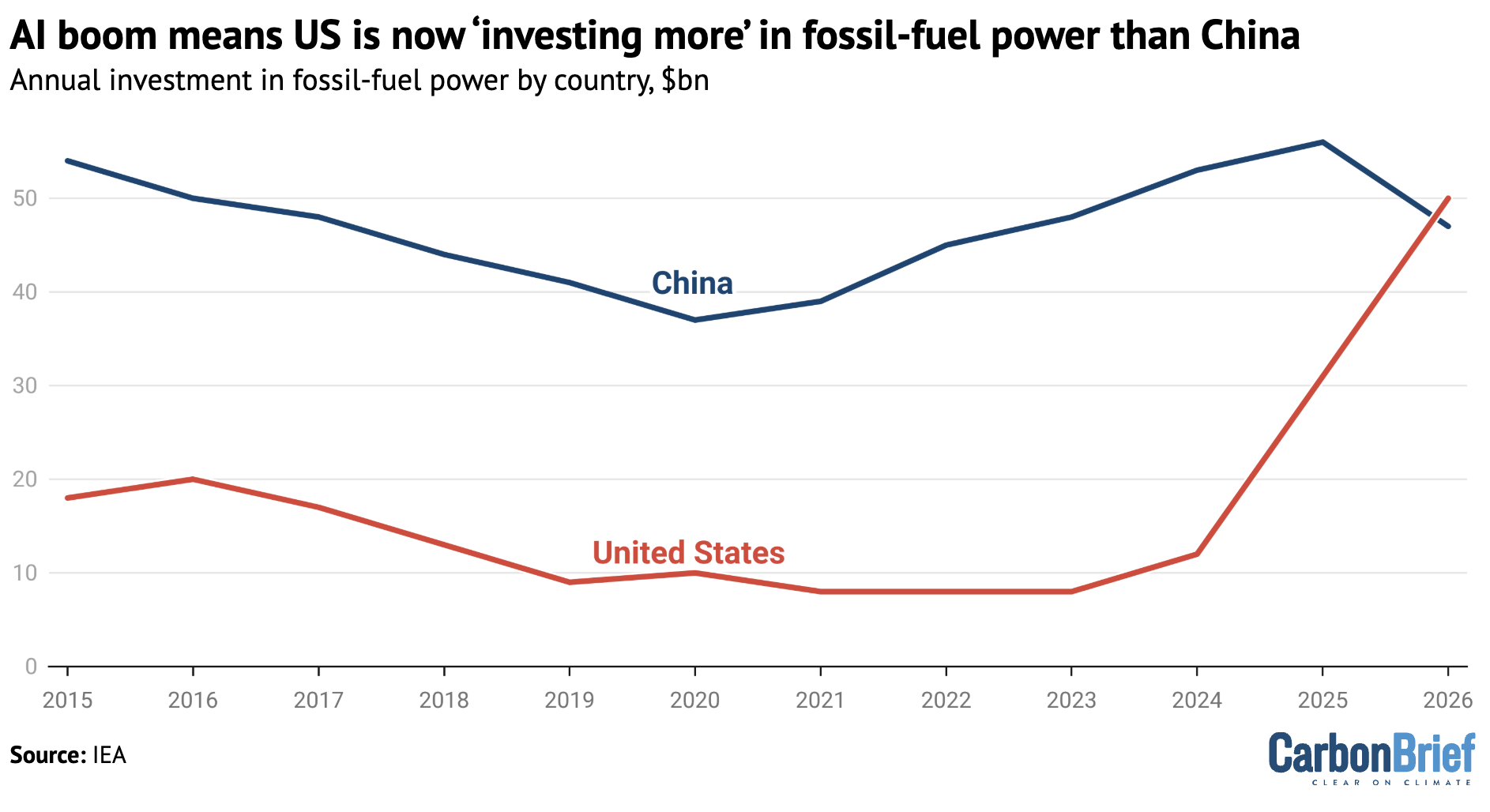
The “data-centre boom” is driving a surge in gas investment in the US, pushing its fossil-power spending ahead of China, according to the International Energy Agency (IEA).
A rapid expansion of data centres across the nation is at the heart of the US tech sector’s plans to continue “dominat[ing]” the global artificial intelligence (AI) industry.
High demand for electricity to power these data centres has led to companies rushing to build new gas-fired power plants across the country.
This trend, combined with “soaring” gas-turbine prices, drove a threefold increase in US gas‑power investment in 2025 – and the IEA expects this to continue throughout 2026.
As the chart below shows, Chinese investment in coal- and gas-fired power is expected to drop this year, amid domestic policy changes and the Iran war sending gas prices spiralling.
Together, these trends mean the IEA expects US investment in fossil-fuelled power plants to overtake China’s in 2026.
The IEA’s latest world energy investment report shows that spending on renewables and electricity grids continues to dominate at the global scale.
In the US, Trump administration policies such as the phase-out of tax credits for renewables has led to the IEA revising its forecast for new wind and solar power downwards.
At the same time, US electricity demand is expected to rise by an average of 2% per year from 2026 to 2030, with data centres contributing half of the overall increase.
This is leading to what the IEA calls an “AI-driven push” to build new gas-power plants in the US, the world’s largest data-centre market and largest gas producer.
Globally, orders for new gas-power plants increased to 130 gigawatts (GW) in 2025 – a 25-year high – and US demand was a “major factor” in this, according to the IEA.
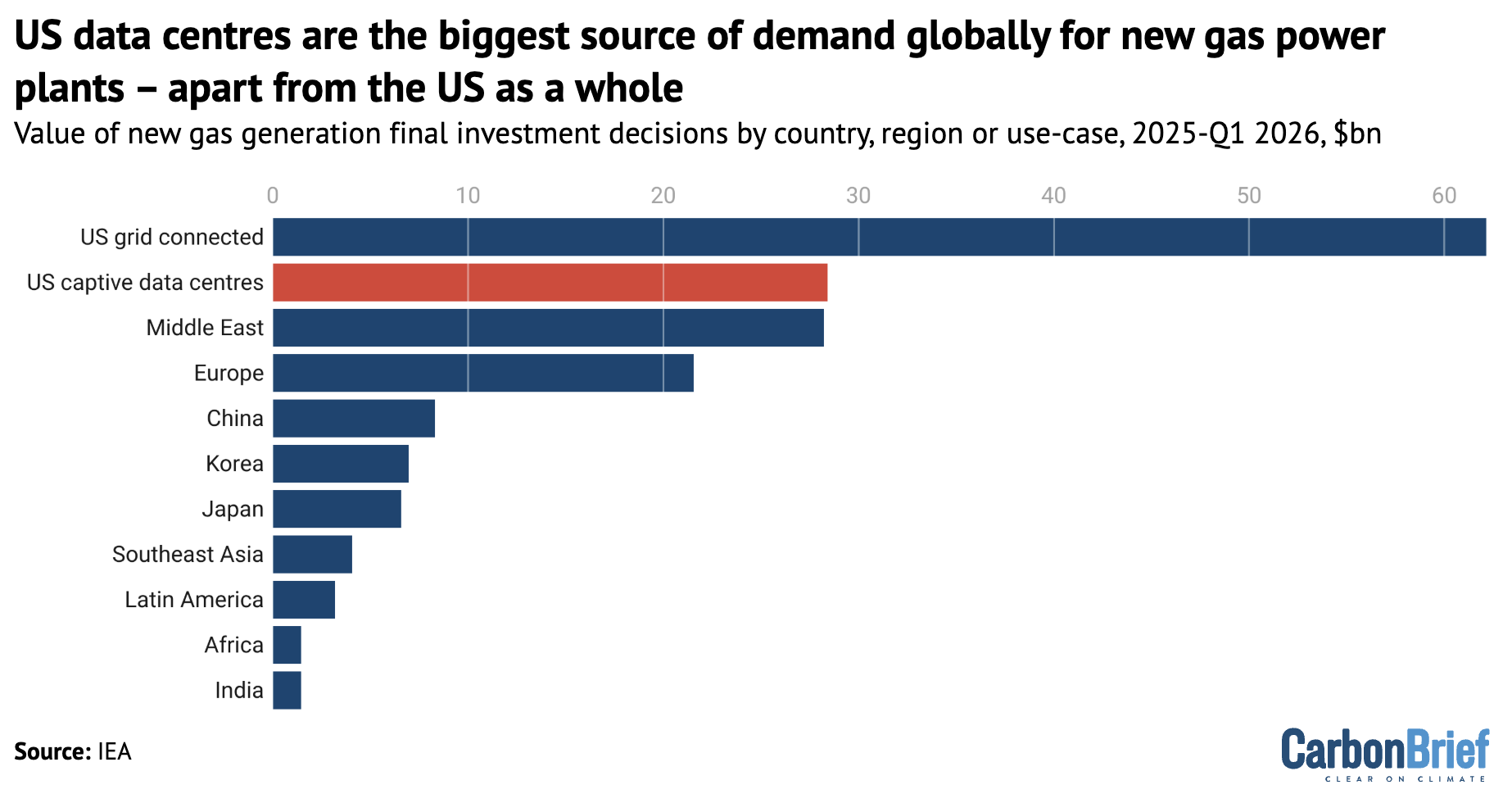
Much of the demand is coming from tech companies in the US seeking to bypass grid connection queues by building “captive” gas-power plants.
As the chart below shows, since the start of 2025 these US captive data centres alone have signed off on more investment in new gas turbines than any country in the world – aside from the US itself.
Overall, investment in grid upgrades, power equipment and electricity generation to support the buildout of data-centre infrastructure around the world hit $105bn in 2025, according to the IEA.
This is more than the total invested in the energy sector across the whole of Africa – a continent where more than 600 million people do not have access to electricity.
The IEA notes that strong demand for gas-power plants for data centres in the US – and, to a lesser extent, the Middle East – is “limiting the availability of turbines for near-term deployment elsewhere in the world”.
The agency also points out that as the tech sector becomes a “major energy investor”, accounting for around 40% of all corporate power-purchase agreements, it is also “underpinning momentum” for emerging clean technologies, such as small modular nuclear reactors and advanced geothermal.

The post AI boom means US is now ‘investing more’ in fossil-fuel power than China appeared first on Carbon Brief.
AI boom means US is now ‘investing more’ in fossil-fuel power than China
Climate Change
Warning against ‘consumer club’ as G7 forms critical minerals alliance
Wealthy nations in the G7 have agreed to work more closely together to secure the minerals they need for the energy transition, AI and defence, and to diversify supply chains away from China, calling for more cooperation with “like-minded partners”.
But the agreement adopted at this week’s G7 leaders’ summit in France is vague on what co-operation with resource-rich developing countries could look like, with critics warning against creating a consumer club of powerful nations that excludes others from shaping standards and building green supply chains.
“The G7 communiqué reaffirms our suspicion that, for the G7, it is all about resource security, not just energy transition,” Claude Kabemba, executive director of Southern Africa Resource Watch, told Climate Home News.
In a joint communique, the leaders of some of the world’s largest economies said they would step up coordination within the group and with partner countries to establish mineral processing and industrial capacity, support local value addition, promote innovation, develop standards, improve mineral traceability and share information on stockpiling systems.
They agreed to create a joint crisis-prevention mechanism with the support of the International Energy Agency to monitor mineral supply and demand disruptions, as well as establish harmonised platforms to provide information about the origin of minerals, starting with lithium and nickel.
The statement was endorsed by France, the UK, Canada, Germany, Italy, Japan, the US and the European Union at the end of the three-day summit in Evian, on the French shores of Lake Geneva. Australia, which isn’t a G7 member, also supported the declaration.
Breaking dependency on China
Western governments have been scrambling to secure the minerals they need to produce clean energy technologies such as batteries, electric vehicles and wind turbines, as well as hardware for artificial intelligence and military equipment while breaking their dependence on China.
China controls most supply chains for the strategic minerals they need, dominating the processing of 19 out of 20 critical minerals. The only exception is nickel, where Indonesia leads on supply and processing. Last year, Beijing spooked governments in Europe and the US when it imposed restrictions on rare earths exports, signalling its willingness to use its industrial clout to achieve its geopolitical objectives.
“We are all faced with risks of over-dependence and therefore vulnerability in our value chains,” French President Emmanuel Macron told a press conference, citing the “risks of divisions” among the group on how to respond to China’s control over strategic resources. “We have decided to move forward together,” he said.
Leaders agreed to aggregate demand to support the development of minerals projects and set targets for reducing dependencies on any single country outside the G7 by the end of the year.
A US proposal to regulate mineral prices and a French push to establish a permanent secretariat to track G7 initiatives on minerals failed to reach consensus among the group, according to Reuters.
Who has a seat at the table?
The declaration recognises the need for “mutually beneficial partnerships” and “plurilateral trade agreements” between G7 countries and “like-minded” and “trusted” partners to build diversified supply chains. Other parts of the text refer to “developing countries” and “emerging economies”.
A separate G7 statement on “mutually beneficial international partnerships” mentions the need for international cooperation along the whole of mineral supply chains.
“Who is going to be part of this conversation is unclear,” said Sébastien Treyer, executive director of France think-tank IDDRI, citing the ambiguity of the language and calling for developing countries to be part of the conversation.
Trade agreements that support green industrialisation can be “an entry point” for investment into value-addition projects in developing countries, said Treyer, but “how this is going to be operationalised is the key question”.
Moving beyond a ‘consumer club’
Resource-rich developing countries, particularly in Africa, have called for investment to build their industrial capacity to turn raw materials into high-value components for clean energy technologies such as batteries, capturing more domestic value and creating jobs.
But Kabemba, whose organisation is based in South Africa, said the declaration says “nothing about transferring industrial capacity to previously exploited regions such Africa”.
“Africa needs to react with its own coalition of the willing to put Africa’s interests first, otherwise, Africa risks being locked into a role as a raw material supplier in a new economic order it is not helping to build,” he said.
Patrick Schröder, a resource governance expert at Chatham House, agreed that the G7 remains overwhelmingly focused on securing minerals supplies and reducing its dependence on China. “The benefits for developing country producers are only marginal in the G7 discussions,” he said.
Brazil, which is rich in rare earths, graphite and copper, was invited to attend the G7 meeting but did not endorse the minerals declaration – highlighting the need for future minerals framework to be more inclusive and responsive to producer-country concerns, said Schröder.
For Luc Tezenas, head of policy and advocacy at the Resource Justice Network, “the answer to rising geopolitical fragmentation cannot be to shrink multilateralism into a smaller club of ‘like-minded’ consumer economies”.
Instead, a non-binding minerals framework put forward by South Africa during its presidency of the G20 last year “shows more promise as a pathway forward because it attempts to link supply resilience with regional value chains and economic justice,” he said. The UK, which is presiding over the G20 next year, has the opportunity to build a more inclusive way forward, he added.
Circularity: another way to capture value
G7 nations also described the circular economy and the substitution of minerals in designing technologies as “key” to meet growing demand and secure sufficient supplies.
This, they said, includes increasing recycling capacity by setting targets, combatting the illegal transfer of used products and components, and promoting the recovery of minerals from secondary sources such as mining waste.
“We also recognise the opportunity for emerging market and developing economies to benefit from capturing added value through the recycling and secondary processing of their mining waste, as well as from circular economy innovations,” they said.
Schröder, of Chatham House, said the challenge now lies in demonstrating that intentions can be turned into creating a circular economy for minerals through investments, business support and a favourable policy environment.
The post Warning against ‘consumer club’ as G7 forms critical minerals alliance appeared first on Climate Home News.
Warning against ‘consumer club’ as G7 forms critical minerals alliance
Climate Change
Q&A: What do China’s provincial five-year plans say about climate and energy?
China’s provincial-level governments have now all published their 15th five-year plans – economic and social development blueprints for 2026-2030.
These provincial plans reaffirm the overall trajectory of China’s energy transition, but reveal regional differences, based on economic and geographic considerations.
Provincial plans are a critical mechanism for showing how high-level targets from the central government will be translated into action.
For example, binding indicators set at national level include reductions in carbon intensity – carbon dioxide (CO2) emissions per unit of economic output – and the proportion of non-fossil energy in total consumption.
Subsequent targets are then set for each province and tied to the performance evaluations of top local officials, who are ultimately responsible for delivery.
Similarly, provincial plans also build on qualitative policy directives in the national-level plan, such as further developing new-energy vehicles (NEVs) and hydrogen industries.
Specific policies, such as boosting production capacity, appear in several provincial-level plans.
Below, Carbon Brief analyses what the 31 documents say about energy and climate.
What do the provincial plans say about climate goals?
At the broad level, the new provincial plans follow China’s overarching climate goals. All 31 provincial-level jurisdictions in mainland China have pledged to peak carbon emissions before 2030.
Every plan also mentions the core elements of China’s energy transition strategy, including solar, wind, hydrogen, energy storage and upgrading the power grid.
While solar features in every plan, specific interests in the technology vary from province to province.
Some set goals to add new solar capacity by 2030. Zhejiang province aims to add 90GW of solar capacity, while Shaanxi plans to “accelerate” construction of wind and solar bases in the north of the province, as well as “solar+” models – such as “forest-solar” and “tea-solar” – in the south. Several plans mention developing offshore solar farms in the next five years.
However, others instead choose to focus on recycling old solar panels or strengthening solar R&D.
The chart below shows the frequency with which key climate and energy terms appeared in the 31 provincial-level five-year plans.

Almost every plan mentions growing consumption and production of NEVs. Growing the NEV industry is seen as an essential step to China becoming “a leading power in automobiles” and “a key strategic move” to address climate change, according to a plan for the sector’s development issued by the State Council in 2020.
Around 15 provinces pledge to promote NEV uptake. Jilin set a target for NEVs comprising more than 50% of new car sales by 2030, although its current rate is already thought to be 47%.
While the central government is issuing directives to limit “overcapacity” in the sector, more than 20 provinces say they will continue developing their NEV industries, with many aiming to generate hundreds of billions – or even trillions – of yuan in value.
Among them are established NEV manufacturing bases such as Shanghai and Chongqing.
Meanwhile, 24 provinces will prioritise developing renewable power “direct connection” models, in which renewable generators supply industrial users via a dedicated line – a system that could boost consumption of clean energy.
Provinces diverge in terms of what other technologies they name and how detailed their plans are.
For example, offshore wind and nuclear are mentioned by 11 and 12 provinces respectively, with both technologies mostly targeted to be built in coastal provinces.
Inland provinces, such as Inner Mongolia, Gansu, Qinghai and Xinjiang, instead focus on developing wind and solar farms across desert regions.
But in general, variation reflects more than just geography or resources endowment, says Anders Hove, a senior research fellow at the Oxford Institute for Energy Studies.
“The differences between provinces reflect primarily differences in economic development capabilities and industrial structure,” he tells Carbon Brief.
Yang Li, deputy executive director at the Beijing-based thinktank Institute for Global Decarbonization Progress (iGDP), echoes this, stating that the variation reflects differences in the resources available to provinces and their own strategic positioning.
Provinces are also increasingly discussing how to manage the decommissioning of solar and windfarms.
Around 19 provinces have set out plans to recycle old clean-energy equipment, a topic that featured in few plans in the previous five-year cycle. While most of the plans that mention the goal only briefly flagged the issue, Inner Mongolia, Jiangsu, Jiangxi and Qinghai have pledged to create dedicated recycling parks or industrial clusters.
How do provinces talk about fossil fuels?
Almost every province has pledged to peak coal and oil consumption, in line with similar language in the national-level plan.
However, 17 local governments also pledge to produce more fossil fuels – trying to peak consumption while also expanding output, opening new reserves or lifting production limits.
Most of these are western and northern regions designated as national energy-supply bases, including Inner Mongolia, Xinjiang, Ningxia, Shaanxi, Gansu, Qinghai, Shanxi, Liaoning, Jilin and Heilongjiang.
Yang tells Carbon Brief this pattern reflects the “two dimensions of China’s [energy] transition”, namely a national-level push for peaking fossil-fuel consumption and a desire for energy security by provinces rich in energy resources.
Provinces that host significant fossil-fuel economies are also the most likely to mention carbon capture and storage, as well as curbs on non-CO2 greenhouse gases.
Carbon capture and efforts to deal with methane, another potent greenhouse gas, appear in 14 plans.
All the provincial plans mention gas. Unlike consumption of coal and oil, which almost every province has pledged to peak, no province has proposed capping gas use.
Several provinces set explicit targets to expand gas production. Sichuan aims for annual gas production of 70bn cubic metres, while Inner Mongolia is targeting 32bn cubic metres by the end of 2030.
Others plan on generally expanding gas extraction, utilisation and infrastructure. Guangdong plans to build several new gas-fired power plants while Henan and Hubei will “accelerate” exploration for and development of oil and gas fields.
Provinces such as Heilongjiang, Sichuan, Chongqing and Tianjin will expand gas storage and pipeline connectivity, framing the fuel as a way to ensure energy security.
Gas occupies a small position in China’s overall energy mix, accounting for 8-9% of primary energy demand and 7% of CO2 emissions. It nevertheless remains a relatively large source of energy for some provinces, such as the industrial hub of Guangdong.
It has often been referred to as a “bridging fuel” that can help countries move away from coal use, with several of China’s policies in the 2010s encouraging coal-to-gas switching. However, in China its growth has slowed in recent years in the face of unreliable supplies and large additions of wind and solar capacity.
Provincial plans to expand gas output, Yang argues, reflect China’s aims to increase overall energy supply under its energy security strategy.
As such, she says, it “should not be viewed as a simple trade-off” between China’s climate and energy security goals. Instead, it is an “inevitable stage” in the country’s “build before breaking” strategy for the energy transition, through which China “maintains a certain level” of fossil-fuel production in the “short- to medium-term” while further developing clean-energy capacity.
What do provinces say about AI and hydrogen?
With the national government preparing to spend trillions of yuan on datacentres for the artificial intelligence (AI) industry in the next five years, provincial officials are also tying AI to their energy systems.
More than 20 aim to use AI to help manage coal mines, power grids, oilfields and forecasting renewables output.
Sichuan, for example, has pledged to apply AI “large language models” across “power grids, power generation, coal and oil and gas”. Shanxi states that it will build a dedicated AI model “for the energy industry”, as well as AI systems for forecasting grid loads and controlling coal mining equipment.
Yang says that “AI+energy” represents a desire by policymakers to use AI to enhance energy governance, but adds that “large-scale commercialisation [of the technology] still has some way to go”.
Hove compares current mentions of using AI in the energy system to similar references in previous plans to concepts such as big data and “Internet Plus”.
Such language, he argues, is “uncontroversial” and its inclusion can be accepted by a wide range of different groups. But he adds that, in his view, AI will not resolve the institutional barriers and market incentives that are currently restricting broader consumption of renewable energy.
Unlike AI, all provincial plans mention hydrogen, which is named as a “future industry” in the central-level five-year plan.
For example, Hunan calls for promoting hydrogen trucks and rail transport and developing “renewable energy-based” hydrogen production, while Shandong pledges to focus on technological breakthroughs around hydrogen transport and storage, as well as production of green hydrogen.
Similarly, 12 provinces name the other energy-related future industry – nuclear fusion, which remains an experimental technology – as a priority for the next five years. These provinces include Anhui, Guangdong, Hebei, Hubei and Shaanxi.
The post Q&A: What do China’s provincial five-year plans say about climate and energy? appeared first on Carbon Brief.
Q&A: What do China’s provincial five-year plans say about climate and energy?
Climate Change
West African nations target Eastern Atlantic for early high seas protection
Six months after a landmark treaty to protect the high seas entered into force in January, a group of West African nations is calling for the Eastern Atlantic to be included in the first wave of marine protected areas established under the agreement.
The area known as the Convergence Zone of the Canary and Guinea Currents stretches from Cape Verde and Senegal in the north, to Nigeria and São Tomé and Príncipe in the south, forming a key migration corridor and nursery for hundreds of marine species.
At the 11th Our Ocean Conference in the Kenyan coastal resort of Mombasa this week, Senegalese Minister of the Environment and Ecological Transition Aliou Gori Diouf said this new marine protected area would contribute to a global goal to protect at least 30% of the planet’s ecosystems by 2030.
“West Africa is asserting its leadership by demonstrating that ocean protection and sustainable
development go hand in hand,” Diouf said in a statement.
To complement the push, the governments of The Gambia, Mauritania, Guinea Bissau and Senegal announced the creation of a joint regional marine protected area (MPA) “to preserve the resources essential to the livelihood” of their communities.
They added that the regional initiative will require global collaboration, as the countries face “massive challenges” from ocean heating as well as illegal fishing and marine pollution “leading to a reduction in biodiversity and lower economic opportunities for fishing-dependent communities”.
The High Seas Treaty – known formally as the agreement on Biodiversity Beyond National Jurisdiction (BBNJ) – entered into force this January just two years after its signing. So far, 90 countries have ratified it, and it is set to host its first conference of the parties (COP) in January 2027 in New York.
Warming threat
The ocean has absorbed 90% of the excess heat trapped in the Earth’s atmosphere, and is a massive carbon sink, trapping 30% of global carbon dioxide emissions. Yet despite covering nearly half of the planet’s surface, only 1% of the high seas are fully protected.
Unless this is stepped up, scientists warn that rapid ocean heating could threaten key species and ecosystems, as well as the communities that depend on them. One 2025 study estimated that fish levels have fallen by 7.2% for every tenth of a degree of global warming.
Big fishing nations secure last-minute seat to write rules on deep sea conservation
Speaking at a plenary in Mombasa, Rebecca Hubbard, director of the advocacy group High Seas Alliance, said governments face the challenge of turning “this promise into real action in the water”.
“It is now urgent for governments to work together to propose the first set of high-seas marine protected areas. This is the only way we can achieve 30% protection of our ocean by 2030. We need the high seas,” said the conservation scientist.
Scientific body to review proposals
Olivier Poivre d’Arvor, France’s special envoy for last year’s UN ocean conference, told the Mombasa gathering that the oceans COP1 will be a “powerful symbol”, as it will be the first major conference opened by the yet-to-be-elected new UN secretary-general.
Other areas under consideration for the first generation of high-seas MPAs include the Salas y Gómez and Nazca ridges – an underwater mountain range rich stretching 3,000 km off the coast of Chile in the South Pacific, the “thermal dome” off the coast of Costa Rica in the Central Pacific, and the Walvis ridge near Namibia in the Southern Atlantic.
Chile and Costa Rica have also announced plans to propose these protected areas in the lead-up to the first High Seas Treaty summit. Before selecting the first conservation areas, governments at the BBNJ meeting must establish a scientific body to review the proposals.
Currently, the only MPA in the high seas is the South Orkney Islands in Antarctica, created in 2009 and managed by the Commission for the Conservation of Antarctic Marine Living Resources.
The post West African nations target Eastern Atlantic for early high seas protection appeared first on Climate Home News.
West African nations target Eastern Atlantic for early high seas protection
-
Climate Change10 months ago
Guest post: Why China is still building new coal – and when it might stop
-
Greenhouse Gases10 months ago
Guest post: Why China is still building new coal – and when it might stop
-
Greenhouse Gases2 years ago嘉宾来稿:满足中国增长的用电需求 光伏加储能“比新建煤电更实惠”
-
Climate Change2 years ago嘉宾来稿:满足中国增长的用电需求 光伏加储能“比新建煤电更实惠”
-
Climate Change2 years ago
Bill Discounting Climate Change in Florida’s Energy Policy Awaits DeSantis’ Approval
-
Renewable Energy8 months agoSending Progressive Philanthropist George Soros to Prison?
-
Carbon Footprint2 years agoUS SEC’s Climate Disclosure Rules Spur Renewed Interest in Carbon Credits
-
Greenhouse Gases11 months ago
嘉宾来稿:探究火山喷发如何影响气候预测