Connect with us

Published

on

Welcome to Carbon Brief’s DeBriefed.
An essential guide to the week’s key developments relating to climate change.

This week

UK, Europe and India battle heatwaves

‘MIND-BOGGLING’ MAY: The UK and continental Europe have set “mind-boggingly crazy”  temperature records for May amid a deadly heatwave, reported the Financial Times. According to the Associated Press, the UK “smashed a century-old temperature record for the second time in 24 hours on Tuesday”. The newswire added that records “also fell in France, where temperatures reached 36C on Monday in the country’s south-west”. On Wednesday, Portugal hit a record May temperature of 40.3C, said BBC News.

‘BRUTAL REMINDER’:  In parts of Italy, the heatwave triggered blackouts, reported Reuters. The heatwave has also been linked to more than a dozen deaths in the UK and France, including from people drowning and suffering heat-related deaths while competing in sporting events, said ABC News. Simon Stiell, the executive secretary of UN Climate Change, said the intense heatwaves were a “brutal reminder” of the cost of global warming, reported Politico. Carbon Brief has in-depth coverage of the record-shattering heatwave.
INDIA’S DEADLY HEAT: In the southern Indian states of Andhra Pradesh and Telangana, more than 100 people died within three days following an intense heatwave, reported the Khaleej Times. The publication noted that authorities urged people to stay indoors and avoid direct exposure to the heat. Meanwhile, some parts of India are “grappling with power cuts as record-breaking heat has pushed electricity demand ​to an all-time high”, reported Reuters.

Around the world

  • CRUDE DIPS: The International Energy Agency (IEA) said global investments in oil projects will fall below $500bn in 2026, continuing a three-year decline, reported Bloomberg. Carbon Brief’s analysis of the data shows the US’s “data-centre boom” means it is now investing more in fossil-fuel power than China.
  • DODGING NET-ZERO: The world’s biggest miner, Australian giant BHP, has backtracked on climate action by halting or delaying projects to cut “vast” amounts of emissions, according to a Guardian investigation.
  • SOLAR SLIP: China’s new solar installations dropped for a fourth straight month, reflecting weakening domestic demand, said Bloomberg.
  • NO LOGGING: Deforestation in the Brazilian Amazon fell last year to its lowest level since 2019, according to a new report, said Agence France-Presse.
  • EXECUTIVE ACTION: Puerto Rico’s governor announced a state of emergency to fight a surge in coastal erosion, citing the need to protect natural resources and vulnerable communities, reported the Associated Press.

Four million

The number of homes in the UK with air conditioning, double the figure from three years ago, reported the Guardian. There are 29m households in the UK.


Latest climate research

  • Carbon Brief will soon be launching a new fortnightly newsletter focused on climate research. Sign up for free today.
  • LGBTQ+ households in the US are “significantly more likely” to face energy poverty and insecurity than the general population | Energy Research & Social Science
  • Global rice-paddy greenhouse gas emissions have doubled over the past six decades | Nature Food
  • Vegetation greening and human-caused warming are the “main drivers” of a surge in flash floods over the last decade | Science Advances

(For more, see Carbon Brief’s in-depth daily summaries of the top climate news stories on Tuesday, Wednesday, Thursday and Friday.)

Captured
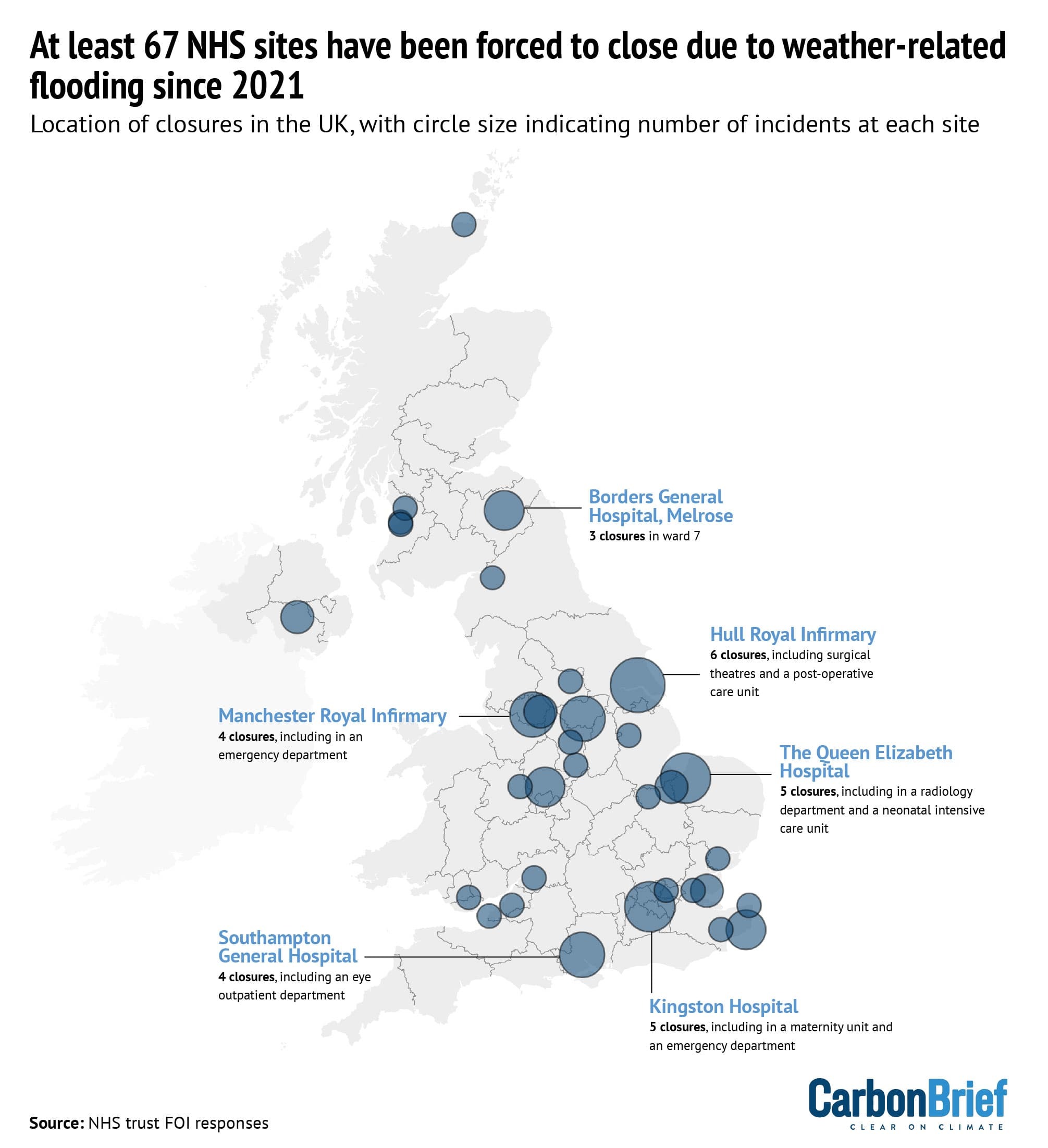
Map of the UK showing that at least 67 NHS sites have been forced to close due to weather-related flooding since 2021

A Carbon Brief investigation has shed light on the impact of weather-related flooding on National Health Service (NHS) facilities across the UK. At least 67 NHS hospital wards, departments and other sites have been forced to temporarily close or relocate due to weather-related flooding. The chart above shows sites of weather-related flooding incidents at NHS facilities. The size of the circles indicates the number of incidents reported at each site.

Spotlight

How solar mini-grids can ‘help boost’ Nigeria’s economy

This week, Carbon Brief covers a new report on Nigeria’s solar mini-grid industry.

Amid the impact of the US-Iran war on the Nigerian economy, a new report has argued that solar-mini grids can help to reduce the country’s reliance on fossil fuels and create more than 200,000 jobs.

In Nigeria, Africa’s third-largest economy, the war has led to an increase in energy prices and a decrease in petrol consumption. Petrol is one of the country’s main sources of transport and household fuel. According to one estimate, prices have surged by up to 40% since the conflict commenced in February.

Although the Nigerian treasury has benefited from rising crude oil prices – the country is a major exporter of oil and gas – the impact has been most visible on the wider population.

Rising energy prices “have affected the purchasing power of workers”, Agnes Funmi Sessi, a labour union leader in Lagos, told Carbon Brief.

However, scaling the deployment of solar “mini-grids” could help the country move away from fossil fuels, stimulate rural economies and improve livelihoods, according to the new report authored by the thinktank, the Africa Policy Research Institute.

“We estimate that, by deploying over 10,000 mini-grids, the sector could create 212,688 direct full-time informal and productive-use jobs across the off-grid and under-grid market segments,” the report said.

A nascent industry

Solar “mini-grids” are small-scale, localised electricity generation and distribution systems powered by solar panels.

The report positioned Nigeria’s mini-grid sector as one of the fastest-growing in Africa, with the country having just 11 mini-grids in 2015 and 155 by 2024, along with at least 42 active developers.

Many of the companies within the sector are young and apply novel local techniques in their deployment of solar technology, the report said.

However, access to finance remains a huge barrier. According to the report, the sector may require up to $8bn to connect 35.4 million people to mini-grids.

“Most Nigerians want solar power in their homes, but it is a capital intensive business for vendors and customers,” Dr Ben Iheagwara, a renewable energy entrepreneur and policy analyst, told Carbon Brief.

The report urged the Nigerian government and its international partners to “attract private capital by de-risking investments and ensuring regulatory clarity and long-term planning”.

Other key recommendations for policymakers and stakeholders include investment in skills development and paying attention to the gender gap.

Powering rural communities

Many rural communities, which make up about 37% of the country, are disconnected from the national grid system, so often have to generate their own electricity through mini-grid systems.

According to Nigeria’s electricity regulator, NERC, a mini-grid is defined as a power generating system with an installed capacity of up to 10 megawatts.

A mini-grid can be powered by fossil fuels such as diesel or petrol, but solar power is now considered a cheaper and cleaner source.

With more than 80 million people lacking access to electricity in Nigeria, solar mini-grids are increasingly viewed as the lowest-cost electrification solution, the report said.

Watch, read, listen

MOVING FORWARD: The Energy Transition Show dug into electricity reform in South Africa, discussing the country’s coal legacy and the role of renewables.

ENERGY POVERTY: In an opinion article for Project Syndicate, executive director of the African Climate Foundation, Saliem Fakir, argued that the energy transition in emerging and developing economies is driven by economics and security rather than emissions targets.
VANISHING CITY: BBC News reported on a coastal community in Nigeria where the ocean has “already swallowed more than half of the town”.

Coming up

Pick of the jobs

DeBriefed is edited by Daisy Dunne. Please send any tips or feedback to debriefed@carbonbrief.org.

This is an online version of Carbon Brief’s weekly DeBriefed email newsletter. Subscribe for free here.


The post DeBriefed 29 May 2026: Europe’s ‘mind-boggling’ May | Indian heat deaths | Nigeria’s solar mini-grids appeared first on Carbon Brief.

DeBriefed 29 May 2026: Europe’s ‘mind-boggling’ May | Indian heat deaths | Nigeria’s solar mini-grids

Continue Reading

Climate Change

The UN climate process was built for negotiation – now it must support implementation

Published

on

By Paul Watkinson, Stefan Ruchti-Crowley, Anju Sharma, Ovais Sarmad and Benito Müller.

In the corridors of the World Conference Centre in Bonn, where the June Climate Meetings (SB64) will conclude on Thursday, the need for change is palpable.

Delegates are grappling once again with overcrowded agendas, growing demands on limited negotiating time, external geopolitical pressures that reverberate internally to test the limits of a consensus-based process, and concerns over its future financial sustainability.

Bonn Bulletin: Finance row threatens to scupper work on adaptation goal

There is growing frustration with a process that consumes vast amounts of time to produce outcomes that are often too incremental to match the accelerating reality of the climate crisis.

The climate regime has delivered. But it is in danger of not delivering enough.

More effective multilateralism

There is no denying the successes of the UN climate process. Over three decades, the UN Framework Convention on Climate Change (UNFCCC), the Kyoto Protocol and the Paris Agreement established a universal framework for climate action, created transparency and accountability mechanisms, and sent powerful signals to governments, businesses and investors.

Thanks in large part to this framework, the world is no longer on a trajectory of more than 4°C of warming, clean technology costs have fallen dramatically, and participation in the global climate effort remains nearly universal.

Yet, global temperatures continue to break records. Climate impacts are intensifying across every region. The world remains far off track to achieve the goals of the Paris Agreement. As warming approaches – and may exceed – 1.5°C, every additional fraction of a degree brings greater losses of lives, livelihoods and ecosystems, with the greatest burdens falling on the most vulnerable countries and communities.

    We remain convinced that the answer to the climate crisis is not less multilateralism, but more effective multilateralism.

    The hard truth is that the UNFCCC remains largely organised around the logic of treaty-making, while the central challenge of climate action has shifted to implementation. A process designed to negotiate agreements and deliver decision text as the outcome is now required to support implementation on the ground—and it is struggling.

    There is a structural mismatch between what the climate process was designed to do, and what it needs to do now.

    Consultations on reforms

    Discussions on the urgency of reform are widespread and no longer confined to the margins. Formally, the Arrangements for Intergovernmental Meetings (AIM) process is exploring ways of improving the efficiency and effectiveness of the process.

    The UNFCCC Executive Secretary has also convened a High-Level Informal Consultative Roundtable for strategic reflection on how to strengthen the complementarity between the intergovernmental process and action in the real economy.

    Defending multilateralism today requires adapting it.

    The good news is that meaningful reform does not require reopening treaties, renegotiating the Paris Agreement, or indeed even resolving long-standing differences on the Rules of Procedure to change the consensus rule. Stefan Ruchti-Crowley and Paul Watkinson’s recent paper for ecbi (European Capacity Building Initiative), Quo Vadis COP? Reforming UNFCCC Sessions to Improve Negotiations and Support Implementation, outlines a practical toolbox of four reforms that can be pursued within the existing institutional framework.

    First, the process must improve its agendas.

    The formal process is burdened by crowded agendas and overlapping workstreams. Consolidating agenda items under broader thematic pillars (such as mitigation, adaptation, finance and transparency); developing good practices for agenda adoption; removing legacy “ghost” items; and concluding outstanding business on the Kyoto Protocol will create more space for substantive discussions and implementation.

    Second, the process must organise its work more strategically.

    The climate process currently attempts to address nearly every issue at every session. A more strategic approach would use thematic multi-year programmes of work; better align review cycles and timelines; improve coherence across the many bodies and processes that have accumulated over time, often to the extent that even insiders have lost oversight; and also make better use of inter-sessional and pre-sessional meetings.

    Third, the process must focus more deliberately on implementation.

    Critically, not every challenge requires a negotiated outcome. Negotiations should focus on issues that genuinely require collective decision-making. Other discussions should prioritise learning, cooperation and practical problem-solving.

    Existing formats such as Talanoa Dialogues, roundtables and other facilitative approaches should be expanded. Likewise, the Enhanced Transparency Framework should become a stronger mechanism for mutual learning and accountability rather than a largely procedural reporting and “box-ticking” exercise.

    Fourth, the process must make structural changes and broaden participation.

    National delegations should include a broader range of practitioners and policymakers, including a Head of Implementation. The process should strengthen engagement with sectoral ministers, investors, technology providers, scientists, local authorities and non-Party stakeholders.

    Stronger links are necessary between science policy and implementation, and with international institutions that shape the enabling conditions for climate action, particularly finance and development. Platforms to address systemic barriers along with AI-enabled learning by doing will equally support strengthened action.

    Delivering commitments with limited resources

    The case for reform is becoming even stronger as financial pressures intensify.

    Improving efficiency is not simply desirable; it has become unavoidable. The UNFCCC faces growing budgetary constraints arising from delayed contributions, uncertainty surrounding major donors, and broader reductions across the UN system.

    A process that is better organised, more implementation-focused and less encumbered by procedural overload will be far better equipped to navigate a future of tighter resources.

    Leadership will be crucial.

    Panama environment minister backs calls for reform of UN climate process

    COP presidencies have an important role to play, as do the Chairs of the Subsidiary Bodies. The UNFCCC Executive Secretary and Secretariat must take a bold approach to work in coordination with the COP Bureau to implement urgent changes.

    Careful diplomacy will, of course, be essential. Parties must be reassured that reform is intended to strengthen the effectiveness of the regime, not weaken its governance. The objective is not to replace mandates, but to ensure that mandates can be fulfilled more effectively. It is to ensure that negotiation is used where negotiation is needed, while other forms of cooperation are used where they can deliver better results.

    The UNFCCC remains the cornerstone of international climate cooperation. No other forum combines its legitimacy, universality and legal authority. But the multilateral climate process must evolve from a system primarily designed to negotiate commitments into one that is equally capable of supporting their delivery.

    The post The UN climate process was built for negotiation – now it must support implementation appeared first on Climate Home News.

    The UN climate process was built for negotiation – now it must support implementation

    Continue Reading

    Climate Change

    The vote that stopped a data center: US communities query resource-hungry AI

    Published

    on

    On quiet streets across the Californian city of Monterey Park, green-and-white “YES on Measure NDC” signs stood on front-yard lawns as volunteers walked door-to-door, drumming up support among residents to vote in favor of a ban on new data centers in their area.

    They clarified the ballot wording in English, Spanish and Chinese, while distributing multilingual flyers warning about the rise in electricity demand, industrial infrastructure and environmental impacts associated with AI-related data center development.

    Less than a month later, on June 2, Monterey Park voters overwhelmingly approved the ban in the San Gabriel Valley east of Los Angeles, with 86.4% voting in favor and 13.6% opposed, according to county election results.

    Social opposition to data centers is on the rise, especially in the US, as artificial intelligence (AI) and the technology hubs needed to support it stoke competition for electricity, water and land in communities where they are based. Industry advocates say data centers bring economic benefits and do not always result in higher power prices for households.

    A front-yard sign encourages Monterey Park residents to vote “YES on Measure NDC” (No Data Centers) in the San Gabriel Valley, LA County on May 9, 2026 (Photo: Kristen Mayol)

    A front-yard sign encourages Monterey Park residents to vote “YES on Measure NDC” (No Data Centers) in the San Gabriel Valley, LA County on May 9, 2026 (Photo: Kristen Mayol)

    The result in Monterey Park made it the first city in the United States to enact a citywide prohibition on data centers through a voter-approved ballot measure.

    “This week our city has been celebrating the landslide results from Measure NDC,” Monterey Park Mayor Elizabeth Yang said in a phone interview.

    On social media, Yang described the city’s response as the result of sustained resident organizing and civic engagement. “We want to fulfill our duty of listening to residents,” Yang told Climate Home News.

    A community campaign takes shape

    The vote came after months of public testimony, neighborhood outreach and organizing surrounding a proposed data center project on Saturn Street in Monterey Park. Here, developers planned to replace an existing commercial office building with a nearly 50-megawatt data center intended to serve growing demand for AI computing.

    Supporters of Measure NDC (Measure No Data Centers) argued that keeping this, and other such centers, out of their community would help protect air quality, drinking water resources, public health and local infrastructure.

    According to CoStar News, a real estate information platform, the backers of the Saturn Street project – Digico Infrastructure REIT and HMC Capital’s StratCap – had already withdrawn their planning application on April 3 amid growing local opposition and regulatory uncertainty, including the city’s decision to place a data center ban before voters.

    Subsequently, on April 20, the Monterey Park City Council adopted an ordinance prohibiting all data centers within the city limits.

    Explainer: Will AI data centres make or break the energy transition?

    Company representatives later said they would explore future “productive land uses … supported by the broader community”. Potential alternatives discussed publicly have included housing, although no formal proposal has been submitted.

    Reuters reported in May that DigiCo Infrastructure, an Australian company, was exploring “monetisation options” for its two Los Angeles sites after rowing back on the Monterey Park proposal. DigiCo is also selling its Chicago data center for $750 million to pay down debt and fund the development of another site in Sydney.

    DigiCo and HMC Capital did not respond to requests for comment for this article.

    Potential local benefits of data centers

    Industry lobby groups argue that data centers can provide economic benefits to host communities. According to the US-based Data Center Coalition, which represents major operators and developers, data centers generate tax revenue, support construction and technical jobs, and provide infrastructure needed for cloud computing, scientific research and AI development.

    The industry has also challenged claims that data centers necessarily raise electricity costs for households. A recent report by energy consulting firm Energy + Environmental Economics (E3), commissioned by the coalition, found no historical evidence that data centers had driven up residential electricity rates under existing utility pricing structures. It argued that factors including inflation, grid modernization costs, natural gas price volatility and investments in wildfire resilience have played a bigger role in rising electricity bills.

    According to E3, large users can, under certain regulatory frameworks, reduce prices for other customers by contributing more revenue to utilities than they cost to serve. In a previous analysis of Amazon data centers, the consultancy found that payments from the facilities exceeded the incremental costs incurred by utilities. The report also noted that regulators across the US have increasingly adopted specialized pricing structures as data center demand has expanded.

    An aerial photo shows the Alibaba Zhejiang Cloud Computing Renhe Data Center in Hangzhou, China, on April 11, 2024. (Photo by Costfoto/NurPhoto)

    An aerial photo shows the Alibaba Zhejiang Cloud Computing Renhe Data Center in Hangzhou, China, on April 11, 2024. (Photo by Costfoto/NurPhoto)

    Hefty carbon, water and land footprints

    The concerns raised in Monterey Park mirror debates over the environmental and infrastructure demands of AI being heard in many countries around the world, from Europe to North America and Asia.

    This month, a UN report estimated that the data centers required for AI globally could consume 945 terawatt-hours of electricity annually by 2030 – roughly twice France’s 2025 power consumption.

    This, it calculated, would have a carbon footprint needing some 6.7 billion trees grown over 10 years to offset, a water footprint equal to the annual domestic needs of 1.3 billion people in Sub-Saharan Africa, and a land footprint of more than 14,500 square kilometers, roughly twice the Jakarta metropolitan area. 

    In a 2026 report, Key Questions on Energy and AI, the International Energy Agency (IEA) found that electricity consumption from AI-focused data centers grew by approximately 50% in 2025 alone.

    It warned that “social acceptability is also a growing issue, as communities push back against data center projects”, citing concerns about environmental sustainability, electricity affordability, infrastructure strain and democratic participation in land-use decisions.

    Global data center electricity consumption by sensitivity case, 2020-2035

    Left axis shows terawatt hours. (IEA: Licence CC BY 4.0)

    Left axis shows terawatt hours. (IEA: Licence CC BY 4.0)

    AI-focused facilities consume substantially more electricity than traditional data centers and often require extensive supporting infrastructure, including cooling systems, industrial electrical equipment, backup generators running on diesel and large-scale energy storage systems.

    The IEA also noted that operators are increasingly exploring onsite natural gas generation and battery infrastructure to maintain electrical reliability as AI workloads intensify.

    Local concern over industrial infrastructure

    Samuel Brown Vazquez, an East San Gabriel Valley community organizer, said doubts about the proposed data center in Monterey Park were informed by broader debates over industrial development in the area.

    Brown cited community opposition to proposals that could bring battery energy storage facilities – and potentially data centers – to the former Puente Hills Mall site  in the City of Industry, where residents have raised concerns about pollution, fire risks, and the impacts of new industrial infrastructure on nearby residential neighborhoods and schools.

    Many viewed the campaign as part of a larger conversation about how communities should respond to the rapid expansion of AI-related infrastructure across Southern California.

    Power-hungry AI data centres seen driving demand for fossil fuels

    According to nonprofit Data Center Watch, around $64 billion-worth of data center projects nationwide were delayed or blocked between May 2024 and March 2025 amid increasing local opposition.

    Mayor Yang wants Monterey Park’s experience to encourage other communities to take a more active role in decisions about AI-related infrastructure. “We’re hoping other cities can follow similarly in banning data centers with proposed ballot measures,” she said, adding that whether such efforts succeed elsewhere will depend in part on how local officials respond to residents’ concerns.

    Materials for the “Yes on Measure NDC” campaign, May, 2026 (Photos: Kristen Mayol)

    Materials for the “Yes on Measure NDC” campaign, May, 2026 (Photos: Kristen Mayol)

    The new UN report this month called on governments and companies to address AI’s environmental impacts proactively to ensure that the technology develops sustainably and its benefits are shared fairly.

    Kaveh Madani, director of the United Nations University Institute for Water, Environment and Health, who led the investigation team for the report, said AI “is a technological transformation that is improving the lives of billions of people around the world”. But, he added, it must be used “responsibly”.   

    “We have a narrow window to ensure that the backbone of the technological revolution of our era develops within planetary limits, and that the communities who provide the critical minerals for advancing AI and the ones that host its infrastructure and e-waste are also among those who benefit from it,” he said.

    This story was developed, reported and produced under the Covering Climate Now (CCNow) Climate Journalism Student Mentorship, which connects USC student journalists with professional newsrooms in CCNow’s global network. Participants receive training, editorial mentorship, and the opportunity to report and publish original climate stories with partner outlets while being paid professional freelance rates.

    The post The vote that stopped a data center: US communities query resource-hungry AI appeared first on Climate Home News.

    The vote that stopped a data center: US communities query resource-hungry AI

    Continue Reading

    Climate Change

    Warning against ‘consumer club’ as G7 forms critical minerals alliance

    Published

    on

    Wealthy nations in the G7 have agreed to work more closely together to secure the minerals they need for the energy transition, AI and defence, and to diversify supply chains away from China, calling for more cooperation with “like-minded partners”.

    But the agreement adopted at this week’s G7 leaders’ summit in France is vague on what co-operation with resource-rich developing countries could look like, with critics warning against creating a consumer club of powerful nations that excludes others from shaping standards and building green supply chains.

    “The G7 communiqué reaffirms our suspicion that, for the G7, it is all about resource security, not just energy transition,” Claude Kabemba, executive director of Southern Africa Resource Watch, told Climate Home News.

      In a joint communique, the leaders of some of the world’s largest economies said they would step up coordination within the group and with partner countries to establish mineral processing and industrial capacity, support local value addition, promote innovation, develop standards, improve mineral traceability and share information on stockpiling systems.

      They agreed to create a joint crisis-prevention mechanism with the support of the International Energy Agency to monitor mineral supply and demand disruptions, as well as establish harmonised platforms to provide information about the origin of minerals, starting with lithium and nickel.

      The statement was endorsed by France, the UK, Canada, Germany, Italy, Japan, the US and the European Union at the end of the three-day summit in Evian, on the French shores of Lake Geneva. Australia, which isn’t a G7 member, also supported the declaration.

      Breaking dependency on China

      Western governments have been scrambling to secure the minerals they need to produce clean energy technologies such as batteries, electric vehicles and wind turbines, as well as hardware for artificial intelligence and military equipment while breaking their dependence on China.

      China controls most supply chains for the strategic minerals they need, dominating the processing of 19 out of 20 critical minerals. The only exception is nickel, where Indonesia leads on supply and processing. Last year, Beijing spooked governments in Europe and the US when it imposed restrictions on rare earths exports, signalling its willingness to use its industrial clout to achieve its geopolitical objectives.

      “We are all faced with risks of over-dependence and therefore vulnerability in our value chains,” French President Emmanuel Macron told a press conference, citing the “risks of divisions” among the group on how to respond to China’s control over strategic resources. “We have decided to move forward together,” he said.

      Leaders agreed to aggregate demand to support the development of minerals projects and set targets for reducing dependencies on any single country outside the G7 by the end of the year.

      A US proposal to regulate mineral prices and a French push to establish a permanent secretariat to track G7 initiatives on minerals failed to reach consensus among the group, according to Reuters.

      Who has a seat at the table?

      The declaration recognises the need for “mutually beneficial partnerships” and “plurilateral trade agreements” between G7 countries and “like-minded” and “trusted” partners to build diversified supply chains. Other parts of the text refer to “developing countries” and “emerging economies”.

      A separate G7 statement on “mutually beneficial international partnerships” mentions the need for international cooperation along the whole of mineral supply chains.

      “Who is going to be part of this conversation is unclear,” said Sébastien Treyer, executive director of France think-tank IDDRI, citing the ambiguity of the language and calling for developing countries to be part of the conversation.

      Trade agreements that support green industrialisation can be “an entry point” for investment into value-addition projects in developing countries, said Treyer, but “how this is going to be operationalised is the key question”.

      Moving beyond a ‘consumer club’

      Resource-rich developing countries, particularly in Africa, have called for investment to build their industrial capacity to turn raw materials into high-value components for clean energy technologies such as batteries, capturing more domestic value and creating jobs.

      But Kabemba, whose organisation is based in South Africa, said the declaration says “nothing about transferring industrial capacity to previously exploited regions such Africa”.

      “Africa needs to react with its own coalition of the willing to put Africa’s interests first, otherwise, Africa risks being locked into a role as a raw material supplier in a new economic order it is not helping to build,” he said.

        Patrick Schröder, a resource governance expert at Chatham House, agreed that the G7 remains overwhelmingly focused on securing minerals supplies and reducing its dependence on China. “The benefits for developing country producers are only marginal in the G7 discussions,” he said.

        Brazil, which is rich in rare earths, graphite and copper, was invited to attend the G7 meeting but did not endorse the minerals declaration – highlighting the need for future minerals framework to be more inclusive and responsive to producer-country concerns, said Schröder.

        For Luc Tezenas, head of policy and advocacy at the Resource Justice Network, “the answer to rising geopolitical fragmentation cannot be to shrink multilateralism into a smaller club of ‘like-minded’ consumer economies”.

        Instead, a non-binding minerals framework put forward by South Africa during its presidency of the G20 last year “shows more promise as a pathway forward because it attempts to link supply resilience with regional value chains and economic justice,” he said. The UK, which is presiding over the G20 next year, has the opportunity to build a more inclusive way forward, he added.

        Circularity: another way to capture value

        G7 nations also described the circular economy and the substitution of minerals in designing technologies as “key” to meet growing demand and secure sufficient supplies.

        This, they said, includes increasing recycling capacity by setting targets, combatting the illegal transfer of used products and components, and promoting the recovery of minerals from secondary sources such as mining waste.

        “We also recognise the opportunity for emerging market and developing economies to benefit from capturing added value through the recycling and secondary processing of their mining waste, as well as from circular economy innovations,” they said.

        Schröder, of Chatham House, said the challenge now lies in demonstrating that intentions can be turned into creating a circular economy for minerals through investments, business support and a favourable policy environment.

        The post Warning against ‘consumer club’ as G7 forms critical minerals alliance appeared first on Climate Home News.

        Warning against ‘consumer club’ as G7 forms critical minerals alliance

        Continue Reading

        Trending

        Copyright © 2022 BreakingClimateChange.com