

Welcome to Carbon Brief’s China Briefing.
China Briefing handpicks and explains the most important climate and energy stories from China over the past fortnight. Subscribe for free here.
Key developments
Emissions fell in first half
POWERING THE TRANSITION: China’s carbon dioxide (CO2) emissions fell 1% year-on-year in the first half of 2025, new analysis for Carbon Brief found, extending a decline that began in March 2024. Power sector emissions fell by 3% during this period, as growth in solar power alone matched the 170 terawatt-hour (TWh) rise in electricity demand, the analysis said. It noted that the sector’s coal use fell 3.4% year-on-year, while gas use increased by 6%. The analysis added that, even if China’s emissions fall in 2025, it will likely miss multiple climate targets this year, such as carbon intensity.
DEMAND UP, PRICES DOWN: Reuters reported that in July, which is not covered in the Carbon Brief analysis, China’s fossil-fuelled power generation “rose 4.3%…from a year earlier”, due to high cooling demand. Extreme heat continued to push power demand to new highs in early August, China Energy News said, with China seeing record demand continuously over 4-6 August. At one point demand reached 1,233 gigawatts, it added. Business news outlet Caixin reported that, despite this, power was “actually getting cheaper in some regions”, driven by the “growing share of renewables in the power mix”.

‘SHORT-TERM SHOCKS’: Extreme heat, heavy rains and floods “caused short-term shocks to economic operations”, Singapore-based outlet Lianhe Zaobao quoted a government official as saying. “Bad weather” specifically affected “steel and coal output”, according to Bloomberg, with the coal industry “also contending with government inspections”. The government will allocate 100bn yuan ($14bn) to “support businesses hit by natural disasters”, Reuters said.
PETROCHEMICALS RISING: The only major sector that saw growth in emissions during the first half of 2025 was the chemicals sector, the Carbon Brief analysis said, rising around 47% year-on-year. At least one segment of the industry is “set to expand by almost half between now and 2028”, Reuters cited a representative of oil giant Sinopec as saying. Meanwhile, state news agency Xinhua said Sinopec is “promoting the construction of a Beautiful China through the development of a beautiful petrochemical industry”.
Clean-tech exports stayed strong
OVERSEAS GROWTH: China’s exports of clean-energy technologies “rose further in July”, Caixin said, with Chinese lithium-ion battery and electric vehicle (EV) exports in the first seven months of 2025 rising around 26% year-on-year, by value. Solar cell exports also rose 54% in terms of volume over this period, it noted, although by value they “fell 23%”. Industry outlet PV Magazine said that China’s exports of solar cells and wafers had “increased significantly”, but that exports of panels declined. Meanwhile, the government has held its second meeting in two months with solar industry representatives on curbing overcapacity, Reuters said. Elsewhere, the Hong Kong-based South China Morning Post (SCMP) covered new research finding that, in 2024, Chinese EV companies invested more overseas than they did in China “for the first time”.
-
Sign up to Carbon Brief’s free “China Briefing” email newsletter. All you need to know about the latest developments relating to China and climate change. Sent to your inbox every Thursday.
‘PRAGMATIC’ ON CLIMATE: Chinese ambassador to the UK Zheng Zeguang argued China and the UK should work “more closely” to address climate change, in a Guardian commentary. (Zheng has also become China’s first permanent representative to the London-based International Maritime Organization, according to Xinhua.) In response to an article by UK government adviser Chris Stark saying that the UK should join China in becoming an “electrostate”, the Global Times published an editorial saying the UK’s energy transition “hinges on pragmatic cooperation” with China. Meanwhile, President Xi Jinping said China and Brazil should “ensure the success” of COP30, Xinhua reported.
CHINA’S SECURITY CONCERNS: China’s third-largest hydropower station has “fully transitioned away” from using western-made chips due to “national security and supply chain resilience concerns”, SCMP reported. The government also issued a notice on “strengthening” supervision of smart EVs, International Energy Net said, including software updates. China’s exports of permanent magnets and other rare-earth products “extended their recovery in July”, Bloomberg said, with export volumes rising 69% from a month earlier. The country is also warning foreign companies not to “stockpile rare earths and derived products such as magnets”, the Financial Times reported.
National ecology day
GREEN TO GOLD: China must “adopt green development approaches to grow our mountains of gold and silver”, Premier Li Qiang said, according to energy news outlet International Energy Net, at an event marking national ecology day. The event was also held on the 20th anniversary of President Xi Jinping’s speech in Zhejiang province, in which he emphasised that “lucid waters and lush mountains are invaluable assets”. [Read more on Xi’s “two mountains” theory in this analysis by Carbon Brief.] Li added that China must “steadily promote the green and low-carbon transformation of industries” and “collaborate with all parties to…address climate change”, it said.
OFFICIALS SPEAK: Speaking a few days earlier, Chinese climate envoy Liu Zhenmin told a conference that “green and low-carbon innovation… [is] the new engine driving global economic growth”, the state-run newspaper China Daily reported, adding that he “attributed much of [China’s energy] transformation to the ‘two mountains’ theory”. National Development and Reform Commission head Zheng Shanjie wrote an essay on the theory for the ideological journal Research on Xi Jinping Economic Thought, saying China must “coordinate efforts to reduce carbon emissions, mitigate pollution, expand green spaces and promote economic growth”. Environment minister Huang Runqiu also said this in a speech broadcasted by the Communist party-affiliated newspaper People’s Daily, adding that the tasks “may seem independent, but are actually closely interconnected”.
MEDIA REACTIONS: State media also issued commentaries on the theory, with the People’s Daily publishing a “Ren Ping” commentary – a byline indicating the article reflects party leaders’ views – saying it is a “beacon” for “global green development”. A People’s Daily commentary under the byline He Yin – which similarly signals that the article reflects party leaders’ views on international affairs – said the theory “contributes Chinese wisdom and solutions to building a clean and beautiful world”. An editorial in the state-supporting Global Times said: “Especially at a time when climate change is an urgent global challenge, [the theory] is timely, visionary and inspiring.”
Draft policies and pilot projects
COUNTING CARBON: The Ministry of Ecology and Environment (MEE) issued four more draft methodologies for China’s voluntary carbon market, three of which address “gas recovery and utilisation” from oil- and gas-fields, BJX News reported. The MEE also published a draft revision to guidelines for provincial greenhouse gas inventories that aims to “enhance the scientific rigour, standardisation and practicality” of compiling the documents, another BJX News article said. Meanwhile, China will also develop “national carbon measurement centres” to help support the development of carbon measurement capabilities, finance outlet EastMoney said.
‘GREEN FUELS’: Meanwhile, China has established nine pilot projects to develop “green fuels” including ammonia, methanol and ethanol, finance news outlet Yicai said, adding that many of the projects use “green hydrogen as a raw material to produce” the chemicals. Separately, China’s National Energy Administration (NEA) said in a statement that it placed “great importance on the development of green liquid fuels”, with co-firing in coal-fired power plants an “important pathway…to achieve low-carbon development”, BJX News reported. According to another BJX News article, the NEA also said it attached “great importance” to the gas-power industry and would continue to plan new “peak-shaving gas-fired power plants”.
OTHER POLICIES: Elsewhere, the NEA released draft guidelines for “assessing the capacity of power grids to accommodate distributed power sources”, BJX News said. Guangdong has become the first province in China to “recognise greenhouse gas emissions quotas as legal collateral for loans”, Yicai reported. Xinhua reported that the China Consumer Association has issued draft guidelines for “green consumption” that explore how “every green consumption choice can contribute to significant emission reduction effects”.
Spotlight
Guest spotlight: How China could decarbonise its cement industry
China could use a “whole-of-system” approach to decarbonise its cement industry, according to a report released today by thinktank Climate Analytics.
In this issue, report author James Bowen, Climate Analytics climate and energy policy analyst, examines how China could reduce the sector’s country-sized emissions.
China’s challenge in managing the carbon dioxide (CO2) emissions accompanying its economic rise is best illustrated by cement.
From about 200m tonnes (Mt) in 1990, Chinese cement production – almost all of which is domestically consumed – climbed to 2.5bn tonnes (Gt) in 2014 and has remained near this level for about a decade.
Its cement sector now emits more than the entire economies of all but three countries other than China itself – more than 1.2bn tonnes of CO2 (GtCO2) a year.
Cement decline significant but not enough for 1.5C
China’s main cement emissions challenge is that it continues to use far more cement and cement products per person than most countries.
Cement demand is now entering sustained decline as China’s economy restructures. Based on current trends, national production could drop below 1Gt by 2050.
But analysts have estimated that in addition to cutting demand – potentially even further than expected by 2050 – the emissions per unit of production would also need to fall, to align with the goals of the Paris Agreement.
Specifically, they estimate that emissions per unit would need to fall to around 360kg of CO2 per tonne by 2030 and 55-90kg by 2050. If each tonne of future Chinese cement continues to generate about 550kg of CO2, as at present, then the sector will remain well off this pace.
This task is formidable. Cement is an inexpensive, high-performance building material with widely available feedstocks.
About 90% of its emissions come from producing clinker – a key ingredient.
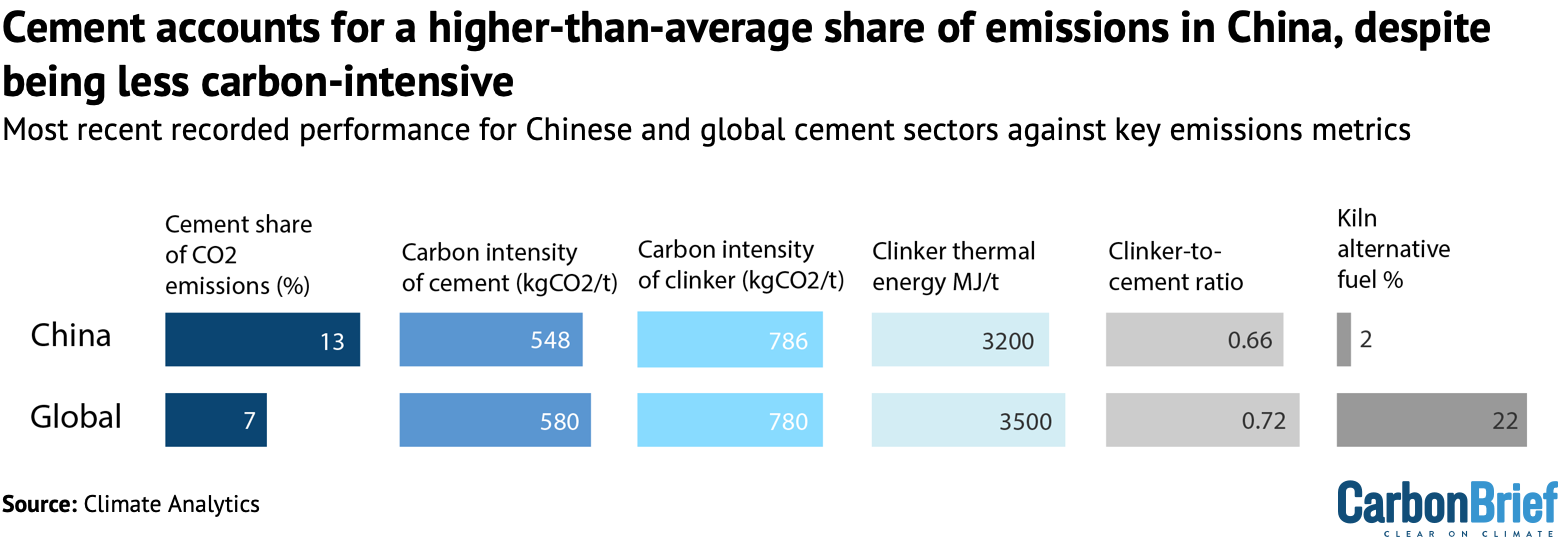
Unavoidable process emissions account for the majority of these emissions. But producers globally have also not yet managed to eliminate the remainder of clinker emissions, which result from heating cement kilns.
Cement’s emissions intensity in China has also rebounded since 2015, driven by new restrictions on cement with lower clinker content, due to quality concerns.
Many areas of past emissions-reduction success in China’s cement sector, such as energy efficiency, are approaching their technical limits.
These challenges help explain why carbon capture, utilisation and storage (CCUS) remains prominent in cement net-zero roadmaps globally.
But CCUS remains expensive and underperforming, given relatively little improvement in learning rates and related cost reductions. Plans to deploy CCUS therefore present a risk of diverting attention from cheaper and more effective abatement options – or failing to deliver as expected. This could sustain considerable mid-century residual emissions, jeopardising net-zero goals.
A ‘whole-of-system’ approach
An alternative “whole-of-system” approach could help China meet its cement emissions challenge more cheaply, without relying so heavily on the promise of CCUS.
This could include enhanced cement demand reduction, such as by extending building lifespans; optimising how concrete is designed and used; using alternative materials – such as timber – where appropriate; and reducing and reusing construction waste.
It could also include accelerating uptake of lower-carbon production technologies, such as alternative cement kiln fuels, electrified kiln heating, as well as low-clinker and alternative binder cements.
A wide range of policy support could advance this whole-of-system approach, including by ensuring a just transition for cement workers and impacted communities.
China has said it is working to include cement in the national emissions trading system (ETS) by 2027.
China could also incentivise companies to use less clinker by adopting a cement-based ETS benchmark, rather than a clinker benchmark, which has encouraged EU firms to continue using the carbon-intensive material under the region’s own ETS.
China could also displace coal from kiln heating, by adopting European-like measures to encourage the use of biomass or waste-derived fuels.
Meanwhile, reform in areas including industry standards, finance, market access and research and development could accelerate adoption of other low-emissions technologies and processes.
Watch, read, listen
WINNING ON STEEL?: China is gradually putting the conditions in place to become a world leader in developing low-carbon steel, according to Canary Media.
TRANSMISSION OMISSION: Jiemian explored how limited transmission capacity and “pricing discrepancies” is hampering China’s development of sending low-carbon power across provinces.
CHINA’S RISE: The Asia Society broadcasted a panel event from its summer summit discussing the factors behind China’s rise as a leader in new-energy and other technologies.
INDUSTRIAL DECARBONISATION: The Institute for Global Decarbonization Progress assessed key steps for improving China’s ability to tackle industrial emissions through zero-carbon industrial parks, informed by an expert dialogue.
15
The number of people who died during flooding in northern China’s Gansu province in early August, China Daily reported.
13
The death toll of flooding this week in Inner Mongolia, another northern province, according to Reuters.
New science
Increasing tropical cyclone residence time along the Chinese coastline driven by track rotation
npj Climate and Atmospheric Science
Tropical cyclones now spend “substantially” more time travelling along China’s coastal regions than they did in the 1980s, according to new research. The study found that tropical cyclones travelling along the coast of China have “become more parallel to the coastline since the 1980s” and the amount of time they spend travelling along the Chinese coast has increased by 2.5 hours per decade during this period. It added that these changes have “led to prolonged durations of heavy rainfall in the coastal regions”.
Resources, Conservation and Recycling
A new study estimated that the average carbon intensity of the electricity used in China fell from 983 grams of carbon dioxide per kilowatt-hour (gCO2/kwh) in 1997 to 545gCO2/kwh in 2022, “cumulatively avoiding 15.8bn tonnes of potential CO2 emissions”. The study used electric-generating unit level data and decomposition analysis to evaluate the effects of different decarbonisation policies on power plants. It found that changes to the fuel mix in China’s coal-fired power plants, reductions in the amount of heat energy needed to generate electricity and deployment of large-sized plants contributed most to reducing carbon emissions.
China Briefing is compiled by Wanyuan Song and Anika Patel. It is edited by Wanyuan Song and Dr Simon Evans. Please send tips and feedback to china@carbonbrief.org

The post China Briefing 21 August 2025: China’s CO2 decline; ‘Two mountains’; China’s cement challenge appeared first on Carbon Brief.
China Briefing 21 August 2025: China’s CO2 decline; ‘Two mountains’; China’s cement challenge

June Rubis is a steering group committee member for the Cali Fund, from Sarawak in Malaysian Borneo.
At COP16 in Cali, governments made a significant commitment: at least half of the funding from the new Cali Fund should support the self-identified needs of Indigenous Peoples and local communities, including women and youth. It was a watershed moment for multilateral benefit-sharing.
The challenge now is to translate that commitment into access arrangements that recognise the different institutions, priorities and decision-making processes of Indigenous Peoples and local communities.
For generations, biodiversity and traditional Indigenous knowledge have provided significant value to companies who depend on nature’s genetic diversity to discover new drugs that fight diseases, create products that improve health, and grow crops resilient to extreme heat and flooding events. While some compounds are sampled directly from the source country, increasingly the digital blueprints are held in online public databases which are freely accessible to use for innovation and research.
Countries urged to ramp up “insufficient” nature policies at COP17
The Cali Fund was established at COP16 to encourage commercial users of Digital Sequence Information, or DSI, to share benefits arising from its use. Estimates suggest it could generate over $3.5 billion a year – a stark contrast to the modest $10,656 currently committed to the fund from just five SMEs, underlining how much progress must be made at COP17 over the next two weeks.
The COP16 decision that set up the fund offers two routes for money to reach Indigenous Peoples and local communities: through government authorities, and through direct payments to institutions identified by Indigenous Peoples and local communities themselves.
Varied ways of organising
Indigenous Peoples and local communities organise through a wide range of institutions. Some have national or regional organisations experienced in managing international grants. Others work through territorial organisations, customary institutions, community associations, cooperatives or networks. Some have professional finance teams and audited accounts; others have extensive experience governing territories, collective resources or conservation work without having been organised around international funding requirements.
For direct access, some questions are already apparent. Which institutions should be able to receive funds? How should they be identified? What fiduciary standards should apply? How should safeguards and accountability work where institutional capacities differ? What support may be needed where institutions have strong community mandates but less experience with international finance?
Comment: Protecting nature is a public duty, not a Wall Street profit opportunity
If access is designed mainly around institutions that already meet the expectations of large international finance mechanisms, early funding will tend to favour those already familiar to funders. They will gain further experience and become better positioned for future funding, while institutions with less administrative capacity may remain outside the system despite strong community mandates and long histories of stewardship.
These first decisions matter most, because they set the terms for everyone who follows.
The role of intermediaries requires care. Some Indigenous organisations may want a fiscal host to hold and manage funds on their behalf. Communities may choose to work through an NGO they trust. Government-facilitated arrangements may work well in particular national contexts.
What matters is the function an intermediary performs and the authority that comes with it. Providing administrative support is different from deciding which Indigenous organisations qualify, which priorities can receive support, or how success will be assessed. Direct access means communities keep that decision-making authority.
Decision-making power
The COP16 decision refers to institutions that Indigenous Peoples and local communities identify. But authority among Indigenous Peoples does not sit in one kind of body. It may sit with territorial organisations, customary institutions, community associations or combinations of these. Legal recognition and customary authority do not always align neatly.
Global deforestation slowed in 2025 but Brazil’s election could undo “fragile” gains
An important feature of the Cali Fund’s governance is that Indigenous Peoples and local communities participate as full members of the Steering Committee, rather than as observers. Seven Indigenous Peoples and local community representatives, one from each of the seven socio-cultural regions, participate in consensus-based decision-making alongside representatives of governments and UN entities. Six additional representatives from civil society, scientific institutions and the private sector participate as observers.
That representation carries responsibility. Institutional legitimacy, access and representation take different forms across the seven socio-cultural regions. Indigenous Peoples and local communities members therefore have an important role in bringing those differences into the Fund’s governance and in ensuring that arrangements developed for one context do not become the assumed model for everyone else.
Safeguards and clear responsibilities
COP17 can establish the core principles and direction, while allowing operational pathways to develop in ways that respond to different regional contexts. The decisions countries take in Yerevan will shape how that flexibility is realised in practice.
The choices made around access will influence which institutions are able to participate, which routes become established and which forms of authority are recognised within the funding architecture. The aim should be an architecture with enough structure to maintain confidence while allowing for different forms of Indigenous and community governance.
A credible direct-access pathway will need safeguards, financial oversight and clear responsibilities. This would give the 50% commitment a stronger institutional foundation.
The Cali Fund’s importance will ultimately depend not only on how much funding reaches Indigenous Peoples and local communities, but on whether they are able to determine how the money is accessed, governed and used. This requires access pathways that recognise their institutions, priorities and decision-making processes, rather than requiring them to conform to a single predetermined model.
The post COP17 must settle who decides how Cali Fund money is disbursed appeared first on Climate Home News.
COP17 must settle who decides how Cali Fund money is disbursed
The UK government has approved extraction at the Jackdaw gas field in the North Sea, despite acknowledging that this decision could make it harder for Britain to convince other countries to move away from fossil fuel production.
UK energy secretary Miatta Fahnbulleh approved the drilling on Wednesday after months of high-profile debate, fuelled in part by interventions from US President Donald Trump. She argued that the project would boost energy security in the wake of the Middle East fossil fuel crisis, protect hundreds of jobs and add £2.9 billion ($3.88bn) to the UK economy.
She said Jackdaw’s gas would be cleaner than imported gas and would not prevent the UK from meeting its legally-binding carbon targets and its goal of net zero by 2050. As the field is already licensed, she said extraction was consistent with the Labour Party’s 2024 manifesto promise not to issue any new oil and gas licenses.
The same morning, the government announced a new Energy Wealth Fund to reinvest oil and gas revenues in the climate transition. It will start with £2 billion ($2.67bn) from the government and be topped up over time with tax revenues from offshore oil and gas production.

Climate campaigners in the UK and abroad were quick to condemn the decision, while a leading legal expert told Climate Home News it goes against the advice of the International Court of Justice. Meanwhile, the government’s own documents reveal that it recognises the drilling could damage the UK’s reputation and its ability to push forward the global transition away from fossil fuels.
“Climate leadership” blow
The 92-page decision document says Fahnbulleh “acknowledges that international standing on climate is important and accepts that a decision to grant consent may not further the UK’s international climate leadership.”
It adds: “She acknowledges concerns about the potential implications for the UK’s credibility and influ