Connect with us

Published

on

Vale

Vale and Sweden’s GreenIron have teamed up to reduce emissions in the mining and metals supply chain. The MOU focuses on key initiatives in Brazil and Sweden, including a feasibility study for a direct reduction facility in Brazil operated by GreenIron. Additionally, Vale will also supply iron ore to GreenIron’s commercial operations in Sandviken, Sweden.

Rogério Nogueira, EVP of Commercial and New Business at Vale noted,

“This agreement brings together Vale’s superior product portfolio, Brazil’s competitive advantage on green hydrogen and GreenIron’s expertise on sustainable iron production to provide low-carbon solutions for the mining and metals industry”,  “We are focused on helping our clients achieve their decarbonization targets and also fostering Brazil’s new industrialization.

Vale and GreenIron’s Collaborative Vision for Metal Recycling

Moving on, their feasibility study will identify the best site and assess renewable energy and resource options for a direct reduction facility in Brazil. Most importantly, it will explore green hydrogen and innovative technologies to reduce the environmental impact of the industries.

GreenIron has conducted rigorous trials to commercialize its hydrogen-based, fossil-free, and energy-efficient technology. The press release revealed that in the last two years, Vale and GreenIron have tested Vale’s iron ore pellets at GreenIron’s Swedish facilities.

  • The new MoU includes plans to test Vale’s iron ore briquettes, which produce lower CO2 emissions than pellets.

Additionally, GreenIron’s technology offers exceptional adaptability. It can handle various feedstocks and customize capacity to meet specific client requirements. It is also cost-effective and compatible with green hydrogen use.

GreenIron’s Sandviken Facility

The company plans to bring the Sandviken Industrial Park, located 160 kilometers north of Stockholm into full-scale production by the end of this year. This is crucial for the company’s goal of becoming a leader in CO2-free metals and mining while advancing to a circular economy.

  • Each GreenIron furnace is expected to cut CO2 emissions by at least 56,000 tonnes annually, paving the way for a greener future.

Edward Murray, CEO of GreenIron said,

“This MOU with Vale marks a significant milestone for GreenIron. It represents a clear commitment to pursue collaborative opportunities that align with our vision for a sustainable mining and metals industry, and to drastically reduce the sector’s climate footprint. By pooling our expertise and resources, we aim to innovate and develop projects that not only benefit both companies but also positively impact the environment and the communities in which we operate.”

Vale Iron Ore: Sustainably Sourced from Brazil

Vale is one of the largest iron ore producers in the world. Iron ore, the key raw material for steelmaking, is found in rocks mixed with other elements. It is refined through advanced industrial processes and then sold to the steel industry.

Vale’s iron ore from Carajás is among the best globally, with a 67% iron content. In Northern Brazil, the company’s mines occupy just 3% of the Carajás National Forest. The remaining 97% is protected in collaboration with environmental institutes. Vale operates in Brazil, China, and Oman to suffice global supply of this crucial resource.

Here’s Vale’s 3Q24 production and sales report for Iron ore, pellets, copper, and nickel.Vale
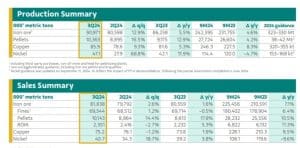
Source: Vale

By 2025, the company plans to transition entirely to renewable energy in Brazil and 100% renewable energy by 2030 globally. Additionally, Vale aims to enhance its global energy efficiency by 5% by 2030, using 2017 levels as the baseline

DOE Partnership

In November, Vale completed negotiations with the U.S. Department of Energy’s Office of Clean Energy Demonstrations. The company will start Phase 1 of a project to develop an industrial-scale briquette plant in Louisiana. It will use over $3.8 million in DOE funds to support engineering studies and community engagement in 2025.

Vale’s sustainably sourced iron ore briquettes can reduce scope 3 emissions by 15% by 2035. These efforts align with Vale’s sustainability targets to cut absolute scope 1 and 2 emissions by 33% by 2030 and achieve net zero by 2050.

The post Vale and GreenIron Partner to Revolutionize Metal Production with Green Hydrogen appeared first on Carbon Credits.

Continue Reading

Carbon Footprint

Google Powers U.S. Data Centers with 1.2 GW of Carbon-Free Energy from Clearway

Published

on

Google Powers U.S. Data Centers with 1.2 GW of Carbon-Free Energy from Clearway

Google has agreed to buy nearly 1.2 gigawatts (GW) of carbon-free energy to power its data centers across the United States. The tech company signed a set of long-term power purchase agreements (PPAs) with Clearway Energy Group (Clearway). These deals will deliver clean electricity from new wind and solar projects in Missouri, Texas, and West Virginia.

The energy will support the electric grid regions where Google’s data centers are located. The agreements are a big step for the tech giant. They help meet its rising electricity needs and cut carbon emissions from its operations.

Amanda Peterson Corio, Global Head of Data Center Energy, Google, stated:

“Strengthening the grid by deploying more reliable and clean energy is crucial for supporting the digital infrastructure that businesses and individuals depend on. Our collaboration with Clearway will help power our data centers and the broader economic growth of communities within SPP, ERCOT, and PJM footprints.”

How Google Secures Carbon-Free Power

A Power Purchase Agreement is a long-term contract between a power buyer and a clean energy producer. In Google’s case, these contracts ensure that the projects Clearway builds will sell electricity to the grid. In return, Google pays for the energy produced over many years.

Clearway agreed to provide Google with 1.17 GW of new carbon-free energy. This energy will support regional grids like SPP, ERCOT, and PJM. The total partnership includes a 71.5 megawatt (MW) clean power deal in West Virginia. This brings the total to around 1.24 gigawatts (GW) of clean energy for Google’s use.

These projects will generate wind and solar power and deliver it into U.S. grid systems that serve Google’s data centers. The total investment in the new energy infrastructure tied to these deals exceeds $2.4 billion.

google data center map
Google’s data center map; Source: Google

Construction for the new wind and solar assets is expected to begin soon, with the first facilities planned to start operations in 2027 and 2028.

The states involved are Missouri, Texas, and West Virginia. These states cover parts of major grid regions like SPP (Southwest Power Pool), ERCOT (Electric Reliability Council of Texas), and PJM Interconnection, which deliver power to millions of customers and data centers.

Why Google Is Investing in Clean Power

Google has set clear climate goals tied to its fast-growing energy use. In 2020, the company became the first major corporation to match 100% of its annual electricity use with renewable energy purchases. This means Google buys enough clean power each year to equal all the electricity its operations consume. However, this approach does not guarantee clean energy at every hour.

Google carbon-free energy goal 2030
Source: Google

To address this gap, Google launched a more ambitious target. The company aims to operate on carbon-free energy, 24 hours a day, 7 days a week, by 2030. This goal goes beyond traditional renewable matching. It requires clean electricity to be available every hour in the same regions where Google uses power. This makes energy sourcing more complex and increases the need for new clean generation near data centers.

Google has also committed to reaching net-zero emissions across its operations and value chain by 2030. This includes direct emissions, purchased electricity, and indirect emissions from suppliers and construction.

  • The tech company does not plan to rely heavily on carbon offsets for this goal. Instead, it focuses on cutting emissions at the source, mainly by cleaning up the electricity supply.

Progress so far shows both gains and challenges. In 2024, Google reported net emissions of about 18 million metric tons of CO₂-equivalent, up from 14.3 million in 2023. The increase came largely from data center expansion and higher electricity demand from artificial intelligence workloads.

Google carbon emissions 2024

At the same time, Google reduced the carbon intensity of its electricity use by about 12% compared with the previous year. This shows efficiency gains, even as total energy use rose.

google emissions
Source: Google

Clean energy purchases play a key role in this strategy. By signing long-term power purchase agreements, Google helps bring new wind and solar projects online. These projects add clean power to local grids and lower emissions over time.

The nearly 1.2 GW of carbon-free energy announced for U.S. data centers supports this approach. It increases clean supply in regions where Google’s power demand is growing fastest.

Broader Clean Energy Strategy

Google’s clean energy purchasing strategy goes beyond these 1.2 GW agreements. The company continues to enter renewable contracts around the world. For example:

  • Google and TotalEnergies signed a 15-year PPA to supply 1.5 terawatt-hours (TWh) of certified renewable electricity from the Montpelier solar farm in Ohio. This power will help support Google’s data centers in that region.

  • Google is also active in international renewable power agreements. It has signed a 21-year PPA with TotalEnergies. This deal provides 1 TWh of solar power for its data centers in Malaysia.

  • In India, Google made a deal with ReNew Energy. They will build a 150 MW solar project in Rajasthan. This project will generate about 425,000 MWh of clean electricity each year, which is enough to power more than 360,000 homes.

These deals illustrate how Google is diversifying its clean energy supply by securing multiple sources and technologies across continents.\

Impact on Data Centers and Regional Grids

Data centers use large amounts of electricity. U.S. data centers’ electricity consumption reached 183 TWh in 2024, accounting for more than 4% of the nation’s total power demand amid surging AI workloads. This marked a continued rise from 176 TWh (4.4%) in 2023. Projections suggest 5% or higher in 2025 as hyperscale facilities expand rapidly.

US data center power use 2030 BLoomberg

When powered by fossil fuels, they also produce high carbon emissions. Clean energy purchases help reduce the carbon footprint of these facilities over time.

Source: Google

As data center demand continues to grow, companies like Google are adding new clean power to the grid. Long-term power purchase agreements support the construction of new wind and solar projects. These projects supply clean electricity to regional grids and benefit all users, not only data centers. This helps lower the overall carbon intensity of power systems.

What This Means for Corporate Renewable Leadership

Google’s nearly 1.2 GW clean energy purchase reflects a wider industry shift. Large technology firms are becoming some of the world’s biggest buyers of renewable power. As artificial intelligence and cloud services expand, long-term clean energy contracts help companies secure a stable power supply and manage energy costs.

These corporate agreements also play a key role in the U.S. energy market. Long-term PPAs give developers the financial certainty needed to build new renewable projects. Supported by policy incentives and rising corporate demand, U.S. wind and solar capacity continues to grow. This makes large clean energy portfolios increasingly viable for companies like Google.

The Clearway deal adds to Google’s global portfolio of renewable energy contracts. This portfolio spans multiple regions and energy technologies. By securing large volumes of clean power, Google is strengthening the sustainability of its data centers as digital demand continues to rise.

The post Google Powers U.S. Data Centers with 1.2 GW of Carbon-Free Energy from Clearway appeared first on Carbon Credits.

Continue Reading

Carbon Footprint

EU Carbon Prices Hit Highest Since August 2023: What Causes The Surge?

Published

on

EU Carbon Prices Hit Highest Since August 2023: What Causes The Surge?

Carbon permits in the European Union have recently climbed to their highest levels since August 2023. The rise reflects tighter supply, policy decisions, and shifting market demand under the EU Emissions Trading System (ETS).

The ETS is the world’s largest cap-and-trade system for greenhouse gas emissions. It mandates large emitters to buy allowances for the carbon dioxide they emit. These allowances are known as EU Allowances (EUAs).

EUAs are now trading at a price over €92 per tonne — the strongest level in about 18 months. This rise shows that companies and markets expect fewer allowances to be available in the future as the EU tightens its emissions cap.

What Is the EU Emissions Trading System?

The EU ETS began in 2005 as a tool to reduce greenhouse gas emissions through market forces. It sets a cap on total emissions from major sectors such as power generation, manufacturing, and aviation. Companies must hold enough allowances to cover their emissions each year.

The cap reduces over time, meaning fewer EUAs are issued. This creates scarcity. As allowances become scarcer, their price tends to rise, which increases costs for polluters. In theory, this pushes companies to reduce emissions or invest in cleaner technology.

In 2026, the system also overlaps with the Carbon Border Adjustment Mechanism (CBAM), a tax on imported carbon-intensive goods. CBAM began to apply in January 2026 and makes carbon costs visible on imports like steel and cement. The measure aims to cut down on “carbon leakage.” This happens when industries move production to areas with cheaper carbon prices.

Recent Price Moves: Highest Since August 2023

In early January 2026, EU carbon permits climbed as high as about €91.82 per tonne on EU markets, up from lower levels earlier in 2025. Now, it’s trading at over €92 per tonne, showing 27% increase from January 2025 prices. The rise represents a fourth consecutive weekly gain in allowances for the December 2026 contract.

EU Carbon Prices January 2025 - January 2026
Data source: TradingEconomics

The price rise reflects tightening supply — fewer allowances are available through auctions and free allocations. Reduced supply increases competition among companies that must surrender EUAs to match their emissions. This dynamic pushes the price higher.

Market analysts also note that colder weather and more heating needs in winter often boost industrial energy demand. This can lead to higher carbon prices during the season.

Why Prices Have Risen?

The recent uptick in EU carbon prices is driven by several key factors:

  • Reduced Supply of Allowances:

The EU continues to tighten its emissions cap and reduce the number of new allowances issued. Estimates from the European Exchange auction calendar and Market Stability Reserve show that auction volumes will drop. They are expected to fall from about 588.7 million EU Allowances in 2025 to around 482.4 million in 2026. A stronger cap reduces the total pool of tradable EUAs, creating scarcity and upward pressure on prices.

  • Policy Signals and Reform Expectations:

Investors and companies anticipate future regulatory tightening. The EU’s long-term climate goals include cutting net emissions by 90% by 2040 compared with 1990 levels. Such policy signals can strengthen confidence that carbon costs will rise further.

  • Market Confidence and Funds:

Investment funds have increased their holdings of EU carbon futures. Trading positions and speculation can also influence price momentum, especially as market sentiment shifts toward tighter futures.

  • Compliance Demand:

Industries covered by the ETS are required to surrender allowances to match their emissions by compliance deadlines. As deadlines near, buying activity can increase, adding short-term upward pressure on prices.

  • Carbon Border Adjustment Mechanism:

With CBAM now active, imported products from outside the EU face carbon costs similar to domestic industries. This mechanism can reduce free allowance allocations and tighten supply further.

Looking Back and Ahead: Carbon Price Trends and Forecasts

Carbon prices in the EU ETS have fluctuated over recent years. Prices surged above €100 per tonne in early 2023. Then, they eased back in 2024 and 2025. This decline was due to shifting market conditions and wider economic factors.

In 2024, the average price of EU ETS carbon permits was around €65 per tonne, down from €84 per tonne the year before. High prices in 2023 reflected strong policy signals from the Fit for 55 climate package and global energy disruptions.

Looking ahead, analysts and forecast models expect prices to continue rising over the coming decade:

  • A survey of market participants predicts that the average EU ETS carbon price will rise to almost €100 per tonne from 2026 to 2030. This increase will happen as demand exceeds supply.
  • Energy market analysts predict that the average price could hit about €126 per tonne by 2030. This rise is due to stricter caps and wider emission coverage.
  • Under the EU ETS II framework, starting in 2027, more sectors will be included, like buildings and transport. In some scenarios, prices might average €99 per tonne from 2027 to 2030.
  • BNEF’s EU ETS II Market Outlook projects carbon prices reaching €149 per metric ton ($156/t) by 2030, driving substantial emissions reductions.
EU carbon prices 2030 BNEF
Source: BNEF

Overall, these forward estimates imply that allowance prices may continue to rise as the EU strengthens its emissions targets to meet climate goals.

Emissions Reductions Under the ETS

The EU ETS has contributed to measurable emissions reductions. In 2024, emissions under the system were roughly 50% lower than in 2005. This progress is set to help the EU meet its 2030 goal of a 62% reduction from 2005 levels. The decline was driven mainly by cuts in the power sector, with increased renewable energy and a shift away from coal and gas.

Renewable energy growth, including wind and solar, played a role. Increases in renewables helped lower emissions by reducing reliance on fossil fuels.

The drop in emissions may lead to higher demand for allowances in the long run. With fewer emissions, companies will need more allowances to meet the cap.

What Higher Carbon Prices Mean for Industry

Higher carbon prices affect the European economy in many ways. For polluting industries, rising carbon costs increase operating expenses. Companies may invest more in cleaner technologies to reduce their allowance needs. This can accelerate decarbonization technology adoption.

Policy makers face the challenge of balancing climate goals with economic competitiveness. Some EU governments, like France, want price limits in the ETS. This could stop big swings in carbon costs. It would also help industries plan better.

The Market Stability Reserve (MSR), a mechanism to absorb excess allowances, also plays a role. It intends to reduce surplus permits and stabilize prices. Combined with the tightening cap, the MSR tends to push prices higher over time.

The ETS’s expansion to include more sectors — such as maritime transport and potentially buildings and road transport under EU ETS II — expands the share of emissions subject to carbon pricing. This broadening can further tighten supply and push prices up.

Why EU Carbon Prices Matter Beyond Europe

The EU ETS remains the largest carbon market in the world. According to global carbon pricing data, carbon pricing instruments currently cover about 28% of global greenhouse gas emissions, up from about 24% previously. The EU’s system is a key driver of this trend.

GHG emissions covered by carbon pricing
Source: World Bank Report

Many national and regional carbon markets have prices much lower than the EU’s. This shows differences in climate policies and economic situations. The ETS’s tightening emissions cap, reduced auction volumes, and shifting market sentiment all play roles in supporting higher carbon prices.

Forecasts suggest that prices may continue upward in the years to come, potentially averaging over €100 per tonne by the end of the decade. Meanwhile, the ETS continues to help reduce emissions in key sectors and supports the EU’s broader climate targets.

These price trends and policy developments make the EU carbon market a central piece of Europe’s climate strategy and an important bellwether for global carbon pricing efforts.

The post EU Carbon Prices Hit Highest Since August 2023: What Causes The Surge? appeared first on Carbon Credits.

Continue Reading

Carbon Footprint

BMW Outpaces Mercedes 2.5x in EV Sales, Proving Electrification Is the Emissions Lever

Published

on

BMW

BMW widened its lead over Mercedes-Benz in the global electric vehicle market in 2025, selling more than 2.5 times as many fully electric cars as its longtime German rival. The growing gap highlights not only BMW’s strong execution but also the mounting pressure on Mercedes-Benz to reset its EV strategy amid weak demand and regional headwinds.

While both automakers faced a challenging macro environment, their electric vehicle performance moved in sharply different directions. BMW accelerated, especially in Europe. Mercedes, by contrast, lost momentum in key markets such as China and North America, forcing difficult product and portfolio decisions.

BMW’s EV Strategy Delivers Scale and Stability

BMW ended 2025 with 442,072 fully electric vehicle deliveries, including more than 105,000 electric Minis, marking a 3.6% increase from the previous year. Over the same period, Mercedes delivered 168,800 battery-electric vehicles, a 9% year-on-year decline. The contrast underscored BMW’s growing dominance in the premium EV segment.

More broadly, the BMW Group delivered 2.46 million vehicles across all powertrains in 2025, slightly higher than the previous year.

  • Electrified vehicles—including plug-in hybrids—reached 642,087 units, up 8.3%, and accounted for 26% of total group sales. This balance between combustion engines, hybrids, and EVs continued to shield BMW from abrupt demand swings.

BMW executives described electrified models as the company’s strongest growth driver. Demand proved especially resilient in Europe, where supportive regulations, charging infrastructure, and consumer incentives remained relatively stable compared to other regions.

bmw EV sales
Source: BMW

Jochen Goller, member of the Board of Management of BMW AG, responsible for Customer, Brands, Sales, said,

“In 2025, in a challenging environment, the BMW Group sold more vehicles than in the previous year. Our electrified vehicles were in particularly high demand. Europe reported especially strong growth, with battery-electric vehicles accounting for about a quarter of total sales, and BEVs and PHEVs combined reaching a share of over 40% across the region. We remain fully on track to meet our EU CO₂ fleet target for 2025. 

Europe Anchors BMW’s Electric Momentum

Europe emerged as the backbone of BMW’s electric success in 2025. Fully electric deliveries surged 28.2% across the region, with battery-electric vehicles representing roughly one-quarter of BMW’s total European sales. When plug-in hybrids are included, electrified vehicles exceeded 40% of sales in several major markets.

This performance also helped BMW stay on track to meet its EU fleet CO₂ targets, a growing priority as emissions rules tighten further later this decade. The company’s ability to scale EV sales without sacrificing profitability reinforced confidence in its multi-powertrain strategy.

Meanwhile, BMW’s British subsidiary Mini reached a notable milestone. The brand delivered its 100,000th fully electric Mini, and more than one in three Minis sold in 2025 featured a battery-electric drivetrain. This success demonstrated that smaller, urban-focused EVs continue to resonate strongly with European buyers.

Warning Signs Emerge in the U.S. Market

Despite strong annual results, BMW’s fourth-quarter performance revealed emerging challenges. Global EV deliveries fell 10.5% year over year in the final quarter, reflecting broader softness in consumer demand.

The United States stood out as a weak spot. BMW’s BEV sales in the U.S. plunged 45.5% in Q4, falling to just 7,557 vehicles. For the full year, U.S. electric deliveries dropped 16.7%, underscoring the impact of high interest rates, uneven incentives, and lingering infrastructure concerns.

Even so, BMW’s diversified geographic exposure helped offset U.S. weakness. Strong European demand and early interest in upcoming models provided confidence heading into 2026.

bmw
Source: BMW

Neue Klasse Signals BMW’s Next Growth Phase

BMW’s outlook received an additional boost from early demand for its upcoming Neue Klasse platform. The first modern model under this architecture, the electric iX3, generated strong initial orders across Europe.

In fact, customer reservations already cover nearly all of BMW’s planned European production for the model in 2026. The Neue Klasse platform is central to BMW’s long-term strategy, combining new battery technology, improved efficiency, and a software-first vehicle architecture.

By 2027, BMW expects to launch or update more than 40 models across various drive options, reinforcing its belief that flexibility—not a single-technology bet—offers the safest path through an uncertain transition.

In this context, Goller further noted,

“Especially in Europe, 2026 will be marked by the NEUE KLASSE. At the same time, we will be introducing several new models this year, such as the BMW X5, BMW 3 Series, and BMW 7 Series. In total, the BMW Group will launch more than 40 new and revised vehicles with various drive options by 2027.” 

Mercedes Faces Structural EV Headwinds

Mercedes-Benz entered 2025 under pressure, and conditions worsened as the year progressed. Global car sales fell 8% in the first nine months, with particularly sharp declines in China (-27%) and North America (-17%). Trade tensions and tariffs further complicated the picture.

The car maker delivered 168,800 BEVs, down 9%. Mercedes achieved higher total electrified sales, including plug-in hybrids (PHEVs), at 368,600 units, flat year-over-year.

Mercedes Benz EV
Source: Mercedes

In the United States, Mercedes paused orders for its EQS and EQE sedans and SUVs mid-year, citing unfavorable market conditions. As per reports, customer feedback highlighted design concerns and price sensitivity, particularly as competitors introduced newer platforms and faster charging capabilities.

As a result, Mercedes decided to phase out the EQE sedan and SUV by 2026, only four years after launch. The move marked a rare admission that parts of its first-generation EV strategy failed to connect with buyers.

Mercedes Bets on a Reset, Not a Retreat

Rather than scaling back electrification, Mercedes is attempting a reset. The company plans an aggressive product offensive, with 18 new or refreshed models in 2026 alone and 25 new models globally over three years.

However, Merc’s electric CLA boosted demand. It’s a new 800-volt EV architecture, starting with the upcoming electric CLA and GLC. Mercedes claims the new CLA can add up to 325 kilometers of range in just 10 minutes, with charging speeds reaching 320 kW. The company hopes these improvements will directly address earlier criticisms around charging and efficiency.

CEO Ola Källenius has described the coming period as the most intense launch cycle in Mercedes’ history. Still, execution risks remain high, particularly as competition intensifies and EV demand growth moderates in some markets.

Sustainability Becomes a Competitive Divider

Beyond sales volumes, sustainability strategies increasingly shape long-term competitiveness. BMW continues to position electrification as the biggest lever for emissions reductions while maintaining optionality across technologies, including hydrogen and efficient combustion engines.

The company aims to cut CO₂e emissions across its value chain by 90% by 2050, using 2019 as a baseline. Interim targets include a 40 million-ton reduction by 2030 and a 60 million-ton reductionby 2035. BMW has already mandated renewable energy use across its battery supply chain and sourcing contracts, including Tier-n suppliers.

Mercedes, meanwhile, is pursuing its “Ambition 2039” plan, targeting a net carbon-neutral new vehicle fleet across the full lifecycle. The company plans to reduce CO₂ emissions per passenger car by up to 50% within the next decade, while increasing renewable energy use in production to 100% by 2039.

Mercedez benz climate

Both automakers recognize that as EV adoption rises, emissions reductions must increasingly come from manufacturing and supply chains, not just vehicle usage.

The Gap Widens, but the Race Continues

By the end of 2025, BMW had clearly established itself as the premium EV leader among Germany’s luxury brands. Its combination of steady electrification, regional balance, and early success with next-generation platforms set it apart.

Mercedes, however, is not conceding the race. Its upcoming models and platform overhaul could still narrow the gap, especially if global EV demand rebounds. For now, though, BMW’s lead remains firmly intact—and the pressure on Stuttgart continues to build.

The post BMW Outpaces Mercedes 2.5x in EV Sales, Proving Electrification Is the Emissions Lever appeared first on Carbon Credits.

Continue Reading

Trending

Copyright © 2022 BreakingClimateChange.com

