Europe has been hit by a searing heatwave, which has shattered temperature records across France, Spain and the UK.
In London, for example, the mercury hit a record high for May of 35.1C at Kew Gardens on Tuesday 26 May, breaking the former record-high May temperature by more than 2C.
Multiple people have died as a result of the high temperatures, including 14 people across the UK and France who drowned.
The heatwave was driven by a “heat dome”, in which warm air moving up from northern Africa has become trapped under a high-pressure system over western Europe.
Experts have been quick to point out the link between extreme heat and global warming, with one saying it was “beyond a shadow of a doubt” that climate change was making such events “more likely and more severe”.
In this article, Carbon Brief examines the impacts of the heatwave and the role of climate change.
- What is happening with the May heatwave in Europe?
- What is driving the record-shattering heat?
- What are the impacts of the extreme heat?
- How has the media responded?
What is happening with the May heatwave in Europe?
Europe has been hit by “mind-bogglingly crazy” temperature records in May, according to the Financial Times, quoting Peter Thorne, director of the ICARUS Climate Research Centre at Maynooth University in Ireland.
In London, on Tuesday 26 May, temperatures hit a record high for May of 35.1C at Kew Gardens – breaking the previous record of 34.8C, set just the day before.
This was more than 2C above the previous May temperature high of 32.8C recorded in 1922 and again in 1944, reported the Times.
The Associated Press added that the UK capital also recorded a rare “tropical night”, when temperatures did not fall below 20C overnight.
The Daily Telegraph reported that Wales and Northern Ireland also saw record-high temperatures, of 27.4C in Cardiff and 23.4C in Armagh, on Sunday.
As with the UK record, these were quickly surpassed. BBC News reported that temperatures hit 32.9C in Bute Park, Cardiff and 24.5C in Thomastown, County Fermanagh, on Tuesday.
BBC News quoted a spokesperson from the Met Office, who said:
“This heat would be exceptional in the UK even in mid-summer, let alone in May.”
The broadcaster added that the average temperature in the UK at the end of May is usually 14-20C.
The Associated Press reported that temperature records have also fallen across Europe.
This includes in France, where temperatures reached 36C on Monday in the country’s south-west and remained above 20C at night across much of the country. The newspaper Libération declared that “it has never been so hot, so early, in France”.
The Guardian reported that the weather agency Météo France said the heatwave could last through the week and bring temperatures as high as 39C in some areas in the country.
As well as the UK and France, other nations have been seeing temperatures soar. France24 reported that temperatures in Spain were expected to reach 38C, with Italy also facing high temperatures.
The Irish Times reported that the May high-temperature record was broken twice in Ireland on the same day, with 29.7C recorded in Carlow and then 30.5C at Shannon Airport on Tuesday.
Le Monde explained that a “heat dome” of warm air from northern Africa is behind the high temperatures across Europe. (See: What is driving the record-breaking heat?)
The Financial Times quoted ICARUS’s Thorne saying that the records being set in Europe, “particularly in the UK and France, are mind-bogglingly crazy”. He added:
“We have more than 100 years of observational records. To break the all-time May record by more than 2C…is hard to comprehend.”
What is driving the record-shattering heat?
The immediate driver of the extreme heat seen over Europe this week is a “heat dome”, according to Politico.
The outlet explained that the phenomenon is driven by “warm air moving up from northern Africa [that] has become trapped under a high-pressure system over western Europe”. It added:
“The effect is similar to that of a lid on a pot, with warm air forced downward and baking affected regions with prolonged, blistering heat.”
Spain’s El Correo explained that the phenomenon is “not a simple heatwave”, adding that such “high-pressure systems trapped over Europe are not usually seen before summer”.
However, many publications have linked the severity of the extreme heat to climate change. The Associated Press quoted ICARUS’s Thorne, who said:
“We know beyond a shadow of a doubt that heatwave events such as this have been made more likely and more severe due to climate change arising from our emissions of heat-trapping greenhouse gases.”
The Guardian quoted Dr Chloe Brimicombe, a researcher at the University of Oxford, who said:
“The record-breaking heat is a reminder of how climate change is impacting our lives in the UK. It highlights the urgency of recent calls for heat adaptation.”
France’s Le Figaro described the event as an “unequivocal sign of global warming”.
The Independent reported that the heatwave “has the fingerprints of climate change all over it”. Other outlets, including Inside Climate News and Scientific American, also covered the links between extreme heat and climate change.
BBC News noted that over the last 30 years, Europe has been warming by 0.56C per decade – more than twice the global average.
The outlet quoted Prof Erich Fischer, professor at the Institute for Atmospheric and Climate Science at ETH Zurich in Switzerland, who compared the record-breaking temperatures to setting a new record in sports.
He explained that “if someone beats a world record in high jump, you would expect them to beat it by one centimetre and not suddenly by 20, 30 centimetres”. Similarly, he said that in the case of temperature, you would expect new records to be broken by a fraction of a degree, rather than 2 or 3C.
However, the broadcaster explained that “when a relatively rare weather system, such as this week’s heat dome, comes around in a warming climate, the margin of record can be huge”.
Simon Stiell, the executive secretary of UN Climate Change, called the heatwave a “brutal reminder of the cost of global warming”, according to Politico.
The Guardian also quotes Stiell, who said:
“The science is clear that human-induced climate change is making these heatwaves more frequent and extreme”.
What are the impacts of the extreme heat?
The heatwave has already been linked to multiple deaths.
This included seven people in France, five of whom died by drowning and two who suffered heat-related deaths while competing in sporting events, said the Guardian.
Separately, the Guardian reported that at least nine people have died in the UK from “water-related incidents” during the heatwave.
France24 reported that “restrictions on outdoor work were imposed in parts of Italy” and that “farmers reported accelerated harvests as temperatures went beyond 30C across [south-west France]”.
The Guardian reported that tennis players at the French Open were “forced to adjust their games while trying to find their best level through obvious discomfort”, amid 33C temperatures in Boulogne-Billancourt, Paris, on Monday.
CNN added that, in the UK, “a wildfire broke out near Arthur’s Seat, a hill in Edinburgh, Scotland, and hundreds of properties in south-east England were left without water as demand spiked”.

BBC News reported on a warning from a chief nurse that hospitals in the south-west of England were busier than usual amid the heatwave.
BBC News reported that the UK saw a surge in emergency calls on Tuesday. The Daily Telegraph added that “Britain’s roads started melting and rail commuters were left stranded for hours”.
Meanwhile, the Guardian reported on a warning from climate campaigners that the government “urgently” needs to start installing air conditioning units in schools and care homes.
The extreme heat has also affected Europe’s renewable energy generation. Bloomberg said that “the heat dome has blocked clouds and fueled booming solar generation”, but added that “by clearing clouds and calming the atmosphere, the heat dome has had the opposite effect on wind speeds”.
How has the media responded?
The unseasonably high temperatures have caught the attention of news outlets in the UK, France and other affected nations.
Often, news stories were accompanied by photos of people relaxing at the beach, eating ice cream and swimming in the sea.
Such images of “fun in the sun” have often drawn criticism from climate researchers for “misrepresenting” the risks of heatwaves.
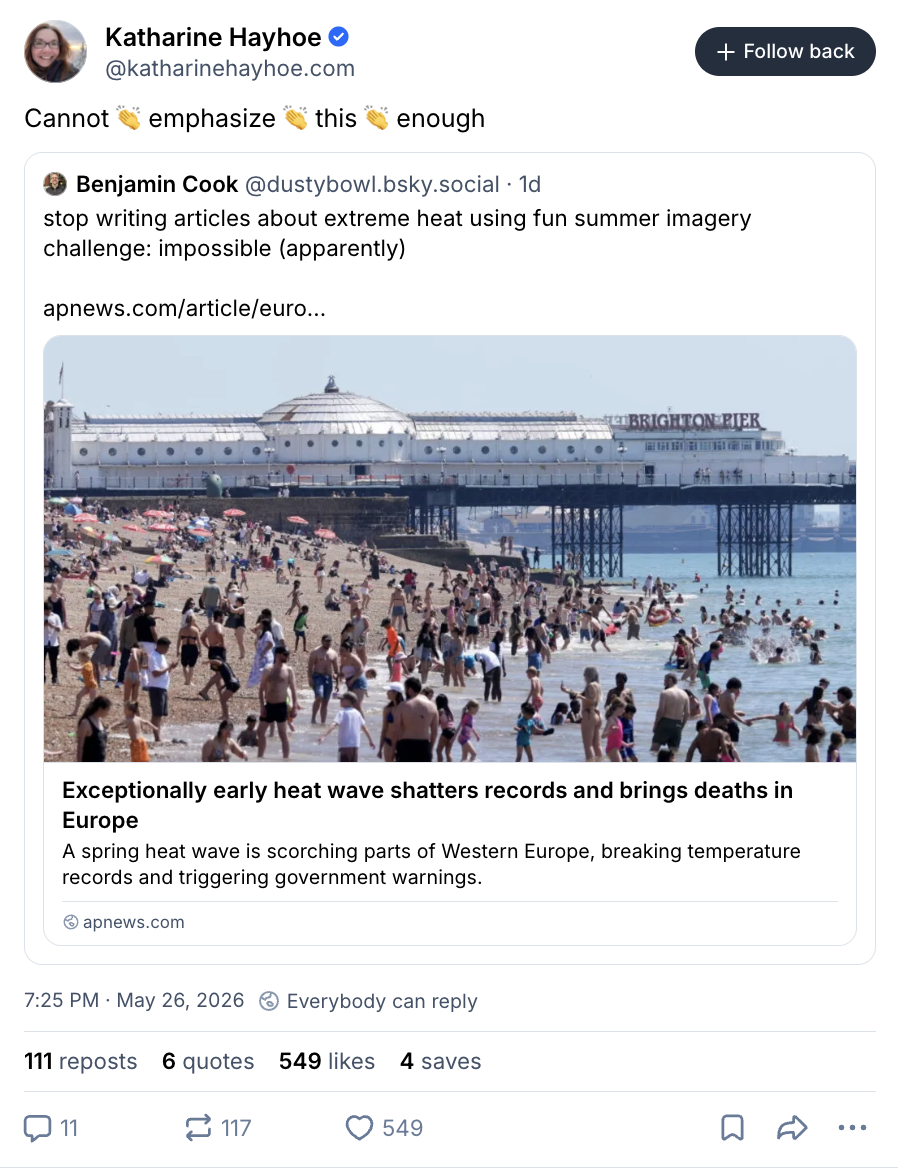
This choice of imagery – and the way right-leaning newspapers in the UK tend to focus on the positive aspects of hot weather – was highlighted by journalist and media critic Mic Wright in a Substack post. He wrote:
“Most British newspapers write about extremely hot weather with the tone of a frog in a boiling pot pretending it’s a jacuzzi.”
Despite blanket news coverage of the record heat in media outlets across western Europe, there has been relatively little commentary from their opinion pages.
No major UK newspapers have published editorials about the heat and there has been no space dedicated to it in the comment sections of the largest French and Spanish newspapers.
One exception in UK media was the Daily Mail’s climate-sceptic columnist Richard Littlejohn writing an article mocking heat-safety measures and warnings issued by the Met Office and the UK Health Security Agency (UKHSA).
In contrast, the Guardian published an article by Bill McGuire, professor emeritus of geophysical and climate hazards at University College London, warning of the dangers facing the UK as extreme heat becomes “the norm”. He wrote:
“We need, then, to face the fact that life in the 2050s is going to be very different from today, and act now. The sooner we recognise this and begin – as a nation – to prepare and adapt accordingly, the better we will be able to meet these enormous challenges to our everyday lives.”
Oliver Duff, editor-in-chief of the i newspaper, wrote that the UK is “emotionally underprepared”, as a nation, for the heat:
“Worries about climate change are forgotten in the giddy determination to enjoy our brief, unreliable summers, whichever month of the year they deign to visit.”
Writing in the Independent, journalist Kat Brown reflected on the Climate Change Committee’s recent advice to the UK government on adapting to climate change. She stressed the need to “take heatwaves seriously”.
James Wallace, chief executive of the charity River Action, was given a guest column in the Daily Express in which he wrote: “As the nation swelters in record-breaking temperatures, England is sleepwalking into a water crisis.”
In reference to water shortages and increasingly extreme weather, Wallace also emphasised that “this is climate breakdown in real time”.


The post Media reaction: UK and Europe’s ‘mind-boggling’ May heat and climate change appeared first on Carbon Brief.
Media reaction: UK and Europe’s ‘mind-boggling’ May heat and climate change

Three countries have been named by the Paris Agreement’s compliance committee for failing to submit a nationally determined contribution (NDC) and repeatedly snubbing offers of help with their climate plans.
After months of internal debate over whether to identify serial non-responders, the Paris Agreement’s Implementation and Compliance Committee (PAICC) named the three countries which have failed to engage with it over their NDCs on Friday.
It named Democratic Republic of Congo, Senegal and North Korea in a footnote of its annual report, adding that it decided to name them “with a view to facilitating engagement”, adding that representatives of the three nations had been invited to its meeting in early 2027 “with the purpose of identifying any challenges and constraints”.
“The Committee noted the importance of Parties engaging with the Committee in a timely manner, while noting that some delays may be due to the national capabilities and circumstances of the Parties”, the report said.
-
Under US pressure, World Bank says it will back gas “where appropriate”
The US wants the World Bank to expand its gas support while climate campaigners are pushing for it to end – its head spoke this week of limited backing for the fossil fuel -
IPCC scientists vow to press on with climate reports despite political deadlock
After governments again failed to agree a timeline, nearly 120 IPCC authors pledged to complete their assessment on time and with full scientific rigour -
Paris Agreement committee snubbed over missing NDC climate plans
Many governments have still not submitted a nationally determined contribution to the UN, breaching a key requirement of the Paris Agreement



In July, PAICC said 12 countries had ignored its repeated attempts to discuss why they had not published an NDC as required every five years under the 2015 Paris accord.
Members of the committee had been divided over whether to name them, but at a September meeting decided to do so in their annual report to the annual climate COP summit.
By the time the report was published on Friday, only Congo, Senegal and North Korea “had not communicated an NDC or submitted a [Biennial Transparency Report] and had not yet responded to any of the Committee’s notifications, despite several reminders issued by the Committee in this regard”.
Rainforest and renewable energy ambitions
The silence from Congo and Senegal is notable because the former is home to much of the Congo Basin rainforest while the latter has sought billions of dollars in climate finance to support its renewable energy ambitions.
After Brazil, Congo has more rainforest than any country in the world. This forest, and the country’s peatlands, absorb huge amounts of greenhouse gas but are fast being lost to expanding farmland, charcoal production, logging and mining.
Senegal signed a Just Energy Transition Partnership with Canada and wealthy European nations in 2023, to help it meet its renewable energy targets under the-then government of Macky Sall. It was chair of the Least Developed Countries group between January 2022 and December 2023.

Tejas Rao, who is researching the PAICC as part of a doctoral thesis at Cambridge University, said the governments of the three countries should engage with the committee.
“Engagement costs these governments very little and the committee has shown it will listen,” he said.
“Silence leaves the committee with no basis to help, and it leaves the [governments] exposed to the narrative that they are simply disengaged,” he told Climate Home News.
Paris Agreement requirement
The 2015 Paris Agreement requires all parties to publish an NDC every five years outlining their emissions reduction targets, with each plan meant to be more ambitious than the country’s last NDC.
The latest set – the third round of plans, with new targets for 2035 – was due in February 2025. While most countries missed this deadline, all but around 30 – mostly small emitters but including Egypt, Vietnam and Argentina – have now submitted them.
Over the year, the PAICC – which is made up of government climate officials from developed and developing countries – has been communicating with governments that have not submitted NDCs and trying to overcome barriers to them doing so.
Some nations have cited exceptional circumstances as the reason for not submitting an NDC, a process that requires a significant amount of work in tracking emissions and consulting on how to curb them across the economy. For example, a letter from a Sudanese official to the PAICC, seen by Climate Home News, said that the country’s civil war had led to the suspension of its NDC preparation.
-
IPCC scientists vow to press on with climate reports despite political deadlock
After governments again failed to agree a timeline, nearly 120 IPCC authors pledged to complete their assessment on time and with full scientific rigour -
Under US pressure, World Bank says it will back gas “where appropriate”
The US wants the World Bank to expand its gas support while climate campaigners are pushing for it to end – its head spoke this week of limited backing for the fossil fuel -
Who shapes climate science? The equity question facing the IPCC
Early completion of the next global climate science assessment reports risks excluding research from the Global South, which is key to ensuring the findings are fair</