

Welcome to Carbon Brief’s China Briefing.
China Briefing handpicks and explains the most important climate and energy stories from China over the past fortnight. Subscribe for free here.
Key developments
Several dead as record rainfall hit several provinces
DEADLY DOWNPOUR: Multiple rounds of heavy rainfall have hit central and eastern China, with Agence France-Presse reporting that at least 25 people were killed in the first round, which affected provinces including Guangxi, Guizhou, Hunan and Hubei. Shortly afterwards, nine people died in south-western Chongqing province, reported finance news outlet Caixin, after receiving “nearly 300mm of rain in just two hours, a deluge local residents described as the worst in more than 60 years”. The government has dedicated 280m yuan ($41m) to support affected provinces, reported state news agency Xinhua. The Communist party-backed newspaper China Youth Daily reported that more than 20 provinces have been affected so far, with rains expected to continue throughout June.
CLIMATE CONTRIBUTION: National rainfall over 11-23 May was 46% higher than the seasonal norm, said Xinhua. Nearly 500 weather stations nationwide have logged record rainfall levels, according to state-sponsored newspaper Guangming Daily. The rains were described as “quite unusual”, according to Xinhua, with the National Climate Centre’s chief forecaster Gao Hui telling the agency that the heavy rains were caused by a combination of factors. These included a convergence of several climate systems carrying in strong flows of moisture from nearby marine regions, as well as “rapid global warming, compounded by a fast-developing El Niño” increasing the atmosphere’s moisture content.
The EU ‘overcapacity’ debate
‘CONCERNS’ REGISTERED: The EU will debate proposals in June to “step up efforts” to reduce economic reliance on China and protect its industries, including “safeguard investigations” for at-risk sectors and an “overcapacity instrument”, reported Politico. Finance news outlet Yicai said China in turn has registered its “concerns” with the World Trade Organization over the EU’s Industrial Accelerator Act (IAA), which includes local content requirements for industries including clean-energy technologies.

PATIENCE ‘WEARING THIN’: A report by the Hong Kong-based South China Morning Post cited “some observers” as saying a trade war characterised by the EU “clos[ing] its market down to Chinese imports” may be the “only” way in which the EU can get China to fully engage with its concerns. A China Daily editorial states that China’s “patience” over the EU’s “politicisation and over-securitisation of trade and economic issues” is “wearing thin”. An editorial in the state-supporting Global Times says “erecting higher trade barriers” against Chinese cleantech is “clearly unwise”, given the Iran conflict, adding: “China will never sit idly by while the EU unreasonably suppresses Chinese companies.”
MISSING AGREEMENTS: Meanwhile, Bloomberg covered US president Donald Trump’s claims that his counterpart Xi Jinping “likes the idea of buying more US oil”, following Trump’s state visit to China. [None of the Chinese government readouts or press briefings covering trade outcomes have mentioned any energy agreements so far.] Similarly, the “Kremlin said…a general understanding” had been reached on the Power of Siberia 2 gas pipeline following Russian president Vladimir Putin’s visit to China, according to Reuters, but that there was “no mention of any oil and gas deals among documents signed” during his meeting with Xi. A joint statement published by China’s Ministry of Foreign Affairs said China and Russia will “deepen” cooperation around oil and gas, coal, nuclear and renewable energy, adding that they will “strengthen cooperation in addressing climate change”.
Coal-power generation rose in April
‘INFLEXIBLE’ COAL: Thermal power generation in China “grew for a fourth straight month in April”, rising 3.1% year-on-year in the face of reduced wind and nuclear generation, reported Bloomberg. “Unfavorable weather” was not the only reason for weaker clean-energy generation, wrote Centre for Research on Energy and Clean Air lead analyst Lauri Myllyvirta on Bluesky, with “grid congestion due to inflexible operation of coal plants and transmission lines” also a factor. Separately, research by Global Energy Monitor found that Chinese coal-plant developers “requested approval for 51 gigawatts (GW)” of new capacity in January-March 2026, reported Bloomberg.
-
Sign up to Carbon Brief’s free “China Briefing” email newsletter. All you need to know about the latest developments relating to China and climate change. Sent to your inbox every Thursday.
SOLAR SLOWDOWN: Total power demand grew 6% year-on-year in April, according to Xinhua. Total capacity rose 14% by the end of April, reported energy news outlet International Energy Net, with China’s total solar-power capacity now exceeding 1,250 gigawatts (GW) and wind reaching 661GW, while thermal capacity rose 7% to 1,556GW. However, the growth rate of new solar installations continued to fall for a “fourth straight month”, said Bloomberg, with 9.5GW added in April 2026 compared to 45.2GW the year before.
POLICY EXPANDS: Meanwhile, the government has expanded its renewable power “direct connection” policy to allow clean-energy generators to supply multiple users directly “through dedicated [power] lines”, rather than just one consumer, reported finance news outlet Caixin. It cited a government official saying the policy is “intended to support cleaner energy use in industrial parks…and other large energy-consuming facilities”, which comprise more than two-thirds of total energy demand. Economic news outlet Jiemian quotes an expert saying the policy enables both “lower electricity prices” and “higher utilisation rates” for renewables, “reducing curtailment rates”.
More China news
- ‘SOLIDARITY AND RESOLVE’: China voted in favour of a UN general assembly resolution to back the International Court of Justice’s (ICJ) landmark 2025 opinion on states’ legal obligations to tackle climate change. The Chinese embassy to Vanuatu said on Facebook this displayed its “solidarity and collective resolve”.
- BOND DISCLOSURE: According to a disclosure report by China’s finance ministry, the country raised 6bn yuan in “green sovereign bonds” in 2025, said finance news outlet EastMoney ($884m), of which 700m ($103m) was spent on clean-energy retrofitting.
- WAR ON SAND: The central government has pledged to “improve” and expand its ecological compensation mechanism, including to now provide compensation for building solar farms in desertified areas, said power news outlet BJX News.
- SPACE-BASED SOLAR: Chinese scientists have begun “initial experiments” in a project to “collect [solar] energy in orbit and beam it wirelessly to Earth”, said PV Magazine.
- MINERAL STRATEGY: China has pledged to “accelerate the construction of strategic mineral-reserve sites”, reported Reuters. It will also work with the US on “reasonable” concerns around its rare-earth export controls, Reuters also reported.
Captured
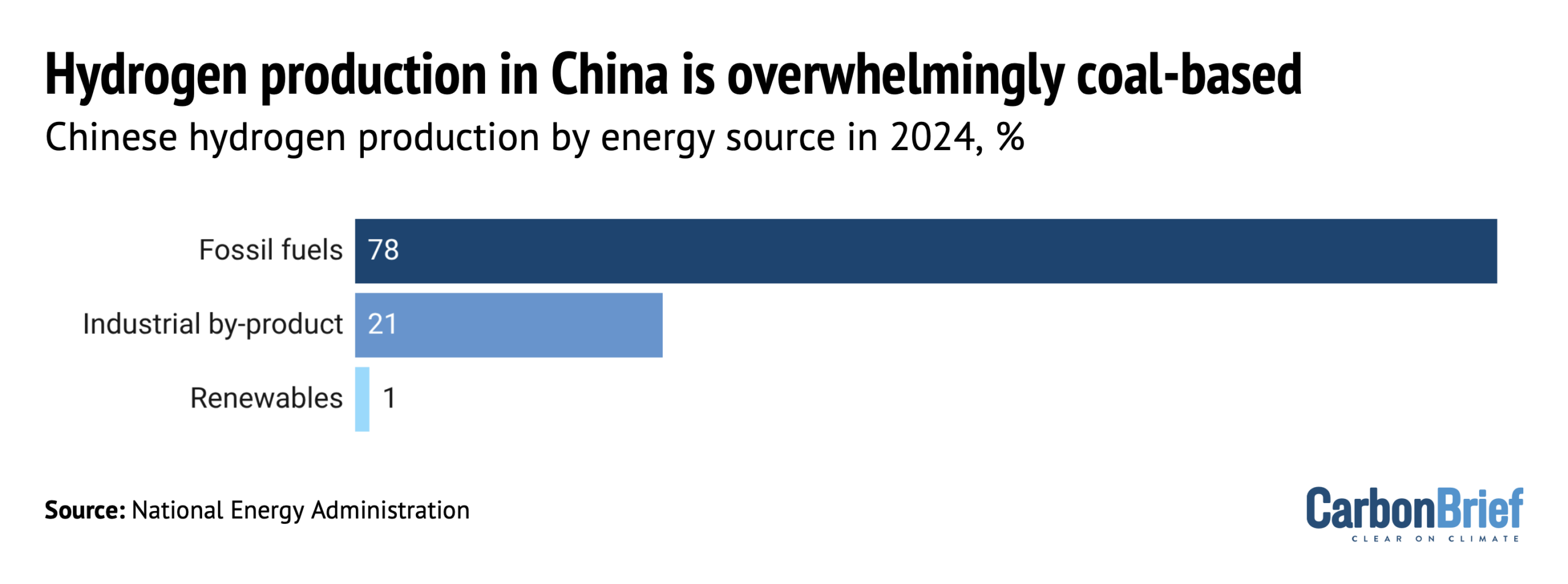
Hydrogen in China continues to be mostly produced from coal, according to a National Energy Administration report. A new Carbon Brief article explored how a series of new policies in China could help scale hydrogen, particularly “green” hydrogen made with renewable power.
Spotlight
China’s new carbon metric leaves Germany-sized gap in its emissions
A major change in the way that China measures its core climate goal has effectively halved the growth in the country’s carbon dioxide (CO2) emissions over the past five years.
The revised measure of “carbon intensity” implies that China’s emissions have only gone up by 7% from 2020-2025, just half of the 14% rise indicated by previous official statistics.
This spotlight is an excerpt of an analysis explaining how the metric appears to have shifted and its implications for China’s climate goals. The full article can be found on the Carbon Brief website.
Germany-sized gap
Reducing carbon intensity – CO2 emissions per unit of GDP – has been China’s key climate commitment since the Copenhagen climate conference in 2009.
Neither China’s international climate pledges nor other official documents have ever set out a definition of carbon intensity.
However, until this year, it was possible to closely reproduce the reported numbers, based on a straightforward interpretation of what carbon intensity means – combining official GDP data with estimates of emissions from the use of fossil fuels.
Now, the types of emissions that are included in the carbon-intensity metric have changed.
The previous carbon-intensity measure apparently included emissions from the use of fossil fuels to generate energy and as chemical feedstocks, so-called “non-energy uses”. It did not include non-fossil fuel CO2 emissions from industrial processes, such as the production of cement.
Based on reported progress against this old scope, China’s carbon intensity had fallen by 12.4% from 2020-2025, well short of its 18% target under the 14th five-year plan.
Yet the 15th five-year plan reported that China had cut its carbon intensity by 17.7% over the same period, indicating a major shift in which types of emissions are included.
A footnote in China’s latest statistical communique indicates that carbon intensity now includes industrial process emissions and excludes non-energy uses of fossil fuels.
The shift has implications for estimates of the country’s emissions.
China’s total emissions were 11.2bn tonnes of CO2 (GtCO2) in 2020. Based on the original methodology, its fossil-fuel CO2 emissions had grown 14% by 2024, an increase of 1,430m tonnes (MtCO2).
In contrast, the newly reported carbon-intensity figures imply that China’s CO2 emissions only grew by 7% between 2020 and 2025, up just 690MtCO2.
The gap between these figures amounts to 730MtCO2, equivalent to the annual emissions of Germany or South Korea.
Decoding the new methodology
The methodology change could have significant implications, making it important to understand how it is being calculated.
The new scope includes industrial-process emissions. One of the largest sources of these emissions, the cement industry, has been contracting, helping explain the improvement to carbon intensity under the new scope.
In addition, the new scope excludes non-energy use of fossil fuels – largely relating to the chemicals industry – which have seen rapid growth in the past five years.
One way to make the numbers add up would be to assume that the amount of carbon embedded in chemical-industry products has increased by the equivalent of 500MtCO2.
However, the reported output of major chemical-industry products cannot account for this level of embedded carbon.
Neither the change in scope of the carbon-intensity calculation, nor the change in the amount of carbon retained in products, can explain the size of the revision in the newly reported numbers. There must be another explanation.
Either the new scope broadly aligns with the explanation outlined above, but also excludes a subset of the CO2 emissions. Or the scope does not exclude any of the CO2, but there are gaps in the monitoring of some energy or industrial-process emissions.
Either explanation would mean China is not accounting for some of its CO2 emissions.
Implications for China’s targets
This change has the effect of weakening China’s climate targets and introducing more uncertainty into tracking progress.
The new numbers means it will require less effort to hit the 2030 carbon-intensity target in its Paris pledge. This target can now be met even if emissions rise, whereas the previous metric would have required a reduction.
It will also require less effort to hit the carbon-intensity target in China’s 15th five-year plan.
In addition, China would be able to officially meet its target to peak emissions by 2030, even if its overall CO2 emissions do not actually peak. The change could also affect delivery of China’s targets to cut emissions by 2035.
While China may use any definition it wants for carbon intensity under the UN climate framework, retrospective changes or inconsistent accounting could erode the value of its commitments.
Moreover, it will ultimately have to close any gaps in its emissions data and reporting, under the transparency rules of the Paris Agreement.
This spotlight is adapted from an article by Centre for Research on Energy and Clean Air lead analyst Lauri Myllyvirta for Carbon Brief.
Watch, read, listen
MINING ACCIDENT: A column in Bloomberg argued that “continuing to veer…toward cleaner [energy] development” could avoid coal-mine accidents such as the one that claimed 82 lives in Shanxi province.
INDONESIAN NICKEL: The European Guanxi Podcast recorded a discussion with Ember’s Dr Muyi Yang about the role China plays in Indonesia’s coal-reliant nickel industry.
INDUSTRIAL HURDLES: A new article in Yicai investigated the reasons why companies are holding back on relocating to zero-carbon industrial parks.
NEGATIVE PRICES: The Communist party-affiliated People’s Daily published a widely-read article on how the emergence of “negative electricity prices” signals a need for a more “coordinated” buildout of clean energy.
163
In billion tonnes, the amount of carbon dioxide (CO2) that China could avoid between 2025-2060 by transitioning to clean energy, according to a new study published by several leading academic institutions in Nature Reviews Earth & Environment. Scientists estimate that the remaining global budget for keeping temperatures below 1.5C is 130bn tonnes of CO2.
New science
- Population exposure to heatwave-drought events “increased markedly” across China during between 1961-90 and 1991-2020, driven by a combination of population growth and more frequent heatwave-drought events | Atmospheric Research
- Fossil-fired power generation accounts for three-quarters of China’s total water consumption for energy production | Mitigation and adaptation strategies for global change
Recently published on WeChat
China Briefing is written by Anika Patel, with contributions from Lekai Liu, and edited by Simon Evans. Please send tips and feedback to china@carbonbrief.org
The post China Briefing 28 May 2026: Deadly rains | China pushes back | Examining China’s carbon intensity metric appeared first on Carbon Brief.

Three countries have been named by the Paris Agreement’s compliance committee for failing to submit a nationally determined contribution (NDC) and repeatedly snubbing offers of help with their climate plans.
After months of internal debate over whether to identify serial non-responders, the Paris Agreement’s Implementation and Compliance Committee (PAICC) named the three countries which have failed to engage with it over their NDCs on Friday.
It named Democratic Republic of Congo, Senegal and North Korea in a footnote of its annual report, adding that it decided to name them “with a view to facilitating engagement”, adding that representatives of the three nations had been invited to its meeting in early 2027 “with the purpose of identifying any challenges and constraints”.
“The Committee noted the importance of Parties engaging with the Committee in a timely manner, while noting that some delays may be due to the national capabilities and circumstances of the Parties”, the report said.
-
Under US pressure, World Bank says it will back gas “where appropriate”
The US wants the World Bank to expand its gas support while climate campaigners are pushing for it to end – its head spoke this week of limited backing for the fossil fuel -
IPCC scientists vow to press on with climate reports despite political deadlock
After governments again failed to agree a timeline, nearly 120 IPCC authors pledged to complete their assessment on time and with full scientific rigour -
Paris Agreement committee snubbed over missing NDC climate plans
Many governments have still not submitted a nationally determined contribution to the UN, breaching a key requirement of the Paris Agreement



In July, PAICC said 12 countries had ignored its repeated attempts to discuss why they had not published an NDC as required every five years under the 2015 Paris accord.
Members of the committee had been divided over whether to name them, but at a September meeting decided to do so in their annual report to the annual climate COP summit.
By the time the report was published on Friday, only Congo, Senegal and North Korea “had not communicated an NDC or submitted a [Biennial Transparency Report] and had not yet responded to any of the Committee’s notifications, despite several reminders issued by the Committee in this regard”.
Rainforest and renewable energy ambitions
The silence from Congo and Senegal is notable because the former is home to much of the Congo Basin rainforest while the latter has sought billions of dollars in climate finance to support its renewable energy ambitions.
After Brazil, Congo has more rainforest than any country in the world. This forest, and the country’s peatlands, absorb huge amounts of greenhouse gas but are fast being lost to expanding farmland, charcoal production, logging and mining.
Senegal signed a Just Energy Transition Partnership with Canada and wealthy European nations in 2023, to help it meet its renewable energy targets under the-then government of Macky Sall. It was chair of the Least Developed Countries group between January 2022 and December 2023.

Tejas Rao, who is researching the PAICC as part of a doctoral thesis at Cambridge University, said the governments of the three countries should engage with the committee.
“Engagement costs these governments very little and the committee has shown it will listen,” he said.
“Silence leaves the committee with no basis to help, and it leaves the [governments] exposed to the narrative that they are simply disengaged,” he told Climate Home News.
Paris Agreement requirement
The 2015 Paris Agreement requires all parties to publish an NDC every five years outlining their emissions reduction targets, with each plan meant to be more ambitious than the country’s last NDC.
The latest set – the third round of plans, with new targets for 2035 – was due in February 2025. While most countries missed this deadline, all but around 30 – mostly small emitters but including Egypt, Vietnam and Argentina – have now submitted them.
Over the year, the PAICC – which is made up of government climate officials from developed and developing countries – has been communicating with governments that have not submitted NDCs and trying to overcome barriers to them doing so.
Some nations have cited exceptional circumstances as the reason for not submitting an NDC, a process that requires a significant amount of work in tracking emissions and consulting on how to curb them across the economy. For example, a letter from a Sudanese official to the PAICC, seen by Climate Home News, said that the country’s civil war had led to the suspension of its NDC preparation.
-
IPCC scientists vow to press on with climate reports despite political deadlock
After governments again failed to agree a timeline, nearly 120 IPCC authors pledged to complete their assessment on time and with full scientific rigour -