


Green artificial intelligence (AI) has a crucial role in accelerating the transition to clean energy and achieving net-zero emissions. AI solutions boost energy efficiency, improve power grids, and cut carbon footprints in various industries.
Machine learning algorithms predict energy demand. This helps integrate renewable sources, such as solar and wind, more effectively. Additionally, AI improves battery storage management, ensuring more effective use of sustainable energy.
Some important statistics on AI-powered energy transition:
-
AI-driven energy efficiency could cut global electricity demand, says the International Energy Agency (IEA). It can deliver more than 40% of the emissions reductions needed by 2040
-
AI smart grids cut energy waste by 30%. This makes electricity distribution more efficient.
-
AI could add $5.2 trillion to the global economy by 2030. A big part will come from applications that focus on sustainability.
Apparently, AI is changing industries. Companies that combine AI with sustainable practices are becoming market leaders. Companies investing in AI for sustainability not only contribute to environmental goals but also position themselves for long-term profitability as the world moves toward cleaner energy solutions.
By 2025, AI, cloud computing, and clean energy will create big investment chances. Among these, four companies stand out for their innovation, robust financials, and commitment to a greener future.
Let’s delve into why these top 4 Green AI stocks are drawing investors’ attention in 2025 and beyond.
Amazon (AMZN): Leading AI in Cloud and Logistics
Amazon has been at the forefront of AI development, leveraging it across various facets of its business—from Amazon Web Services (AWS) to AI-driven logistics and automation. The AI recommendation engine boosts e-commerce sales. Also, AWS AI tools are now used in many industries worldwide.
AI is also key to Amazon’s supply chain. It helps cut inefficiencies, reduce emissions, and speed up deliveries.
Financial Performance. For the fourth quarter of 2024, Amazon reported:
-
Revenue: $187.8 billion, a 10% increase from the previous year.
-
Operating Income: $21.2 billion, a significant increase from the previous year.
-
Net Income: $20.0 billion, nearly doubling from the previous year.
-
AWS Revenue: Grew 19% to $28.8 billion, contributing significantly to profitability.
These figures underscore Amazon’s robust financial health and strategic positioning in the AI and cloud computing sectors.
Amazon’s stock experienced an increase of 1.78% on March 10, 2025, at market close, but dipped the next day. Despite the slight uptick, the broader tech sector has faced significant challenges, with major companies experiencing substantial losses due to escalating trade tensions and recession concerns.

Regardless, the e-commerce giant continues to push for sustainable growth.
Key Sustainability Initiatives
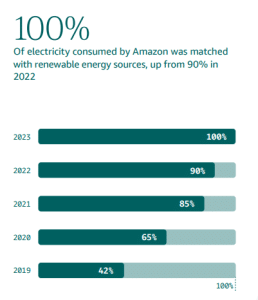
Amazon has set ambitious sustainability goals, including a commitment to reach 100% renewable energy by 2025, which it achieved in 2023. The company uses AI systems to cut energy use in data centers. This helps reduce waste and lower costs.
The company’s AI logistics network optimizes routes. This cuts fuel use and emissions a lot. Amazon is also deploying 100,000 electric delivery vans worldwide, aiming to reduce its carbon footprint in logistics operations.
AWS AI tools also help customers cut their environmental impact. They do this by optimizing workloads and boosting energy efficiency in cloud operations. These initiatives highlight Amazon’s dedication to integrating sustainability with technological innovation.
Alphabet (GOOGL): Pioneering AI with Google DeepMind
Alphabet’s subsidiaries, Google DeepMind and Gemini AI (formerly Bard), are at the cutting edge of artificial intelligence research and application. Google uses AI to boost search algorithms, make ads work better, and lead in cloud computing.
DeepMind’s AI models have played a key role in energy management, significantly improving the efficiency of Google’s data centers. DeepMind’s AI uses reinforcement learning to adjust cooling systems on its own. This leads to a 40% cut in energy use.
Financial Performance. In the fourth quarter of 2024, Alphabet announced the following results:
-
Revenue: $86.31 billion, a 13% increase from the previous year.
-
Ad Revenue: $65.52 billion, slightly below analysts’ estimates of $65.94 billion.
-
Google Cloud Revenue: $9.19 billion, showing a 26% growth.
These results reflect Alphabet’s effective integration of AI across its operations, enhancing both performance and efficiency. However, the tech giant’s stock saw a slight decrease of 0.73% on March 11, 2025, closing at $164.02.

The company has not been immune to the broader tech selloff, with significant market value losses reported recently. Yet, Google is moving forward with its green promise.
Major Sustainability Achievements
Alphabet has made significant strides in sustainability. Google is working toward achieving 24/7 carbon-free energy by 2030, a goal that will make all of its operations run on clean energy at all times. AI plays a major role in this transition, as DeepMind’s models optimize energy consumption in data centers, leading to a 30% reduction in power usage.
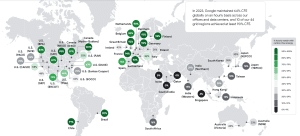
Google has also invested over $5 billion in renewable energy projects worldwide, including solar, wind, and battery storage. These investments help Google reach its sustainability goals. They also boost the use of clean energy technologies in the industry.
These efforts make Alphabet a leader in blending tech progress with caring for the environment, making it one of the green AI stocks to watch for.
- READ MORE on Google: Google’s Q4 Financial Success vs. Net-Zero Pledge: Can It Balance AI Growth with Sustainability?
Meta (META): AI-Driven Metaverse with Green Data Centers
Meta leverages AI to enhance user experiences across its platforms—Facebook, Instagram, and WhatsApp—while leading advancements in AI-driven virtual reality (VR) and the metaverse.
AI is crucial for Meta. It optimizes ad-targeting algorithms. This cuts down on wasted ad spending and boosts efficiency.
Additionally, AI-driven automation in data centers has improved server utilization, decreasing energy consumption across its infrastructure.
Financial Results. Meta reported the following performance for the fourth quarter of 2024:
-
Revenue: $48.39 billion, surpassing expectations of $47.04 billion.
-
Earnings Per Share (EPS): $8.02, exceeding the anticipated $6.77.
-
Net Income: $20.8 billion, up 49% year-over-year from $14 billion.
-
Daily Active People (DAP): 3.35 billion, a 5% increase year-over-year.
These numbers highlight Meta’s strong financial results and successful AI use on its platforms. With this, the company’s stock experienced a 1.93% increase on March 10, 2025, at market close.

Despite this gain, the company has faced notable declines recently, reflecting broader market challenges. Still, it strives harder toward sustainable and clean digital solutions.
Sustainability Commitment Highlights:
Meta has set and achieved several sustainability goals. The company aims to achieve net-zero emissions by 2030, decarbonizing its operations through investments in renewable energy and energy-efficient AI applications.
AI models help optimize power use in Meta’s data centers. They boost efficiency by 40% and cut overall electricity demand.
Additionally, Meta invests in carbon removal projects to offset its residual emissions, supporting global reforestation and clean energy initiatives. The tech giant’s green data centers aim for energy efficiency. They use advanced cooling systems to lower water and power use.
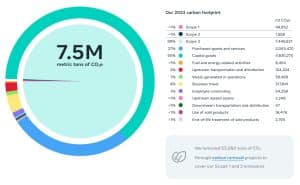
These initiatives reflect Meta’s dedication to integrating sustainability into its technological advancements.
Tesla (TSLA): AI-Powered EVs and Energy Solutions
Tesla is not just an electric vehicle (EV) manufacturer but a leader in AI-driven automation and energy efficiency. From self-driving AI technology to sustainable energy solutions, Tesla continues to push the boundaries of innovation.
AI is at the core of Tesla’s Full Self-Driving (FSD) system, improving safety and efficiency by optimizing traffic flow and reducing energy waste. Tesla’s AI battery management systems boost energy storage. This makes renewable energy easier to use on a larger scale.
Financial Results. In the fourth quarter of 2024, Tesla reported:
-
Revenue: $25.17 billion, a 3% increase year-over-year.
-
Net Income: $7.9 billion, up from $4.1 billion the previous year.
-
Earnings Per Share (EPS): $2.27, surpassing estimates.
-
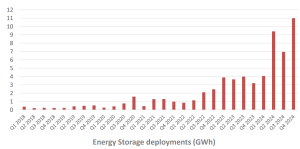
Energy Storage Deployments: Reached 9.5 GWh, a record high, driven by demand for Tesla’s Megapacks and Powerwalls.
Despite economic challenges, Tesla’s strong financial performance and continued AI advancements make it a solid investment choice among green stocks.
Tesla’s stock rose by 4.56% on March 10, 2025, closing at $232.29. Despite this increase, the company recently experienced a significant drop of 15.4%, driven by escalating recession fears and CEO Elon Musk’s controversial political engagements.

But how does the company move forward with its green and sustainability promises?
Sustainability and AI Integration
Tesla is committed to sustainability through its AI-powered solutions. The company’s Full Self-Driving AI cuts emissions. It does this by making EVs more efficient and reducing wasted energy.
The EV giant uses AI to manage its energy battery storage and solar solutions. This helps optimize energy storage and distribution. As a result, grid reliability improves, and renewable energy adoption increases.
Tesla’s Gigafactories focus on sustainability. They reduce waste and mainly use renewable energy sources. These initiatives solidify Tesla’s position as a leader in green AI and sustainable transportation.
Why These 4 Stocks Could Shape the Future of Green AI
As AI and sustainability become key investment themes, Amazon, Alphabet, Meta, and Tesla stand out as top choices for 2025. Each company uses advanced AI and is committed to the environment. This makes them appealing to forward-thinking investors.
Whether it’s Amazon’s cloud dominance, Alphabet’s AI research, Meta’s metaverse expansion, or Tesla’s EV and energy solutions, these stocks represent the future of green AI innovation. Investors looking for long-term growth with a focus on sustainability should keep an eye on these four industry leaders in 2025 and beyond.
- FURTHER READING: Top 3 Tech Stocks to Watch Out for Smart Investments in 2025
The post Top 4 Green AI Stocks You Shouldn’t Ignore in 2025 and Beyond appeared first on Carbon Credits.

EU carbon credit claims changed on 27 September 2026, the day the Directive (EU) 2024/825 began to apply across the European Union. The change is narrow. It changes how a company can talk about the credits it buys. A product can no longer be called neutral on the strength of compensation alone; however, every specific, evidenced statement about what a company measured, reduced, and funded stays fully available.

The post Promoting Improved Cooking Practices in Nigeria appeared first on Terrapass.


-
Climate Change1 year ago
Guest post: Why China is still building new coal – and when it might stop
-

 Greenhouse Gases2 years ago
嘉宾来稿:满足中国增长的用电需求 光伏加储能“比新建煤电更实惠”
-
Greenhouse Gases1 year ago
Guest post: Why China is still building new coal – and when it might stop
-

 Climate Change2 years ago
嘉宾来稿:满足中国增长的用电需求 光伏加储能“比新建煤电更实惠”
-

 Renewable Energy12 months ago
Sending Progressive Philanthropist George Soros to Prison?
-
Climate Change2 years ago
Bill Discounting Climate Change in Florida’s Energy Policy Awaits DeSantis’ Approval
-
Greenhouse Gases1 year ago
嘉宾来稿:探究火山喷发如何影响气候预测