Connect with us

Published

on

Solar Power to Grow 400% by 2030, Beating Down Coal

The International Energy Agency (IEA) recently released its World Energy Outlook 2024, highlighting big shifts in global energy trends. Solar power is at the forefront of this transformation, with projections showing that global solar electricity generation could grow fourfold by 2030. This growth is set to accelerate the decline of coal and reshape the global energy mix. 

Solar’s Big Moment: The Future of Power Generation

According to the report, global energy markets stabilized in 2023, with natural gas prices dropping after a spike in 2022 and energy demand growing by 2.1%, aligning with the pre-2020 average. However, under the Stated Policies Scenario (STEPS), demand growth is expected to slow to 0.7% annually until 2030. Most of this growth will be in emerging markets and developing economies. 

Efficiency improvements and increased electrification are key factors, with the Announced Pledges Scenario (APS) showing a slight decline in energy demand, and the Net Zero Emissions (NZE) Scenario indicating a more significant drop.

oil and natural gas price by scenario, 2010 - 2050
Source: IEA Energy Outlook 2024 Report

Electricity demand is set to grow across all scenarios, driven by economic progress, electrification of transport (such as electric vehicles), and the rising need for data centers. 

By 2033, solar is expected to surpass nuclear, wind, hydro, and natural gas as a major electricity source. Eventually, it could even overtake coal to become the largest source of electricity worldwide. This marks the beginning of what the IEA calls the “age of electricity,” where clean energy growth and efficiency gains gradually reduce our reliance on fossil fuels.

By 2035, electricity’s share of global consumption will reach 26% in STEPS, 29% in APS, and 36% in the NZE Scenario. In particular, China’s electricity demand is expected to surpass the combined demand of advanced economies by 2030.

electricity demand growth by scenario 2023-2035
Source: IEA Energy Outlook 2024 Report

How Renewables Are Reshaping Energy Markets

The rise of solar power is part of a larger shift toward cleaner energy sources. The IEA predicts that as more renewable energy like solar and wind comes online, global carbon dioxide (CO2) emissions from energy will reach their peak around 2025. This could be a major step forward in reducing the impact of climate change. 

However, the IEA warns that these changes alone aren’t enough to meet the goals of the Paris Agreement, which aims to limit global warming to well below 2°C, preferably to 1.5°C, above pre-industrial levels. Even with the growth of renewables, CO2 emissions are expected to fall only 4% below 2023 levels by 2030. This would still result in a global temperature increase of about 2.4°C—higher than the desired target.

To reach the 1.5°C target, the IEA outlines a path that it calls “increasingly narrow, but achievable.” This path requires three things:

  • a rapid shift to clean energy technologies,
  • faster adoption of electric systems, and
  • a big reduction in emissions—around 33%—by 2030.

Achieving these goals will demand new policies and large investments in renewable energy, especially in regions that still rely heavily on fossil fuels. 

The IEA suggests that along with expanding clean energy, improving energy efficiency is crucial to keeping global energy demand in check, even as economies and populations grow.

Electricity’s Rise For Cleaner Power 

The World Energy Outlook 2024 also explores various possibilities, including the growth of electric vehicles, energy demand from data centers, and the rising need for air conditioning due to more frequent heat waves. 

No matter the scenario, the IEA expects that demand for coal, oil, and natural gas will peak soon. This shift represents a turning point as the world moves from fossil fuels to renewable energy. 

Coal, which has been a major energy source, could start its decline by 2025, particularly as renewables like solar and wind gain ground in Asia, where coal has traditionally been dominant. Moving away from coal is crucial for reducing the carbon footprint of electricity production and for improving air quality in growing urban areas.
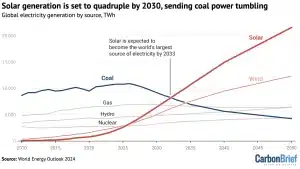
solar capacity by 2030

For oil and gas, demand is expected to peak around 2030 before gradually decreasing. The transition away from these fuels will be slower because of their key roles in transportation, petrochemicals, and manufacturing. 

  • The adoption of clean technologies, such as renewables and EVs, is driving a peak in demand for oil, natural gas, and coal by 2030. Yet, additional investment in clean energy is necessary to make more carbon emissions reductions.

However, as EVs become more popular and cleaner alternatives become available, the reliance on oil is expected to drop. The demand for natural gas is also projected to decline as options like green hydrogen and advanced battery storage become more viable. These alternatives are vital for hitting climate goals and ensuring energy security.

Achieving Net-Zero 2050 with Renewables

The report emphasizes that the growth of renewable energy is central to reshaping the world’s energy system. By 2030, renewable energy capacity could grow to nearly 3x of its current size. 

While this progress is significant, it’s still not enough to reach the ambitious goals to triple renewable capacity. To meet these goals, the IEA stresses the need for more policy support, innovation, and investment in renewables. 

  • Remarkably, solar and wind could provide nearly 60% of global electricity by 2050. However, fossil fuels still met 80% of global energy needs in 2023, though their demand could peak by 2030. 

One major factor driving the rise of clean energy is the falling cost of solar and wind power, which has made them competitive with traditional fossil fuels. The IEA estimates that solar capacity could exceed 16,000 gigawatts (GW) by 2050, a huge jump from current levels. 
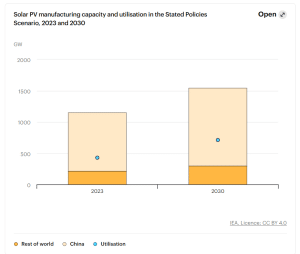
solar manufacturing capacity and use, 2023 and 2030

This growth is supported by advancements in battery technology, which help balance the fluctuations of renewable energy sources like solar. In its latest forecasts, the IEA has increased its estimates for battery storage, showing more optimism about the role of these technologies in making renewable energy systems work smoothly.
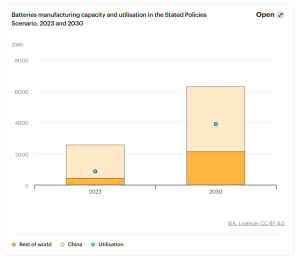
battery manufacturing capacity and use, 2023 and 2030

Despite these promising trends, the IEA stresses that more action is needed to reach climate goals. To stay on track for net-zero emissions by 2050, the world needs more investments in renewable energy and policies that support the shift away from fossil fuels. This could include carbon pricing, subsidies for renewable projects, and regulations that push industries to be more energy efficient. 

According to the IEA, the world has the tools to move to a cleaner energy future, but it will take a lot of effort to make the transition happen quickly enough.

The post Solar Power to Grow 400% by 2030, Beating Down Coal appeared first on Carbon Credits.

Continue Reading

Carbon Footprint

CSRD for SME Suppliers: How to turn data requests into a competitive advantage

Published

on

Across Europe, a quiet but decisive shift is reshaping how companies work with their suppliers. As the Corporate Sustainability Reporting Directive (CSRD) comes into force, large organisations are under mounting pressure to disclose detailed, verifiable sustainability information—not only about their own operations, but across their entire value chain. And because up to 80% of a company’s emissions often come from its supply chain, the spotlight naturally turns to SMEs.

Continue Reading

Carbon Footprint

Lithium Prices Surge Amid Strong Demand Forecasts, Could Reach Up to $28,000/Ton by 2026

Published

on

Disseminated on behalf of Surge Battery Metals Inc.

Lithium prices have jumped sharply overnight, catching the attention of investors, automakers, and battery makers. In China, lithium carbonate futures on the Guangzhou Futures Exchange hit about 95,200 yuan (≈$13,400 USD) per metric ton. This marks a rebound from earlier lows caused by oversupply.

Historically, lithium prices have been volatile. Peak prices reached around 150,000 yuan per ton in 2022, followed by a slump during the oversupply period in 2023–2024.

The recent spike followed comments from the chairman of Ganfeng Lithium, Li Liangbin, who projected a 30–40% rise in global demand by 2026. He suggested prices could reach between 150,000 and 200,000 yuan per ton if this growth materializes.

The surge highlights lithium’s critical role in powering electric vehicles (EVs) and large-scale energy storage.

Growing Demand for Lithium: What Drives the Boom?

Electric vehicles remain the largest driver of lithium demand. Around 16 million EVs were on the road globally in 2024, up from 10 million in 2022. Sales are forecast to exceed 25 million units by 2026 and reach over 50 million by 2030. Longer-range vehicles require larger batteries, which increases lithium use.

Energy storage systems are another fast-growing source of demand. Utilities expanding solar and wind energy need lithium-based batteries to store surplus electricity. Heavy-duty electric trucks and buses have larger batteries. This means they use more lithium per vehicle compared to passenger EVs.

Long-term trends toward decarbonization and renewable energy growth further support lithium demand. Analysts say that EV batteries make up about 70% of lithium demand. Grid storage accounts for 15%. Electric trucks use 10%, and other uses, like electronics and specialty chemicals, are around 5%.

Supply Challenges Keep Prices Elevated

Lithium carbonate prices in China have climbed dramatically, moving from $8,259/tonne on June 23, 2025, to $12,791/tonne on November 19, 2025 – a rise of about 55% over five months. 

This recent rally is primarily attributed to tight supply conditions, with major Chinese mines, including those operated by CATL, pausing operations due to falling prices earlier in the year. As output was reduced or shut in, inventories were gradually drawn down, tightening available supply.

lithium carbonate price

Moreover, lithium production is highly concentrated. Australia leads with around 60,000 tonnes LCE annually, followed by Chile (35,000 tonnes), China (25,000 tonnes), Argentina (18,000 tonnes), and the U.S. (≈5,000 tonnes). Geographic concentration adds risk: environmental regulations, political tensions, or operational issues could tighten supply.

Restarting idled mines or opening new projects takes 2–5 years. Inventories from the oversupply period act as a buffer. Current estimates show global lithium stocks at about 350,000 tonnes LCE. This amount can help with short-term supply issues, but it’s not enough for long-term growth.

The factors that keep pushing lithium demand higher include:

Lithium makes up about 20–25% of total EV battery costs. So, price changes can greatly impact EV production costs. Also, battery chemistry trends show that sodium-ion and solid-state batteries might take a small share of the market by 2030. However, lithium-ion will remain the leader for now.

Lithium carbonate prices in China have climbed sharply, as shown in the chart. Prices rose more than 17% this month as investors bet on accelerating demand from the energy storage sector.

What Analysts Say: Forecasts and Future Trends

Fastmarkets predicts a small surplus in 2025, shifting to a deficit of 1,500 tonnes LCE by 2026. A few years ago, the market had a surplus of about 175,000 tonnes in 2023 and 154,000 tonnes in 2024. Cuts in production at high-cost or marginal mines and rising demand from EVs and storage systems are driving this rebalancing.

Arcane Capital forecasts global demand could hit 4.6 million tonnes LCE by 2030, led by EVs, grid storage, and heavy-duty transport.

Benchmark Mineral Intelligence expects lithium carbonate prices to stay between $15,000 and $17,000 USD per ton in 2025, but prices may be lower in 2026 if supply increases faster than demand.

Still, the chart from Katusa Research highlights a growing deficit in lithium supply and demand. This supply deficit will likely underpin upward pressure on lithium prices moving toward 2030.

lithium supply deficit KR
Source: Katusa Research

Production in Australia, China, and South America should grow by about 10% each year, per industry estimates. However, delays or cost overruns might slow this growth. 

Risks to the Price Recovery

Lithium prices face several risks. EV adoption could slow if subsidies or incentives drop. Battery makers might adopt sodium-ion or other chemistries if costs rise. Rapid restarts of idled mines or new production could oversupply the market.

Regulatory hurdles, environmental restrictions, and trade tensions could also disrupt supply. Recent price spikes were partly due to speculative trading, highlighting the market’s sensitivity to sentiment.

Who Wins and Who Loses?

Higher lithium prices may hurt automakers and battery makers, pushing them to secure contracts or invest in recycling. Mining companies benefit from higher prices but must manage timelines and costs.

Meanwhile, investors have opportunities, though volatility is high. Policymakers consider lithium a strategic resource and are encouraging domestic production, recycling, and robust supply chains.

With global supply growth uncertain, focus is turning to projects that provide steady, long-term output. This is especially true in areas aiming to boost domestic supply chains, where Surge Battery Metals comes in.

Spotlight: Surge Battery Metals – US Lithium Hero

Surge Battery Metals (TSX-V: NILI | OTCQX: NILIF) is emerging as a key U.S. lithium developer. Its Nevada North Lithium Project (NNLP) hosts the highest-grade lithium clay resource currently reported in the United States, with an Inferred Resource of 11.24 million tonnes of lithium carbonate equivalent (LCE) grading 3,010 ppm lithium (NI 43-101, September 24, 2024).

Surge Nevada lithium clay comparison
Source: Surge Battery Metals

A Preliminary Economic Assessment (PEA) on the project outlines robust economics, including:

  • After-tax NPV₈%: US$9.21 billion
  • After-tax IRR: 22.8%
  • Low operating costs: US$5,243 per tonne LCE

NNLP benefits from access to regional infrastructure, including established roads and nearby power, supporting future development. 

Surge’s leadership team includes veterans from Millennial Lithium, a company acquired for US$490 million in 2022. The company has also secured a staged C$10 million JV funding agreement with Evolution Mining to advance NNLP toward Pre-Feasibility while maintaining majority ownership.

How Nevada North Fits into the Global Picture

The Nevada North Lithium Project demonstrates the potential to become a globally significant lithium operation. According to comparative analysis from 3L Capital and S&P Global, NNLP’s Life-of-Mine (LOM) average production of 86 kt LCE per year—as outlined in the PEA—would rank the project as the 5th largest lithium-producing project in the world compared with 2024 producers and developers.

Lithium demand vs supply
Source: Surge Battery Metals

Even in its first year, NNLP is projected to produce 26 kt LCE, placing it among the top 16 lithium projects globally on a 2024 comparative basis. This combination of scale, grade, and location underscores NNLP’s potential as a strategic U.S. supply source in a market seeking domestic, high-quality lithium to reduce dependence on overseas imports.

top lithium producing companies 2024
Source: Surge Battery Metals

If advanced through feasibility, permitting, and construction decisions, NNLP has the potential to become a competitive, American-based lithium operation—supporting both EV manufacturing and large-scale energy storage with “American-made” battery-grade feedstock.

Lithium Surges, Supply Matters, and America Prepares

Prices are shaped by several key factors. These include updates on production from major mines, trends in EV adoption, grid storage deployment, new battery technologies, and changes in policy. Inventory levels and market speculation will continue to influence short-term volatility.

Lithium prices have jumped, signaling a possible market turning point after past oversupply. High demand from EVs, grid storage, and heavy-duty transport, along with limited production and geographic concentration, is pushing prices up.

Industry stakeholders, investors, and policymakers have to monitor developments closely as lithium continues to play a central role in the global energy transition. Surge Battery Metals shows the type of domestic production needed to meet rising demand and strengthen supply chains in a rapidly evolving market.


DISCLAIMER 

New Era Publishing Inc. and/or CarbonCredits.com (“We” or “Us”) are not securities dealers or brokers, investment advisers, or financial advisers, and you should not rely on the information herein as investment advice. Surge Battery Metals Inc. (“Company”) made a one-time payment of $50,000 to provide marketing services for a term of two months. None of the owners, members, directors, or employees of New Era Publishing Inc. and/or CarbonCredits.com currently hold, or have any beneficial ownership in, any shares, stocks, or options of the companies mentioned.

This article is informational only and is solely for use by prospective investors in determining whether to seek additional information. It does not constitute an offer to sell or a solicitation of an offer to buy any securities. Examples that we provide of share price increases pertaining to a particular issuer from one referenced date to another represent arbitrarily chosen time periods and are no indication whatsoever of future stock prices for that issuer and are of no predictive value.

Our stock profiles are intended to highlight certain companies for your further investigation; they are not stock recommendations or an offer or sale of the referenced securities. The securities issued by the companies we profile should be considered high-risk; if you do invest despite these warnings, you may lose your entire investment. Please do your own research before investing, including reviewing the companies’ SEDAR+ and SEC filings, press releases, and risk disclosures.

It is our policy that the information contained in this profile was provided by the company, extracted from SEDAR+ and SEC filings, company websites, and other publicly available sources. We believe the sources and information are accurate and reliable but we cannot guarantee them.

CAUTIONARY STATEMENT AND FORWARD-LOOKING INFORMATION

Certain statements contained in this news release may constitute “forward-looking information” within the meaning of applicable securities laws. Forward-looking information generally can be identified by words such as “anticipate,” “expect,” “estimate,” “forecast,” “plan,” and similar expressions suggesting future outcomes or events. Forward-looking information is based on current expectations of management; however, it is subject to known and unknown risks, uncertainties, and other factors that may cause actual results to differ materially from those anticipated.

These factors include, without limitation, statements relating to the Company’s exploration and development plans, the potential of its mineral projects, financing activities, regulatory approvals, market conditions, and future objectives. Forward-looking information involves numerous risks and uncertainties and actual results might differ materially from results suggested in any forward-looking information. These risks and uncertainties include, among other things, market volatility, the state of financial markets for the Company’s securities, fluctuations in commodity prices, operational challenges, and changes in business plans.

Forward-looking information is based on several key expectations and assumptions, including, without limitation, that the Company will continue with its stated business objectives and will be able to raise additional capital as required. Although management of the Company has attempted to identify important factors that could cause actual results to differ materially, there may be other factors that cause results not to be as anticipated, estimated, or intended.

There can be no assurance that such forward-looking information will prove to be accurate, as actual results and future events could differ materially. Accordingly, readers should not place undue reliance on forward-looking information. Additional information about risks and uncertainties is contained in the Company’s management’s discussion and analysis and annual information form for the year ended December 31, 2024, copies of which are available on SEDAR+ at www.sedarplus.ca.

The forward-looking information contained herein is expressly qualified in its entirety by this cautionary statement. Forward-looking information reflects management’s current beliefs and is based on information currently available to the Company. The forward-looking information is made as of the date of this news release, and the Company assumes no obligation to update or revise such information to reflect new events or circumstances except as may be required by applicable law.


Disclosure: Owners, members, directors, and employees of carboncredits.com have/may have stock or option positions in any of the companies mentioned: None.

Carboncredits.com receives compensation for this publication and has a business relationship with any company whose stock(s) is/are mentioned in this article.

Additional disclosure: This communication serves the sole purpose of adding value to the research process and is for information only. Please do your own due diligence. Every investment in securities mentioned in publications of carboncredits.com involves risks that could lead to a total loss of the invested capital.

Please read our Full RISKS and DISCLOSURE here.

The post Lithium Prices Surge Amid Strong Demand Forecasts, Could Reach Up to $28,000/Ton by 2026 appeared first on Carbon Credits.

Continue Reading

Carbon Footprint

Canada’s Carbon Pricing Reset in 2026: Will Industry Step Up or Stall Climate Progress?

Published

on

Canada’s Carbon Pricing Reset in 2026: Will Industry Step Up or Stall Climate Progress?

Canada is at a key moment in its fight against climate change. Carbon pricing has been the central tool used to cut emissions, but recent policy changes and differences across provinces have created uncertainty.

This article examines how Canada’s carbon pricing system works now. It covers expert concerns and what the key federal review in 2026 might mean for both industry and the country’s journey toward a lower-carbon future.

How Canada Prices Pollution

Canada uses carbon pricing to encourage companies and people to cut greenhouse gas (GHG) emissions. Under that system, there are two main parts.

For ordinary people and small businesses, there used to be a “fuel charge” or carbon tax on fossil fuels. For large industrial emitters, there is a program called the Output-Based Pricing System (OBPS).

Under the OBPS, factories or facilities that produce a lot of emissions get a limit based on how much they produce. If they emit more than their limit, they must pay; if they emit less, they earn credits that they can sell or use later.

This approach aims to reduce carbon pollution while trying to protect industries that compete globally. The goal is to cancel out the risk that companies might move to other countries with weaker climate rules.

From Gas Pumps to Smokestacks: A Major Policy Shift

In 2025, the federal government made important changes. It removed the “consumer-facing” carbon tax — the fuel charge — effective April 1, 2025. This means people pay no extra carbon tax when buying gasoline or heating fuel.

Canada carbon price per tonne yearly
Source: RBN Energy LLC website

Instead, the focus shifted more clearly onto industrial carbon pricing. The government said it would review the carbon pricing “benchmark” in 2026. This review could change how industrial carbon pricing operates.

A recent analysis by ClearBlue Markets shows that Canada’s carbon pricing for industry is now fragmented. Fragmentation has caused uncertainty. This is a problem for companies that need stable cost signals before they invest in cleaner technology.

The ClearBlue report stated:

“The federal benchmark review will therefore trigger extensive engagement between the federal government and the provinces, aimed at aligning key benchmark elements such as coverage, pricing stringency, and competitiveness protections. Negotiations are likely to be complex and politically charged, particularly with provinces like Alberta and Saskatchewan, which have already taken strong positions. These types of unilateral decisions reflect ongoing tensions and highlight the difficulty of achieving a truly aligned national approach.”

Carbon pricing today: A patchwork across Canada

Because Canada is large and its provinces have different rules, carbon pricing for industry is not the same everywhere. ClearBlue Markets shows that credit prices—what companies pay or earn—vary a lot by province or system.

Here are specific examples:

In Alberta, the Environmental Monitoring, Evaluation and Reporting Agency has seen a big drop in credits under its Technology Innovation and Emissions Reduction Program (TIER). Despite a compliance price of CAD 95 per tonne, market credits trade at around CAD 18 per tonne. This shows a credit surplus and weak demand.

In British Columbia (B.C.), the new B.C. Output-Based Pricing System (B.C. OBPS) began to be applied recently. Credits are trading at about CAD 65 per tonne, a discount compared with the regulatory level of CAD 80.

In Ontario, the Emissions Performance Standards (EPS) system governs industrial emissions. Because the program does not allow offset credits, supply is tighter — units (EPUs) recently traded at around CAD 72 per tonne.

In areas where the federal OBPS still applies, like some territories and small provinces, cheap carbon offset credits from Alberta’s TIER have lowered prices. Now, they can be as low as about CAD 37.50 per tonne.

Canada carbon prices per jurisdiction
Data source: ClearBlue Markets

The true cost of carbon emissions differs greatly by industry and province. The federal government aims to raise the carbon price to CAD 170 per tonne by 2030 for direct pricing systems.

The 2026 Showdown: Can Canada Fix Its Carbon Market?

The upcoming review of the federal benchmark is seen as a turning point. It could lead to stronger, more aligned carbon pricing across all provinces. As ClearBlue Markets notes, the review may address issues such as:

  • Align different provincial systems under a common design. This way, credits and compliance will act more alike.
  • Improving transparency in reporting credit inventories, trades, and emission reductions.
  • Possibly introducing a “floor price” — a minimum cost for carbon credits — to avoid extreme price drops like those seen in some programs.
  • Setting a long-term carbon price path past 2030 helps industries plan investments more clearly. This is especially important for clean technologies.

All of these could make carbon pricing more predictable and effective. If the review doesn’t meet expectations, patchwork and uncertainty may persist. This could weaken the carbon price signal and confuse investment in clean technology.

This patchwork of provincial and federal carbon pricing programs has created a corresponding patchwork of compliance offset markets. The image below shows how these offset markets are distributed across Canada.

Canada Offset Credit Issuances
Source: ClearBlue Markets

Global Pressure Is Rising: Europe Could Hit Canada with Carbon Tariffs

One major external risk comes from the global trade environment. Starting in 2026, the European Union’s Carbon Border Adjustment Mechanism (CBAM) will impact imports based on their carbon emissions.

For Canadian exporters, this raises a key question:

  • Will EU authorities accept the compliance credits or offsets generated under Canada’s various carbon pricing systems as evidence of “carbon price paid”?

If not, Canadian exports might face extra tariffs. This could double the carbon cost or hurt competitiveness.

This makes it even more important for Canada to standardize and strengthen its carbon pricing framework before 2026. This is to ensure that its pricing and credits are recognized internationally. Otherwise, Canadian industries like steel, aluminum, and cement might find it hard to compete. This is especially true in markets with strict climate-related import rules.

Strengths and Challenges of Canada’s Carbon Pricing

Carbon pricing works to link environmental costs with economic decision-making. For large emitters, it encourages improved efficiency. Carbon pricing revenue, especially from the OBPS, can fund clean energy projects. It also supports carbon capture and investments in low-carbon infrastructure.

A recent evaluation by the government highlights that industrial carbon pricing helps reduce emissions with minimal impact on households.

But there are major challenges too. The system varies by province, so many industries might have low carbon costs. This means there is little motivation for real change.

A 2022 report from the Office of the Auditor General of Canada (OAG) found that weak rules in provincial large-emitter programs lower the impact of carbon pricing. Also, the unclear use of carbon revenues and the long-term price outlook have made some firms hesitant to invest in cleaner technologies.

The Stakes: Canada’s Climate Credibility and Industrial Future

The 2026 benchmark review could reshape Canada’s carbon pricing for decades. Key signs to watch are:

  • Whether the government sets a new, clear carbon price path beyond 2030 — possibly up to 2050, that would give firms confidence to invest in long-term clean solutions.
  • Whether provincial carbon pricing systems become more harmonized. This means similar rules, credit prices, and transparency everywhere.
  • Introducing a price floor or other methods can help prevent deeply discounted carbon credits. This ensures a strong carbon price signal.
  • Will Canadian industrial credits and compliance be set up to gain recognition under global systems like CBAM? This could help keep Canadian exports competitive.

Canada’s carbon pricing, especially for industry, is at a crossroads. The removal of the consumer carbon tax in 2025 reflects a shift toward focusing on industrial emissions. Meanwhile, the upcoming 2026 benchmark review offers a chance to make this system stronger, fairer, and more predictable.

However, much depends on political and regulatory will. Without clear pricing, rules, and long-term certainty, the carbon price might be too weak. This puts Canada’s climate goals and global competitiveness at risk. But if the government and provinces act quickly, carbon pricing can help Canada shift to a low-carbon economy while also keeping industries competitive.

The post Canada’s Carbon Pricing Reset in 2026: Will Industry Step Up or Stall Climate Progress? appeared first on Carbon Credits.

Continue Reading

Trending

Copyright © 2022 BreakingClimateChange.com

