


Uranium Royalty Corp. (NASDAQ: UROY, TSX: URC) recently announced the acquisition of a royalty on the Millennium and Cree Extension Uranium Projects located in Saskatchewan, Canada. The company purchased this royalty from a third-party industrial gas firm for $6 million in cash.
Scott Melbye, Chief Executive Officer of Uranium Royalty Corp. stated:
“We are very excited to acquire this significant royalty on the Millennium and Cree Extension Projects. Cameco has previously completed substantial development work on the Millennium project and it remains one of the largest undeveloped projects in Cameco’s portfolio. It represents an important potential contributor to the future global production pipeline. The transaction is another example of our ability to leverage the URC team’s experience and networks to source and execute accretive uranium royalty transactions.”
The Millennium Project
The Millennium Project is an advanced-stage conventional uranium project located 36 km northwest of Cameco’s Key Lake Mill in Saskatchewan, Canada. This project is a joint venture between Cameco and Japan Canada Uranium (JCU). Cameco holds a 69.9% equity share and operates the project.
As one of the largest global suppliers of uranium fuel, Cameco plays a vital role in promoting a clean-energy future. JCU, a Canadian exploration company, focuses on Saskatchewan’s Athabasca Basin and is jointly owned by Uranium Energy Corp. and Denison Mines Corp.
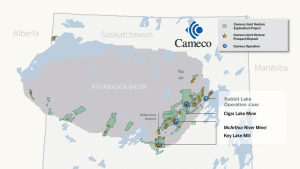
Figure: Location of the Millennium deposit – Source: Cameco Corporation website
The Cree Extension Project
The Cree Extension Project is currently in the exploration stage and is situated 36 kilometers northwest of Cameco’s Key Lake Mill. This project is a joint venture between Cameco, Orano Canada Inc., and JCU. The land is located to the west of Denison’s Wheeler River project and southwest of Cameco’s McArthur River project.
Cameco’s Uranium Revelation
Cameco Corporation, headquartered in Saskatchewan, Canada is the operator of the Millennium and Cree Extension Uranium Projects. The company submitted an Environmental Impact Statement (EIS) in 2009. The EIS outlined plans for the project to produce between 150,000 and 200,000 tons of ore annually, with a potential mine life of 10 years.
They reported that:
- The Millennium Project contains an estimated 1.4 million tons of resources at an average grade of 2.39% U3O8. This equates to 75.9 million pounds of U3O8 in the indicated category.
- Additionally, it has 0.4 million tonnes at an average grade of 3.19% U3O8, totaling 29.0 million pounds in the inferred category.
However, on May 15, 2014, Cameco decided to withdraw the EIS application due to unfavorable market conditions at that time.
The Millennium and Cree Extension Royalty
The press release revealed that the royalty consists of a 10% net profit interest (NPI) based on an approximate 20.6955% participating interest in the projects. This participating interest was transferred to the current owners in 1992.
In this profit-based arrangement, royalties are calculated from the revenue generated, with deductions allowed for certain expenses, including cumulative development costs. Royalties are only payable after all eligible preproduction expenses are recovered.
By securing royalties on these two projects, URC gains rights to about 12,800 hectares in the Athabasca Basin, which has the world’s top mining areas.
Uranium Royalty Corp.: Powering Decarbonization with Nuclear Efficiency
The only pure-play uranium royalty company is focused on capturing value from uranium price shifts through strategic investments. These include royalties, streams, debt, equity in uranium companies, and even physical uranium holdings. Notably, the company is growing with the rising demand for uranium.
- IEA revealed that in the U.S. alone, nuclear energy supplied roughly 19% of total electricity in 2022 and accounted for 55% of the nation’s carbon-free electricity.
- This nuclear output mitigated around 482 MMT of CO₂ emissions, which is equivalent to taking 107 million gasoline-powered vehicles off the roads.
More Power per Punch: Nuclear Energy Outshines Fossil Fuels
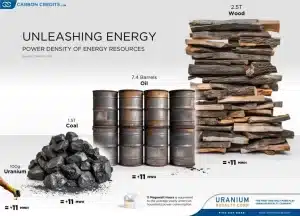
The U.S. government is boosting nuclear energy with a $6 billion program from the bipartisan Infrastructure Bill to support plants shifting to clean energy. The Inflation Reduction Act also offers Production Tax Credits that can drive investments to the upgradation of plants.
Nuclear energy is not only one of the safest but also among the most cost-effective and economical ways to achieve the decarbonization target.
Moving on and talking about sustainability, Uranium Royalty Corp. will collaborate with its property manager to measure emissions from its corporate office (Scope 1 and 2) for FY 2023. Additionally, the uranium miner will explore opportunities to co-invest with operators to advance shared sustainability priorities.
Disclosure: Owners, members, directors and employees of carboncredits.com have/may have stock or option position in any of the companies mentioned:
Carboncredits.com receives compensation for this publication and has a business relationship with any company whose stock(s) is/are mentioned in this article
Additional disclosure: This communication serves the sole purpose of adding value to the research process and is for information only. Please do your own due diligence. Every investment in securities mentioned in publications of carboncredits.com involve risks which could lead to a total loss of the invested capital.
Please read our Full RISKS and DISCLOSURE here.
The post Strategic Acquisition: Uranium Royalty Corp. Adds Cameco’s Uranium Projects to its Portfolio appeared first on Carbon Credits.

EU carbon credit claims changed on 27 September 2026, the day the Directive (EU) 2024/825 began to apply across the European Union. The change is narrow. It changes how a company can talk about the credits it buys. A product can no longer be called neutral on the strength of compensation alone; however, every specific, evidenced statement about what a company measured, reduced, and funded stays fully available.

The post Promoting Improved Cooking Practices in Nigeria appeared first on Terrapass.


Ming Yang Eyes 33 MW Turbine, Greenvolt Delays FID
‘A strong start’: WA’s transition to renewable energy powerhouse aided by Premier’s announcement
WA EPA warned Woodside of ‘serious, significant and irreversible’ harms to Scott Reef from gas plans, new documents reveal
-
Climate Change1 year ago
Guest post: Why China is still building new coal – and when it might stop
-

 Greenhouse Gases2 years ago
嘉宾来稿:满足中国增长的用电需求 光伏加储能“比新建煤电更实惠”
-
Greenhouse Gases1 year ago
Guest post: Why China is still building new coal – and when it might stop
-

 Climate Change2 years ago
嘉宾来稿:满足中国增长的用电需求 光伏加储能“比新建煤电更实惠”
-

 Renewable Energy1 year ago
Sending Progressive Philanthropist George Soros to Prison?
-
Climate Change2 years ago
Bill Discounting Climate Change in Florida’s Energy Policy Awaits DeSantis’ Approval
-
Greenhouse Gases1 year ago
嘉宾来稿:探究火山喷发如何影响气候预测
-

 Climate Change2 years ago
Analysis: China’s CO2 falls 1% in Q2 2024 in first quarterly drop since Covid-19