

Since Donald Trump returned to the White House last year, his administration in the US has laid off thousands of scientists and frozen research grants worth billions of dollars.
The cutbacks have had far-reaching consequences for all areas of scientific research, extending all the way to Earth’s fragile polar regions, researchers say.
Speaking to Carbon Brief, polar researchers explain how Trump’s attacks on science have affected efforts to study climate change at Earth’s poles, including by disrupting fieldwork, preventing data collection and even forcing researchers to leave the US.
One climate scientist tells Carbon Brief that the administration’s decision to terminate the only US icebreaker used in Antarctica forced her to cancel her fieldwork at the last minute – with her scientific cargo still held up in Chile.
As US polar scientists reel from the cuts, Trump has caused a geopolitical storm with threats to take control of Greenland, the self-ruling island which is part of the Kingdom of Denmark and located between the Arctic and Atlantic oceans.
Below, Carbon Brief speaks to experts about what Trump’s sweeping changes could mean for climate science at Earth’s poles
- Why is the US important for polar research?
- How has Trump affected US polar research in his second term?
- What could the changes mean for international climate research at Earth’s poles?
- What could be the impact of Trump’s threats to take control of Greenland on climate research?
Why is the US important for polar research?
The US’s wealth, power and geography have made it a key player in polar research for more than a century.
Ahead of Trump’s second term, the National Science Foundation (NSF), a federal agency that funds US science, was the largest single funder of polar research globally, with its Office of Polar Programs overseeing extensive research in both the Arctic and Antarctica.
The US has three permanent bases in Antarctica: McMurdo Station, Amundsen-Scott South Pole Station and Palmer Station.
In Alaska, which the US purchased from Russia in 1867, there is the Toollik Field Station and the Barrow Arctic Research Center. The US also has the Summit Station in Greenland.
US institutes operate several satellites that provide scientists across the world with key data on the polar regions.
This includes the National Oceanic and Atmospheric Administration’s (NOAA) Joint Polar Satellite System, which provides data used for extreme weather forecasting.
Over the past few years, US institutes have led and provided support for the world’s largest polar expeditions.
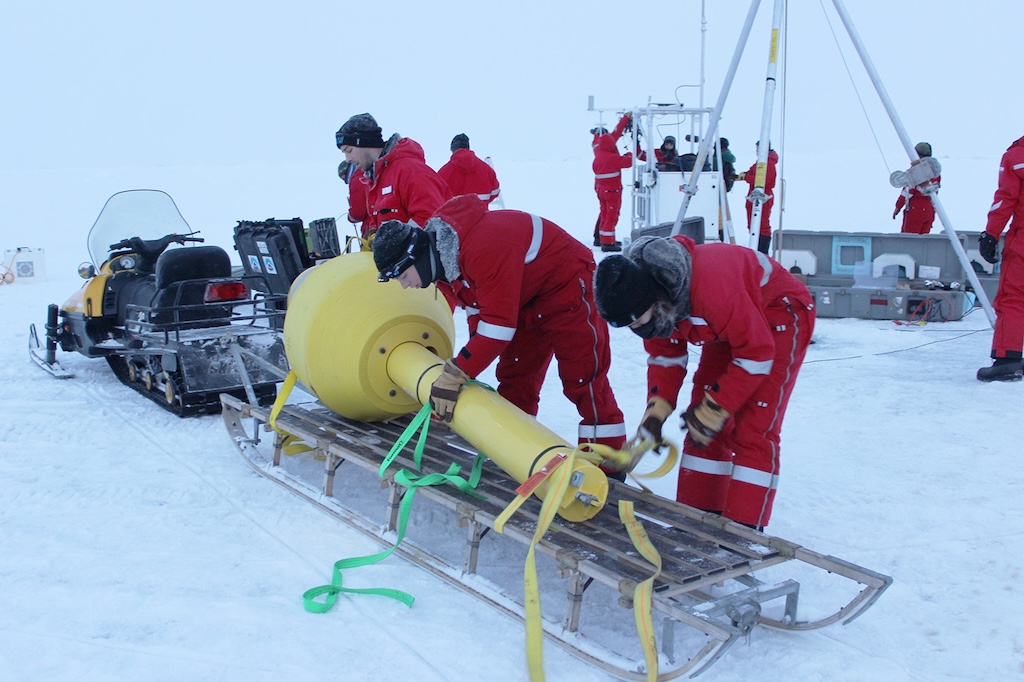
This includes MOSAiC, the largest Arctic expedition on record, which took place from 2019-20 and was co-led by research institutes from the US and Germany. [Carbon Brief joined the expedition for its first leg and covered it in depth with a series of articles.]
The US has historically been “incredibly valuable” to research efforts in the Arctic and Antarctica, a senior US polar scientist currently living in Europe, who did not wish to be named, tells Carbon Brief.
“For a lot of the international collaborations, the US is a big component, if not the largest,” the scientist says.
“We do a lot of collaborative work with other countries,” adds Dr Jessie Creamean, an atmospheric scientist working in polar regions based at Colorado State University. “Doing work in the polar regions is really an international thing.”
How has Trump affected US polar research in his second term?
Since returning to office, the Trump administration has frozen or terminated 7,800 research grants from federal science agencies and laid off 25,000 scientists and personnel.
This includes nearly 2,000 research grants from the NSF, which is responsible for the Office for Polar Programs and for funding a broad range of climate and polar research.
Courts have since made orders to reinstate thousands of these grants and some universities have settled with the federal government to unfreeze funding. However, it is unclear whether scientists have yet received those funds.
As with other areas of US science, the impact of Trump’s attacks on polar research have been far-reaching and difficult to quantify, scientists tell Carbon Brief.
Key scientific institutions affected include NASA, NOAA and the National Center for Atmospheric Research (NCAR) in Colorado.
In December, the Trump administration signalled that it planned to dismantle NCAR, calling it a source of “climate alarmism”. At the end of January, the NSF published a letter that “doubled down” on the administration’s promise to “restructure” and “privatise” NCAR.
NCAR has been responsible for a host of polar research in recent years, with several NCAR scientists involved in the MOSAiC expedition.
“NCAR is kind of like a Mecca for atmospheric research,” the US polar scientist who did not want to be named tells Carbon Brief. “They’ve done so much. Now their funding is drying up and people are scrambling.”
At NOAA, one of the major polar programmes to be affected is the National Snow and Ice Data Center (NSIDC), which regularly issues updates about Arctic and Antarctic sea ice.
Last July, Space reported that researchers at NSIDC were informed by the Department of Defense – now renamed the Department of War under Trump – that they would lose access to data from a satellite operated by the US air force, which was used to calculate sea ice changes.
Although the Department of Defense reversed the decision following a public outcry, the uncertainty drove the researchers at NSIDC to switch to sourcing data from a Japanese satellite instead, explains Dr Zack Labe. Labe is a climate scientist who saw his position at NOAA terminated under the Trump administration and now works at the nonprofit research group Climate Central. He tells Carbon Brief:
“It looked like they were losing access to that data and, after public outcry, they regained access to the data. And then, later this year, they had to switch to another satellite.”
He adds that the Trump administration’s layoffs and budget cuts has also forced the programme to scale back its communications initiatives:
“A big loss at NSIDC is that they used to put out these monthly summaries of current conditions in Greenland, the Arctic and Antarctic called Sea Ice Today. It was a really important resource to describe the current weather and sea ice conditions in these regions.
“These reports went to stakeholders, they went to Indigenous communities within the Arctic. And that has stopped in the past year due to budget cuts.”
Elsewhere, the New York Times reported that a director at the Office for Polar Programs found out she was being laid off while on a trip to Antarctica.
US polar research took another hit in September, when the NSF announced that it was terminating the lease for the Nathaniel B Palmer, the only US icebreaker dedicated to Antarctic research.

The statement gave just one month’s notice, saying that the vessel would be returned to its operator in October.
Creamean was among the scientists who were affected by the termination. She tells Carbon Brief:
“I was supposed to go on that icebreaker in September. I have a project funded at Palmer Station, along with colleagues from Scripps Institution of Oceanography. We were supposed to go set up for an 18-month study there. We have the money for the project, but we just didn’t get to go because the icebreaker got decommissioned.
“It was a big bummer. We shipped everything down to South America. All of our cargo is still sitting in Punta Arenas [in Chile].”
Elsewhere, other scientists have warned that the termination of the icebreaker could affect the continuity of Antarctic data collection.
In a statement, Dr Naomi Ochwat, a glaciologist at the University of Colorado, Boulder, said that decades of data on changes to Antarctic glaciers taken from the deck of the Palmer had been vital to her research.
For some, one of the most worrying impacts of Trump’s attacks on US polar science is on the careers of scientists, which will likely lead to many of them leaving the country.
All of the researchers that Carbon Brief spoke to said they had heard many stories of US polar scientists deciding to relocate outside of the country or to leave the profession altogether.
Creamean is one of the polar scientists to make the difficult decision to temporarily leave the US. She says:
“I’m actually moving to Sweden for a year starting in May. I’m going to do a visiting science position [at Stockholm University]. I’m hoping to come back. But if things are not looking good and things are looking more positive in Sweden, maybe I’ll stay there. I don’t know.”
Labe tells Carbon Brief that the “brain drain” of US scientists is the “biggest story” when it comes to Trump’s impact on polar research:
“I think one of the long-term repercussions is just how many people will be forced out of science due to a lack of opportunities. I think this is something that will grow in 2026. There were a lot of grants that were two-to-three years and, so, were still running, but they will be ending now.”
What could the changes mean for international climate research at Earth’s poles?
With all research at Earth’s poles relying heavily on international collaboration, Trump’s attacks on science are likely to have far-reaching implications outside of the US, scientists tell Carbon Brief.
One implication of budget and personnel cuts could be the loss of continuous data from US researchers, bases and satellites.
Many US polar datasets have been collected for decades and are relied upon by scientists and institutes around the world. This includes records for Arctic and Antarctica’s oceans, sea ice, atmosphere and wildlife.
Trump’s impact has highlighted to scientific organisations outside of the US how vulnerable US datasets can be to political changes, says Labe, adding:
“From a climate perspective, you need a consistent data record over a long period of time. Even a small gap in data caused by uncertainty can cause major issues in understanding long-term trends in the polar regions.
“Other scientific organisations around the world are realising that they’re going to have to find alternative sources for data.”
Creamean tells Carbon Brief that, while some datasets have been discontinued, researchers have made an effort to keep records going despite personnel and budget constraints. She says:
“I know at Summit Station in Greenland they had some instruments that were pulled out that had been measuring things like the surface energy budget for a long time. That dataset has been discontinued.
“Thankfully, some programmes have been able to somehow hold on and continue to do baseline measurements. There’s a station up in Alaska [Barrow] where, as far as I know, measurements have been maintained there. That’s good because some measurements up there have been happening since the 60s and 70s.”

Trump’s changes could also cast uncertainty over the US’s role in taking part and offering support to upcoming collaborative Arctic and Antarctic expeditions.
In addition to helping scientists better understand the impact of climate change on Earth’s polar regions, these expeditions have also enabled countries with testy geopolitical relationships to come together for a common goal, the US polar scientist who did not want to be named tells Carbon Brief.
For example, the MOSAiC expedition from 2019-20 saw the US and Germany work alongside Russian and Chinese research institutes to study the impact of climate change on the Arctic, says the scientist, adding:
“It was an international collaboration that involved people who should be geopolitical enemies. Science is a way that we seem to be able to work together, to solve problems together, because we all live on one planet. And, right now, to see these changes in the US, it’s quite concerning [for these kinds of collaborations].”
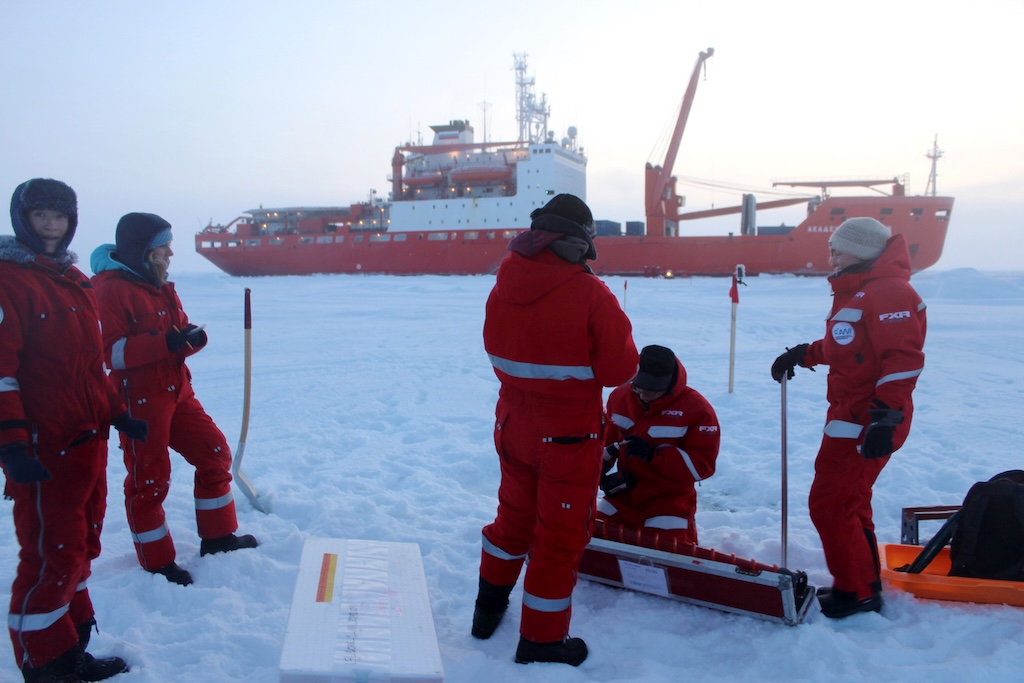
The retreat of the US from polar research might see other powers step up to fill the gap, scientists tell Carbon Brief.
Several scientists mentioned the Nordic countries as possibly taking a larger role in leading polar research, while one said that “China seems to be picking up the slack that’s left behind”.
China currently has five Antarctic research stations – Great Wall, Zhongshan, Kunlun, Taishan and Qinling – along with one Arctic station in Ny-Ålesund, Svalbard.
The Financial Times recently reported on China’s growing ambitions for Arctic exploration, involving its fleet of five icebreakers.
What could be the impact of Trump’s threats to take control of Greenland on climate research?
In recent months, Trump has whipped up a media frenzy with threats to take control of Greenland, the world’s largest island lying between the Arctic and Atlantic oceans, which is self-governing and part of the Kingdom of Denmark.
Last month, he clarified that he will not try to take Greenland “by force”, but that he is seeking “immediate negotiations” to acquire the island for “national security reasons”.
Trump’s interest in the island is likely influenced by the rapid melting away of Arctic sea ice due to climate change, which is opening up new sea routes and avenues for potential resource exploitation, reported the Washington Post.
His comments have sparked condemnation from a wide range of US scientists who conduct fieldwork in Greenland.
An open letter signed by more than 350 scientists “vehemently opposes” Trump’s threats to take control of Greenland and expresses “solidarity and gratitude” to Greenland’s population. It says:
“Greenland deserves the world’s attention: it occupies a key position geopolitically and geophysically. As climate warms, rapid loss of Greenland’s ice affects coastal cities and communities worldwide.”
A breakdown in diplomatic relations between the US and Greenland could prevent scientists from being able to carry out their climate research on the island, one of the scientists to sign the letter wrote in a supporting statement:
“Scientific access to Arctic environments is essential for research which secures our shared future and, directly, materially benefits American citizens. It is deeply upsetting that these essential relationships are being undermined, perhaps irreparably, by the Trump administration.”
Dr Yarrow Axford, one of the letter’s organisers who is a palaeoclimatologist and science communicator based in Massachusetts, told Nature that Trump’s comments could put Greenland climate research at risk, saying:
“We Americans have benefited from all these decades of peaceful partnership with Greenland. Scientific understanding of climate change has benefited tremendously. I hope scientists can reach out to Congress and point out what a wonderful partnership that is.”
In addition to the US-run Summit Station, there are at least eight other research stations in Greenland, operated by a range of institutions from across the world.

A major focus of research efforts in the region is the Greenland ice sheet, Earth’s second-largest body of ice which is rapidly melting away because of climate change.
The ice sheet holds enough freshwater to raise global sea levels by around more than seven metres, if melted completely.
Any political moves that could “jeopardise” the study of the Greenland ice sheet would be detrimental, says Creamean:
“Greenland is a ‘tipping point’ in that, the ice sheet melting, that could be one of the biggest contributors to sea level rise. It’s not like we can wait to study it, it needs to be understood now.”

The post Q&A: How Trump is threatening climate science in Earth’s polar regions appeared first on Carbon Brief.
Q&A: How Trump is threatening climate science in Earth’s polar regions

The launch of the Africa Energy Bank (AEB) has been put back yet again, raising doubts about the institution’s future ability to finance fossil fuel projects – its main objective – as global lenders retreat from such investments over climate concerns, experts told Climate Home News.
The bank, which had been billed to launch in September after a series of delays, is now scheduled to begin operations in November, according to the head of the African Energy Chamber, an advocacy body for the continent’s oil and gas sector.
Even as the world aims to transition away from fossil fuels, many African leaders have made clear they want to continue exploring and extracting the continent’s large oil and gas deposits – estimated at around 125 billion barrels of crude and over 600 trillion cubic feet of gas – to boost economic development.
As a group, Africa sided with a number of powerful oil-and-gas producing nations in blocking progress on negotiations to craft a global roadmap to transition away from fossil fuels at last year’s UN COP30 climate talks, although some countries did individually support the proposal.
-
Campaigners oppose Dangote’s planned Kenya refinery over climate and ecological risks
Plans to build Africa’s second largest oil refinery in ecologically sensitive region criticised as “environmental recklessness” -
Tanzania pushed African nations to oppose fossil fuel transition at COP30
While chairing the African group at the summit, the gas-dependent nation advised the continent’s ministers to block language on transitioning away from fossil fuels


Meanwhile, major projects under development across the continent – including the 1,443-km East African Crude Oil Pipeline (EACOP) and Dangote’s 700,000-barrel-per-day Kenyan refinery – show that African governments see oil and gas as playing a significant role in meeting their energy and economic needs for many years to come.
In 2022, at a gathering of the African Petroleum Producers’ Organization (APPO) in oil-rich Angola, ministers from its member states adopted a resolution to create the Africa Energy Bank to finance projects for the production, use and trade of oil, gas and broader energy sources.
African control over energy resources
An article on the APPO website explains that the bank was conceived as a way to overcome “disenchantment” with fossil fuels among “the international community” which it said had crystallised around the “energy transition” concept.
“If Western countries, after having long taken advantage of the energy sources they now revile to develop, can afford the luxury of abandoning them, this is not the case in Africa,” it adds, noting that many of the continent’s economies are still largely dependent on oil and gas revenues.
A separate web page about the bank, also hosted on APPO’s website, says its objectives include financing the exploration, production and refining of oil and gas, as well as supporting member states in transitioning from fossil fuels to cleaner energy sources “while ensuring energy security”.
Said Addi, a former executive with Shell and energy commodities trading house Gunvor, said the new bank was judged necessary because financing for hydrocarbons from many traditional international lenders has become constrained.
In trying to fill this financing gap, Africa is not simply setting up another fund to support oil and gas, he added. “It is also an attempt to give African countries greater control over how their energy resources and infrastructure are financed,” he explained.
Nigeria to host the AEB
The energy bank – a joint initiative of APPO and the African Export–Import Bank (Afreximbank) – has so far suffered several delays and is almost two years behind schedule. The initial plan was to start operations in January 2025, with Nigeria as the host country, but the bank’s opening was delayed to June of that year to allow Nigeria time to finalise the construction of the bank’s headquarters in Abuja.
After the government announced the completion of the offices in late November 2025, a new launch date was set for January 2026, which was moved back to April, June and then September. Now it has shifted again to November, raising concerns that the institution may be losing momentum.
Former Shell executive Addi said that if the capital is eventually paid in, the bank becomes operational and its first projects are commercially credible, then the delays will be regarded as normal teething troubles in setting up a multilateral institution. But, he added, scepticism will be justified if it continues to stall.
Uganda may see lower oil revenues than expected as costs rise and demand falls
Baron Lamarré, an oil and gas expert and former Petronas oil trader, said that missing “three deadlines in a row is not normal”, and warned that if the timeline slips again, “the story flips from ‘ambitious institution finding its footing’ to ‘good idea that lost momentum before it found any’.”
The Nigerian government, APPO and Afreximbank did not respond to requests for comment by the time of publication.
The funding challenge
The Africa Energy Bank is targeting base capital of $5 billion, with plans to scale up to $120 billion within five years by mobilising private-sector funds. However, it is expected to start operations with initial seed capital of $500 million.
The funding plan is to have the 18 member countries of the APPO contribute $83 million each to the bank as equity for a combined $1.5 billion. Afreximbank, other non-APPO African countries and investors outside the continent are expected to provide the remaining $3.5 billion.
But even the initial $500 million has not been easy to mobilise. In May, APPO Secretary-General Farid Ghezali called on members to deliver on their pledges towards the startup goal before the end of June. But the delays suggest this may not have been met, with experts saying Africa may be finding it difficult to self-fund its oil and gas projects in the absence of international capital.
Lamarré said every extension of the deadline points to the fact that “raising fossil fuel capital in Africa without the majors and their financing networks is brutally hard”.
Why the global electrification agenda misses the point on Africa’s energy crisis
Since 2020, Western lenders, export credit agencies and insurers have been in steady retreat from African hydrocarbons, he said, while oil majors are divesting their African assets, handing over fields to smaller local operators whose credit ratings are not high enough to borrow cheaply.
Even capital from China and the Gulf, which has partially filled the gap, cannot match the volume, tenor or pricing that Western investors once offered, Lamarré argued.
“If mobilising the first $500 million of seed capital [for the AEB] has taken this long, that’s the clearest signal yet of how steep the climb to $120 billion looks,” he said, noting that the continent’s energy financing gap is as large as $30 billion-$45 billion per year.
Africa’s investment landscape, meanwhile, has been shifting. While foreign direct investment dropped from a 2024 peak, inflows remained roughly one-third above the continent’s long-term average in 2025, according to the 2026 World Investment Report from UN Trade and Development (UNCTAD). They are concentrated in a few sectors including critical minerals needed for renewable energy technologies, battery manufacturing and advanced industrial production.
At the same time, data on global energy investment from the International Energy Agency (IEA) shows that fossil fuel investment in Africa has declined over the last decade.

“Trojan horse” for fossil fuels
While the Africa Energy Bank struggles to get off the ground, climate campaigners have criticised its primary aim of financing oil and gas on the continent at a time when the world is starting to move away from high-carbon fuels to cleaner alternatives.
Bhekumuzi Dean Bhebhe, founder of Africa Change Lab, described the bank as a “Trojan horse”, arguing that its focus on fossil fuel financing runs counter to the global energy transition and the African Union’s Agenda 2063 goals of sustainable development and inclusive growth.
The energy bank, he warned, “risks locking Africa into a new cycle of debt, dependency and fossil fuel entrenchment”, adding that its financing blueprint does not pave the way for a climate-resilient future. “In truth, it is to deepen the same extractive, carbon-heavy pathways that the continent should be moving away from,” he added.
Ugandan farmers use British court to try to stop East Africa oil pipeline
Kenya-based climate and energy expert Joab Okanda said the AEB’s plan to finance oil and gas is “a misplaced priority” and it should instead back clean energy in line with the policies of some of Africa’s major export markets like Europe.
In addition, the new bank could struggle to mobilise enough resources to advance large-scale oil and gas projects, he added, noting that its proposed $5-billion initial capital is equivalent to the cost of