

Für mich ist es meine erste Seereise, das erste Mal länger als nur einen Tag auf dem Meer. Und ja, die Labradorsee ist vielleicht nicht unbedingt der einfachste Ort für den Einstieg. Wie viele andere wurde ich in der ersten Nacht ordentlich seekrank. Die starken Bewegungen der Maria S. Merian bei diesen rauen Bedingungen waren anfangs wirklich herausfordernd. Doch nach ein paar anstrengenden Stunden, viel Schlaf und einigen wetterbedingten Arbeitspausen gewöhnte man sich langsam an das ständige Schaukeln und der Bord Alltag konnte beginnen.
Wie beschreibt man das Leben auf einem Forschungsschiff für jemanden, der das noch nie erlebt hat?
Grundlegendes zuerst – das tägliche Leben an Bord:
Essen:
Für Verpflegung ist bestens gesorgt: Frühstück gibt es um 7:30 Uhr, Mittagessen um 11:30 Uhr und Abendessen bereits um 17:30 Uhr. Zusätzlich steht rund um die Uhr ein kleiner Kühlschrank mit Snacks bereit, niemand muss hier hungrig bleiben.
Schlaf:
Guter Schlaf ist zwar nicht immer garantiert, aber man lernt schnell, sich anzupassen. Die meisten Wissenschaftler schlafen in Zweierkabinen mit eigener Nasszelle. Wer Nachtschicht hat, lebt ohnehin in einem anderen Rhythmus. Ein hilfreicher Tipp von einem erfahrenen Seebären: Einfach eine Decke unter eine Seite der Matratze legen, um eine kleine Kuhle zu formen so rollt man nicht ständig hin und her. Mein persönlicher Trick: auf dem Bauch schlafen und sich mit Ellbogen und Knien stabilisieren. So kann man selbst bei starkem Seegang und 11 Windstärken erstaunlich gut schlafen, fast „wie in Mamas Arm“, wie Sascha sagen würde.
Freizeit an Bord:
Allein ist man hier selten, und das ist auch gut so. In den Laboren ist eigentlich immer etwas los, besonders im CTD-Labor, das schnell zum sozialen Mittelpunkt wird. Unser Fahrtleiter Fehmi hat sich vorgenommen, einen neuen CTD-Rekord aufzustellen, was uns viel Zeit dort verbringen lässt, zur Freude der einen und zur Herausforderung für unsere Chemiker.
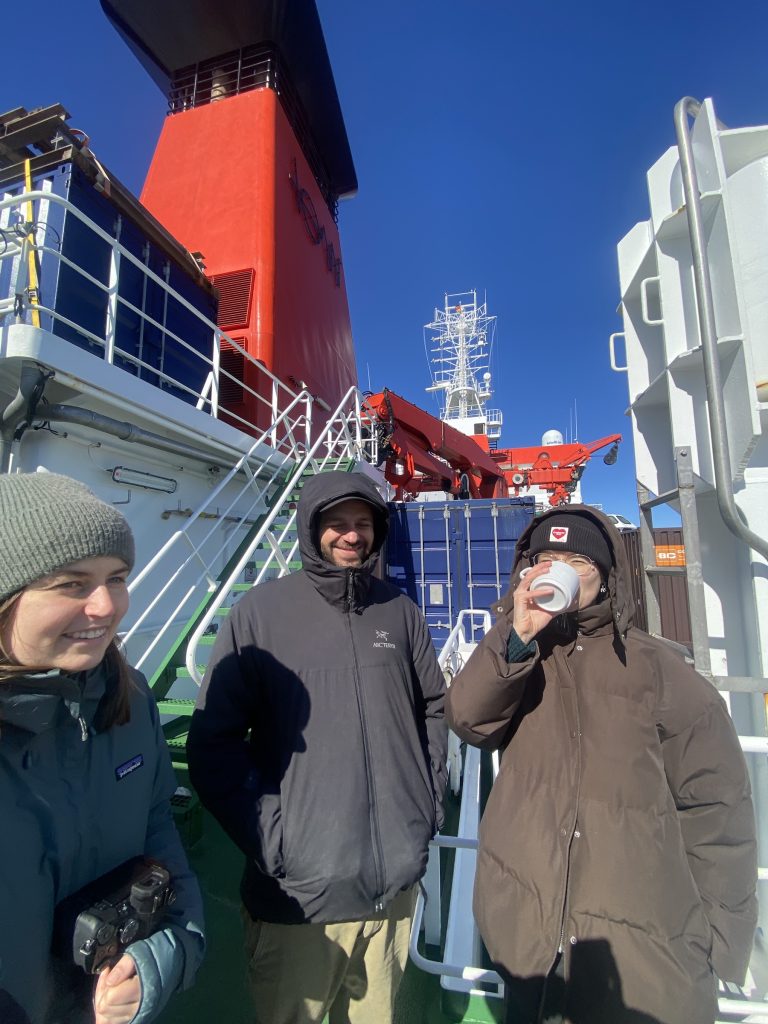
Abends trifft man sich häufig im Hangar oder in der Messe, um gemeinsam den Tag mit einem Feierabendgetränk ausklingen zu lassen. Ein Highlight ist unser „Echtzeit-Werwolf“-Spiel: Vor ein paar Tagen wurden die Rollen verteilt, und seitdem wird jede Nacht jemand „eliminiert“. Tagsüber wird dann gemeinsam diskutiert und abgestimmt. Aktuell schlagen sich die „Schiffbewohner“ ziemlich gut – nach drei Tagen sind bereits drei Werwölfe enttarnt. Wir bleiben gespannt für wen es heute der letzte Sonnenaufgang war.
Sport und Ausgleich:
Wer sich bewegen möchte, kann den kleinen Sportraum Richtung Bug nutzen, ausgestattet mit Gewichten, Fahrrad, Rudergerät und sogar einem Laufband (auch wenn das bei Seegang durchaus Mut erfordert). Alle drei Tage gibt es außerdem ein Zirkeltraining unter Anleitung von Sven, unserem Chief Engineer. Danach lädt die Sauna zur wohlverdienten Entspannung ein.
Arbeiten auf dem Schiff:
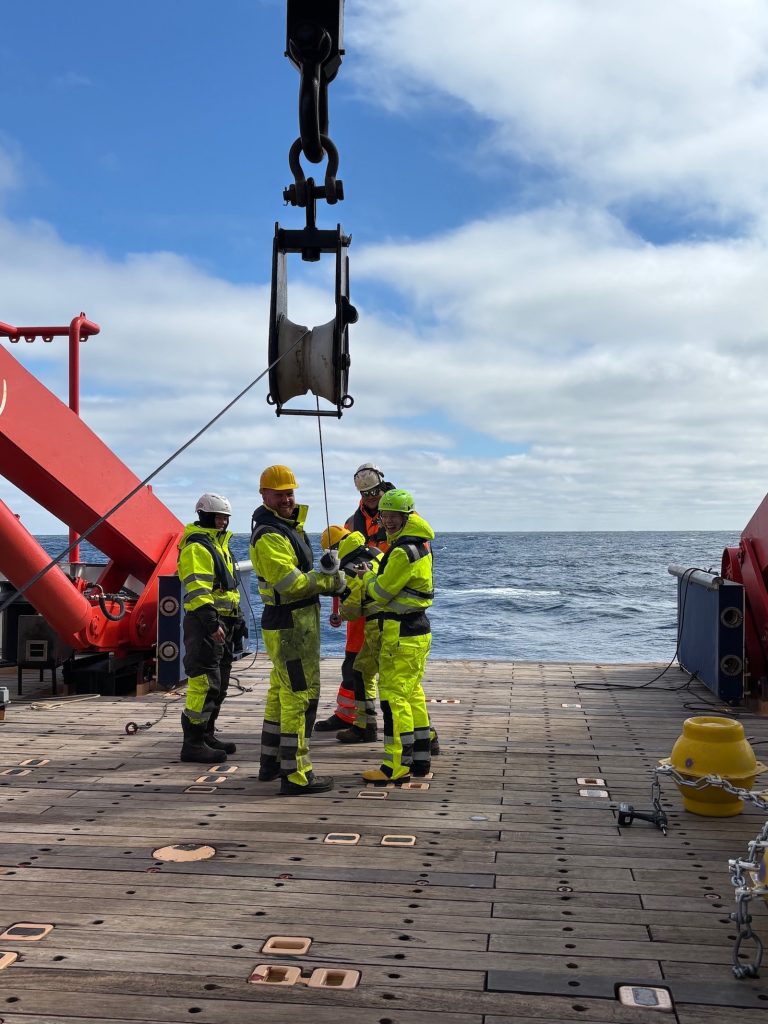
Auch wenn man es sich anders vorstellt: Den Großteil der Zeit verbringt man tatsächlich im Inneren des Schiffs. Das liegt vor allem an den oft rauen Wetterbedingungen. Gearbeitet wird in verschiedenen Laboren oder, wenn möglich, an Deck zum Auswerfen und Einholen der Verankerungen sowie Gliedern.
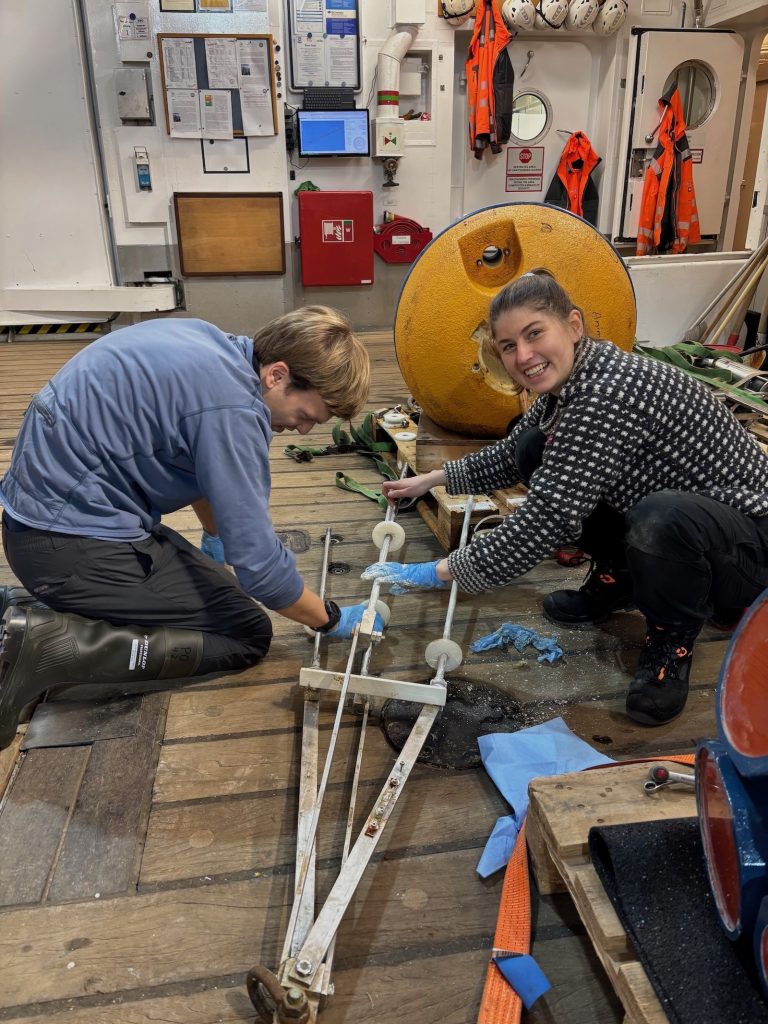
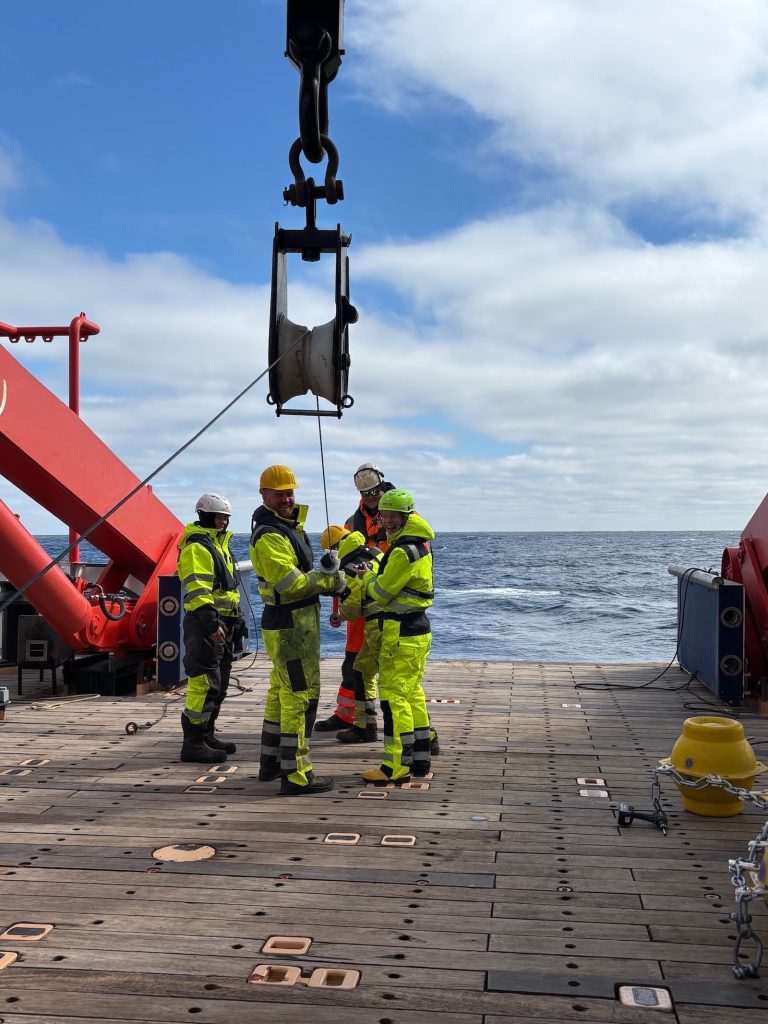
Im Chemielabor werden Proben analysiert, während in anderen Bereichen Geräte vorbereitet, Daten ausgewertet und die nächsten Schritte geplant werden. Ein zentraler Bestandteil ist die Arbeit mit der CTD, also das Messen von Leitfähigkeit, Temperatur und Tiefe im Wasser.
Natürlich läuft nicht immer alles reibungslos. Wenn beim Aussetzen einer Verankerung ein Gerät nicht funktioniert, muss die gesamte Konstruktion wieder eingeholt, repariert und neu ausgebracht werden. In solchen Momenten ist gute Stimmung entscheidend, meine Empfehlung: einfach mal spontan Macarena tanzen. Das kann Wunder bewirken.
Trotz der intensiven Arbeit ist es genau diese Mischung aus Teamarbeit, gemeinsamen Herausforderungen und spontanen Momenten, die das Leben an Bord so besonders macht. Das gemeinsame Rätseln im CTD-Labor und die Planung unter wechselnden Wetterbedingungen, all das schweißt zusammen.
Nach drei Wochen wird das Schiff mehr als nur ein Arbeitsplatz, es wird zu einem kleinen, schwimmenden Zuhause auf Zeit.
Life and Work on Board a Research Vessel
This is my (Julia Pelle) first sea voyage, my first time spending more than just a day out on the ocean. And yes, the Labrador Sea might not be the easiest place to start. Like many others, I got properly seasick on the first night. The movement of the Maria S. Merian in such rough conditions were definitely challenging at first. But after a few exhausting hours, plenty of sleep, and some weather-related work delays, I gradually got used to the constant motion. Just like that, everyday life on board began.
So how do you describe life on a research vessel to someone who has never experienced it?
Let’s start with the basics, the daily routine on board:
Food:
Catering is excellent: breakfast is served at 7:30 a.m., lunch at 11:30 a.m., and dinner as early as 5:30 p.m. In addition, there is a small fridge stocked with snacks available 24/7 so no one goes hungry.
Sleep:
Good sleep is not always guaranteed, but you quickly learn to adapt. Most scientists share double cabins with a shared bathroom. Those on night shifts naturally switch their day and night. A helpful tip from an experienced sailor: place a blanket under one side of your mattress to create a small dip this helps keep you from rolling around. My personal trick is to sleep on my stomach and stabilize myself with elbows and knees. That way, even in strong winds and heavy seas, I can sleep surprisingly well almost “like being held by your mom,” as Sascha would say.
Free time on board:
You are rarely alone here and that’s a good thing. There is almost always something going on in the labs, especially in the CTD lab, which quickly becomes a social hub. Our chief scientist, Fehmi, is aiming to break a new CTD record, which means we spend a lot of time there to the delight of some and the challenge of our chemists.
In the evenings, people often gather in the hangar or the mess room to wind down with a drink after work. One highlight is our “real-time Werewolf” game: roles were assigned a few days ago, and since then, one person is “eliminated” each night. During the day, everyone debates and votes. So far, the “ship community” is doing quite well after three days, three werewolves have already been identified. We’re curious to see for whom today’s sunrise will be the last.
Sports and relaxation:
For those who want to stay active, there is a small gym near the bow, equipped with weights, a bike, a rowing machine, and even a treadmill though using it in rough seas requires a bit of courage. Every three days, there is also a circuit training session led by Sven, our Chief Engineer. Afterwards, the sauna offers a perfect way to relax.
Working on the ship:
Even though you might imagine otherwise, most of the time is actually spent inside the ship, mainly due to the often harsh weather conditions. Work takes place in various laboratories or, when possible, on deck deploying and recovering moorings and equipment.
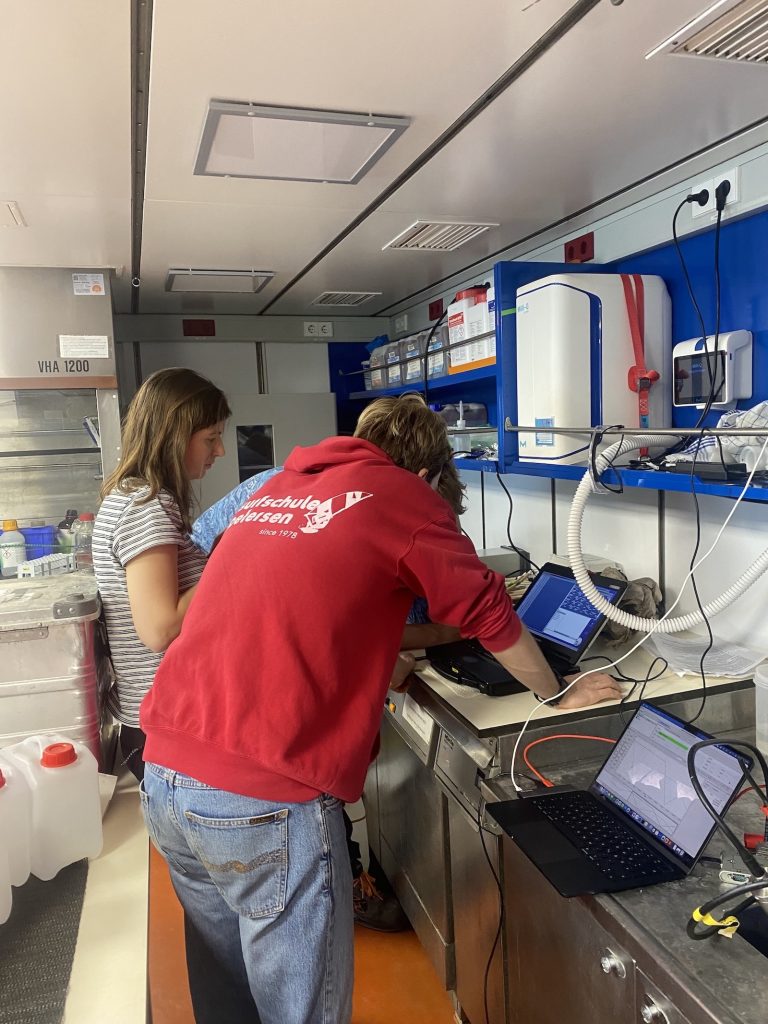
In the chemistry lab, samples are processed, while in other labs instruments are prepared, data is analysed, and plans for the coming days are made. A central part of the work is the CTD, which measures conductivity, temperature, and depth in the water.
Of course, things don’t always go smoothly. If a device fails while deploying a mooring, the entire setup has to be recovered, repaired, and redeployed. In moments like these, keeping a good mood is essential my recommendation: just dance the Macarena. It works surprisingly well.
Despite the demanding workload, it is exactly this mix of teamwork, shared challenges, and spontaneous moments that makes life on board so special. Figuring things out together in the CTD lab and planning around constantly changing weather conditions. All of this brings people closer together.
After three weeks, the ship becomes more than just a workplace it turns into a small, floating home.

When I attended the OBIS Data Mobilization Workshop in the Azores (Thanks to the Air Center) this year, one observation immediately caught my attention: compared with countries such as the United States, Europe still appears surprisingly fragmented and underinvested in biodiversity data mobilization. The issue is not necessarily a lack of biodiversity research. European scientists produce enormous amounts of ecological data. The challenge is that publishing biodiversity observations into global infrastructures such as MBON/GBIF often remains an additional task rather than an integral part of funded research. In the United States, biodiversity data publication is frequently embedded in funding mechanisms and institutional mandates. Data management, curation, and dissemination seem to be recognized research activities. In much of Europe, including Denmark, researchers often mobilize data on top of their existing responsibilities, with limited dedicated funding for long-term stewardship.
I asked myself how is Denmark performing compared with its Nordic and neighboring countries?
Denmark is not lagging behind, but neither is it leading
The numbers reveal a mixed picture.
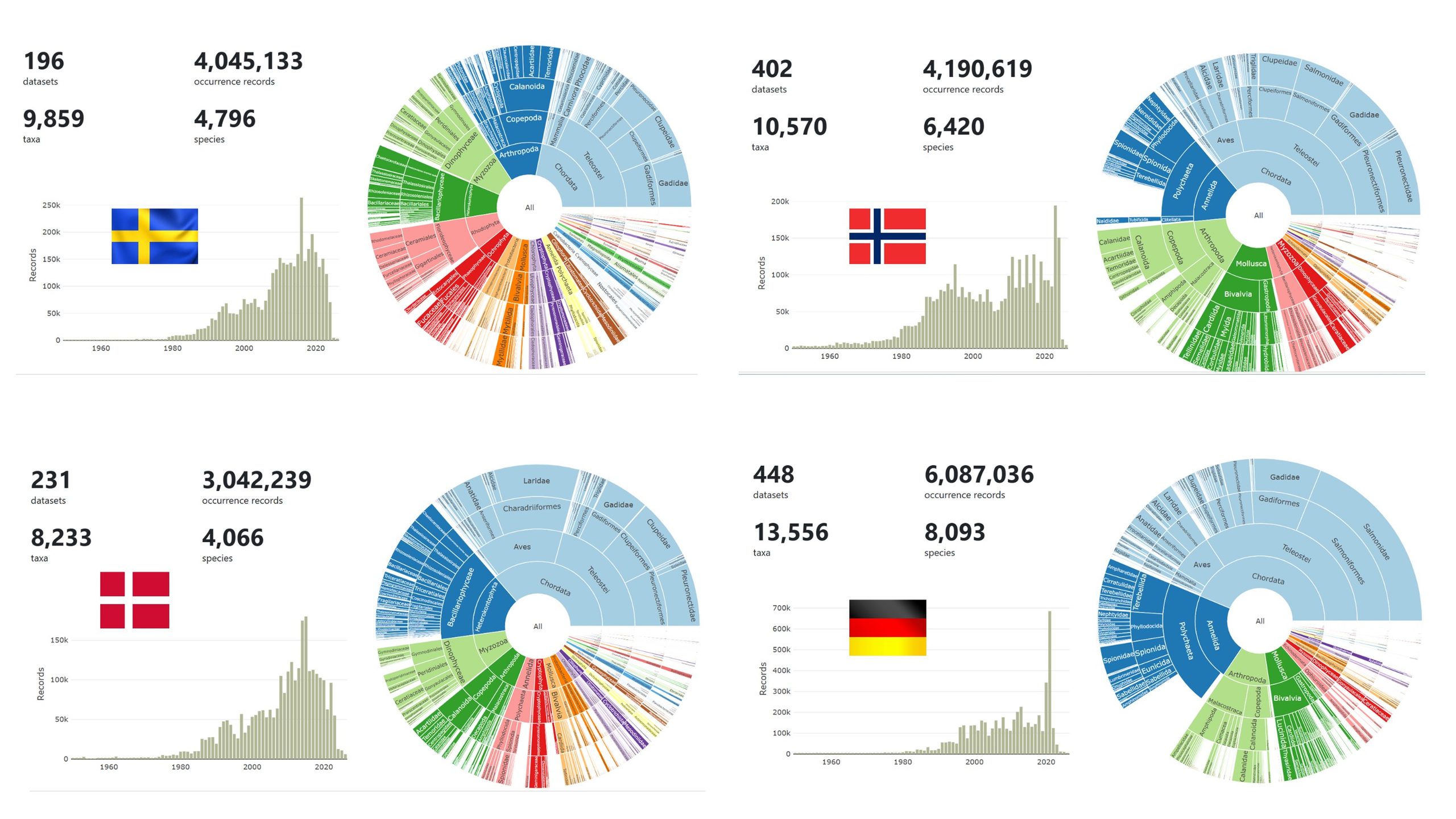
Germany clearly stands out as the regional leader, with both the highest number of datasets and the highest taxonomic coverage. Denmark has the lowest number of occurrence records and species represented among the four countries, despite having a very active biodiversity research community. What is striking is that Denmark does not fall dramatically behind in dataset numbers. Rather, the difference appears in scale and breadth. Danish datasets tend to contain fewer records and cover fewer taxa than those from Germany, Norway, and Sweden.
Different countries tell different biodiversity stories
The taxonomic breakdowns are equally revealing. Denmark should appreciate its fish and birds’ activists. Large portions of the records belong to Gadidae (cod family), Clupeidae (herring family), Laridae (gulls), and other marine vertebrates. This reflects Denmark’s historical strengths in fisheries monitoring, marine ecology, and seabird observations. However, many invertebrate groups, microorganisms, and less visible components of biodiversity remain comparatively underrepresented in global data sets despite active programs like national Program like MONIS.
Norway shows stronger contributions from invertebrate sides such as polychaetes, bivalves, copepods, and marine benthic fauna. The Norwegian data landscape appears heavily influenced by aquaculture sectores, long-term marine monitoring programs and offshore environmental surveys. There is greater representation of marine invertebrates, which are often critical indicators of ecosystem change.
What stood out in Sweden’s data profile is the relatively large contribution from copepods, diatoms, dinoflagellates, and macroalgae. These groups are often overlooked in biodiversity databases because they require specialized expertise and monitoring programs. Sweden’s contribution suggests sustained investment in aquatic ecosystem monitoring beyond commercially important species. Well done Sweden!
Germany’s profile appears the most diverse. While fish and vertebrates remain important, there are strong contributions from polychaete worms, molluscs, arthropods, plankton in general term and benthic organisms. Germany not only contributes more records but also appears to mobilize a wider variety of biodiversity data types. You made me proud Germany 
The real gap may be invisible biodiversity
One lesson from the workshop was that biodiversity databases often reflect what is easiest to observe, identify, and fund. Fish, birds, and mammals are well represented almost everywhere. The groups that drive ecosystem processes, such as jellyfish, zooplankton, benthic invertebrates, phytoplankton, and microbial communities, remain far less visible. This is particularly relevant for marine ecosystems. Some of the most important ecological changes currently occurring in our seas involve gelatinous zooplankton, plankton communities, and benthic assemblages, yet these groups remain underrepresented in many biodiversity repositories. For someone working with jellyfish and marine food webs, this raises an important question:
Are we documenting the biodiversity that is easiest to count, or the biodiversity that is most important for understanding ecosystem change?
This fall, Ocean Conservancy is celebrating its 41st annual International Coastal Cleanup® (ICC), once again bringing together volunteers to protect the beaches and waterways we all love. Ocean Conservancy recently hosted flagship events in Long Beach and Washington, D.C. that celebrated this global movement close to home.
Over the past four decades, nearly 20 million volunteers have rolled up their sleeves to remove more than 405 million pounds of trash from beaches and waterways around the world. And their impact extends far beyond what they collect. ICC volunteers have documented nearly 440 million individual items, creating the world’s largest marine debris database and providing invaluable information that helps Ocean Conservancy and others better understand—and tackle—ocean plastic pollution.
This year’s celebration continued that incredible legacy. At Alamitos Beach in Southern California, more than 150 volunteers gathered on September 19 and removed 1,109 pounds of trash, alongside members of Team USA Artistic Swimming and Olympic and Paralympic athletes. In Washington, D.C., 439 volunteers gathered on September 26 to remove 2,182 pounds of trash from Anacostia Park along the Anacostia River.


“I am so grateful to all of the volunteers who came out today for our ocean—and every volunteer who has made the last 41 years of impact possible,” said Ocean Conservancy’s Senior Director of Conservation Cleanups, Allison Schutes. “Every piece of plastic collected helps protect marine animals and habitats and contributes to research and advocacy.”
And the impact doesn’t stop when the cleanup ends. During International Coastal Cleanup events, volunteers do more than remove trash: They document what they find, helping build a clearer picture of the plastic pollution threatening our waterways and wildlife. Through the Clean Swell® app or paper data sheets, ICC volunteers contribute to Ocean Conservancy’s online, open-access database, the world’s largest repository of marine debris data. These records help scientists, conservation groups and governments understand pollution trends and identify solutions.
That data can also drive meaningful policy change. ICC data were recently used in a peer-reviewed study showing that plastic bag bans lead to reduced plastic bag pollution. The data have also helped advance policies ranging from California’s SB 54 to Florida’s balloon release ban and the federal Farewell to Foam Act. From a neighborhood cleanup to statewide action, every piece of documented trash helps build the evidence needed to tackle plastic pollution at its source.
Get Ocean Updates in Your Inbox
Sign up with your email and never miss an update.