

Claver Gatete is Executive Secretary of the UN Economic Commission for Africa. Jason Veysey is Energy Modeling Program Director and Senior Scientist at the Stockholm Environment Institute. Lisa Sachs is Director of the Columbia Center on Sustainable Investment at Columbia University.
The case for global energy transition has rarely been clearer. The closure of the Strait of Hormuz earlier this year exposed the cost of unplanned, fossil-dependent systems, while the falling cost of renewables, the rising penetration of electric vehicles, and the growing value of demand flexibility have made the direction of travel obvious. The benefits of a clean, secure, integrated system are no longer in dispute. What remains unclear is how to build it.
Countries around the world have called for faster renewable energy deployment and alternative energy arrangements. A secure, affordable, resilient, decarbonised system requires specific investments in specific places in a specific sequence, optimised across sectors and borders. But very few governments have the analytical foundation to translate those imperatives into investment.
The two instruments that are supposed to determine investment priorities for decarbonisation – Nationally Determined Contributions (NDCs) and country platforms – cannot answer the most basic question facing any country undertaking an energy transition: what should the energy system look like?
-
New coal mine openings slow as East Asian demand plateaus
China and Australia drove global decline in new capacity additions in 2025, but planned production kept growing

To close this gap, every country needs a bankable, economy-wide optimisation model for its energy system. A model is not a plan, but it can help answer the critical question of what the future energy system should look like. It shows how optimal scenarios vary as assumptions and policies are adjusted, calculates investment requirements and sequencing, and quantifies how system costs are affected by assumptions, policies, and exogenous variables like trade policy and financing terms.
Tool for efficient investment
Optimisation is a simplified way of simulating an energy system, but it can be an extremely powerful tool for moving energy planning from reactive (how do we manage the disparate actions in the energy system?) to intentional (what energy system underpins our national objectives?). A model can show how optimal scenarios vary as assumptions and policies are adjusted, and how investment requirements are quantified and sequenced.
Optimisation models can treat the energy system and the sectors it serves as an integrated whole, optimising across sectors and projects in ways that can be mutually reinforcing. If considered independently, growth in industrial demand, transport electrification, and digital infrastructure can add stress to the energy system. But an optimised plan can arrange these and other changes in an efficient, synergistic way.
Two to tango: How governments can unlock private investment for national climate goals
New load can be added where low-cost power is available; industrial customers can ensure the viability of investments in energy supply; electric vehicle charging policy can smooth load curves and reduce costs for all consumers.
Additionally, optimisation modeling can also change the financeability of investments. Taken alone, each project faces uncertainty about the rest of the system, which raises the cost of capital and causes projects to stall or unwind after contracts are signed. A coherent, optimised plan makes visible the coordination that private capital would otherwise have to bet on: identified offtake, sequenced and committed transmission, contracted power supply, and so on.
What COP31 and COP32 should do
The upcoming COPs in Turkey and Ethiopia can shift the center of gravity of international climate cooperation from fragmented commitments to planning. Three moves are urgently needed.
First, optimised, economy-wide, long-term energy system planning must be the foundation on which any meaningful NDC, country platform, or finance commitment rests. NDCs are typically drafted by environment or single-line ministries, with limited cross-sectoral input from ministries of energy, finance, and planning. They contain targets, derived from sectoral strategies or national commitments, not from an analytically grounded picture of what the energy system should look like and what investments would make it work. Country platforms are generally a portfolio of investments assembled from existing project pipelines, rather than derived from a system-level analysis of what an optimised, decarbonised energy system would require.
Second, recognise regions as a key planning unit. Modern integrated energy systems are inherently regional. Renewable endowments are unevenly distributed; balancing variable supply across borders lowers aggregate cost, reduces redundant backup capacity, and unlocks economies of scale no individual nation can achieve. Many energy investments in Southeast Asia, East Africa, Southern Africa and Central Asia may only be financeable in a regional context. Assessing domestic infrastructure without regional optimisation perpetuates the perception that decarbonisation is more expensive than it is.
COP31 leaders unveil global targets, with spotlight on electrification
Third, finance the planning capacity. A coordinated commitment by multilateral development banks, bilateral donors, and philanthropic partners to help every region and its constituent countries develop and maintain their own modelling capability, with open-source tools and regional analytical hubs, would close the most consequential gap in the current architecture. The cost is small relative to current spending on country platforms, failed project preparation, and misallocated infrastructure investment.
This includes supporting regional institutions such as the ASEAN Centre for Energy, the African Energy Commission, regional power pools, and the Latin American and Caribbean Energy Organization to determine what optimised regional systems require. Country-by-country pledging, repeated at every COP, will not deliver what meaningfully integrated systems can.
The 2026 energy crisis made the cost of unplanned, fossil-dependent systems newly visible. That window of clarity will close. The international community should seize the moment to build the planning foundation that has been missing for thirty years, rather than commissioning another round of NDCs or pledges, striving for outcomes neither was designed to deliver.
The post Every country needs a model to help optimise its energy transition appeared first on Climate Home News.
Every country needs a model to help optimise its energy transition

For the first time, new-energy vehicles (NEVs) made up 67% of new car sales in China in September, according to the latest data from the China Passenger Car Association (CPCA).
The figures show that NEVs, which include battery electric cars and plug-in hybrids, captured a record share of sales, even though fewer were sold than last year.
This is because sales of combustion-engine cars are falling steeply, a trend that the CPCA has attributed to rising petrol prices following the start of the Hormuz crisis.
Indeed, sales of fuel-only cars were down 31% year-on-year in the first nine months of 2026, with plug-in hybrid sales down 26% – whereas battery EV sales were only down 4%.
One analyst tells Carbon Brief that China’s rapidly growing EV fleet has offset demand for 143m barrels of oil since the start of the Hormuz crisis.
Another says that the crisis is “reinforcing China’s electrification of road transport”.
Meanwhile, amid slowing domestic sales, Chinese carmakers’ exports of NEVs more than doubled [in 2026 to date / in September] from a year earlier.
NEV record
A record two out of every three cars sold in September in China were NEVs, according to CPCA data, as shown in the figure below.
(NEVs predominantly include battery electric vehicles – BEVs – and plug-in hybrids – PHEVs. BEVs only run on electricity, whereas PHEVs also have a combustion engine.)
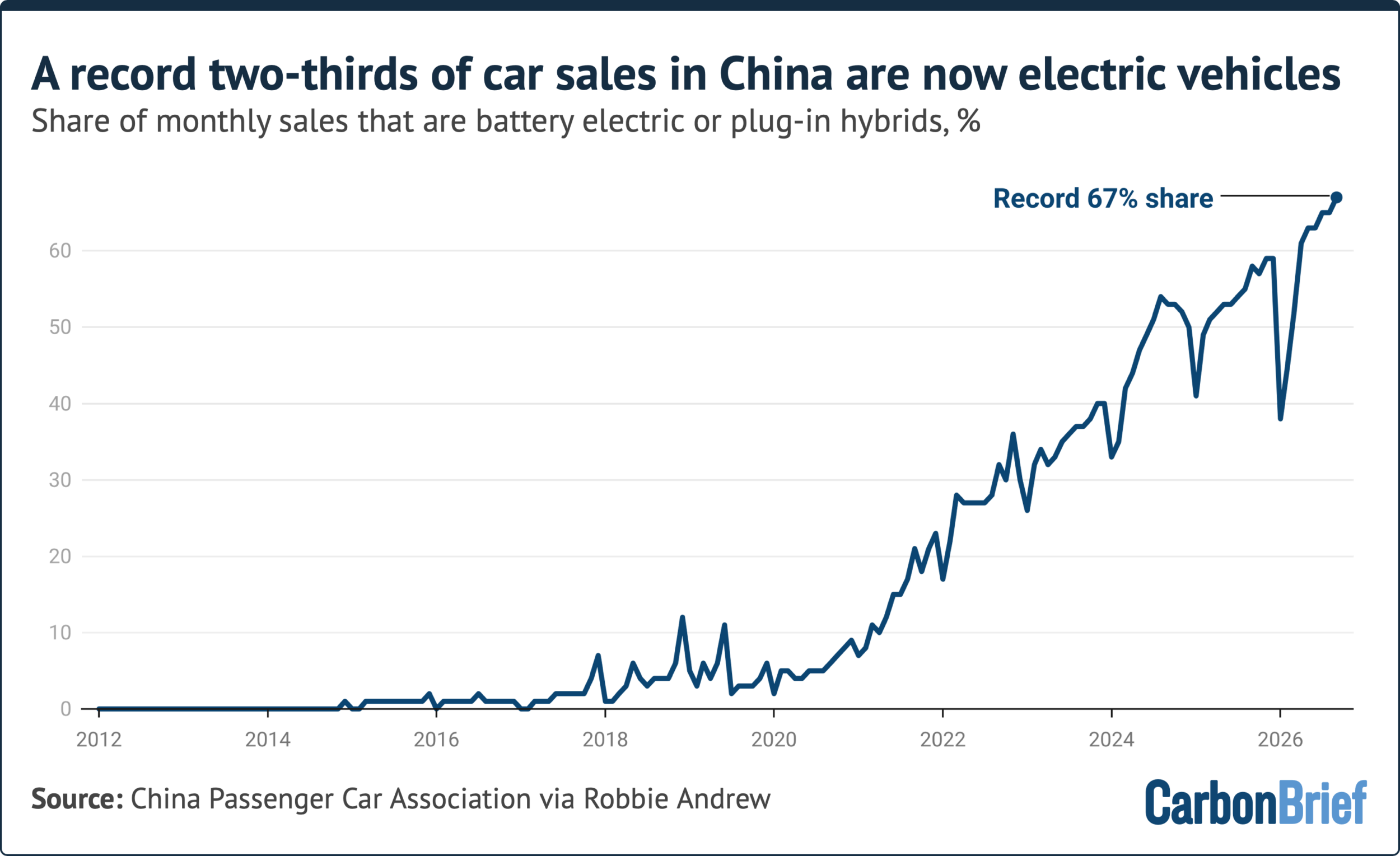
This marks a rapid rise for NEVs from just 6% of new car sales in 2020 up to 58% in 2026 to date – and a record 67% in the month of September.
This year, NEVs’ share of sales has also bounced back from a low of 39% in January, after the full purchase tax exemption that had been in place for more than a decade came to an end in December 2025.
The gain in NEV share in 2026 has come amid a slowdown across the wider domestic passenger-car market, which has hit sales of combustion-engine vehicles particularly hard.
This September, passenger-car retail sales across all categories declined, with overall sales volumes falling 28% year-on-year.
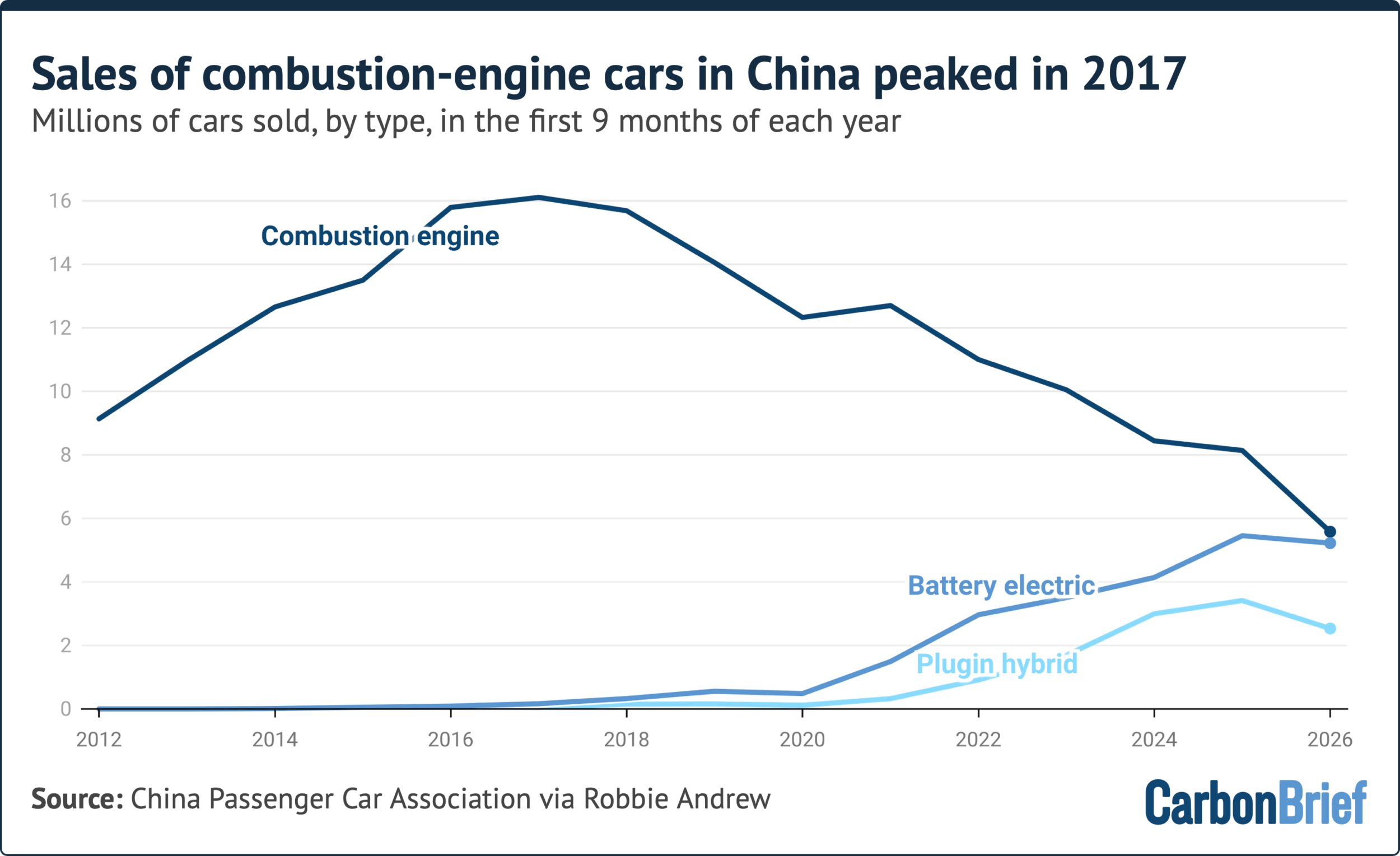
The contraction was led by combustion-engine vehicles, which saw sales fall 43% year-on-year in September and 31% in 2026 to date.
However, sales of PHEVs also fell by 36% year-on-year in September and by 26% in 2026 to date. By comparison, BEVs performed better, although sales still declined 8.5% from a year earlier in September and 4% in 2026 to date.
As a result, NEV sales overall fell by 17% in September and 13% in 2026 to date.
While the market changes in 2026 to date were particularly dramatic, they reflect a broad continuation of trends seen over the past decade.
Indeed, sales of combustion-engine cars in China peaked in 2017 and they have been declining ever since, shown in the figure below.
Impact of Hormuz
Part of the reason for the advance of NEVs in 2026, said Chinese technology news outlet OFweek, was petrol cars “giving up market share” as they were outperformed by electric alternatives.
Cui Dongshu, secretary-general of the CPCA, cited higher petrol prices as an explanation for September’s weak combustion-car sales, in comments to financial news outlet National Business Daily.
Imports of oil into China in January-September have fallen 15% compared to 2025, equivalent to 470m barrels, as ongoing conflict tightened supply and drove up prices.
China’s passenger-car NEV fleet has displaced 143m barrels of oil so far during the strait of Hormuz crisis, Euan Graham, senior energy analyst at thinktank Ember, tells Carbon Brief.
EVs “accounted for 12% of the decrease in China’s oil use post-Hormuz”, according to an estimate provided to thinktank the Brookings Institute by an unnamed analyst.
Erica Downs, a senior research scholar at Columbia University’s Center on Global Energy Policy, tells Carbon Brief that the strait of Hormuz crisis and higher oil prices are “reinforcing China’s electrification of road transport”.
She says the “world’s largest oil supply disruption” vindicates China’s early bet on EVs, which was partly driven by concerns about oil-supply security.
NEV demand down
Nevertheless, NEV sales have fallen year-on-year, albeit at a slower rate than overall car sales. The growth in NEV market share has also been decelerating.
Zhang Yichao, a partner at consulting firm AlixPartners, tells Carbon Brief that NEVs benefit from government trade-in policies and a “strong pipeline” of new models, particularly those involving innovation.
He says these factors help explain why NEVs sales have fallen at a slower rate to their combustion-car counterparts.
Cui told the state-run China National Radio that the fall for NEVs and for cars overall in September 2026, is also due to a high baseline of sales from the same month in 2025, as well as changes to trade-in policies and disruptions from the holiday period.
Other factors, says consulting firm Wood Mackenzie, are the weakened demand due to “demand pull-forward” in 2025 caused by the end of subsidies, as well as “tighter financing conditions”.
Zhang tells Carbon Brief he does not “see much more room ahead” for further growth in NEVs’ market share.
He adds that, in his view, their share in China is unlikely to exceed 80%, as some premium-market segments and specific use cases will continue to require combustion-engine vehicles.
Exports surge
Meanwhile, while domestic NEV retail sales fell 17% in September 2026, exports more than doubled, increasing 164% year-on-year, according to the CPCA.
This extends the decline in domestic sales and very strong growth in exports seen across 2026 to date, as shown in the figure below.
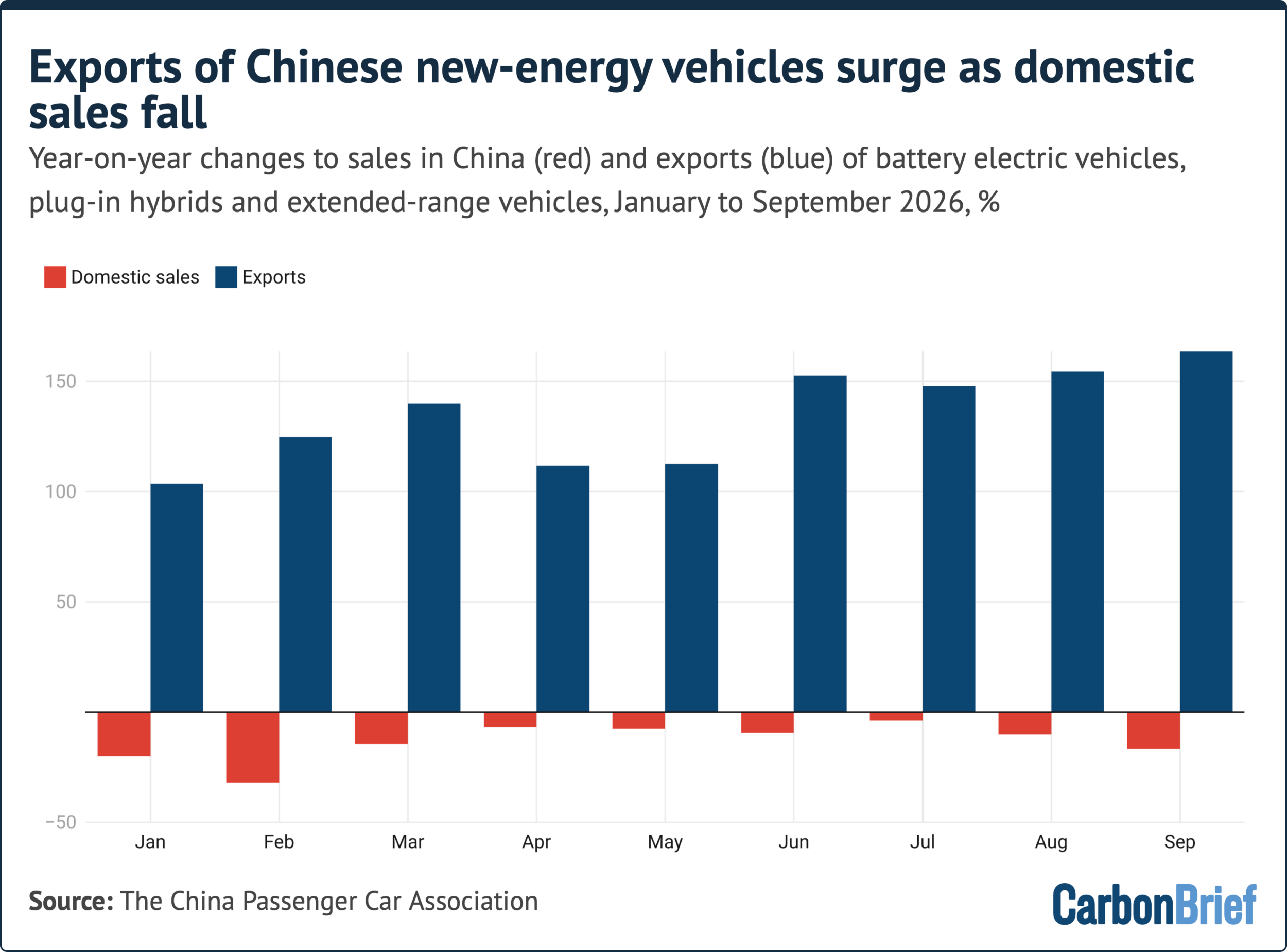
In September, 1,084,000 NEVs were sold domestically in China, while 558,000 NEVs were exported.
Exports are becoming increasingly important to Chinese carmakers, in the face of weaker domestic demand and cut-throat industrial competition.
The CPCA says exports have become “a core priority” for some carmakers.
However, the s