Connect with us

Published

on

Editor’s Note: This is a sponsored posting.

Curbside food scrap collection has spread fast. BioCycle’s nationwide survey counted 14.9 million U.S. households with access to food waste collection in 2023, up 49 percent from 10 million two years earlier.

Getting those bins used is the harder part. Reported participation runs from near-universal in a handful of cities to under 30 percent in others. That gap matters. Food waste is about 24 percent of what U.S. municipal landfills take in, and the EPA estimates it accounts for 58 percent of the fugitive methane those landfills release. An unused green bin isn’t a neutral outcome.

Quick definition first, since the name varies. The green bin is the curbside cart for household organics: food scraps, plus yard trimmings and food-soiled paper depending on your program. It’s collected separately from trash and recycling and sent to a composting or anaerobic digestion facility instead of a landfill. It isn’t green everywhere. Toronto runs a Green Bin program, New York City uses brown ones, and elsewhere it’s the organics cart, the compost cart, or the food scraps cart. What matters is where the material ends up, not the color.

Why People Quit the Green Bin

Households opt out for a long list of reasons: confusion about what’s accepted, forgetting collection day, plain inconvenience. I’d add one that gets less attention because it’s unglamorous. The bin gets disgusting, cleaning it turns into a recurring chore, and eventually the chore wins.

I’ll be straight that this is a hypothesis, not a documented finding. I haven’t found a study that isolates bin cleaning as a reason people quit. What I’ve got is the pattern I hear from customers constantly. But there’s evidence that making the job less unpleasant moves the numbers.

In 2023–24, Essex County Council in the UK ran a year-long Food Recycling Project. It delivered a package to more than 375,000 households: a sticker for the general waste bin, an information leaflet, and a free roll of compostable liners. Food recycling tonnage rose an average of 21 percent against a control group in the first three months after delivery, more than double the council’s 10 percent target.

The liners were one piece of that package, running alongside a media campaign, so the case study can’t tell us how much of the gain they drove on their own. What it does show is that handing people a tool to keep the mess contained belongs in the mix alongside better signage. It also shows the limit. Free liner giveaways are a subsidy most households will never get.

So the question isn’t whether a cleaner, contained bin helps people stick with the program. Plainly it does. The question is how you get there when nobody’s handing out free bags. That’s the gap BagEZ fills.

Set up in under a minute: pull the bag through, over the frame, clip it on, hang it in the bin. Photo: BagEZ

Doing More With Less

BagEZ holds a standard bag open inside the green bin, 13 gallons (49 liters) and up. Food scraps go into the bag, not against the cart. Everything stays contained, and the bin stays clean and dry. That’s aimed straight at the reason people give up: the cleaning.

It’s a folding steel rack with clips that lock the bag to the frame. The handles grip the bin’s rim and hold the bag open and suspended. On collection day you pull off the clips, seal the bag, and lift out the frame before setting the bin at the curb.

The size is up to you, and the data says most kitchens don’t need much. The MITRE-Gallup survey, the largest U.S. household food-waste study to date, surveyed nearly 10,000 households and put the average household’s food waste at 6.2 cups a week, or about 8.8 cups once you count peels, cores, and bones. That’s a bit over half a gallon. Even a household running well above average isn’t close to filling a big curbside cart with food scraps. So size the bag to your kitchen, not your bin. A 13-gallon bag is plenty for most households, it costs less than lining a full cart, and a right-sized bag is also what makes the odor tricks below work. Size up if your program takes yard trimmings too, or if collection runs every other week.

One caveat before you change anything: check what your program accepts. Liner rules vary a lot across North America. Some programs take certified compostable bags only, some want paper or newspaper, some want food scraps loose in the cart. A bag your hauler doesn’t accept can get your cart skipped and the whole load flagged for contamination. Earth911’s recycling search is a good place to start: earth911.com/recycling-search
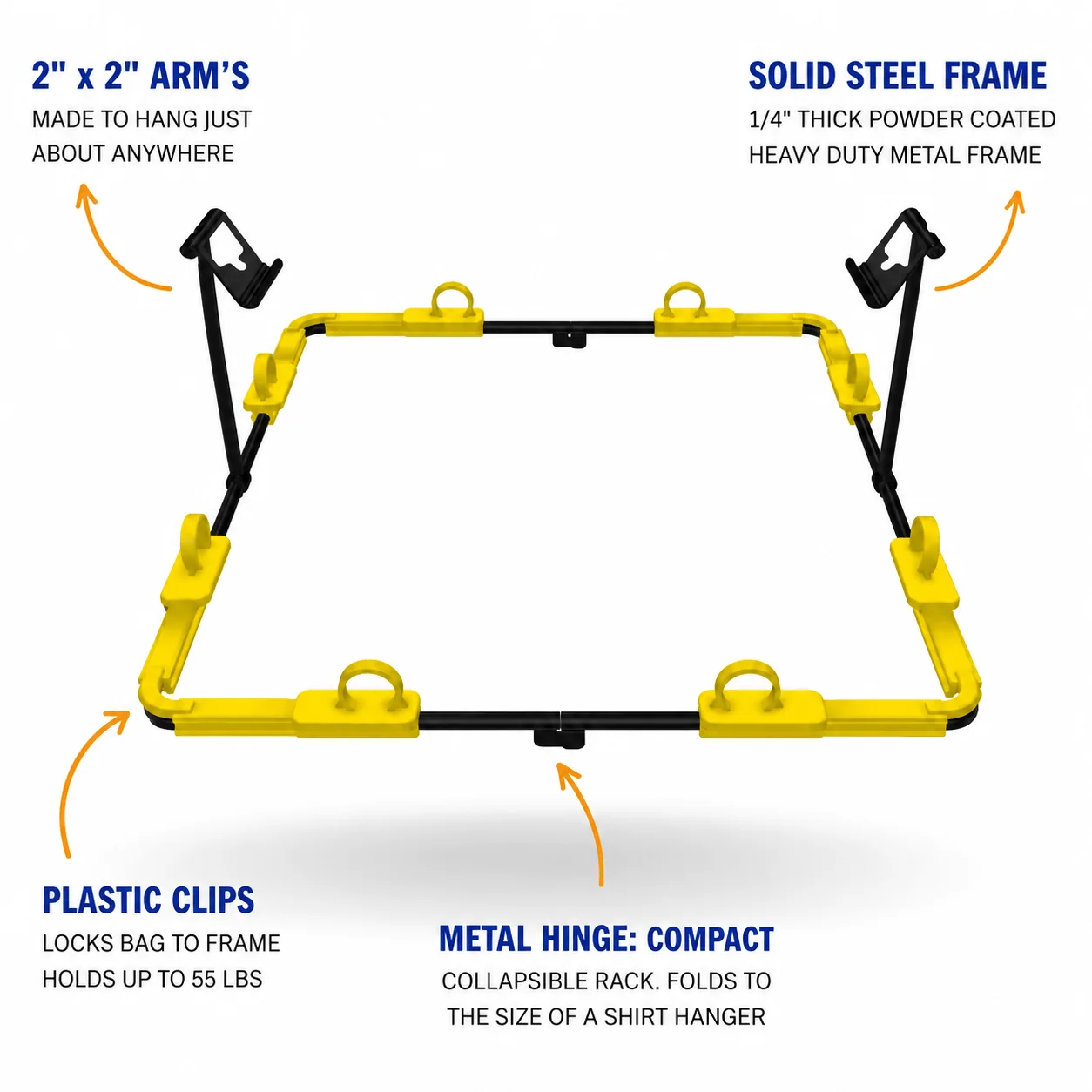
The frame folds flat, and the clips lock any accepted bag to it. Photo: BagEZ

After collection, a wipe with vinegar and water handles anything that’s built up. On a bin that’s stayed dry, that’s a seasonal job, not a weekly one, and you never have to drag out the hose.

The Green Bin Yuck Factor

Ever notice the puddle in the bottom of your countertop organics caddy after you pull the bag? That’s mostly moisture coming out of the food itself. Produce is largely water, and as it breaks down that water gets released.

The same thing happens in the curbside bin, at a bigger scale. Bags of scraps keep releasing moisture as they sit, and when a bag rests against the bottom and sides of the bin, that liquid builds up into the sticky residue that smells and makes the bin dirty.

BagEZ works differently because the bag never touches the bin. The frame holds it up and lets air move all the way around: underneath, the sides, everywhere. Condensation on the outside of the bag has nowhere to pool. It evaporates instead of collecting at the bottom, and the walls stay dry.

A right-sized bag makes the odor tricks work better, too. A sprinkle of baking soda in the small contained space around the bag does more than the same sprinkle spread thin across a big empty floor. Less smell, fewer flies. Fewer flies, no maggots.

Some people use food-grade diatomaceous earth against fly larvae. DE works by drying insects out, and it stops working the moment it gets wet, so a dry bin is a precondition for it doing anything at all. Same story as the baking soda: it only earns its keep in a dry, contained gap.

Two more that help, cheap. A few sheets of newspaper under the bag catch drips if a bag ever fails. And a cloth sachet of peppermint and cloves tied to the outside of the bin throws off raccoons and rodents, which hunt almost entirely by smell. A bin that doesn’t smell like food stops being worth their trouble.
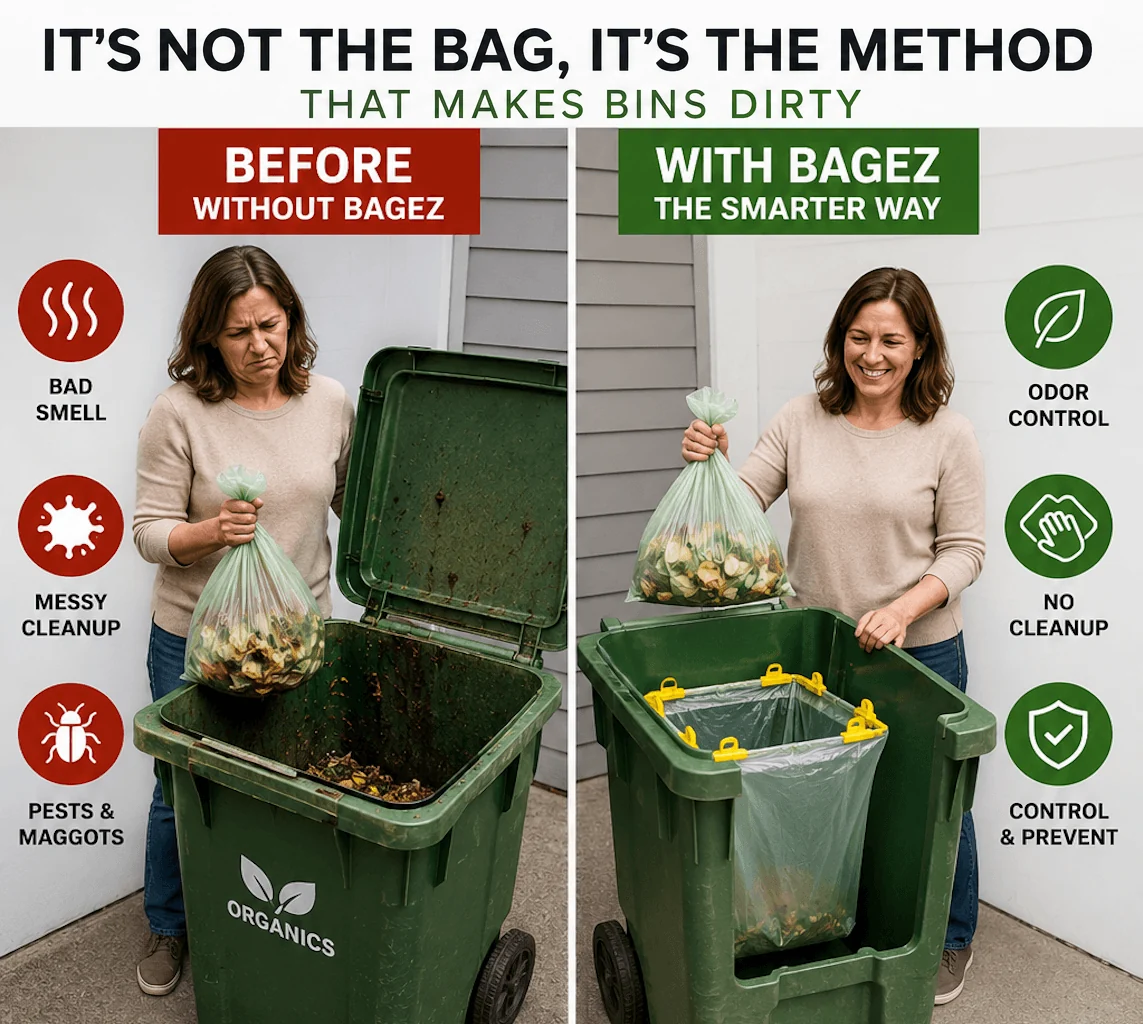
Without BagEZ: odor, cleanup, pests. With BagEZ: contained waste, a dry bin, fewer visitors. Photo: BagEZ

Why It Works

The infrastructure is already there. The bins are at the curb, the trucks run, and the environmental case, going by the numbers up top, isn’t in question. What’s been missing is a cheap, fast way to keep the bin clean enough that people don’t quietly give up on it.

A reusable steel frame that holds a bag open sounds too simple to matter. That’s sort of the point. The bin stays clean, the habit stays easy, and food scraps end up where they’re meant to.

Set it next to the alternatives and the difference is in how each one works. Bin cleaning services deal with the problem after it happens, on a schedule, for a recurring fee. Full-size liners cost money every week and are sized to the bin, not to what you actually throw out. A frame is a one-time buy that works with the bag size your household already uses.
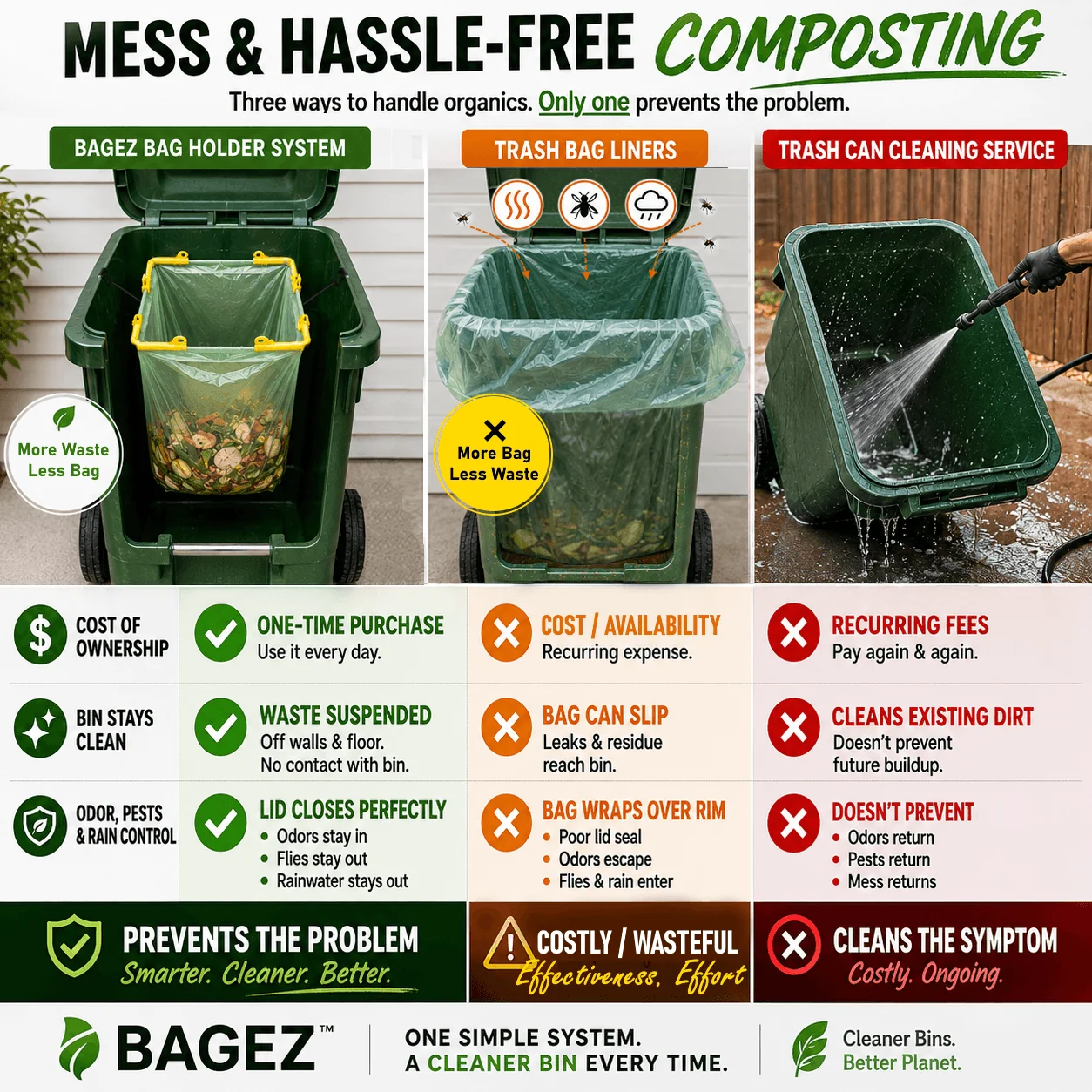
Three ways to handle organics, compared. Source: BagEZ.

A green bin program only works if people keep using it, and people keep using what doesn’t gross them out. That’s the hinge the whole thing turns on. Take away the wet mess on the walls and most of the reasons to quit go with it: nothing pooling at the bottom, nothing to hose out, no smell pulling animals across the yard. The bin stays clean on its own, week after week, with a bag you were going to buy anyway.

Size it to your kitchen instead of your bin, clip it to the frame, and the green bin stops being the chore you avoid. Find it at bagez.com.

About the Author

This sponsored article was written by Sean Rana, the founder of BagEZ, a Canadian company behind the steel hanging bag frame that keeps garbage and green bins clean without special liners or ongoing costs, and works for waste and storage on the go.

The post Guest Idea: Green Bins Are Spreading Faster Than the Habit of Using Them appeared first on Earth911.

https://earth911.com/how-to-recycle/guest-idea-green-bins-are-spreading-faster-than-the-habit-of-using-them/

Continue Reading

Green Living

Sustainability In Your Ear: David Fenton on How to Win the Climate Debate

Published

on

Yale researchers estimate that roughly 80 million Americans are alarmed about climate change. About 40 million of them say they want to be politically active on the issue. But only about 3 million actually are. When that 37 million-American group is asked why they aren’t active, researchers most often hear that nobody has asked them. That’s the focus of this week’s conversation on Sustainability In Your Ear. Only 12% of Americans say they ever see anything about climate change on social media, and two-thirds say they rarely or never hear about it from friends or in the media. At the same time, the fossil fuel industry treats persuasion as core business. David Fenton calls the situation unilateral disarmament at a moment when an information war is needed. The crowning result of climate action to date is the Inflation Reduction Act that passed by one vote and was repealed by one vote. A bill you win by a single vote, he says, is a bill you never really won David founded Fenton Communications in 1982, the first public relations firm in America built solely for progressive causes. His campaigns helped free Nelson Mandela and end apartheid, helped ban fracking in New York, where Yoko Ono’s “Imagine There’s No Fracking” billboard went up along Governor Andrew Cuomo’s commute, and helped launch fossil fuel divestment with the heirs to the Standard Oil fortune as the messengers. His book, The Activist’s Media Handbook: Lessons from Fifty Years as a Progressive Agitator, includes a foreword by cognitive linguist George Lakoff, who we discuss at length in this thought-provoking interview.

David Fenton, founder of Fenton Communications and host of The Fenton Forecast, is our guest on Sustainability In Your Ear.

He places the blame on climate advocacy spending and, more importantly, the words used to frame the issue. The climate NGO and philanthropic world spends billions a year on policy, law, and science, and spends on communication mainly to raise money from people already on its lists. David traces that to what Lakoff calls the Enlightenment fallacy, the belief that a strong idea reproduces itself because it is correct, and to its corollary, that selling ideas is dirty work beneath serious people. The second is vocabulary. “Net Zero means almost nothing to most people. “Carbon” sounds like an abstraction. And “justice,” in cognitive research, evokes images of the police and courts, not of fairness and a shared mission. We need to pivot to simpler language, like “pollution,” when describing the source of global warming. Pollution is a word nobody defends, and a blanket of pollution trapping heat that would otherwise escape into space is a picture people can easily grasp and act on.

Asked how to solve climate change, the most common answer Americans give is “reduce, reuse, and recycle.” Earth911 has spent three decades on that vocabulary, and it holds up on its own terms as a materials strategy. Increased curbside recycling participation rates don’t necessarily lead to decarbonizing the grid or the truck fleets. David Fenton’s prescription for listeners is blunter than any campaign plan: talk about it, post about it, and press the funders you know to spend generating public demand for change rather than direct mail fundraising. Learn more about David’s work at davidfentonactivist.com, and find his podcast at fentonforecast.com.

Interview Transcript

Mitch Ratcliffe  0:09
Hello. Good morning. Good afternoon. Or good evening, wherever you are on this beautiful planet of ours. Welcome to Sustainability In Your Ear. This is the podcast conversation about accelerating the transition to a sustainable, carbon-neutral society, and I’m your host, Mitch Ratcliffe. Thank you for joining the conversation today. Let’s talk about how to win the fight for planet and people. We already know what to do about climate change. The clean energy solutions exist. They’re the cheapest form of power on Earth, and the warning signs, from fires and floods to the rising costs of food and insurers walking away from whole regions, are impossible to miss. And yet, after decades of effort, only about a quarter of Americans are deeply engaged with the urgency of climate action, and just half are even concerned. So here’s the puzzle that my guest today, David Fenton, has wrestled for more than 50 years. If the danger is this clear and the answers are this good, why has the movement failed to bring the public along?

Part of the answer is that we’re making the case in openly hostile territory. Federal climate policy has been rolled back. The fossil fuel industry has spent decades manufacturing doubt about global warming, and its allies are ready to blame wind and solar within hours of any grid emergency, whether or not the facts support it. The social platforms where most people get their news quietly bury anything labeled climate, showing it only to the people who already agree. And if you’re a climate-concerned person, the audiences that you most need to reach will never see those messages. As David puts it, we’re in a propaganda war with the fossil fuel industry, and we’re not even on the battlefield.

David Fenton has spent his life trying to change that. He started as a teenage high school dropout, shooting photographs of the anti-war movement and the Black Panthers for the underground press in the 1960s. He co-produced the No Nukes concert at Madison Square Garden, and in 1982 he founded Fenton Communications, the first public relations firm in America built solely for progressive causes.

Over four decades, his work has helped free Nelson Mandela and end apartheid, helped ban fracking in New York, and helped launch the fossil fuel divestment movement in partnership with the Rockefellers. In fact, the heirs to the Standard Oil fortune as the messengers for the movement. And now he’s distilled it all into a book called The Activist’s Media Handbook: Lessons from Fifty Years as a Progressive Agitator. And that includes a foreword by cognitive linguist George Lakoff. We’re going to explore how to speak to people’s hearts before their heads, and why “make polluters pay” travels farther than “net zero by 2050,” as well as how to fight disinformation when a lie outruns the truth, and how to win over conservatives without bending the facts. So, what does a lifetime of victories and hard-won failures teach us about protecting the planet and democracy itself in this pivotal moment? Let’s find out after this brief commercial break.

David Fenton, welcome to Sustainability In Your Ear. How are you doing today?

David Fenton  3:15
I’m feeling sustained. Thank you. How are you? Sustained.

Mitch Ratcliffe  3:17
Good. I’m doing well. It’s a beautiful day here in southern Oregon, and I know in Berkeley it’s probably a nice morning as well.

David Fenton  3:25
It’s a little foggy, and that’s good. We are avoiding the heat waves of the rest of the country.

Mitch Ratcliffe  3:30
Twain’s observation about San Francisco is always kind of a satisfying one when you get there, but you hear about it and you think, “Gosh, it must be cold.”

David Fenton  3:38
Yeah, well, colder is a little better right now, given what’s going on in our overheated world.

Mitch Ratcliffe  3:44
Absolutely. Hey, look, you’ve spent 50 years working on trying to change the world, to put it mildly. And in the book, you turn the lens on the movement itself, calling the climate crisis the biggest communication failure in the history of progressive advocacy. Why does so much of the fault lie on our side of the conversation?

David Fenton  4:04
Well, it’s not only on our side, but everybody talks correctly about the fault of the corporate polluting interests that have confused everybody and spread all this propaganda and intentional lying, the biggest criminals of all time, in my opinion, at least measured by impact, but our movement bears some responsibility also. You know, I mean, just look at the data. You know, only 12% of Americans say they ever see anything at all about climate change on social media, their main source of news increasingly. Only, let’s say, two thirds, according to the Yale research, say they rarely or never see or hear anything about climate change from their friends or in the media.

You know, the environmental groups do a lot of great things: policy, law, science. But they don’t communicate. They don’t spend money on communicating, by and large, even though they’re very wealthy. They have huge budgets. They don’t value that, you know. As we all know, they only go out to communicate with their members to raise money, not to educate or get people involved in action. When people say that they rarely or never see or hear anything about this, that’s a failure.

And at the same time, the fossil fuel industry is very focused on propaganda and communication. They’re building up all these online influencers. They’ve always had a natural focus on this, and we’re practicing what, in the main, I would call a unilateral disarmament in the information wars. And you know, you can’t decarbonize the economy at the speed we need to according to physics without the public being on board. You know, we saw this when Biden’s Inflation Reduction Act passed by only one vote, and when you win only by one vote, you’ve won nothing permanent. And in my opinion, it’s an indicator that you have not done enough to get the public on your side, and that’s why Trump was able to repeal most of it by one vote. So if we’re winning and losing by one vote, we’re losing.

Mitch Ratcliffe  6:22
But do you feel, because of the one vote that still separates the two sides of the country, so to speak, that there is a lot of opportunity for real permanent change still ahead?

David Fenton  6:33
Absolutely. You know, I’m very optimistic because you know the data shows we can help people understand what this is simply, in ways that speak to their concerns about their health and their children and their property and their jobs and their prosperity and their security. But we don’t, by and large. I mean, first of all, we don’t reach people hardly at all, and then when we do, our language is an obstacle. We do not speak in terms that people can understand or that speak to their values and their everyday concerns. You know, like take the term net zero. Nobody knows what the hell that means. You know, people really do not know what carbon is, sorry. And so the whole, you know, and climate justice, that’s another one. You know, as I tell people, if you want climate justice, please don’t call it that, because nobody knows what it means. And you know, if you look at the science of cognition and linguistics, when you say the word justice, what comes into people’s head is the police and the court. So you’re confusing the hell out of people.

Now, when you talk about pollution, which is the cause of this, everybody knows what you’re talking about. And the other great thing about the word pollution is that no one will ever defend it. Pollution is never good. No one ever likes it. So, you know, we know from the research that the best language and imagery to explain what we’re doing to the Earth to people is that we have put a blanket of pollution around the Earth that’s trapping heat that used to go back out to space, and everybody can see that. That activates existing mental frames. People know what pollution is. They know what a blanket looks like. They know what a blanket does. It traps heat. So all that heat energy that used to go back out to space is now making it hotter, duh. So that’s how we need to talk about this, but we don’t.

So another thing, you know, stop me from rambling on here too much, is that people learn from influencers and characters and personalities, and we don’t build hardly any up. Al Gore has, you know, long faded from predominant view. Bless him, he did a great job. But where are influencers? You know, we have them in the wings, and we have no infrastructure to create more visibility for them, and we don’t think it’s important. So you know, I’ve written about, why is this? Why does the climate community, the vast NGO and philanthropic enterprise behind it, and it is vast, it’s very, you know, it’s many billions of dollars a year, why, excuse me, why doesn’t it value communicating and getting the public on board to demand change?

So, the best answer I’ve found comes from the great Berkeley linguist George Lakoff, and he says that people who study the humanities, the sciences, and the law (I’m talking to you, Bill Gates) have what Lakoff calls the Enlightenment fallacy.

That is the idea that a great piece of science or a great policy idea is going to magically reproduce itself because of its sheer intrinsic engineering brilliance, and this is a false view. The world does not work that way, and there is a corollary view to the Enlightenment fallacy, which is that selling ideas is dirty, manipulative, and beneath us, and we don’t do that even truthfully. So contrast that, Lakoff does, with the people who go to business school. That’s who we’re up against largely, who study cognitive and marketing science, and who, in most cases, except the finance guys, have to sell products and services to advance their careers, so they have a natural tendency and inclination to engage in public persuasion to succeed, and it’s very profitable for them. You know, do marketing and public confusion and propaganda, and you can avoid regulations on your industry, or get yourself a multibillion-dollar tax cut.

Mitch Ratcliffe  11:25
Thank you. That’s a great kickoff because you covered about half the questions I wanted to talk about. But let’s go back and unpack some of that stuff.

David Fenton  11:32
Sure.

Mitch Ratcliffe  11:33
Money was where you started, with money in politics, and you closed with business people earning a profit. So money is a theme here. Is the problem partly, and I find that I am consistently put off by the number of requests for money I get daily, is the problem money in politics in the first place? Should Citizens United be repealed?

David Fenton  11:59
Absolutely, of course. You know, we’re supposed to have a democracy, which means one person, one vote. But because of our very corrupt and very partisan, sadly, Supreme Court, they’ve turned it into one dollar, one vote. That is not what the founders intended, and that’s not a democracy. That’s a kleptocracy. So yes, this is a fundamental problem, but that’s a surmountable problem. You know, if you create a mass movement.

Mitch Ratcliffe  12:34
What would it look like to show up and create that mass movement?

David Fenton  12:37
Well, we’ve seen it many times before. You know, I’m very privileged. At age 74, I’ve seen and participated in a number of mass movements fighting the odds and winning. You know, we stopped the Vietnam War. We overcame segregation in the South. We got gay marriage. We got compassionate care to HIV victims. You know, on and on and on. There have been a lot of victories. We legalized marijuana. You know, we’ve certainly vastly improved the status of women and gays, and civil rights in our country. We have a long way to go, but it’s nothing like it was.

So these were all the results of mass movements, and there will be a mass movement to save a livable Earth. That’s going to happen. The weather’s going to make it happen. The problem, of course, as you know from the physics, is that we wait too long to let it happen spontaneously instead of nurturing it. It could be too late. So I’m confident it’ll happen, but we’re not building the infrastructure and creating the demand for it to the degree that we could, and it would cost a fraction of the philanthropic and NGO spending on climate and the environment today if it was directed to that.

Mitch Ratcliffe  14:01
Well, so how do you win that business person over to the idea that there is more profit in a more sustainable, renewable energy-based economy?

David Fenton  14:09
Well, that’s happening more and more because, of course, as you know, almost all new investment in energy is going into clean energy and storage. So the market is doing that more than people know. Actually, you know, the industry, the renewable power industry, has done a very bad job of marketing. It’s kind of, you know, shell-shocked and browbeaten and keeping its head down. There is a new effort underway called Amped, amped.org, to have the industry do more sophisticated communications and to stop getting punched in the face so much.

You know, all this ridiculous stuff. Offshore wind kills whales, a meme brought to you by the people that don’t give a crap about whales. You know, or well, all the mining for solar panels and batteries, which of course is a tiny, tiny fraction of the drilling and mining for fossil fuels. I mean, these people are shameless, and they’re good at it, and we don’t counter them hardly at all.

Mitch Ratcliffe  15:21
One of the issues is sort of the preponderance of bad news, and I think back to Love Canal galvanized the environmental movement in there in the 80s.

David Fenton  15:31
Sure.

Mitch Ratcliffe  15:32
And now, you know, Altadena burns to the ground, Pacific Palisades burns to the ground, wildfires everywhere. I literally was evacuated because of a wildfire a couple of weeks ago.

David Fenton  15:42
Oh, wow, sorry.

Mitch Ratcliffe  15:43
And well, we made it. My house is here. When you mentioned Vietnam, for instance, I mean, we lost about 58,000 Americans in Vietnam. But because of pollution from oil and natural gas, about 91,000 people die every year in the United States, and an additional 15,000 because of the wildfire smoke and the particulates that people are inhaling. What do we do to focus the potential rage that would change things?

David Fenton  16:11
Yeah, well, again, only 12% of Americans see or hear anything about climate change and clean energy on social media. Two thirds say that they rarely or never see or hear anything about it in the media or from their friends. It’s not an issue people talk about, and that’s all overcomeable. We have no infrastructure, no marketing campaign, no persuasion campaign, none, zero, zilch at any scale to do something about this, so you can’t expect people to mobilize and organize when you have one side of an information war confusing them and reaching them all the time, and the other side quiet, basically, and underfunded.

And it’s especially tragic because in the digital communication age, we know exactly how to reach people. It’s not expensive, really, compared to the money we’re spending on other things. We know how to do it. We have all the data. There’s a great group called Potential Energy Coalition, run by a former branding guy, corporate branding guy. They have all the data. They know exactly what messages work with which audiences, but nobody is deploying it. So this is the problem. You know, there are other problems, of course, in the digital age. People sometimes feel that clicking on something is the same thing as activism, which it isn’t. But you know, I mean, here’s another issue.

So according to the Yale research, the Yale Center on Climate Change Communication, there are approximately 80 million Americans who are in the category of alarmed about climate change, and half of them, 40 million people, say they want to be politically active on the issue, but only 3 million of them are politically active on it. And by the way, that’s about the combined mailing list of the environmental groups asking you for money. So then, when they ask the 37 million who want to be politically active and aren’t, why aren’t you? You know what the number one answer they get is: nobody has asked me.

Mitch Ratcliffe  18:23
They’ve only asked for money.

David Fenton  18:25
The 37 million, they even haven’t asked them for that. So, in other words, you have an infrastructure failure. We are not reaching our own base, and our own base, according to Dr. Anthony Leiserowitz at Yale, is the largest potential issue public in the country, other than abortion, much bigger than the NRA and guns. But it’s not being organized. I mean, ask yourself: if you wanted to go take effective climate action today, where would you go? What website would you go to? What social media channel would you go to? Where would you go?

Mitch Ratcliffe  19:06
Yeah, I have to say that in order to act, other than going to the website where I can send a note to my representative in Congress, not a lot of places come immediately to mind because everything is so diffuse.

David Fenton  19:19
That’s right. So no one’s building up a trusted brand, a trusted organization to do that. We could, of course, we could, and you know that speaks to a whole other issue, which is, I think we’re past peak crazy wokeness in the progressive nonprofit world, but we still have a lot of it.

You know, the language problem is big, as I mentioned, but there’s also a dogmatic problem and an ideological problem. You know, if you are stressing racial and gender divisions in your communication, you’re not going to unite people against a common enemy, so not that those subjects aren’t important. Everybody’s identity is important, but we’re not going to win by appealing to subgroups. We’re going to win by assembling majorities.

Mitch Ratcliffe  20:18
We have to think of a big tent.

David Fenton  20:20
That’s right, and we need, and look, you know, we could win conservatives too. No one has a program to do that at any scale. Now, I’ve conducted experiments where I’ve bought videos on climate change into the social media feeds of conservatives, and the videos feature conservatives explaining how global warming threatens conservative values, and they’re very effective, but no one does it.

So if you’re a conservative or Republican in your filter bubble, all you ever see is that climate change is a hoax. So what do you think you’re going to believe if that’s the only information that ever reaches you? Okay, so we could disrupt that. You can buy advertising on Facebook and Instagram, and LinkedIn, and you know all these platforms. The Russians do it, but we don’t.

Mitch Ratcliffe  21:18
David, you’ve ignited a great conversation. I want to take a quick commercial break, and we’re going to be right back to continue the conversation. Stay tuned, folks.

Welcome back to Sustainability In Your Ear. Let’s get back to my conversation with author and progressive activist David Fenton, whose new book, The Activist’s Media Handbook: Lessons from Fifty Years as a Progressive Agitator, is a guide for multi-generational campaigns for a rational climate response. David, you mentioned social media and buying advertising there, but one of the problems, and not just for advertising, but just individual posts, is that when you use the word climate, it ends up being routed to the people who already care about climate. How do you communicate when the name of the problem that you’re addressing is buried?

David Fenton  22:07
Well, first of all, you can buy access to people who aren’t in that bubble. You can just pay for it, and it’s not expensive. And of course, with digital communications, you can test your messages and content to see what really works before you pay to scale it. So it’s not an excuse, you know.

And there is something else, which is, I think that we need to put more pressure on the tech platforms and companies, and by the way, also on the television networks, which are not irrelevant as people may think. You know, I mean, the TV networks are big on TikTok as sources of news, and they don’t ever, hardly ever, link extreme weather to pollution from fossil fuels. So, you know, these people can be pressured. The problem is, the only people that pressure them are the right. We don’t, because again, our community doesn’t think you need to sell ideas. We think that’s dirty and manipulative.

But by the way, you know, thanks for mentioning my book. You know, I also have a podcast now called The Fenton Forecast on all platforms, and we’re looking at the future of climate and AI and health and democracy and all these issues.

Mitch Ratcliffe  23:27
You’ve got a rule: fight falsehood immediately, and that’s because a lie will harden into a truth the more times it’s seen. But now a lie outruns the truth by a pretty wide margin, largely because the other side pays for it to do so. What’s your playbook for fighting disinformation? How’s it changed, particularly as a result of AI and the ability to amplify everything?

David Fenton  23:48
Well, it’s not only that they pay for it; they’re unified, and we’re the Tower of Babel. So you know, the Koch-funded conservative infrastructure of all their think tanks and influencers and podcasts and you know all of it. You know, they speak to the same topics and messages on a daily and weekly basis. They meet. They coordinate. They’re in lockstep, and that’s very important because the cognitive science is very clear. The way people learn is from significant amounts of repetition of simple messages. Repeat, repeat, repeat, repeat. Simple, simple, simple, simple, simple.

And by the way, most people in our community hate that. We hate simplifying things. We’re not rewarded for it, and we hate repeating ourselves. But that’s what works, and they understand it, so they organize their field to do that. And we’re, you know, everybody on their own doing their thing. So that’s one big problem. I mean, even in our scientific community, there’s no unity of discourse or language or imagery that would help a lot. Nobody organizes it, so, and we could pay for it also.

Now AI is a whole other thing, of course, and you know I don’t have all the answers to that, but I do think that eventually we are going to have to have laws in this country that demand that AI-generated content is labeled as such, and we also should have laws that to be on a social media platform, you have to prove you are a human, not a Russian bot. We’re going to go through a lot of hard times, and eventually we’re going to end up regulating these platforms. You know, you see the difference. Look at why are the Europeans so much more focused on appropriate levels of regulation of social media, and they have some rules about media in general. It’s because they went through fascism and the Holocaust, and they saw how unchecked demagoguery can kill millions. So they’re focused on this, and we’re still in a frontier, false idea of freedom model. And but it’s not going to last.

Mitch Ratcliffe  26:17
When you say that people on the left don’t like to repeat themselves, it really comes home for me because I hate repeating myself. And George Lakoff, who wrote the foreword to your book, in addition to being somebody you talk about, has argued that there are two kinds of minds politically, or two moral worldviews, that are based on different models of the family. One’s the strict father; the other is the nurturing parent. And Lakoff’s work on metaphor and how it informed our relationship with the world, Women, Fire, and Dangerous Things, is a brilliant, brilliant book. And his book on mathematics just blew my mind 20, 30 years ago. But I’ve never really agreed with that bicameral mind idea. How does that framework change the way you think about talking to people about climate?

David Fenton  27:03
Okay, so you left out a third category from Lakoff, which are the biconceptuals, he calls them. So Trump’s the conservative strict father. The father’s always right. White people on top. Man on top. That’s conservative morality, and the nurturing parent, that’s, you know, we kumbaya feel-good liberals. But the swing voters are the people who have both neural networks, and they either can be activated depending on the language and personalities they are exposed to.

For example, in an election campaign, so take for example James Talarico in Texas, who’s running for Senate. So he’s attracting lots of swing and independent voters and some Trump voters because he’s activating the nurturing, caring, love thy neighbor, actual Christian side of their brains. So I think that the job here is to activate and mobilize the base and win over a significant number of the biconceptuals, and then you have an enduring majority. So I think that’s how I use his framework.

You know, of course, the reason we don’t like repetition and simplicity is in academia, you’re not rewarded for that. You’re rewarded for specialization. Yeah. You know, the smaller the better. So yeah, it’s bad training. It really is.

Mitch Ratcliffe  28:41
Two of your signature wins turned on the messenger who delivered the message, not just the message. One was the Rockefellers divesting from fossil fuels, and the other was Yoko Ono put up a billboard on Governor Cuomo’s commute that said, “Imagine there’s no fracking.” And as I read about that in the book, I was thinking of McLuhan and his argument that the medium is the message, but it sounds like we’ve moved to the messenger is the message. Is that the case?

David Fenton  29:08
More, yeah, because as trust in institutions has declined, including traditional media institutions, what trust remains is in people, is in individual influencers online, including some celebrities like take Taylor Swift or people like that. So yes, whereas the media used to be the message, it’s increasingly what we call parasocial influencers, people that you trust and who you follow.

So the fossil fuel industry is building up a bunch of these people. You can see it. In fact, right now there is a torrent of horrible disinformation on climate on Elon Musk’s racist platform. It’s unbelievable. The worse the fires get, the hotter it gets, the more torrent of bullshit is on X. And a lot of it comes through, “Well, I used to be a climate activist, and I’ve seen the light. Fossil fuels are the greatest thing ever.” We have nobody like, so we have some incredible talent. Like, have you ever heard of Dr. Katharine Hayhoe?

Mitch Ratcliffe  30:25
Oh, sure. Yeah.

David Fenton  30:26
Okay. So she’s a Christian evangelical climate scientist at Texas Tech University. Her husband’s an evangelical preacher. She’s amazingly talented, and she has no help online, none. She has no video team, no social media team, no PR firm, no strategist. She does it all by herself. And because she’s so good, she has a million followers. She’d have 15 or 20 million, in my opinion, if she had help.

And here’s a comment on the philanthropic community and its prioritizing communication. Here we have this proven talent, and she can’t raise hardly any money to get a team because we don’t value this work.

Mitch Ratcliffe  31:13
What you’re describing is this talk of authenticity. That person represents the real, and I buy into it. What makes a messenger land, and how do you find the right one?

David Fenton  31:23
Well, she lands. We’ve proven it. I’ve done focus groups with her videos and online dial testing, and there are, you know, there are TV meteorologists who are really, really good at this. You know, former Governor Jay Inslee of Washington, he’s terrific at the clean energy side of this. The founder of Amped, Steve McBee, is really a terrific spokesperson. You know, Michael Mann, the climate scientist, he’s very talented. There’s a young scientist, Marcius Extavour, who’s really effective. There’s a number of them, but they have no help. Let’s get them some help.

Mitch Ratcliffe  32:04
The other issue that seems to be activating everyone, left and right, is concerns about the state of our democracy. And in fact, it ranks right up there with climate change. How do you see the fight for climate and democracy potentially merging in some way in order to make this into one struggle for a major change in the way we do things?

David Fenton  32:22
Yeah, I think that will happen. You know, we have fossil fuel industry evil billionaires, and now, unfortunately, we have Silicon Valley fascist evil billionaires, and these people are corrupting the democracy, and they’re also threatening people’s health and homes and livelihoods and prosperity and children and their lungs, so and their ability to get insurance. And you know, it’s like the Supreme Court Justice Louis Brandeis said in the 1940s. He said, you know, you could either have a democracy or you can have great concentrations of wealth, but you can’t have both.

So I think that this is all going to merge into a movement to have checks and balances on private power, which we’ve had before. Teddy Roosevelt broke up the monopolies and the trusts. You know, the top marginal tax rate in this country used to be functionally 70% under Eisenhower. It was 90, but functionally it was 70. That made owners of companies invest in their workers and businesses rather than give all the money to the government.

So actually, the whole ideology about taxes is backwards, so yeah, you know, there’s this tax on billionaires on the ballot in California this November. I think it’s very likely to pass, and it’s kind of sad to watch some of these billionaires. They’re so upset. It’s 1% a year for five years, guys. You know, this is half what you pay your hedge fund managers, and you pay them that even if they lose money. So it’s, you know, the wealth inequality is corrupting, and there are some good billionaires, you know, who fund a lot of great things, but this is distorted, and you can’t have a functioning democracy with this degree of disparity.

So yeah, I think it’s all going to change. I’m really confident it’s all going to change. History shows that periods of great income concentration lead to rebellion, and periods of less income concentration, just like periods of fascism and repression, never last. They lead to rebellions and it collapses. But the real problem, as you know, is we are running out of time to save a livable Earth and climate because the carbon dioxide stays up there for millennia, and this is the worry. Will this happen in time? And that’s up to us.

Mitch Ratcliffe  35:03
That’s the nail we have to figure out how to drive home. And Franklin Roosevelt, the other one, there’s an apocryphal story about him after coming to office. The Depression was underway. He brought the richest people in the world, in the country, to the White House and said, “Look, we have to do something about this, or they’re going to kill you. What is it going to take to …”

David Fenton  35:26
I want. There’s another meeting that Franklin Roosevelt had when he first took office. He brought in all these progressive and labor leaders, and they all laid out what they wanted him to do. And Roosevelt looked at them and said, “I agree with you on everything. Now go out and make me do it.” So that’s the job.

Mitch Ratcliffe  35:49
Well, okay, but what event catalyzes that moment here in the United States? Do we have to wait for the ultimate disaster?

David Fenton  35:55
You know, the disasters are happening all around us.

Mitch Ratcliffe  35:58
That’s the problem. It’s just, it’s …

David Fenton  36:02
Okay, but back to, there’s nothing on social media. There’s almost nothing in the regular media about this at all. But there’s certainly nothing simply linking the pollution from oil, coal, and gas to these weather disasters. So this is not something that people really know at a deep enough level.

You know, When you ask Americans what causes climate change, you know the number one answer you get: it’s caused by the ozone hole, which it isn’t. And when you ask them how to solve it, the number one answer you get, 40%, is reduce, reuse, and recycle, which won’t solve it. So you have climate illiteracy, which we could fix, and until we do, we won’t get action.

Mitch Ratcliffe  36:52
For someone listening right now, what is the one thing you would urge them to do?

David Fenton  36:56
Talk about it. Talk about it. Talk about it. Post about it. Get everybody to talk about it. We have an emergency that people aren’t talking about. That’s not good.

And I think that, pressure any philanthropies, philanthropists, and NGOs that you know to devote more of their resources to creating public demand. Public knowledge and public demand is what we lack. We don’t lack solutions; we lack demand.

Mitch Ratcliffe  37:30
David, this has been a fascinating conversation. How can people follow your work and tune into the podcast?

David Fenton  37:35
So The Fenton Forecast is on Spotify and Apple and YouTube and all the major platforms. The website’s fentonforecast.com. The website for my book is davidfentonactivist.com. Davidfentonactivist.com. And if anybody wants to write to me, it’s hello at fentonforecast.com. Hello at fentonforecast.com.

Mitch Ratcliffe  38:01
David, I hope you get a lot of mail. Thanks so much for your time today.

David Fenton  38:05
All right, thank you. Let’s stay in touch.

Mitch Ratcliffe  38:07
I’d love to.

David Fenton  38:07
Okay, bye.

Mitch Ratcliffe  38:14
Welcome back to Sustainability In Your Ear. You’ve been listening to my conversation with David Fenton, the founder of Fenton Communications, author of The Activist’s Media Handbook: Lessons from Fifty Years as a Progressive Agitator, and host of The Fenton Forecast. You can learn more about David’s work at davidfentonactivist.com. David Fenton Activist is all one word, no space, no dash. DavidFentonActivist.com, and you can find the podcast at fentonforecast.com, which is also all one word, no spaces, no dash. Fentonforecast.com.

So, 50 years of campaigning from No Nukes to the fight over fracking in New York, and here’s the verdict that David brings back: the climate movement is losing an information war because it showed up for the fight with ideas, not effective messaging. 12% of Americans say that they ever see anything about climate change on social media. Of the roughly 40 million Americans who say they want to be politically active on climate, only about 3 million follow through with action. And when researchers ask the other 37 million why they aren’t involved, the top answer is that nobody has asked them. Well, that’s not a public opinion problem. It’s an organizing failure based on overreliance on mailing-list-based fundraising. You’ve got to give people something to do, not just ask them for money to do something for them.

So let’s start with where the money goes. Climate philanthropy and the NGOs that it funds are very good at policy, law, and science, and they spend almost nothing on persuading the public that any of that matters. David traced that to what George Lakoff calls the Enlightenment fallacy, the belief that a strong policy argument will spread on its own just because it’s correct, in addition to the corollary that selling ideas is beneath serious people. I hear a version of this every week on the show. We are not short of solutions. We cover them constantly: heat pumps, geothermal networks, sorting technology that can pull a specific polymer out of a mixed stream. What we are short of is the 40 million voices that make any of it politically survivable. The Inflation Reduction Act passed by one vote and was gutted by one vote. And David’s read is that a bill that you win by one vote is a bill that you never really won. And so far, that’s proven to be true.

Now another point cuts closer to home for those of us who care about this. When Americans are asked how to solve climate change, the most common answer is reduce, reuse, and recycle, and bully for them. I believe that that is part of the solution. Earth911 has spent three decades on exactly that vocabulary, and I’m not going to pretend that it has succeeded. Recycling is a material strategy. It’s a big one because most of what we call consumption is really extraction, processing, and transportation, as well as the emissions embedded in the goods we buy, and they’re a bigger share of the national footprint than most people assume. But no rate of curbside recycling participation decarbonizes the grid or the fleet that delivers the products to us and takes it away, including for recycling.

David’s fix is to stop leading with the words that failed to gain cognitive traction. Net zero means almost nothing to most listeners. Carbon, which is the basis for life, is a mystery to most people. Pollution, however, is a word nobody defends, and David’s description of a blanket of pollution around the Earth that traps heat is a picture people already have in their heads. That’s worth borrowing and worth testing in conversations with your friends and family.

And finally, it’s time to look closely at the messenger economics that are involved in this new communications conflict. Trust has shifted from institutions to individuals, some of them pretty shady, and the fossil fuel side is investing in individuals. They’re hiring them, while our side leaves the best communicators to fend for themselves. David’s example of Katharine Hayhoe, the evangelical climate scientist with about a million followers who has no video team, no social team, and no strategist, is an example of that. Meanwhile, the clean energy industry, after years of taking punches over whales and mining, has launched another advocacy platform, Amped, in May of this year. Take a listen to my recent conversation with GoodPower’s Leah Qusba, who is working the same strategy from the tools end of the equation. That is, with AI-assisted tools for spotting anti-renewables messaging and responding to them.

And to David’s caution, I would add another: attention purchased is not the same as earned trust. Industry-funded persuasion carries a credibility discount, and the parasocial channel can cut both ways. The influencer who tells you that they gave up being a climate activist after seeing the light is using the exact same machinery in our minds. Money buys reach, but it doesn’t necessarily buy a message or messenger people will continue to believe. So here’s the number that I’m going to be watching for this year, and it’s not the number of gigatons of carbon or the gigawatts of energy, but whether a single large climate funder moves serious money into permanent communications infrastructures. And by the way, I am hearing rumors that there is one big one out there looking at a $300 million campaign. The 37 million wannabe climate advocates are still waiting to be asked, and they need to be equipped with messages and tools they can use to take action. So we’re going to continue to watch this story and share progress as it develops.

Hey, if this conversation gave you something to argue with, send it to somebody who will argue back and leave us a review while you’re there, folks. You’re the amplifiers that can spread more ideas to create less waste, and there are more than 560 episodes in the Sustainability In Your Ear archive to share with your friends, your family, and coworkers. You can find us on Apple Podcasts, Spotify, iHeartRadio, Audible, and any other purveyor of podcast goodness you prefer. Thanks for your support. We really appreciate you spreading the word.

I’m Mitch Ratcliffe. This is Sustainability In Your Ear, and we will be back with another innovator interview soon. In the meantime, folks, take care of yourself, take care of one another, and let’s all take care of this beautiful planet of ours. In fact, let’s advocate for it. Have a Green Day.

The post Sustainability In Your Ear: David Fenton on How to Win the Climate Debate appeared first on Earth911.

https://earth911.com/podcast/sustainability-in-your-ear-david-fenton-on-how-to-win-the-climate-debate/

Continue Reading

Green Living

8 Sustainable and Non-Toxic Bed Frames for a Peaceful Slumber

Published

on

Unwind and sleep easy with one of these non-toxic and eco-friendly bed frames that you know was sourced consciously, both in respect to your own health and the health of our common home: Mother Earth.

What is a Non-Toxic and Eco-Friendly Bed Frame?

Just as with other eco-friendly furniture, the key elements to consider when it comes to bed frames are the materials, finishes, general production practices, and durability.

Materials

If you’re looking for a natural bed frame and want it to be non-toxic, it’s typically best to go the solid wood route if you can.

Most plywood, particleboard, or engineered wood is made with glue that contains added formaldehyde. As a Volatile Organic Compound (VOC) and probable carcinogen, formaldehyde is an environmental and health risk for yourself and the workers producing that product. While all wood naturally contains formaldehyde, pressed wood contains higher concentrations of it.

Another material to consider if you’re looking for non-toxic furniture is solid metal, due to its durability, easy maintenance, and recyclability. However, this option isn’t as eco-friendly if that metal was newly mined, rather than recycled.

Sourcing

Of course, although wood is renewable, it’s not always sustainably sourced. Look at a company’s About or Sustainability pages to see what information they can provide about how the wood they use is harvested and where it is sourced from. Look for things like:

  • Local sourcing. This minimizes the product’s carbon footprint and typically means that a company has more transparency into their supply chain.
  • FSC-certified. While not perfect, the Forest Stewardship Council seal is the most widely used third-party verification for sustainably-sourced wood.
  • Reclaimed wood. Finding a bed frame made from repurposed materials is a fantastic option if you can find it. Not only does using reclaimed wood reduce waste, but it minimizes the need to cut down additional trees.

Finishes

Most conventional finishes used on furniture contain VOCs, which can cause a myriad of short-term and long-term health impacts. Look for non-toxic bed frames with low-VOC or even better, zero-VOC finishes.

Other Production Practices:

  • Renewable energy use. Does the company use wind or solar power for its operations? Do they purchase Renewable Energy Credits?
  • Waste reduction. How does the company handle material waste such as leftover wood? Do they work to minimize water use and energy use?
  • Donations. Does the company give back to an environmental organization through a group like 1% for the Planet? Do they plant more trees than the number of trees cut down to produce their products?

Durability

One of the all-too-often left out elements of sustainability is durability and longevity! The longer the bed frame lasts, the longer it stays out of the landfill, and the fewer new bed frames you’ll have to consume.

How can you determine durability? Look for sturdy materials, good construction, check out the reviews for the brand’s products, and see what sort of warranty the brand offers. Some brands offer 1-year or 5-year warranties, and some even include a lifetime guarantee! The longer a brand commits to standing behind its products, the better.

If you’re planning to move around often, you may also want to consider how well the bed frame can be deconstructed and reconstructed. Fast furniture brands with poor construction — and that may use plastic in places that should be supported with metal — may not hold up after a few moves.

A Quick Note on Certifications

Certifications aren’t the full story in sustainability, but they can provide an important added layer of verification to a company’s claims.

  • FSC Certified = the wood sourcing was responsibly managed (not perfect but generally recommended as a stronger standard that Sustainable Forestry Initiative)
  • GOTS Certified = the fabric meets strict organic and safety standards; this applies to the textiles only (like any upholstery on a bed frame), not the wood or any foam
  • GREENGUARD / GREENGUARD Gold Certified = the finished product was tested for low chemical emissions, with Gold representing the stricter tier;
  • LEED Certified = verifies the environmental performance of the building or manufacturing facility itself (energy use, water efficiency, indoor air quality); this is a facility-level certification, not a claim about the product’s materials or emissions
  • Carbon Neutral Certified = verifies that a company has measured its greenhouse gas emissions and offset or reduced them to net zero; this is typically a company-level claim, not a guarantee about any single product’s individual footprint

How to Find Sustainable and Natural Bed Frames

As always, shopping secondhand is a great way to source furniture sustainably and more affordably! Sites like Facebook Marketplace, local Buy Nothing groups, and Craigslist can be resources for finding cheap eco-friendly furniture — sometimes, you can even get a piece for free if you’re willing to take care of the pick-up.

I also recommend checking out EstateSales.net to find local estate sales happening near you! I have found some of my absolute favorite pieces of high-quality, preloved furniture at estate sales.

For a more curated selection of secondhand bed frames, check out AptDeco.

And if vintage furniture (usually defined by being more than 40 years old) is more your style, take a look at Chairish, EBTH, or 1st Dibs.

If you can’t find anything preloved, or you’d prefer to purchase a verified non-toxic bed frame, check out these brands below for sustainable bedroom furniture!

Note that this sustainable bed frame guide contains affiliate links, meaning we’ll earn a small commission if you choose to purchase through one of these links, which helps us continue to run this site. As always, all brands meet rigorous criteria for sustainability and are brands we love — and that we think you’ll love too!

Brands with Sustainable and Non-Toxic Bed Frames:

Our Top Overall Pick: Savvy Rest

Eco bed frames from Savvy rest

Savvy Rest has everything you need to sleep more restfully, from organic mattresses to non-toxic bedroom furniture. The brand’s timeless all-natural platform beds — The Afton is their flagship platform bed and The Esmont is a platform bed with a customizable headboard — are made in their own Virginia workshop. Each bed is crafted out of sustainably-sourced maple and poplar wood and is available unfinished or with a zero-VOC finish.

The non-toxic furniture company also has a sustainable adjustable bed frame crafted from responsibly-sourced solid red oak, featuring a mid-century modern headboard.

Conscious Qualities: Sustainably-Sourced Wood, Zero-VOC Finishes, Local Production

Price Range: $1,049 (Twin platform bed) – $4,799 (King adjustable bed frame) | Use code CONSCIOUSSTYLE20 for 20% off

Shipping: Free White Glove delivery within continental U.S.; contact for quotes outside 48 contiguous states

Best Reclaimed Wood Bed Frame Options: Avocado

Wooden and sustainable bed frame from Avocado Mattress

Made in their own GOTS-certified Los Angeles factory, Avocado Mattress makes eco-friendly bed frames with high environmental, health, and social standards. Each bed frame is made out of reclaimed wood or solid FSC-certified timber and zero-VOC finishes.

For the bed frames made from new wood, Avocado Mattress uses non-toxic Titebond wood glues. The Certified B-Corporation also pays living wages and offers benefits, including family healthcare, to their production factory team members.

Conscious Qualities: Reclaimed or FSC-Certified Wood, Zero-VOC Finishes, Local Production in a GOTS-Certified Factory, Greenguard-Certified (Gold), Carbon Neutral Certified

Price Range: $750 (Twin platform bed) – $7,999 (California King frame with headboard)

Shipping: Ships furniture within the contiguous U.S.

Best Variety of Eco-Friendly Beds: Medley

White upholstered eco-friendly bed from Medley

Using only the highest quality non-toxic materials for their sustainable furniture, Medley has natural bed frames are made from domestically-sourced FSC-certified solid wood. Each wooden bed frame is made-to-order in Los Angeles using zero-VOC glue and zero-VOC all-natural furniture polish. (Note: Medley’s bamboo furniture uses low-VOC finishes.)

If you prefer an upholstered sustainable bed, check out Medley’s Nein bed which has the option to use organic natural latex.

Conscious Qualities: Local In-House Production, FSC-Certified Wood, Natural Finishes, Made-to-Order

Price Range: $2,495 (Twin bed with headboard) – $6,595 (King bed with headboard and storage)

Shipping: Contiguous U.S. (contact Medley for quotes outside of the U.S.)

Best for Sustainable Upholstered Beds: Saatva

Modern eco-friendly bed frame from Saatva

Saatva is a sustainable mattress company that has expanded into eco-friendly bed frames too. The company uses responsibly sourced hardwood that has been kiln-dried for maximum durability for the bed frame as well as plywood slats for additional support. (Note: I asked Saatva’s customer support team about potential toxins in the plywood, and they have told me that their beds are free of formaldehyde.)

For upholstery, Saatva offers natural linen as an option, which would be the non-toxic fabric choice!

Probably the most impressive feature of Saatva’s beds is their attention to quality and proper support. They even offer a 180-day trial to make sure you love the bed, plus a lifetime warranty — a feature you definitely won’t find at most big box furniture stores.

Conscious Qualities: Sustainably-Sourced Hardwood, Natural Upholstery Option, Lifetime Warranty

Price Range: $795 (Twin platform bed) – $3,295 (King bed with leather headboard)

Shipping: Contiguous U.S; free in-room delivery

Best Design Forward Sustainable Beds: Cisco Home @ Urban Natural

eco-friendly bed made with red upholstered fabric and sustainable bed with gray upholstered fabric

Made to order with exceptional care in Los Angeles, Cisco Home is the real deal when it comes to quality sustainable furniture, including their eco-friendly upholstered or slipcovered beds. (Choose upholstered for a more classic style or select slipcovered for easy cleaning and maintenance.) Cisco’s cozy yet elegant beds will transform your bedroom into an aesthetically pleasing sanctuary.

Cisco Home’s default furniture options don’t automatically include their best eco materials. So for the most eco-minded and non-toxic option, select “Make it Organic” on the product pages which will ensure your bed gets made with only the highest quality earth-conscious materials: FSC-certified woods, organic latex, jute, hemp, organic cotton, and wool.

Conscious Qualities: Made In California, Made-to-Order, Low-VOC Stains, FSC-Certified Wood and Natural Materials (with “Inside Green” option)

Price: $3,588 (Twin upholstered bed) – $10,979 (King organic upholstered bed)

Shipping: Ships within contiguous U.S.; white glove delivery available with fee

Best Simple Sustainable Wood Bed Frame: Birch

Solid wood non-toxic bed frame from Birch with mattress

Organic and eco-friendly mattress company Birch also has a natural wood bed frame made from responsibly-sourced hardwood. In fact, all of the wood in the Birch Wood Frame are from FSC-certified and LEED compliant sources, to verify their commitment to responsible wood harvesting and energy use.

Specifically, this sustainable bed frame is made up of Appalachian hardwood bed rails, solid Southern Yellow Pin wood slats, and Appalachian Maple legs. This minimal solid wood bed frame is finished with all-natural water-based VOC-free finishes.

And in case you needed more reasons to love this non-toxic bed frame: it’s handmade in the USA, ships free, and comes with a 5-year warranty.

Conscious Qualities: Solid Wood, Responsibly Sourced, Zero VOC Finishes

Price: $599 (Twin) – $978 (King)

Shipping: U.S. and Canada (feel applies to HI, AK, and Canada)

Best Affordable Eco-Friendly Bed Frame: Thuma

Sustainable and wooden bed frame from Thuma

Minimal yet functional, Thuma’s eco-friendly beds are designed with intention — they are supportive and sturdy yet simple and easy to assemble.

Each minimalist bed is made from upcycled and repurposed rubberwood trees and is shipped out efficiently in recycled cardboard. (No styrofoam here!) With an average 4.9 star rating from nearly 21,000 reviews, there’s clearly a lot to love about Thuma’s sustainable bed frames.

Conscious Qualities: GREENGUARD Certified, Repurposed Wood

Price Range: $895 (Twin bed, frame only) – $2,595 (King bed with upholstered headboard)

Shipping: Ships within U.S. and Canada (international customers can use freight forwarder)

Best Untreated Non-Toxic Bed Frame: My Green Mattress

Non-toxic and eco bed frames from My Green Mattress

MyGreenMattress.com has a simple sustainable bed frame made in the US from untreated domestically-sourced Poplar wood. The non-toxic bed frame does not have any wood stains, adhesives, or toxic chemicals. This slatted platform bed also eliminates the need for a box spring.

Conscious Qualities: Domestically-Sourced Wood, Non-Toxic & Untreated, Made in the US

Price: $799 (Twin without headboard) – $1,899 (King with headboard)

Shipping: Free shipping within U.S.

And that’s a wrap on our guide to sustainable and non-toxic bed frames. Thanks for reading, and for taking the time to be thoughtful about your next bedroom furniture purchase. And I hope that this guide saved you some time and research and you’re on your way to finding the right sustainably-crafted bed that suits your needs and interior aesthetic.

Complete Your Bedroom: Non-Toxic Mattresses | Eco-Friendly Pillows | Organic Bedding | Non-Toxic Nightstands

Shopping For Other Furniture? Browse These Guides:

The Best Sustainable Furniture Brands

Non-Toxic Furniture Brands For A Healthy Home

Actually Sustainable and Non-Toxic Sofas for Restful Relaxation

The post 8 Sustainable and Non-Toxic Bed Frames for a Peaceful Slumber appeared first on Conscious Life & Style.

8 Sustainable and Non-Toxic Bed Frames for a Peaceful Slumber

Continue Reading

Green Living

5 Sustainable Mirrors That Make for Stunning Wall Decor

Published

on

When I was curating furniture and decor for my first home, I was well-prepared for sourcing furniture and textile-based decor like pillows given all of the research I’ve done over the years for my guides. But mirrors presented a new challenge: what makes a mirror “sustainable”? And are there any style-forward sustainable mirrors to choose from? And how do I source something like a full-length sustainable mirror within a reasonable budget?

This guide is the result of all of that research — mirrors from companies I purchased from and others I researched but didn’t ultimately select for my own space.

What to Look for in a Sustainable Mirror:

Most mirrors are made from glass and reflective metal with a frame. Some lighter weight or “shatterproof” mirrors use transparent acrylic or polycarbonate — in other words: plastic. If sustainability is something you’re looking for I’d avoid those materials, as they’re directly derived from fossil fuels.

Here’s what else to keep in mind.

Note that this guide includes affiliate links, meaning if you make a purchase through some of these links, we may earn a commission which enables us to keep creating resources just like this one. As always, these are brands that meet high standards for sustainability and are brands we truly love — and that we think you’ll love too!

Search for Secondhand Mirrors

Shopping for pre-loved mirrors keeps existing mirrors out of the landfill while reducing the need for new production. (Get tips for shopping secondhand home goods here.)

Local Secondhand Options:

  • Local thrift shops and furniture resale stores
  • Estate sales or garage sales
  • Apps like Facebook Marketplace and OfferUp for local pickups

Online Secondhand Options:

While these options are typically priced a bit higher (and may involve shipping fees) they can be more convenient and curated than the above options. These resources do all the work of inspection, cleaning, and delivery for you.

  1. AptDeco is best for big name brands at lower prices. The resale site has gently used, mid-market furniture (think West Elm and Ethan Allen) for prices that are anywhere from 10-85% lower than new.
  2. Chairish is best for unique finds and investment pieces. The vintage site has a stunning, curated selection of everything from art deco mirrors to traditional 19th century mirrors.
  3. Happy Vintage Studio is best for vintage accent mirrors. This “star seller” on Etsy has plenty of one-of-a-kind mirrors of all shapes and sizes — and at quite reasonable prices for vintage, too. You can get the pieces delivered or do a local pickup if you’re near the Virginia-based seller.

Responsible Materials

If shopping new, look for mirrors with eco-friendly frames. As I mentioned, the mirror itself doesn’t vary all that much (just make sure it’s glass, not plastic!). The frames, though, can vary quite a bit. Most mass-production mirrors are made with metal frames or pressed wood, potentially sourced irresponsibly. Instead look for mirrors made from materials like sustainably-sourced or reclaimed wood, bamboo, rattan, or recycled metal.

Working Conditions & Craftsmanship

The people aspect of sustainability is just as important to consider. Does the brand publish information about how the mirror was made and if the makers earned fair, living wages? If they worked in safe conditions and had benefits? There are some certifications like Fair Trade Certified factories, though this is still rare among furniture companies unfortunately.

Where to Find Sustainable Mirrors

Sustainable home decor shopping isn’t easy, but I’ve done a lot of the heavy lifting for you. Check out the following vetted sources to find responsibly-made more sustainable mirrors.

1. Ethnicraft @ Urban Natural

Ethnicraft has mastered the art of creating stylish home objects with exceptional craftsmanship over the course of their 25 years in business. Their sustainable mirrors are crafted by artisans using materials like solid mahogany, walnut, oak and bronze.

The brand sources FSC-certified wood and repurposes waste, like recycling leftover wood into things like base material.

Best for: Elegant, artisan-made mirrors

Price range: $539 (wall mirror) – $1,269 (aged floor mirror)

2. Green Row

Best for: Artful mirrors that add real character

This sustainable furniture and decor brand is newer to the scene, and I only recently learned about it. Part of the Williams Sonoma family, Green Row was founded with sustainability at its foundation — with decades of design and sourcing experience behind it.

Green Row’s mirror collection leans into artisan techniques you don’t see often in mainstream home decor: from bone hand-inlaid onto mango wood frames and reverse-painted etched glass (made in India) to natural shell inlay(Philippines). Each piece is framed as an effort to preserve traditional handcraft techniques, so the natural variation between pieces is part of the character. (They do use MDF for backings, though.)

Conscious Qualities: Mango Wood and Rattan Frames, Artisan-Made, Cultural Craft Preservation

Price Range: $219 (accent mirror) – $5,000 (hand-sculpted Venetian glass mirror)

3. Village Thrive

Best for: Rattan mirrors in playful, artisan-made shapes

Village Thrive partners with an artisan collective of over 100 makers in Kerobokan, Bali, handcrafting rattan mirrors sustainably sourced on the island. Beyond the classic round and rectangle shapes, they offer genuinely distinctive silhouettes — think arches, crescent moons, blooms, an “opened eye” shape, and a rainbow.

One of the touches I appreciate is that Village Thrive sells “imperfect” mirrors with slight cosmetic damage at a discount, rather than discarding them — this is both a way to reduce waste from the handcraft process, and a good option if you’re not picky about flawless decor and want to save some money.

Conscious Qualities: Ethically Artisan-Made, Natural Materials

Price Range: $111 (imperfect option) – $285

Boho arch mirror made with rattan by artisans in Bali

4. VivaTerra

Best for: Organic and antique accent mirrors

Green lifestyle retailer VivaTerra offers a selection of sustainably-crafted home decor and furniture, including mirrors.

Among their current available options are a hand-hammered antique brass framed mirror made by their artisan partners and a woven flower-shaped mirror crafted from cane.

Conscious Qualities: Artisan-Made, Natural Frame Options

Price Range: $249 – $329

Flower shaped rattan mirror from sustainable retailer VivaTerra

5. What We Make

Best for: handcrafted solid wood mirrors

Made from sustainably-sourced American hardwood by a woodworking studio in Pittsburgh, these are not your average mirrors.

Each timeless mirror is handmade to order with heirloom quality joinery and a mirror glass with hardboard backing (to make it easily replaceable). Choose between Walnut, natural White Oak, or White Oak with a black finish.

Conscious Qualities: Sustainably-Sourced Hardwood, Made to Order in the US

Price Range: $995 – $1,495

Arched mirror handmade from sustainably sourced American hardwood

Honorable mention:

West Elm – Natural Fiber Mirrors

Furniture retailer West Elm has several accent mirrors made with natural rattan. The natural mirrors blend contemporary shapes with a textured frame for a beautiful modern on the boho interior aesthetic.

Best for: Contemporary mirrors with natural fiber frames

Price Range: $229 – $439

Rattan circle mirror hanging above sideboard

More Sustainable Home Decor Guides:

Ethical Home Decor Brands to Curate a Conscious Space

Sustainable Throw Pillows for Every Aesthetic

Fair Trade Baskets & Hampers to Store Everything and Anything

The post 5 Sustainable Mirrors That Make for Stunning Wall Decor appeared first on Conscious Life & Style.

5 Sustainable Mirrors That Make for Stunning Wall Decor

Continue Reading

Trending

Copyright © 2022 BreakingClimateChange.com