

Electric vehicles (EVs) now account for more than one-in-four car sales around the world, but the next phase is likely to depend on government action – not just technological change.
That is the conclusion of a new report from the Centre for Net Zero, the Rocky Mountain Institute and the University of Oxford’s Environmental Change Institute.
Our report shows that falling battery costs, expanding supply chains and targeted policy will continue to play important roles in shifting EVs into the mass market.
However, these are incremental changes and EV adoption could stall without efforts to ensure they are affordable to buy, to boost charging infrastructure and to integrate them into power grids.
Moreover, emerging tax and regulatory changes could actively discourage the shift to EVs, despite their benefits for carbon dioxide (CO2) emissions, air quality and running costs.
This article sets out the key findings of the new report, including a proposed policy framework that could keep the EV transition on track.
A global tipping point
Technology transformations are rarely linear, as small changes in cost, infrastructure or policy can lead to outsized progress – or equally large reversals.
The adoption of new technologies tends to follow a similar pathway, often described by an “S-curve”. This is divided into distinct phases, from early uptake, with rapid growth from very low levels, through to mass adoption and, ultimately, market saturation.
However, technologies that depend on infrastructure display powerful “path-dependency”, meaning decisions and processes made early within the rollout can lock in rapid growth, but equally, stagnation can also become entrenched, too.
EVs are now moving beyond the early-adopter phase and beginning to enter mass diffusion. There are nearly 60m on the road today, according to the International Energy Agency, up from just 1.2m a decade ago.
Technological shifts of this scale can unfold faster than expected. Early in the last century in the US, for example, millions of horses and mules virtually disappeared from roads in under three decades, as shown in the chart below left.
Yet the pace of these shifts is not fixed and depends on the underlying technology, economics, societal norms and the extent of government support for change. Faster or slower pathways for EV adoption are illustrated in the chart below right.
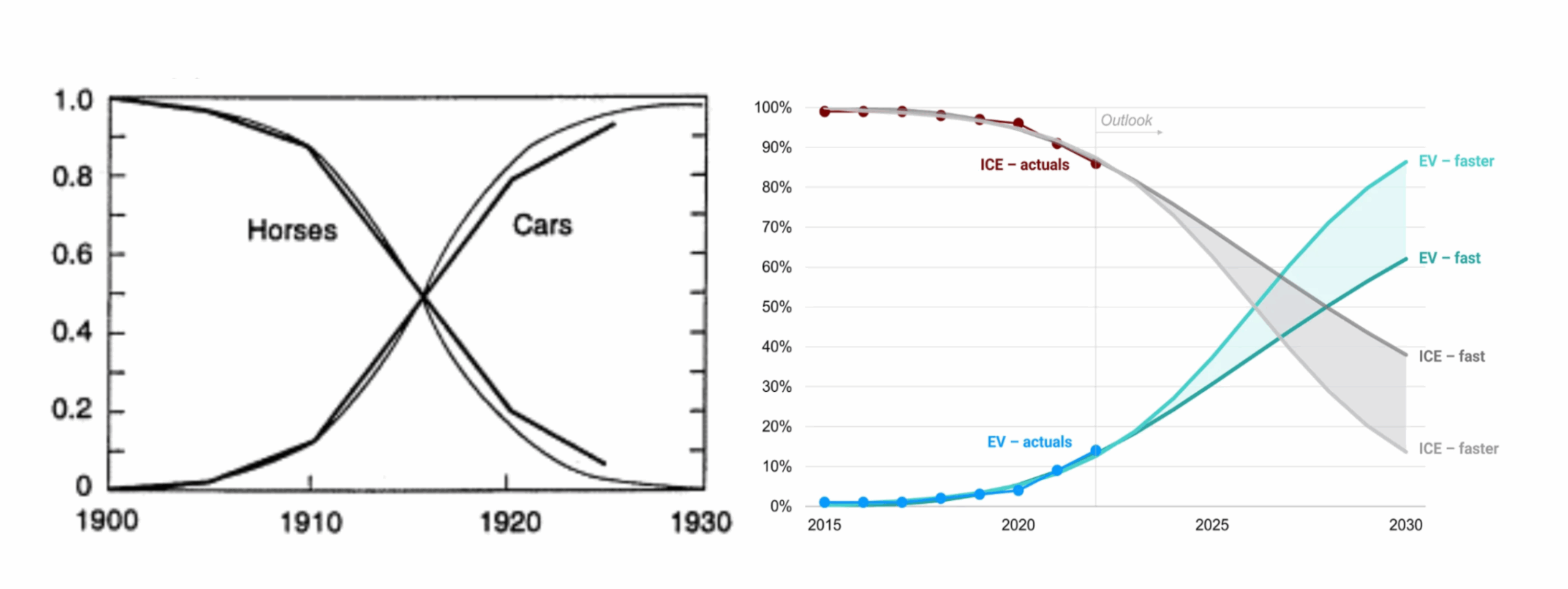
Internal combustion engine (ICE) vehicles did not prevail in becoming the dominant mode of transport through technical superiority alone. They were backed by massive public investment in roads, city planning, zoning and highway expansion funded by fuel taxes.
Meanwhile, they faced few penalties for pollution and externalities, benefitting from implicit subsidies over cleaner alternatives. Standardisation, industrial policy and wartime procurement further entrenched the ICE.
EVs are well-positioned to follow a faster trajectory, as they directly substitute ICE vehicles while being cleaner, cheaper and quieter to run.
Past transitions show that like-for-like replacements – such as black-and-white to colour TVs – tend to diffuse faster than entirely novel products.
Late adopters also benefit from cost reductions and established norms. For example, car ownership took 60 years to diffuse across the US, but just 20 years in parts of Latin America and Japan.
In today’s globalised economy, knowledge, capital and supply chains travel faster still. Our research suggests that the global EV shift could be achieved within decades, not half a century.
Yet without decisive policy, investment and coordination, feedback loops could slow, locking in fossil-fuel dependence.
Our research suggests that further supporting the widespread deployment of EVs hangs on three interlinked actions: supporting adoption; integrating with clean electricity systems; and ensuring sustainability across supply chains and new mobility systems.
Closing the cost gap
EVs have long offered lower running costs than ICE vehicles, but upfront costs – while now cost-competitive in China, parts of Europe and in growing second-hand markets – remain a major barrier to adoption in most regions.
While battery costs have fallen sharply – lithium-ion battery packs fell by 20% in 2024 alone – this has not fully translated into lower retail vehicle prices for consumers.
In China, a 30% fall in battery prices in 2024 translated into a 10% decline in electric SUV prices. However, in Germany, EV retail prices rose slightly in 2024 despite a 20% drop in battery costs.
These discrepancies reflect market structures rather than cost fundamentals. Our report suggests that a competitive EV market, supported by transparent pricing and a strong second-hand sector, can help unlock cost parity in more markets.
Beyond the sale of EVs, government policy around running costs, such as fuel duty, has the potential to disincentivse EV adoption.
For example, New Zealand’s introduction of road-pricing for EVs contributed to a collapse in registrations from nearly 19% of sales in December 2023 to around 4% in January 2024.
EV-specific fees have also been introduced in a number of US states. Last month, the UK also announced a per-mile charge for EVs – but not ICEs – from 2028.
Addressing the loss of fuel-duty revenue as EVs replace ICE vehicles is a headache for any government seeking to electrify mobility.
However, to avoid slowing diffusion, new revenues could be used to build out new charging infrastructure, just as road-building was funded as the ICE vehicle was scaling up.
While subsidies to support upfront costs can help enable EV adoption, the best approach to encouraging uptake is likely to shift once the sector moves into a phase of mass diffusion.
Targeted support, alongside innovative financing models to broaden access, from blended finance to pay-as-you-drive schemes, could play a greater role in ensuring lower-income drivers and second-hand buyers are not left behind.
Mandates as engines of scale
Zero-emission vehicle (ZEV) mandates and ICE phase-out deadlines can reduce costs more effectively than alternatives by guaranteeing market scale, our research finds, reducing uncertainty for automakers and pushing learning rates forward through faster production.
California’s ZEV mandate was one of the first in the 1990s, a policy that has since been adopted by ten other US states and the UK.
China’s NEV quota system has produced the world’s fastest-growing EV market, while, in Norway, clear targets and consistent incentives mean EVs now account for nearly all of new car sales. These “technology-forcing” policies have proved highly effective.
Analyses consistently show that the long-run societal benefits of sales mandates for EVs far outweigh their compliance costs.
For example, the UK’s ZEV mandate has an estimated social net present value of £39bn, according to the government, driven largely by emissions reductions and lower running costs for consumers.
Benefits can also extend beyond national borders. For example, California’s “advanced clean cars II” regulations – adopted by a number of US states and an influence on other countries – have been instrumental in compelling US automakers to develop and commercialise EVs, which can, in turn, trigger innovation and scale to reduce costs worldwide.
Research suggests that, where possible, combining mandates and incentives creates further synergies: mandates alleviate supply-side constraints, making subsidies more effective on the demand side.
Public charging: a critical bottleneck
Public charging is one of the most significant impediments to EV adoption today.
Whereas EVs charged at home are substantially cheaper to run than ICE vehicles, higher public charging costs can erase this benefit – in the UK, this can be up to times the home equivalent.
While most homes in the UK, for example, do have access to off-street parking, there are large swathes of low-income and urban households without access to private driveways. For these households, a lack of cheap public charging has been described as a de facto “pavement tax”, which is disincentivising EV adoption and resulting in an inequitable transition.
Our research shows that a dual-track charging strategy could help resolve the situation. Expanding access to private charging – through cross-pavement cabling, “right-to-charge” legislation for renters and planning mandates for new developments could be combined with strategic investment in public charging, to overcome the “chicken-and-egg” problem for investors uncertain about future EV demand.
Meanwhile, “smart charging” in public settings – where EV demand is matched with cheaper electricity supply – can also help close the affordability gap, by delivering cheap off-peak charging that is already available to those charging at home.
The Centre for Net Zero’s research shows that drivers respond to dynamic pricing outside of the convenience of their homes, which reduces EV running costs below those of petrol cars.
The figure below shows that, while the level of discount being offered had the strongest impact, lower-income areas showed the largest behavioural response, indicating that they may stand to gain the most from a rollout of such incentives.
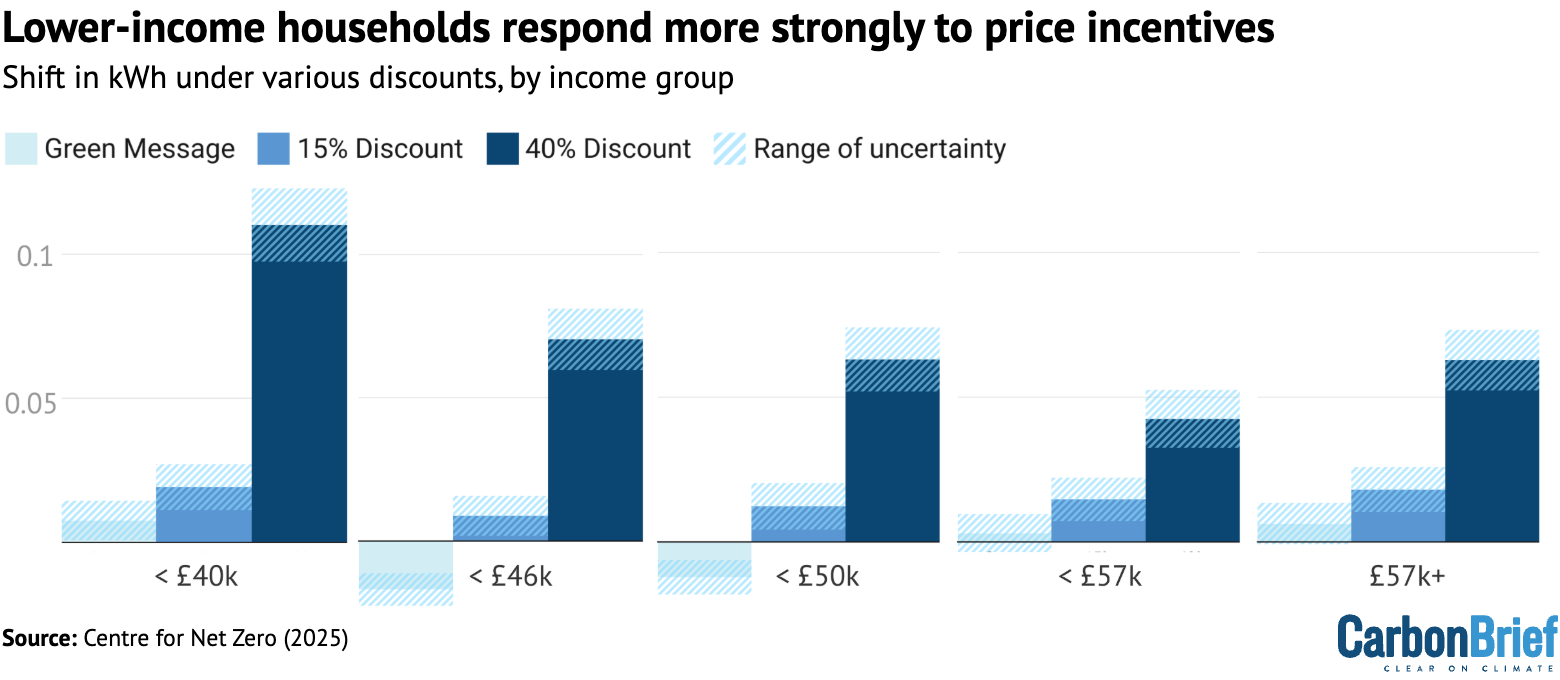
Our research suggests that policymakers could encourage this type of commercial offering by creating electricity markets with strong price signals and mandating that these prices are transparent to consumers.
Integrating with clean electricity grids
Electrification is central to decarbonising the world’s economies, meaning that sufficient capacity on electricity networks is becoming a key focus.
For the rollout of EVs, pressure will be felt most on low-voltage “distribution” networks, where charging is dispersed and tends to follow existing peaks and troughs in domestic demand.
Rather than responding to this challenge by just building out the grid – with the corresponding economic and political implications – making smart charging the norm could help mitigate pressure on the network.
Evidence from the Centre for Net Zero’s trials shows that AI-managed charging can shift EV demand off-peak, reducing residential peak load by 42%, as shown in the chart below.
Additionally, the amount of time when EVs are plugged in but not moving is often substantial, giving networks hours each day in which they can shift charging, targeting periods of low demand or high renewable output.
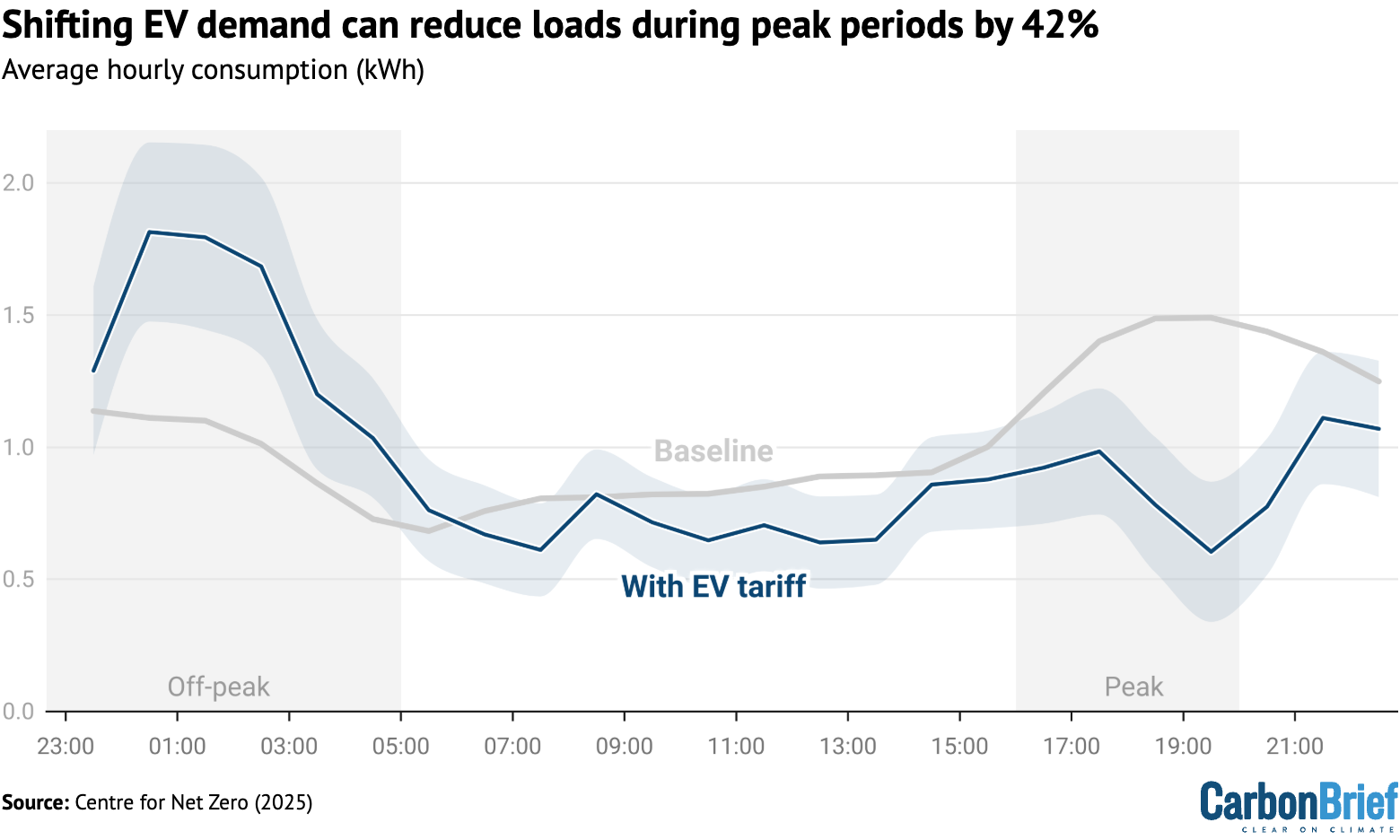
The system value of this flexible charging is significant. In the UK, managed charging could absorb 15 terrawatt hours (TWh) of renewable electricity that would otherwise be curtailed by 2030 – equivalent to Slovenia’s entire annual consumption.
For these benefits to be realised, our research suggests that global policymakers may need to mandate interoperability across vehicles, chargers and platforms, introduce dynamic network charges that reflect local grid stress and support AI-enabled automation.
Bi-directional charging – which allows EVs to export electricity to the grid, becoming decentralised, mobile storage units – remains underexploited. This could allow EVs to contribute to the capacity of the grid, helping with frequency and providing voltage support at both local and system levels.
The nascency of such vehicle-to-grid (V2G) technology means that penetration is currently limited, but there are some markets that are further ahead.
For example, Utrecht is an early leader in real-world V2G deployment in a context of significant grid congestion, while Japan is exploring the use of V2G for system resilience, providing backup power during outages. China is also exploring V2G systems.
Our research shows that if just 25% of vehicles across six major European nations had V2G functionality, then the theoretical total capacity of the connected vehicles would exceed each of those country’s fossil-fuel power fleet.
Mandating V2G readiness at new chargepoints, aligning the value of exports with the value to the system and allowing aggregators to pool capacity from multiple EVs, could all help take V2G from theory to reality.
A sustainable EV system
It is important to note that electrification alone does not guarantee sustainability.
According to Rocky Mountain Institute (RMI) analysis, the total weight of ore needed to electrify the world’s road transport system is around 1,410mtonnes (Mt). This is 40% less than the 2,150Mt of oil extracted every year to fuel a combustion-based system. EVs concentrate resource use upfront, rather than locking in fossil-fuel extraction.
Moreover, several strategies can reduce reliance on virgin minerals, including recycling, new chemistries and improved efficiency.
Recycling, in particular, is progressing rapidly. Some 90% of lithium-ion batteries could now be recycled in some regions, according to RMI research. Under an accelerated scenario, nearly all demand could be met through recycling before 2050.
Finally, while our report focuses largely on EVs, it is important to highlight that they are not a “silver bullet” for decarbonising mobility.
Cities such as Seoul and New York have demonstrated that micromobility, public transport and street redesign can cut congestion, improve health and reduce the number of overall vehicles required.
Better system design reduces mineral demand, lowers network strain and broadens access.
The ‘decision decade’ ahead
Policy decisions made today will determine whether EVs accelerate into exponential growth or stall.
Our research suggests that governments intent on capturing the economic and environmental dividends of electrified mobility are likely to need coherent, cross-cutting policy frameworks that push the market up the steep climb of the EV S-curve.




The post Guest post: How to steer EVs towards the road of ‘mass adoption’ appeared first on Carbon Brief.
Guest post: How to steer EVs towards the road of ‘mass adoption’

Next week, diplomats from around the world will descend on Yerevan, Armenia, to negotiate a series of decisions under the UN Convention on Biological Diversity (CBD).
Between 19 and 30 October, 196 parties will gather to hammer out the precise wording of the dozens of legal texts that make up the decisions under the Conference of the Parties (COP) to the CBD.
This year’s summit is particularly significant, as it marks the halfway point between the agreement of the Kunming-Montreal Global Biodiversity Framework and the deadline for achieving its targets.
The CBD has found that countries are currently not on track to meet 22 out of the framework’s 23 targets.
During the fortnight, delegates will also be negotiating decisions relating to the two supplemental protocols to the CBD: the Cartagena Protocol, which covers biosafety; and the Nagoya Protocol, which covers access and benefit-sharing for the use of genetic resources.
(The Cartagena and Nagoya Protocols, which are each governed by a “meeting of the parties”, or “MOP”, have fewer parties than the CBD as a whole, with 173 and 141, respectively.)
Carbon Brief is tracking the progress of countries towards consensus on dozens of negotiating texts using the interactive table below.
The tracker includes texts from the COP, as well as the MOPs for the Cartagena and Nagoya protocols. It also includes draft decisions from the most recent subsidiary body meetings, as these form the starting point for the negotiations in Yerevan.
The CBD has three subsidiary bodies: the subsidiary body on scientific, technical and technological advice (SBSTTA), the subsidiary body on implementation (SBI) and the subsidiary body on article 8(j) and other provisions (SB8J).
SB8J focuses on issues related to the Indigenous peoples and local communities. It was established at COP16 in Cali, Colombia, in 2024.
The first two columns of the interactive tracker list the topic of each agenda item and the relevant body, with subsequent columns including dates, page counts and links to the original documents.
The table is searchable and can be sorted using the arrows in the header.
Areas of disagreement in UN draft texts are denoted by square brackets. Counting the brackets in a particular iteration of a text therefore gives a sense of how far parties are from reaching consensus.
The bracket column is colour-coded, with dark green indicating a low number of brackets and red indicating a high number of brackets remaining.
Texts can also present parties with choices using “options” or alternatives (“alt”), which are counted together in the sixth column of the table.
The key discussions in Yerevan will centre around two agenda items in particular. The first is the global review, which will assess progress towards the GBF and make recommendations for accelerating action.
The second is finance, which can be separated into two parts: resource mobilisation and the financial mechanism. On resource mobilisation, biodiverse global south countries are likely to push for an increased amount of international finance for conservation.
Disagreement over the creation of the financial mechanism led to the suspension of COP16 in Cali in October 2024, as parties failed to find agreement on the mobilisation of finance before the end of the summit.
Global south countries want the establishment of a separate financial mechanism under the control of the CBD; global north countries largely prefer to maintain the existing mechanism, which sits under the Global Environment Facility.
At the resumed session of COP16 in Rome in early 2025, countries agreed on a roadmap that would lead to the establishment of a permanent mechanism.
related

Analysis: Lula presidency saved at least 20,000km2 of Brazilian Amazon since 2022

Why land-use emissions have fallen by a third this century – in six charts

Analysis: 84% of nations miss deadline to identify ‘nature-harming’ subsidies by 2025

UK withdraws millions in funding from world’s second-largest rainforest in Congo
The post Interactive: Tracking negotiating texts at the COP17 biodiversity summit appeared first on Carbon Brief.
Interactive: Tracking negotiating texts at the COP17 biodiversity summit
A beacon of love
On an outer island of Fiji, two thousand nautical miles from Sydney, is a shining light of hope and resilience for our troubled world.
The island of Kioa is home to a Tuvaluan community who migrated from their atoll of Vaitupu in the late 1940s. It is a land of warm hearts, big smiles, and deep cultural roots; a place where the sound of a conch still summons the island together, where islanders paddle out to fish in carved outrigger canoes, and healthy happy children walk barefoot to school.
Here, culture is life. Kioans live sustainably through their traditional knowledge and practices. The island is alive with song, dance and the rhythms of a life tied to the tides, the winds, and the seasons.