

Electric heat pumps are set to play a key role in the UK’s climate strategy, as well as cutting the nation’s reliance on imported fossil fuels.
Heat pumps took centre-stage in the UK government’s recent “warm homes plan”, which said that they could also help cut household energy bills by “hundreds of pounds” a year.
Similarly, innovation agency Nesta estimates that typical households could cut their annual energy bills nearly £300 a year, by switching from a gas boiler to a heat pump.
Yet there has been widespread media coverage in the Times, Sunday Times, Daily Express, Daily Telegraph and elsewhere of a report claiming that heat pumps are “more expensive” to run.
The report is from the Green Britain Foundation set up by Dale Vince, owner of energy firm Ecotricity, who campaigns against heat pumps and invests in “green gas” as an alternative.
One expert tells Carbon Brief that Vince’s report is based on “flimsy data”, while another says that it “combines a series of worst-case assumptions to present an unduly pessimistic picture”.
This factcheck explains how heat pumps can cut bills, what the latest data shows about potential savings and how this information was left out of the report from Vince’s foundation.
How heat pumps can cut bills
Heat pumps use electricity to move heat – most commonly from outside air – to the inside of a building, in a process that is similar to the way that a fridge keeps its contents cold.
This means that they are highly efficient, adding three or four units of heat to the house for each unit of electricity used. In contrast, a gas boiler will always supply less than one unit of heat from each unit of gas that it burns, because some of the energy is lost during combustion.
This means that heat pumps can keep buildings warm while using three, four or even five times less energy than a gas boiler. This cuts fossil-fuel imports, reducing demand for gas by at least two-fifths, even in the unlikely scenario that all of the electricity they need is gas-fired.
Since UK electricity supplies are now the cleanest they have ever been, heat pumps also cut the carbon emissions associated with staying warm by around 85%, relative to a gas boiler.
Heat pumps are, therefore, the “central” technology for cutting carbon emissions from buildings.
While heat pumps cost more to install than gas boilers, the UK government’s recent “warm homes plan” says that they can help cut energy bills by “hundreds of pounds” per year.
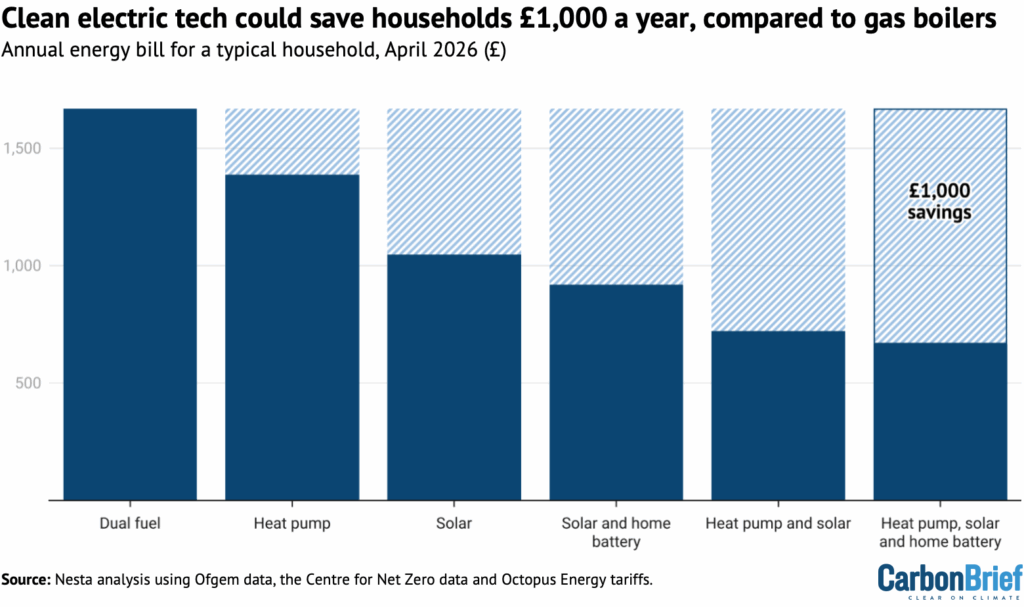
Similarly, Nesta published analysis showing that a typical home could cut its annual energy bill by £280, if it replaces a gas boiler with a heat pump, as shown in the figure below.
Nesta and the government plan say that significantly larger savings are possible if heat pumps are combined with other clean-energy technologies, such as solar and batteries.
Both the government and Nesta’s estimates of bill savings from switching to a heat pump rely on relatively conservative assumptions.
Specifically, the government assumes that a heat pump will deliver 2.8 units of heat for each unit of electricity, on average. This is known as the “seasonal coefficient of performance” (SCoP).
This figure is taken from the government-backed “electrification of heat” trial, which ran during 2020-2022 and showed that heat pumps are suitable for all building types in the UK.
(The Green Britain Foundation report and Vince’s quotes in related coverage repeat a number of heat pump myths, such as the idea that they do not perform well in older properties and require high levels of insulation.)
Nesta assumes a slightly higher SCoP of 3.0, says Madeleine Gabriel, the organisation’s director of sustainable future. (See below for more on what the latest data says about SCoP in recent installations.)
Both the government and Nesta assume that a home with a heat pump would disconnect from the gas grid, meaning that it would no longer need to pay the daily “standing charge” for gas. This currently amounts to a saving of around £130 per year.
Finally, they both consider the impact of a home with a heat pump using a “smart tariff”, where the price of electricity varies according to the time of day.
Such tariffs are now widely available from a variety of energy suppliers and many have been designed specifically for homes that have a heat pump.
Such tariffs significantly reduce the average price for a unit of electricity. Government survey data suggests that around half of heat-pump owners already use such tariffs.
This is important because on the standard rates under the price cap set by energy regulator Ofgem, each unit of electricity costs more than four times as much as a unit of gas.
The ratio between electricity and gas prices is a key determinant of the size and potential for running-cost savings with a heat pump. Countries with a lower electricity-to-gas price ratio consistently see much higher rates of heat-pump adoption.
(Decisions taken by the UK government in its 2025 budget mean that the electricity-to-gas ratio will fall from April, but current forecasts suggest it will remain above four-to-one.)
In contrast, Vince’s report assumes that gas boilers are 90% efficient, whereas data from real homes suggests 85% is more typical. It also assumes that homes with heat pumps remain on the gas grid, paying the standing charge, as well as using only a standard electricity tariff.
Prof Jan Rosenow, energy programme leader at the University of Oxford’s Environmental Change Institute, tells Carbon Brief that Vince’s report uses “worst-case assumptions”. He says:
“This report cherry-picks assumptions to reach a predetermined conclusion. Most notably, it assumes a gas boiler efficiency of 90%, which is significantly higher than real-world performance…Taken together, the analysis combines a series of worst-case assumptions to present an unduly pessimistic picture.”
Similarly, Gabriel tells Carbon Brief that Vince’s report is based on “flimsy data”. She explains:
“Dale Vince has drawn some very strong conclusions about heat pumps from quite flimsy data. Like Dale, we’d also like to see electricity prices come down relative to gas, but we estimate that, from April, even a moderately efficient heat pump on a standard tariff will be cheaper to run than a gas boiler. Paired with a time-of-use tariff, a heat pump could save £280 versus a boiler and adding solar panels and a battery could triple those savings.”
What the latest data shows about bill savings
The efficiency of heat-pump installations is another key factor in the potential bill savings they can deliver and, here, both the government and Vince’s report take a conservative approach.
They rely on the “electrification of heat” trial data to use an efficiency (SCoP) of 2.8 for heat pumps. However, Rosenow says that recent evidence shows that “substantially higher efficiencies are routinely available”, as shown in the figure below.
Detailed, real-time data on hundreds of heat pump systems around the UK is available via the website Heat Pump Monitor, where the average efficiency – a SCoP of 3.9 – is much higher.
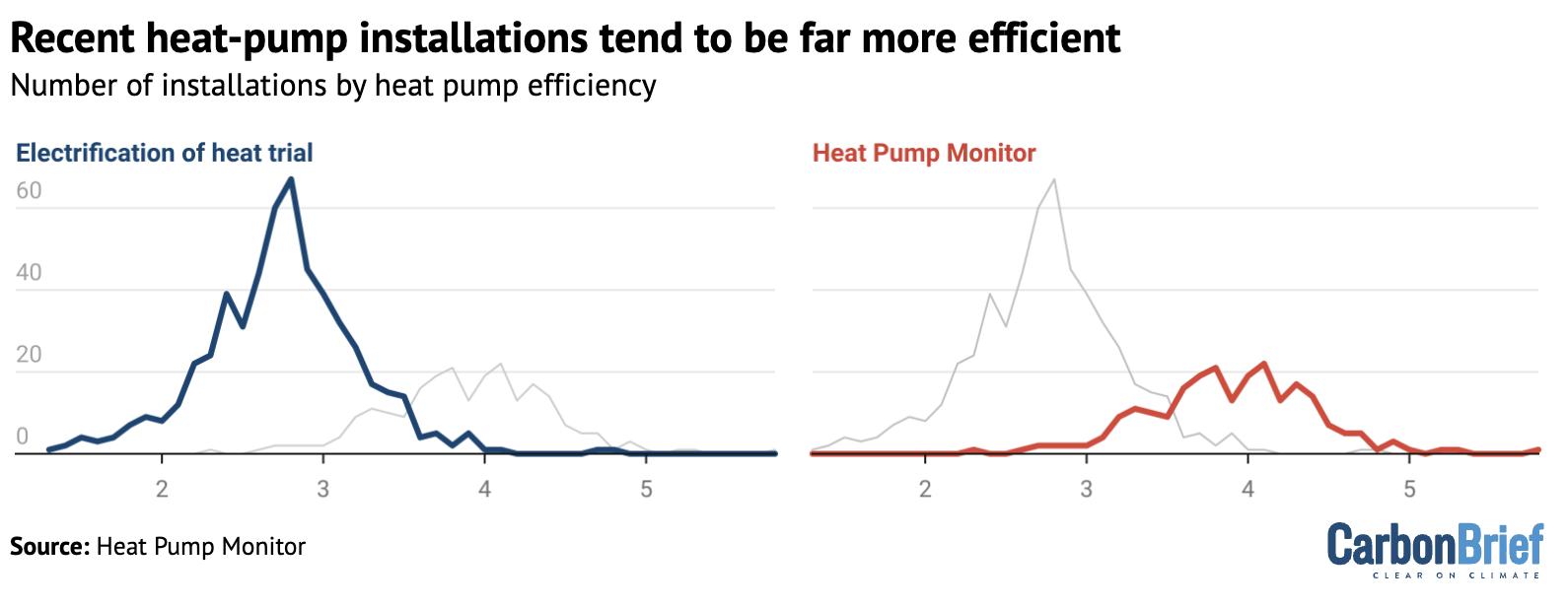
Homes with such efficient heat-pump installations would see even larger bill savings than suggested by the government and Nesta estimates.
Academic research suggests that there are simple and easy-to-implement reasons why these systems achieve much higher efficiency levels than in the electrification of heat trial.
Specifically, it shows that many of the systems in the trial have poor software settings, which means they do not operate as efficiently as their heat pump hardware is capable of doing.
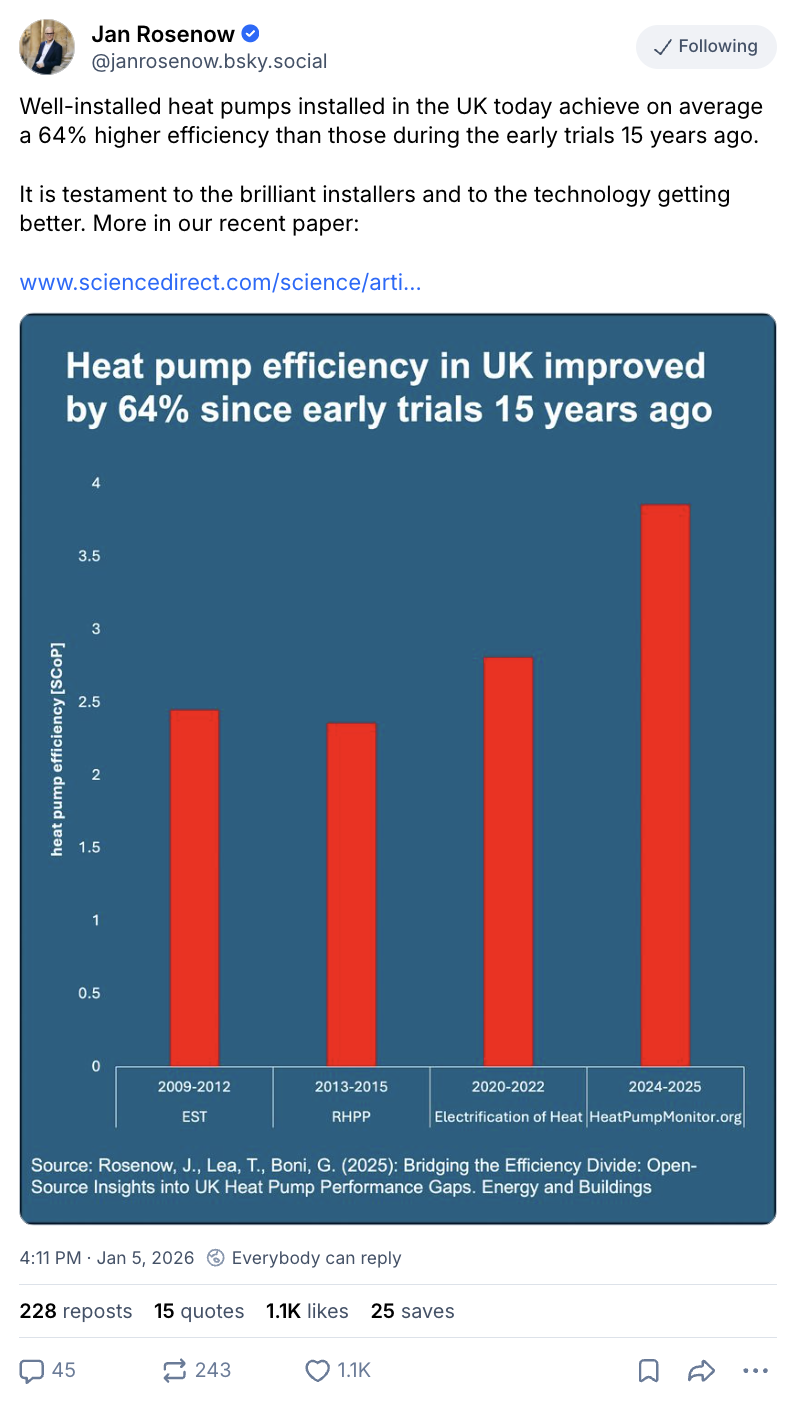
The research suggests that heat pump installations in the UK have been getting more and more efficient over time, as engineers become increasingly familiar with the technology.
It indicates that recently installed heat pumps are 64% more efficient than those in early trials.
Notably, the Green Britain Foundation report only refers to the trial data from the electrification of heat study carried out in 2020-22 and the even earlier “renewable heat premium package” (RHPP). This makes a huge difference to the estimated running costs of a heat pump.
Carbon Brief analysis suggests that a typical household could cut its annual energy bills by nearly £200 with a heat pump – even on a standard electricity tariff – if the system has a SCoP of 3.9.
The savings would be even larger on a smart heat-pump tariff.
In contrast, based on the oldest efficiency figures mentioned in the Green Britain Foundation report, a heat pump could increase annual household bills by as much as £200 on a standard tariff.
To support its conclusions, the report also includes the results of a survey of 1,001 heat pump owners, which, among other things, is at odds with government survey data. The report says “66% of respondents report that their homes are more expensive to heat than the previous system”.
There are several reasons to treat these findings with caution. The survey was carried out in July 2025 and some 45% of the heat pumps involved were installed between 2021-23.
This is a period during which energy prices surged as a result of Russia’s invasion of Ukraine and the resulting global energy crisis. Energy bills remain elevated as a result of high gas prices.
The wording of the survey question asks if homes are “more or less expensive to heat than with your previous system” – but makes no mention of these price rises.
The question does not ask homeowners if their bills are higher today, with a heat pump, than they would have been with the household’s previous heating system.
If respondents interpreted the question as asking whether their bills have gone up or down since their heat pump was installed, then their answers will be confounded by the rise in prices overall.
There are a number of other seemingly contradictory aspects of the survey that raise questions about its findings and the strong conclusions in the media coverage of the report.
For example, while only 15% of respondents say it is cheaper to heat their home with a heat pump, 49% say that one of the top three advantages of the system is saving money on energy bills.
In addition, 57% of respondents say they still have a boiler, even though 67% say they received government subsidies for their heat-pump installation. It is a requirement of the government’s boiler upgrade scheme (BUS) grants that homeowners completely remove their boiler.
The government’s own survey of BUS recipients finds that only 13% of respondents say their bills have gone up, whereas 37% say their bills have gone down, another 13% say they have stayed the same and 8% thought that it was too early to say.


The post Factcheck: What it really costs to heat a home in the UK with a heat pump appeared first on Carbon Brief.
Factcheck: What it really costs to heat a home in the UK with a heat pump

Scientists have vowed to keep working on the next flagship set of reports for the Intergovernmental Panel on Climate Change (IPCC), after a political row over the timeline for their release saw its latest session suspended on Friday evening without agreement.
During the weekend, government officials and scientists alike expressed disappointment over the inability to reach a compromise before some delegates from developing countries and small island states had to leave the week-long meeting in Ethiopia to catch flights home.
The disagreement – which has persisted since early 2024 – turns on whether the three key parts of the AR7 assessment should all be published before the conclusion of the UN’s next Global Stocktake of global climate action, which is due to be completed in late 2028.
The IPCC issued a statement after the close of the session, saying that “key agenda items” – the timelines for the three AR7 reports, as well as the IPCC budget – remain open and under discussion. It said the IPCC’s plenary session and its deliberations on the pending agenda “will resume at the earliest opportunity”, giving no further details of when.
IPCC Chair Jim Skea told delegates in closing remarks that recent months had been some of the most turbulent for the climate science panel and that, if there were stronger words than “profound disappointment” he would use them, according to a summary published by the Earth Negotiators Bulletin (ENB). IPCC discussions happen behind closed doors.
IPCC scientists remained committed
In an open letter, issued on Monday, a group of nearly 120 scientists – from a total of 664 AR7 authors – said they “stand committed to continue working to deliver the AR7 reports in a manner that is rigorous, timely and inclusive, in line with our mandate to be policy-relevant”.
“An assessment that arrives after the decisions it is meant to inform cannot serve its purpose,” they emphasised. “The second Global Stocktake in 2028 is such a decision point, and the world should not have to face it without the IPCCʼs latest assessment.”
Europe, small islands and the least developed countries, plus many Latin American and developed nations, want the IPCC to meet this deadline, arguing that the findings from the UN climate science body are irreplaceable in the UN climate policy-making process.
However, around a dozen developing countries plus Russia have argued that the reports should come later in order to allow for greater research input from the Global South – something that, in their view, would make the findings fairer. They also claim that a shorter timeline would put excessive pressure on experts.
-
Who shapes climate science? The equity question facing the IPCC
Early completion of the next global climate science assessment reports risks excluding research from the Global South, which is key to ensuring the findings are fair -
Governments that support climate science must stand firm against naysayers
The IPCC is meeting to decide the timing of its next major report, as some countries try to delay it and weaken the case for faster emissions cuts


The most vocal of this group at last week’s meeting were India and Saudi Arabia, according to the ENB summary and a developed country diplomat. Critics see this push for a longer timeline as an excuse to deprive government decision-makers of the latest science and ease pressure on emerging economies to raise their ambition, particularly on cutting emissions.
Commenting on last week’s meeting, France’s ambassador for climate negotiations Benoît Faraco said a broad coalition of developed and developing countries from all five continents, “united in their support for science and the timeline proposed by scientists”, had withstood pressure “from a few countries” seeking to slow down the process of adopting the IPCC reports.
He added that France would not back down and would “continue to fight tirelessly for science, protect the integrity of information, and convince our partners that without the best available scientific data, we will be less effective in tackling climate change and protecting our populations”.
Inclusivity proposal stalled
In a bid to unlock a solution for the AR7 timeline, countries discussed ways to improve the inclusivity of the IPCC’s work. One option put on the table was for the IPCC to expand its funding for delegates from developing countries to attend some or all of its sessions from one to two participants, according to the ENB summary and a delegate speaking to Climate Home News.
That would increase the costs for the IPCC to complete AR7 by up to a quarter, according to an assessment shared by the secretariat. The panel’s budget is under severe strain and its officials have warned that, without additional voluntary contributions, it risks running out of money before it can deliver on this assessment cycle.
Climate Home News understands that some of the IPCC’s traditional donors – which mainly include European countries, Japan and Australia – indicated a willingness to support funding for an additional developing country participant. But without an agreement over the budget or the timeline for the reports, that option was ultimately not adopted.
‘Disappointed and worried’
The three reports are managed by working groups that collate and draw overall findings from the latest scientific studies and data on the physical effects of global warming around the world, how to adapt to it, and pathways for cutting planet-heating emissions in order to meet the temperature goals of the Paris Agreement.
Winston Chow, an urban climate professor at Singapore Management University who co-chairs Working Group II on adaptation, wrote in a LinkedIn post that he was “disappointed and worried” for the IPCC authors who have worked “extraordinarily hard” to assess the relevant climate science over the past two years.
He said he shared their concern that “the rigour, time and goodwill they’ve invested are now being put at risk by the Panel’s stalemate”.
As science comes under attack at UN talks, climate movement splits over how to respond
For Working Group II, a meeting for 250 experts writing that report is scheduled for January 2027, followed by the approval of a special report on cities and climate change in Singapore next March.
But because the IPCC’s budget has not been confirmed due to uncertainty about the AR7 schedule, travel support for those researchers is at risk, wrote Chow. “If they cannot participate, our assessments will lose vital expertise, perspectives and scientific breadth, and the collective effort of our authors will be undermined,” he warned.
Scientific work continues
Despite the political holdups, he – together with French climate scientist Robert Vautard, co-chair of Working Group 1 – agreed with IPCC head Skea who told the IPCC’s closing session on Friday: “The engine room of the IPCC is working, and it’s healthy.”
Vautard commented in a separate post on LinkedIn after it ended: “The boat is at full steam.” Working groups I and II are due to start revising the first drafts of their reports, while Working Group III on reducing emissions is finalising its first draft which will be out soon, he wrote.
“The most exciting two years of the cycle are ahead, for the authors. The momentum in the engine room is here and now. Trust the engine room!” he added.
The IPCC and some scientists report that progress has been made towards achieving an equitable balance of authors from the Global North and the Global South.
The group of researchers who signed the open letter on Monday noted that “inclusivity is at the heart of how we work”, with author teams bringing together experts from developed and developing countries with diverse backgrounds and at different stages of their careers.
Plea to overcome political differences
The signatories include several scientists from some of the countries opposed to the alignment of all IPCC reports with the Global Stocktake.
“We are committed to an assessment in which the knowledge, experience and priorities of every region are fully reflected, a commitment we share with the leadership of the IPCC.
Equity is built into how our assessment is being drafted,” they added.
They appealed to governments that make up the IPCC “to overcome their political differences and work together as we do as a global scientific community, so that we can deliver the IPCC reports the world needs to hear”.
In a statement published on Monday, IPCC chair Skea said reaching consensus on the schedule for the reports is “vital”. He added that the assessments provide authoritative scientific evidence to inform national climate policies, strengthen adaptation and resilience and support access to climate finance, as well as helping communicate the scale of the climate crisis and the urgency of efforts to tackle it.
The post IPCC scientists vow to press on with climate reports despite political deadlock appeared first on Climate Home News.
IPCC scientists vow to press on with climate reports despite political deadlock
An Lambrechts is a biodiversity politics expert at Greenpeace International with extensive experience in biodiversity-related multilateral negotiations. She is the head of the Greenpeace delegation at the Convention on Biological Diversity (CBD) COP17 happening in Yerevan, Armenia.
In 2022, COP15 delivered the landmark Kunming-Montreal Global Biodiversity Framework to halt and reverse biodiversity loss by 2030. With COP17 starting in Yerevan, we are now halfway to the deadline, and according to the first Global Review of progress, countries are not on track to meet the biodiversity targets, and implementation must accelerate fast.
One of the main findings of the Global Review is that funding falls far short of the scale needed to halt and reverse nature loss. But the crisis facing the world’s biodiversity is not an absolute scarcity of capital – it is a profound public policy distortion.
The global economy currently spends roughly $30 destroying nature for every single dollar invested in its protection. According to a report from the Intergovernmental Science-Policy Platform on Biodiversity and Ecosystem Services, a staggering $2.4 trillion is spent in public subsidies for fossil fuels, agriculture and water use, while global investment in biodiversity conservation and restoration stands at a mere $220 billion.
Countries urged to ramp up “insufficient” nature policies at COP17
Yet, discussions about how to close the biodiversity finance gap continue to claim that salvation lies in mobilising private capital, scaling offsets and “derisking” investments in nature. This is a fundamental misunderstanding of both the nature of ecological stewardship and of the global financial architecture.
Biodiversity conservation is not a speculative investment portfolio – it is the