Welcome to Carbon Brief’s DeBriefed.
An essential guide to the week’s key developments relating to climate change.
This week
Pakistan and India floods
EXTREME WEATHER: Heavy flooding forced half a million people to evacuate their homes in just 24 hours in Pakistan’s Punjab this week, the Associated Press reported. It brings the total number of people displaced since last month to 1.8 million, the newswire said. According to Arab News, at least 41 people have died as a result of the flooding since last week. The flooding has also destroyed thousands of acres of crops in Punjab, a province that accounts for 68% of Pakistan’s total annual food grain production, Bloomberg reported.
CROSS-BORDER EVENT: Meanwhile, in Indian Punjab, “at least 30 people have died and more than 354,000 have been affected” by flooding, BBC News reported. India also warned Pakistan about more cross-border flooding for the second time in as many weeks, as both countries reeled from monsoon rains, the Associated Press reported.
UK dividing lines
NEW FACE: Zack Polanski has been elected as the new leader of the Green Party of England and Wales in a landslide victory, the Financial Times reported. Polanski is an “outspoken campaigner who has argued his party needs to ‘connect with people’s anger’ and become more combative against ‘villains’, including oil major Shell and the ‘super-rich’”, the newspaper said. Polanksi wants to “replace” the ruling Labour party on a platform of “eco-populism”, according to BBC News.
NORTH SEA OIL: Meanwhile, the UK Conservative leader Kemi Badenoch pledged to drill “all” of the remaining oil and gas in the North Sea if elected, BBC News reported. [The Conservatives are polling third, at 17%.] In response to the speech, the Daily Telegraph‘s world economy editor Ambrose Evans-Pritchard argued that Badenoch’s plan would not “raise this country’s long-term output of oil and gas by more than homeopathic amounts” nor “move the needle on UK energy prices” (more below).
Around the world
- HIGHER AMBITIONS: The UN urged countries to set new, more ambitious national climate plans this month, ahead of this year’s COP30 summit in Belém, Brazil, Reuters reported.
- ‘JUNK SCIENCE’: A group of more than 85 climate scientists released a “scathing review” of the Trump administration’s misleading climate report, DeSmog reported.
- FOSSIL ENERGY: Russia said China had agreed to a massive new pipeline capable of importing as much as 50bn cubic metres of gas a year, the Financial Times reported.
- US PRESSURE: Reuters reported that the US is pressuring other countries to reject a UN deal on cutting emissions from shipping by threatening them with tariffs, visa restrictions and port levies.
- SWELTERING HEAT: Authorities in Japan and South Korea said 2025 was the hottest summer in their countries since records began, Al Jazeera reported.
- MITIGATION WORK: According to Bloomberg, Zimbabwe has published draft regulations to establish a National Climate Fund. The fund will finance projects “aimed at mitigating the impact of climate change and respond[ing] to emergencies”.
20%
The amount by which clean-energy production has surged in India this year, according to Reuters, citing data from the thinktank Ember.
Latest climate research
- “Extreme cold surges” have “robustly weakened in middle-to-high latitude continents during autumn and winter” due to climate change, according to a study in Nature Communications.
- A study published in npj Climate Action found that exposing people to moral appeals results in overall carbon footprint reduction and increased participation in civic and political climate action, regardless of ideological affiliation.
- The World Bank’s increase in climate finance spending since the Paris Agreement has been driven by projects with “low climate components”, according to a study in Climatic Change.
(For more, see Carbon Brief’s in-depth daily summaries of the top climate news stories on Monday, Tuesday, Wednesday, Thursday and Friday.)
Captured

A claim that gas produced in the North Sea emits “four times” less CO2 than imported liquified natural gas (LNG) featured prominently in both the Guardian and the Daily Telegraph this week, following Badenoch’s pledge to drill “all” the remaining oil and gas in the UK. However, this figure is highly misleading. It only refers to the emissions that come from the process of extracting and delivering the gas, which are much smaller than those from burning it. When both extraction and burning of the gas are taken into account, CO2 emissions from UK production are only around 15% lower than those from LNG imports, according to a new factcheck from Carbon Brief.
Spotlight
A man-made lake threatened by climate change
This week, Carbon Brief reports on how climate change is impacting the sustainability of a scenic nature reserve in the southern US.
In 1941, as World War 2 thickened, the US Congress approved a plan to construct a reservoir storage project on the Hiwassee River, a water body that cuts across the states of Georgia, North Carolina and Tennessee.
The dam, which came to be known as Chatuge after an 18th-century Cherokee village, was originally built for power generation purposes. However, after it was completed, it became more than a hydroelectric project.
In May 1942, the Towns County Lions Club started stocking fish in the newly created Lake Chatuge. In 1944, Clay County leased a tract of land for a public park.
Today, the park offers “scenic mountain views” and “panoramic views” of Lake Chatuge. The lake is also home to rare, endangered plant species and is an important source of drinking water.
However, Lake Chatuge’s future has been plunged into uncertainty after the Tennessee Valley Authority proposed a plan to repair the dam’s spillway, which could involve draining the lake’s water levels by 20 feet (6m) for up to eight years.
The TVA’s action is largely forward-thinking. While the dam and its spillway are in good condition, the public utility company is wary of extreme weather events made more likely by climate change.
In September 2024, Hurricane Helene tore through parts of Georgia and North Carolina, leaving more than 128 people dead across the US and uprooting communities in its wake. One analysis estimated that 44% of the economic damage from the storm can be attributed to human-caused climate change.

The Lake Chatuge area was largely spared, but officials worry that the next extreme weather event may not be far off.
“It’s the kind of event – the unusual storm event that can happen, that’s pretty rare – is what we’re looking out for,” a TVA project manager has said.
Meanwhile, aside from the imminent repairs made more likely by the increased possibility of extreme weather events, Lake Chatuge is also battling a parrot feather infestation, a phenomenon involving the spread of an invasive plant that has been linked to global warming in other parts of the US.
Saving Lake Chatuge
The threat posed by climate change to Lake Chatuge is not an isolated case. A July 2025 report by researchers at Utah State University found that climate change is affecting the social benefits of dams across the country.
Elsewhere in the world, the impact of extreme weather on ageing dams is wide ranging, including recently heightening tensions between India and Pakistan.
However, community members in the Lake Chatuge area are not giving up easily. A Facebook group dedicated to saving the lake has more than 2,000 members.
“Lake Chatuge is our economy,” Towns County’s sole commissioner, Cliff Bradshaw, told Carbon Brief. He added:
“The main attraction to this area is Lake Chatuge. Without the lake, the county’s tourism would drop, and our economy would suffer greatly – could even drive the county into a depression – as we have a great deal of businesses that rely solely on activities on Lake Chatuge for their customers, such as marinas, party boats and water activity playgrounds. The other businesses in town may not rely on the lake for customers, but do rely on the tourist traffic brought into the area by the lake to drive customers into their place of business.”
According to reporting by the Atlanta-Journal Constitution, visitors have spent up to $100m annually in the area since 2021.
The TVA’s repair work could begin as soon as 2027, but community members are asking both the public utility company and political leaders to help find the least damaging pathway.
Watch, read, listen
SCIENCE CUTS: The Financial Times reported on how the Trump administration has “gutted” the Federal Emergency Management Agency (Fema), throwing into doubt the nation’s ability to respond to extreme weather disasters.
SUSTAINABLE ECONOMICS: In an interview with Le Monde, the French economist Thomas Piketty argued that protecting the planet from climate change requires wealth redistribution.
TWEAKING NATURE: A Havard atmospheric chemist and an Oxford planetary physicist discussed the nuances and subtleties of geoengineering on the podcast Entanglements by Undark.
Coming up
- 8 September: Norway election
- 8-12 September: 54th Pacific Islands Forum Leaders Meeting, Honoraria, Solomon Islands
- 9-23 September: 80th Session of the UN General Assembly, New York
Pick of the jobs
- Energy UK, policy manager | Salary: £38,450. Location: London
- CNN Digital, climate and weather editor | Salary: $91,000-$169,000. Location: Atlanta, Washington DC, New York, Chicago or Burbank, California
- The Post and Courier, rising waters reporter | Salary: Unknown. Location: South Carolina, US
- The Seattle Times, climate reporter | Salary: $75,000-$90,000. Location: Seattle, US
DeBriefed is edited by Daisy Dunne. Please send any tips or feedback to debriefed@carbonbrief.org.
This is an online version of Carbon Brief’s weekly DeBriefed email newsletter. Subscribe for free here.


The post DeBriefed 5 September 2025: Pakistan floods hit 1.8m people; UK ‘eco-populism’; How warming threatens a man-made lake appeared first on Carbon Brief.

Three countries have been named by the Paris Agreement’s compliance committee for failing to submit a nationally determined contribution (NDC) and repeatedly snubbing offers of help with their climate plans.
After months of internal debate over whether to identify serial non-responders, the Paris Agreement’s Implementation and Compliance Committee (PAICC) named the three countries which have failed to engage with it over their NDCs on Friday.
It named Democratic Republic of Congo, Senegal and North Korea in a footnote of its annual report, adding that it decided to name them “with a view to facilitating engagement”, adding that representatives of the three nations had been invited to its meeting in early 2027 “with the purpose of identifying any challenges and constraints”.
“The Committee noted the importance of Parties engaging with the Committee in a timely manner, while noting that some delays may be due to the national capabilities and circumstances of the Parties”, the report said.
-
Under US pressure, World Bank says it will back gas “where appropriate”
The US wants the World Bank to expand its gas support while climate campaigners are pushing for it to end – its head spoke this week of limited backing for the fossil fuel -
IPCC scientists vow to press on with climate reports despite political deadlock
After governments again failed to agree a timeline, nearly 120 IPCC authors pledged to complete their assessment on time and with full scientific rigour -
Paris Agreement committee snubbed over missing NDC climate plans
Many governments have still not submitted a nationally determined contribution to the UN, breaching a key requirement of the Paris Agreement

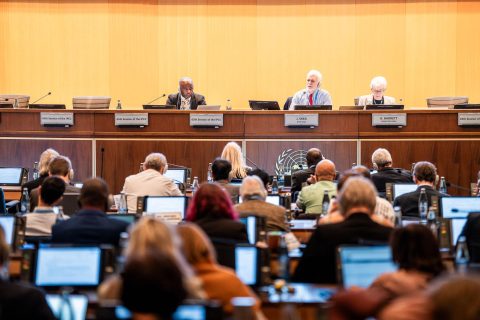

In July, PAICC said 12 countries had ignored its repeated attempts to discuss why they had not published an NDC as required every five years under the 2015 Paris accord.
Members of the committee had been divided over whether to name them, but at a September meeting decided to do so in their annual report to the annual climate COP summit.
By the time the report was published on Friday, only Congo, Senegal and North Korea “had not communicated an NDC or submitted a [Biennial Transparency Report] and had not yet responded to any of the Committee’s notifications, despite several reminders issued by the Committee in this regard”.
Rainforest and renewable energy ambitions
The silence from Congo and Senegal is notable because the former is home to much of the Congo Basin rainforest while the latter has sought billions of dollars in climate finance to support its renewable energy ambitions.
After Brazil, Congo has more rainforest than any country in the world. This forest, and the country’s peatlands, absorb huge amounts of greenhouse gas but are fast being lost to expanding farmland, charcoal production, logging and mining.
Senegal signed a Just Energy Transition Partnership with Canada and wealthy European nations in 2023, to help it meet its renewable energy targets under the-then government of Macky Sall. It was chair of the Least Developed Countries group between January 2022 and December 2023.

Tejas Rao, who is researching the PAICC as part of a doctoral thesis at Cambridge University, said the governments of the three countries should engage with the committee.
“Engagement costs these governments very little and the committee has shown it will listen,” he said.
“Silence leaves the committee with no basis to help, and it leaves the [governments] exposed to the narrative that they are simply disengaged,” he told Climate Home News.
Paris Agreement requirement
The 2015 Paris Agreement requires all parties to publish an NDC every five years outlining their emissions reduction targets, with each plan meant to be more ambitious than the country’s last NDC.
The latest set – the third round of plans, with new targets for 2035 – was due in February 2025. While most countries missed this deadline, all but around 30 – mostly small emitters but including Egypt, Vietnam and Argentina – have now submitted them.
Over the year, the PAICC – which is made up of government climate officials from developed and developing countries – has been communicating with governments that have not submitted NDCs and trying to overcome barriers to them doing so.
Some nations have cited exceptional circumstances as the reason for not submitting an NDC, a process that requires a significant amount of work in tracking emissions and consulting on how to curb them across the economy. For example, a letter from a Sudanese official to the PAICC, seen by Climate Home News, said that the country’s civil war had led to the suspension of its NDC preparation.
-
IPCC scientists vow to press on with climate reports despite political deadlock
After governments again failed to agree a timeline, nearly 120 IPCC authors pledged to complete their assessment on time and with full scientific rigour -
Under US pressure, World Bank says it will back gas “where appropriate”
The US wants the World Bank to expand its gas support while climate campaigners are pushing for it to end – its head spoke this week of limited backing for the fossil fuel -
Who shapes climate science? The equity question facing the IPCC
Early completion of the next global climate science assessment reports risks excluding research from the Global South, which is key to ensuring the findings are fair