

The retreat of sea ice in the Arctic has long been a prominent symbol of climate change.
Observations reveal that Arctic sea ice extent at the end of summer has halved, since satellite records began in the late 1970s.
Yet, since the late 2000s, the pace of Arctic sea ice loss has slowed markedly, with no statistically significant decline for about 20 years.
In new research, published in Geophysical Research Letters, my colleagues and I explore the reasons for the recent slowdown of Arctic sea ice – and turn to climate models to understand what might happen next.
Our findings show that, rather than being an unexpected or rare event, climate model simulations suggest we should expect periods like this to occur relatively frequently.
This current slowdown is likely caused by natural fluctuations of the climate system – just as they played a part in an acceleration of sea ice loss in the decades prior.
Were it not for human-caused warming, it is likely that sea ice would have increased over this period.
According to our simulations, the slowdown could even last for another five or 10 years – even as the world continues to warm.
Widespread slowdown
The changes in the Arctic are one of the most clear and well-known indicators of a warming climate.
With the Arctic warming up to four times the rate of the global average, the region has lost more than 10,000 cubic kilometres of sea ice since the 1980s. (The volume of ice lost is roughly equivalent to 4bn Olympic swimming pools).
Arctic sea ice reached its smallest extent on record in September 2012, dwindling to 3.41m square kilometres (km2). This triggered discussions of when the Arctic might see its first “ice-free” summer, where sea ice extent drops below 1m km2.
Research has shown that human-caused warming is responsible for up to two-thirds of this decline, with the remainder down to natural fluctuations in the climate system, also known as “internal climate variability”.
Despite the record low of 2012, satellite data reveals a widespread slowdown in Arctic sea ice loss over the past two decades.
Climate model simulations of Arctic sea ice thickness and volume further reinforce these observations, indicating little or no significant decline over the past 15 years.
This data is laid out in the charts below, which show average sea ice extent in September (left) and for the whole year (middle), as well as how annual average sea ice volume differs from the long-term average (right).
(September is typically the point in the year where sea ice reaches its annual minimum, at the end of the Arctic summer.)
The coloured lines indicate that the data originates from the National Snow and Ice Data Centre (NSIDC, orange), the Ocean and Sea Ice Satellite Application Facility (OSISAF, red) and the Pan-Arctic Ice Ocean Modeling and Assimilation System (PIOMAS, blue).
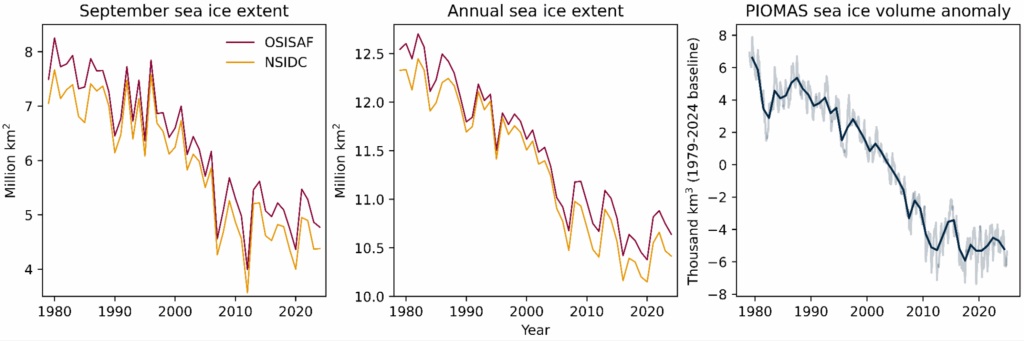
These observational records show how the precipitous decline in sea ice seen over much of the satellite data has slowed since the late 2000s.
It also shows that the slowdown is not limited to summer months, but is occurring year-round.
Our study is not the first to highlight this slowdown – several recent studies have also examined various aspects of this phenomenon. Meanwhile, a 2015 paper was remarkably prescient in suggesting such a slowdown could occur.
Is the slowdown surprising?
The loss of sea ice around the north pole is both a cause and effect of Arctic amplification – the term given to the rapid warming in the region.
Melting snow and ice reduces the reflectiveness, or “albedo”, of the Arctic’s surface, meaning less incoming sunlight is reflected back out to space. This causes greater warming and even more melting of ice and snow.
This “surface-albedo feedback” is one of several drivers of Arctic amplification.
Given global warming is caused by the continued rise in greenhouse gas emissions, it might seem puzzling – or even impossible – that Arctic sea ice loss could slow down.
However, the recent generations of climate models used for the Coupled Model Intercomparison Project (CMIP) – the international modelling effort that feeds into the influential reports from the Intergovernmental Panel on Climate Change (IPCC) – illustrate why this might be happening.
Models from CMIP5 and CMIP6, which simulate the historical period and explore different future warming scenarios, indicate that slowdowns in Arctic sea ice loss lasting multiple decades are relatively common – happening in roughly 20% of model runs.
This is due to natural variability in the climate system, which can temporarily counteract decline of sea ice – even under high-emission scenarios.
One way that climate scientists investigate natural variability is by running multiple simulations of a model, each with identical levels of human-caused emissions of carbon dioxide, aerosols and methane. These are known as “ensembles”.
Due to the chaotic nature of the climate system, which results in different phases of natural variability, the different model runs produce different outcomes – even if the long-term climate change signal from human activity remains constant.
Large ensembles help us to understand how to interpret the Earth’s observed climate record, which has been influenced by both human-induced climate change and natural variations.
In our research, we examine how many individual model runs within the ensemble exhibit a similar or greater slowdown in sea ice loss than the observed record over 2005-24.
The models show that natural climate variability can accelerate sea ice loss, as seen during the dramatic record-lows in 2007 and 2012. However, this natural variability can also temporarily slow the longer-term downward trend.
The primary suspects behind this multi-decade variability are natural fluctuations linked to the tropical Pacific and the North Atlantic, although the precise causes are yet to be quantified.
For example, a shift from the positive, warm phase to the negative, cool phase of a natural cycle in the Interdecadal Pacific Oscillation is associated with bringing much cooler waters close to the North American coastline and into the Arctic. This could potentially lead to sea ice growth.
What might happen to Arctic sea ice cover next?
So how long could this current slowdown persist?
Climate model simulations suggest the current slowdown might continue for another five or 10 years.
However, there is an important caveat: slowdowns like this often set the stage for faster declines later.
Climate models suggest that when the slowdown inevitably ends, the rate of sea ice loss could rapidly accelerate.
Thousands of simulations analysed in our research reveal that September sea ice loss ramps up at a rate of more than 500,000km2 per decade after prolonged periods of minimal sea ice loss.
This would equate to more than 10% of current sea ice cover in September.
An analogy of Arctic sea ice extent behaving like a ball bouncing downhill – set out in a 2015 Carbon Brief article by Prof Ed Hawkins – is particularly apt here.
Just like the ball – which eventually reaches the bottom due to gravity, despite an erratic journey – Arctic sea ice loss may temporarily seem to defy expectations at present.
Ultimately, however, sea ice loss will resume, reflecting the underlying human-induced warming trend.
While it may seem contradictory that Arctic sea ice loss can slow even as global temperatures climb, climate models clearly show that such periods are expected parts of climate variability.
As a result, the recent slowdown in Arctic sea ice does not signal an end to climate change or lessen the urgency of cutting greenhouse gas emissions, if global goals are to be met.
While the current slowdown might persist for some years to come, when sea ice loss resumes, it could do so with renewed intensity.

The post Guest post: Why the recent slowdown in Arctic sea ice loss is only temporary appeared first on Carbon Brief.
Guest post: Why the recent slowdown in Arctic sea ice loss is only temporary

Three countries have been named by the Paris Agreement’s compliance committee for failing to submit a nationally determined contribution (NDC) and repeatedly snubbing offers of help with their climate plans.
After months of internal debate over whether to identify serial non-responders, the Paris Agreement’s Implementation and Compliance Committee (PAICC) named the three countries which have failed to engage with it over their NDCs on Friday.
It named Democratic Republic of Congo, Senegal and North Korea in a footnote of its annual report, adding that it decided to name them “with a view to facilitating engagement”, adding that representatives of the three nations had been invited to its meeting in early 2027 “with the purpose of identifying any challenges and constraints”.
“The Committee noted the importance of Parties engaging with the Committee in a timely manner, while noting that some delays may be due to the national capabilities and circumstances of the Parties”, the report said.
-
Under US pressure, World Bank says it will back gas “where appropriate”
The US wants the World Bank to expand its gas support while climate campaigners are pushing for it to end – its head spoke this week of limited backing for the fossil fuel -
IPCC scientists vow to press on with climate reports despite political deadlock
After governments again failed to agree a timeline, nearly 120 IPCC authors pledged to complete their assessment on time and with full scientific rigour -
Paris Agreement committee snubbed over missing NDC climate plans
Many governments have still not submitted a nationally determined contribution to the UN, breaching a key requirement of the Paris Agreement



In July, PAICC said 12 countries had ignored its repeated attempts to discuss why they had not published an NDC as required every five years under the 2015 Paris accord.
Members of the committee had been divided over whether to name them, but at a September meeting decided to do so in their annual report to the annual climate COP summit.
By the time the report was published on Friday, only Congo, Senegal and North Korea “had not communicated an NDC or submitted a [Biennial Transparency Report] and had not yet responded to any of the Committee’s notifications, despite several reminders issued by the Committee in this regard”.
Rainforest and renewable energy ambitions
The silence from Congo and Senegal is notable because the former is home to much of the Congo Basin rainforest while the latter has sought billions of dollars in climate finance to support its renewable energy ambitions.
After Brazil, Congo has more rainforest than any country in the world. This forest, and the country’s peatlands, absorb huge amounts of greenhouse gas but are fast being lost to expanding farmland, charcoal production, logging and mining.
Senegal signed a Just Energy Transition Partnership with Canada and wealthy European nations in 2023, to help it meet its renewable energy targets under the-then government of Macky Sall. It was chair of the Least Developed Countries group between January 2022 and December 2023.

Tejas Rao, who is researching the PAICC as part of a doctoral thesis at Cambridge University, said the governments of the three countries should engage with the committee.
“Engagement costs these governments very little and the committee has shown it will listen,” he said.
“Silence leaves the committee with no basis to help, and it leaves the [governments] exposed to the narrative that they are simply disengaged,” he told Climate Home News.
Paris Agreement requirement
The 2015 Paris Agreement requires all parties to publish an NDC every five years outlining their emissions reduction targets, with each plan meant to be more ambitious than the country’s last NDC.
The latest set – the third round of plans, with new targets for 2035 – was due in February 2025. While most countries missed this deadline, all but around 30 – mostly small emitters but including Egypt, Vietnam and Argentina – have now submitted them.
Over the year, the PAICC – which is made up of government climate officials from developed and developing countries – has been communicating with governments that have not submitted NDCs and trying to overcome barriers to them doing so.
Some nations have cited exceptional circumstances as the reason for not submitting an NDC, a process that requires a significant amount of work in tracking emissions and consulting on how to curb them across the economy. For example, a letter from a Sudanese official to the PAICC, seen by Climate Home News, said that the country’s civil war had led to the suspension of its NDC preparation.
-
IPCC scientists vow to press on with climate reports despite political deadlock
After governments again failed to agree a timeline, nearly 120 IPCC authors pledged to complete their assessment on time and with full scientific rigour -
Under US pressure, World Bank says it will back gas “where appropriate”
The US wants the World Bank to expand its gas support while climate campaigners are pushing for it to end – its head spoke this week of limited backing for the fossil fuel -
Who shapes climate science? The equity question facing the IPCC
Early completion of the next global climate science assessment reports risks excluding research from the Global South, which is key to ensuring the findings are fair
The US and Iran are not signed up to the Paris Agreement and so do not have active NDCs, nor does Taiwan, which is not a UN member state.
Rao said that because the PAICC is “facilitative and non-punitive”, naming the countries “is meant to open a door, not close one – the invited consultation is the point”.
“In recent months, governments that explained their constraints, whether capacity, finance or domestic process, have been met with follow-up and support rather than sanction, and the number of silent governments has fallen sharply,” Rao said.
The post Paris Agreement committee names three countries snubbing it over NDCs appeared first on Climate Home News.
Paris Agreement committee names three countries snubbing it over NDCs