

Capturing carbon dioxide (CO2) to use or store remains one of the costliest ways to cut emissions. That means the technique – known as CCUS – has yet to scale up, still relies on taxpayer support and should only be pursued after other green solutions, key industry players told a recent conference in London.
Companies and governments that depend heavily on fossil fuel revenues have long promoted CCUS technology as a way to carry on producing and consuming fossil fuels while keeping emissions down.
But over 50 years since the first project began operating, CCUS is still barely used. According to the Global CCS Institute, just 50 facilities were running around the world in 2024, with the capacity to capture about a thousandth of global emissions.
Most of those capture CO2 from gas facilities and pump it underground to squeeze more oil from reservoirs, a process called enhanced oil recovery (EOR).
At this month’s Carbon Capture Global Summit 2025 – organised by Leader Associates – business representatives admitted that the technology has failed to expand on a commercial scale despite strong government support. CCUS momentum has even “plateaued a wee bit” in 2025, said Mhairidh Evans, head of CCUS research at consultancy Wood Mackenzie.
Subsidies still needed
Julia Dubinina, a former Shell manager now developing oil and gas firm Harbour Energy’s carbon storage business, was asked if CCUS is entering its “deployment phase”. She replied that it is “too early to talk about scale”, adding “we need to be careful of not trying to fly before we can walk”. “There is still quite a lot of work to be done,” she added.
She remains cautious partly because “public funding is an absolute must for every project, and scaling is kind of limited when you need public funding for every single project,” she explained.

The industry depends on subsidies because capturing and transporting CO2 is among the most expensive climate solutions. In 2021, Intergovernmental Panel on Climate Change scientists reported that while solar and wind investments usually save money, CCUS costs $50-200 per tonne of CO2 captured.
In a keynote speech at the conference, Katharina Beumelberg, sustainability chief at Heidelberg Materials – which produces cement, aggregates, concrete and asphalt – acknowledged the sector’s reliance on taxpayer support.
Praising the Norwegian government’s funding for one of the company’s CCUS projects, she said: “We need these funding processes to be able to do this pioneering work because, otherwise, from the private sector it would be unrealistic to get there”. She added: “Whatever we do in the end needs to make money.”
Beumelberg called for more taxpayer support for CCUS. Noting that three-fifths of Heidelberg’s products are used in government-funded projects, she said governments should create a market for carbon-free products, “recognising that a carbon-free product in the end does need to come with different pricing because it is carbon-free”.

Because of its high cost, most experts say CCUS should be reserved for sectors that are hard to clean up in other ways like steel, chemicals and particularly cement.
Expensive last resort
Cement-making produces 8% of global emissions, more than any country apart from the US and China, as fossil fuels are burned to heat limestone and the chemical process itself releases CO2.
But Rozemarijn Wesby, vice-president of CCUS at the world’s biggest cement company Holcim, told the conference that even in cement, the high cost of CCUS means it is only the “last piece of the puzzle”.
That’s because Holcim’s decarbonisation goal is more important than its CCUS goal, she said – and CCUS is one of the more expensive ways to cut emissions. For that reason, Holcim is first ensuring that its power is “green”, fuels are “sustainable and renewable” and emissions avoided “wherever possible”.

Evans of Wood Mackenzie echoed this, saying governments and companies should prioritise energy efficiency, then “electrifying everything that we possibly can with renewables, then fuel switching [and] substituting” before “at the last, directly abating or removing carbon dioxide”.
Wesby stressed that using CCUS only as a last step limits costs and prevents oversized “downstream” infrastructure. The CCUS infrastructure discussed at the conference included pipelines and trains to move CO2, terminals to store, compress and load it onto ships, and underground storage sites.
A Nature study published this month, however, found that the world’s CO2 storage potential is far more constrained than previously thought. Lead author Matthew Gidden of the University of Maryland argued in a post on CarbonBrief that governments should prioritise who gets access to storage space.
Carbon capture for gas plants?
Electricity is one of the easiest sectors to decarbonise because renewable power is often cheaper than fossil fuels. As of 2024, only five fossil-fuel power plants had CCUS, all of which used the CO2 for EOR. Only one, Huaneng Yangpu in China, is a gas power station and that is just a demonstration project.
Nonetheless, the UK government financially supports a CCUS project at a gas plant in England’s Northeast and is considering support for another in Wales run by power firm Uniper. Mike Lockett, Uniper’s UK head, said that Germany’s new centre right-led government had also “opened the door for gas-fired CCS”.
Supporters say such plants produce flexible and dispatchable power, unlike solar and wind. Critics argue batteries, demand management, nuclear and cross-border interconnections can provide sufficient backup.
Greg Jackson, the chief executive of Octopus, a UK-based clean energy, electric vehicle services and heat pump company, said recently that – while it’s useful for cement – subsidising CCUS for energy is misguided.

Jackson, who is also an official adviser to the UK government, told the Financial Times Weekend Festival that the technology has “been a gift to the oil and gas industry to carry on what they’re doing and carry on the fiction that somehow enormous amounts of public money should enable them to keep doing it”.
“It’s a boondoggle for oil and gas – and we would be better off in the UK just burning unabated gas, because the cheaper we make electricity, the cheaper our heat pumps and electric cars are going to be and they are the key to emissions reductions,” he said.
Risk of pipeline leaks
Building out CCUS on a large scale will involve vast CO2 pipeline networks. These come with risks: In 2020, a landslide caused a carbon pipeline to leak in the US state of Mississippi, hospitalising at least 45 people. High concentrations of CO2 can cause headaches, drowsiness, elevated heartbeat and blood pressure, and even death.
-
Ethiopia’s preparedness puts it ahead of Nigeria in bid to host COP32, campaigners say
Ethiopia’s logistics, infrastructure and climate diplomacy make it seem better placed to host the 2027 UN climate talks than its West African rival – for now -
Digging beyond oil: Saudi Arabia bids to become a hub for energy transition minerals
The top crude exporter is using its oil riches to position itself as a major player in clean energy supply chains. Investors are interested, but hurdles remain -
After record-hot summer, London plans to trial air con on ‘deep Tube’ trains
As climate change brings longer, hotter summers, Transport for London and Network Rail are racing to modernise the city’s 19th-century transport system


Climate Home News asked Niko Bosnjak, policy and communications lead at carbon pipeline operator Open Grid Europe (OGE), which is converting German gas pipelines to carry CO2, if similar leaks could happen in Europe.
He said he had heard about the Mississippi incident, although he didn’t “know exactly what happened”. OGE, he added, is working on a security framework and “looking at the thickness of the pipeline in a way that is supposed to provide more security”.
Despite such concerns, CCUS has continued to receive strong political backing. US President Donald Trump, for example, cut subsidies for other green technologies but expanded support for CCUS, while India is preparing CCUS subsidies.
“The need for CCS is broadly recognised at the political level,” said Shell’s CCS general manager Kelly Ripley. Oil and gas giant Shell is launching CCUS projects – especially in North America and northwest Europe – she added, and is “doing a lot of learning from this political and regulatory perspective and also hoping to bring other countries on the same journey with us”.
The post Industry says carbon capture still an expensive last resort to cut emissions appeared first on Climate Home News.
Industry says carbon capture still an expensive last resort to cut emissions

Three countries have been named by the Paris Agreement’s compliance committee for failing to submit a nationally determined contribution (NDC) and repeatedly snubbing offers of help with their climate plans.
After months of internal debate over whether to identify serial non-responders, the Paris Agreement’s Implementation and Compliance Committee (PAICC) named the three countries which have failed to engage with it over their NDCs on Friday.
It named Democratic Republic of Congo, Senegal and North Korea in a footnote of its annual report, adding that it decided to name them “with a view to facilitating engagement”, adding that representatives of the three nations had been invited to its meeting in early 2027 “with the purpose of identifying any challenges and constraints”.
“The Committee noted the importance of Parties engaging with the Committee in a timely manner, while noting that some delays may be due to the national capabilities and circumstances of the Parties”, the report said.
-
Under US pressure, World Bank says it will back gas “where appropriate”
The US wants the World Bank to expand its gas support while climate campaigners are pushing for it to end – its head spoke this week of limited backing for the fossil fuel -
IPCC scientists vow to press on with climate reports despite political deadlock
After governments again failed to agree a timeline, nearly 120 IPCC authors pledged to complete their assessment on time and with full scientific rigour -
Paris Agreement committee snubbed over missing NDC climate plans
Many governments have still not submitted a nationally determined contribution to the UN, breaching a key requirement of the Paris Agreement

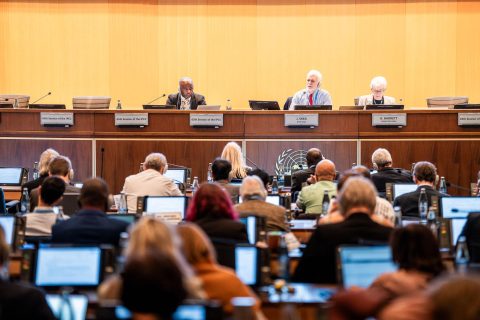

In July, PAICC said 12 countries had ignored its repeated attempts to discuss why they had not published an NDC as required every five years under the 2015 Paris accord.
Members of the committee had been divided over whether to name them, but at a September meeting decided to do so in their annual report to the annual climate COP summit.
By the time the report was published on Friday, only Congo, Senegal and North Korea “had not communicated an NDC or submitted a [Biennial Transparency Report] and had not yet responded to any of the Committee’s notifications, despite several reminders issued by the Committee in this regard”.
Rainforest and renewable energy ambitions
The silence from Congo and Senegal is notable because the former is home to much of the Congo Basin rainforest while the latter has sought billions of dollars in climate finance to support its renewable energy ambitions.
After Brazil, Congo has more rainforest than any country in the world. This forest, and the country’s peatlands, absorb huge amounts of greenhouse gas but are fast being lost to expanding farmland, charcoal production, logging and mining.
Senegal signed a Just Energy Transition Partnership with Canada and wealthy European nations in 2023, to help it meet its renewable energy targets under the-then government of Macky Sall. It was chair of the Least Developed Countries group between January 2022 and December 2023.

Tejas Rao, who is researching the PAICC as part of a doctoral thesis at Cambridge University, said the governments of the three countries should engage with the committee.
“Engagement costs these governments very little and the committee has shown it will listen,” he said.
“Silence leaves the committee with no basis to help, and it leaves the [governments] exposed to the narrative that they are simply disengaged,” he told Climate Home News.
Paris Agreement requirement
The 2015 Paris Agreement requires all parties to publish an NDC every five years outlining their emissions reduction targets, with each plan meant to be more ambitious than the country’s last NDC.
The latest set – the third round of plans, with new targets for 2035 – was due in February 2025. While most countries missed this deadline, all but around 30 – mostly small emitters but including Egypt, Vietnam and Argentina – have now submitted them.
Over the year, the PAICC – which is made up of government climate officials from developed and developing countries – has been communicating with governments that have not submitted NDCs and trying to overcome barriers to them doing so.
Some nations have cited exceptional circumstances as the reason for not submitting an NDC, a process that requires a significant amount of work in tracking emissions and consulting on how to curb them across the economy. For example, a letter from a Sudanese official to the PAICC, seen by Climate Home News, said that the country’s civil war had led to the suspension of its NDC preparation.
-
IPCC scientists vow to press on with climate reports despite political deadlock
After governments again failed to agree a timeline, nearly 120 IPCC authors pledged to complete their assessment on time and with full scientific rigour -
Under US pressure, World Bank says it will back gas “where appropriate”
The US wants the World Bank to expand its gas support while climate campaigners are pushing for it to end – its head spoke this week of limited backing for the fossil fuel -
Who shapes climate science? The equity question facing the IPCC
Early completion of the next global climate science assessment reports risks excluding research from the Global South, which is key to ensuring the findings are fair

The US and Iran are not signed up to the Paris Agreement and so do not have active NDCs, nor does Taiwan, which is not a UN member state.
Rao said that because the PAICC is “facilitative and non-punitive”, naming the countries “is meant to open a door, not close one – the invited consultation is the point”.
“In recent months, governments that explained their constraints, whether capacity, finance or domestic process, have been met with follow-up and support rather than sanction, and the number of silent governments has fallen sharply,” Rao said.
The post Paris Agreement committee names three countries snubbing it over NDCs appeared first on Climate Home News.