We handpick and explain the most important stories at the intersection of climate, land, food and nature over the past fortnight.
This is an online version of Carbon Brief’s fortnightly Cropped email newsletter. Subscribe for free here.
Key developments
High Seas Treaty milestone
OCEAN PROTECTION: The High Seas Treaty, which aims to “protect the world’s oceans and reverse damage to marine life”, will take effect next January after reaching a key milestone, BBC News reported. Morocco brought the global agreement, which was approved in 2023, to the threshold of 60 ratifications required for it to take effect. The broadcaster said: “Environmentalists heralded the milestone as a ‘monumental achievement’ and evidence that countries can work together for environmental protection.” UN chief António Guterres described it as a “lifeline for the ocean and humanity”, according to Al Jazeera.
-
Sign up to Carbon Brief’s free “Cropped” email newsletter. A fortnightly digest of food, land and nature news and views. Sent to your inbox every other Wednesday.
CLIMATE WEEK: Meanwhile, Chile and the UK joined a number of countries who have “committed to promoting ocean-based actions” in their respective national climate plans, Inside Climate News reported. Speaking at a New York Climate Week event, officials said they are considering many steps including phasing out offshore oil and gas drilling, decarbonising shipping and committing to marine ecosystem conservation. According to another Inside Climate News story, many Climate Week events are “centred around” regenerative agriculture – a method of farming that prioritises soil quality and ecosystem biodiversity. The term is now a “ubiquitous buzzword…increasingly deployed on marketing labels”, the outlet said.
OVERFISHING: Elsewhere, a “long-wrought” global agreement “aimed at reducing overfishing” took effect earlier this month, the Associated Press reported. The World Trade Organization agreement on fisheries subsidies entered into force after it was adopted by 112 countries. The AP noted that the agreement “will require countries to limit some of the $22bn in subsidies worldwide that encourage practices by fleets that deplete fish stocks and will create a ‘fish fund’ that can help developing countries implement it”. An article in the Conversation said the agreement is a “major milestone, but it’s only the beginning”.
‘Erratic’ water cycle
DELUGE TO DROUGHT: Almost two-thirds of the world’s rivers did not experience “normal” conditions in 2024, dealing with either too much or too little water, according to the World Meteorological Organization’s state of global water resources report. In its coverage, Al Jazeera said that “climate change is making the Earth’s water cycle increasingly erratic”. The report, the outlet noted, said that 2024 was the sixth year in a row with a “clear imbalance” in river basins. It was also the third consecutive year of widespread ice loss in every glacier region, the report said.
WATER IMPACTS: The report said that floods hindered agriculture in many regions in 2024, including impacting wheat harvests in Afghanistan and sweeping away almost 130,000 cows in west and central Africa. CNN’s coverage said the findings highlight “big trouble for economies and societies” dealing with the impacts of a less-predictable water cycle.. Last year was the hottest on record, with many regions “grappl[ing] with a dearth of water”, the outlet noted. Other regions, however, experienced “more floods than in other years”, a lead author on the report, Prof Stefan Uhlenbrook, told CNN. He added that some of these floods caused billions of dollars in damage.
FLOOD AFTERMATH: Meanwhile, major floods in Pakistan’s Punjab province have “wreaked havoc” on agriculture, impacting more than half a million hectares of farming land, according to the Nation. The Pakistani newspaper reported that the floods, covered in last month’s Cropped, “devastat[ed]” crops including cotton, rice, sugarcane and maize. Around 6% of Punjab’s farmland was damaged by recent floods, the newspaper said. Reuters reported that at least 220,000 hectares of rice fields flooded from the deluge between August and September. In India’s Punjab state, farmers are also dealing with the impacts of the “worst floods in four decades”, Al Jazeera said.
News and views
CASH FOR NATURE: The UK spent a record £800m on “nature protection and restoration” as part of climate aid spending last year, according to government figures obtained by Carbon Brief. The figures suggested that the country is on track to achieve its five-year pledge to provide £3bn in nature-related funds for developing countries by 2026. Meanwhile, a report from Wildlife and Countryside Link found that 38% of UK waters are in protected areas, but just 6% of land is – “far short” of the target to protect 30% of the country’s land and sea by 2030, the report said.
DEFORESTATION DELAYS: The European Commission has proposed a further one-year delay to the implementation of its anti-deforestation law, Reuters reported. The law, which is currently due to take effect this December, was already postponed by one year in late 2024. Reuters said that the commission cited concerns about IT systems. The outlet noted that both the European parliament and a majority of EU member states “must approve the delay”.
GROWING FOOD: This year looks set to see record-high production of corn, wheat, soya beans and rice, according to analysis by data scientist Dr Hannah Ritchie on her Substack, Sustainability by numbers. Looking at agricultural projections from the US Department of Agriculture, Ritchie noted that decades of steady production increases in most crops, “with the exception of sorghum and millet”, are expected to continue. Elsewhere, Australia’s ABC News reported on a new climate risk assessment that identified future farming impacts, including “shifting growing seasons…and damage to crops and livestock from extreme heat”.
VIOLENCE CONTINUES: A new Global Witness report found that 146 land and environmental defenders were killed or disappeared worldwide in 2024, Dialogue Earth reported. About 82% of those cases occurred in Latin America. Although last year had fewer murders compared to 2023, an author told the outlet that “criminalisation and other types of non-lethal attacks are on the rise”. Folha de São Paulo noted that Colombia topped the world ranking for the third consecutive year with 48 killings. The newspaper added that Indigenous peoples were victims of one-third of the attacks.
SUSTAINABLE COCOA: Increasing the cover of trees providing shade for cocoa plantations to 30% could sequester 307m tonnes of CO2-equivalent in west Africa, according to new research covered by Carbon Brief. That figure is enough to counterbalance current cocoa-related emissions in Ivory Coast and Ghana, the study notes.
COP30 INCOMING: The Brazilian government opened a funding programme worth R$12bn (£1.7bn) for “rural producers and cooperatives affected by climate events” between June 2020 and 2025, ((o))eco reported. Low rainfall in 2023 and 2024 “harmed agricultural production, especially soya beans”, the outlet noted. Elsewhere, InfoAmazonia found that deforestation and agricultural expansion means that only seven countries in the world emit more carbon than the Brazilian Amazon. Bloomberg reported that the “top US diplomat” in Brazil is due to visit COP30 host city Belém this week to discuss “deforestation and organised crime in the region”.
BIG MEAT IS WATCHING: An organisation funded by the US meat and dairy industry has “engaged in intrusive surveillance of animal rights groups”, according to DeSmog. The outlet found that the Animal Agriculture Alliance created a database of 2,400 people “linked to animal welfare and environmental groups” and “shared information with livestock companies about the romantic partners and even biological ties” of people in these groups. The organisation told DeSmog: “The Alliance shares relevant information and resources that are helpful to the food community, but does not seek to influence or direct the actions of any organisation or law enforcement.”
Spotlight
Family food at COP30
This week, Carbon Brief’s food, land and nature reporter, Yanine Quiroz, covers an initiative to serve food from the rainforest at the upcoming COP30 in November in Belém, Brazil.
Quiroz attended a press trip to Belém in September, organised by the Nature Conservancy Brazil, the Climate and Society Institute and Nature4Climate.
On the table sit bowls of cocoa, açaí, jatobá, chicory, Vitória-régia jelly and other foods typical of the Brazilian Amazon.

These foods are just a handful of the many grown in Pará by family farmers, quilombola communities, women and young people, who make up the Bragantina Network.
This network, supported by the civil-society organisation Regenera Institute and philanthropic organisation Climate and Society Institute (iCS), has pushed for a commitment from Brazil that 30% of the food served at COP30 will be sourced from family farming, agroecology and Indigenous peoples.
That would inject at least $3.3m Brazilian reals (£463,000) into family farming in Pará, according to Mauricio Alcântara, co-founder of Regenera Institute. He told Carbon Brief:
“I think this is a great achievement for family farmers.”
Alcântara said that at climate COPs, food is often “very poor and disconnected from the local culture”. The Belém summit aims to showcase the great crop diversity of Brazil’s Amazon and the sustainable practices supported by the federal government, he added.
A history of resistance
A 2024 report from Escholas Institute found that 80% of the food that reaches Belém comes from other states in Brazil, even though Pará is located in the “most biodiverse biome in the world”, Alcântara said.
That is why the Bragantina Network helps agroecological producers in Pará gain access to markets through promoting public policies. One such example is the National School Feeding Programme, which feeds 45 million children on a daily basis, Pedro Zanetti, a specialist in land-use transition, food systems and bioeconomy at iCS, told the press.

The Bragantina Network emerged in the 1990s as a movement aimed at rescuing native Amazonian seeds and products, such as cassava and manioc, that had largely disappeared from agricultural practices and diets, Maria de Nazaré Ghirardi, a family farmer and technical advisor for the Bragantina Network, said.
In Pará, there are 80 cooperatives that employ 8,000 families of farmers, according to a mapping analysis done by Regenera Institute, Frontiers of Development Institute and iCS.
Alcântara told the press:
“When we talk about the COP, in addition to generating income for many producers, it is also about showing that this food has a history. A history of climate action, community resilience, women’s empowerment and traditional communities.”
He also said that after COP30, the Bragantina Network will seek the building of public infrastructure to store the foods produced by family farms to supply the metropolitan region of Pará through public policies and the private market.
Watch, read, listen
‘GOLD RUSH’: A Mongabay video looked at the impact of gold mining on local communities, water quality and forests in the Republic of the Congo.
INDIA ISLAND ISSUES: Time reported on how India’s biodiverse Great Nicobar island is threatened by “mega” development projects put forward by the government.
NEW BLEND: The New York Times examined whether hybrid grape varieties can “solve the climate change dilemma for winemakers”.
AGRI IMPACTS: Journalist Michael Grunwald discussed his new book, “We are eating the Earth: The race to fix our food system” on US late-night talk programme, the Daily Show.
New science
- India’s government-incentivised “zero-budget natural farming” programme more than doubled farmers’ profits, improved “bird biodiversity outcomes” and maintained similar crop yields | Nature Ecology & Evolution
- Annual CO2 emissions from forest and shrub fires in China decreased over 2001-22, but increased for cropland fires, especially in the country’s north-east | Atmospheric Chemistry and Physics
- Watching documentaries can increase public interest in plant-based diets in the US, according to an analysis of search queries linked to six documentaries and consumption data | Nature Food
In the diary
- 24 September: UN special high-level event on climate action | New York
- 26 September: World maritime day
- 29 September: International day of awareness of food loss and waste
- 30 September-1 October: 42nd UN-Water Meeting | Geneva, Switzerland
Cropped is researched and written by Dr Giuliana Viglione, Aruna Chandrasekhar, Daisy Dunne, Orla Dwyer and Yanine Quiroz. Please send tips and feedback to cropped@carbonbrief.org
The post Cropped 24 September 2025: High Seas Treaty milestone; ‘Erratic’ water cycle; Family food at COP30 appeared first on Carbon Brief.
Cropped 24 September 2025: High Seas Treaty milestone; ‘Erratic’ water cycle; Family food at COP30

Three countries have been named by the Paris Agreement’s compliance committee for failing to submit a nationally determined contribution (NDC) and repeatedly snubbing offers of help with their climate plans.
After months of internal debate over whether to identify serial non-responders, the Paris Agreement’s Implementation and Compliance Committee (PAICC) named the three countries which have failed to engage with it over their NDCs on Friday.
It named Democratic Republic of Congo, Senegal and North Korea in a footnote of its annual report, adding that it decided to name them “with a view to facilitating engagement”, adding that representatives of the three nations had been invited to its meeting in early 2027 “with the purpose of identifying any challenges and constraints”.
“The Committee noted the importance of Parties engaging with the Committee in a timely manner, while noting that some delays may be due to the national capabilities and circumstances of the Parties”, the report said.
-
Under US pressure, World Bank says it will back gas “where appropriate”
The US wants the World Bank to expand its gas support while climate campaigners are pushing for it to end – its head spoke this week of limited backing for the fossil fuel -
IPCC scientists vow to press on with climate reports despite political deadlock
After governments again failed to agree a timeline, nearly 120 IPCC authors pledged to complete their assessment on time and with full scientific rigour -
Paris Agreement committee snubbed over missing NDC climate plans
Many governments have still not submitted a nationally determined contribution to the UN, breaching a key requirement of the Paris Agreement

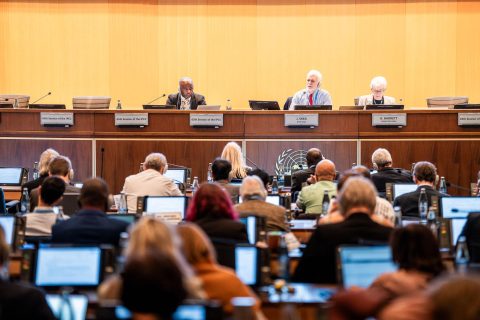

In July, PAICC said 12 countries had ignored its repeated attempts to discuss why they had not published an NDC as required every five years under the 2015 Paris accord.
Members of the committee had been divided over whether to name them, but at a September meeting decided to do so in their annual report to the annual climate COP summit.
By the time the report was published on Friday, only Congo, Senegal and North Korea “had not communicated an NDC or submitted a [Biennial Transparency Report] and had not yet responded to any of the Committee’s notifications, despite several reminders issued by the Committee in this regard”.
Rainforest and renewable energy ambitions
The silence from Congo and Senegal is notable because the former is home to much of the Congo Basin rainforest while the latter has sought billions of dollars in climate finance to support its renewable energy ambitions.
After Brazil, Congo has more rainforest than any country in the world. This forest, and the country’s peatlands, absorb huge amounts of greenhouse gas but are fast being lost to expanding farmland, charcoal production, logging and mining.
Senegal signed a Just Energy Transition Partnership with Canada and wealthy European nations in 2023, to help it meet its renewable energy targets under the-then government of Macky Sall. It was chair of the Least Developed Countries group between January 2022 and December 2023.

Tejas Rao, who is researching the PAICC as part of a doctoral thesis at Cambridge University, said the governments of the three countries should engage with the committee.
“Engagement costs these governments very little and the committee has shown it will listen,” he said.
“Silence leaves the committee with no basis to help, and it leaves the [governments] exposed to the narrative that they are simply disengaged,” he told Climate Home News.
Paris Agreement requirement
The 2015 Paris Agreement requires all parties to publish an NDC every five years outlining their emissions reduction targets, with each plan meant to be more ambitious than the country’s last NDC.
The latest set – the third round of plans, with new targets for 2035 – was due in February 2025. While most countries missed this deadline, all but around 30 – mostly small emitters but including Egypt, Vietnam and Argentina – have now submitted them.
Over the year, the PAICC – which is made up of government climate officials from developed and developing countries – has been communicating with governments that have not submitted NDCs and trying to overcome barriers to them doing so.
Some nations have cited exceptional circumstances as the reason for not submitting an NDC, a process that requires a significant amount of work in tracking emissions and consulting on how to curb them across the economy. For example, a letter from a Sudanese official to the PAICC, seen by Climate Home News, said that the country’s civil war had led to the suspension of its NDC preparation.
-
IPCC scientists vow to press on with climate reports despite political deadlock
After governments again failed to agree a timeline, nearly 120 IPCC authors pledged to complete their assessment on time and with full scientific rigour -
Under US pressure, World Bank says it will back gas “where appropriate”
The US wants the World Bank to expand its gas support while climate campaigners are pushing for it to end – its head spoke this week of limited backing for the fossil fuel -