



- What timeline options were delegates debating?
- How did the timeline discussions unfold?
- What were the main points of disagreement?
- Why is the IPCC in a ‘serious funding crisis’?
- How have scientists reacted?
- What other issues remain unresolved?
- How are the IPCC AR7 reports progressing?
- How might the IPCC use AI and enhance gender inclusivity?

Hello! My Name is Athena Geer, and I am the Youth Climate Justice Coordinator here at Climate Generation.
I get the honor and immense privilege of co-facilitating our Youth Environmental Activist Program (YEA)!. YEA! is a network for and by young people. From weekly programming to our annual Youth Climate Justice Summit (YCJS), the leaders in our program are acting on systems perpetuating the climate crisis. We gather every Wednesday, and each meeting is a space for students to co-collaborate, plan, and lead. Each member runs a meeting, practicing in this space, so they can organize and lead in their own communities and schools. This year was full of co-mentorship and learning. We explored how climate justice connects with our individual lives and our communities, dove deep into policy, and learned with and from community leaders. YCJS brings all of this energy together in one place, a culmination of organizing by students to bring a network of young people from across the state to advocate for climate justice policies they care about. It has been incredible to collaborate with these changemakers. Their creativity, insight, and passion are helping move this movement forward.
This has been a transformative year, and I invite you to follow along as I share a few highlights for each arc and stay tuned towards the end to witness some pieces from our students!
Climate Justice 101
We first started the programming year with our Climate Justice 101 Arc, where students got to understand and re-establish the current status of the climate movement in Minnesota, and also got to learn topics like Capitalism vs. The Climate Crisis, Intersectionality in Climate organizing, and The Root Cause, Tree Activity. The Root Cause Tree activity is taught at the beginning of the year to enable students to highlight the impacts of capitalism and its varied levels of structures to understand its further harm on the climate crisis. In this activity, students use a metaphorical tree to highlight how the Roots of the tree (capitalism, colonialism) then hold up the trunk (power structures) to then hold the branches (institutions), to then hold the leaves (interpersonal acts) that perpetuate the climate crisis. This tree correlates to our collective change efforts; the further down the tree we go, the more effective and long-term that change can be, but also the harder it can be, and vice versa. Students then learn in the end that, in order to create the most long-lasting change, we need big and bold climate solutions that address the root causes of the issue.
Students the following week, then got to watch that in action! Students watched “Youth v Gov,” a powerful story about 21 plaintiffs between the ages of 13 and 24 who sued the US Government for unsafe living conditions and perpetuating the climate crisis.


Fast Fashion
We then started our second arc: Fast Fashion. Students had the opportunity to explore how the current state of textile waste and cheap fast fashion is and are impacting the climate crisis. Students got to learn about greenwashing in the clothing industry, Learn about communities who are impacted by fast fashion, and students also got to learn how to mend the clothes to last longer from our friends at REuse MN! In addition to learning how to mend, Students then held a community clothing swap for friends and peers to join and share already existing clothes to help slow the spread of consumerism in fast fashion!

Human Migration
In spring, we transitioned to our third arc: Human Migration! Students dove into international conversations around human migration. We were joined by our friends at COPAL to have a conversation about the current narratives on human migration and its intersection with the climate crisis via on-the-ground work, community conversation, and understand what needs are truly needed when talking about migrations of people. Students also learned about climate displacement and migration work happening in the continent of Africa from our friends at the Mortensen Family Foundation. Margretta talked about how “Migration is not a NEW topic of conversation, but that climate is changing and it’s forcing people to move” and discussed with students about how this impacted the social impacts, the economic impacts, and also the cultural and emotional impacts of people having to move. Students also during this arc got the chance to attend a play on how the migration of people and the climate crisis are deeply linked, using themes like water, sacredness, and liberation.


Storytelling
Our final arc of the programming year was storytelling. Storytelling is a crucial and pivotal tool used to explain, invoke emotions, and pass down information. Students spent a few weeks working on individual pieces that they showcased these pieces at our end-of-year storytelling slam! Students got to put all their learning and thoughts throughout the year together in an assortment of art pieces to showcase to friends and family! Some students wrote personal climate narratives, while others drew and painted art pieces, some wrote poems, while others wrote climate stories. In the end, students were able to reflect on the year and celebrate the amazing learning space created together.

Beneath, still branches
the machine grinds through silence,
faces wet with grief.
Haiku, written by Spencer Snyder
After an amazing time during summer programming, we will be starting YEA! programming this fall. Learn more about our program and email yea@climategen.org, OR athena@climategen.org, OR ramiro@climategen.org for more information.

Athena Geer is a Somali-American who grew up in the Cedar-Riverside/Phillips neighborhood. Athena came to YEA! 6 years ago and learned about the framework of climate justice, the importance of climate literacy, and the concept of youth agency. Athena hopes to give and aspire youth to take hands on their climate journey and that they are there to support them in that. Athena enjoys journaling, songwriting, and playing with their purfect roommate, Leona the kitten.
The post YEA! 2025 Updates appeared first on Climate Generation.
Continue Reading
Three countries have been named by the Paris Agreement’s compliance committee for failing to submit a nationally determined contribution (NDC) and repeatedly snubbing offers of help with their climate plans.
After months of internal debate over whether to identify serial non-responders, the Paris Agreement’s Implementation and Compliance Committee (PAICC) named the three countries which have failed to engage with it over their NDCs on Friday.
It named Democratic Republic of Congo, Senegal and North Korea in a footnote of its annual report, adding that it decided to name them “with a view to facilitating engagement”, adding that representatives of the three nations had been invited to its meeting in early 2027 “with the purpose of identifying any challenges and constraints”.
“The Committee noted the importance of Parties engaging with the Committee in a timely manner, while noting that some delays may be due to the national capabilities and circumstances of the Parties”, the report said.
-
Under US pressure, World Bank says it will back gas “where appropriate”
The US wants the World Bank to expand its gas support while climate campaigners are pushing for it to end – its head spoke this week of limited backing for the fossil fuel -
IPCC scientists vow to press on with climate reports despite political deadlock
After governments again failed to agree a timeline, nearly 120 IPCC authors pledged to complete their assessment on time and with full scientific rigour -
Paris Agreement committee snubbed over missing NDC climate plans
Many governments have still not submitted a nationally determined contribution to the UN, breaching a key requirement of the Paris Agreement
In July, PAICC said 12 countries had ignored its repeated attempts to discuss why they had not published an NDC as required every five years under the 2015 Paris accord.
Members of the committee had been divided over whether to name them, but at a September meeting decided to do so in their annual report to the annual climate COP summit.
By the time the report was published on Friday, only Congo, Senegal and North Korea “had not communicated an NDC or submitted a [Biennial Transparency Report] and had not yet responded to any of the Committee’s notifications, despite several reminders issued by the Committee in this regard”.
Rainforest and renewable energy ambitions
The silence from Congo and Senegal is notable because the former is home to much of the Congo Basin rainforest while the latter has sought billions of dollars in climate finance to support its renewable energy ambitions.
After Brazil, Congo has more rainforest than any country in the world. This forest, and the country’s peatlands, absorb huge amounts of greenhouse gas but are fast being lost to expanding farmland, charcoal production, logging and mining.
Senegal signed a Just Energy Transition Partnership with Canada and wealthy European nations in 2023, to help it meet its renewable energy targets under the-then government of Macky Sall. It was chair of the Least Developed Countries group between January 2022 and December 2023.

Tejas Rao, who is researching the PAICC as part of a doctoral thesis at Cambridge University, said the governments of the three countries should engage with the committee.
“Engagement costs these governments very little and the committee has shown it will listen,” he said.
“Silence leaves the committee with no basis to help, and it leaves the [governments] exposed to the narrative that they are simply disengaged,” he told Climate Home News.
Paris Agreement requirement
The 2015 Paris Agreement requires all parties to publish an NDC every five years outlining their emissions reduction targets, with each plan meant to be more ambitious than the country’s last NDC.
The latest set – the third round of plans, with new targets for 2035 – was due in February 2025. While most countries missed this deadline, all but around 30 – mostly small emitters but including Egypt, Vietnam and Argentina – have now submitted them.
Over the year, the PAICC – which is made up of government climate officials from developed and developing countries – has been communicating with governments that have not submitted NDCs and trying to overcome barriers to them doing so.
Some nations have cited exceptional circumstances as the reason for not submitting an NDC, a process that requires a significant amount of work in tracking emissions and consulting on how to curb them across the economy. For example, a letter from a Sudanese official to the PAICC, seen by Climate Home News, said that the country’s civil war had led to the suspension of its NDC preparation.
-
IPCC scientists vow to press on with climate reports despite political deadlock
After governments again failed to agree a timeline, nearly 120 IPCC authors pledged to complete their assessment on time and with full scientific rigour -
Under US pressure, World Bank says it will back gas “where appropriate”
The US wants the World Bank to expand its gas support while climate campaigners are pushing for it to end – its head spoke this week of limited backing for the fossil fuel -
Who shapes climate science? The equity question facing the IPCC
Early completion of the next global climate science assessment reports risks excluding research from the Global South, which is key to ensuring the findings are fair
The US and Iran are not signed up to the Paris Agreement and so do not have active NDCs, nor does Taiwan, which is not a UN member state.
Rao said that because the PAICC is “facilitative and non-punitive”, naming the countries “is meant to open a door, not close one – the invited consultation is the point”.
“In recent months, governments that explained their constraints, whether capacity, finance or domestic process, have been met with follow-up and support rather than sanction, and the number of silent governments has fallen sharply,” Rao said.
The post Paris Agreement committee names three countries snubbing it over NDCs appeared first on Climate Home News.
Paris Agreement committee names three countries snubbing it over NDCs
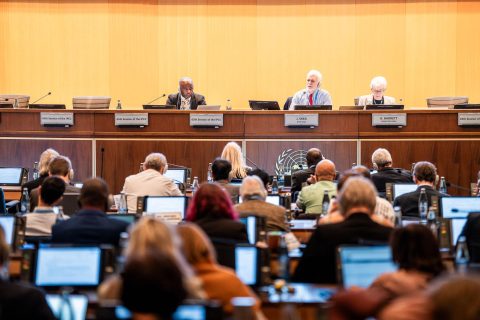
Countries have failed – for the sixth time running – to agree on the timeline for publishing the Intergovernmental Panel on Climate Change’s (IPCC) next set of influential reports.
The IPCC’s 65th session (IPCC-65) was seen by many to be the final opportunity for countries to agree on a schedule where its seventh assessment report (AR7) would be published in time for the UN’s second “