Connect with us

Published

on

A record number of heat-related “emergencies” have been triggered by councils this year to help rough sleepers in England and Wales, Carbon Brief analysis reveals.

As climate change drives more heat extremes, there is a growing recognition that homeless people face a higher risk of illness and even death when temperatures soar.

This summer has been the hottest on record in the UK, with official warnings about heat-related health threats issued across every part of England and Wales.

The main tool councils have to help people sleeping rough during dangerously hot periods is the “severe weather emergency protocol” (SWEP).

Freedom-of-information (FOI) requests submitted by Carbon Brief to 93 local authorities across England and Wales with significant rough-sleeper populations reveal that SWEP use has surged this year.

Many councils have used the protocol to provide water, sunscreen and “cool spaces” for rough sleepers.

However, at least 20 councils said they have never triggered a SWEP during the summer months and others failed to provide any information when asked.

Dangerous heat

Climate change is increasing the severity of dangerously hot weather in the UK and these conditions harm certain groups more than others.

People sleeping rough are both more exposed to heat due to their living conditions and more likely to experience heat-related illness, due to underlying health conditions and other issues.

Councils shoulder much of the responsibility for helping homeless people in England – the part of the UK that faces the most extreme heat – as well as in Wales.

The main mechanism councils have to deal with weather extremes is the SWEP, which can involve giving emergency shelter to rough sleepers, among other things. There is no legal obligation to use SWEPs, meaning their implementation is not consistent or universal.

SWEPs have traditionally been a response to cold weather, but there has been growing awareness in the UK of the risk posed by heat, particularly since the extreme temperatures of summer 2022.

Charities and researchers have highlighted this issue and argued for hot-weather use of SWEPs as a necessary precaution to protect rough sleepers during heatwaves. In 2023, the UK government issued its first guidance for helping homeless people during hot weather.

Record SWEP

To investigate how local authorities are helping rough sleepers deal with heat extremes, Carbon Brief sent FOI requests to 90 councils in England and three in Wales.

This covers all areas with a sizable rough-sleeper population (see: Methodology). It also includes 33 London boroughs, which together are home to a quarter of the homeless population in England and Wales, plus the Greater London Authority.

Carbon Brief asked whether councils had been using SWEPs, how often and on which dates, during the summer months from 2022 to 2025.

This period saw the UK Health Security Agency (UKHSA) announce around 40 “heat-health alerts” across different parts of England, indicating temperatures that threaten public health.

The council FOI results reveal a surge in SWEP usage in 2025, as the UK faced its hottest ever summer. Just half way through summer in mid-July, councils had already collectively triggered SWEPs at least 149 times – up from 93 in the entirety of summer in 2024, as the chart below shows.
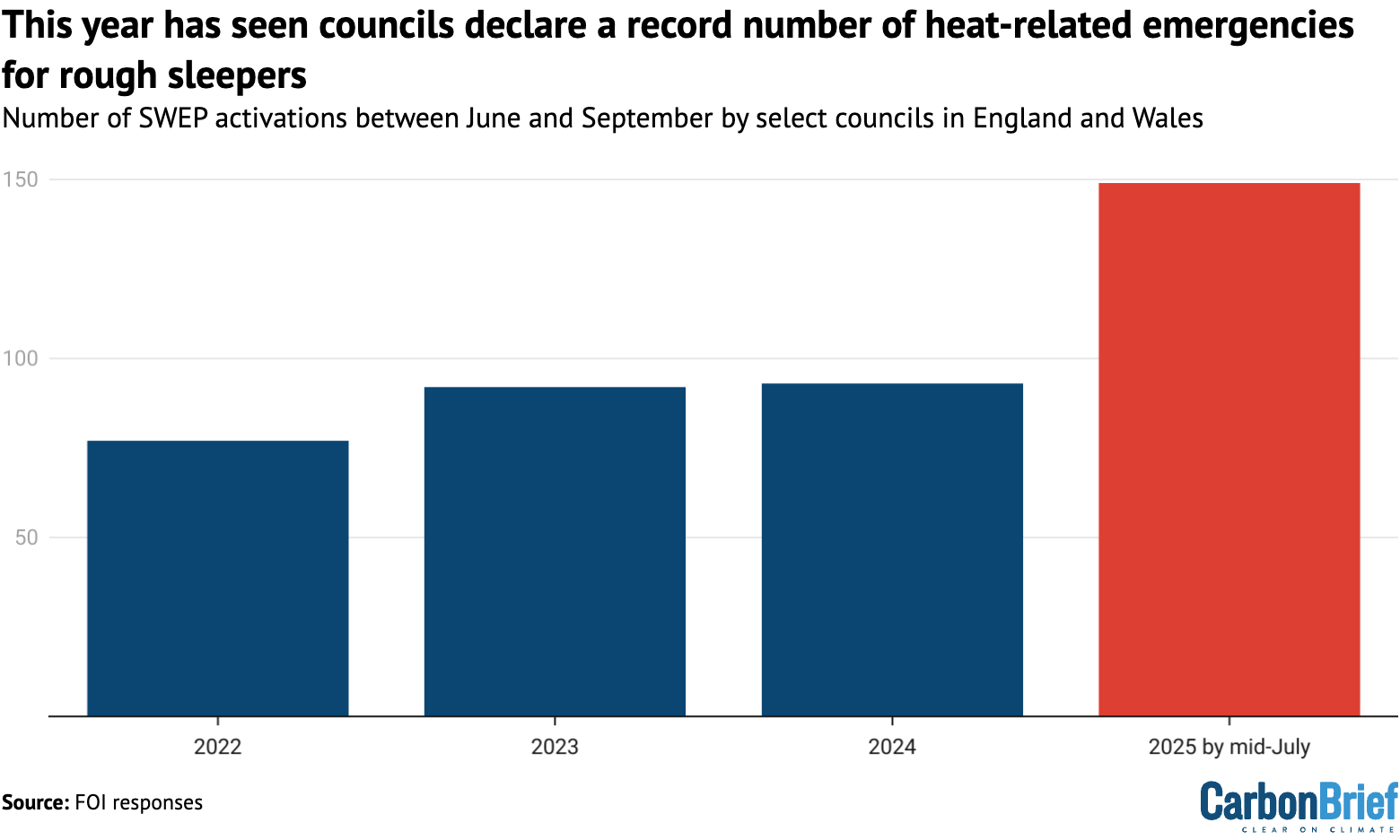
Bar chart showing that this year (2025) has seen councils declare a record number of heat-related emergencies for rough sleepers
Total annual number of SWEP activations by select councils in England and Wales with significant rough-sleeper populations. The data for 2025 only includes dates up to 17 July, whereas the other years cover the whole of June-September. Source: FOI responses.

Not all SWEP activations are the same, with some councils using it for single days and others triggering it for longer stretches.

Nevertheless, roughly the same trend emerges when looking at the total number of days that councils have activated SWEPs since 2022. By mid-July, 2025 had already seen the longest period of SWEP activation, as the chart below shows.
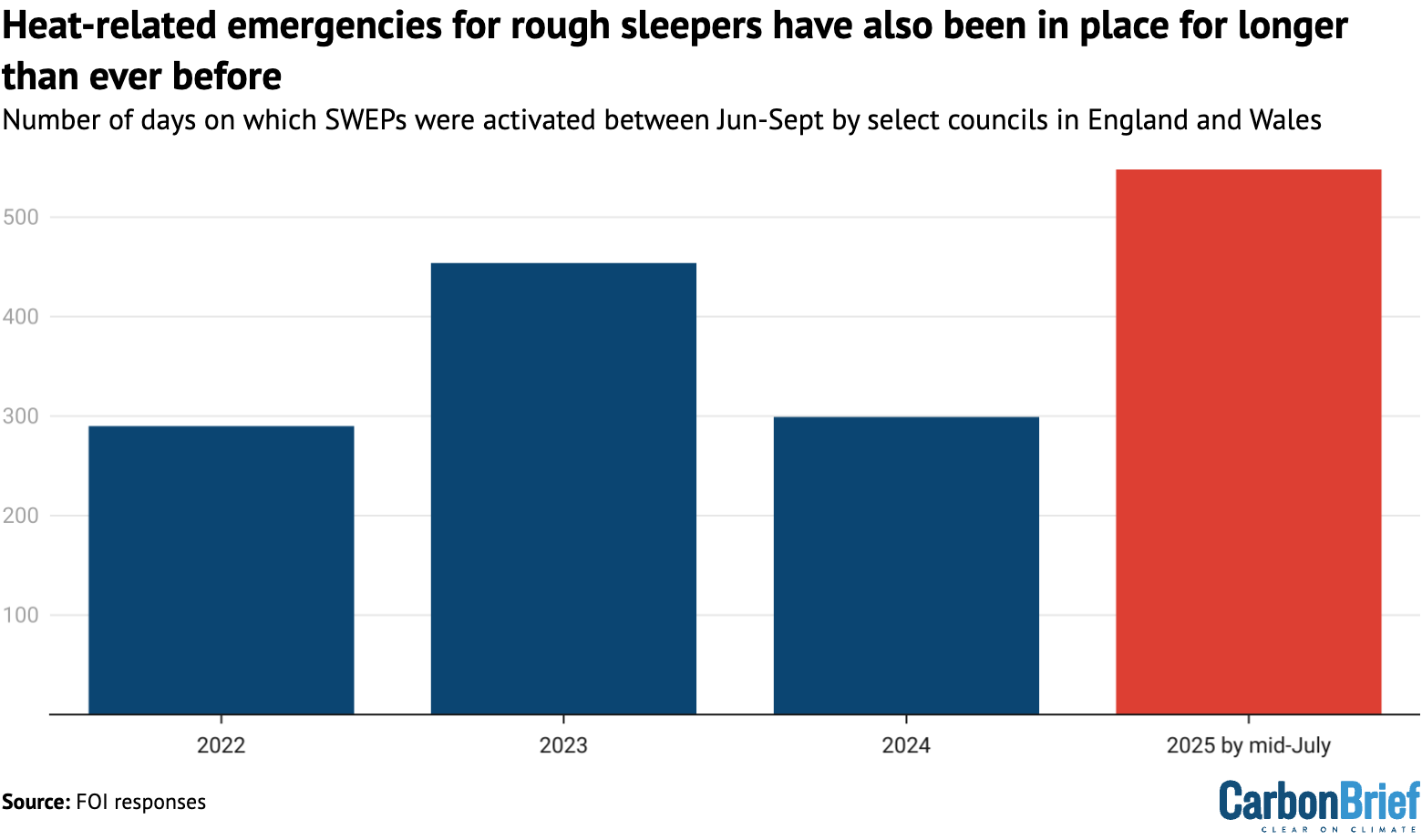
Bar chart showing that heat-related emergencies for rough sleepers have also been in place for longer than ever before
Total annual number of days on which SWEPs were activated by select councils in England and Wales with significant rough-sleeper populations. The data for 2025 only includes dates up to 17 July, whereas the other years cover the whole of June-September. Source: FOI responses.

The surge in SWEP activation mirrors both the record UK heat in 2025 and the growing salience of this issue, with more councils making use of it during the summer months. By July, 48 councils had triggered heat-related use of SWEPs this year, compared to just 36 two years earlier.

The increase may also reflect the numbers of people sleeping rough, which have surged in England over this time period, while remaining relatively steady in Wales.

‘Inadequate’ assistance

Previous analysis in 2023 by the Museum of Homelessness, a London-based organisation that researches homelessness, concluded that SWEPs were “inconsistently applied” and “inadequate”. It highlighted particular shortcomings in heat-related use of SWEPs.

Despite the surge in SWEP use this year, the data provided to Carbon Brief suggests that some councils are still not responding urgently to periods of extreme heat.

Of the 93 councils that Carbon Brief requested data from, 59 – or 63% – confirmed that they had activated SWEPs at least once during the summer months between 2022 and 2025, as shown in the figure below.

Common provisions resulting from this activation included the distribution of sunscreen, bottles of water and sun hats, as well as making “cool spaces” available and providing extra welfare checks. Most councils did not mention providing emergency accommodation.
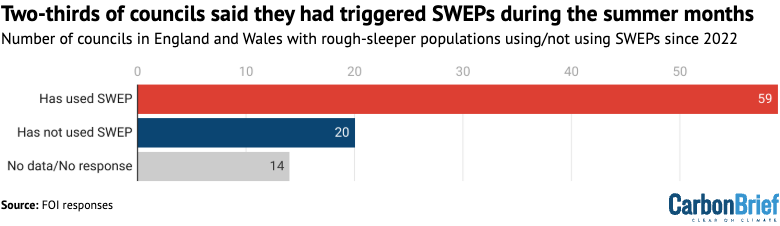
Bar chart showing that two-thirds of councils said they had triggered SWEPs during the summer months
Number of select councils in England and Wales that indicated they have or have not used SWEPs between June and September, since 2022. Source: FOI responses.

Among the remainder, 14 councils either did not hold the data requested or never responded.

This leaves 20 councils that stated they did not trigger SWEPs at all during summers over this period, including those in Manchester, Nottingham and Cornwall.

All of the regions covered by these local authorities were issued with heat-health alerts in 2025.

Some of these councils said they were mindful of hot weather and mentioned other actions taken during these periods, some of which overlapped with SWEP responses.

Other councils, including Plymouth, Hastings and the London boroughs of Waltham Forest and Barking and Dagenham, did not mention any provisions for rough sleepers during periods of extreme heat.

Matthew Turtle, co-director of the Museum of Homelessness, tells Carbon Brief:

“These findings, like our own research, show that many councils opt not to help people who need it the most when there is extreme weather…This is not just smaller councils, but includes major towns and cities across the UK, who simply have no emergency protocol in place to protect people who are homeless during spells of extreme weather.”

Turtle argues that the use of SWEP should be made a legal duty in order to guarantee protection from extreme weather for those sleeping rough.

Researchers have argued that extreme heat should be taken more seriously by authorities when dealing with rough sleepers, with one study finding that homeless people in London were 35% more likely to be hospitalised at 25C compared to 6C. The authors suggest this is because people are better prepared for the threat of cold weather.

Dr Becky Ward, a researcher at the University of Southampton who is investigating how climate change interacts with homelessness, tells Carbon Brief that “the conversation is changing and awareness is building” about this issue. She adds:

“There’s a more fundamental need to improve the provision of shelter for people experiencing homelessness, alongside providing psychological support to address the causes and maintaining factors for people who are rough sleeping.”

Methodology

Carbon Brief obtained the list of 93 local authorities with significant rough-sleeping populations in England and Wales from the Museum of Homelessness. The criteria for this included being in one of the top 50 most populated cities in the UK, having a rough sleeping count of at least 15 people and/or being a London borough. These councils make up 28% of the 317 local authorities in England and 14% of those in Wales.

FOI requests were sent to these councils, asking for details of when SWEPs were activated and for how long over the summers of 2022-2025, as well as information about what activities this involved. (These requests were sent in mid-July, meaning data for 2025 is only for half the summer period.)

Carbon Brief asked for SWEP activations between June and September, mirroring the timescale used by the UKHSA and the Met Office for their heat-health alert service.

The results demonstrate the ad-hoc nature of SWEP use, with different councils using it in different ways and some relying on third-party organisations to coordinate their responses. Nevertheless, the combined results capture overall trends.

Some 20 councils said they did not record SWEP activations, or only kept partial records. Another five never responded to Carbon Brief’s FOI request.

In this article, Carbon Brief has used the term “rough sleeper” when referring to people sleeping outside or in other spaces not designed for people to stay. When referring to studies or datasets that cover the wider homeless population, the term “homeless” has been used.


The post Revealed: Use of heat ‘emergencies’ for rough sleepers hits record in England and Wales appeared first on Carbon Brief.

Revealed: Use of heat ‘emergencies’ for rough sleepers hits record in England and Wales

Continue Reading

Climate Change

DeBriefed 29 May 2026: Europe’s ‘mind-boggling’ May | Indian heat deaths | Nigeria’s solar mini-grids

Published

on

Welcome to Carbon Brief’s DeBriefed.
An essential guide to the week’s key developments relating to climate change.

This week

UK, Europe and India battle heatwaves

‘MIND-BOGGLING’ MAY: The UK and continental Europe have set “mind-boggingly crazy”  temperature records for May amid a deadly heatwave, reported the Financial Times. According to the Associated Press, the UK “smashed a century-old temperature record for the second time in 24 hours on Tuesday”. The newswire added that records “also fell in France, where temperatures reached 36C on Monday in the country’s south-west”. On Wednesday, Portugal hit a record May temperature of 40.3C, said BBC News.

‘BRUTAL REMINDER’:  In parts of Italy, the heatwave triggered blackouts, reported Reuters. The heatwave has also been linked to more than a dozen deaths in the UK and France, including from people drowning and suffering heat-related deaths while competing in sporting events, said ABC News. Simon Stiell, the executive secretary of UN Climate Change, said the intense heatwaves were a “brutal reminder” of the cost of global warming, reported Politico. Carbon Brief has in-depth coverage of the record-shattering heatwave.
INDIA’S DEADLY HEAT: In the southern Indian states of Andhra Pradesh and Telangana, more than 100 people died within three days following an intense heatwave, reported the Khaleej Times. The publication noted that authorities urged people to stay indoors and avoid direct exposure to the heat. Meanwhile, some parts of India are “grappling with power cuts as record-breaking heat has pushed electricity demand ​to an all-time high”, reported Reuters.

Around the world

  • CRUDE DIPS: The International Energy Agency (IEA) said global investments in oil projects will fall below $500bn in 2026, continuing a three-year decline, reported Bloomberg. Carbon Brief’s analysis of the data shows the US’s “data-centre boom” means it is now investing more in fossil-fuel power than China.
  • DODGING NET-ZERO: The world’s biggest miner, Australian giant BHP, has backtracked on climate action by halting or delaying projects to cut “vast” amounts of emissions, according to a Guardian investigation.
  • SOLAR SLIP: China’s new solar installations dropped for a fourth straight month, reflecting weakening domestic demand, said Bloomberg.
  • NO LOGGING: Deforestation in the Brazilian Amazon fell last year to its lowest level since 2019, according to a new report, said Agence France-Presse.
  • EXECUTIVE ACTION: Puerto Rico’s governor announced a state of emergency to fight a surge in coastal erosion, citing the need to protect natural resources and vulnerable communities, reported the Associated Press.

Four million

The number of homes in the UK with air conditioning, double the figure from three years ago, reported the Guardian. There are 29m households in the UK.


Latest climate research

  • Carbon Brief will soon be launching a new fortnightly newsletter focused on climate research. Sign up for free today.
  • LGBTQ+ households in the US are “significantly more likely” to face energy poverty and insecurity than the general population | Energy Research & Social Science
  • Global rice-paddy greenhouse gas emissions have doubled over the past six decades | Nature Food
  • Vegetation greening and human-caused warming are the “main drivers” of a surge in flash floods over the last decade | Science Advances

(For more, see Carbon Brief’s in-depth daily summaries of the top climate news stories on Tuesday, Wednesday, Thursday and Friday.)

Captured

Map of the UK showing that at least 67 NHS sites have been forced to close due to weather-related flooding since 2021

A Carbon Brief investigation has shed light on the impact of weather-related flooding on National Health Service (NHS) facilities across the UK. At least 67 NHS hospital wards, departments and other sites have been forced to temporarily close or relocate due to weather-related flooding. The chart above shows sites of weather-related flooding incidents at NHS facilities. The size of the circles indicates the number of incidents reported at each site.

Spotlight

How solar mini-grids can ‘help boost’ Nigeria’s economy

This week, Carbon Brief covers a new report on Nigeria’s solar mini-grid industry.

Amid the impact of the US-Iran war on the Nigerian economy, a new report has argued that solar-mini grids can help to reduce the country’s reliance on fossil fuels and create more than 200,000 jobs.

In Nigeria, Africa’s third-largest economy, the war has led to an increase in energy prices and a decrease in petrol consumption. Petrol is one of the country’s main sources of transport and household fuel. According to one estimate, prices have surged by up to 40% since the conflict commenced in February.

Although the Nigerian treasury has benefited from rising crude oil prices – the country is a major exporter of oil and gas – the impact has been most visible on the wider population.

Rising energy prices “have affected the purchasing power of workers”, Agnes Funmi Sessi, a labour union leader in Lagos, told Carbon Brief.

However, scaling the deployment of solar “mini-grids” could help the country move away from fossil fuels, stimulate rural economies and improve livelihoods, according to the new report authored by the thinktank, the Africa Policy Research Institute.

“We estimate that, by deploying over 10,000 mini-grids, the sector could create 212,688 direct full-time informal and productive-use jobs across the off-grid and under-grid market segments,” the report said.

A nascent industry

Solar “mini-grids” are small-scale, localised electricity generation and distribution systems powered by solar panels.

The report positioned Nigeria’s mini-grid sector as one of the fastest-growing in Africa, with the country having just 11 mini-grids in 2015 and 155 by 2024, along with at least 42 active developers.

Many of the companies within the sector are young and apply novel local techniques in their deployment of solar technology, the report said.

However, access to finance remains a huge barrier. According to the report, the sector may require up to $8bn to connect 35.4 million people to mini-grids.

“Most Nigerians want solar power in their homes, but it is a capital intensive business for vendors and customers,” Dr Ben Iheagwara, a renewable energy entrepreneur and policy analyst, told Carbon Brief.

The report urged the Nigerian government and its international partners to “attract private capital by de-risking investments and ensuring regulatory clarity and long-term planning”.

Other key recommendations for policymakers and stakeholders include investment in skills development and paying attention to the gender gap.

Powering rural communities

Many rural communities, which make up about 37% of the country, are disconnected from the national grid system, so often have to generate their own electricity through mini-grid systems.

According to Nigeria’s electricity regulator, NERC, a mini-grid is defined as a power generating system with an installed capacity of up to 10 megawatts.

A mini-grid can be powered by fossil fuels such as diesel or petrol, but solar power is now considered a cheaper and cleaner source.

With more than 80 million people lacking access to electricity in Nigeria, solar mini-grids are increasingly viewed as the lowest-cost electrification solution, the report said.

Watch, read, listen

MOVING FORWARD: The Energy Transition Show dug into electricity reform in South Africa, discussing the country’s coal legacy and the role of renewables.

ENERGY POVERTY: In an opinion article for Project Syndicate, executive director of the African Climate Foundation, Saliem Fakir, argued that the energy transition in emerging and developing economies is driven by economics and security rather than emissions targets.
VANISHING CITY: BBC News reported on a coastal community in Nigeria where the ocean has “already swallowed more than half of the town”.

Coming up

Pick of the jobs

DeBriefed is edited by Daisy Dunne. Please send any tips or feedback to debriefed@carbonbrief.org.

This is an online version of Carbon Brief’s weekly DeBriefed email newsletter. Subscribe for free here.

The post DeBriefed 29 May 2026: Europe’s ‘mind-boggling’ May | Indian heat deaths | Nigeria’s solar mini-grids appeared first on Carbon Brief.

DeBriefed 29 May 2026: Europe’s ‘mind-boggling’ May | Indian heat deaths | Nigeria’s solar mini-grids

Continue Reading

Climate Change

Q&A: How can African electricity access power jobs not just lightbulbs?

Published

on

At the African Development Bank (AfDB) annual meetings this week, several African leaders called for investments in electricity infrastructure which go beyond lighting homes to powering economies.

Applauding the AfDB for its energy programmes like Mission 300 – which aims to provide electricity access to 300 million Africans by 2030 – the Central African Republic’s President Faustin-Archange Touadera said that without power supply “we will not be able to achieve development”.

Speaking alongside him, the Republic of Congo’s President Denis Sassou Nguesso echoed this, saying that “as we need to help our people to turn towards agriculture, to turn towards livestock rearing, we also need to provide power to them.”

As the Mission 300 initiative advances, attention is increasingly shifting from simply connecting households to ensuring that electricity access translates into economic opportunities and livelihoods. That shift is driving the launch of a new Centre of Excellence for Productive Use of Energy being developed under Mission 300 by the philanthropically funded Global Energy Alliance for People and Planet (GEAPP).

    In an interview with Climate Home News, Carol Koech, GEAPP’s vice president for Africa, said the initiative is designed to ensure that electrification supports income generation, agriculture and local economic development rather than only basic household access.

    Q: What is the Centre of Excellence for Productive Use of Energy aiming to achieve with Mission 300?

    A: Mission 300 is increasingly being seen as a job platform and so the role of the Centre of Excellence in translating those electricity connections to jobs. So we want the centre to do four things. First, as a delivery engine, which enables countries to embed a cross-institutional advisor that supports the electrification components, but also other components that are happening in the country.

    Second, we want the centre to be an innovation and strategy hub. Today, there’s really no place where you can go to find the state of the industry for productive use of energy across the globe, and we want to make the centre of excellence the place where you can go and get information about what technologies are available, where deployment is happening and how much is being deployed.

    Campaigners in Africa are demanding their governments stop the development of fossil fuels on the continent and embrace the opportunities of renewable energy
    (Photo: Lighting Global/SunCulture/World Bank)

    The third pillar is to coordinate and mobilise capital. We anticipate the centre coordinating internally within the ecosystem but also mobilising additional financing to help productivity. The last piece is how to scale businesses, enterprises and partnerships around this centre because we anticipate that as we grow this space, new industries will emerge and those industries will need to be supported.

    Q: Why is productive use of energy becoming important under Mission 300?

    A: Mission 300 gave us a bigger platform to demonstrate that energy is truly an enabler for economic development. It’s not sufficient to just provide a connection, but it is required that that connection truly translates to economic development for the communities that benefit.

    We shouldn’t bring electricity and then start thinking about what people can do with it. We need to think about both at the same time and ensure electricity arrives together with the things that will make a difference in people’s lives. Historically, we’ve brought electricity and imagined a miracle would happen, but we know that hasn’t been the case.

    The question is how to ensure universal access in the cheapest way while still transforming communities. Some mini-grids have been deployed in places where demand is extremely low, making them too expensive to sustain. But when mini-grids are paired with productive uses, the economics start to change. If businesses currently running on fossil fuel generators move to solar or renewable energy, operating costs fall and the business case for mini-grids becomes much stronger.

    Q: How could this work in practice for agriculture and rural communities?

    A: I’ll give you a practical example in our pilot country Zambia. Zambia has two programmes, they have the ASCENT programme for energy access and they also have the Zambia agribusiness and trade platform (ZATP). Some of the components of the ZATP programme – which is an agri-business program to help farmers to be productive – have a productive use component but don’t have an energy supply component. So we’re offering things like mills, processing facilities, irrigation and others. In some parts of Zambia, these productive use equipment has been supplied but has not been powered, so communities are not benefiting from that.

    So the whole point is if we coordinate where the agribusiness programme is deployed together with where the energy access programme is deployed and layer those two programmes together in one place, then you could solve the energy access problem and solve productive use together and therefore have really meaningful outcomes for communities.

    Q: How will the centre help both households and small businesses use electricity productively?

    A: The question on whether we should electrify households or businesses is neither here nor there. We need to electrify all. The argument is really once we electrify businesses, the owners of those businesses will be able to pay what they need for their households as well as increase production for their businesses.

    Electricity consumption is usually an indicator of economic development and by pushing productive use into households, especially where households are also smallholder farmers, the question becomes: how can electricity access translate to additional economic development for them? If you are connected onto a mini-grid, then you can actually use that connection to run irrigation, put in a dryer, or a cold storage system, whatever you require to improve your income but the fact that you have energy means that you can access productive use. Now, we need to ask ourselves how do these farmers or these households then get access to these appliances, because that’s another barrier.

    Q&A: Will subsidy cuts for Chinese clean-tech exports hurt Africa’s solar boom?

    The cost of these appliances is usually extremely high, and when you have programmes such as the ZATP running in Zambia, that’s already a public funding approach to making these appliances available and potentially reachable for farmers, either at household level, at farm level or at community level.

    Q: How does this complement the already existing Mission 300 national energy compacts designed by countries?

    A: Each of the national energy compacts have a productive use component, a pillar that talks about distributed renewable energy, productive use, and clean cooking. This is actually complementing the work of the countries, and this centre is like an available support, back office for countries to tap into as they implement their national energy compacts, if they have specific requirements and support for that pillar three.

    So the advisers that will be embedded into countries, their role is to coordinate within country programs that are running where energy could make a difference. The advisers will be sourced from the country and so they will make sure that the donor money is coordinated to benefit the country fully. Their role will include going to ministries of agriculture or any related ministries and understanding where they are prioritising programmes that require electrification. In many cases, programmes and money have already been allocated, but this component is about how do we deploy it in a way that it actually truly brings a difference, so those advisers will do that.

    Q: How will the centre address financing and private sector investment challenges?

    A: What we’re really looking at is different financing mechanisms. In the past, we have provided subsidies and results-based financing to suppliers, distributors and manufacturers to help create markets for productive-use appliances. I see this as one mechanism the centre could use, but the bigger opportunity is aligning public funding across different programmes so that more of it can support productive uses, either through direct funding or subsidies.

    Nigerians bet on solar as global oil shock hits wallets and power supplies

    When it comes to private sector investment, the reality is that Africa’s energy sector still faces serious constraints. Most private investment has gone into power generation, particularly through independent power producers, and even then that has only been possible in places where the off-takers, usually utilities, are bankable.

    To unlock more private capital, countries need the right policies, reforms and regulations, but even more importantly, utilities must become financially viable. If the off-taker is not bankable, then the project is not bankable.

    Another major question is how to attract private investment into transmission infrastructure. There are different models being explored, but the reality is that public funding alone is not sufficient to achieve Mission 300, so finding new ways to mobilise private capital will be critical.

    The post Q&A: How can African electricity access power jobs not just lightbulbs? appeared first on Climate Home News.

    Q&A: How can African electricity access power jobs not just lightbulbs?

    Continue Reading

    Climate Change

    AI boom means US is now ‘investing more’ in fossil-fuel power than China

    Published

    on

    The “data-centre boom” is driving a surge in gas investment in the US, pushing its fossil-power spending ahead of China, according to the International Energy Agency (IEA).

    A rapid expansion of data centres across the nation is at the heart of the US tech sector’s plans to continue “dominat[ing]” the global artificial intelligence (AI) industry.

    High demand for electricity to power these data centres has led to companies rushing to build new gas-fired power plants across the country.

    This trend, combined with “soaring” gas-turbine prices, drove a threefold increase in US gas‑power investment in 2025 – and the IEA expects this to continue throughout 2026.

    As the chart below shows, Chinese investment in coal- and gas-fired power is expected to drop this year, amid domestic policy changes and the Iran war sending gas prices spiralling.

    Together, these trends mean the IEA expects US investment in fossil-fuelled power plants to overtake China’s in 2026.

    Annual investment in fossil-fuel power in China and the US
    Annual investment in fossil-fuel power in China and the US, $bn. The figure for 2026 is an IEA estimate, based on current trends. Source: IEA.

    The IEA’s latest world energy investment report shows that spending on renewables and electricity grids continues to dominate at the global scale.

    In the US, Trump administration policies such as the phase-out of tax credits for renewables has led to the IEA revising its forecast for new wind and solar power downwards.

    At the same time, US electricity demand is expected to rise by an average of 2% per year from 2026 to 2030, with data centres contributing half of the overall increase.

    This is leading to what the IEA calls an “AI-driven push” to build new gas-power plants in the US, the world’s largest data-centre market and largest gas producer.

    Globally, orders for new gas-power plants increased to 130 gigawatts (GW) in 2025 – a 25-year high – and US demand was a “major factor” in this, according to the IEA.

    Much of the demand is coming from tech companies in the US seeking to bypass grid connection queues by building “captive” gas-power plants.

    As the chart below shows, since the start of 2025 these US captive data centres alone have signed off on more investment in new gas turbines than any country in the world – aside from the US itself.

    Total value of new gas generation final investment decisions
    Total value of new gas generation final investment decisions by country, region or use-case, between 2025 and the first quarter of 2026, $bn. Source: IEA.

    Overall, investment in grid upgrades, power equipment and electricity generation to support the buildout of data-centre infrastructure around the world hit $105bn in 2025, according to the IEA.

    This is more than the total invested in the energy sector across the whole of Africa – a continent where more than 600 million people do not have access to electricity.

    The IEA notes that strong demand for gas-power plants for data centres in the US – and, to a lesser extent, the Middle East – is “limiting the availability of turbines for near-term deployment elsewhere in the world”.

    The agency also points out that as the tech sector becomes a “major energy investor”, accounting for around 40% of all corporate power-purchase agreements, it is also “underpinning momentum” for emerging clean technologies, such as small modular nuclear reactors and advanced geothermal.

    The post AI boom means US is now ‘investing more’ in fossil-fuel power than China appeared first on Carbon Brief.

    AI boom means US is now ‘investing more’ in fossil-fuel power than China

    Continue Reading

    Trending

    Copyright © 2022 BreakingClimateChange.com