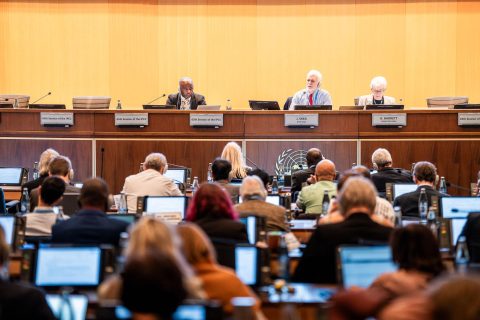
Governments drew their battle lines this week over how COP30 should respond to an expected shortfall in ambition in countries’ national climate plans, raising the prospect of a fight at the UN summit in Belém.
Countries are divided over the need for the COP30 talks to formally discuss an upcoming UN review of newly announced targets to cut greenhouse gas emissions. That ‘synthesis report’ is widely expected to show that the world is not on track to limit global warming in line with the temperature goals of the Paris Agreement.
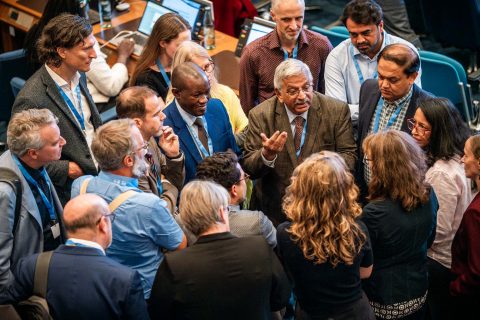
The clash of views became public for the first time on Thursday as Brazil’s COP30 president André Corrêa do Lago hosted a first round of informal consultations with delegations in a bid to avert procedural arguments over the agenda delaying the start of negotiations, as has occurred in recent years.
Anticipating the row in a letter last month, the seasoned Brazilian diplomat on Thursday appealed to countries to “exercise restraint” at a time when UN climate diplomacy is facing “one of the greatest tests” ever.
Rich nations, least developed countries (LDCs), small island states, Latin American nations and the United Arab Emirates spoke in favour of a COP30 decision that acknowledges the progress and remaining gaps in nationally determined contributions (NDCs) and lays out a pathway for accelerating climate action in the years ahead.
But a group of high-income emerging countries – including China, Saudi Arabia and India – voiced strong opposition to that plan. They argued that discussions of those NDCs and the UN “synthesis report” assessing them are not on the summit’s agenda – and the only space for addressing a shortfall in ambition remains the Global Stocktake (GST).
A five-yearly process established by the Paris Agreement, the next GST is scheduled to be completed in 2028.
Two years ago, the first GST found the world was significantly off track to meet its climate goals. That exercise resulted at COP28 in Dubai in what was hailed as a historic global commitment to transition away from fossil fuels in energy systems – but little has since been done to put that pledge into practice.
COP30 call for stronger climate plans
Speaking at Thursday’s consultation, the climate envoy for the low-lying Marshall Islands in the Pacific, said this round of NDCs – the third under the Paris Agreement – is “the last chance to course correct” emissions reductions in line with the 1.5C warming limit.
“We cannot wait for the next Global Stocktake,” she added. “That will be far too late for my country and millions of people around the world”.
Only a sixth of countries have presented their updated NDCs so far, including an emissions-cutting target for 2035, with those from many major economies including the European Union (EU), China and India still missing. A flurry of submissions is expected in the coming weeks ahead of an end-of-September deadline for their inclusion in the synthesis report.
The last such assessment, published last year, estimated that full implementation of the NDCs available at that point would lead to a 5.9% reduction in planet-heating emissions by 2030, compared to the 2019 level. That is far short of the 43% fall in global emissions the Intergovernmental Panel on Climate Change (IPCC) has said is needed by the end of this decade to be in line with the 1.5C target.
Nepal’s lead negotiator, taking the floor for the world’s poorest nations, said COP30 must offer “a clear plan” to address gaps in both climate ambition and the implementation of existing commitments. “It must provide confidence that we are moving forward, offer solutions to close the gap and reaffirm trust in multilateralism,” he added.
Responding to NDCs seen as “priority”
Colombia’s head of delegation argued that COP30 will be “a defining political moment for the international community”. “It will test whether parties are willing to match words with action and put forward contributions that genuinely keep 1.5C within reach,” she added.
Framing talks on the updated climate plans as one of COP30’s main objectives, most developed countries urged a strong response to the expected shortfall, ideally in the form of a negotiated outcome agreed by all nations.
In new book, WRI chief argues for climate optimism despite obstacles
The EU went as far as calling for the creation of a new item on the summit’s agenda that directly addresses the level of collective ambition of NDCs and the steps needed to plug remaining gaps. “This is the key priority for the EU,” said the climate negotiator for the bloc.
Switzerland, speaking on behalf of the self-styled Environmental Integrity Group, suggested that, at the talks in the Amazon city of Belém, countries could launch a new political process to “bring us closer to 1.5C”. That could include a forum for ministers to come together and identify opportunities for cooperation on climate action.
Emerging economies push back
Large emerging economies and the group of Arab countries pushed back on the need to discuss climate plans – arguing the topic is not on the agenda and would go against the “nationally determined” nature of the Paris Agreement. Instead, they called for talks to focus on finance and trade measures.
India said it is unclear why a separate discussion on the NDC synthesis report is needed when it is not an item on the formal agenda.
China argued that the COP30 presidency should not create a new process to consider NDCs that would risk diluting the GST. “The current multilateral process is complex and fragile,” said the country’s delegate, adding “any negative evaluation of NDCs might lead to a decrease in confidence and mutual trust”.
China on course to peak fossil fuel power as soon as this year, reports say
Speaking on behalf of the “Like-Minded” group of developing countries, Bolivia’s lead negotiator said the bloc is not in favour of reflecting messages from the NDCs in any COP30 decisions, and in particular in a political cover text, as the Global Stocktake remains the only dedicated space to assess collective climate efforts. He added that there is no consensus on the need to respond to the latest round of NDCs at COP30.
Saudi Arabia, on behalf of the group of Arab countries, raised the concern “that this push places undue pressure on developing countries with respect to ambition at a time when the Paris Agreement has clearly moved into an implementation phase”.
Saudi Arabia’s negotiator added that submitting national climate plans and assessing them in one year is “destructive” and out of step with the Paris Agreement. He urged the Brazilian presidency to focus on issues around finance and trade, which often refers to mechanisms such as the EU’s forthcoming carbon border tax.
More consultations on the calendar
While the disagreements were starkly evident this week, the COP30 presidency plans further consultations in the hope that countries can work out a way forward on how to respond to the NDC and other tricky issues before the summit in November.
An in-person consultation will take place on September 25 in New York, the day after a high-level UN event where countries are due to unveil their latest NDCs, and a second will be held on October 15, in Brasília as part of the “Pre-COP” meetings.
“The smooth adoption of the agenda at COP30 may be one of our strongest demonstrations to the outside world that this [UN climate] regime works, is alive and well,” Corrêa do Lago told country officials on Thursday.
The post Countries trail COP30 clash over global response to shortfall in national climate plans appeared first on Climate Home News.
Countries trail COP30 clash over global response to shortfall in national climate plans
Climate Change
Maryland Passes Energy Bill That Delivers Short-Term Relief, Locks Ratepayers into Long-Term Nuclear Subsidy
Advocates say Maryland lawmakers passed consequential energy proposals without adequate analysis or public debate during the 2026 session.
Maryland lawmakers’ new solution for rising utility bills reduces a surcharge funding an effective energy-efficiency program, offers rebates by raiding the state’s clean energy fund and includes subsidies for nuclear power that advocates say may prove costly over time.
Climate Change
To avoid COP mistakes, Santa Marta conference must be shielded from fossil fuel influence
Rachel Rose Jackson is a climate researcher and international policy expert whose work involves monitoring polluter interference at the UNFCCC and advancing pathways to protect against it.
Next week, dozens of governments will gather in the Colombian city of Santa Marta for a conference on transitioning away from fossil fuels.
The conference is a first of its kind, in name and in practice. It’s a welcome change to see a platform for global climate action actually acknowledge the primary cause of the climate crisis – fossil fuels. This sends a clear message about what needs to be done to avoid tumbling off the climate cliff edge we are precariously balancing on.
The agenda set for governments to hash out goes further than any other multilateral space has managed to date. Over the week, participants will discuss how to overcome the economic dependence on fossil fuels, transform supply and demand, and advance international cooperation to transition away from fossil fuels.
Alongside the conference, academics, civil society, movements and others are convening to put forward their visions of a just and forever fossil fuel phase out. The conference can help shape pathways and tools governments can use to achieve a fossil-fuel-free future, particularly if the dialogue begins with an honest assessment of “fair shares.”
This means assessing who is most responsible for emissions and exploring truer means of international collaboration that can unlock the technology, resources and finances necessary for a just transition.
Fossil fuel-driven violence is spiraling in places like Palestine, Iran, and Venezuela. Climate disasters are causing billions and billions of dollars in damage annually with no climate reparations in sight. All of this remains recklessly unaddressed on account of corporate-funded fascism.
We know the world’s addiction to fossil fuels must end. Is it surprising that a global governmental convening chooses now to try to tackle fossil fuels? It shouldn’t be, but it is.
COP failures
By contrast, meetings of governments signed up to the longest-standing multilateral forum for climate action—the United Nations Framework Convention on Climate Change (UNFCCC) – took nearly three decades before it officially responded to the power built by movements and acknowledged the need to address fossil fuel use at COP28 in 2023.
Even then, this recognition came riddled with loopholes. It may seem illogical that a forum established by governments in 1992 to coordinate a response to climate change should take decades to acknowledge the root of the problem. Yet there are clear reasons why arenas like the UNFCCC have consistently failed to curb fossil fuels decade after decade.
What would the outcome be when a fossil fuel executive literally oversaw COP28 and when Coca-Cola was one of the sponsors for COP27?
How can strong action take hold when, year after year, the UNFCCC’s COPs are inundated with thousands of fossil fuel lobbyists?
And how can justice be achieved when there are zero safeguards in place to protect against the conflicts of interest these polluters have?
Colombia pledges to exit investment protection system after fossil fuel lawsuits
Justly transitioning off fossil fuels cannot be charted when the very actors that have knowingly caused the climate crisis are at the helm—the same actors that consistently spend billions to spread denial and delay.
Unless platforms like the UNFCCC take concerted action to protect climate policymaking from the profit-at-all-costs agenda of polluters, the world will not deliver the climate action people and the planet deserve.
The impacts of climate action failure are now endured on a daily basis in some way by each of us – and especially by frontline communities, Indigenous Peoples, youth, women, and communities in the Global South. We must be closing gaps and unlocking pathways for advancing the strongest, fairest and fastest action possible.
Learn from mistakes
Yet, as we chase a fossil-fuel-free horizon, it’s essential that we learn from the mistakes of the past. We do not have the luxury or time to repeat them. History shows us we must protect against the polluting interests that want the world addicted to fossil fuels for as long as humanly possible.
We must also reject their schemes that undermine a just transition—dangerous distractions like carbon markets and Carbon Capture Utilisation and Storage (CCUS) that are highly risky and spur vast harm, all while allowing for polluters to continue polluting.
Fossil Free Zones can be on-ramps to the clean energy transition
We get to a fossil-fuel-free future by following the leadership of the movements, communities and independent experts who hold the knowledge and lived experience to guide us there.
We succeed by protecting against those who have a track record of prioritising greed over the sacredness of life.
And we arrive at a world liberated from fossil fuels by doing all of these things from day one, before the toxicity of the fossil fuel industry’s poison takes hold.
If this gathering in Santa Marta can do this, then it can help set a new precedent for what people-centered and planet-saving climate action looks like. When everything hangs in the balance, there can be no if’s, and’s, or but’s. There’s only here and now, what history shows us must be done, and what we know is lost if we do not.
The post To avoid COP mistakes, Santa Marta conference must be shielded from fossil fuel influence appeared first on Climate Home News.
To avoid COP mistakes, Santa Marta conference must be shielded from fossil fuel influence
Climate Change
Q&A: How the UK government aims to ‘break link between gas and electricity prices’
The UK government has announced a series of measures to “double down on clean power” in response to the energy crisis sparked by the Iran war.
The conflict has caused a spike in fossil-fuel prices – and the high cost of gas is already causing electricity prices to increase, particularly in countries such as the UK.
In response, alongside plans to speed the expansion of renewables and electric vehicles, the UK government says it will “move…to break [the] link between gas and electricity prices”.
Ahead of the announcement, there had been speculation that this could mean a radical change to the way the UK electricity market operates, such as moving gas plants into a strategic reserve.
However, the government is taking a more measured approach with two steps that will weaken – but not completely sever – the link between gas and electricity prices.
- From 1 July 2026, the government will increase the “electricity generator levy”, a windfall tax on older renewable energy and nuclear plants, using part of the revenue to limit energy bills.
- The government will encourage older renewable projects to sign fixed-price contracts, which it says will “help protect families and businesses from higher bills when gas prices spike”.
There has been a cautious response to the plans, with one researcher telling Carbon Brief that it is a “big step in the right direction in policy terms”, but that the impact might be “relatively modest”.
Another says that, while the headlines around the government plans “suggest a decisive shift” in terms of “breaking the link” between gas and power, “the reality is more incremental”.
- Why are electricity prices linked to gas?
- What is the government proposing?
- What is not being proposed?
- What will the impact be?
Why are electricity prices linked to gas?
The price of electricity is usually set by the price of gas-fired power plants in the UK, Italy and many other European markets.
This is due to the “marginal pricing” system used in most electricity markets globally.
(For more details of what “marginal pricing” means and how it works, see the recent Carbon Brief explainer on why gas usually sets the price of electricity and what the alternatives are.)
As a result, whenever there is a spike in the cost of gas, electricity prices go up too.
This has been illustrated twice in recent years: during the global energy crisis after Russia invaded Ukraine in 2022; and since the US and Israel attacked Iran in February 2026.
Notably, however, the expansion of clean energy is already weakening the link between gas and electricity, a trend that will strengthen as more renewables and nuclear plants are built.
The figure below shows that recent UK wholesale electricity prices have been lower than those in Italy, as a result of the expansion of renewable sources.
The contrast with prices in Spain is even larger, where thinktank Ember says “strong solar and wind growth [has] reduced the influence of expensive coal and gas power”.

The share of hours where gas sets the price of power on the island of Great Britain (namely, England, Scotland and Wales) has fallen from more than 90% in 2021 to around 60% today, according to the Department of Energy Security and Net Zero (DESNZ). (Northern Ireland is part of the separate grid on the island of Ireland.)
This is largely because an increasing share of generation is coming from renewables with “contracts for difference” (CfDs), which offer a fixed price for each unit of electricity.
CfD projects are paid this fixed price for the electricity they generate, regardless of the wholesale price of power. As such, they dilute the impact of gas on consumer bills.
The rise of CfD projects means that the weeks since the Iran war broke out have coincided with the first-ever extended periods without gas-fired power stations in the wholesale market.
This shows how, in the longer term, the shift to clean energy backed by fixed-price CfDs will almost completely sever the link between gas and electricity prices.
The National Energy System Operator (NESO) estimated that the government’s target for clean power by 2030 could see the share of hours with prices set by gas falling to just 15%.
What is the government proposing?
For now, however, about one-third of UK electricity generation comes from renewable projects with an older type of contract under the “renewables obligation” scheme (RO).
It is these projects that the new government proposals are targeting.
The government hopes to move some of these projects onto fixed-price contracts, which would no longer be tied to gas prices, further weakening the link between gas and electricity prices overall.
When RO projects generate electricity, they earn the wholesale price, which is usually set by gas power. In addition, they are paid a fixed subsidy via “renewable obligation certificates” (ROCs).
This means that the cost of a significant proportion of renewable electricity is linked to gas prices. Moreover, it means that, when gas prices are high, these projects earn windfall profits.
In recognition of this, the Conservative government introduced the “electricity generator levy” (EGL) in 2022. Under the EGL, certain generators pay a 45% tax on earnings above a benchmark price, which rises with inflation and currently sits at £82 per megawatt hour (MWh).
The tax applies to renewables obligation projects and to old nuclear plants.
The current government will now increase the rate of the windfall tax to 55% from 1 July 2026, as well as extending the levy beyond its previously planned end date in 2028.
It says it will use some of the additional revenue to “support businesses and households with the impacts of the conflict in the Middle East on the cost of living”. Chancellor Rachel Reeves said:
“This ensures that a larger proportion of any exceptional revenues from high gas prices are passed back to government, providing a vital revenue stream so that money is available for government to support businesses and families with the impacts of the conflict in the Middle East.”
The increase in the windfall tax may also help to achieve the government’s second aim, which is to persuade older renewable projects to accept new fixed-price contracts.
Reeves made this aim explicit in her comments to MPs, saying the higher levy “will encourage older, low-carbon electricity generators, which supply about a third of our power, to move from market pricing to fixed-price contracts for difference”.
(This is an adaptation of a proposal for “pot zero” fixed-price contracts, made by the UK Energy Research Centre (UKERC) in 2022, see below for more details.)
As with traditional CfDs, the new fixed-price contracts would not be tied to the price of gas power. Instead of earning money on the wholesale electricity market, these generators would take a fixed-price “wholesale CfD”. In addition, they would be exempted from the windfall tax and would continue to receive their fixed subsidy via ROCs.
The government says this will be voluntary. It will offer further details “in due course” and will then consult on the plans “later this year”, with a view to running an auction for such contracts next year.
It adds: “Government will only offer contracts to electricity generators where it represents clear value for money for consumers.”
(It is currently unclear if the proposals for new fixed-price contracts would also apply to older nuclear plants. Last month, the government said it intended to “enable existing nuclear generating stations to become eligible for CfD support for lifetime-extension activities”.)
What is not being proposed?
Contrary to speculation ahead of today’s announcement, the government is not taking forward any of the more radical ideas for breaking the link between gas and electricity prices.
Many of these ideas had already been considered in detail – and rejected – during the government’s “review of electricity market arrangements” (REMA) process.
This includes the idea of creating two separate markets, one “green power pool” for renewables and another for conventional sources of electricity.
It also includes the idea of operating the market under “pay as bid” pricing. This has been promoted as a way to ensure that each power plant is only paid the amount that it bid to supply electricity, rather than the higher price of the “marginal” unit, which is usually gas.
However, “pay as bid” would have been expected to change bidding behaviour rather than cutting bills, with generators guessing what the marginal unit would have been and bidding at that level.
Finally, the government has also not taken forward the idea of putting gas-fired power stations in a strategic reserve that sits outside the electricity market.
Last year, this had been proposed jointly by consultancy Stonehaven and NGO Greenpeace. In March, they shared updated figures with Carbon Brief showing that – according to their analysis – this could have cut bills by a total of around £6bn per year, or about £80 per household.
However, some analysts argued that it would have distorted the electricity market, removing incentives to build batteries and for consumers to use power more flexibly.
What will the impact be?
The government’s plan for voluntary fixed-price contracts has received a cautious response.
UKERC had put forward a similar proposal in 2022, under which older nuclear and renewable projects would have received a fixed-price “pot zero” CfD.
(This name refers to the fact that CfDs are given to new onshore wind and solar under “pot one”, with technologies such as offshore wind bidding into a separate “pot two”.)
In April 2026, UKERC published updated analysis suggesting that its “pot zero” reforms could have saved consumers as much as £10bn a year – roughly £120 per household.
Callum McIver, research fellow at the University of Strathclyde and a member of the UKERC, tells Carbon Brief that the government proposals are a “big step in the right direction in policy terms”.
However, he says the “bill impact potential is lower” than UKERC’s “pot zero” idea, because it would leave renewables obligation projects still earning their top-up subsidy via ROCs.
As such, McIver tells Carbon Brief that, in his view, the near-term impact “could be relatively modest”. Still, he says that the idea could “insulate electricity prices” from gas:
“The measures are very welcome and, with good take-up, they have the potential to insulate electricity prices further from the impact of continued or future gas price shocks, which should be regarded as a win in its own right.”
In a statement, UKERC said the government plan “stops short of the full pot-zero proposal, since it will leave the RO subsidy in place”. It adds:
“This makes the potential savings smaller, but it will break the link with gas prices. The devil will be in the detail, but provided the majority of generators join the scheme, most of the UK’s power generation fleet will have a price that is not related to the global price of gas.”
Marc Hedin, head of research for Western Europe and Africa at consultancy Aurora Energy Research, tells Carbon Brief that, while the headlines “suggest a decisive shift” in terms of “breaking the link” between gas and power, “the reality is more incremental”. He adds:
“In principle, moving a larger share of generation onto fixed prices would reduce consumers’ exposure to gas‑driven price spikes and aligns well with the direction already taken for new build [generators receiving a CfD].”
However, he cautioned that “poorly calibrated [fixed] prices would transfer value to generators at consumers’ expense, while overly aggressive pricing could result in low participation”.
In an emailed statement, Sam Hollister, head of UK market strategy for consultancy LCP, says that the principle of the government’s approach is to “bring stability to the wholesale market and avoid some of the disruption that a more radical break might have caused”.
However, he adds that the reforms will not “fundamentally reduce residential energy bills today”.
Johnny Gowdy, a director of thinktank Regen, writes in a response to the plans that while both the increased windfall tax and the fixed-price contracts “have merit and could save consumers money”, there were also “pitfalls and risks” that the government will need to consider.
These include that a higher windfall tax could “spook investors”. He writes:
“A challenge for policymakers is that, while the EGL carries an investment risk downside, unless there is a very significant increase in wholesale prices, the tax revenue made by the current EGL could be quite modest.”
Gowdy says that the proposed fixed-price contracts for older renewables “is not a new idea, but its time may have come”. He writes:
“It would offer a practical way to hedge consumers and generators against volatile wholesale prices. The key challenge, however, is to come up with a strike price that is fair for consumers and does not lock future consumers into higher prices, given that we expect wholesale prices to fall over the coming decade.”
Gowdy adds that it might be possible to use the scheme as a way to support “repowering”, where old windfarms replace ageing equipment with new turbines.
On LinkedIn, Adam Bell, partner at Stonehaven and former head of government energy policy, welcomes the principle of the government’s approach, saying: “The right response to yet another fossil fuel crisis is to make our economy less dependent on fossil fuels.”
However, he adds on Bluesky that the proposals were “unlikely to reduce consumer bills”. He says this is because they offered a weak incentive for generators to accept fixed-price contracts.
The post Q&A: How the UK government aims to ‘break link between gas and electricity prices’ appeared first on Carbon Brief.
Q&A: How the UK government aims to ‘break link between gas and electricity prices’
-
Climate Change8 months ago
Guest post: Why China is still building new coal – and when it might stop
-
Greenhouse Gases8 months ago
Guest post: Why China is still building new coal – and when it might stop
-
Greenhouse Gases2 years ago嘉宾来稿:满足中国增长的用电需求 光伏加储能“比新建煤电更实惠”
-
Climate Change2 years ago
Bill Discounting Climate Change in Florida’s Energy Policy Awaits DeSantis’ Approval
-
Climate Change2 years ago嘉宾来稿:满足中国增长的用电需求 光伏加储能“比新建煤电更实惠”
-
Climate Change Videos2 years ago
The toxic gas flares fuelling Nigeria’s climate change – BBC News
-
Renewable Energy6 months agoSending Progressive Philanthropist George Soros to Prison?
-
Carbon Footprint2 years agoUS SEC’s Climate Disclosure Rules Spur Renewed Interest in Carbon Credits