

Children born in 2020 will face “unprecedented exposure” to extreme weather events, including heatwaves, droughts and wildfires, even if warming is limited to 1.5C above pre-industrial temperatures.
That is according to a new study, published in Nature, which calculates the number of unprecedented extreme events that people born in different decades and countries might live through.
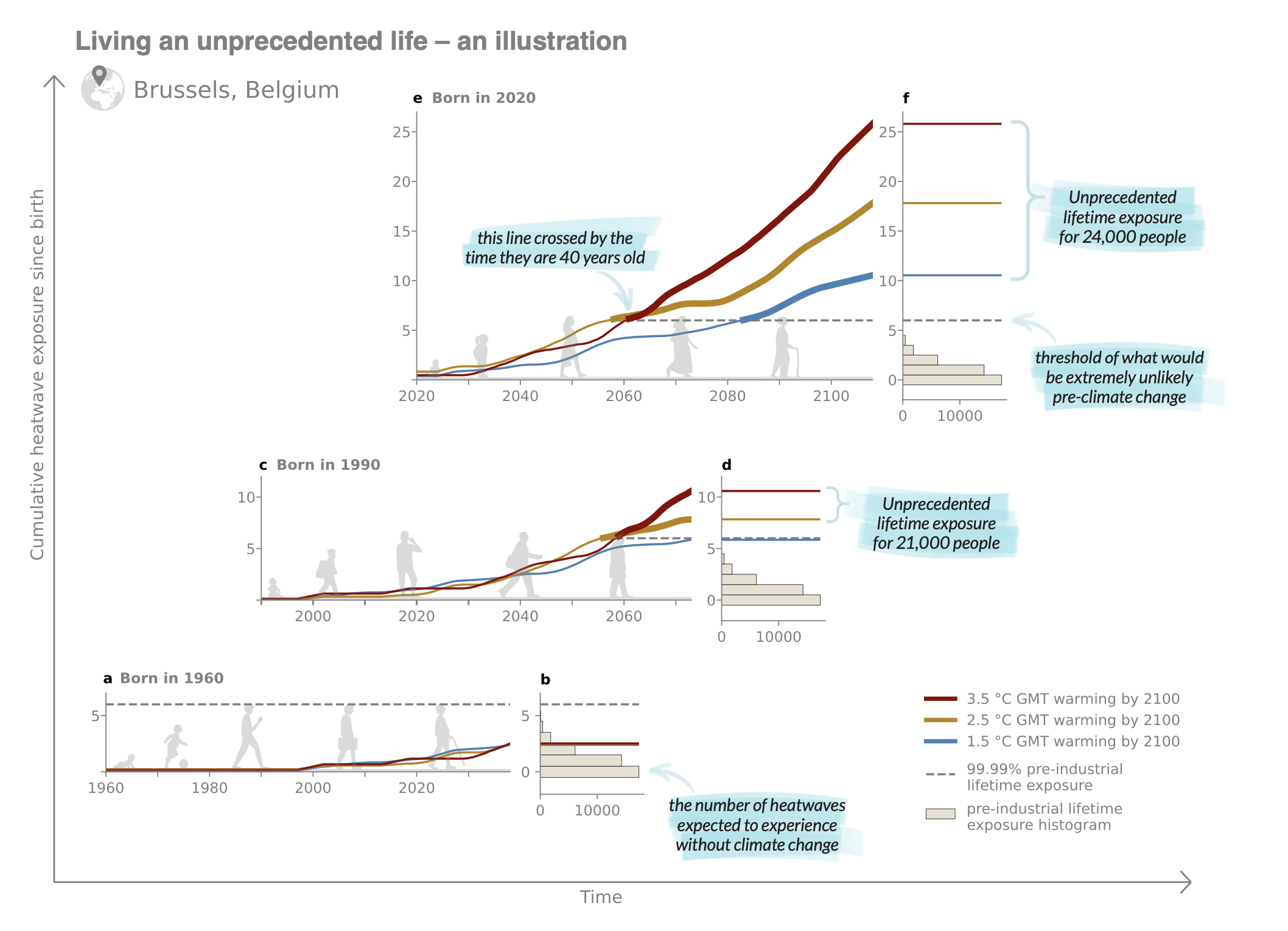
Using a case study focused on Brussels, the researchers find that people born in 2020 will experience an “unprecedented” 11 heatwaves in their lifetime – even if global warming is limited to 1.5C by the end of the century.
In contrast, in a pre-industrial climate, a person living in the Belgian capital would likely experience just three such heatwaves, according to the study.
More than half of children born in 2020 – around 62 million people – will experience “unprecedented lifetime exposure” to heatwaves, even if warming is limited to 1.5C, the study finds.
However, this number nearly doubles to 111 million under a scenario where warming hits 3.5C.
The study also analyses crop failures, river floods, tropical cyclones, wildfires and droughts.
The research “helps the climate community build new narratives that better clarify the impacts [of climate change] on younger generations and vulnerable populations”, one expert who was not involved in the study tells Carbon Brief.
Intergenerational justice
As the planet warms, extreme weather events such as heatwaves, floods and droughts are becoming more intense, more frequent and lasting longer.
A popular 2021 study found that children born in the 21st century will be exposed to more extreme weather events in their lifetimes than their parents and grandparents.
The paper found that in a scenario of 3C of warming above pre-industrial levels, a child who turns six in 2020 will experience twice as many wildfires and tropical cyclones, three times more river floods, four times more crop failures, five times more droughts and 36 times more heatwaves over their lifetime than a six-year-old living in a pre-industrial climate.
The authors also found a “particularly strong increase” in children’s future exposure to extremes in the Middle East and North Africa.
The lead author of the study – Prof Wim Thiery from Vrije Universiteit Brussel – told Carbon Brief at the time that today’s youth will live “an unprecedented life”, in which they will “face conditions which older generations have never experienced”.
Four years later, Dr Luke Grant – a researcher in Thiery’s team – has led a new study building on the ideas of the 2021 paper.
Grant tells Carbon Brief that rather than counting the number of extreme events that an individual might experience, his new study counts the number of people that reach an “unprecedented state” of exposure to extremes.
Prof Kaveh Madani is the director of the UN University Institute for Water, Environment and Health and was not involved in the study. He tells Carbon Brief that the paper “helps the climate community build new narratives that better clarify the impacts [of climate change] on younger generations and vulnerable populations”.
The authors define “exposure” as the number of extreme events that a person experiences in their lifetime, relative to the number they would have experienced in a pre-industrial climate.
“Unprecedented lifetime exposure” is defined as exposure so high that it has only a one-in-10,000 chance of happening in a world without any greenhouse gas emissions.
‘Unprecedented lifetime exposure’
The authors present a case study of extreme heat in Brussels, Belgium, to explain their method.
They define a heatwave as a three-day extreme heat event, which reaches average temperatures that would be expected once per century in a pre-industrial climate.
Using models from the Inter-Sectoral Impact Model Intercomparison Project (ISIMIP), the authors calculate heatwave frequency in a world without climate change. They also assess scenarios in which warming is limited to 1.5C, 2.5C and 3.5C by the end of the century.
They combine this data with demographic information, including how many people are born in the country each year and their average life expectancy, using data from sources including the ISIMIP database and UN population estimates and projections.
In a world without climate change, the study finds that a person born in 1960 in Brussels would have a one-in-10,000 chance of experiencing six of the pre-defined heatwaves in their lifetime. Any member of this “birth cohort” who experiences more than six heatwaves in their lifetime has therefore faced “unprecedented lifetime exposure” to extreme heat, according to the study.
The authors find that a person born in Brussels in 1960 is likely to experience three heatwaves on average during their lives under all of the three future warming pathways– meaning that they are unlikely to face “unprecedented lifetime exposure” to heat.
By contrast, the researchers find that many younger age cohorts will experience unprecedented heatwave exposure. For many younger age cohorts, lifetime exposure to heatwaves is greater for higher warming pathways.
For example, people born in Brussels in 2020 will experience 11 heatwaves in their lifetime if global warming is limited to 1.5C by the end of the century. If warming rises to 2.5C or 3.5C, they could experience 18 or 26 heatwaves, respectively.
The graphic below shows heat exposure since birth in Brussels for three “birth cohorts” of 1960 (bottom row), 1990 (middle row) and 2020 (top row). It presents three future scenarios, in which warming is limited to 1.5C (blue), 2.5C (yellow) and 3.5C (red) by 2100. The dotted line shows the threshold for an “unprecedented” lifetime exposure to extreme heat.
Heat exposure
The authors repeat their analysis across the Earth’s entire land surface, by dividing it into grid cells and using location-specific temperature and demographic data.
Of the 81 million people born in 1960, they find that 13 million are likely to face unprecedented exposure to heatwaves in their lifetimes. They add that for this age cohort, lifetime exposure to unprecedented extremes does not vary depending on the warming scenario.
However, 21st century warming has a significant effect on exposure for younger generations. Under a 1.5C warming pathway, 52% of people born in 2020 will face unprecedented exposure to heatwaves. This rises to 92% under a 3.5C warming scenario.
The study adds:
“This implies that 111 million children born in 2020 will live an unprecedented life in terms of heatwave exposure in a world that warms to 3.5C versus 62 million in a 1.5C pathway.”
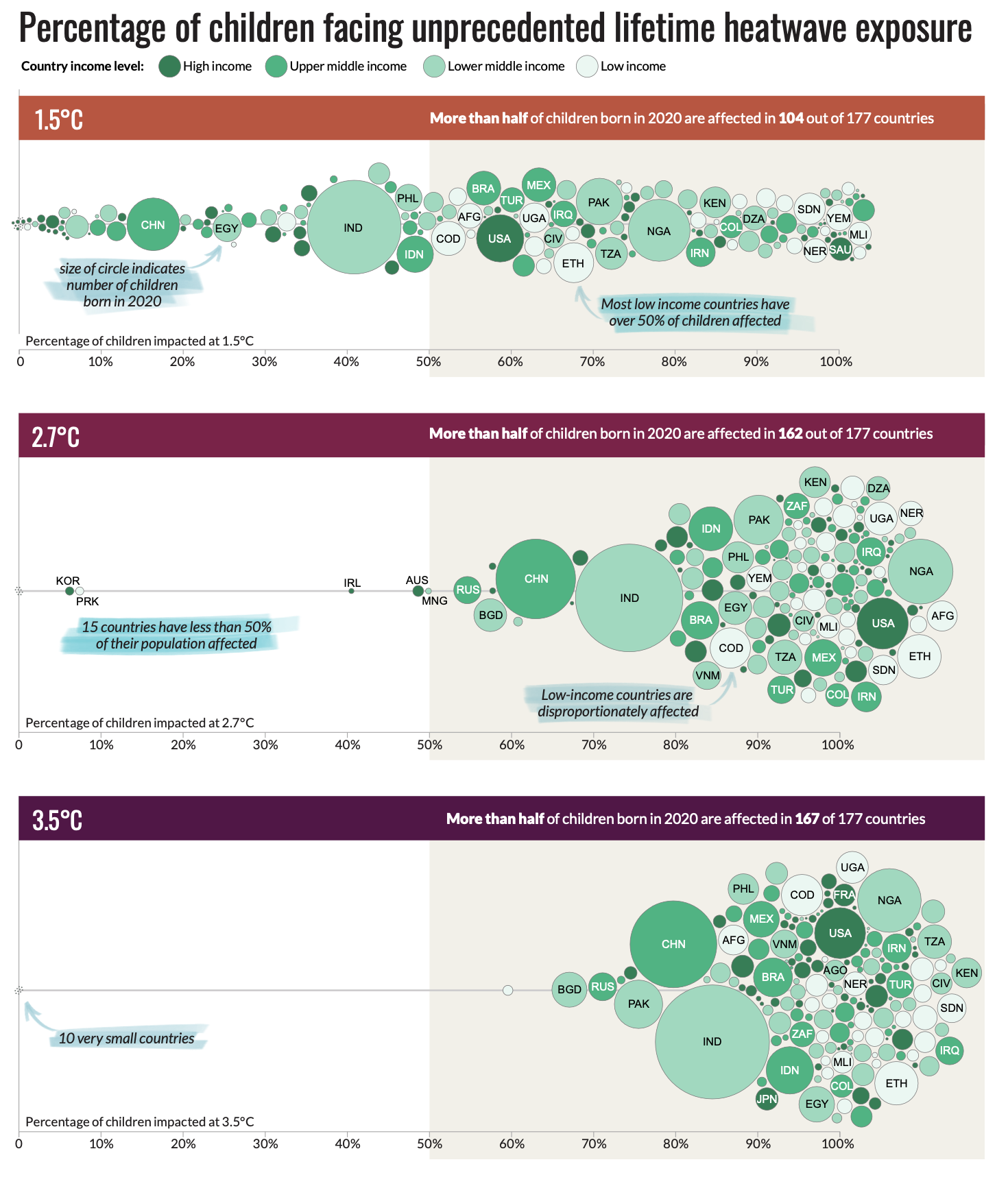
The charity Save the Children has published a report which unpacks the findings of the study. The graphic below, from the report, shows the percentage of people from different countries born in 2020 who will face unprecedented lifetime exposure to heatwaves under the 1.5C (top), 2.5C (middle) and 3.5C (bottom) warming scenarios.
Each circle shows a country, indicated by its three-letter countries code. The size of the circle indicates the number of people in the country. Darker circles indicate higher-income countries.
Circles on the right hand side of the graphic indicate that more than half of the country’s 2020 cohort will be exposed to unprecedented heatwaves in their lifetime.
“The evidence is now inescapable that heatwaves impact every community around the world,” Dr Luke Harrington, a senior lecturer in environmental science at the University of Waikato, who was not involved in the study, tells Carbon Brief. He adds:
“This paper offers the clearest view that climate change is verifiably unfair: those who have done the least to contribute to rising global temperatures will experience the most extreme impacts.”
From floods to fires
The authors apply the same method to five other climate extremes – crop failure, wildfires, droughts, floods and tropical cyclones.
The graphic below shows the key findings. The coloured portion of the bar shows the number of people born in 2020 who will face unprecedented exposure to each extreme under a 1.5C warming pathway. The dark green and light green bars show the additional exposure under 2.7C and 3.5C warming.

The authors find that unprecedented lifetime exposure to heatwaves will affect the most people, with 62 million people born in 2020 likely to face unprecedented exposure to heat in their lifetimes if warming is limited to 1.5C.
This is followed by crop failures and river floods, which will impact 23 million and 10 million people from the 2020 birth cohort under the 1.5C warming pathway, respectively.
Lead author Grant tells Carbon Brief that he is “most confident” about his heatwave findings because temperature is a “basic” metric for climate models to “get right”.
Meanwhile, extremes such as crop failure depend on a range of factors including soil moisture, land-atmosphere interactions and rainfall, which can make it harder for the models to accurately capture changes, Grant explains.
Vulnerability
The authors also assess how “socioeconomic vulnerability” affects their findings using a global deprivation index – a tool which measures the level of disadvantage and hardship experienced by individuals or communities in a particular geographic area.
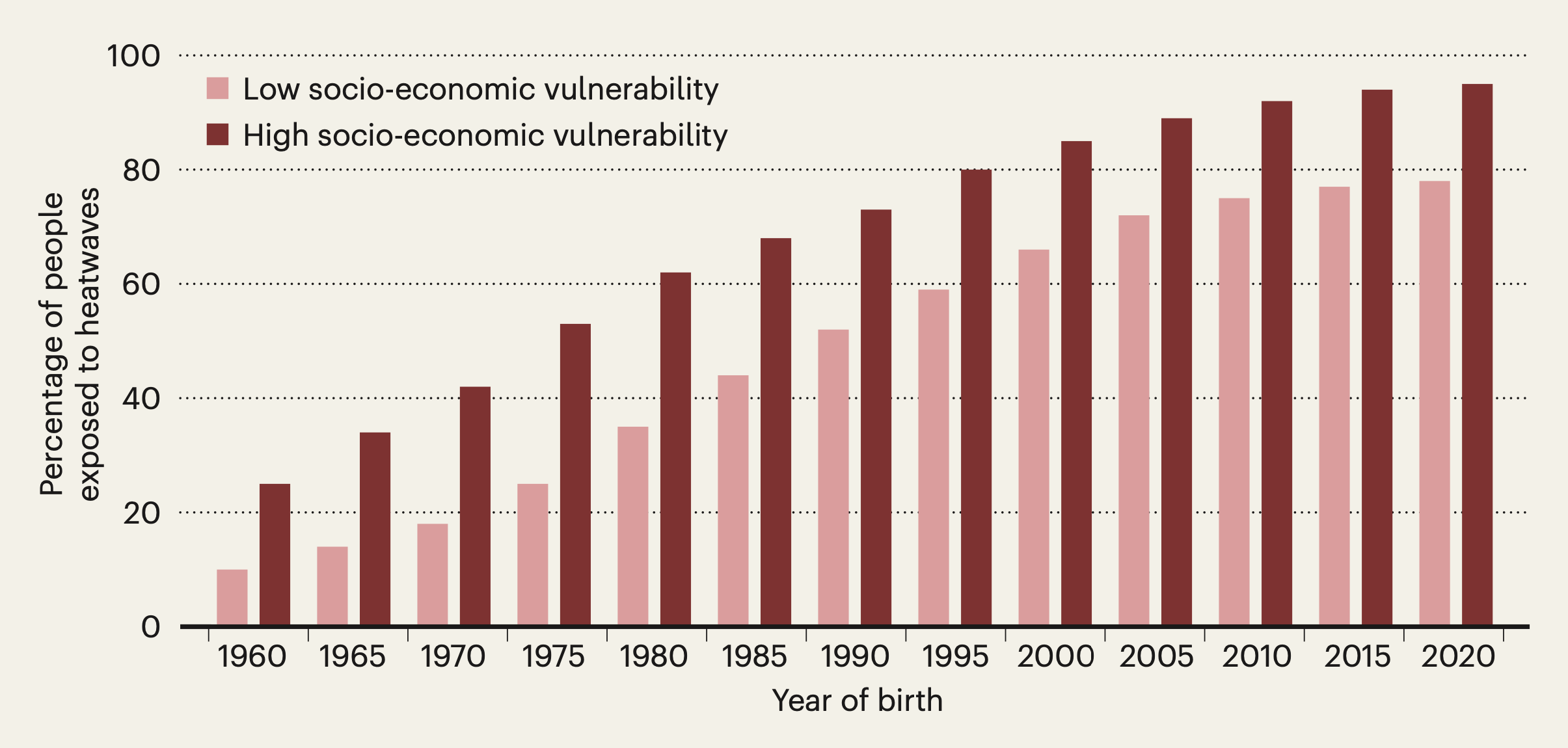
The authors use the index to identify the 20% most and least vulnerable people in each age cohort. They find that the most vulnerable groups are overwhelmingly from African countries.
The authors also conclude that “socioeconomically vulnerable people have a consistently higher chance of facing unprecedented lifetime heatwave exposure compared to the least vulnerable members of their generation”.
The graph below, taken from a news and views article about the study, shows the percentage of high vulnerability (red) and low vulnerability (pink) people in each age cohort who would be exposed to unprecedented heat, under a 2.7C warming scenario.
Dr Marina Romanello, a research fellow at the University College London and research director of the Lancet Countdown on Health and Climate Change who was not involved in the study, tells Carbon Brief that the paper “is an important addition to the scientific literature, showing how our delays in tackling climate change are putting the future of our children at risk”.
She adds:
“The authors have used well-established models to project future health threats, framing them around what matters the most: the wellbeing, health and survival of present and future generations.”



The post Children born in 2020 will face ‘unprecedented exposure’ to climate extremes appeared first on Carbon Brief.
Children born in 2020 will face ‘unprecedented exposure’ to climate extremes

The launch of the Africa Energy Bank (AEB) has been put back yet again, raising doubts about the institution’s future ability to finance fossil fuel projects – its main objective – as global lenders retreat from such investments over climate concerns, experts told Climate Home News.
The bank, which had been billed to launch in September after a series of delays, is now scheduled to begin operations in November, according to the head of the African Energy Chamber, an advocacy body for the continent’s oil and gas sector.
Even as the world aims to transition away from fossil fuels, many African leaders have made clear they want to continue exploring and extracting the continent’s large oil and gas deposits – estimated at around 125 billion barrels of crude and over 600 trillion cubic feet of gas – to boost economic development.
As a group, Africa sided with a number of powerful oil-and-gas producing nations in blocking progress on negotiations to craft a global roadmap to transition away from fossil fuels at last year’s UN COP30 climate talks, although some countries did individually support the proposal.
-
Campaigners oppose Dangote’s planned Kenya refinery over climate and ecological risks
Plans to build Africa’s second largest oil refinery in ecologically sensitive region criticised as “environmental recklessness” -
Tanzania pushed African nations to oppose fossil fuel transition at COP30
While chairing the African group at the summit, the gas-dependent nation advised the continent’s ministers to block language on transitioning away from fossil fuels


Meanwhile, major projects under development across the continent – including the 1,443-km East African Crude Oil Pipeline (EACOP) and Dangote’s 700,000-barrel-per-day Kenyan refinery – show that African governments see oil and gas as playing a significant role in meeting their energy and economic needs for many years to come.
In 2022, at a gathering of the African Petroleum Producers’ Organization (APPO) in oil-rich Angola, ministers from its member states adopted a resolution to create the Africa Energy Bank to finance projects for the production, use and trade of oil, gas and broader energy sources.
African control over energy resources
An article on the APPO website explains that the bank was conceived as a way to overcome “disenchantment” with fossil fuels among “the international community” which it said had crystallised around the “energy transition” concept.
“If Western countries, after having long taken advantage of the energy sources they now revile to develop, can afford the luxury of abandoning them, this is not the case in Africa,” it adds, noting that many of the continent’s economies are still largely dependent on oil and gas revenues.
A separate web page about the bank, also hosted on APPO’s website, says its objectives include financing the exploration, production and refining of oil and gas, as well as supporting member states in transitioning from fossil fuels to cleaner energy sources “while ensuring energy security”.
Said Addi, a former executive with Shell and energy commodities trading house Gunvor, said the new bank was judged necessary because financing for hydrocarbons from many traditional international lenders has become constrained.
In trying to fill this financing gap, Africa is not simply setting up another fund to support oil and gas, he added. “It is also an attempt to give African countries greater control over how their energy resources and infrastructure are financed,” he explained.
Nigeria to host the AEB
The energy bank – a joint initiative of APPO and the African Export–Import Bank (Afreximbank) – has so far suffered several delays and is almost two years behind schedule. The initial plan was to start operations in January 2025, with Nigeria as the host country, but the bank’s opening was delayed to June of that year to allow Nigeria time to finalise the construction of the bank’s headquarters in Abuja.
After the government announced the completion of the offices in late November 2025, a new launch date was set for January 2026, which was moved back to April, June and then September. Now it has shifted again to November, raising concerns that the institution may be losing momentum.
Former Shell executive Addi said that if the capital is eventually paid in, the bank becomes operational and its first projects are commercially credible, then the delays will be regarded as normal teething troubles in setting up a multilateral institution. But, he added, scepticism will be justified if it continues to stall.
Uganda may see lower oil revenues than expected as costs rise and demand falls
Baron Lamarré, an oil and gas expert and former Petronas oil trader, said that missing “three deadlines in a row is not normal”, and warned that if the timeline slips again, “the story flips from ‘ambitious institution finding its footing’ to ‘good idea that lost momentum before it found any’.”
The Nigerian government, APPO and Afreximbank did not respond to requests for comment by the time of publication.
The funding challenge
The Africa Energy Bank is targeting base capital of $5 billion, with plans to scale up to $120 billion within five years by mobilising private-sector funds. However, it is expected to start operations with initial seed capital of $500 million.
The funding plan is to have the 18 member countries of the APPO contribute $83 million each to the bank as equity for a combined $1.5 billion. Afreximbank, other non-APPO African countries and investors outside the continent are expected to provide the remaining $3.5 billion.
But even the initial $500 million has not been easy to mobilise. In May, APPO Secretary-General Farid Ghezali called on members to deliver on their pledges towards the startup goal before the end of June. But the delays suggest this may not have been met, with experts saying Africa may be finding it difficult to self-fund its oil and gas projects in the absence of international capital.
Lamarré said every extension of the deadline points to the fact that “raising fossil fuel capital in Africa without the majors and their financing networks is brutally hard”.
Why the global electrification agenda misses the point on Africa’s energy crisis
Since 2020, Western lenders, export credit agencies and insurers have been in steady retreat from African hydrocarbons, he said, while oil majors are divesting their African assets, handing over fields to smaller local operators whose credit ratings are not high enough to borrow cheaply.
Even capital from China and the Gulf, which has partially filled the gap, cannot match the volume, tenor or pricing that Western investors once offered, Lamarré argued.
“If mobilising the first $500 million of seed capital [for the AEB] has taken this long, that’s the clearest signal yet of how steep the climb to $120 billion looks,” he said, noting that the continent’s energy financing gap is as large as $30 billion-$45 billion per year.
Africa’s investment landscape, meanwhile, has been shifting. While foreign direct investment dropped from a 2024 peak, inflows remained roughly one-third above the continent’s long-term average in 2025, according to the 2026 World Investment Report from UN Trade and Development (UNCTAD). They are concentrated in a few sectors including critical minerals needed for renewable energy technologies, battery manufacturing and advanced industrial production.
At the same time, data on global energy investment from the International Energy Agency (IEA) shows that fossil fuel investment in Africa has declined over the last decade.

“Trojan horse” for fossil fuels
While the Africa Energy Bank struggles to get off the ground, climate campaigners have criticised its primary aim of financing oil and gas on the continent at a time when the world is starting to move away from high-carbon fuels to cleaner alternatives.
Bhekumuzi Dean Bhebhe, founder of Africa Change Lab, described the bank as a “Trojan horse”, arguing that its focus on fossil fuel financing runs counter to the global energy transition and the African Union’s Agenda 2063 goals of sustainable development and inclusive growth.
The energy bank, he warned, “risks locking Africa into a new cycle of debt, dependency and fossil fuel entrenchment”, adding that its financing blueprint does not pave the way for a climate-resilient future. “In truth, it is to deepen the same extractive, carbon-heavy pathways that the continent should be moving away from,” he added.
Ugandan farmers use British court to try to stop East Africa oil pipeline
Kenya-based climate and energy expert Joab Okanda said the AEB’s plan to finance oil and gas is “a misplaced priority” and it should instead back clean energy in line with the policies of some of Africa’s major export markets like Europe.
In addition, the new bank could struggle to mobilise enough resources to advance large-scale oil and gas projects, he added, noting that its proposed $5-billion initial capital is equivalent to the cost of the East African Crude Oil Pipeline alone.
The AEB’s aim of backing more fossil fuels should be flipped “to support countries that are oil-dependent to start working on their transition plans”, Okanda said.
The post Launch of Africa Energy Bank delayed again in blow to oil and gas hopes appeared first on Climate Home News.
Launch of Africa Energy Bank delayed again in blow to oil and gas hopes
A booklet published by the UK’s opposition Conservative party includes a “cost of net-zero” that appears to have been doubled by a spreadsheet error.
The “common sense” policy document argues that “what people ultimately want is a government competent enough to solve the problems for which it takes responsibility”.
In a section that says “sophisticat[ed]…modelling” should not be a substitute for “political judgement”, the “Right Way” document disparages various estimates of the cost of net-zero.
The Conservative document then claims – incorrectly – that the government’s official adviser, the Climate Change Committee (CCC), had put the cost of net-zero at close to £1tn. It says:
“In 2020, the CCC estimated that its route to net-zero would cost £957bn.”
In fact, the CCC’s 2020 estimate was exactly half this amount – £478bn – and last year it published a revised figure of £108bn, largely as a result of the falling cost of electric vehicles (EVs).
Spreadsheet error
The Conservative party’s erroneous claim appears to stem from another report that had accidentally added up numbers twice, using a spreadsheet published by the CCC in 2020.
The 2020 spreadsheet contains a table listing the additional investments that would be needed to build a net-zero economy, from low-carbon electricity generation through to heat pumps and EVs.
These extra capital expenditures, listed as “CAPEX”, add up to a total of £1.38tn over the 30 years of 2020-50. They are set against operational savings, listed as “OPEX”, of £0.90tn.
Added up over 2020-50, the combined CAPEX and OPEX figures come to a total of £478bn.
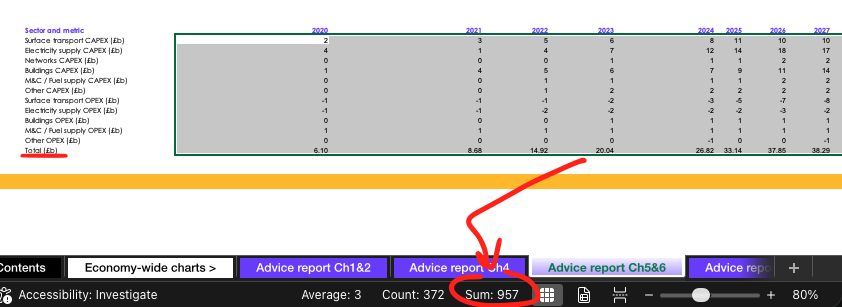
In addition to the annual sectoral CAPEX and OPEX figures, the CCC’s 2020 spreadsheet also has a line giving combined totals for each year. It appears that someone has added all of these numbers together, resulting in the savings and costs being counted twice.
This double-counted total for the cost of net-zero amounts to £957bn – as shown in the image below – and it appears to be the source of the claim in the Conservative booklet.
At the time of publication in 2020, the CCC said that the £478bn net cost of net-zero amounted to less than 1% of GDP over 30 years – and that the large investment needed would not only result in savings due to lower fossil-fuel imports, but that it would boost GDP overall, by around 2%.
In 2025, the CCC revised its estimates for investment costs and operating savings to £670bn and £562bn respectively, giving a net total of £108bn over 2025-50, or less than 0.2% of GDP.
Earlier this year, the committee said that cutting emissions to net-zero would cost less than a single fossil-fuel price shock and that doing so would have benefits worth £110bn per year.
Paper trail
The erroneo