

We handpick and explain the most important stories at the intersection of climate, land, food and nature over the past fortnight.
This is an online version of Carbon Brief’s fortnightly Cropped email newsletter. Subscribe for free here.
Key developments
US ocean actions cause alarm
DEEP-SEA BREACHES: US president Donald Trump signed an executive order “aimed at making it easier for companies to mine the deep seafloor”, including in international waters, according to National Public Radio. BBC News reported that the move “has been met by condemnation from China, which said it ‘violates’ international law”. In the South China Morning Post, two researchers at Nanjing University wrote that the order “will force China to act”, adding that Trump has “set the stage for heightened geopolitical tensions”. They concluded: “Should the US insist on unilateral mining, China, in collaboration with international partners, may implement maritime monitoring initiatives…[that] could document the environmental impact and breaches of standards.”
RISKY BUSINESS: Meanwhile, a Trump proclamation to loosen fishing regulations surrounding federally protected areas of the ocean – issued in mid-April – “poses major risks”, the Guardian reported. The Pacific Islands Heritage Marine national monument is home to the “most undisturbed coral reef within the US”, as well as “many threatened, endangered and depleted species”, the outlet added. Other experts said that the order – which purportedly aims to promote US fishing interests – “will negatively impact American fishers in the long run, leading to higher seafood prices for American consumers”.
OCEAN FUNDING FALLS: The 10th edition of the Our Ocean conference was held in Busan, South Korea, over 28-30 April, EFE Verde reported, where it was “attended by ministerial representatives from 100 different countries”. The newswire added that the conference would “serve as an impetus for participants to announce effective actions to accelerate the achievement of the goal of protecting 30% of the world’s oceans by 2030”. According to Mongabay, delegates to the conference announced funding commitments “totalling around $9.1bn”, but added that “this year’s numbers were the lowest since 2016”. The outlet noted that this edition was the first time the US “did not send an official delegation or make any pledges”.
Between tariffs and traceability
TARIFF-DRIVEN DEFORESTATION: US tariffs on Indonesian and Malaysian palm oil could drive up demand for soybean oil – a cheaper but more land-intensive option – and exacerbate deforestation, according to climate experts consulted by BusinessGreen. Elsewhere, Dialogue Earth reported on expectations that Brazil could expand its export of agricultural commodities to China, increasing the risk of deforestation in the South American country. Experts told the outlet that products such as soya, corn, beef and chicken could experience a surge in international demand. It added that Brazil captured a significant share of the Chinese soya market from the US during Trump’s first term.
BACKWARDS STEPS: Brazil’s supreme court ruled that Mato Grosso, the country’s biggest farming state, is allowed to withdraw tax incentives for signatories of the “soy moratorium” initiative, Reuters reported. The soy moratorium, a 2006 voluntary ban aimed at disincentivising soybean purchases from deforested areas of the Amazon, has been praised by conservationists for “slowing damage to the world’s largest rainforest”, the newswire said. However, farm lobbyists interested in increasing production are opposed to the agreement. The ruling needs to be ratified by a panel of supreme court justices before entering into force in January 2026.
COFFEE TRACEABILITY: The EU deforestation regulation has coffee farmers in Ethiopia “scrambling”, the New York Times reported. Under the new EU environmental regulation, which will enter into force at the end of the year, producers of major commodity crops will have to provide geolocation data to demonstrate that their products were not grown on recently deforested land. The outlet quoted the head of a coffee farmers’ cooperative, who said they need support to carry out the traceability of their products, adding that to do so is “very challenging and costly, and we don’t have any help”.
Spotlight
The climate uncertainties for west Africa’s fishers
This week, Carbon Brief unpacks three key takeaways from a recent report, published by the Salata Institute for Climate and Sustainability, on the sustainability of west African fisheries.
In west Africa, coastal fishing communities underpin a large proportion of the region’s economies and traditional ways of life.
Their number has only increased in recent years as a result of population growth and migration, driven by economic opportunity – even as fishers have faced declining catches.
A new report detailed the challenges facing the Gulf of Guinea’s fisherfolk amid a warming climate, as well as offering insight into what the future of the fishery could look like.
Here, Carbon Brief unpacked three key messages from the report.
1. Key fish catches have declined dramatically since the 1990s.
The report identified three major factors that have contributed to the decline of fish stocks in the Gulf of Guinea: climate-change-driven ocean warming, illegal fishing by industrial Chinese trawling ships and overfishing by fisherfolk using traditional methods.
According to the report, sea surface temperatures along the Ghanaian coast have increased at a rate of 0.011C annually since the 1960s – and could increase by another 1.6C by the end of the century under a high-emissions scenario. This warming is driving “significant geographic shifts” in the range of the species targeted by west Africa’s fisherfolk, the report said.
The report also identified other climate-driven threats to fishers, such as sea level rise, deoxygenation of ocean waters and beach erosion.
As a result of dwindling numbers, catches have fallen significantly – in some cases, by more than 50% – since the early 1990s “despite an increased number of workdays spent fishing, evidence of an underlying stock collapse”, the report warned.
Even under good fisheries management in the future, the report warned that the maximum catch potential will continue to decline due to warming.
2. Current management strategies are not sufficient to allow fish stocks to recover.
The climate pressures on the Gulf of Guinea fish stocks are compounded by overfishing from two main sources – industrial trawling ships, predominantly from China, and an increasing number of artisanal fisherfolk using improved equipment, such as outboard motors.
Ghana’s artisanal fishing fleet has grown from around 8,000 canoes in 1990 to more than 12,000 in 2022. Previous research has estimated that this fleet lands up to 70% of the small fish taken in the country. The report did not mince words:
“They clearly contribute to overfishing.”
Both Ghana and neighbouring Ivory Coast have implemented “closed seasons” during peak spawning months in an attempt to allow the fish populations to recover, but the policies “have produced disappointing results so far”, the report noted. It said:
“To be technically effective in rebuilding fish stocks, the closed seasons should have begun prior to 2016, before spawning stock biomass had been so badly harmed.”
3. Diversifying income will be key for adapting these communities to climate change.
The researchers surveyed fishing communities in Ghana, Ivory Coast and Nigeria that relied on fishing for “nearly all” of their livelihoods. Most of the individuals identified a decrease in catch over the preceding years.
A large majority of respondents answered “no” when asked if their children would be able to make a living off fishing or fishing-related activities.
The researchers then evaluated programmes in Ghana, undertaken alongside the US Agency for International Development, that were focused on helping fishing households diversify their income. The weekly earnings “were far from a full replacement for fishing income, but to a varying extent they did provide a useful supplement”, the authors wrote.
However, funding for these programmes was cancelled by the Trump administration in its attempt to dismantle USAID in early 2025. The report added:
“Finding substitute funding…will be difficult.”
News and views
CONSERVATION REFORM: The Washington Post editorial board called for “reforming” the US Endangered Species Act “to better incentivise citizens to protect the country’s precious biodiversity”, amid Trump’s attempted weakening of the landmark law. It argued for “giving landowners financial incentives to assist in conservation efforts” – similar to existing subsidy programmes from the US agriculture department. The editorial said: “The scale of the threats to biodiversity…makes it essential to expand federal conservation strategy beyond punitive measures.”
IMPORT IMBALANCE: Amid growing US-China tensions, top Chinese policymakers “said the country could do without American farm and energy imports”, according to the Financial Times. China’s state planner, Zhao Chenxin, “said domestic farm and energy production, along with imports from non-US sources, would be more than enough to satisfy demand”, the outlet reported. At the same time, the FT said, the “loss of the Chinese market would be a substantial hit for US farmers”. It added: “China has shown little appetite for negotiations and repeatedly blasted Washington’s claims of ongoing discussions as false.”
WAYWARD WHALES: Australia’s whale-watching season “started early” this year, according to the Sydney Morning Herald, which said the early migration was a “possible sign of stress from climate change”. A population of humpback whales migrates from Antarctica to Australia at the end of the southern hemisphere summer in “one of the longest migrations of any mammal”, the outlet said. The newspaper cited Dr Olaf Meynecke, a research fellow at Australia’s Griffith University, who explained that the “earlier migration was probably because record-low sea ice reduced krill numbers, making it harder for whales to find food”.
COFFEE GOES UP: The Associated Press reported that coffee prices have remained high due to drought and heat last year that impacted production in Brazil and Vietnam, the world’s largest coffee growers. US tariffs on coffee-producing countries “are expected to drive up costs for Americans”, the newswire added. Elsewhere, extreme weather conditions, such as drought and tropical cyclones, have affected major coconut-growing countries, with the Philippines’ output expected to decline by 20%, Bloomberg reported.
OFFSET OPPOSITION: Inhabitants of the Kajiado county, in Kenya, clashed over a carbon-offsetting initiative that would have set up a 40-year land lease deal, the Daily Nation reported. The project involved leasing 168,000 acres of the community’s ancestral land in return for “promis[ed] financial benefits”. Opponents of the deal said they were “misled and misinformed about the whole process”, but the community’s chair “dismissed the allegations of fraud or coercion”. The final signing of the deal was “postponed indefinitely”, as the two sides could not come to an agreement.
INCOMPLETE ACCOUNTING: Science Feedback questioned a recent study, published in Environmental Research Letters and covered in the media, that claimed agriculture is the largest greenhouse gas-emitting sector. According to climate scientists consulted by the outlet, while methane emissions from agriculture and fossil fuels are comparable, fossil fuels have a greater impact on CO2 emissions. Prof Pierre Friedlingstein, a climate scientist at the University of Exeter, told the outlet that the paper only considered gross emissions, not factoring in the carbon sequestration that occurs in agriculture.
Watch, read, listen
ATTENBOROUGH’S OCEAN: BBC News covered Sir David Attenborough’s new documentary, which chronicles the Earth’s oceans.
SIGHTING BIRDS: The New York Times chronicled a bird-watching trip to the Panama Canal, home to a thousand native and migratory birds.
WHALE SONGS: A Mongabay podcast interviewed biological oceanographer Dr John Ryan, who explained why listening to whales’ songs is important for their conservation.
FORESTS MONITORING: A short video by France24 featured the European Space Agency’s new satellite, which is aimed at monitoring the world’s forests.
New science
- Research published in Nature Ecology & Evolution found that there is no “one-size-fits-all” approach to preserving biodiversity amid growing agriculture. The scientists found that neither agricultural expansion and intensification “consistently benefits biodiversity” and urged a “context-dependent balance” between the two.
- Intense tropical cyclones may pose an extinction risk to organisms living on five island chains that are biodiversity hotspots, a Biological Conservation study found. The researchers tracked the trajectory and frequency of severe tropical cyclones over the last 50 years and used the IUCN red list to identify species at risk.
- Another Nature Ecology and Evolution study found that implementing strategic restoration measures – such as those outlined in the EU nature restoration law – could improve the conservation status of more than 20% of endangered species and increase carbon sequestration.
In the diary
- 5-8 May: World Bank Land Conference | Washington DC
- 5-9 May: 20th session of the UN Forum on Forests | New York
- 10 May: World Migratory Bird Day
- 22 May: International Day for Biological Diversity
Cropped is researched and written by Dr Giuliana Viglione, Aruna Chandrasekhar, Daisy Dunne, Orla Dwyer and Yanine Quiroz. Please send tips and feedback to cropped@carbonbrief.org
The post Cropped 7 May 2025: Ocean alarm; Tariff deforestation risk; West Africa’s fisheries appeared first on Carbon Brief.
Cropped 7 May 2025: Ocean alarm; Tariff deforestation risk; West Africa’s fisheries

The launch of the Africa Energy Bank (AEB) has been put back yet again, raising doubts about the institution’s future ability to finance fossil fuel projects – its main objective – as global lenders retreat from such investments over climate concerns, experts told Climate Home News.
The bank, which had been billed to launch in September after a series of delays, is now scheduled to begin operations in November, according to the head of the African Energy Chamber, an advocacy body for the continent’s oil and gas sector.
Even as the world aims to transition away from fossil fuels, many African leaders have made clear they want to continue exploring and extracting the continent’s large oil and gas deposits – estimated at around 125 billion barrels of crude and over 600 trillion cubic feet of gas – to boost economic development.
As a group, Africa sided with a number of powerful oil-and-gas producing nations in blocking progress on negotiations to craft a global roadmap to transition away from fossil fuels at last year’s UN COP30 climate talks, although some countries did individually support the proposal.
-
Campaigners oppose Dangote’s planned Kenya refinery over climate and ecological risks
Plans to build Africa’s second largest oil refinery in ecologically sensitive region criticised as “environmental recklessness” -
Tanzania pushed African nations to oppose fossil fuel transition at COP30
While chairing the African group at the summit, the gas-dependent nation advised the continent’s ministers to block language on transitioning away from fossil fuels


Meanwhile, major projects under development across the continent – including the 1,443-km East African Crude Oil Pipeline (EACOP) and Dangote’s 700,000-barrel-per-day Kenyan refinery – show that African governments see oil and gas as playing a significant role in meeting their energy and economic needs for many years to come.
In 2022, at a gathering of the African Petroleum Producers’ Organization (APPO) in oil-rich Angola, ministers from its member states adopted a resolution to create the Africa Energy Bank to finance projects for the production, use and trade of oil, gas and broader energy sources.
African control over energy resources
An article on the APPO website explains that the bank was conceived as a way to overcome “disenchantment” with fossil fuels among “the international community” which it said had crystallised around the “energy transition” concept.
“If Western countries, after having long taken advantage of the energy sources they now revile to develop, can afford the luxury of abandoning them, this is not the case in Africa,” it adds, noting that many of the continent’s economies are still largely dependent on oil and gas revenues.
A separate web page about the bank, also hosted on APPO’s website, says its objectives include financing the exploration, production and refining of oil and gas, as well as supporting member states in transitioning from fossil fuels to cleaner energy sources “while ensuring energy security”.
Said Addi, a former executive with Shell and energy commodities trading house Gunvor, said the new bank was judged necessary because financing for hydrocarbons from many traditional international lenders has become constrained.
In trying to fill this financing gap, Africa is not simply setting up another fund to support oil and gas, he added. “It is also an attempt to give African countries greater control over how their energy resources and infrastructure are financed,” he explained.
Nigeria to host the AEB
The energy bank – a joint initiative of APPO and the African Export–Import Bank (Afreximbank) – has so far suffered several delays and is almost two years behind schedule. The initial plan was to start operations in January 2025, with Nigeria as the host country, but the bank’s opening was delayed to June of that year to allow Nigeria time to finalise the construction of the bank’s headquarters in Abuja.
After the government announced the completion of the offices in late November 2025, a new launch date was set for January 2026, which was moved back to April, June and then September. Now it has shifted again to November, raising concerns that the institution may be losing momentum.
Former Shell executive Addi said that if the capital is eventually paid in, the bank becomes operational and its first projects are commercially credible, then the delays will be regarded as normal teething troubles in setting up a multilateral institution. But, he added, scepticism will be justified if it continues to stall.
Uganda may see lower oil revenues than expected as costs rise and demand falls
Baron Lamarré, an oil and gas expert and former Petronas oil trader, said that missing “three deadlines in a row is not normal”, and warned that if the timeline slips again, “the story flips from ‘ambitious institution finding its footing’ to ‘good idea that lost momentum before it found any’.”
The Nigerian government, APPO and Afreximbank did not respond to requests for comment by the time of publication.
The funding challenge
The Africa Energy Bank is targeting base capital of $5 billion, with plans to scale up to $120 billion within five years by mobilising private-sector funds. However, it is expected to start operations with initial seed capital of $500 million.
The funding plan is to have the 18 member countries of the APPO contribute $83 million each to the bank as equity for a combined $1.5 billion. Afreximbank, other non-APPO African countries and investors outside the continent are expected to provide the remaining $3.5 billion.
But even the initial $500 million has not been easy to mobilise. In May, APPO Secretary-General Farid Ghezali called on members to deliver on their pledges towards the startup goal before the end of June. But the delays suggest this may not have been met, with experts saying Africa may be finding it difficult to self-fund its oil and gas projects in the absence of international capital.
Lamarré said every extension of the deadline points to the fact that “raising fossil fuel capital in Africa without the majors and their financing networks is brutally hard”.
Why the global electrification agenda misses the point on Africa’s energy crisis
Since 2020, Western lenders, export credit agencies and insurers have been in steady retreat from African hydrocarbons, he said, while oil majors are divesting their African assets, handing over fields to smaller local operators whose credit ratings are not high enough to borrow cheaply.
Even capital from China and the Gulf, which has partially filled the gap, cannot match the volume, tenor or pricing that Western investors once offered, Lamarré argued.
“If mobilising the first $500 million of seed capital [for the AEB] has taken this long, that’s the clearest signal yet of how steep the climb to $120 billion looks,” he said, noting that the continent’s energy financing gap is as large as $30 billion-$45 billion per year.
Africa’s investment landscape, meanwhile, has been shifting. While foreign direct investment dropped from a 2024 peak, inflows remained roughly one-third above the continent’s long-term average in 2025, according to the 2026 World Investment Report from UN Trade and Development (UNCTAD). They are concentrated in a few sectors including critical minerals needed for renewable energy technologies, battery manufacturing and advanced industrial production.
At the same time, data on global energy investment from the International Energy Agency (IEA) shows that fossil fuel investment in Africa has declined over the last decade.

“Trojan horse” for fossil fuels
While the Africa Energy Bank struggles to get off the ground, climate campaigners have criticised its primary aim of financing oil and gas on the continent at a time when the world is starting to move away from high-carbon fuels to cleaner alternatives.
Bhekumuzi Dean Bhebhe, founder of Africa Change Lab, described the bank as a “Trojan horse”, arguing that its focus on fossil fuel financing runs counter to the global energy transition and the African Union’s Agenda 2063 goals of sustainable development and inclusive growth.
The energy bank, he warned, “risks locking Africa into a new cycle of debt, dependency and fossil fuel entrenchment”, adding that its financing blueprint does not pave the way for a climate-resilient future. “In truth, it is to deepen the same extractive, carbon-heavy pathways that the continent should be moving away from,” he added.
Ugandan farmers use British court to try to stop East Africa oil pipeline
Kenya-based climate and energy expert Joab Okanda said the AEB’s plan to finance oil and gas is “a misplaced priority” and it should instead back clean energy in line with the policies of some of Africa’s major export markets like Europe.
In addition, the new bank could struggle to mobilise enough resources to advance large-scale oil and gas projects, he added, noting that its proposed $5-billion initial capital is equivalent to the cost of the East African Crude Oil Pipeline alone.
The AEB’s aim of backing more fossil fuels should be flipped “to support countries that are oil-dependent to start working on their transition plans”, Okanda said.
The post Launch of Africa Energy Bank delayed again in blow to oil and gas hopes appeared first on Climate Home News.
Launch of Africa Energy Bank delayed again in blow to oil and gas hopes
A booklet published by the UK’s opposition Conservative party includes a “cost of net-zero” that appears to have been doubled by a spreadsheet error.
The “common sense” policy document argues that “what people ultimately want is a government competent enough to solve the problems for which it takes responsibility”.
In a section that says “sophisticat[ed]…modelling” should not be a substitute for “political judgement”, the “Right Way” document disparages various estimates of the cost of net-zero.
The Conservative document then claims – incorrectly – that the government’s official adviser, the Climate Change Committee (CCC), had put the cost of net-zero at close to £1tn. It says:
“In 2020, the CCC estimated that its route to net-zero would cost £957bn.”
In fact, the CCC’s 2020 estimate was exactly half this amount – £478bn – and last year it published a revised figure of £108bn, largely as a result of the falling cost of electric vehicles (EVs).
Spreadsheet error
The Conservative party’s erroneous claim appears to stem from another report that had accidentally added up numbers twice, using a spreadsheet published by the CCC in 2020.
The 2020 spreadsheet contains a table listing the additional investments that would be needed to build a net-zero economy, from low-carbon electricity generation through to heat pumps and EVs.
These extra capital expenditures, listed as “CAPEX”, add up to a total of £1.38tn over the 30 years of 2020-50. They are set against operational savings, listed as “OPEX”, of £0.90tn.
Added up over 2020-50, the combined CAPEX and OPEX figures come to a total of £478bn.
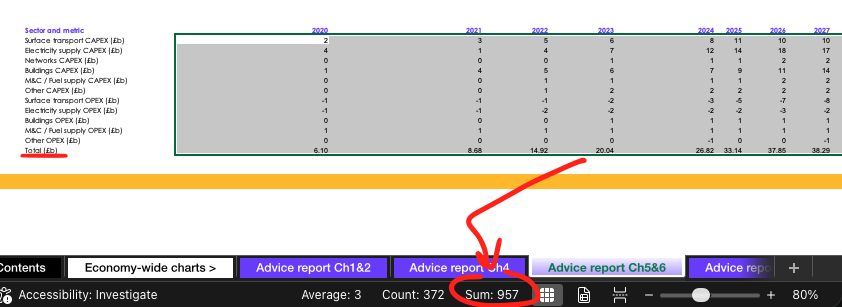
In addition to the annual sectoral CAPEX and OPEX figures, the CCC’s 2020 spreadsheet also has a line giving combined totals for each year. It appears that someone has added all of these numbers together, resulting in the savings and costs being counted twice.
This double-counted total for the cost of net-zero amounts to £957bn – as shown in the image below – and it appears to be the source of the claim in the Conservative booklet.
At the time of publication in 2020, the CCC said that the £478bn net cost of net-zero amounted to less than 1% of GDP over 30 years – and that the large investment needed would not only result in savings due to lower fossil-fuel imports, but that it would boost GDP overall, by around 2%.
In 2025, the CCC revised its estimates for investment costs and operating savings to £670bn and £562bn respectively, giving a net total of £108bn over 2025-50, or less than 0.2% of GDP.
Earlier this year, the committee said that cutting emissions to net-zero would