A push to get rich nations to end their export credit support for overseas oil and gas projects has failed, after opposition from South Korea and Türkiye – and only late and lukewarm support from the United States.
The European Union, UK, Canada and Norway have been trying to get the 38 countries in the Organisation for Economic Co-Operation and Development (OECD) to agree to expand a 2021 ban on support for coal to the other planet-heating fossil fuels – oil and gas.
But South Korea and Türkiye opposed this effort, according to a document released by a South Korean government agency and seen by Climate Home. With pro-fossil fuel Donald Trump becoming US president on January 20, campaigners following the OECD talks said negotiators had given up trying to reach a deal.
An OECD spokesperson confirmed on Tuesday that governments had been “unable to reach an agreement to further restrict the provision of support for fossil-fuel related projects”, although “this issue may be revisited in the future”. Talks will continue in March but, because of Trump’s election as the incoming US leader, expectations of a breakthrough are low.
Missed chance
Climate campaigners lamented the lack of progress by OECD countries before Trump takes office. Kate DeAngelis, deputy director of international finance at Friends of the Earth US, said she had been “pretty hopeful that they were going to reach a deal” but “in the end, they failed”.
Dongjae Oh, gas lead at Korean campaign group Solutions for Our Climate, told Climate Home that “given the change in US administration, the 2024 momentum was a key moment for positive change – and it has been deeply regrettable to see talks stall, even with the majority of countries supporting the fossil fuel-finance restrictions”.
According to analysis from Oil Change International, the export credit agencies of OECD governments provide about $40 billion in support to foreign fossil fuel projects every year, with the vast majority going to oil and gas projects.
For example, before it promised to end support for fossil fuels in 2021, the UK’s export credit agency provided $300 million in loans to British companies working on a project to extract gas in Mozambique.
A joint UK-Canadian proposal and a separate one from the European Union would have committed governments – with some exceptions – to end their support for foreign projects that produce, transport, store, refine or distribute fossil fuels.
Opponents revealed
These OECD negotiations take place in secret, with no journalists or observers allowed to attend. But the Korean Trade Insurance Corporation (K-SURE) was present at the negotiations in March and June 2024. The organisation wrote up a summary of the talks and countries’ positions, which was released to a member of the Korean National Assembly – and an English translation has been seen by Climate Home.
It said that South Korea, Australia and Türkiye were opposed to the export credit proposals while the US, Japan and Switzerland were “reserved”.
According to K-SURE, South Korea argued that the ban would unfairly affect developing countries which are not members of the OECD and said there is a need to consider the pace of the green transition.
Record-hot 2024 shows world must adapt to extremes, says EU climate service
Türkiye said that fossil fuels should be reduced only gradually, without disrupting energy supply chains and energy security, and Australia said it was “unable to accept the current proposal”.
In March, according to K-SURE, the US argued that options other than a blanket ban should be considered, while Japan pushed for more exceptions and Switzerland wanted additional time for discussions between Swiss ministries.
In June, K-SURE reported that most countries other than South Korea and Türkiye agreed on the “fundamental direction” of the ban but differences remained on the details.
“South Korea conveyed its dissenting opinion,” K-SURE noted, while Türkiye said the proposal was “not feasible” because of national and energy security.
Trump deadline
The talks continued – and, according to DeAngelis, intensified after the election of Donald Trump on November 5 last year “put a fire under the Biden White House to take this seriously and really engage in the talks”.
Oil Change campaign strategist Adam McGibbon told Climate Home there were several rounds of talks throughout November and December, but those talks broke down without agreement on December 20.
McGibbon, DeAngelis and Oh criticised Türkiye and especially South Korea for opposing the agreement. South Korea is a leading producer of the ships that carry liquefied natural gas, and its export credit agencies often loan companies the money to buy them.
Oxfam: Super-rich have already burned more than their fair share of carbon for 2025
“Continuing to hinder global climate ambitions in the year ahead would be harmful both for domestic development and Korea’s global ambitions,” Oh said.
But DeAngelis believes the US should take “a lot of the blame” for only supporting the proposal late and for failing to persuade South Korea to agree to it, as she said the US had done for the previous OECD ban on coal finance.
Next steps
DeAngelis said that while the OECD talks seem to have stalled for at least the four-year period of Trump’s presidential term, climate campaigners would encourage countries to sign up individually to the Clean Energy Transition Partnership (CETP).
This initiative was launched at COP26 in 2021 and commits countries and public finance institutions to end overseas support for fossil fuels. Its members now number 41 after Norway and Australia joined at COP28. While the OECD only addresses export credit agencies, the CETP also includes support from development finance institutions and contributions to multilateral development banks.
Research released last August by the International Institute for Sustainable Development (IISD) found signatories were largely delivering on their promise, with their collective fossil fuel financing in 2023 amounting to $5.2 billion – a decrease of two thirds from the pre-CETP baseline. This, IISD said, was “a historic achievement”.
DeAngelis said campaigners are trying to get South Korea and Japan to join the CETP, particularly if there is a change of government in Korea after the current political turmoil triggered by the suspended president’s short-lived declaration of martial law.
The OECD spokesperson said that, when it comes to limiting international support for fossil fuel projects, any government “that wishes to do so is free to join those who have already voluntarily adopted more restrictive terms and conditions for such transactions”.
(Reporting by Joe Lo; editing by Megan Rowling)
The post Bid to end export credit help for oil and gas fails, with Korea and Türkiye opposed appeared first on Climate Home News.
Bid to end export credit help for oil and gas fails, with Korea and Türkiye opposed

For the first time, new-energy vehicles (NEVs) made up 67% of new car sales in China in September, according to the latest data from the China Passenger Car Association (CPCA).
The figures show that NEVs, which include battery electric cars and plug-in hybrids, captured a record share of sales, even though fewer were sold than last year.
This is because sales of combustion-engine cars are falling steeply, a trend that the CPCA has attributed to rising petrol prices following the start of the Hormuz crisis.
Indeed, sales of fuel-only cars were down 31% year-on-year in the first nine months of 2026, with plug-in hybrid sales down 26% – whereas battery EV sales were only down 4%.
One analyst tells Carbon Brief that China’s rapidly growing EV fleet has offset demand for 143m barrels of oil since the start of the Hormuz crisis.
Another says that the crisis is “reinforcing China’s electrification of road transport”.
Meanwhile, amid slowing domestic sales, Chinese carmakers’ exports of NEVs more than doubled [in 2026 to date / in September] from a year earlier.
NEV record
A record two out of every three cars sold in September in China were NEVs, according to CPCA data, as shown in the figure below.
(NEVs predominantly include battery electric vehicles – BEVs – and plug-in hybrids – PHEVs. BEVs only run on electricity, whereas PHEVs also have a combustion engine.)
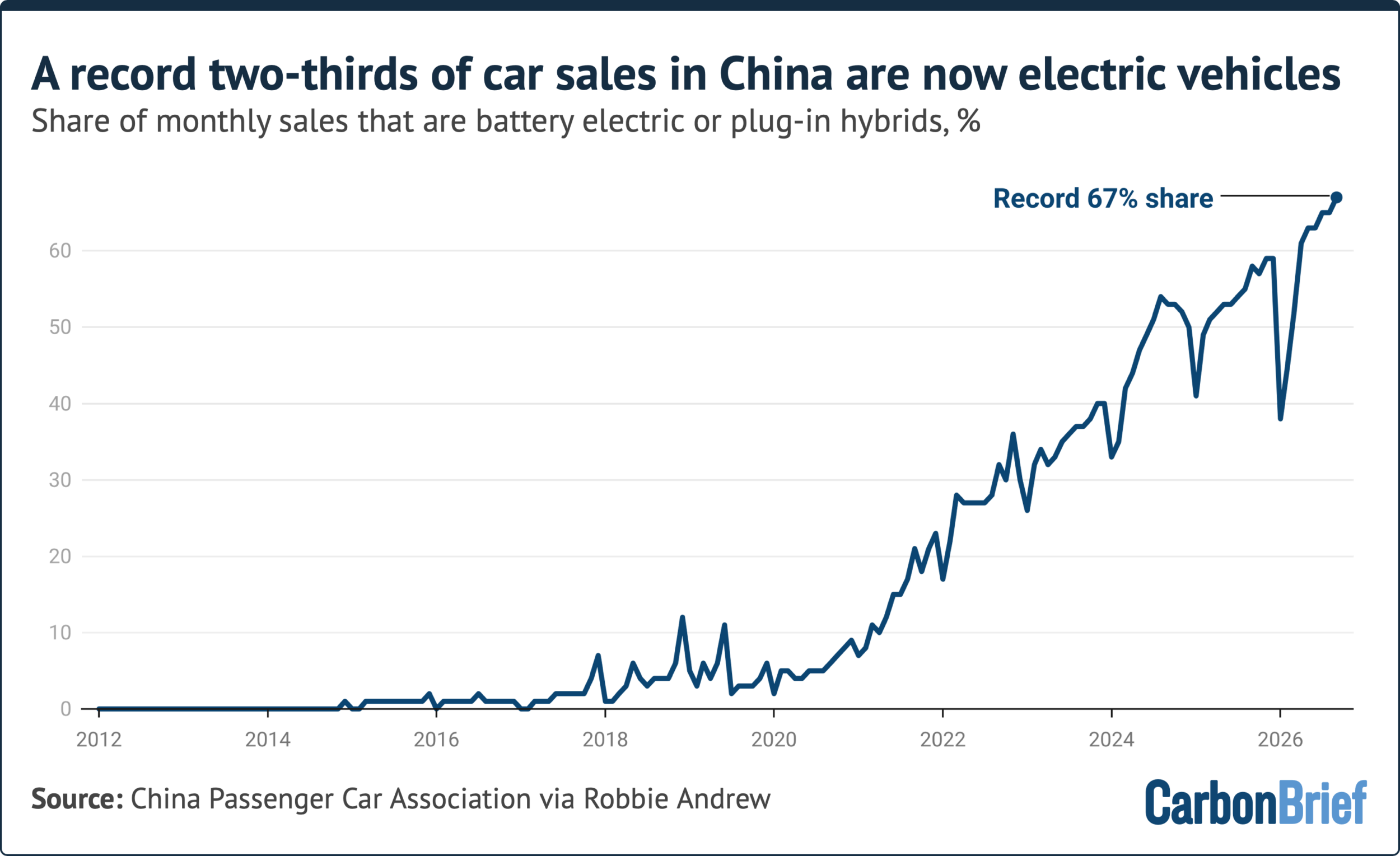
This marks a rapid rise for NEVs from just 6% of new car sales in 2020 up to 58% in 2026 to date – and a record 67% in the month of September.
This year, NEVs’ share of sales has also bounced back from a low of 39% in January, after the full purchase tax exemption that had been in place for more than a decade came to an end in December 2025.
The gain in NEV share in 2026 has come amid a slowdown across the wider domestic passenger-car market, which has hit sales of combustion-engine vehicles particularly hard.
This September, passenger-car retail sales across all categories declined, with overall sales volumes falling 28% year-on-year.
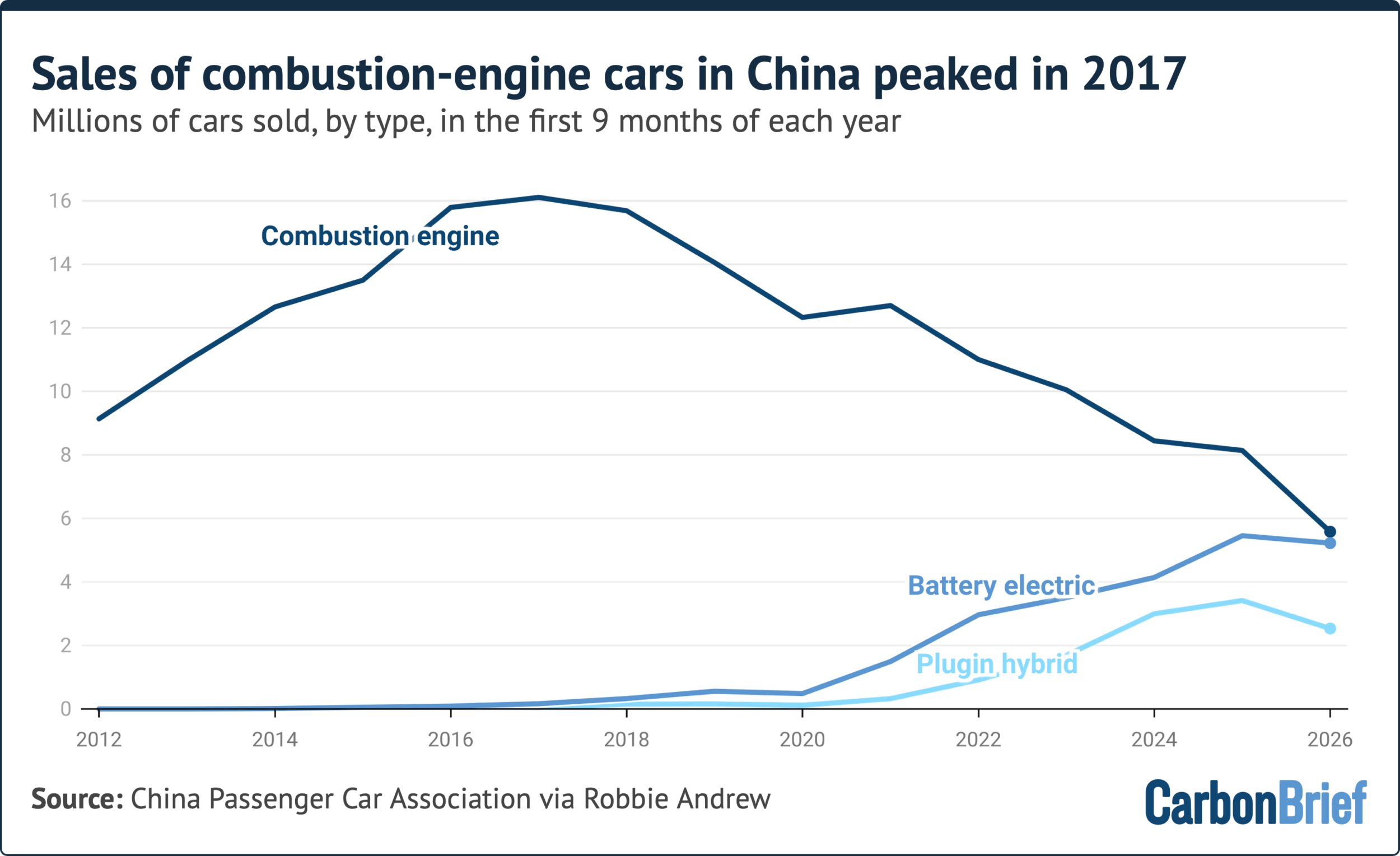
The contraction was led by combustion-engine vehicles, which saw sales fall 43% year-on-year in September and 31% in 2026 to date.
However, sales of PHEVs also fell by 36% year-on-year in September and by 26% in 2026 to date. By comparison, BEVs performed better, although sales still declined 8.5% from a year earlier in September and 4% in 2026 to date.
As a result, NEV sales overall fell by 17% in September and 13% in 2026 to date.
While the market changes in 2026 to date were particularly dramatic, they reflect a broad continuation of trends seen over the past decade.
Indeed, sales of combustion-engine cars in China peaked in 2017 and they have been declining ever since, shown in the figure below.
Impact of Hormuz
Part of the reason for the advance of NEVs in 2026, said Chinese technology news outlet OFweek, was petrol cars “giving up market share” as they were outperformed by electric alternatives.
Cui Dongshu, secretary-general of the CPCA, cited higher petrol prices as an explanation for September’s weak combustion-car sales, in comments to financial news outlet National Business Daily.
Imports of oil into China in January-September have fallen 15% compared to 2025, equivalent to 470m barrels, as ongoing conflict tightened supply and drove up prices.
China’s passenger-car NEV fleet has displaced 143m barrels of oil so far during the strait of Hormuz crisis, Euan Graham, senior energy analyst at thinktank Ember, tells Carbon Brief.
EVs “accounted for 12% of the decrease in China’s oil use post-Hormuz”, according to an estimate provided to thinktank the Brookings Institute by an unnamed analyst.
Erica Downs, a senior research scholar at Columbia University’s Center on Global Energy Policy, tells Carbon Brief that the strait of Hormuz crisis and higher oil prices are “reinforcing China’s electrification of road transport”.
She says the “world’s largest oil supply disruption” vindicates China’s early bet on EVs, which was partly driven by concerns about oil-supply security.
NEV demand down
Nevertheless, NEV sales have fallen year-on-year, albeit at a slower rate than overall car sales. The growth in NEV market share has also been decelerating.
Zhang Yichao, a partner at consulting firm AlixPartners, tells Carbon Brief that NEVs benefit from government trade-in policies and a “strong pipeline” of new models, particularly those involving innovation.
He says these factors help explain why NEVs sales have fallen at a slower rate to their combustion-car counterparts.
Cui told the state-run China National Radio that the fall for NEVs and for cars overall in September 2026, is also due to a high baseline of sales from the same month in 2025, as well as changes to trade-in policies and disruptions from the holiday period.
Other factors, says consulting firm Wood Mackenzie, are the weakened demand due to “demand pull-forward” in 2025 caused by the end of subsidies, as well as “tighter financing conditions”.
Zhang tells Carbon Brief he does not “see much more room ahead” for further growth in NEVs’ market share.
He adds that, in his view, their share in China is unlikely to exceed 80%, as some premium-market segments and specific use cases will continue to require combustion-engine vehicles.
Exports surge
Meanwhile, while domestic NEV retail sales fell 17% in September 2026, exports more than doubled, increasing 164% year-on-year, according to the CPCA.
This extends the decline in domestic sales and very strong growth in exports seen across 2026 to date, as shown in the figure below.
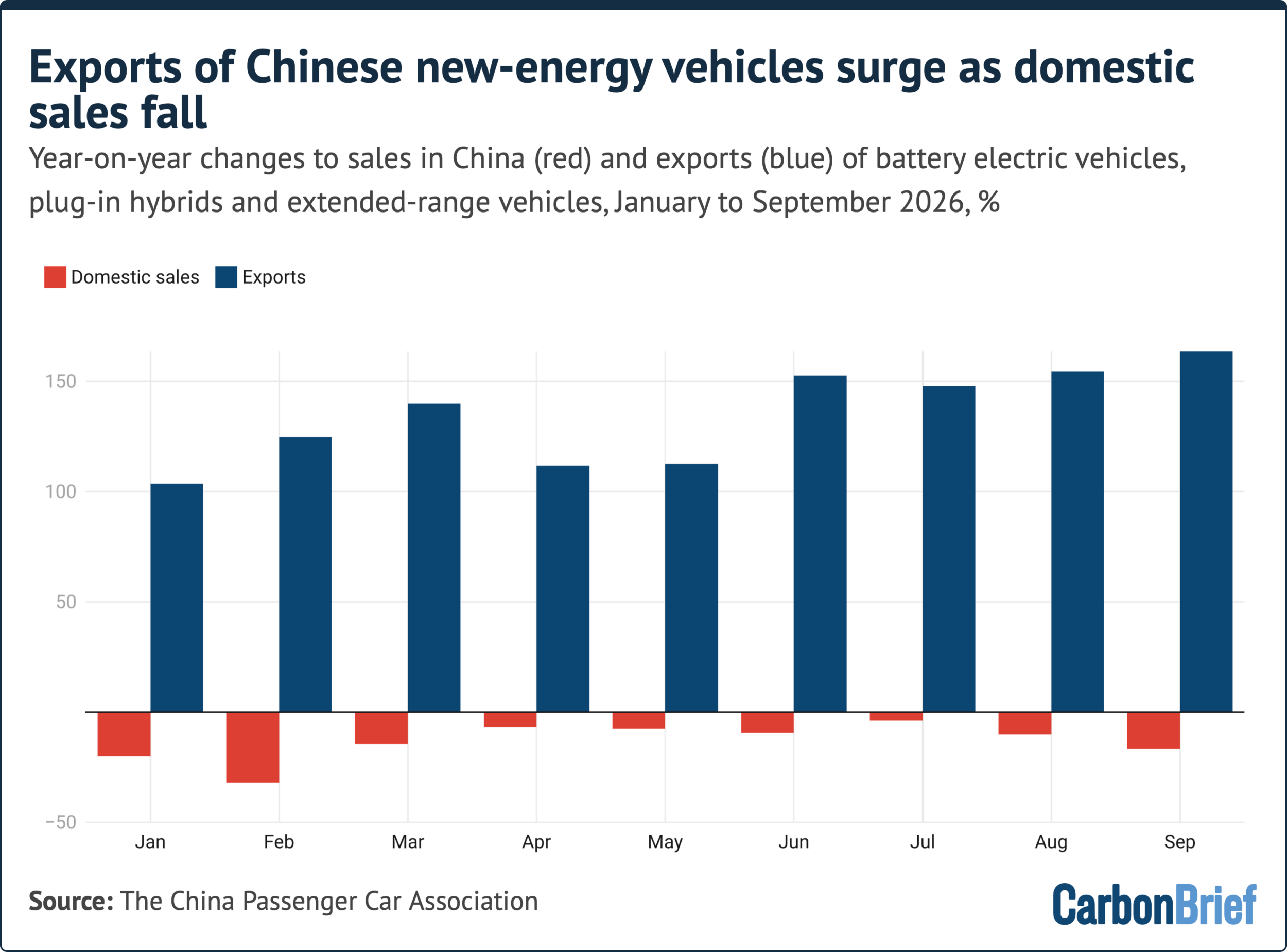
In September, 1,084,000 NEVs were sold domestically in China, while 558,000 NEVs were exported.
Exports are becoming increasingly important to Chinese carmakers, in the face of weaker domestic demand and cut-throat industrial competition.
The CPCA says exports have become “a core priority” for some carmakers.
However, the surge in exports from China has created concern in the EU, which has placed tariffs on imports of EVs from China and recently agreed plans to cut imports of hybrids.
Countries including Mexico and Turkey have also placed tariffs on Chinese EV imports.
At the same time, the Chinese government is putting policies in place that might be expected to disincentivise exports, such as cutting VAT export rebates.
Analysts differ on what impact this policy shift will have, with some saying it will be limited, while others believe it could cause the price of exported cars to rise.
Related