

On the desert shores of the Red Sea, Jordan plans to build a vast desalination plant to send drinking water hundreds of kilometres across its arid interior to the capital, Amman – bolstering climate resilience and reducing the country’s reliance on Israel for the vital resource.
As climate change exacerbates water scarcity in Jordan, a deterioration in the country’s already prickly ties with Israel since the start of the Gaza war has underscored the strategic importance of the roughly $6-billion desalination initiative, billed by its backers as a strategic climate adaptation project.
But despite receiving $295 million in support for the project from the UN’s Green Climate Fund (GCF), the energy-hungry plant – which will double the power needs of Jordan’s water sector – will get no more than 27% of its electricity from a purpose-built solar farm in the desert near the plant in Aqaba. The rest will come from the grid, whose power is mostly generated by fossil gas.
To get salt out of sea water, it has to be pushed at high pressure through a membrane – a process requiring huge amounts of electricity.
-
Self-taught mechanics give second life to Jordan’s glut of spent EV batteries
As EV sales boom in Jordan, a lack of formal infrastructure for dealing with end-of-life batteries is leading to some innovative solutions -
Egypt seeks to unlock renewable potential to power regional clean energy hub
Europe is investing in Egypt’s bid to position itself as a clean electricity exporter to reduce its emissions and generate a new source of income -
Palestine: Israel’s bombing has left Gaza vulnerable to climate change
With homes, hospitals and water storage destroyed, Palestine’s government says that Gazans have little protection from climate impacts and sets conditional emissions targets


The annual planet-heating emissions from producing the non-renewable power needed for the plant would be equivalent to having 160,000 petrol-run cars on the road for a year, according to an analysis by Climate Home News of figures provided by the project’s developers to the GCF – the world’s largest multilateral fund to help developing countries tackle climate change.
Such forecasts prompted a warning from its independent technical advisory panel and criticism by climate campaigners, but the GCF board nevertheless approved the financing at a meeting late last year, with GCF Executive Director Mafalda Duarte hailing it as a “milestone project”.
A GCF spokesperson told Climate Home News its design “required the balanced optimisation of multiple objectives”, among them water security, financing considerations and climate-related benefits.
Asked to respond to concerns about the project’s sustainability, a spokesperson for Jordan’s Ministry of Water and Irrigation said the plant is key to tackling the nation’s water deficit, in tandem with other steps to conserve supplies such as managing leaks.
“We have carried out environmental impact studies for the Aqaba desalination plant,” the spokesperson added. “All donor countries reviewed and approved these studies.”
Dry and getting drier
Jordan is already one of the world’s most water-stressed countries, and climate change impacts mean the country of about 11 million people is getting less rain at a time of population growth, in part due to the arrival of refugees from the war in Syria.
Half of Jordanian homes currently receive water for less than 24 hours a week and many pay to get tanker trucks to deliver extra water despite the high cost.
“Every Jordanian living in a village or city … can feel, especially in the summer, that the amount of water reaching their home is not enough,” said University of Jordan water science professor Elias Salameh.

At the same time, heightened political tensions in the region are raising fears over a long-standing water supply accord with Israel.
Prominent Israeli news outlet Ynet quoted government officials as saying last year that – until Jordan ends its criticism of Israel’s actions in Gaza – it would no longer send Jordan 100 million cubic metres of water a year, as it has been doing since 2021.
Instead, media reports said Israel had decided to send just the 50 million cubic metres required by the 1994 Israel-Jordan peace agreement.
That makes the desalination project all the more urgent, Motasem Saidan, a former water minister who pushed it forward, told Climate Home News.
“Relying on neighbouring countries for sources of the most important resource for life is risky. You need to have self-sufficiency and water security,” Saidan added.
Largest single GCF investment
French multinationals Meridiam and Suez have been awarded the contract to lead construction of the desalination facility, which Suez says will be one of the largest of its kind globally.
Scheduled for completion in 2030, it will turn 300 million cubic metres of seawater a year – enough to fill 120,000 Olympic-sized swimming pools – into drinking water, which will then be carried by pipeline more than 400 km across the desert to reservoirs near Amman, home to nearly half of Jordan’s population.

The GCF will support it with a $220 million loan and a $75 million grant. While that represents a small share of the total cost, Duarte said last year it represented “the largest single investment in one project that we have made”.
But the GCF’s decision to pour millions into the project followed strong criticism from climate campaigners, initial opposition from some of the fund’s board members and a warning by its independent technical advisory panel (ITAP) over its potential impact on emissions.
The emissions it aims to avoid rest on the timely completion of a 65-km transmission line connecting the desalination plant to the solar farm. Without this, the plant will run entirely on Jordan’s gas-dominated grid, the ITAP said in its assessment report.
Moreover, while the government plans to make the power supplied by the national grid greener in the years ahead, there is no guarantee this will be achieved, the report added.
Such issues make the project “difficult to reconcile with climate finance objectives”, the ITAP said, adding there is a significant risk that “concessional resources could end up subsidising a high-carbon, high-cost water pathway”.
Still, the ITAP concluded that “given the dire water situation in Jordan”, the project’s benefits outweighed those concerns and recommended approval to the board.
Bigger renewables role deemed unfeasible
The possibility of producing more of the plant’s electricity from solar power and batteries was dismissed by the project’s proposer and co-funder – the World Bank’s International Finance Corporation (IFC) – and the GCF as too expensive and impractical, a decision critics see as a wasted opportunity to shift to clean energy.
The companies that carried out the project’s environmental and social impact assessment – Eco Consult and Energies Group – said the option of sourcing all power from renewables “was not studied in detail” because it was seen as unfeasible.
-
Nepal flood destruction shows “limits to adaptation”, scientists say
The rock-ice avalanche that caused the flood was very hard to predict, scientists from across the world have found -
Can new CEO steer Global Center on Adaptation back on course?
Madagascar’s Rindra Rabarinirinarison takes the helm of the troubled organisation promising to prioritise fundraising, rebuild trust with donors and hone its mission -
Business-as-usual: Donors pour climate adaptation finance into big infrastructure, neglecting local needs
A deep-sea port project in Bangladesh highlights how some major donor nations are labelling funds for industry-friendly transport and energy projects as adaptation finance, reporting by Climate Home News shows


Asked to comment, the GCF spokesperson said the fund supported that conclusion, citing renewable energy’s intermittency and noting that excess solar power produced would be wasted because there is no provision for it to be sold to the grid.
“The optimum design of such a critical life-line desalination project for Jordan is fundamentally a whole-of-system water optimisation challenge rather than a standalone energy storage exercise,” the spokesperson said.
Instead, the plan’s advocates have touted potential emissions reductions as the pipeline replaces water trucks. They say the solar farm set to supply more than a quarter of the desalination plant’s power will prevent 6.7 million tonnes of CO2-equivalent being emitted over its 26-year projected lifetime.
Saidan, the former water minister, said the urgency of providing water must take priority over gas dependency concerns.
“This is not the time to raise such issues,” he told Climate Home News.
But Kostanta Rangelova, a global electricity analyst at think-tank Ember, said the plant could “easily” get at least 80% of its power from solar with batteries, pointing to Jordan’s abundant sunshine and the plunging costs of the equipment needed.
Such systems are set to power large facilities elsewhere in the region, like a luxury Red Sea resort just over the Saudi border and a data centre near Abu Dhabi, she said. Jordan’s own energy sector strategy, published in May, lists increasing battery storage as a strategic target.
Rangelova noted that with battery prices falling significantly in recent years, the cost of solar plus battery storage is now competitive with grid power in many places, particularly in countries like Jordan that have a lot of sun but currently rely on expensive imported gas.
“With solar and batteries, Jordan (could) use homegrown electricity not just during daytime hours, but round-the-clock, which can significantly strengthen its energy security position,” she added.
Lesser of two evils
Using more renewables in the project could also help reduce demand for Israeli natural gas imports – a sensitive issue in Jordan.
“[The desalination plant] will not be viable if we depend on gas supplied by the Israeli occupation,” Mahmoud Amin Al-Hayari, an activist with the General Trade Union of Electricity Workers in Jordan, told Climate Home News.
Jordan’s government is working to develop new sources of gas imports to diversify its current supply, and also wants to boost domestic gas production, alongside renewables.
In the meantime, Jordan’s National Electric Power Company (NEPCO) remains heavily dependent on Israeli gas for electricity generation, industry experts say. Latest government figures from 2024 show the country got 58% of its electric power from gas.
Most of that gas is likely to be Israeli. “About 57% of the electricity that NEPCO supplies to distribution companies comes from gas imported from Israel,” a Jordanian energy and conflict analyst told Climate Home News, asking to speak anonymously due to the sensitivity of the subject.
The spokesperson for Jordan’s Ministry of Water and Irrigation declined to comment on the source of the gas that would help power the Aqaba desalination project.
The issue has gained attention due to several security-related gas supply disruptions from Israel related to the conflict in the Middle East.
For countries like Jordan, a net fuel importer, the energy security case for boosting renewables is a no-brainer, said Ember’s Rangelova. “Unlike imported fossil fuels, the sun cannot be turned off,” she said.
The post Jordan’s mega-plan for water security risks locking in fossil gas demand appeared first on Climate Home News.
Jordan’s mega-plan for water security risks locking in fossil gas demand

A second set of world leaders give their speeches on Thursday before heading out of town and leaving their negotiators to it. After around 40 leaders spoke on Wednesday, today there will be just 25 or so including the UK’s Andy Burnham, Venezuela’s Delcy Rodriguez and Bangladesh’s Tarique Rahman.
But Brazil’s President Lula is still there and is expected to keep grabbing headlines, along with California’s Governor – and maybe next US president – Gavin Newsom – and Swedish climate activist Greta Thunberg who has lost none of her star power, if the crowd around her in the press centre was anything to go by.
We’ll bring you highlights through the day on issues ranging from finance to methane, and update you on a pledging event for the Pacific Resilience Facility, which the climate-vulnerable region is relying on to keep small island nations as safe as possible in the face of intensifying storms, drought and sea level rise.

The post COP31 Bulletin Day 4: Burnham speaks with UK climate policy under fire appeared first on Climate Home News.
COP31 Bulletin Day 4: Burnham speaks with UK climate policy under fire
Climate Change
Australia must ‘pull all available levers’ to deliver fossil fuel phase out, following Albanese’s COP31 address
ANTALYA, Türkiye, Wednesday 11 November 2026 — In response to Prime Minister Albanese’s COP31 Leaders’ Summit address, Dr Susie Byers, Head of Advocacy at Greenpeace Australia Pacific, speaking from Antalya said:
“Prime Minister Albanese’s Leaders’ Summit address emphasised the power and clarity of Pacific climate leadership and that we must all fight to return warming to below 1.5°C. To inject the momentum these talks critically need, Australia must lead by example.
“Australia takes the reins of the COP31 talks at a critical moment where global instability can spark transformative change, or entrench more of the same inaction and paper pledges. Australia must pull all available levers over the next two weeks, taking the baton from Brazil and sprinting forward.
“The world’s most important job in Antalya is to deliver tangible action to end the fossil fuel era. Communities in Australia, the Pacific and around the world who are grappling with climate disasters and a cost of living crisis need concrete dates and credible plans. We know the transition is coming, one way or another. Our Government has a responsibility to make a plan for this change, which is based on the best available science, and a commitment to put people, energy security and our environment ahead of fossil fuel profits.
“In his address, UN climate chief Guterres told leaders to “tell the truth”. Prime Minister Albanese told an important truth today: that we all have solemn responsibilities to return warming to below 1.5°C. We also know that the best way for Australia to lead through this summit is to start by making its own commitments to turn the temperature down, by stopping developing and exporting fossil fuels.
“Australia’s domestic progress on renewables, and the ‘35 by 35’ electrification goal, are welcome and important. Now we must ensure electricity comes from clean, renewable sources that actually displace fossil fuels and align with the science of 1.5°C.
“The pressure on Australia is building. COP31 must deliver real action to advance multilateral climate cooperation, accelerate the just transition away from fossil fuels, and advance Pacific priorities — including significantly scaling-up climate finance and keeping 1.5°C alive.”
ENDS
COP31 images and video available here in Greenpeace Media Library
Media contact: Kate O’Callaghan in Antalya (GMT+3) on +61 406 231 892 (Whatsapp/Signal)
Confusion reigned in Antalya on Wednesday morning as some delegates heeded the Turkish organisers’ warning to get to the COP31 venue before 7am today. Others saw a later UN clarification that this wasn’t necessary, and many more decided not to chance it and work from their hotel rooms.
Additional restrictions seem to have been put in place so that the 40 or so world leaders due to speak could be ferried from the airport to the venue and so that President Recep Tayyip Erdoğan could plant some symbolic olive trees without ordinary COP delegates ruining the photo op.
The list of world leaders speaking today is considerably shorter than the (already short) list from just six days ago, with the leaders of Nigeria, Kenya, Egypt, the Netherlands and Sweden among those dropping out.
Still on there are the co-hosts Erdoğan and Australia’s Albanese plus Brazil’s recently re-elected President Lula and the European Commission head Ursula Von der Leyen. The leader of rainforest-rich DR Congo and the vice president of clean energy and coal superpower China will also speak, as well Barbados’s Mia Mottley and Saudi Arabia’s energy minister Abdulaziz bin Salman.
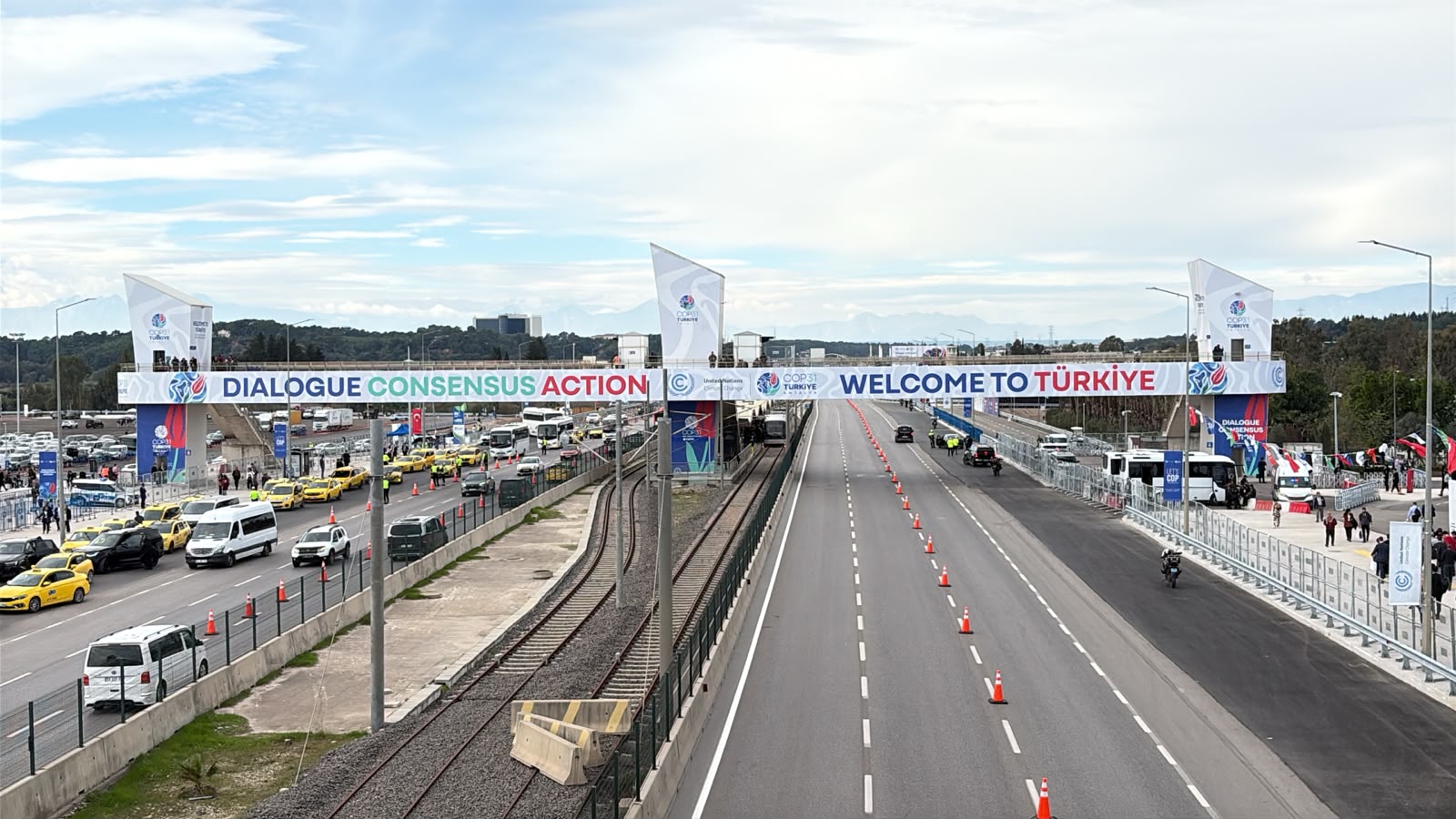
While the leaders of big-emitting countries have not turned up, there will be plenty of voices from the frontlines of climate change with heads of government from desertifying Mauritania, water-stressed Iraq, the sinking Marshall Islands and drought-hit Somalia all speaking.
Today is also “Zero Waste” Day, with First Lady Emine Erdoğan holding an afternoon roundtable on her pet topic. Before COP, Climate Home News visited a landfill and zero waste education centre in Ankara to find out how well – or otherwise – Türkiye is doing in its pursuit of waste reduction.
Türkiye pushes “zero waste” at COP31, but is it delivering at home?
We’re watching out for any news on the country’s single-use plastics ban, which has been introduced to parliament but not yet – after some lobbying from the plastics industry – got the president’s signature.
The post COP31 Bulletin Day 3: With the people stuck outside, world leaders jet in appeared first on Climate Home News.
COP31 Bulletin Day 3: With the people stuck outside, world leaders jet in