

This is the second part of a three-part post. It begins with the failure of carbon tax advocacy and continues with the closure of Indian Point and the concurrent dissolution of my dream that renewable energy could do it all. Part I, “Beginning,” started with the Three Mile Island accident and covered the decline of nuclear dread, the advent of splendidly reliable reactor operation, and nuclear’s climate-hero status. It’s available here. — C.K.
4. A Climate Cure No One Wanted
Nuclear fission, wind turbines, solar panels. Each is a kind of miracle, creating electricity from sunlight, air currents, or the splitting of atoms rather than by setting things on fire. But to economists focused on decarbonization, a greater miracle would have been the widespread adoption of carbon taxes, or, as some prefer to call it, a “price on carbon” — a fee added to fossil fuels’ market price based on their carbon content. Such a tax would shift incentives across the economy away from using fossil fuels, cutting production of the main greenhouse gas, carbon dioxide.
Economists trace the carbon tax idea to the early 20th century British economist Alfred Pigou and his conception of “externalities” ― social costs, like pollution, that aren’t reflected in market prices, and are dumped on communities “external to the process.” My interest dates to the early 1970s, when I was a fledgling environmental analyst in New York City government. I had a front-row seat as an ingenious “sulfur surcharge” eliminated the price advantage of dirty, high-sulfur fuel oil, foiling an eleventh-hour attempt by the oil industry to undercut a groundbreaking clean-air regulation.
Much later, in 2007, I co-founded the Carbon Tax Center, an organization built around the idea of taxing fossil fuels by their carbon content. We proposed a national carbon tax starting at $15 per ton of CO2 and rising in annual steps to $100 within a decade. Our modeling suggested that by then, the myriad changes driven by the financial rewards for burning less carbon would be cutting U.S. emissions by nearly a third ― far more than conventional energy-efficiency standards or clean-energy subsidies.
To be clear, this wasn’t an either-or choice. A carbon tax was unusual in that it reinforced nearly every other decarbonization measure rather than competing with it. But what really set carbon pricing apart was its reach. Carbon taxes would reward every action that reduced fuel use ― not just buying more fuel-efficient cars, but driving less overall; not just laws mandating energy-efficient buildings, but reforming zoning to let new homes be built in town instead of spreading into sprawl; and, in the power sector, switching from higher-carbon coal to lower-carbon gas and from gas to virtually zero-carbon solar, wind, and nuclear power.
A carbon tax would have worked something like New York’s congestion pricing program, which last year began charging drivers $9 a day to enter Manhattan south of 60th Street. Congestion pricing hits gridlock with a one-two punch. The first punch is the price itself: faced with the toll, enough car owners find driving no longer worth it, that traffic actually drops. The second punch is the steady stream of subway improvements funded from the toll revenue — station elevators, real-time train signals, new lines — which pull still more commuters out of cars. Just so, the “stick” of a price and the “carrot” of better alternatives reinforce each other.
I took part in the 20-year campaign that pushed congestion pricing across the finish line. Its advent — and survival — in Trump’s second term is heartening. But it also highlights, by contrast, how little headway has been made toward a U.S. carbon price.
That failure constitutes a tragically missed opportunity for nuclear power, given how much a $100-per-ton carbon price could strengthen its economics. Compared with burning natural gas, the dominant source of U.S. electricity today, a $100/ton CO2 price would give nuclear roughly the same competitive edge as shaving 40 percent off the cost to build new reactors. Or, put another way, that carbon price would be like doubling or tripling what gas-fired power plants pay for pipeline fuel — pushing prices back to pre-fracking scarcity levels.[7])
5. Losing Indian Point
In the spring of 2020, with the COVID-19 pandemic raging, my wife and I fled the city for our cabin in the Adirondacks. One morning I was outside the general store, loading groceries onto my bicycle, when my phone started buzzing. It was Dietmar Detering, someone I knew slightly as leader of the advocacy group Nuclear NY, calling from Queens. I picked up and said hello.
“You call yourself a climate activist,” Dietmar began, his voice sputtering with anger. “Indian Point is being taken apart, and you haven’t said a word to stop it. How dare you?”
 I vaguely knew that a 2017 deal ― pushed by the self-proclaimed environmental group Riverkeeper and brokered by then-Gov. Andrew Cuomo ― was about to shut down the Indian Point nuclear plant, located on the Hudson River 35 miles north of midtown Manhattan. The older of its two reactors unit would (literally) get the chop within a week; its twin would follow in a year. Both reactor vessels would be cut to pieces and their radioactive components chemically dissolved. Once that process began, there’d be no turning back.
I stood there holding my phone, stunned. A near-stranger was berating me! I would have hung up, but there was something raw in his voice that I couldn’t ignore. I don’t remember exactly what I said ― probably some version of “don’t blame me.” After all, the carbon tax I’d spent years advocating would have made Indian Point too valuable to shut down. Then I offered what I thought was my strongest point: soon enough, Indian Point’s carbon-free electricity would be replaced by zero-carbon wind and solar anyway, so little harm would be done.
Then Dietmar lowered the boom.
“You don’t get it, do you?,” he said, his voice now cold. “Even if all those new solar panels and wind turbines get built, they won’t displace fossil fuels. They’ll just be replacing carbon-free nuclear electricity that was already protecting the climate. They can’t do both.”
“Wait. What? Say that again.”
“Think of it this way,” Dietmar said. “When new renewables have to replace an existing power source that was already displacing fossil fuels, like Indian Point, their net climate benefit is zero. The renewables you’ve been counting on to push out fossil fuels can’t do that job as long as they’re having to take the place of nuclear plants that were already doing the decarbonizing.”
Full disclosure: those aren’t Dietmar’s exact words. They’re actually mine, drawn from articles I later wrote for Gotham Gazette and The Nation, and from a letter I co-wrote with futurist Stewart Brand, yes, the “Whole Earth Catalog” guy, urging California Gov. Gavin Newsom to halt the planned closure of the Diablo Canyon reactors along his state’s coast. But they capture Dietmar’s central point: shutting down a working nuclear power plant ― or any large source of carbon-free electricity ― nullifies the climate benefit that new replacement wind and solar projects are supposed to provide.
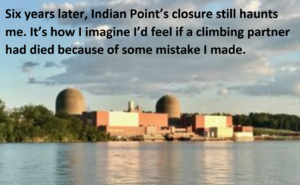
Six years later, Indian Point’s closure still haunts me. Why didn’t I speak up? It’s how I imagine I’d feel if a climbing partner had died because of some mistake I made. In New York, where I live, I measure every increment of renewable energy against the carbon benefit we threw away when Indian Point was shut down and dismantled.
 By that gauge, wind and solar look mediocre. Take those 42-inch square “balcony solar” arrays that Germans are buying like hotcakes ― they’re a neat idea, but it would take 50 million of them to match the carbon reduction Indian Point provided, as I wrote here in June. Or consider a rooftop solar setup for the City Island boathouse where my ecologically minded physicist pal stows his sailboat ― fine on its own, but matching Indian Point’s climate value would require solarizing 600,000 similar buildings across the state.[8]
Underneath these daunting numbers is Dietmar’s deeper point: all of this new renewable capacity should have been added on top of Indian Point, not built to replace it.
6. Renewables in a Dimmer Light
Solar and wind power were guiding passions of my adult life. From the 1970s onward, I savored every news story about the latest gains in solar efficiencies and blade lengths. Wind turbines especially stirred me, with their kinetic kinship to bicycles and futuristic look.
Befitting my mathematical bent, I would calculate how much fossil fuel each new wind farm would keep in the ground. For Cape Wind, intended as the first U.S. offshore wind farm, near Cape Cod, I consulted a digest of ballpark dimensions to illustrate how much coal the project would displace each year: enough to cover the entire playing field at Boston’s Fenway Park — foul territory included — in a pile three times the height of the park’s famed “Green Monster” outfield wall.[9]
While I was playing with those numbers, a Stanford mechanical engineering professor named Mark Z. Jacobson was launching a stream of papers spelling out just how many wind turbines and solar panels ― on land, at sea, on rooftops, on farmland or rangeland ― would be required to satisfy the energy needs of different states and countries.
A table in Jacobson’s paper for New York helpfully broke down how much energy had to come from each source. Offshore wind was his largest category, charged with supplying 40 percent of New York State’s energy year-round. The number of turbines: 12,700.
That figure should have given me pause. Filling that quota meant building a hundred Cape Wind projects in the waters off Long Island, even as well-heeled locals including Riverkeeper figurehead Robert F. Kennedy Jr. (yes, that Kennedy) and Walter Cronkite (yes, that Cronkite) were NIMBYing the actual Cape Wind project to death. Ditto, wind projects proposed for the next county over from our cabin in the Adirondacks.
None of those projects were ever built — not just because of local opposition, but also because of a lack of full-throated support from environmentalists who should have championed them for their climate value. Especially in liberal Northeastern states, it seemed impossible to build anything that asked property owners to tolerate construction disruption or changed views, decarbonization be damned.
You might expect the outlook for Jacobson’s all-renewables vision for New York to be improving. Wind turbines are now so prodigious that he can propose 8,000 15-gigawatt turbines instead of 12,700 5-gigawatt ones.[10] And solar power has captured the public’s imagination in a way wind power has not — it’s no accident that climate activist (and Jacobson acolyte) Bill McKibben titled his 2025 call-to-action book, “Here Comes The Sun.”
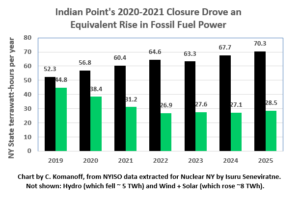
Nevertheless, the carbon-free electricity lost when Indian Point closed has gone almost entirely unreplaced. Nearly nine-tenths of the power it generated is being made up by burning natural gas — not due to corporate chicanery but because no other source has stepped up. (See chart below.)
And dreams of an all-renewables grid still have to contend with an intrinsic fault ― one even more disabling than the NIMBY opposition sparked by the projects’ thirst for land. That weakness is intermittency: the fact that wind and solar output varies not just day to day, but moment to moment, at the mercy of the weather.
Jacobson has doggedly calculated how many megawatt-hours of wind and solar would be needed to match New York’s ― and other states’ ― total annual energy use. But neither his nor anyone else’s atmospheric models are detailed enough, meteorologically, to verify that a 100% wind-water-solar grid could keep the power on continuously ― hour by hour, year in and year out. Building in extra capacity doesn’t solve this problem. Compensating for weather’s unpredictability by deliberately oversupplying wind and solar, or backing them up with batteries, may look good on paper. But either approach would be punishingly expensive and probably insufficient as well, without ample supplies of reliable, dispatchable power such as nuclear. If there’s no wind, having twice as many turbines won’t help.[11]
In New York, the political fallout from losing Indian Point’s copious ’round-the-clock carbon-free electricity is landing on Cuomo’s successor. With the plant’s closure having pushed New York’s carbon-reduction targets out of reach, Gov. Kathy Hochul this year bowed to reality and froze a 2019 law tying New York’s climate and energy future to renewables. Forces ranging from standard-issue Democrats to grassroots greens are pillorying Hochul as a sellout to Big Oil, though her proposal to add five large reactors across the state — she dubs it her Nuclear Reliability Backbone — is almost certainly a more assured path to decarbonization than the fashionable all-renewables approach.
Click here for the final installment, Why I’m Pro-Nuke Now: Conclusion.
[7] The two representations in the text of carbon pricing’s boost to new reactors’ economics are derived and sourced in my Sept. 2026 paper with James Boucher, Beyond Vogtle: What History Tells Us About the Cost of New Nuclear.
[8] Comparisons in this paragraph employ: 2,028 MW capacity and 90% capacity factor for Indian Point; 220 W capacity and 15% CF for balcony solar. 17 kW capacity and 20% CF for boathouse solar. 10 MW and 40% CF for each wind turbine.
[9] Cape Wind assumptions: 130 3.6-GW turbines and 40% capacity factor yield 1,641 GWh/year. Coal assumptions: 9,800 Btu/kWh, 11,500 Btu/lb of coal, 1.32 coal specific gravity, 62.4 lb of water per cubic foot. Calculations yield 132-foot-high coal pile covering Fenway Park’s 128,000 sq ft surface (est’d from http://www.baseball-statistics.com/Ballparks/Bos/index.htm). That is 3-4x Green Monster height of 37 feet, 2 inches, per Wikipedia.
[10] While Jacobson’s new offshore wind configuration would outproduce its predecessor by nearly two to one, he has also upped his forecast for total required energy, leaving constant offshore wind’s share 40 percent share.
[11] To take a recent example: at the onset of a late June – early July 2026 heat wave, New York State’s wind farms collectively were producing less than one percent of their rated 3,000-megawatt capacity. See my “Beyond Vogtle” report (FN 46) referenced in Footnote 7.

Nature-based carbon investments deserve consideration when they address a specific business dependency and produce outcomes you can measure. Imagine Moonbucks, a global coffee roaster planning next season’s espresso blend. It is considering natural Grade 4 coffee from Jimma, in southwestern Oromia, Ethiopia. Its sourcing decisions affect the roasting schedule and the cash tied up in coffee purchases. Moonbucks needs to understand which measures could protect that supply, what they would cost and how it would judge the results.
1. Define the sourcing problem before choosing a project
Moonbucks needs a dependable component for its espresso blend. Its procurement team wants continuity of volume and an agreed cup profile. Replacing a shipment at short notice could require new sample approval and changes to the blend, and given the schedules for cultivation, processing, and freight delivery, is practically impossible. Moonbucks needs to get this right, and its initial concern is inconsistent deliveries. It commissions an assessment of the supplying farms and post-harvest chain. The questions cover land condition, harvest availability and whether drying or storage problems are affecting saleable lots.
This distinction changes the investment brief. A tree-planting proposal cannot be assumed to fix drying problems. Better storage cannot restore eroded land. The team must establish which problem exists before selecting the response.
CCC’s guide to finding nature-based solutions in your supply chain explains where to look. Here, the next task is to turn a broad concern into a testable proposal.
2. Develop nature-based carbon investments around the actual supply chain
The assessment would trace Moonbucks’ purchases back through the exporter and supplying producer groups. Which farms supply the contracted lots? Who controls land-management decisions? How long does the buyer expect to maintain the purchasing relationship?
Furthermore, Jimma natural Grade 4 cannot be treated as interchangeable with every Ethiopian coffee. Moonbucks would need to test any substitute against its own blend and quality requirements.
Suppose Moonbucks’ assessment identifies an opportunity to maintain shade trees and restore vegetation along exposed streambanks. The IPCC describes agroforestry as a way to store carbon in vegetation and soil, with potential benefits for erosion control and water quality.1 Moonbucks would need local advice on species, growing conditions and maintenance before deciding how these measures fit its sourcing plan.
The proposal now has a defined sourcing connection and a candidate intervention. The next steps are to test its effect on production, assess carbon eligibility and build the financial case.
3. Compare the proposal with other ways to protect supply
WBCSD’s Nature-based Solutions Blueprint recommends comparing nature-based options with other responses across their benefits and costs.2 For Moonbucks, that means evaluating the landscape proposal alongside drying improvements, storage controls and alternative sourcing arrangements.
The product’s natural-process designation matters. Moonbucks should examine the drying and dry-milling chain alongside land conditions. Its team would check storage practices, contamination risks and incoming-lot quality to see whether problems arise before or after the coffee leaves the farms.
The revised proposal might combine land stewardship with separate post-harvest controls. Each component needs its own purpose and budget. A sustainability label should not obscure which activity is expected to solve which problem.
The project develops as the evidence improves. Its scope should follow the diagnosis rather than preserve the first idea unchanged.
4. Establish what the carbon outcome could count toward
Moonbucks’ sustainability team now tests the proposed carbon case separately from the sourcing case. Is the objective a measurable change in Moonbucks’ value-chain emissions, verified credits for separate voluntary use, or distinct outcomes under carefully defined arrangements?
Scope 3 covers value-chain emissions. A purchasing relationship alone does not prove that a farm intervention can be included in Moonbucks’ inventory. The team needs an applicable accounting method, defensible boundaries and evidence supporting attribution.
SBTi’s FLAG Guidance (forest, land and agriculture), version 1.2, says purchased credits used as offsets cannot meet near-term FLAG or energy and industry targets. Eligible land-based removals are subject to accounting requirements.3 Moonbucks needs to test its proposal against those rules before including an outcome in its targets.
For Moonbucks’ Jimma proposal, maintaining existing trees and establishing new vegetation could involve different carbon questions. Specialists must examine the baseline and additionality, meaning what changes because the project proceeds. They must also assess measurement and the risk that stored carbon is lost. CCC’s MRV and additionality article introduces those tests.
Until that work is complete, Moonbucks should not budget an assumed Scope 3 reduction or credit-sale receipt. Direct emissions reductions remain the priority.
5. Build a financial case that survives weaker assumptions
Moonbucks’ finance team would now build a multi-year budget. UNEP’s State of Finance for Nature 2023 compares current finance with the investment needed to meet climate, biodiversity and land-restoration goals.4 The company would cost its proposed activities, farmer participation and ongoing monitoring. Verification, where required, is a separate expense. Maintenance and responsibility for replacing failed plantings must remain visible after the initial establishment budget ends.
Operational benefits need equally careful treatment. If fewer rejected lots reduce emergency purchasing, count that saving once. Do not add “supply resilience” as another financial benefit when it represents the same avoided cost.
Moonbucks should compare a base case with slower benefits, higher implementation costs and no carbon revenue. It should also distinguish production outcomes from quality and shipment outcomes. A single good harvest would not prove that the landscape intervention caused better delivery performance.
A project can remain worth funding even when its carbon case needs more work. That decision must rest on the operational evidence and the company’s objectives, without unsupported environmental claims.
6. Fund a pilot with a clear expansion decision
Moonbucks’ first approval would fund a bounded pilot, rather than commit the entire sourcing program. Before spending, Moonbucks would agree on participating farms, responsibilities and the evidence needed at review.
Its scorecard could track farmer participation, implementation costs and plant survival, alongside accepted coffee volumes and lot-quality results. Carbon measurements would follow the selected method. Farm-level traceability must connect the intervention to the actual sourcing relationship.
Suppose Moonbucks’ review later finds that storage changes explain most quality improvements, while the land measures need longer observation. Those findings would shape the next decision: expand the proven component, adjust the landscape work or pause further spending. They would not justify crediting all improvements to tree planting.
This gives nature-based carbon investments a practical place in a multi-year strategy. Funding increases as the evidence supports it, and the project can change direction before a larger commitment.
Discuss a sourcing opportunity with CCC
Carbon Credit Capital’s nature-based supply-chain investment service uses its Dual-Value Model to examine supply-chain economics alongside potential sustainability outcomes.
Schedule a consultation to discuss your sourcing exposure and the questions to resolve before allocating capital.
Sources
- Intergovernmental Panel on Climate Change (IPCC), Climate Change 2022: Mitigation of Climate Change, Chapter 7, Agriculture, Forestry and Other Land Uses, section 7.4.3.3 (Agroforestry).
- World Business Council for Sustainable Development (WBCSD), Nature-based Solutions Blueprint, 5 June 2024.
- Science Based Targets initiative (SBTi), Forest, Land and Agriculture Science-Based Target-Setting Guidance, version 1.2, March 2026, section 3.1.4, pp. 37–38.
- United Nations Environment Programme (UNEP), State of Finance for Nature 2023, 2023.
A plastic credit funds the collection of plastic waste in places where no formal system exists to collect it. Each credit represents a measured, independently audited quantity of plastic taken out of the environment or returned to use, tracked on a public registry.

EU carbon credit claims changed on 27 September 2026, the day the Directive (EU) 2024/825 began to apply across the European Union. The change is narrow. It changes how a company can talk about the credits it buys. A product can no longer be called neutral on the strength of compensation alone; however, every specific, evidenced statement about what a company measured, reduced, and funded stays fully available.




-
Climate Change1 year ago
Guest post: Why China is still building new coal – and when it might stop
-

 Greenhouse Gases2 years ago
嘉宾来稿:满足中国增长的用电需求 光伏加储能“比新建煤电更实惠”
-
Greenhouse Gases1 year ago
Guest post: Why China is still building new coal – and when it might stop
-

 Climate Change2 years ago
嘉宾来稿:满足中国增长的用电需求 光伏加储能“比新建煤电更实惠”
-

